 NihontoWatchNihontoWatch
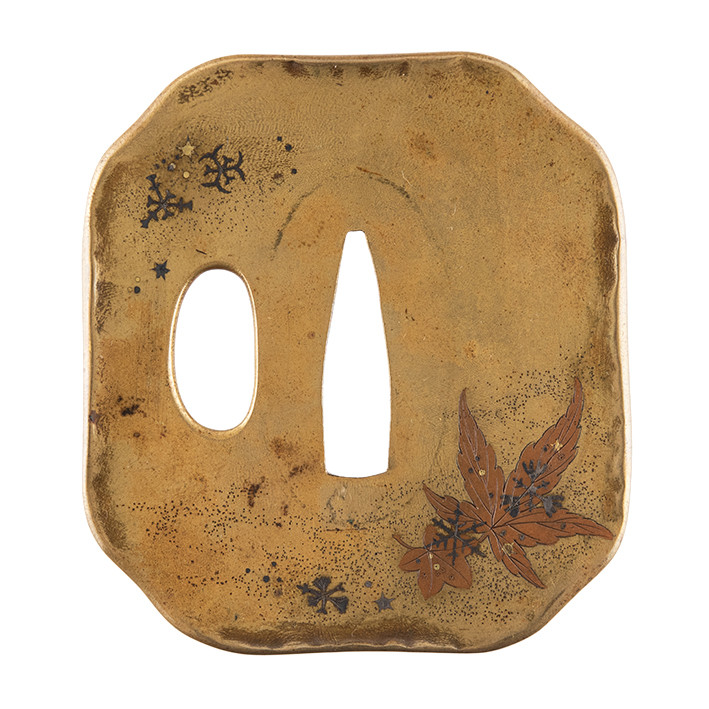
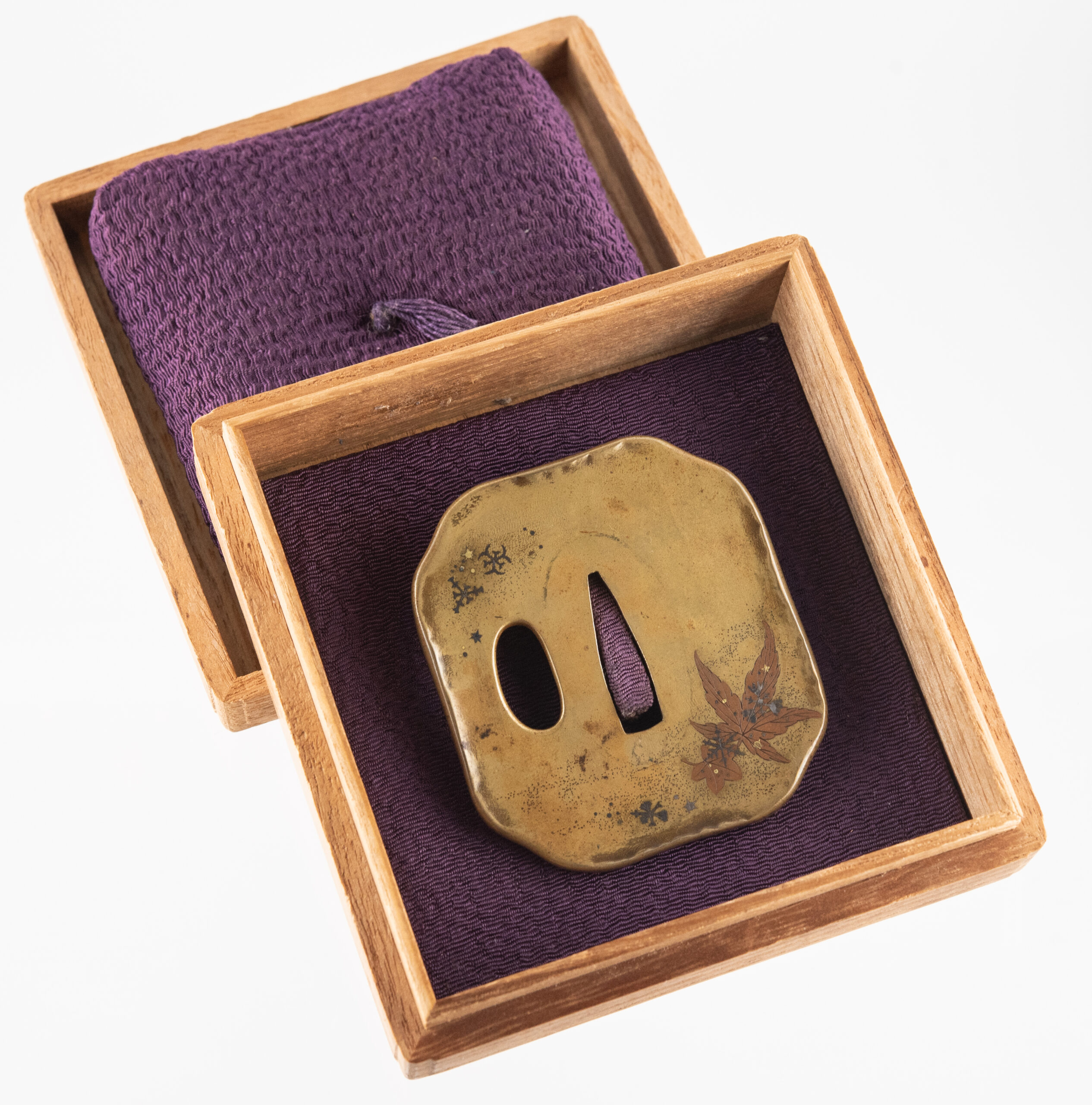
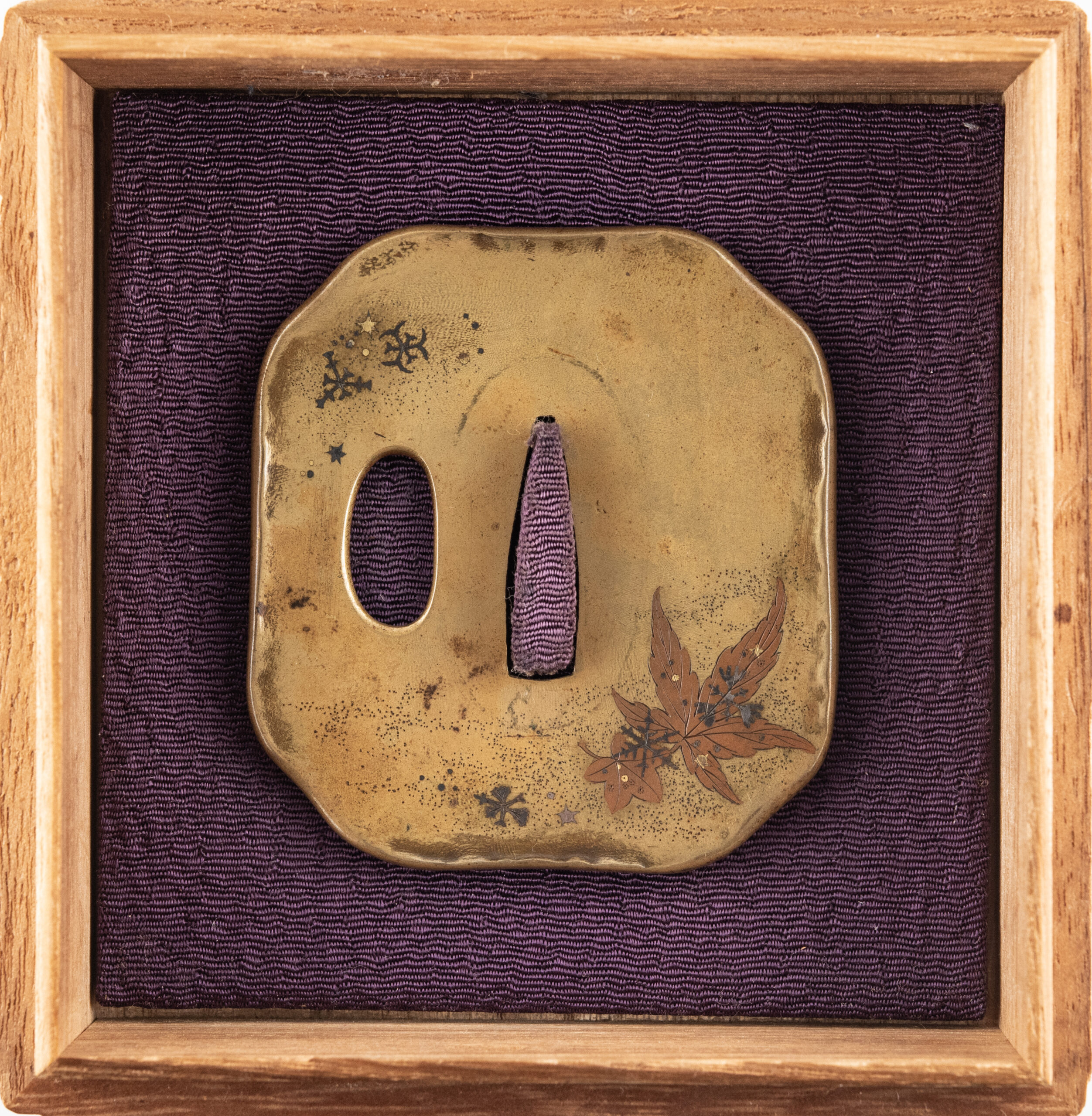
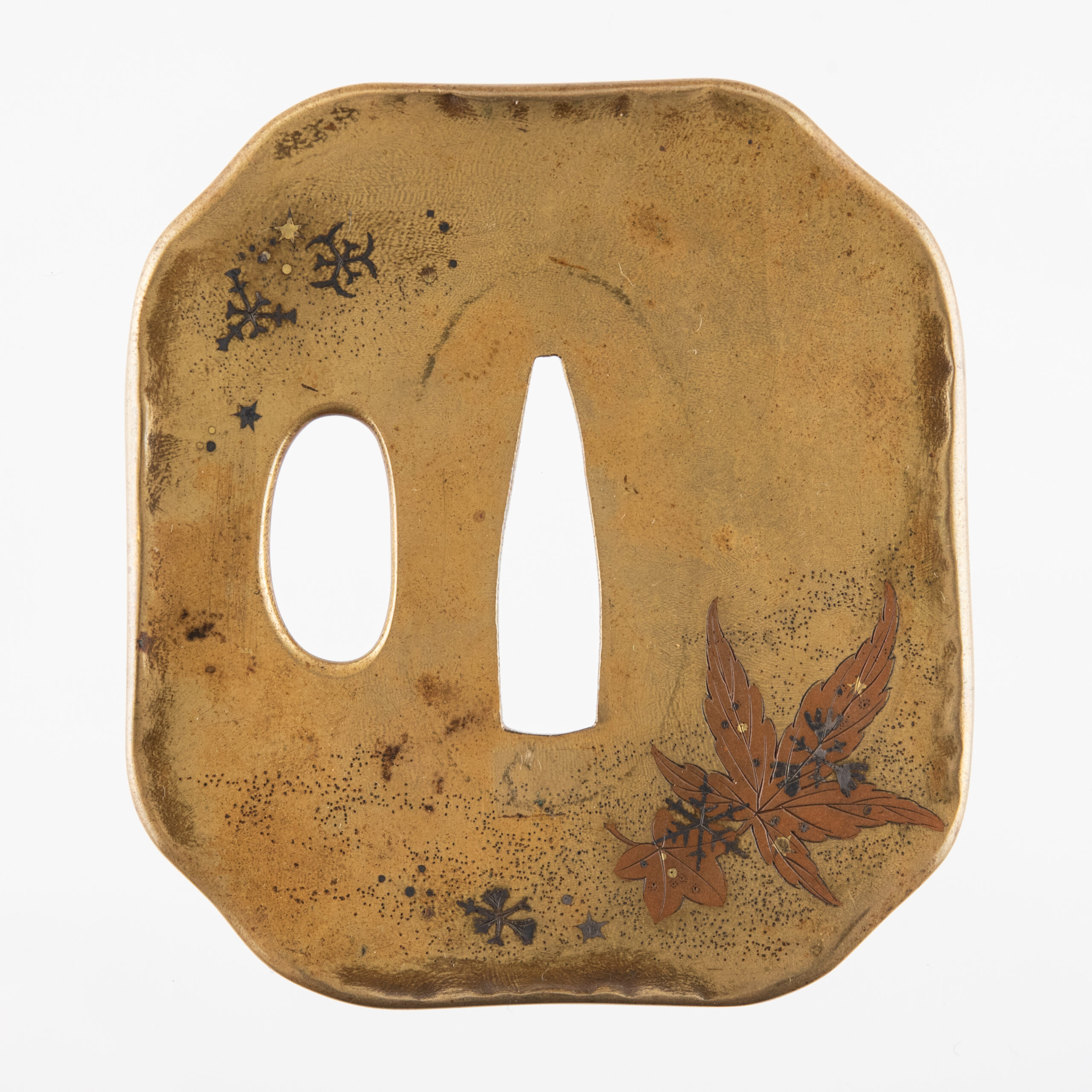
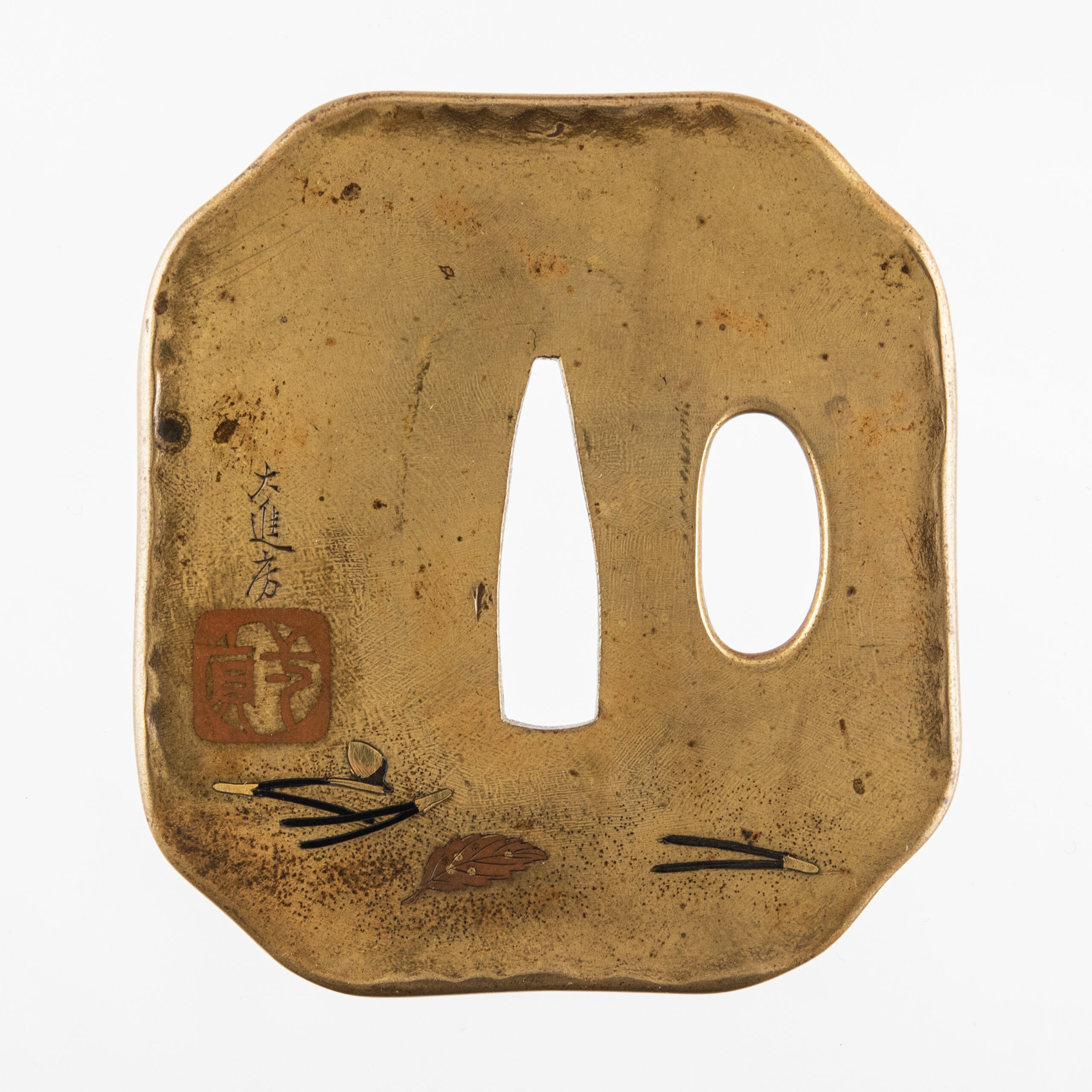
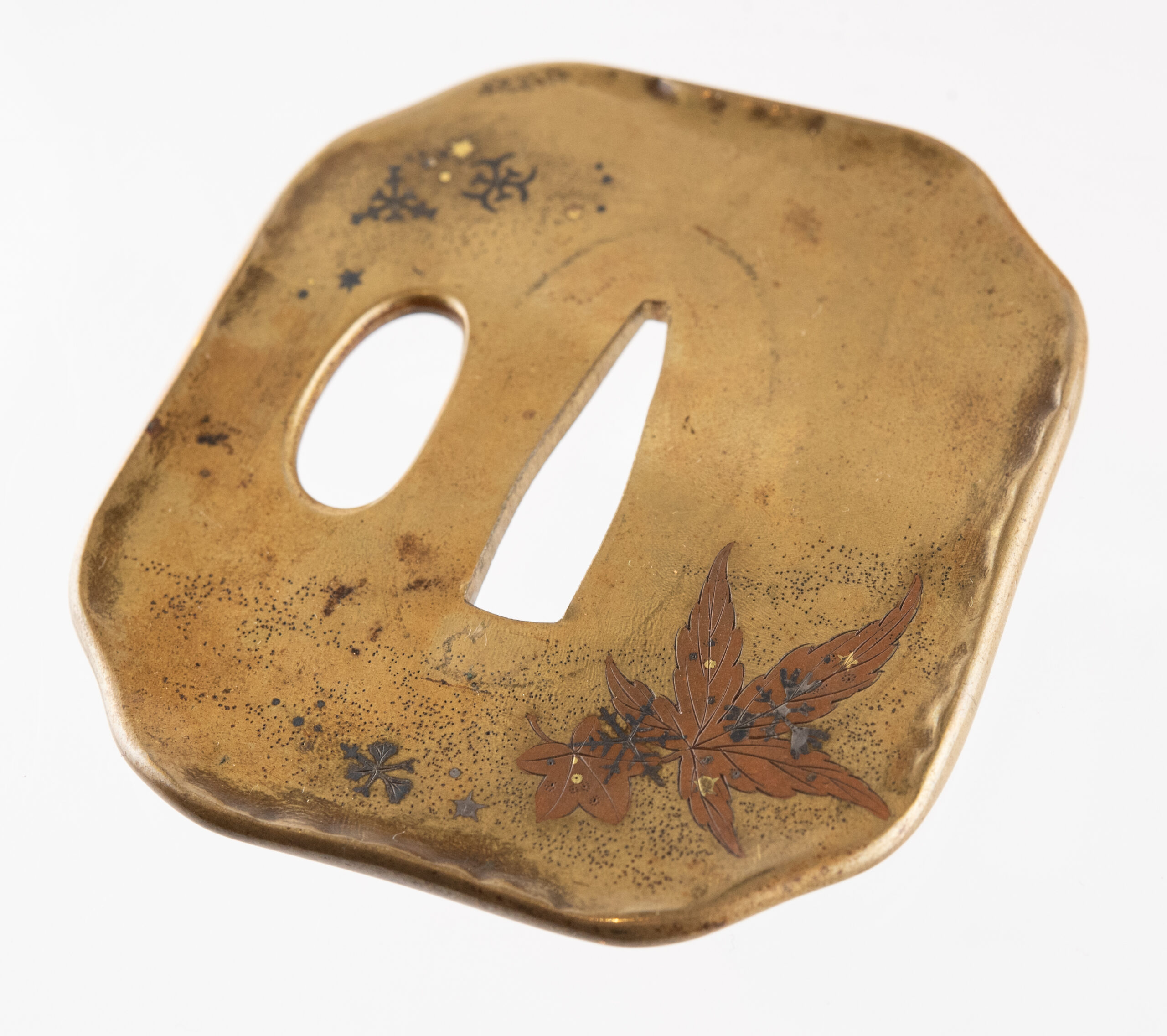
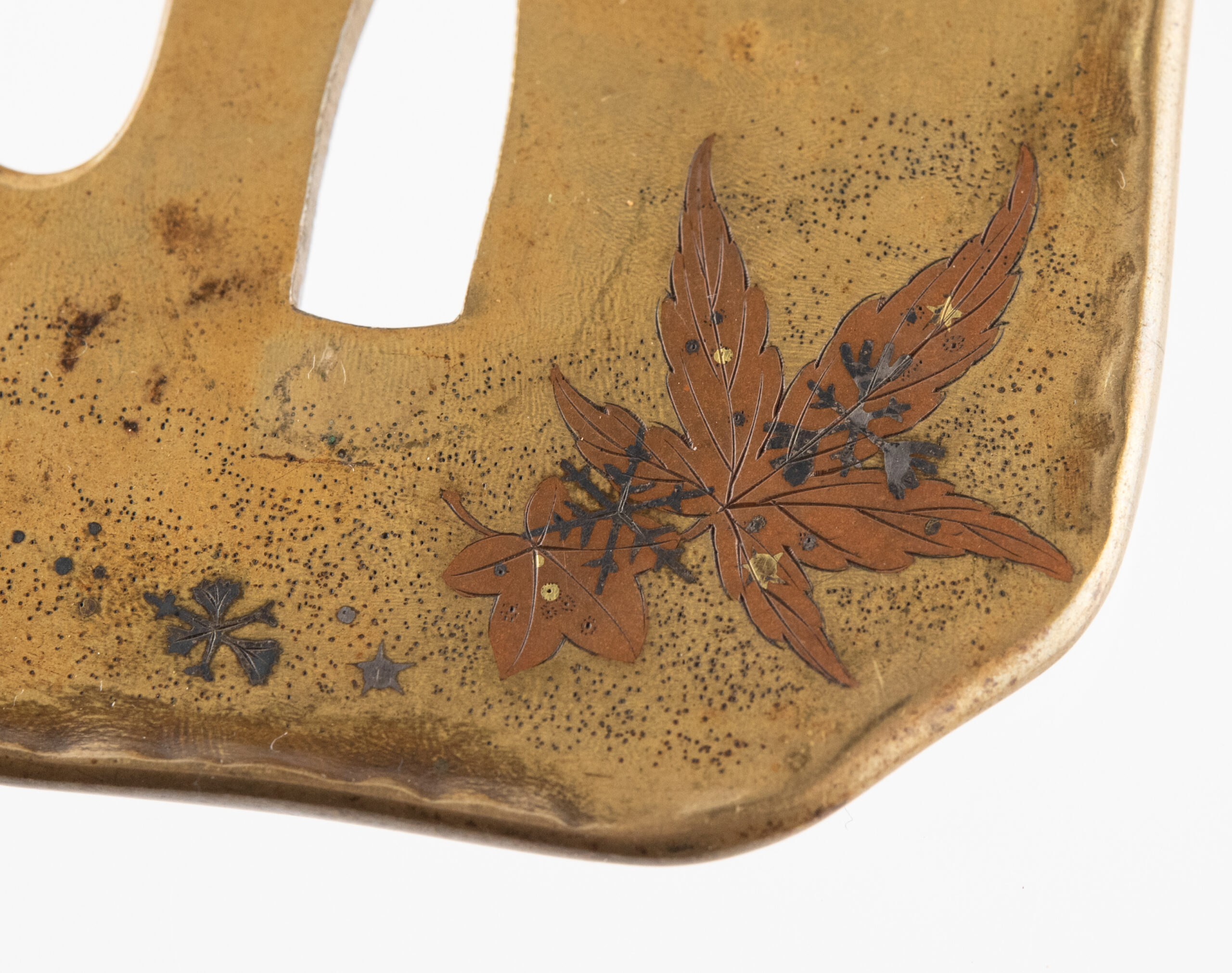
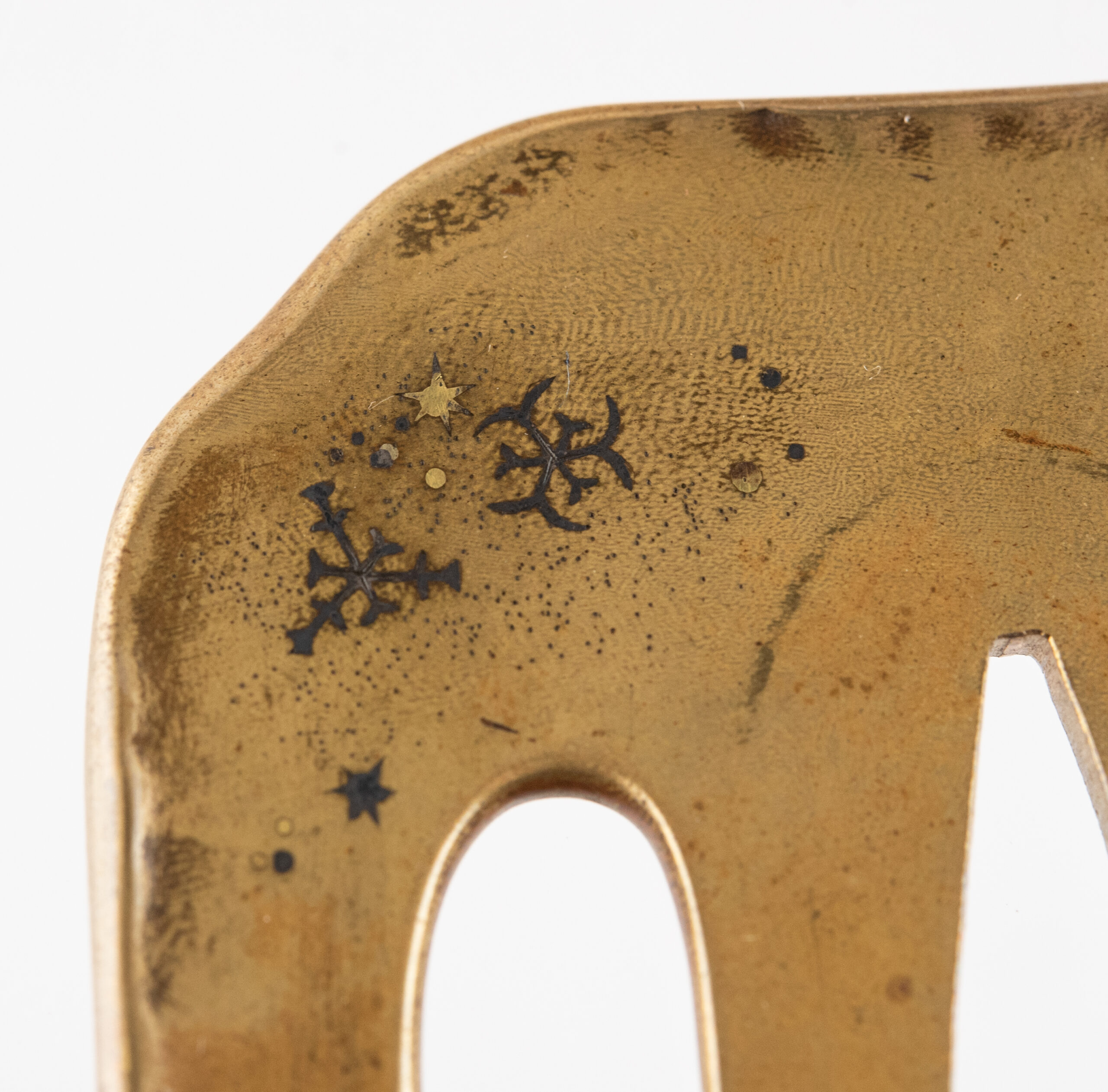
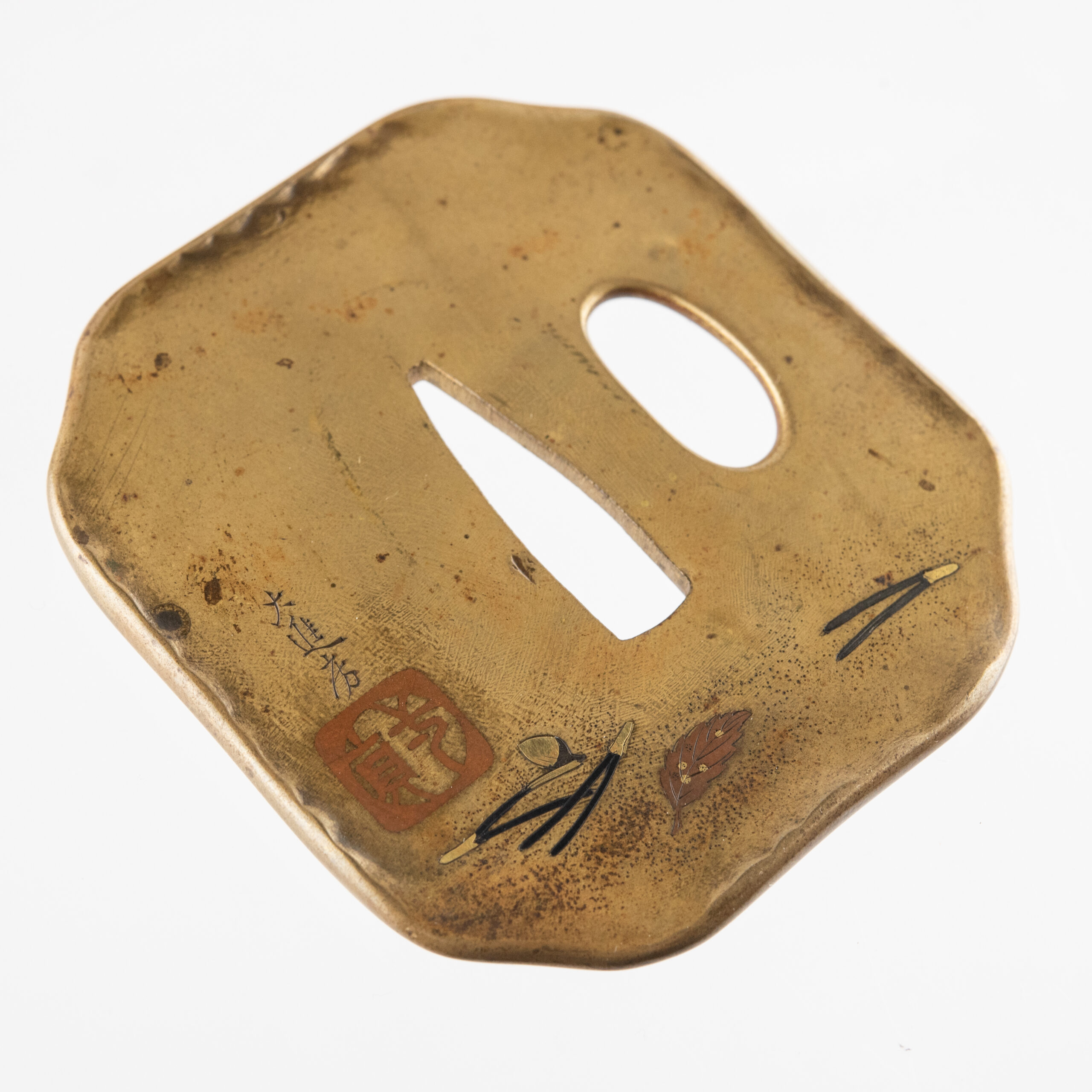
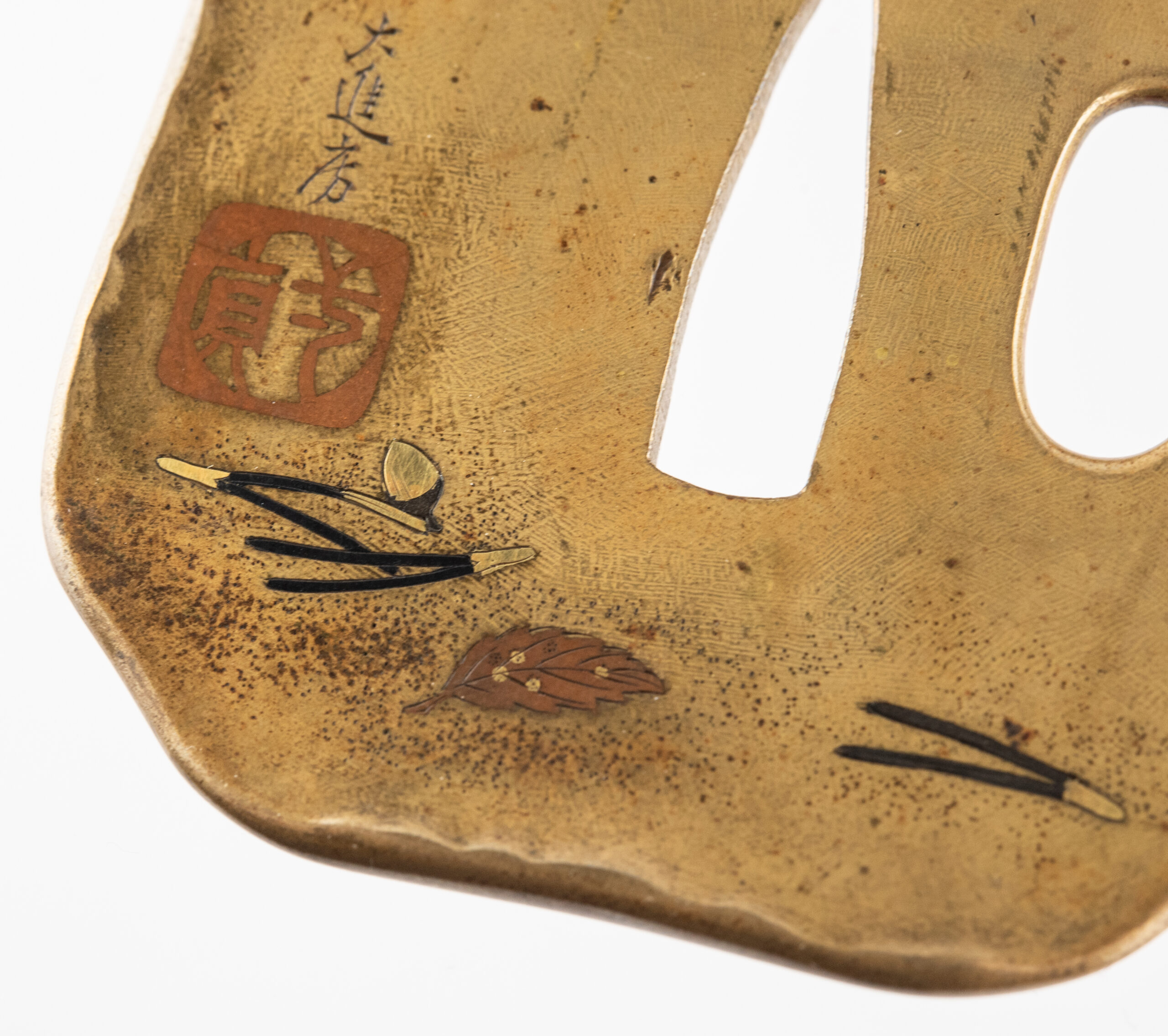
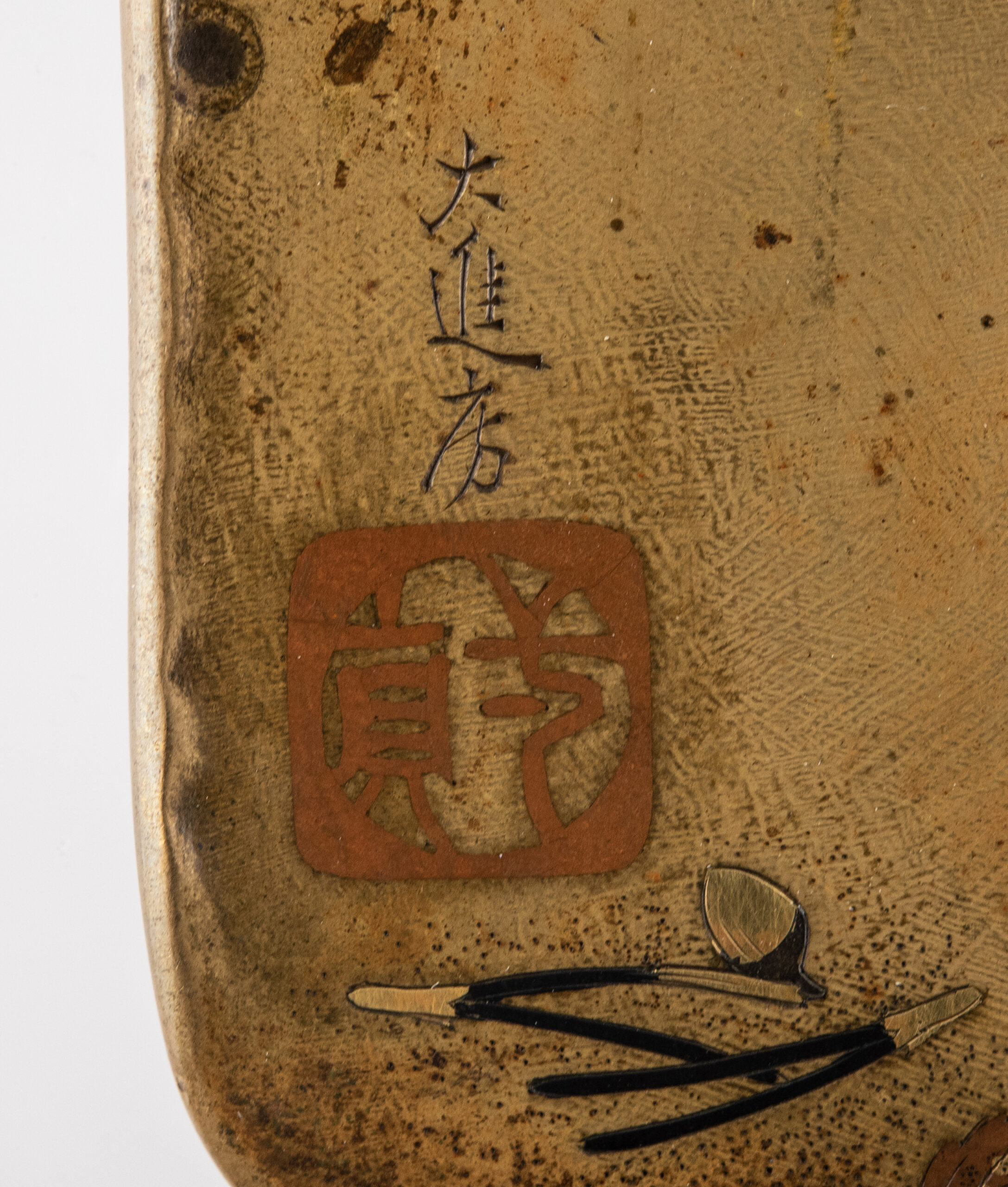
This refined Tsuba is a work by Wada Isshin (1814–1882), one of the distinguished students of Goto Ichijo. Isshin worked during the late Edo and early Meiji periods and became known for his highly accomplished sword fittings. The NBTHK awarded this piece Tokubetsu Hozon certification. Workmanship and Design The Tsuba is made of sentoku and has developed an attractive greenish-brown patina. Its dimensions correspond to a Wakizashi-size Tsuba. The plate has a kakugata form with sumikiri corners, giving it an almost octagonal outline while retaining a distinctly rectangular appearance. The thin plate rises gently toward the rim, creating a subtle three-dimensional profile. It has one kozuka-hitsuana and is otherwise solid. On the lower right of the front, the artist inlaid two autumn leaves in copper. One is a maple leaf, while the second is a rounded five-lobed leaf whose species remains unidentified. Delicate silver snowflakes lie across the maple leaf. Additional silver snowflakes and minute gold inlays appear toward the upper left. The juxtaposition of autumn foliage and snow suggests the arrival of early snow in late autumn. Isshin executed the decoration predominantly in delicate hirazogan, or flat inlay, allowing the design to remain closely integrated with the smooth sentoku surface. Reverse and Signature The reverse carries Isshin’s go Daishinho on the left, with an Isshin seal rendered in copper below. The lower area features an acorn in gold and shakudo, accompanied by scattered matsuba (pine needles) and another red autumn leaf. Together, these details continue the seasonal theme of the front. About Wada Isshin Wada Isshin (1814–1882) was born in Kyoto. He first studied under Fujiki Kyubei, a craftsman associated with Goto-style fittings, and later entered the school of Goto Ichijo. Ichijo permitted him to use the character “Ichi,” after which he adopted the name Isshin. He used several art names during his career, including Daishinho, Gekkindo, Yusai and Bizan, and became one of the notable metalworkers of the Ichijo tradition. Details 後藤一乗門の名工・和田一真(1814–1882)による、幕末期の上質な鍔です。一真は江戸時代末期から明治時代初期に活躍した装剣金工で、本作にはNBTHK特別保存刀装具鑑定書が付属します。 形状と地金 地金は宣徳で、緑褐色の美しい古色を呈しています。寸法は脇差用の鍔として適した大きさです.形状は角形を基調としながら四隅を切った隅切角形で、長方形に近い印象を保ちながら八角形状の輪郭を形成しています。薄手の地板は耳に向かってわずかに盛り上がり、穏やかな立体感を見せます。小柄櫃孔を一つ備え、その他は地透かしのない構成です。 紅葉と初雪の意匠 表の右下には、銅象嵌による二枚の秋葉が配されています。一枚は楓で、もう一枚は丸みを帯びた五裂の葉ですが、樹種は未詳です。楓の上には銀で繊細な雪華が象嵌されています。また、左上にも銀の雪華と微細な金象嵌が見られます。 秋の葉と雪を組み合わせた意匠は、晩秋に訪れる初雪を表現したものと考えられます。文様の多くは平象嵌によって表され、滑らかな宣徳地と一体化した繊細な表現となっています。 裏面と銘 裏面左側には一真の号「大進房」があり、その下には銅象嵌による「一真」の印があります。 下部には金と赤銅で表した団栗、散らされた松葉、さらに赤い秋葉が配され、表面から続く秋の季節感を構成しています。 和田一真について 和田一真(1814–1882)は京都に生まれ、初め後藤家系の金工・藤木久兵衛に学び、その後、後藤一乗の門人となりました。一乗から「一」の字を許され、一真と名乗ったと伝えられています。大進房、月琴堂、幽斎、眉山など複数の号を用い、一乗門を代表する金工の一人として知られています。
Offered by Tsuba Info
This piece has sold
Get an email when a new Wada Isshin piece hits the market.

Gotō Wada Isshin
late Edo–Meiji (1814–1882)
Signed
Tokuho (NBTHK)
Iebori · Yamashiro
1 piece on the market now
Wada Isshin Masamasa was born in Kyoto in Bunka 11 (1814). He first trained under Fujiki Kyubei, a craftsman who produced fittings in the Goto manner as an outsourced engraver (shiirebori-shi), and at that time used the name Masataka. Later, through the intermediation of the sword merchant Sawaya Chubei, who recognized his natural talent, he entered the school of Goto Ichijo. He was granted permission to use the character "Ichi" and accordingly changed his name to Isshin. A man of broad cultivation, he possessed knowledge of medicine, was devout in matters of religion, and enjoyed composing waka poetry and playing the gekkin (moon lute). He used art names (go) such as Gekkindo, Bizan, and Tennenka, and many of his works bear honorific prefixes including Shoshin, Daishin, and Asomi. He died in December of Meiji 15 (1882) at the age of sixty-nine.
Isshin's work is distinguished by its comprehensive command of the Goto Ichijo repertoire, deployed across ambitious, large-scale coordinated sets. His productions characteristically employ takabori with polychrome iroe, executed with painstaking care and meticulous finishing across every component. In his complete daishio fittings set unified by the Twelve Zodiac theme, the NBTHK observes that he "deploys every available technique -- high relief, suemon ornament, inlay, and polychrome iroe -- devoting himself to the portrayal of each animal with painstaking care." His mitsudogu of Genji 1 (1864), a Four Seasons flowers-and-birds set executed in oborogin with takabori iroe, is recognized as "one of the foremost large-scale works among Isshin's productions," a work "into which Isshin poured his full abilities" whose "level of completion is exceptionally high." In passages of individual expression, such as the concentrated ingenuity in the "eight"-shaped brow markings of his coiled dragons, he tests a character distinctly his own.
The NBTHK consistently positions Isshin as a leading figure within the Ichijo lineage who faithfully inherited and carried forward his master's style. In his tsuba forms, the rendering of clouds and waves, and the yasurime on fuchi-kashira, the characteristics of Ichijo are prominently displayed, making it "especially interesting to observe how this craftsman, who was a leading figure within the lineage, faithfully inherited and carried forward his master's style." Yet Isshin is not merely an imitator; his works reveal a craftsman who, while working within the inherited vocabulary, concentrated creative zeal into individual passages of invention -- achieving what the NBTHK calls a "masterpiece in which the creative zeal of Wada Isshin is fully brought to expression."
Where Isshin stands among comparable artisans: across all of nihontō, and within tradition, era, and period. The tiers (Foremost · Leading · Major · Notable) weigh official designations from the NBTHK and Japan's Agency for Cultural Affairs, together with historical honors of lasting repute such as the Sansaku and Meibutsu-chō.
Select a lens to see how it's measured.
Iebori · Kyoto
37 pieces on the market now
" Ichijo was the fifth-generation head of the Shichiroemon house, a cadet branch of the Goto family, and trained under Hanzaemon Kamejo before succeeding to the headship at fifteen. His imperial commissions -- fittings for Emperor Kokaku in 1824 and Emperor Komei in 1862 -- earned him the ranks of Hokyo and Hogen respectively, and his atelier in Kyoto attracted a circle of gifted disciples who extended his aesthetic into the Bakumatsu and early Meiji periods. Among them, the celebrated "Five Tigers" (Goko) -- Funada Ikkin, Imai Nagatake, Hashimoto Isshi, Nakagawa Issho, and Wada Isshin -- together with the master's younger brother Goto Koran, constituted one of the most prolific and technically accomplished workshops in the history of Japanese tosogu production. The collective technical identity of the Ichijo school rests upon a foundation of shakudo nanako-ji of surpassing fineness -- described as "minute and orderly, deep and limpid," meriting the appellation kinume-nanako -- upon which elaborate pictorial compositions are built through takabori enriched by polychrome iroe employing gold, silver, shakudo, shibuichi, and suaka. Ichijo himself established the artistic direction by shifting from the canonical iebori subjects of dragons and lions toward compositions centered on close observation (shasei), rendering grasses, flowers, insects, birds, and landscapes with meticulous carving and refined dignity. This painterly sensibility pervades the entire school. Nagatake brought a distinctive ornamental density, arranging seasonal plants across entire surfaces with richly varied colored metals.
" Ikkin developed an unrivaled command of kosuki-bori -- a bold, thick chiseling technique that even Ichijo conceded was "beyond my own reach[[c:1]]" -- and his dragon subjects carried a distinctive forcefulness. " Isshin absorbed the hereditary vocabulary while concentrating creative zeal into individual passages of invention, and Issho achieved works of luxurious, courtly elegance through refined kinu-nanako and precise kebori. Koran, working in a manner akin to his elder brother yet "finished with an even more delicate and nuanced sensibility," brought the Shichiroemon branch to its most accomplished expression. Across the school, the favored tsuba form is the sumi-iri mokko-gata, and many works exhibit chuya shitate -- "day-and-night" construction using contrasting alloys on obverse and reverse. Complete daisho soroe kanagu sets, coordinated around seasonal, auspicious, or literary-historical themes, represent the school's highest format. " This standard was transmitted faithfully through the circle. " The school's productions are consistently praised for an elevated, Kyoto-inflected refinement that balances splendor and restraint in just measure. Learn more →
| Smith | Era | Designated |
|---|---|---|
| Goto Ichijo後藤一乗 | — | 91 |
| Tomei東明 | — | 30 |
| Nagatake永武 | — | 13 |
| Ikkin一琴 | — | 11 |
| Issho一匠 | 1828-1876 | 10 |
A Hozon-certified fitting of notably superior craftsmanship and condition, often with signature or workmanship of high reference value.
The NBTHK (Nihon Bijutsu Tōken Hozon Kyōkai, the Society for the Preservation of Japanese Art Swords) is a public-interest incorporated foundation founded in 1948 and supervised by Japan’s Agency for Cultural Affairs (Bunkachō); it is based at the Japanese Sword Museum in Tokyo. Its expert panels physically examine each submitted work (shinsa) and issue a certificate (kanteishō) ranking it by artistic and historical merit. NBTHK papers are the most widely recognized standard of authentication for Japanese swords and fittings.
NBTHK official siteAll sales are final and no refund will be issued. Individual refund conditions may be offered on request. For items with third-party certificates (e.g. NBTHK), a return is offered if the certificate is proven falsified and claimed within one year after shipment.