 NihontoWatchNihontoWatch
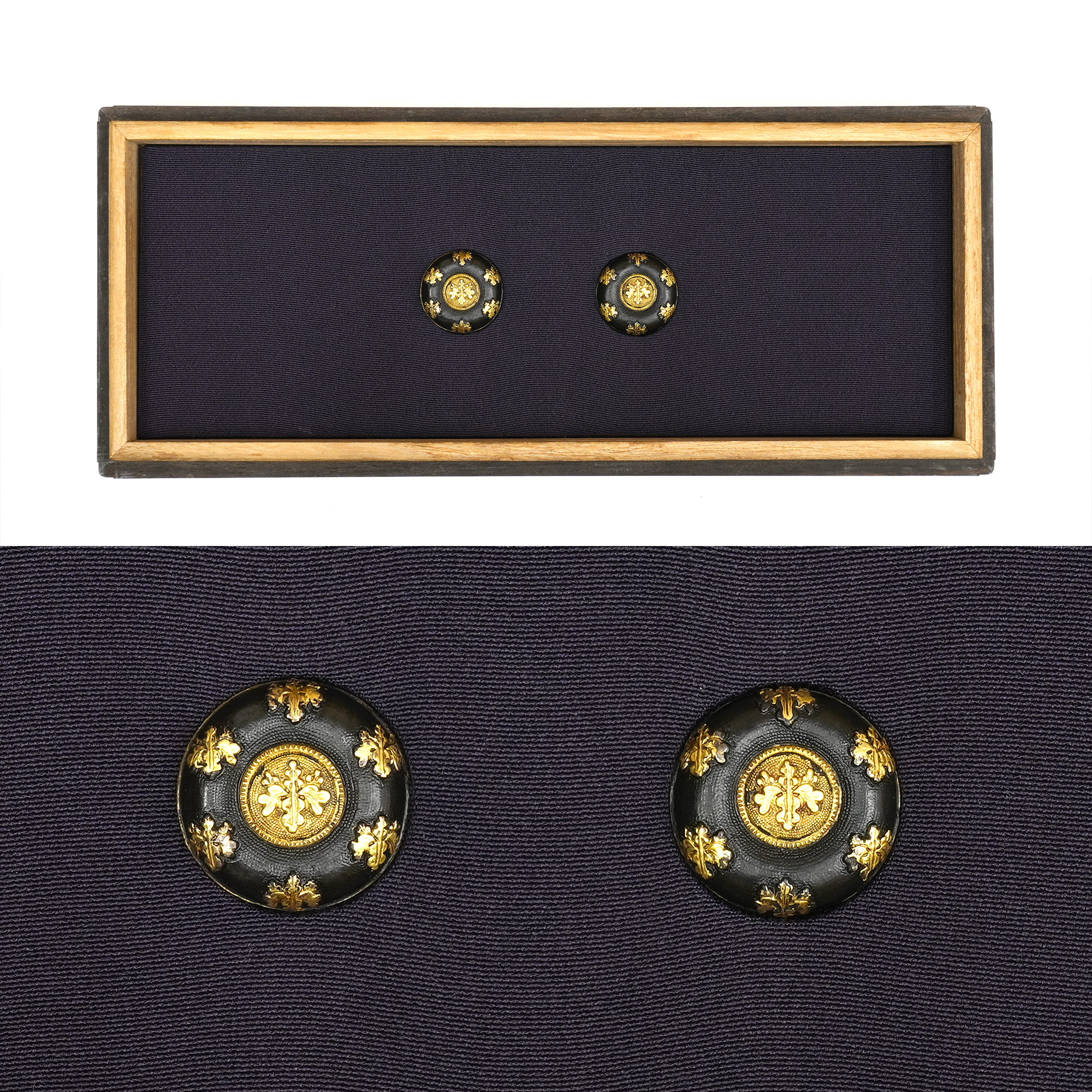
後藤徳乗は後藤宗家五代を継いだ桃山時代を代表する金工で、天文19年(1550)に生まれ、寛永8年(1631)に没しました。織田・豊臣から徳川へと天下の主が移り変わる時代に家彫の伝統を担い、徳乗以降の後藤宗家が四郎兵衛家と呼ばれる端緒を開いた人物として知られます。後藤家は将軍家や諸大名の格式ある刀装具を手掛け、赤銅魚子地へ金の高彫色絵を配する格調高い様式を完成させましたが、徳乗の作には桃山らしい豊かな量感と堂々たる構成、細部まで揺るがない端正な鏨使いが備わり、家彫金工の中でも特に高い評価を受けています。 五三桐紋は三本の花序に五・三・五の花を配した桐紋で、古くから朝廷や武家の権威と結び付き、桃山時代には豊臣政権の象徴的意匠としても重んじられました。桐は鳳凰が宿る瑞木とされ、繁栄、威信、家運隆盛を表す格の高い吉祥文であり、本品のように桐紋を壺笠目貫へ整然と配した意匠は、実用の装具を超えて、所持者の格式を端的に示すための荘厳な装飾といえます。 本品は赤銅地をふっくらと盛り上がる壺笠形に仕立て、その全面へ極めて細密な魚子を打ち、中央の円形座と外周へ五三桐紋を金色絵で配した一対です。中央には粒を揃えた魚子地の上へ大きな五三桐を据え、周囲を細かな連珠状の縁で引き締めながら、外周には六つの桐紋を均衡よく巡らせることで、直径約20ミリという凝縮された画面に、桃山の気宇を感じさせる華麗さと厳正な秩序を両立させています。 漆黒に近い赤銅の地色と金色絵の鮮やかな対照は遠目にも明快であり、手元では中央座の緻密な魚子、立体的に起こされた桐葉、細く伸びる花序、外周を締める縁取りまで、鏨仕事の密度を余すところなく味わえます。左右は単純な型の繰り返しではなく、一つ一つの葉先や花房に微妙な変化を持たせながら、一対として寸分の乱れもない品格へまとめられており、丸く張り出す壺笠形の量感が斜めの光を受けるたび、黒と金の間に豊かな陰影を生み出します。 裏面は深く内刳りされ、古い装着の痕跡を留める素朴で力強い裏行を示しており、表の華麗で精密な装飾とは対照的に、桃山金工らしい確かな構造と時代の深さを伝えています。享保6年(1721)に後藤宗家十一代通乗が徳乗作と極め、「代金弐枚五両」と評価した折紙が伝来し、さらに日本美術刀剣保存協会の審査によって重要刀装具第3469号に指定され、桃山時代の徳乗作として重ねて高く評価されています。江戸時代に発給された後藤家の折紙と、現代の重要指定が揃って伝わる点は、作品そのものの完成度に加えて確かな来歴を備えることを示し、後藤宗家の格、桃山の華麗な美意識、由緒ある伝世を一対の中に凝縮した、収蔵の中心に据えるに相応しい名品です。
NihontoWatchOffered by Toushin
3 on the market

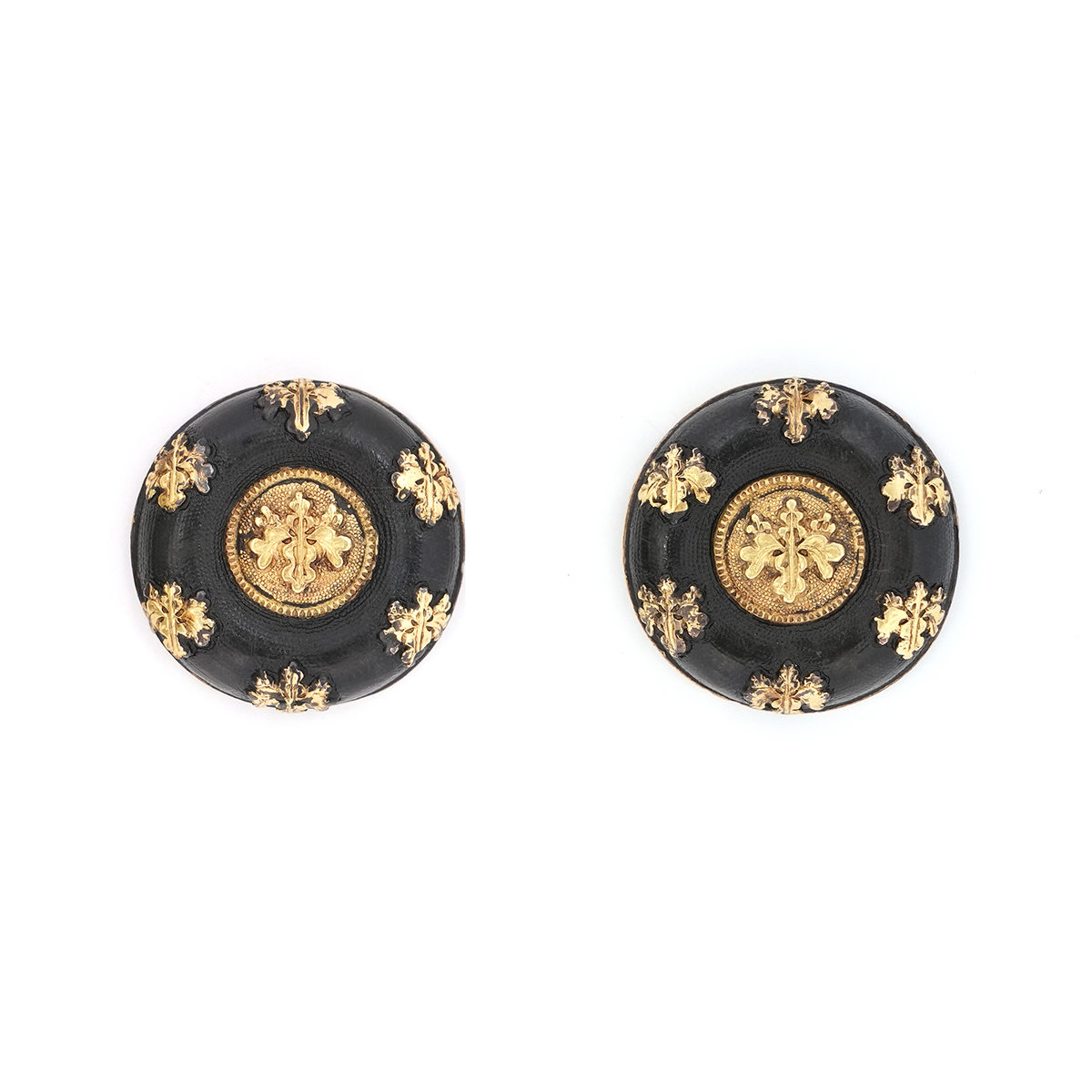
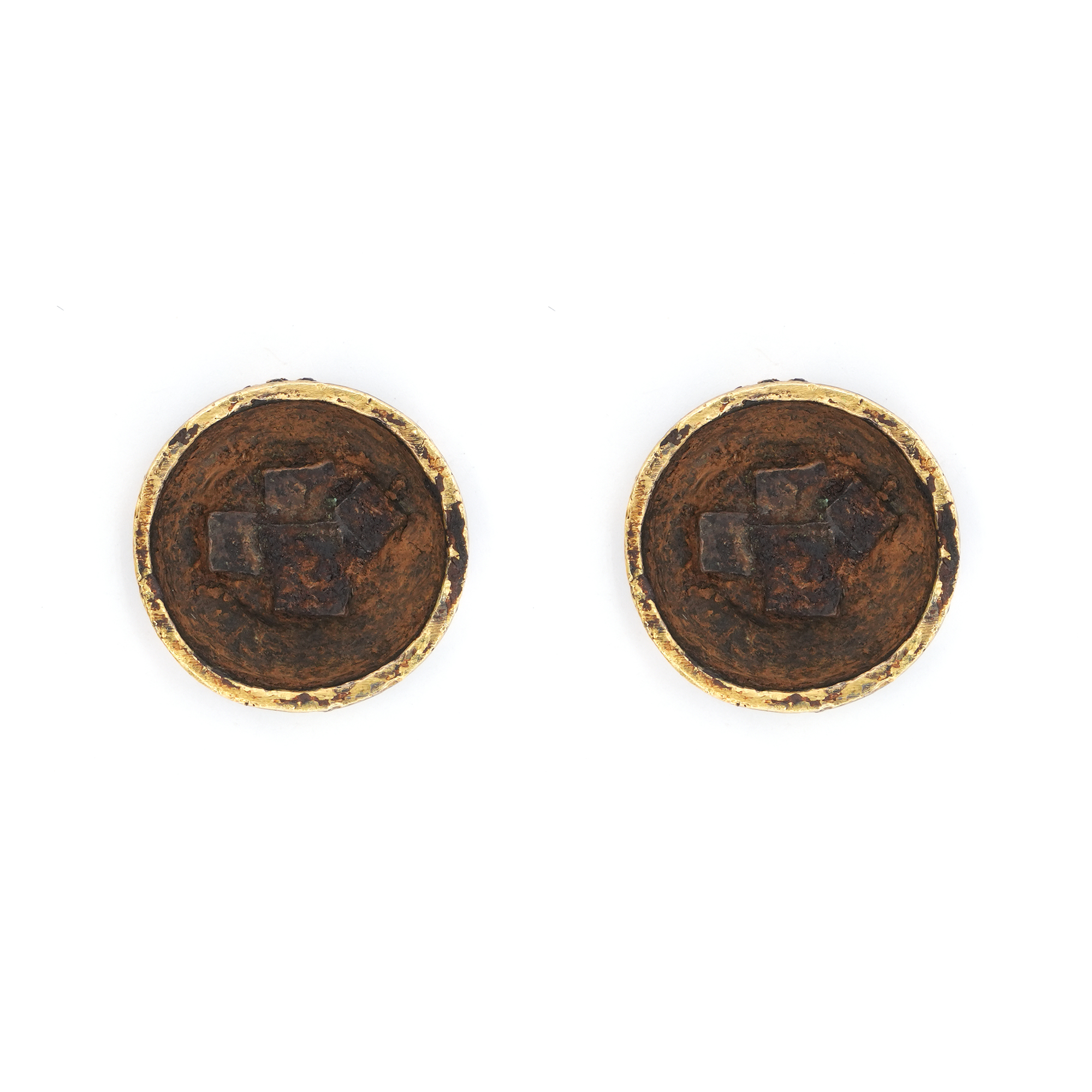
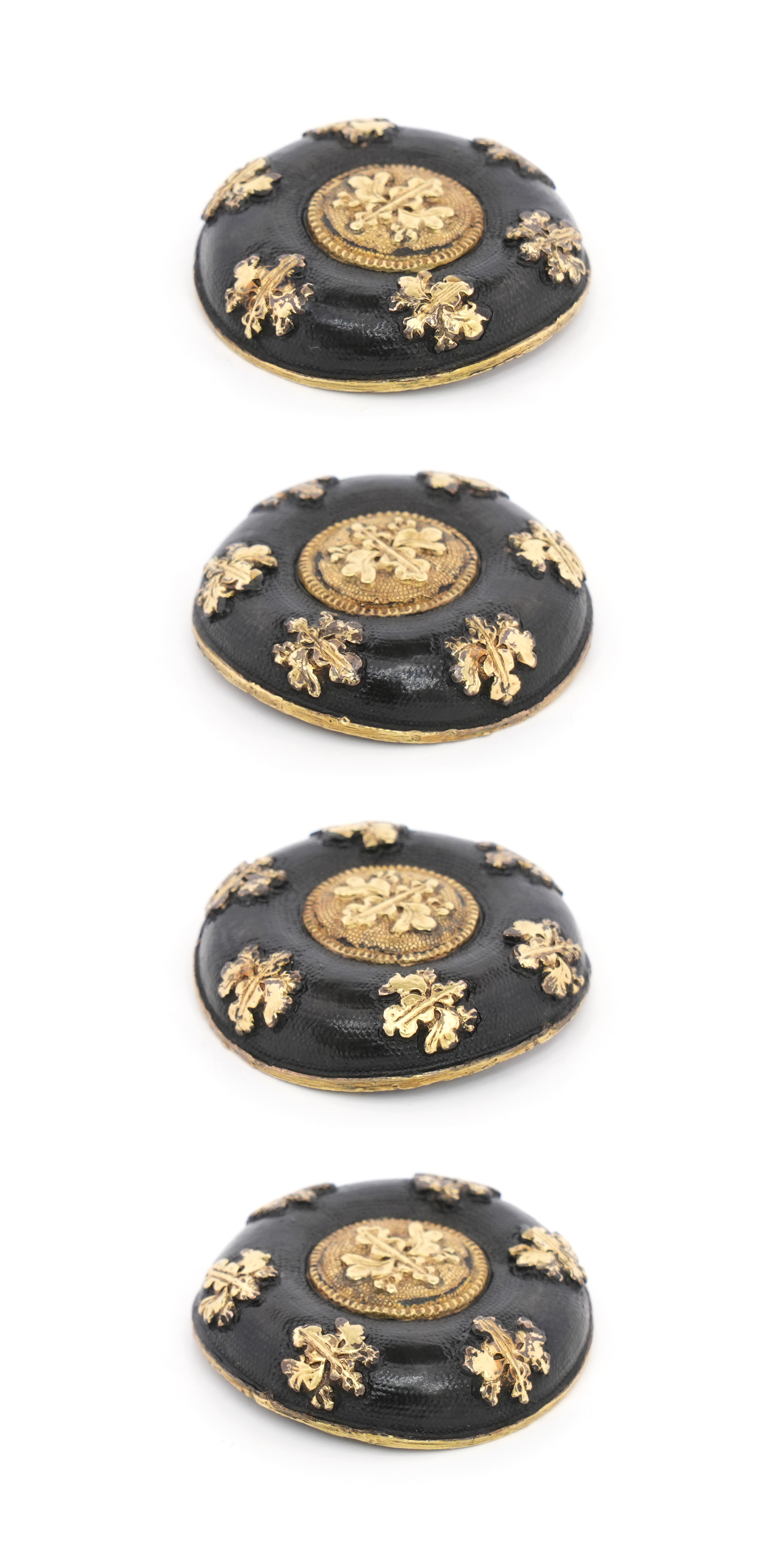
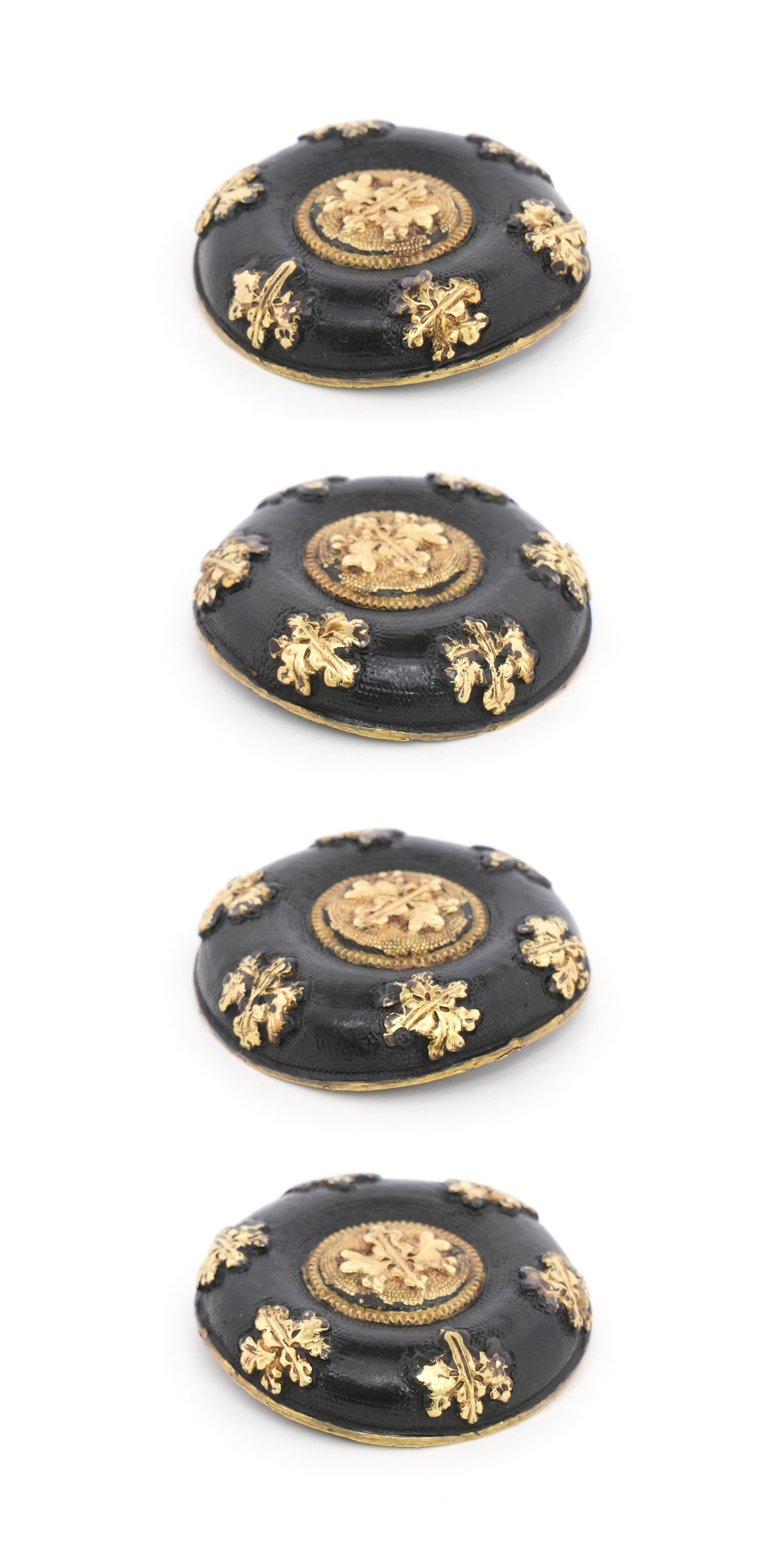
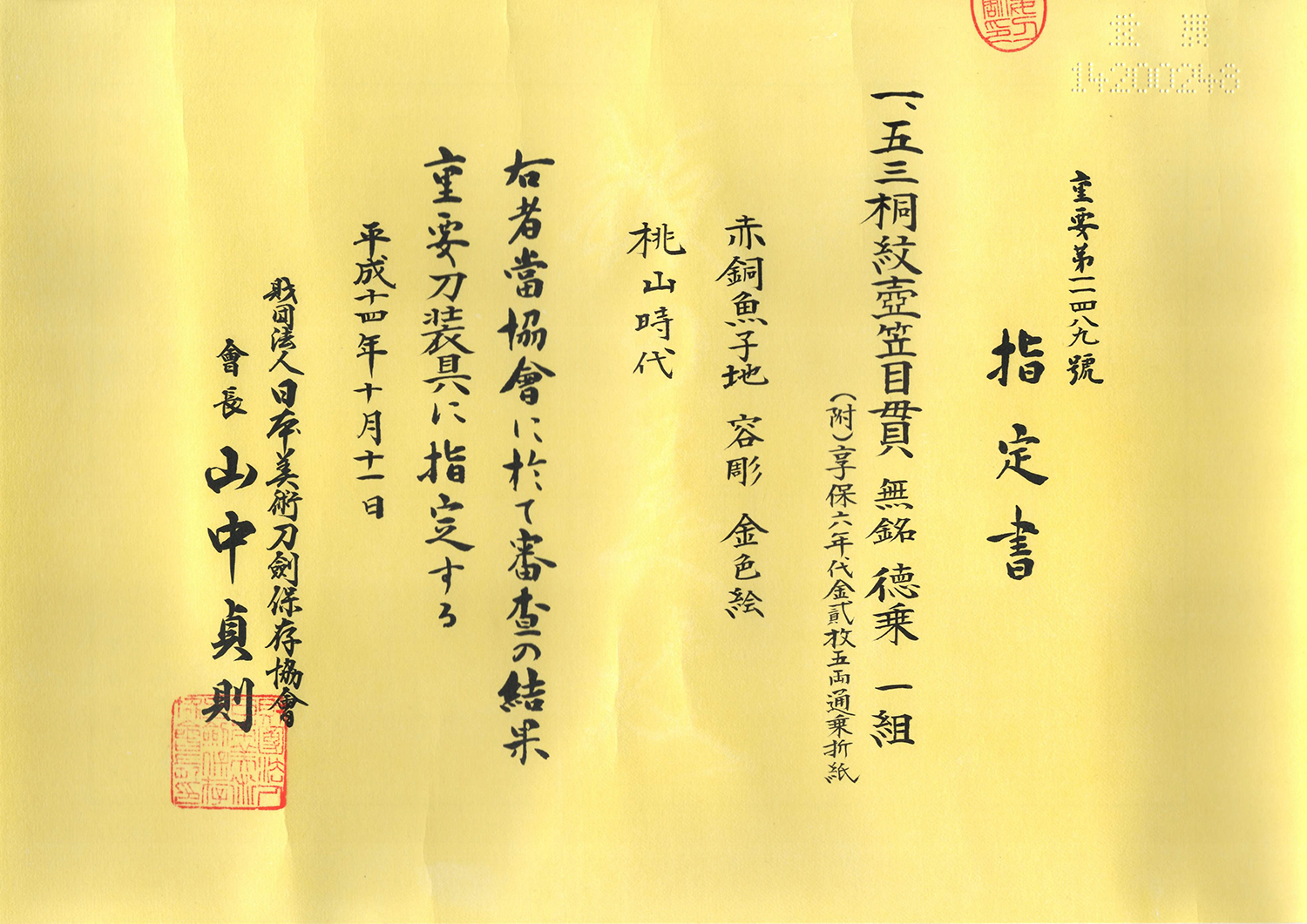
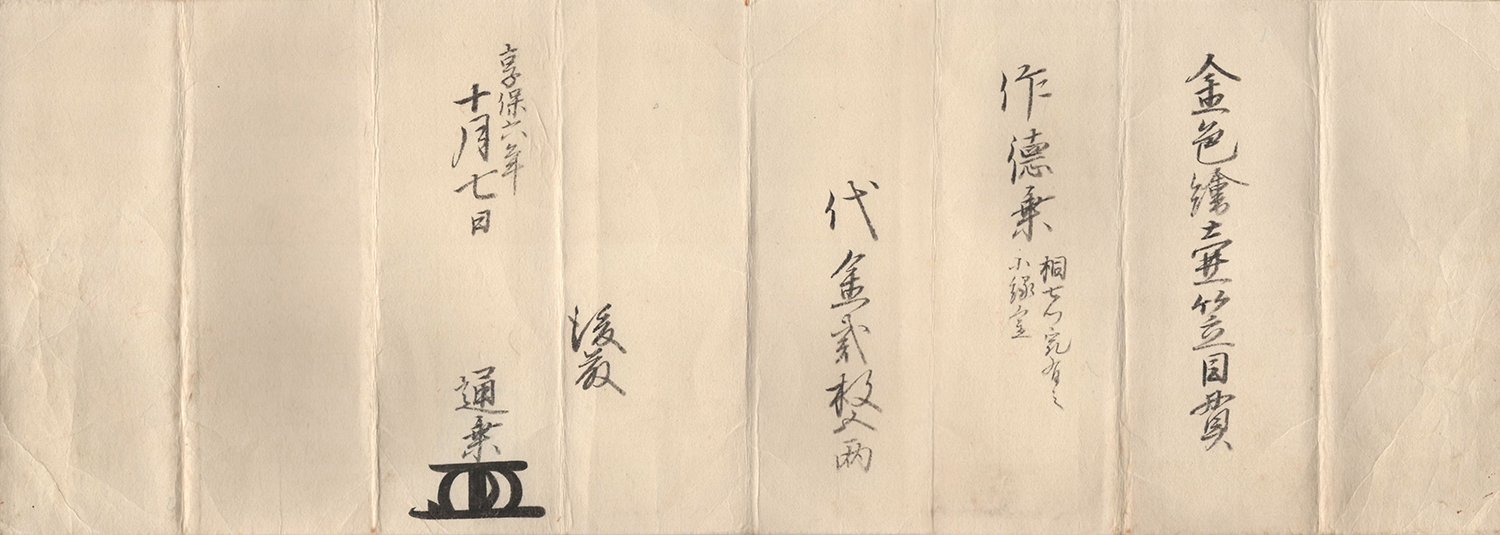
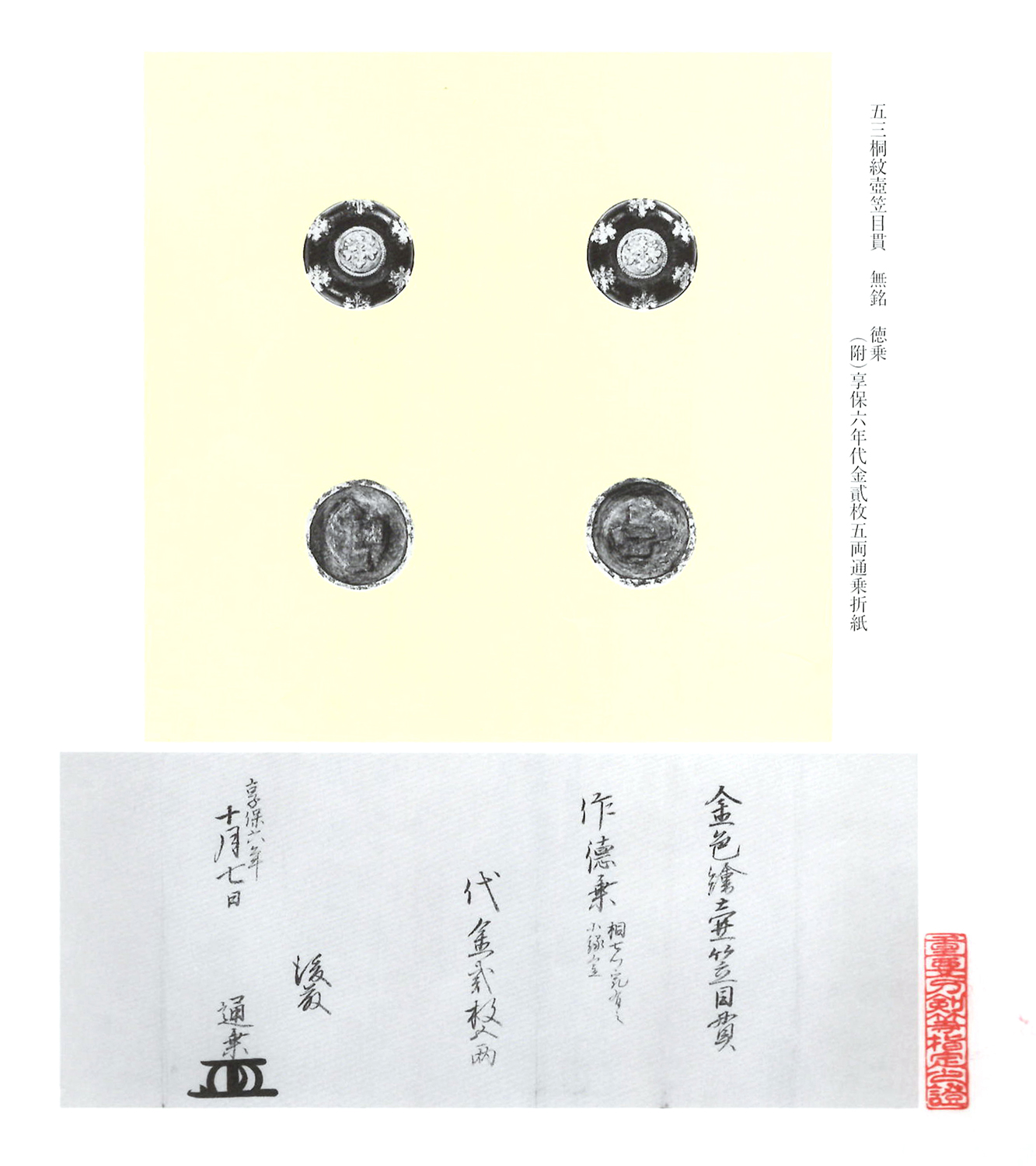
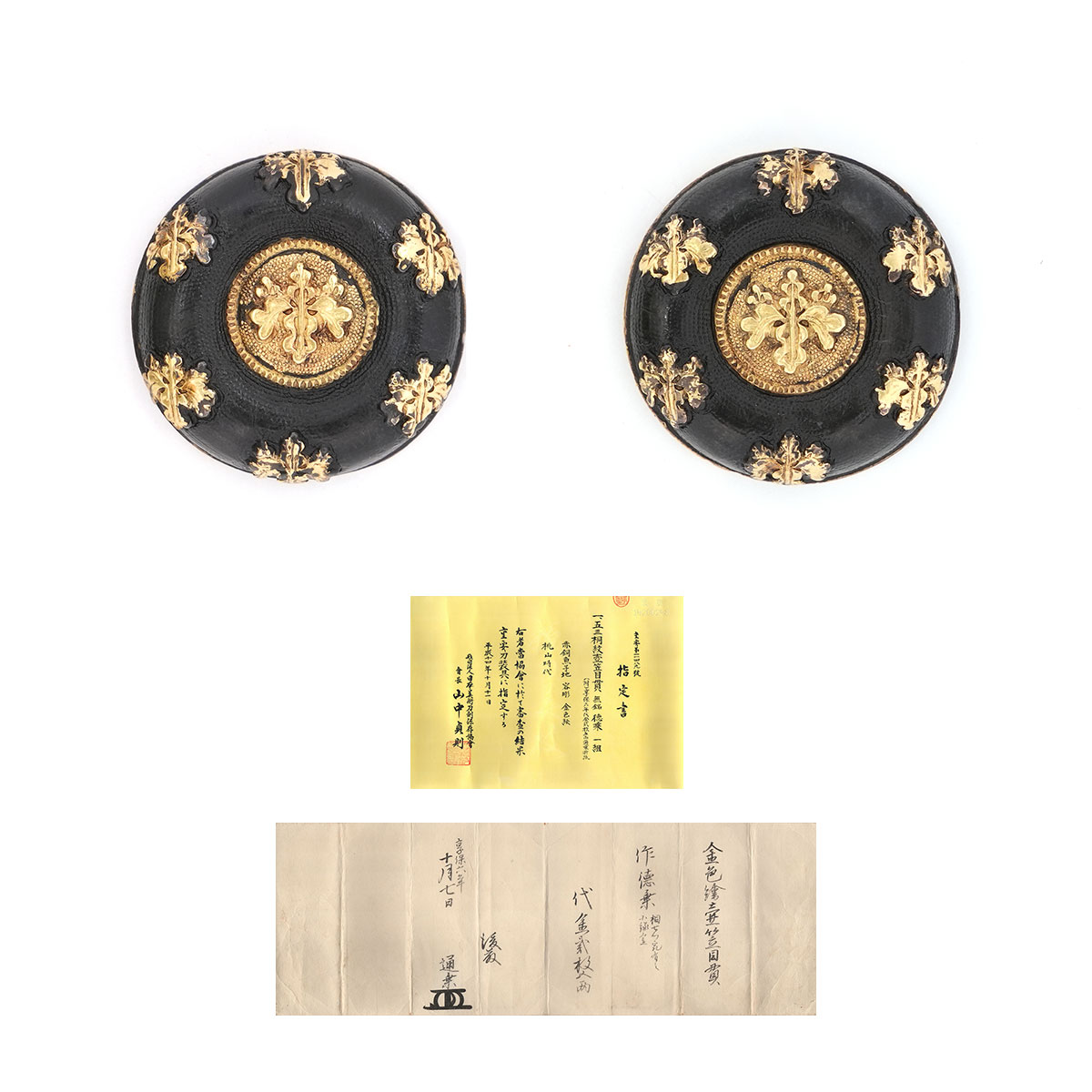
Goto Tokujo
Momoyama
Unsigned
Jūyō (NBTHK)
As written by the shop
(Translation unavailable)
Iebori · Yamashiro · around 1550-1631
3 pieces on the market now
Goto Tokujo, the fifth-generation head of the Goto main line, was the eldest son of the fourth master, Kojo. He was born in Tenbun 19 (1550) and died in Kan'ei 8 (1631). His common name was first Genjiro, later Shirobei, and his personal name is recorded as Mitsumoto and also as Masaie. Since the first master, Yujo, the Goto had served the Ashikaga shoguns. When the Ashikaga line ended in his father's time, Kojo and Tokujo served Oda Nobunaga, and after Nobunaga's death Toyotomi Hideyoshi, who charged them with three offices: the great gold coinage, the weights, and the carving of sword fittings. In Tensho 16 (1588) Tokujo made the great and small gold coins, struck them with a paulownia stamp known as the Tokujo-giri or Taiko-giri, and wrote his own name on them in ink. He remained in office under Ieyasu and Hidetada and in his last years received the rank of Hogen.
The published sources record his family in detail. He had five sons and four daughters. His eldest son, Eijo Masafusa, succeeded as the sixth head; the second son died young; the third son became the seventh head, Kenjo; and the fourth and fifth sons, Takujo and Kyujo, founded branch houses. His daughters married into the Hon'ami family, the gold-mint house of Goto Shozaburo Mitsutsugu, and the Kano family. Through these ties the Goto house stood at the centre of the craft lineages of the Momoyama period.
His work is executed above all on shakudo nanako-ji, the minute, dense nanako that underlies the Goto formal repertoire. His principal technique is takabori with gold iroe, the gold applied thick, often with silver iroe and a gilt reverse. For menuki he carves in yobori with in'yo-ne roots. The published sources describe the modelling as usu-kin-dashi with a deep underside, the pressing from the front and the high-and-low change of the modelling standing out, and they call it highly refined. His subjects include crawling dragons, the lucky gods Hotei and Idaten, and the house's formal designs.
Among his formal designs the paulownia crest is the most celebrated. The published sources write that Tokujo's paulownia is famous under the names Taiko-giri and Tokujo-giri, and that 「麦鏨と称される特殊タガネは十個打っている」, the special barley chisel struck ten times. They read the slightly narrow width of one of his kozuka as a mark of the Momoyama age. Like the other early Goto heads, his work is mostly unsigned and attributed by the origami and gold-inlaid appraisal signatures of later heads, above all the thirteenth master Enjo Mitsutaka. A self-signed piece is rare: of a kogai of Hotei signed Goto Tokujo with a kao, the published sources write that 「自身銘は特に珍稀である」.
The published sources describe his work as conveying the bold, sumptuous spirit of the Momoyama age, with a dignity proper to the Goto main line. Of a three-piece set of Hotei they write that the robes and bags are varied between the menuki, kozuka and kogai and that fine chisel work reaches every joint, so that the work lets one fully appreciate 「御家彫後藤家の技術の確実さ」, the sureness of the official Goto house carving. Another set they call 「品格を兼ね備えた後藤家の面目躍如たる作品」, a work of dignity that shows the Goto house at its best, judged from its origami to be one of the few sets of his own making. He set the standard of authority and richness against which the main-line Goto work of the following generations is measured.
His designated record stands at thirty-two Juyo. Several of his works descended in great houses, the Hachisuka daimyo family and the Osaka merchant house of Konoike among them, and the Nabeshima family appears in the recorded provenance as well. No current institutional holder is recorded against them. Because his work is almost wholly unsigned and much of it kept as complete sets, a piece by Tokujo comes to light only occasionally, and a signed one is among the rarest things a collector of Goto work could encounter.
Where Goto Tokujo stands among comparable artisans: across all of nihontō, and within tradition, era, and period. The tiers (Foremost · Leading · Major · Notable) weigh official designations from the NBTHK and Japan's Agency for Cultural Affairs, together with historical honors of lasting repute such as the Sansaku and Meibutsu-chō.
Select a lens to see how it's measured.
Iebori · Yamashiro
317 pieces on the market now
The Goto house stands as the preeminent dynasty of sword-fitting makers in the history of Japanese metalwork, an unbroken lineage of seventeen generations spanning from the founding master Yujo (1440--1512), who served Ashikaga Yoshimasa amid the refined culture of Higashiyama, through the final head Hojo (1816--1856) in the closing years of the Tokugawa shogunate. From its inception the house served successive rulers -- Ashikaga shoguns, Oda Nobunaga, Toyotomi Hideyoshi, and the Tokugawa -- and its productions became known as iebori, the "house carving" distinguished from machibori made for ordinary public demand. The fourth master Kojo first introduced warrior subjects and employed preparatory drawings by Kano Motonobu and Eitoku; the fifth master Tokujo struck the celebrated "Tokujo kiri" hallmark upon oban gold coinage for Hideyoshi; the third master Joshin -- "not only a metalworker but also a warrior" -- was killed in battle against the Azai clan in 1562. The seventh master Kenjo, praised since ancient times as a restorer of the house's fortunes (the finest exponents being termed Yuko-ken), traveled to Kaga and laid the foundations for the later flourishing of the Kaga-Goto tradition, while the tenth master Renjo carried the mainline from Kyoto to Edo, where it would remain through the seventeenth generation. The eleventh master Tsujo bridged the formal tradition with the expressive spirit of the Genroku era, and the thirteenth master Enjo served as an authoritative appraiser, authenticating works by earlier masters across the entire succession. The collective technical vocabulary of the Goto house is built upon shakudo nanako-ji grounds of extraordinarily minute and dense stippling, upon which motifs are rendered in takabori with kin-iroe and gin-iroe, frequently supplemented by solid gold (kinmuku) construction and kin'ura gilt backing. The sculptural manner is characterized by what the NBTHK repeatedly describes as "high mountains and deep valleys" -- a modulation of volume in which modeling rises emphatically while recesses are cut deep and clean, producing forceful and crisply articulated relief.
" Sojo inherited and tightened these forms with controlled elegance; Joshin amplified them to conspicuously larger scale with claws that are "characteristically large and long, with the tips splayed open"; Eijo brought a finer, more delicate precision to compositions of equally grand ambition; and Kenjo introduced a distinctive shosha quality -- austere and urbane -- that distinguished his work from the first six generations. The later masters sustained this discipline: Teijo's calm restraint and distinctive coloristic effects, Renjo's forty-five years of deeply worked takabori capturing instantaneous warrior movements, Tsujo's innovative left-right spreading compositions, and Hojo's reintroduction of machibori aesthetics into the official house style all demonstrate the lineage's capacity for renewal within tradition. The Goto house's enduring significance resides not merely in the technical excellence of individual masters but in the institutional continuity of a critical tradition sustained across four centuries. Works from the "upper six generations" (kami roku-dai) through Eijo established the canonical repertoire of prescribed okitemono motifs -- dragons, lions, paulownia crests, Kurikara, and auspicious figures -- while successive heads served simultaneously as makers and authenticators, issuing origami certificates and kiwame-mei inscriptions that themselves constitute important documents of connoisseurship. Valuations reaching one thousand kan and transmission through such distinguished collections as the Konoike, Shimazu, Tokugawa, and Maeda houses attest to the unrivaled esteem in which Goto metalwork has been held. Even Sokujo, whose tenure lasted barely four years before his death at thirty-two, left a small but distinguished body of work authenticated across eight subsequent generations of headmasters. From Yujo's founding vision through Hojo's final flowering -- whose technical command the NBTHK judges the finest from the twelfth master onward, betraying "not the slightest hint of the approaching conclusion" of the unbroken line -- the Goto house represents the defining standard against which all Japanese metalwork is measured, the wellspring from which the entire sokeN kinkO tradition flows. Learn more →
| Smith | Era | Designated |
|---|---|---|
| Goto Joshin後藤乗真 | 1512-1562 | 68 |
| Goto Yujo後藤祐乗 | 1440-1512 | 41 |
| Goto Kenjo後藤顕乗 | 1586-1663 | 46 |
| Goto Sojo後藤宗乗 | 1461-1538 | 56 |
| Goto Teijo後藤程乗 | 1603-1673 | 42 |
Exceptional craft of very high artistic value, judged to rank with a nationally recognized Important Art Object (Jūyō Bijutsuhin).
The NBTHK (Nihon Bijutsu Tōken Hozon Kyōkai, the Society for the Preservation of Japanese Art Swords) is a public-interest incorporated foundation founded in 1948 and supervised by Japan’s Agency for Cultural Affairs (Bunkachō); it is based at the Japanese Sword Museum in Tokyo. Its expert panels physically examine each submitted work (shinsa) and issue a certificate (kanteishō) ranking it by artistic and historical merit. NBTHK papers are the most widely recognized standard of authentication for Japanese swords and fittings.
NBTHK official siteAs a rule we do not accept returns, except when we have sent a different item from the one ordered or when there is a significant discrepancy between the description and the item. If you wish to return an item, please contact us within 3 days of its arrival and then send it back.
¥3,300,000