 NihontoWatchNihontoWatch
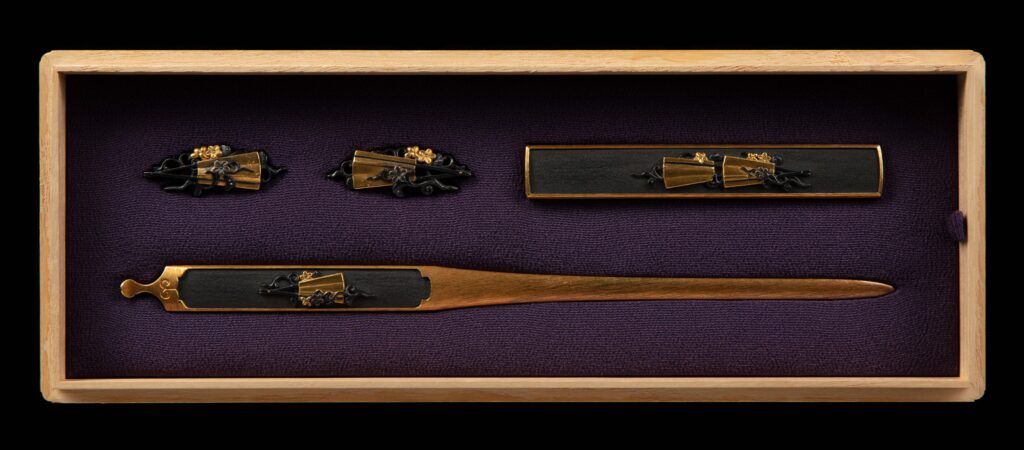
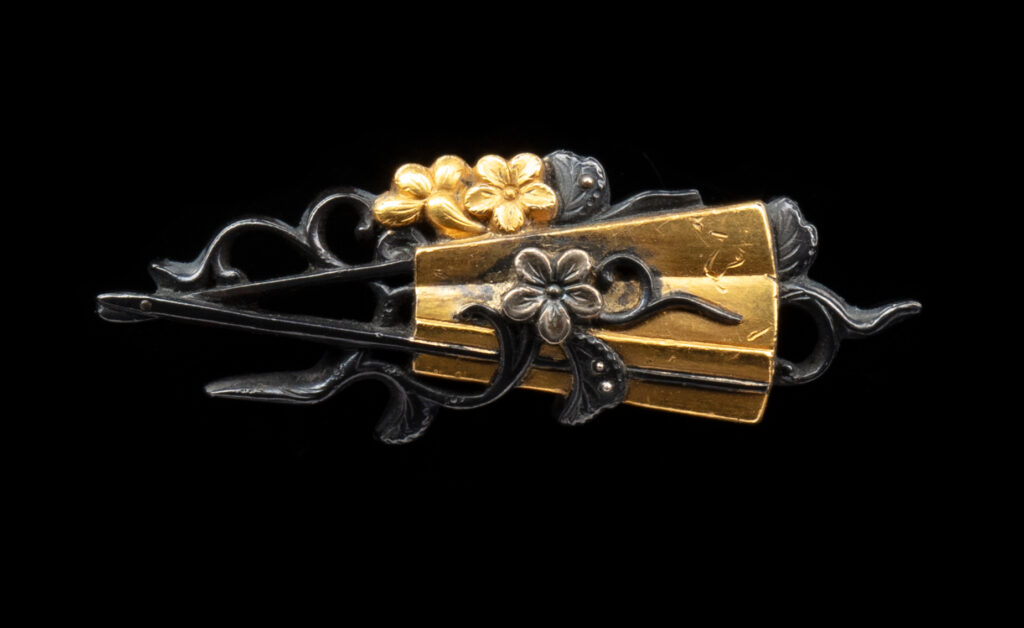
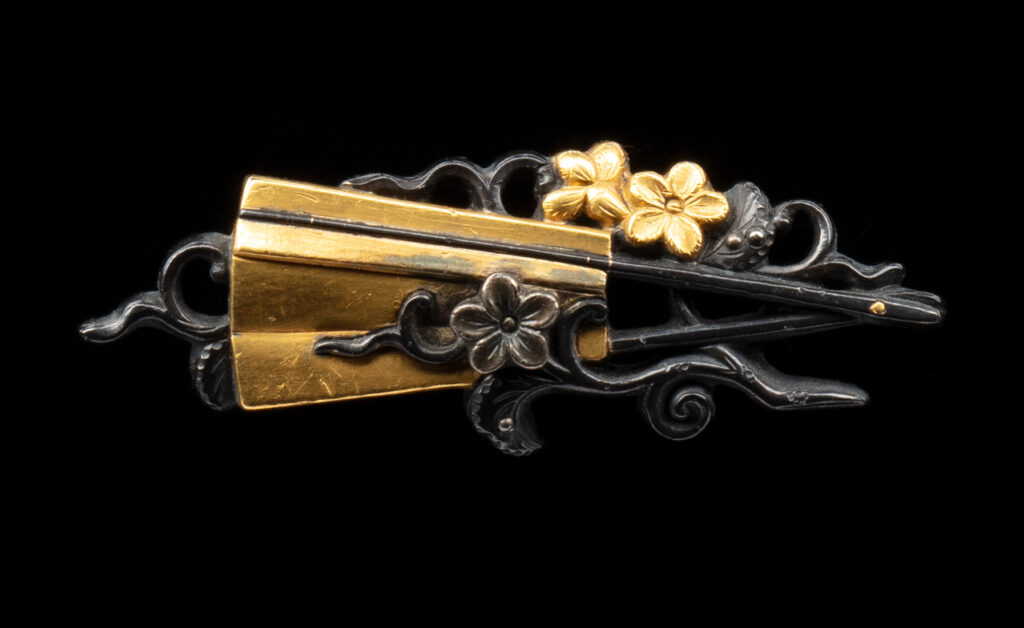
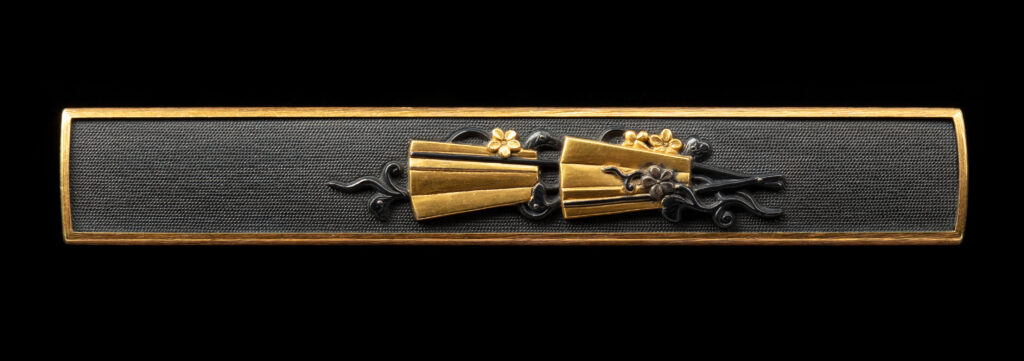
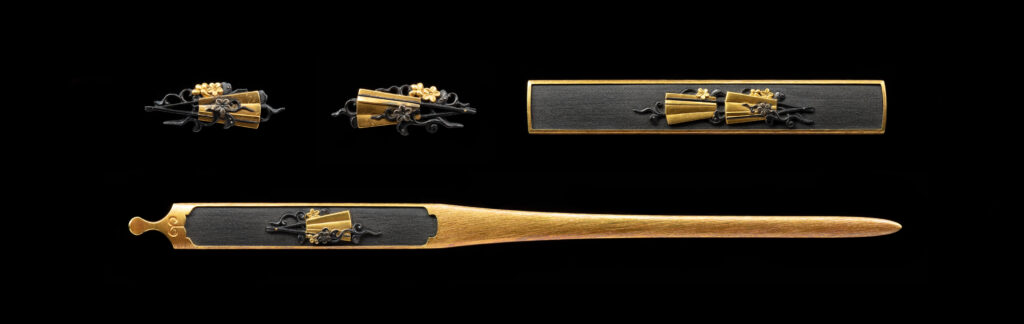
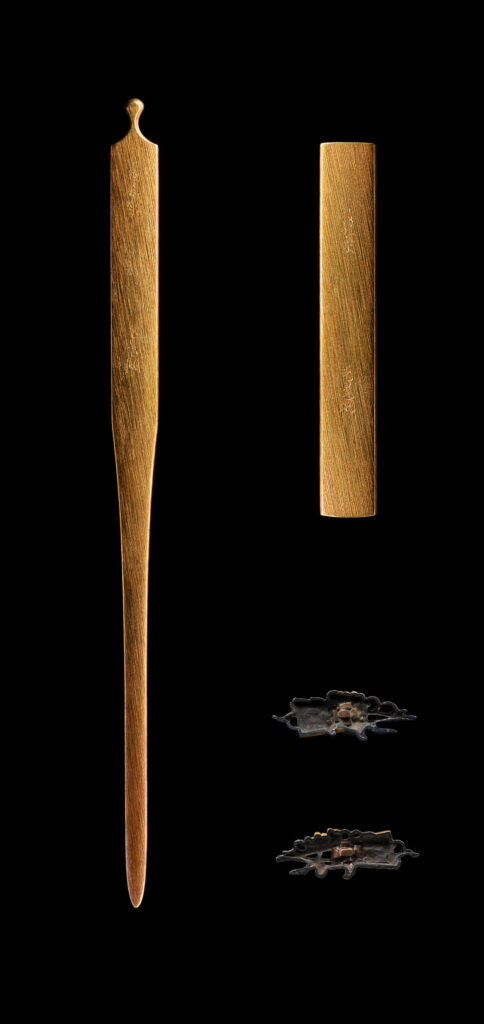
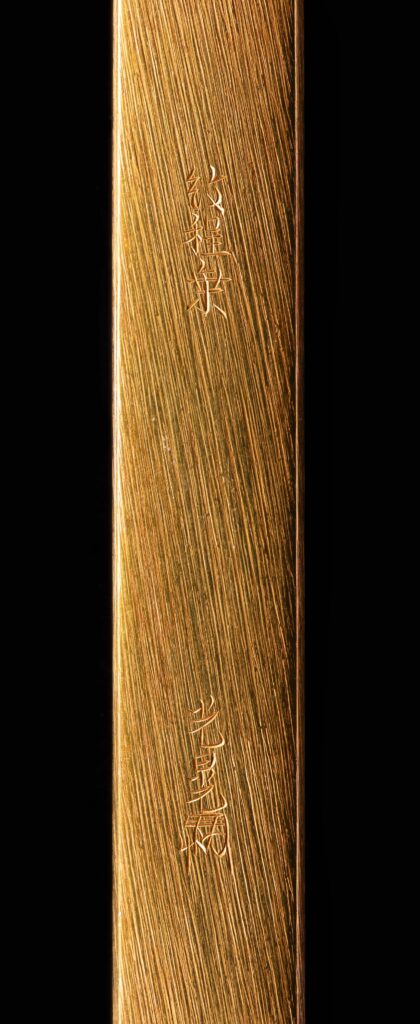
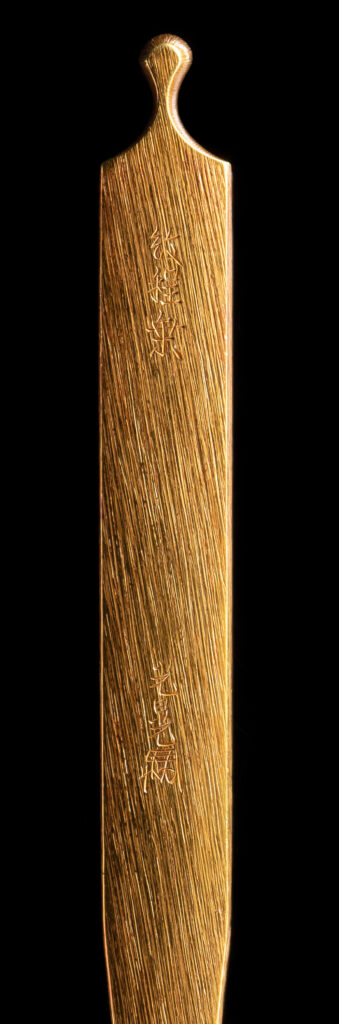
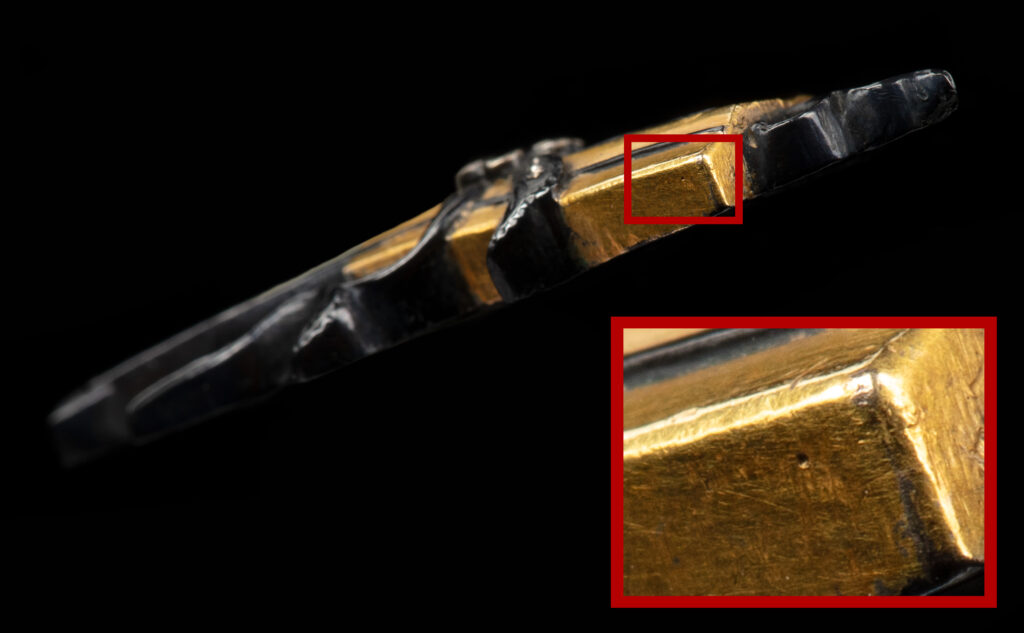
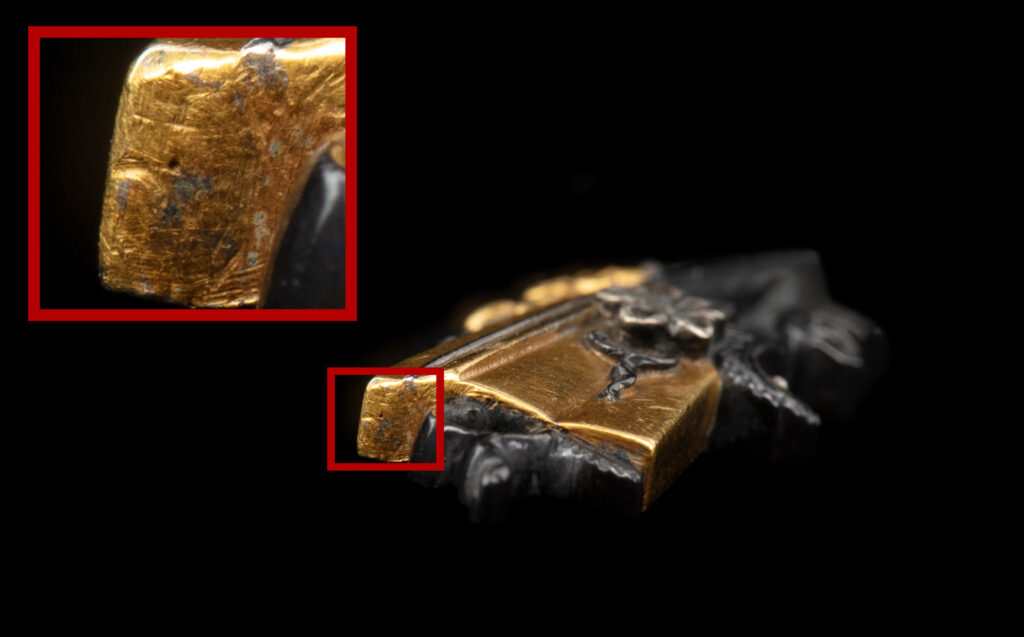
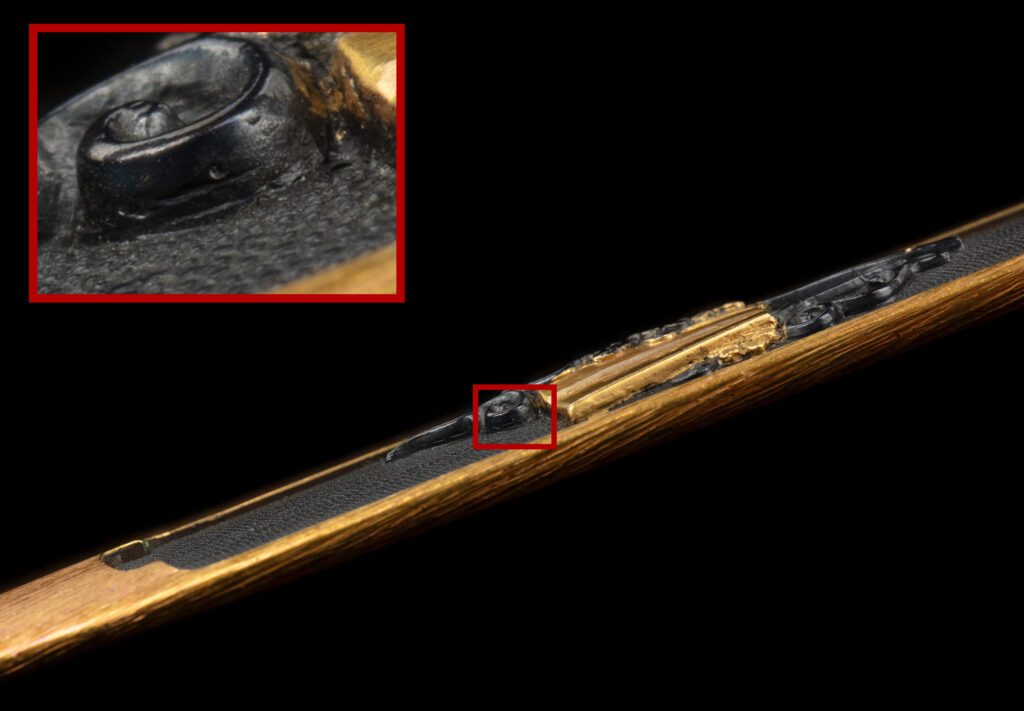
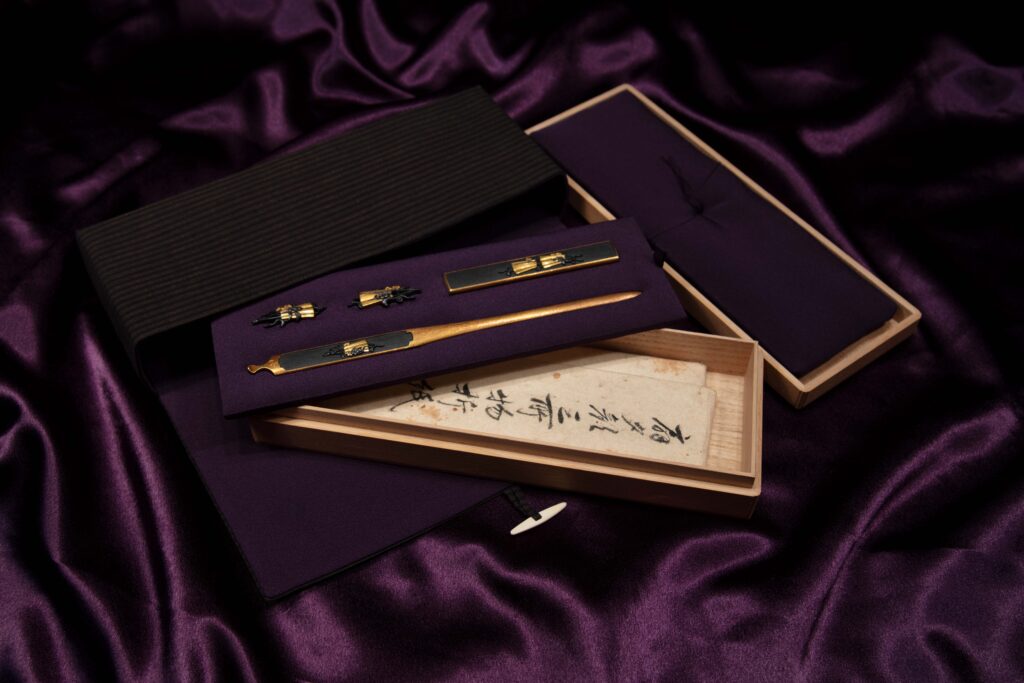
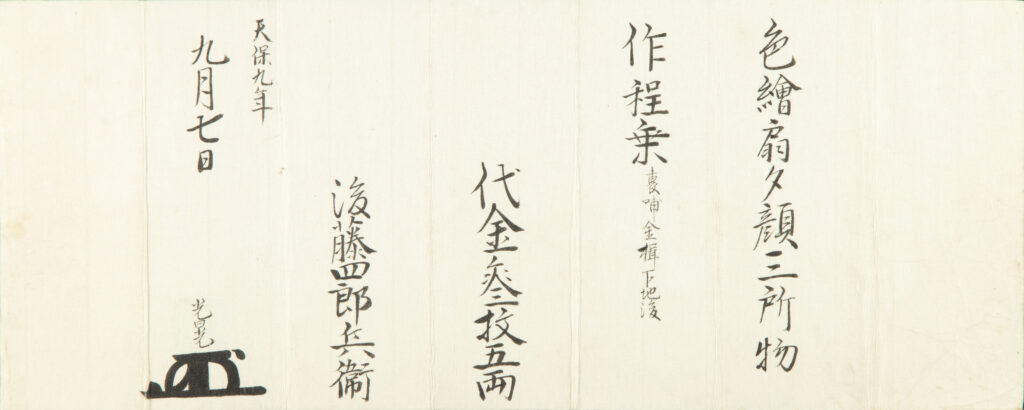
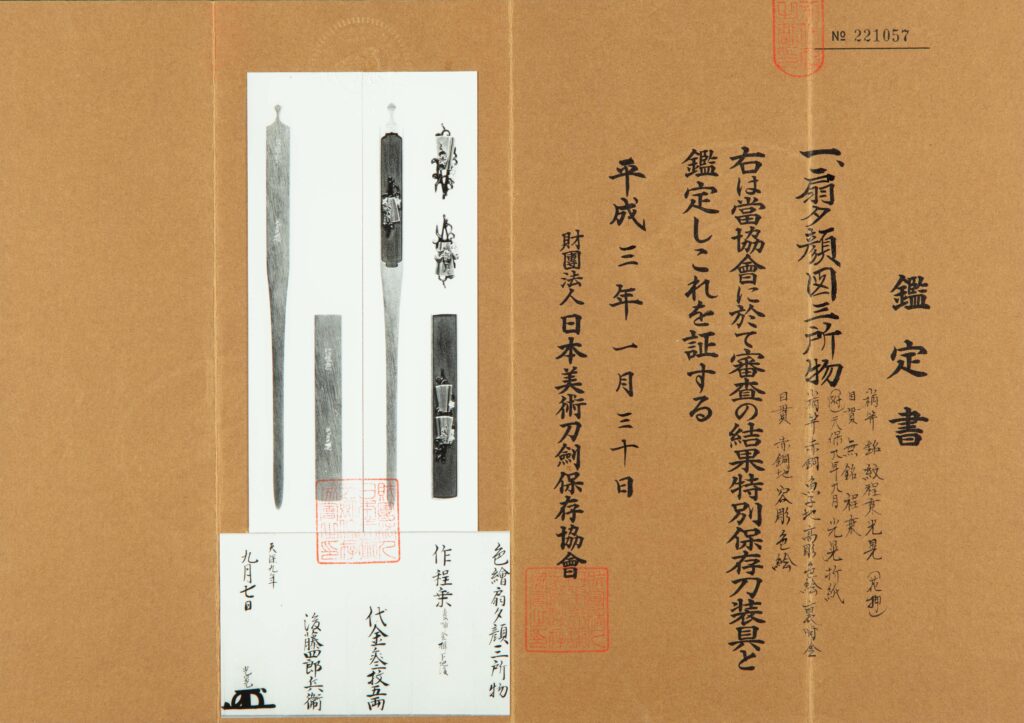
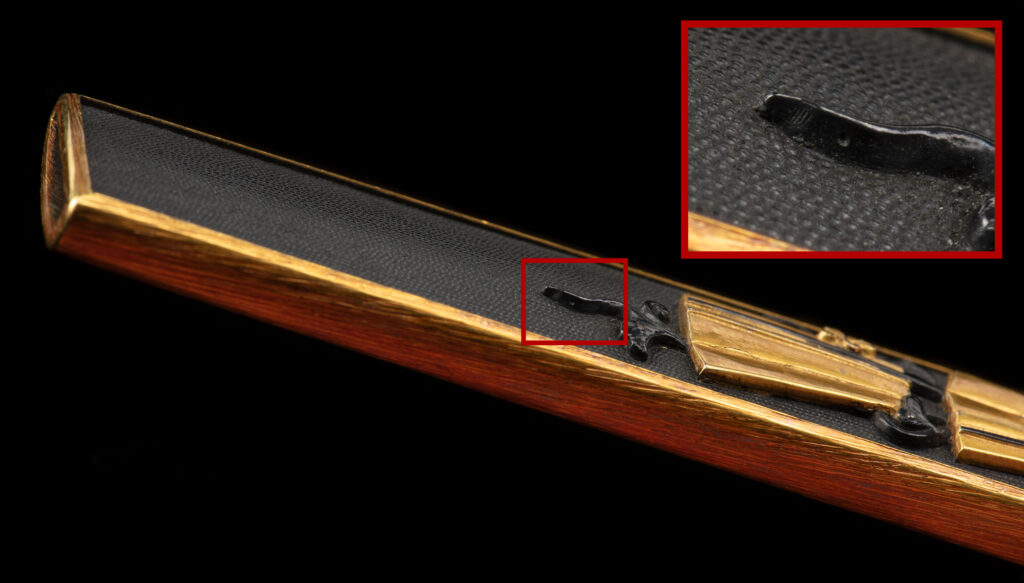
9th Mainline Shirobei Master with Origami by Goto Hojo The Goto school is preeminent in the history of sword fittings. With the establishment of the first generation, Goto Yujo to work for the Ashikaga Shogun, Yoshimasa, the hereditary mainline continued for another 16 generations until the end of the Edo period. This service to the Shogunate was also somewhat hereditary as Yujo was in the service of Ashikaga Yoshimasa and when the Ashikaga fell from power, the Goto family then turned to work for Oda Nobunaga when he had conquered more provinces of Japan. Power again transferred from Nobunaga to Toyotomi Hideyoshi, thus the Goto once again shifted their service. With the subsequent defeat of Hideyoshi and consolidation of power by the Tokugawa clan, the Goto were left in a precarious position, but were accepted as craftsmen to the Shogunate via the delicate and nimble negotiations of Goto Chojo. Goto Teijo Teijo was born in 1603. His civilian adult name was Mitsumasa (光昌), and also he went by Mitsutada (光伊). He was the oldest son of Goto Kenjo, the seventh mainline master. Kenjo had split his work locations between Kyoto, and Kaga province, and his cousin, Kakujo, also worked for the Maeda Daimyo of Kaga province. Teijo moved to Kaga at the invitation of Kakujo and was eventually retained by Maeda Toshitsune who provided him a mansion in Kanazawa. The origins of what we see as “Kaga Goto” works flow from Kenjo, Kakujo, and Teijo working under the Maeda clan. As a mainline master, Teijo also was directly employed by the fourth Tokugawa Shogun, Ietsuna. Teijo was actually not slated to be the 9th master of the school. His cousin, Sokujo (see my other listing for a Sokujo work) was the 8th master and it was his son that was the legacy. However, Sokujo died at the very young age of 32, leaving his 4 year old son far too young to assume the head of the school. Teijo assumed the position of 9th mainline master and took the boy who would eventually become Goto Renjo, the 10th mainline master, into his care. Although Teijo and Renjo are cited in some sources as “uncle” and “nephew” respectively, in following the genealogy Renjo was actually Teijo’s first cousin once removed. The developmental years of Renjo’s life were placed in Teijo’s hands and in 1646, Teijo passed the head of the line to Renjo thus establishing him as the 10th mainline master. Teijo lived and worked about another 27 years and passed away on September 17th, 1673, at the age of 71. Omote Menuki Ura Menuki Kozuka The workmanship of Teijo is everything you would expect of a Goto master. His thematics ranged from powerful and menacing to delicate and elegant. This mitokoromono (things for three places) consists of a kozuka, kogai, and a pair of menuki (the pair being considered as one the three things). The theme of folding fans with blossoms are sculpted in shakudo base metals with lustrous gold elements. There is also a small mix of silver blossoms, and even one shakudo blossom to carry more variety of colors. Each blossom is masterfully shaped and detailed with tiny incisions that invite the viewer ever closer to the work. On the leaves of the vines we can see small drops of water. Close inspection of the details confirms the nanako ground work on the jiita (ground plate) of the kozuka and kogai is carried even into the small negative spaces of the vines and fan ribs that rest upon it. The Theme It never ceases to amaze me that just about every sword fitting theme has some allusion, parable, allegory, or legendary reference that are most times illustrated in wordplay of the Japanese language, called “kotoba asobi”. The theme on this set tells us a parable with a very valuable moral lesson in the end. As the story goes, a famous warrior named Ota Dokan was traveling when he was suddenly caught out in a torrid rainstorm. As he was without a raincoat (called “mino”蓑in Japanese), he stopped at a humble farmhouse to borrow one before continuing his journey. Around this farmhouse grew an abundance of brilliant gold Yamabuki (Kerria Japonica, aka: Japanese Rose) flowers. He approached the house and a woman appeared to whom he asked if he could borrow a raincoat. The woman disappeared inside and then returned with a folding fan upon which was placed a Yamabuki blossom. She knelt before him in a deep bow, raising the fan and flower high above her head. Ota was incensed and angry that she would be so impudent to return without a raincoat, and offer him something for which he had not asked and was of no use to his need. He stormed away. Later, he remembered (or in another version of the story, he was later informed by one of his retainers) a poem that related to the lady’s offering; Nanae yae hana wa sakedomo yamabuki no mi no (mino) hitotsu dani naki zo kanashiki. The yamabuki blossoms are abundant with petals. Despite this, Sad to say They bear no fruits (straw raincoat) Waka Poem by Prince Kaneakira Goshi-Wakashu Anthology Dokan was greatly embarrassed and regretful of his actions toward the woman, and began his devoted study of poetry for his self-improvement. The words “Mi no” (実の) meaning “seed of” and “Mino” 蓑, meaning “raincoat” are central to the wordplay in the poem. By offering Ota the Yamabuki blossoms, she was striving to convey with embarrassment that while her home may have looked well-to-do from all the blossoming Yamabuki, it was actually quite poor as Yamabuki bear no fruit (i.e. no “seed”). Being so poor, they had no raincoat to offer, but did not wish to return to him empty handed. It’s a charming and lovely parable that extends a lesson of elegance and empathy. One should not be too quick to dismiss or become angry when confronted with a confusing situation, but give pause and consideration. The fans, blossoms, and water droplets (alluding to rain) on the items in this set tell a well-known story of a famous warrior, and teach us a valuable lesson in a touching, charming, and elegant manner. There is yet another layer of detail to lend even deeper interpretation to this theme which extends from the legend of the origin of the Yamabuki flower. As this legend goes, it is said there was once a person who dropped some gold coins from which sprang the bright gold Yamabuki flowers. Thus, the flower is associated with gold coins, and there are other legends that associate it with wealth and fortune. In the Edo period, the term “yamabuki iro” was used to describe the color of a gold coin. Therefore, this flower in particular, growing so plentifully around a humble farmhouse could present a subliminal impression of a wealthy household to any passersby. *My deepest appreciation to Mr. George Miller for his assistance with the identification and information of this theme. But, who was Ota Dokan? Ota Sukenaga was born in 1432, and took his Buddhist name, Dokan, in 1478. By accounts, he was regarded as a child genius. He was a vassal of a branch of the Yamanouchi Uesugi, reporting directly to Uesugi Sadamasa. In his lifetime, he successfully fought over 30 battles, and almost single-handedly saved the Yamanouchi clan from internal clan power struggles. He is a celebrated samurai in Tokyo where he was the architect of Edo castle built in 1457, which Tokugawa Ieyasu took over in 1590 at the direction of Toyotomi Hideyoshi. Today the Imperial Palace in Tokyo is built upon Ota Dokan’s Edo Castle. One part of the extensive network of moats that Dokan constructed as part of the original Edo castle can still be visited on the Imperial Palace grounds. Today it is named “Shimodokanbori” and there is a small name placard posted adjacent to it.Ota Dokan died by the spear of Soga Hyogo on the grounds of the Uesugi Sadamasa’s palace grounds in Isehara, Kanagawa, as he exited from a bath. It is likely he was assassinated at the direction of Sadamasa who was suspicious of Ota, and probably not a little bit jealous of his intelligence and the favor he was granted within the Uesugi clan at large. Kiwame – Making a decision This set of fittings is by definition “Kiwamemono” or, “things upon which a decision has been made”. For the sake of brevity and clarity, what we may also alternatively hear for “kiwame” is “appraisal”, “judgement”, or “attribution”. These three terms also somewhat describe the meaning, but for an even better understanding, the verb form, “Kiwameru” can be defined as “extending an opinion with firm purpose”, and this describes the process of kiwame by the Goto masters quite appropriately. The reason for the process is quite logical in its origin; the first four generations of Goto masters, didn’t sign their works. In fact, signatures aren’t seen until about the 5th generation, Goto Tokujo. It became the de facto task of subsequent Goto masters to “decide” on which of the prior generations of their forebears made a particular piece based on the evident characteristics and tooling. When a decision was made then it would be written onto a large piece of folded paper called an “origami” (which means oddly enough… yes, “folded paper”). The information brushed in ink would include the item, the theme, who made it, perhaps a monetary value, the date of the appraisal, and the appraisers name and monogram. This procedure is also thought to have begun in the time of the 5th master, Tokujo. But kiwame were not limited to just the evaluation of an intact old work. It also extended to restoration. When a piece was damaged, the sculpting of the main thematic could be remounted into a new kogai or kozuka frame and perhaps a new jiita (ground plated on which the sculpture was positioned). In such a case, the Goto master performing the work would sign the kozuka and/or kogai with the inclusion of the kanji “mon”(紋) above the name of the maker of the theme sculpture. “Mon” means “design” or, “pattern”. Then the repairing/appraising master would sign their own name with perhaps their monogram in a lower position on the piece as well. This maintains that the original motif was by the hand of a prior master, and remounted by the master that restored and appraised it. “Mon Teijo” “Mitsuaki” [kao] on the kozuka “Mon Teijo” “Mitsuaki” [kao] on the kogai In cases where the entire original work was appraised without remounting or repairs, then the signature would include “tsukuru” (作 also “saku”) instead of “mon”, denoting that the entire piece was original in whole to the past master of note. Oddly enough, the accompanying origami will always be written as “Tsukuru” regardless of whether the item(s) had been repaired or not. Go figure… I’m still working on the “why” for that, but it probably has to do with mandates in the Goto traditions of writing the origami. But wait, there’s more…… Kiwamemono can also include secrets; very small and difficult to see punch marks made in discrete locations on each piece to denote that the piece had been previously seen and appraised in its past. It’s my understanding (which is to say I need to verify the info I was given regarding this) that when an item was appraised and marked, the item was described and recorded into a master log, along with a notation of where the mark was made on the item. This served to securitize the process a bit from outside fraud. Unfortunately, the master logs have been lost to time and we have to rely on an entirely modern process of evaluation to authenticate both the items and their oshigata; shinsa. This set carries both the kiwame tagane (appraisal marks) and origami written by the 16th Goto master, Hojo. Kiwame Tagane on the Omote Menuki Kiwame Tagane on the Ura Menuki Kiwame Tagane on the Kozuka Origami written by Goto Hojo Dated September 7th, 1838 Goto Hojo was born in 1816, assumed headmaster of the Goto school at 19 years old, and died in 1856. He wrote these papers when he was 22 years old. His living name was Mitsuaki (光晃) which is sometimes pronounced incorrectly as the kanji are “mitsu” and “akira”, but are properly read “Mitsuaki”. He received his art name, Hojo, posthumously. NBTHK Tokubetsu Hozon Tosogu Certificate Dated January 30th, 1991 This set also holds a Tokubetsu Hozon Tosogu certificate from the NBTHK declaring its quality, condition, and authenticity and includes an image and notation of the Goto Origami, which binds the papers to the set, and declares their authenticity as well. This is a lovely and historic set and will grace any collection. It is held in a custom made box which also has a premium custom made shifuku (fabric slip cover).
Offered by Legacy Swords
10 on the market


Goto Teijo
Edo
Tokuho
Iebori · Yamashiro · around 1603-1673
10 pieces on the market now
Gotō Teijō (程乗), whose personal name was Mitsumasa (光昌), was the ninth-generation head of the Gotō main line (sōke) and a pivotal figure in the transition of the house's metalwork tradition into the early Edo period. Born in Keichō 8 (1603) as the second son of the seventh head Kenjō (顕乗), his childhood name was Gen'ichirō. In Kan'ei 1 (1624), when his father Masatsugu took the tonsure and assumed the art name Kenjō, Teijō succeeded as the second head of the Rihei branch house, changing his name to Rihei Mitsumasa. When the eighth head of the main line, Mitsushige (Sokujō), died at the young age of thirty-two and his heir Kameichi was still only four years old, Kenjō temporarily assumed responsibility for the main line, after which Teijō inherited the position as ninth head. He served as guardian to the young tenth head Renjō, transferring the headship when Renjō reached eighteen and continuing as his protector until he turned twenty-five. Teijō also served the Kaga Maeda house, alternating by year with Enjō, a son of Kakujō, and in this way made a major contribution to the development of the refined culture supported by Kaga's "million-koku" domain, where his influence established what became known as the Kaga-Gotō lineage.
Teijō's work is executed predominantly in shakudō nanako-ji grounds with takabori relief carving and polychrome iroe employing gold and silver, though he also produced pieces on solid gold (kinmuku) grounds of exceptional sumptuousness. His carving manner is characterized by a calm, restrained temperament and fine precision[[c:1]]; the chisel work varies freely between measured and rapid passages, and the modeling of forms is full yet taut. He is noted for achieving distinctive coloristic effects through the purposeful deployment of irogane such as silver and copper. His menuki display powerful yōbori rounded relief with pronounced variation in height and depth, and his kozuka and kōgai are consistently finished with gold-backed reverse plates (kin'ura). While Teijō carefully preserved the Gotō house's hereditary design vocabulary -- dragons, lions, and tigers rendered with the sculptural fullness and expressive modeling characteristic of the main line -- he also incorporated novel themes including literary and historical narratives such as the Rashōmon legend, scenes from the Tale of Genji, and the Oxherd and Weaver Maiden, as well as uncommon subjects such as anchors and the rare one-horned dragon, a motif of imperial rank.
Teijō's output spans the full range of tōsōgu forms, including mitokoromono, sanshōmono, and nisomono sets as well as individual kozuka, menuki, and tsuba. His fittings also appear integrated into formal koshirae mountings of the highest order, including ito-maki tachi transmitted in the great Tokugawa houses. Numerous works bear origami appraisals and authentication inscriptions by later Gotō masters -- the tenth head Renjō, the thirteenth head Enjō Mitsutaka, and the fifteenth head Shinjō Mitsuyoshi among them -- attesting to the esteem in which his production was held within the house's own critical tradition. Several important pieces are recorded as having been handed down in the Kōnoike family, the wealthy Osaka merchants, further demonstrating the regard accorded to his work among the most discriminating collectors of the Edo period. As the master who bridged the Gotō main line's Kyoto heritage and its new role serving the Kaga domain, Teijō occupies a position of particular consequence in the history of the house, and his works consistently manifest the elevated dignity that defines mainline Gotō metalwork at its finest[[c:2]].
Where Goto Teijo stands among comparable artisans: across all of nihontō, and within tradition, era, and period. The tiers (Foremost · Leading · Major · Notable) weigh official designations from the NBTHK and Japan's Agency for Cultural Affairs, together with historical honors of lasting repute such as the Sansaku and Meibutsu-chō.
Select a lens to see how it's measured.
Iebori · Yamashiro
Phase: Goto Main Line後藤宗家· 1573–1900
317 pieces on the market now
| Smith | Era | Designated |
|---|---|---|
| Goto Joshin後藤乗真 | 1512-1562 | 68 |
| Goto Yujo後藤祐乗 | 1440-1512 | 41 |
| Goto Kenjo後藤顕乗 | 1586-1663 | 46 |
| Goto Sojo後藤宗乗 | 1461-1538 | 56 |
| Goto Teijo後藤程乗 | 1603-1673 | 42 |
A Hozon-certified blade judged to show notably superior workmanship and a better state of preservation. The bar is higher: re-tempered blades and most unsigned Muromachi/Edo works are excluded.
The NBTHK (Nihon Bijutsu Tōken Hozon Kyōkai, the Society for the Preservation of Japanese Art Swords) is a public-interest incorporated foundation founded in 1948 and supervised by Japan’s Agency for Cultural Affairs (Bunkachō); it is based at the Japanese Sword Museum in Tokyo. Its expert panels physically examine each submitted work (shinsa) and issue a certificate (kanteishō) ranking it by artistic and historical merit. NBTHK papers are the most widely recognized standard of authentication for Japanese swords and fittings.
NBTHK official site$12,500
Certificate reading — 無銘(程乗)