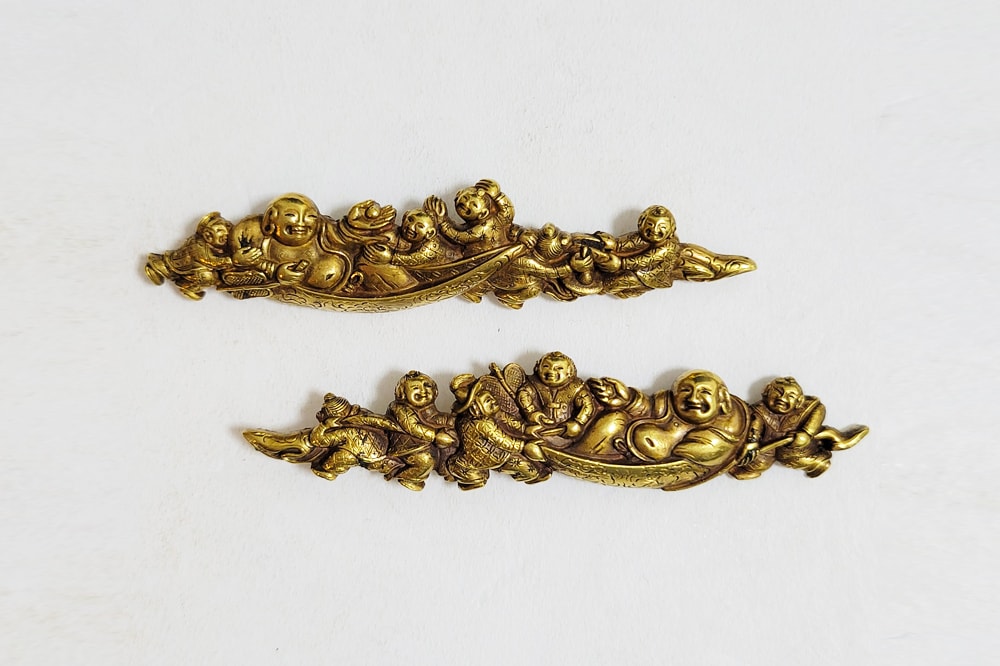
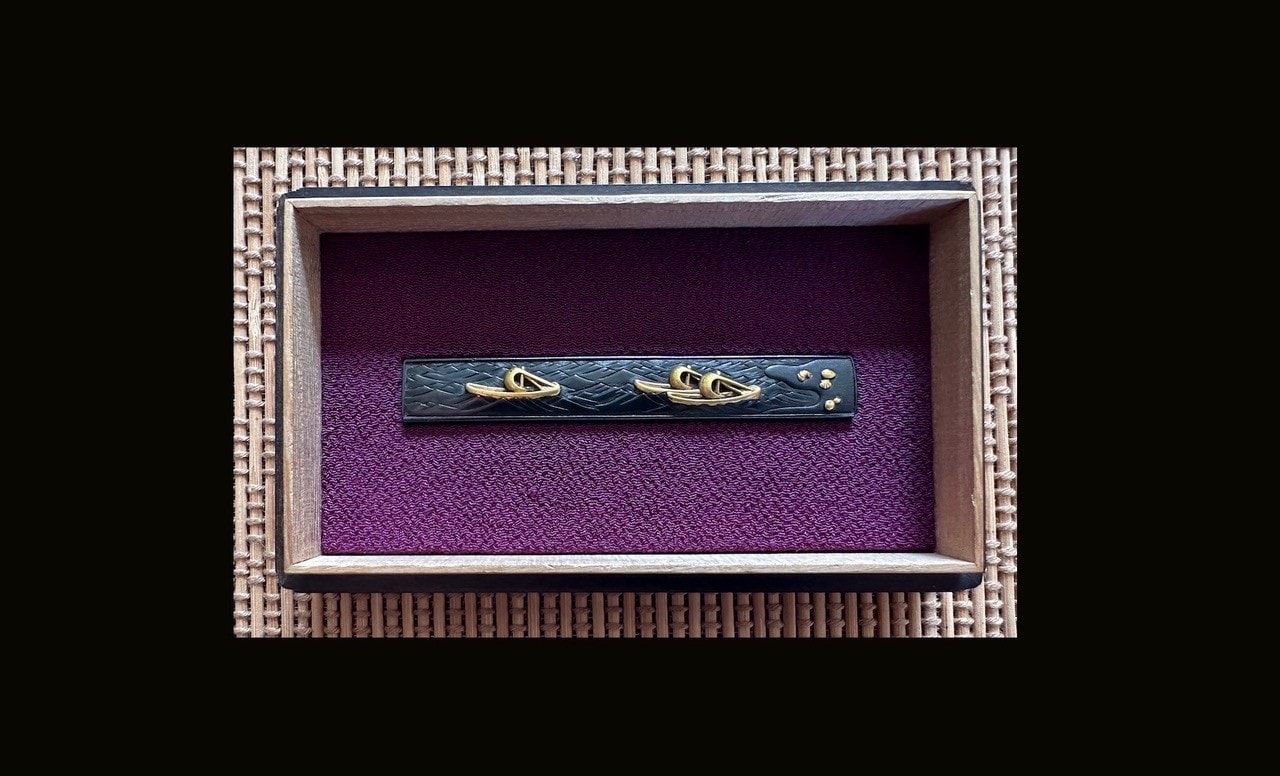
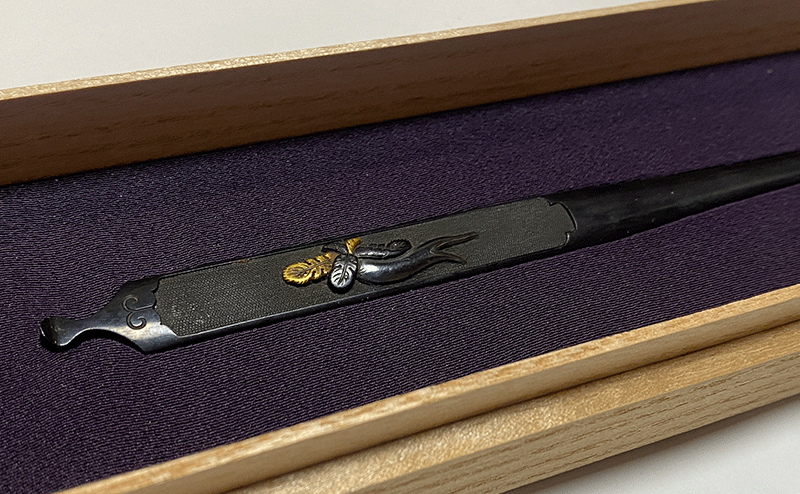
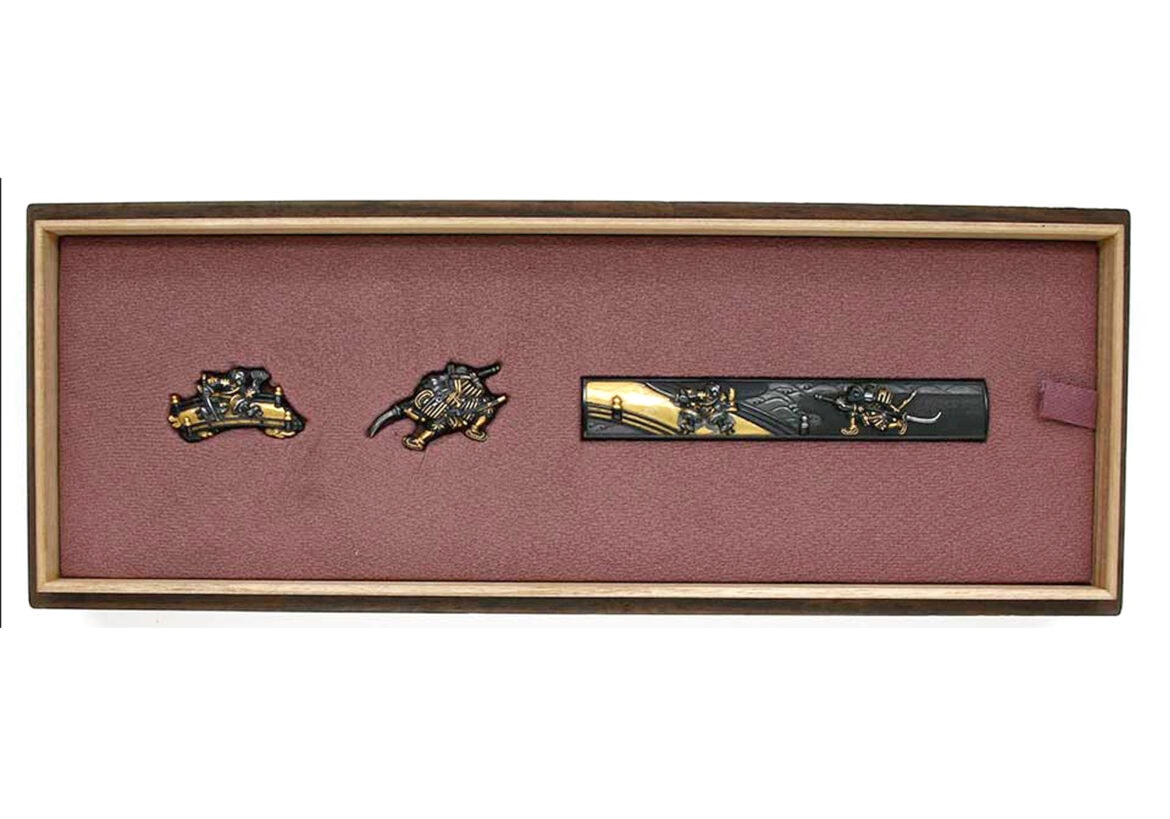
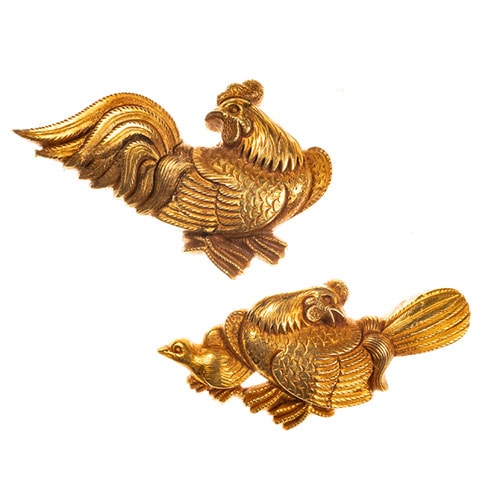
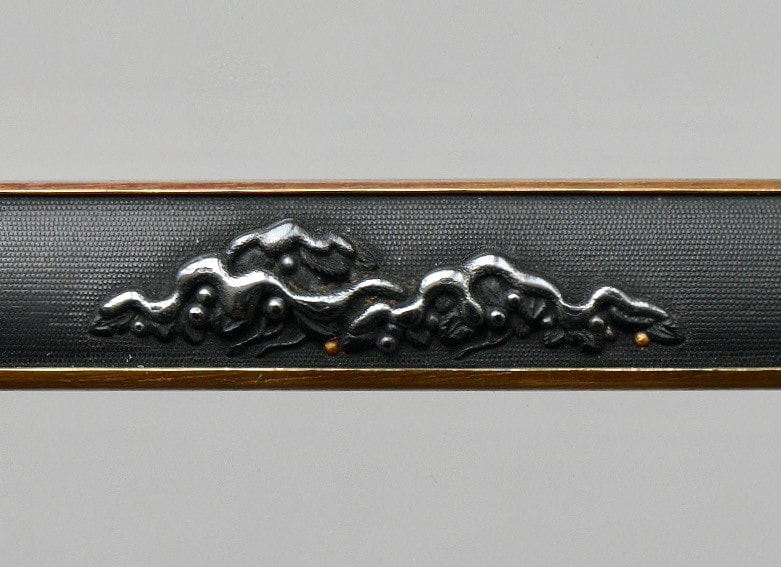
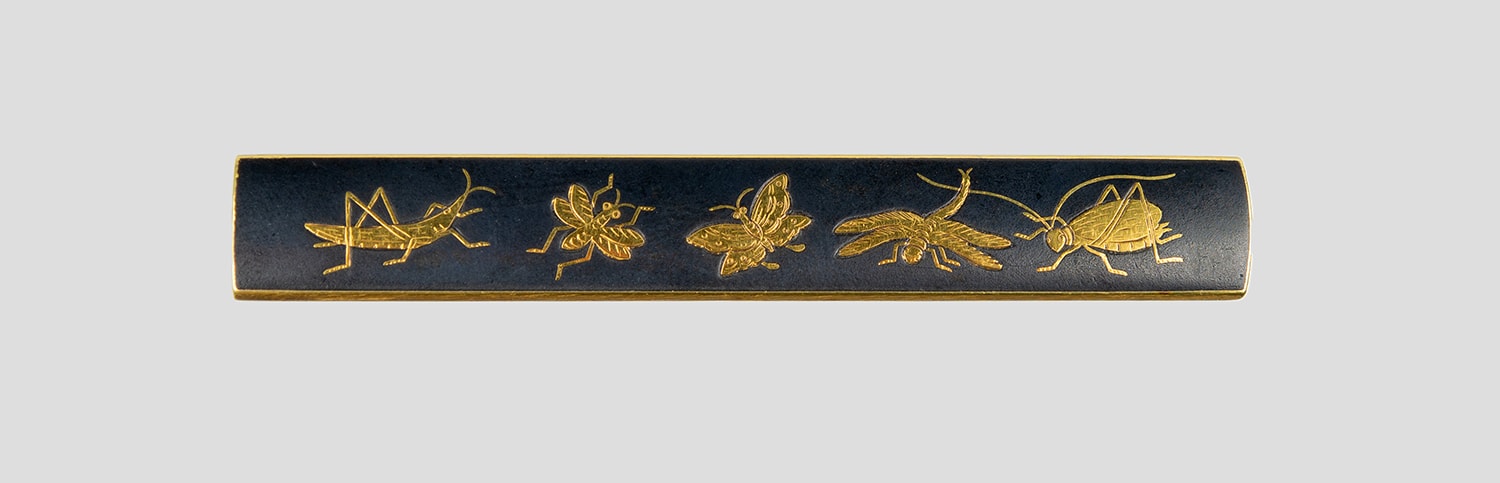
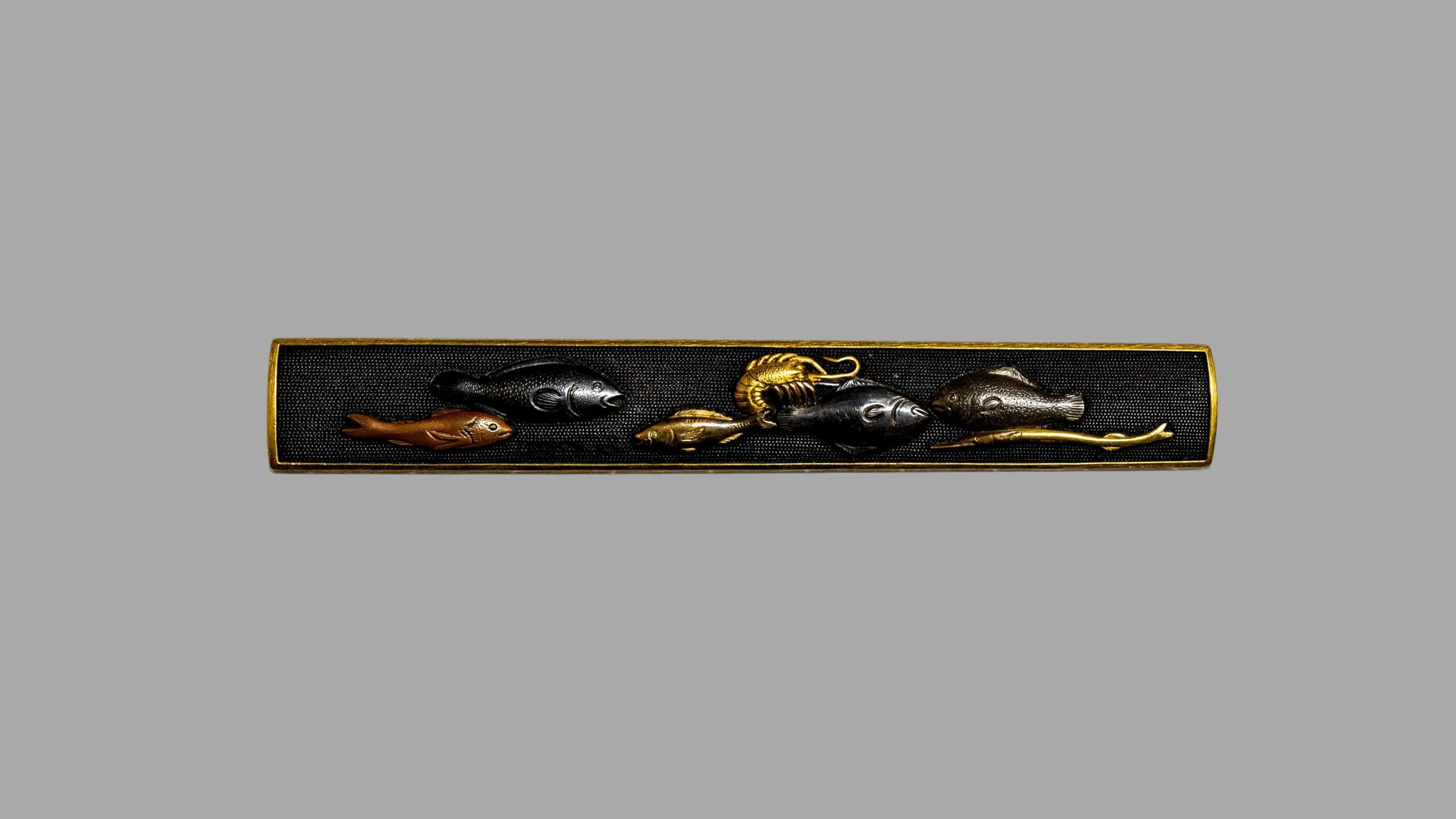
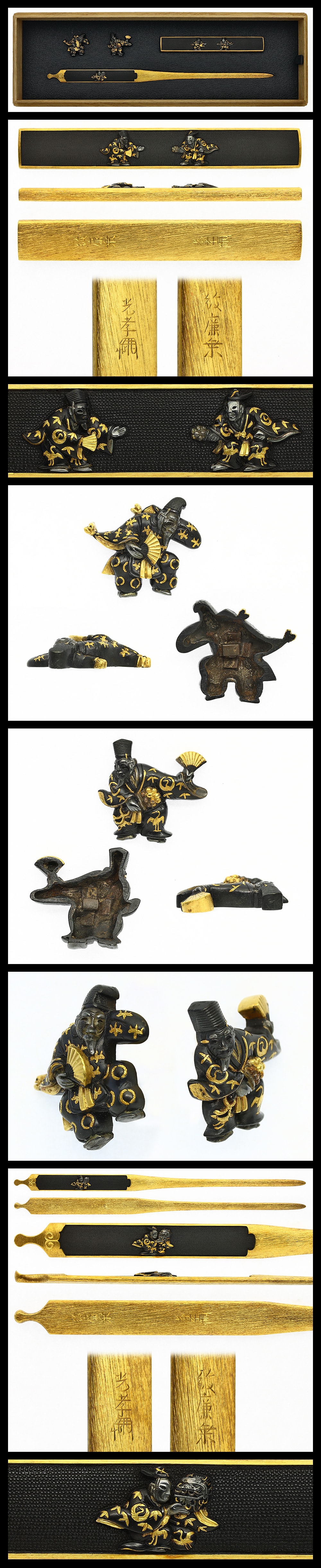
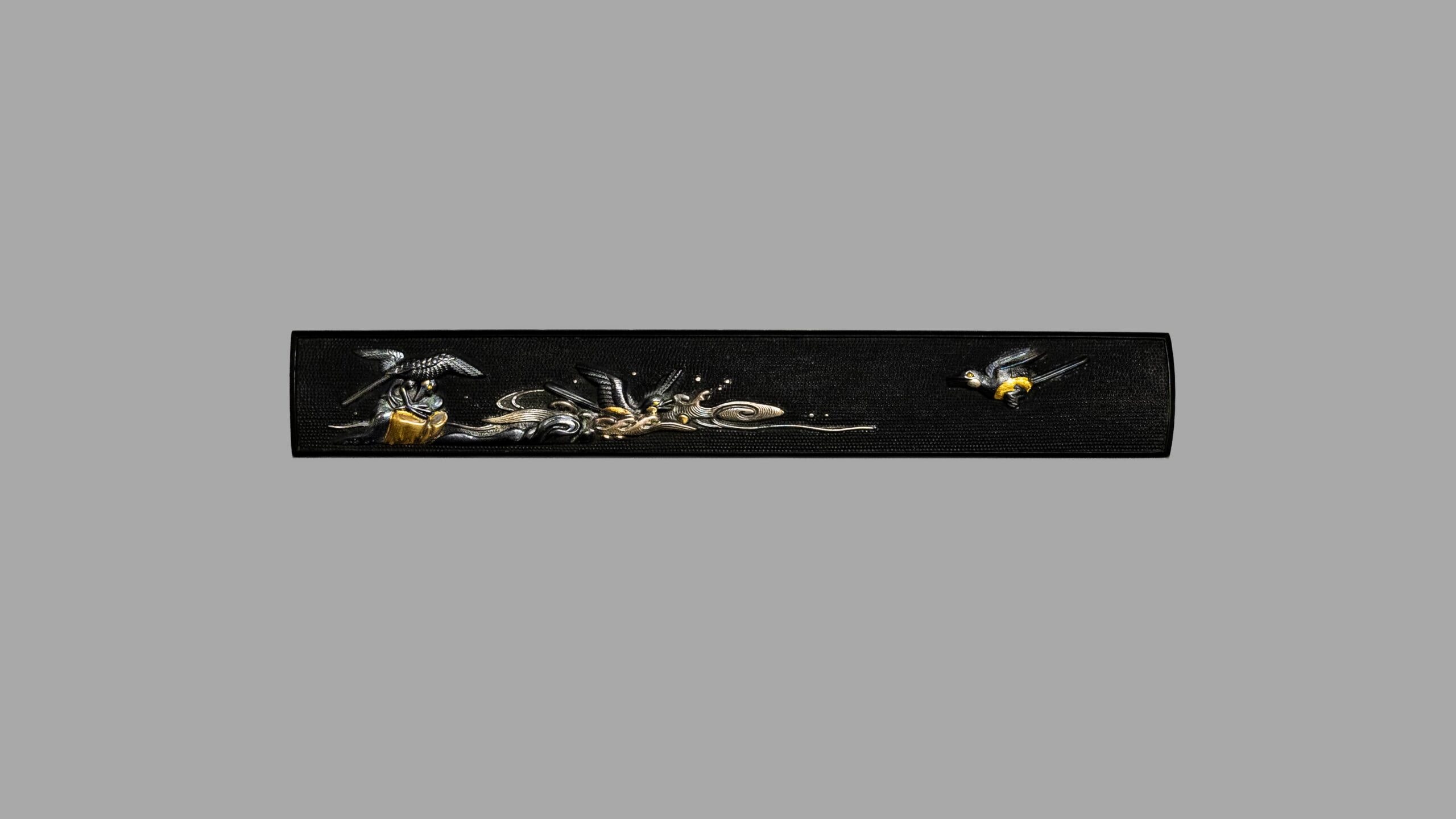
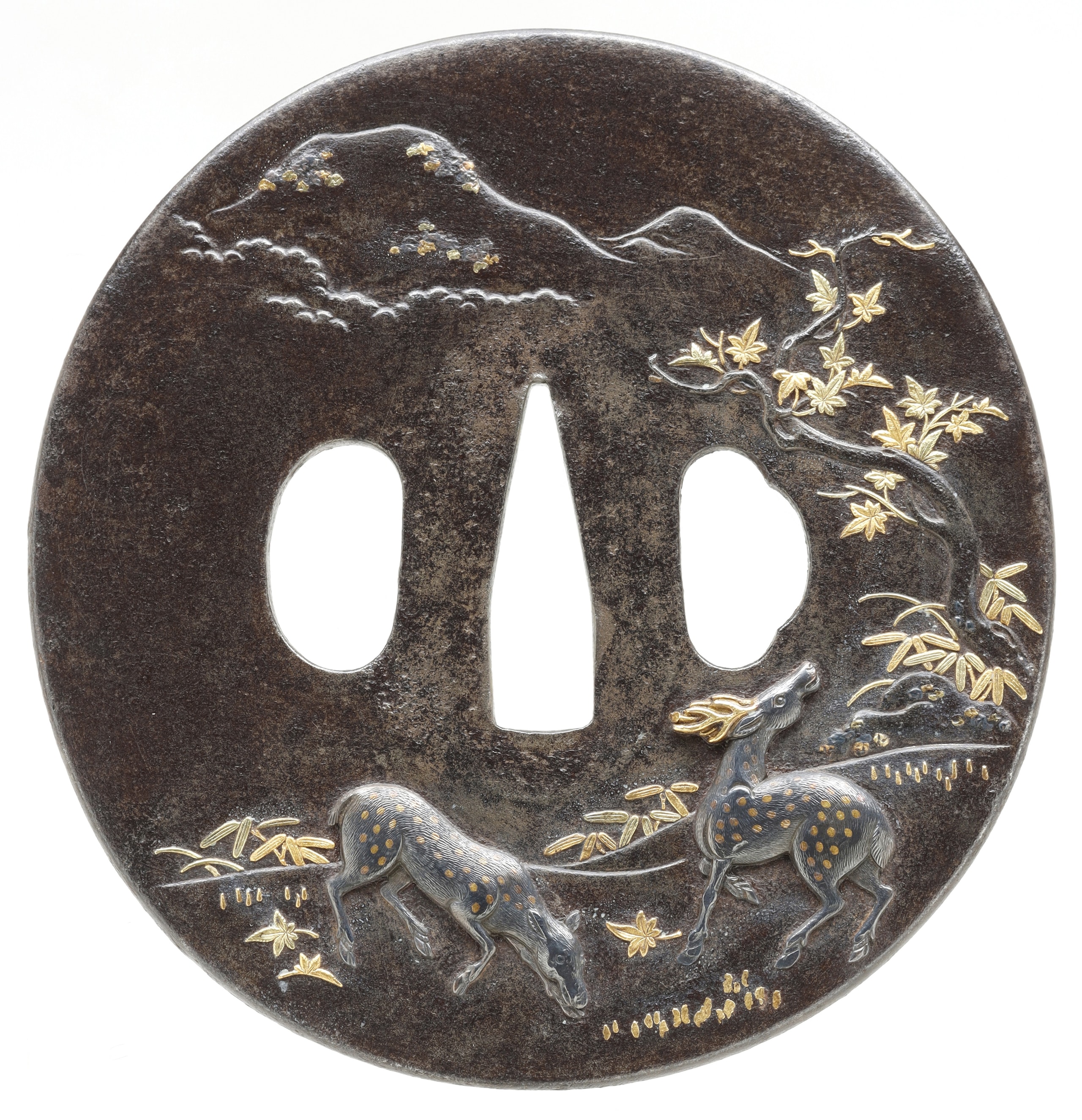
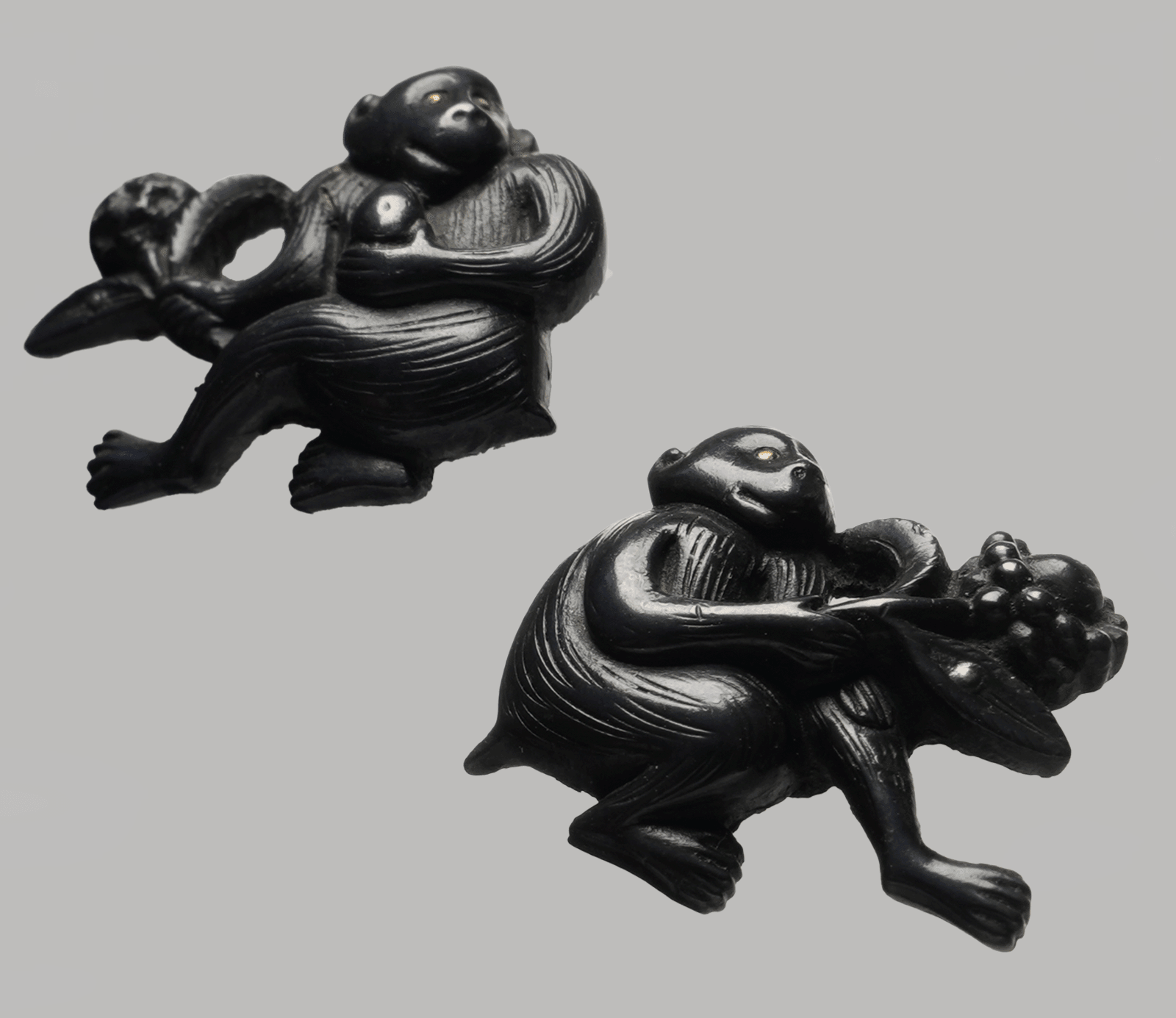
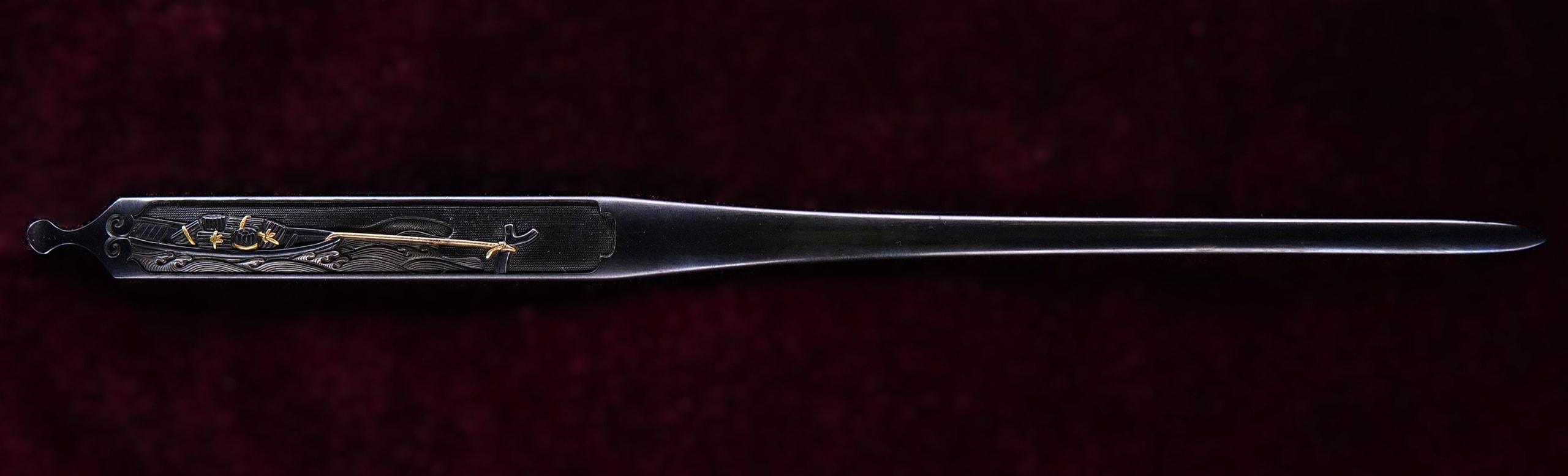
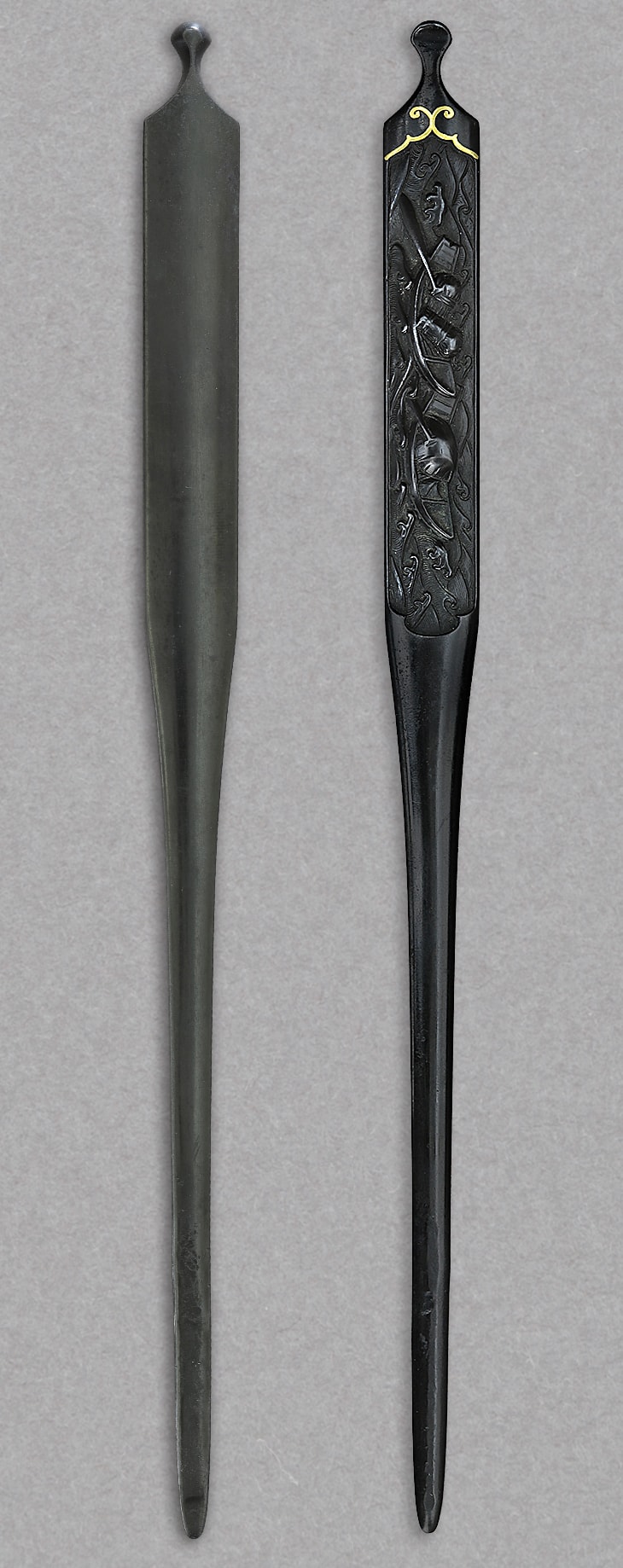
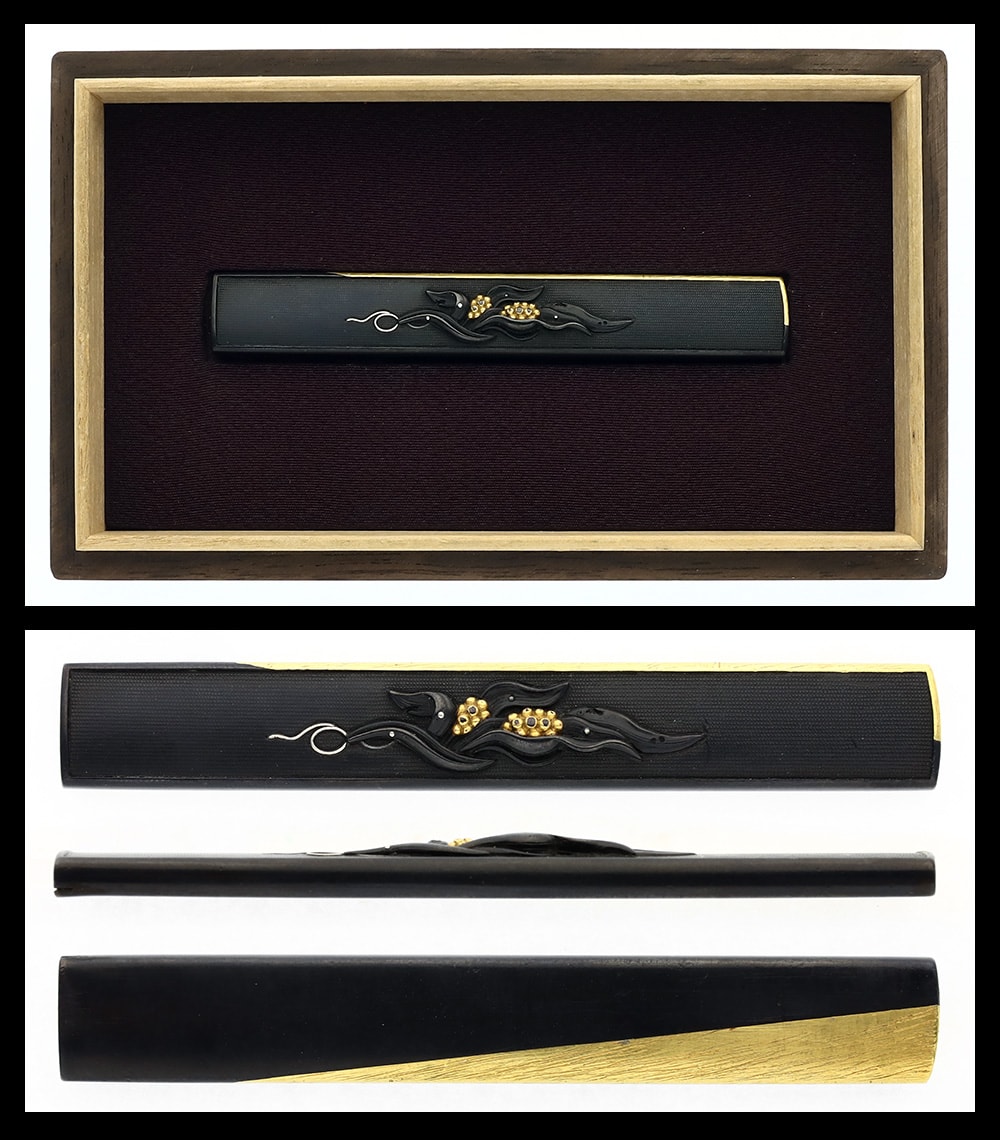
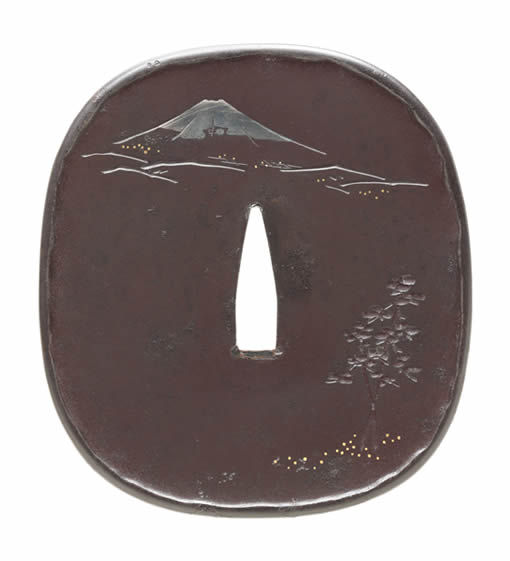
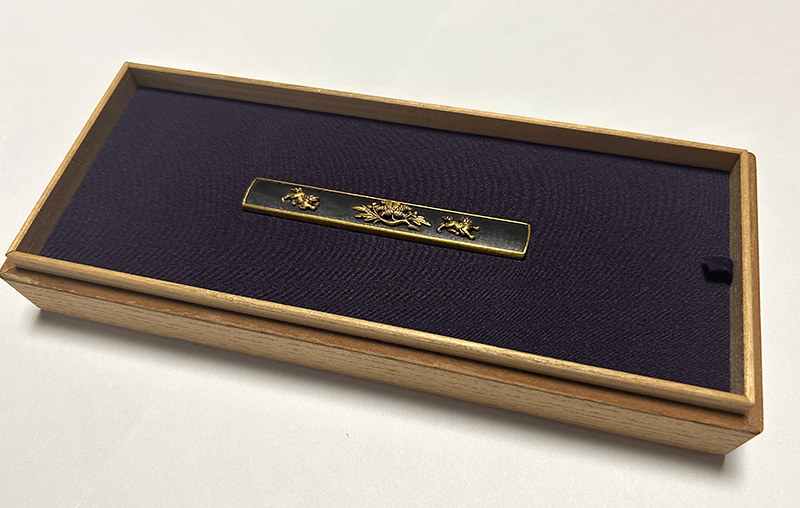
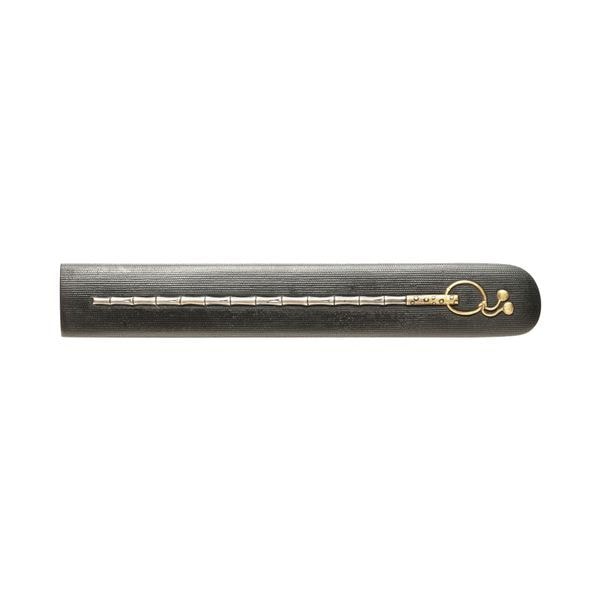
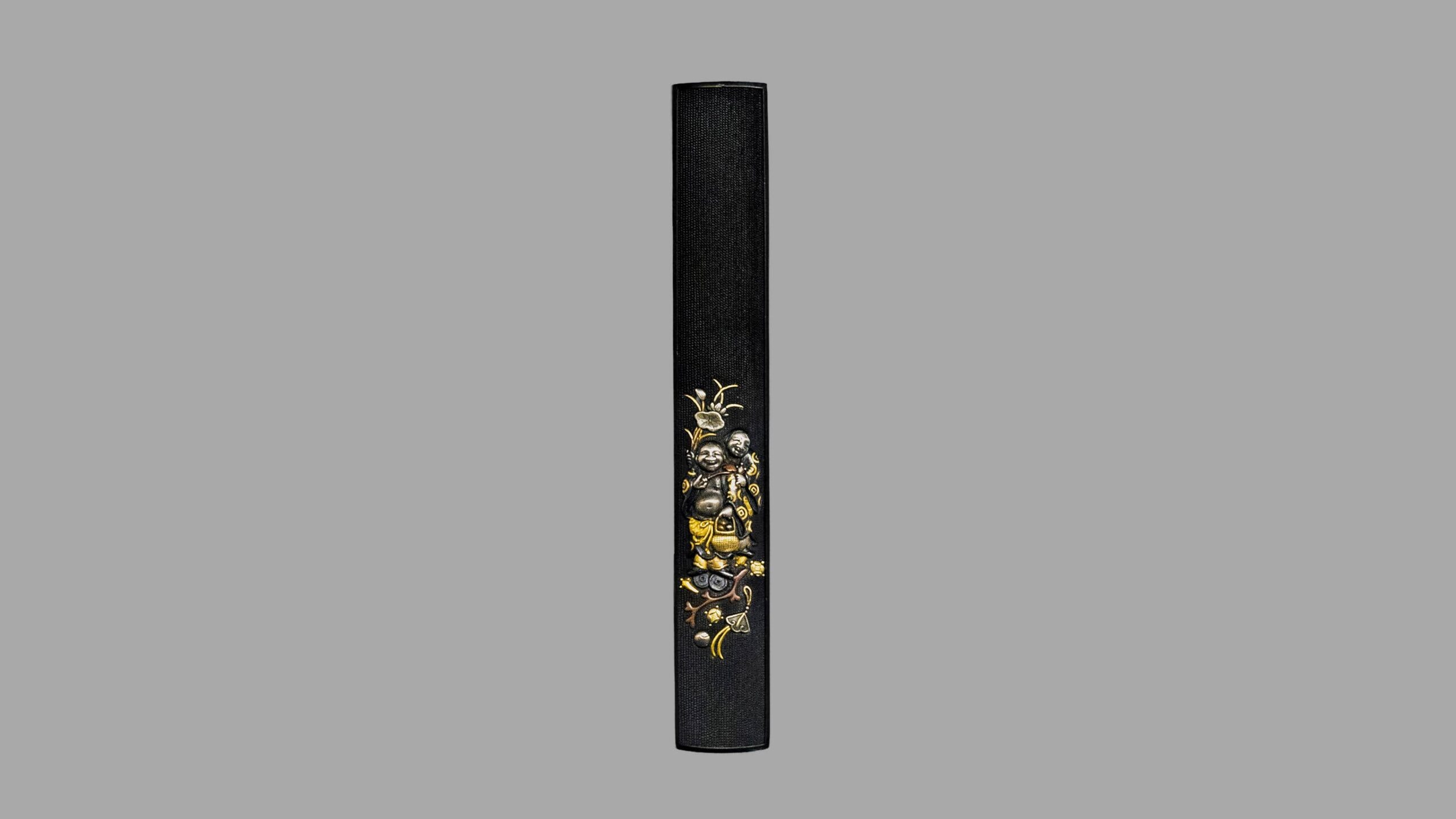
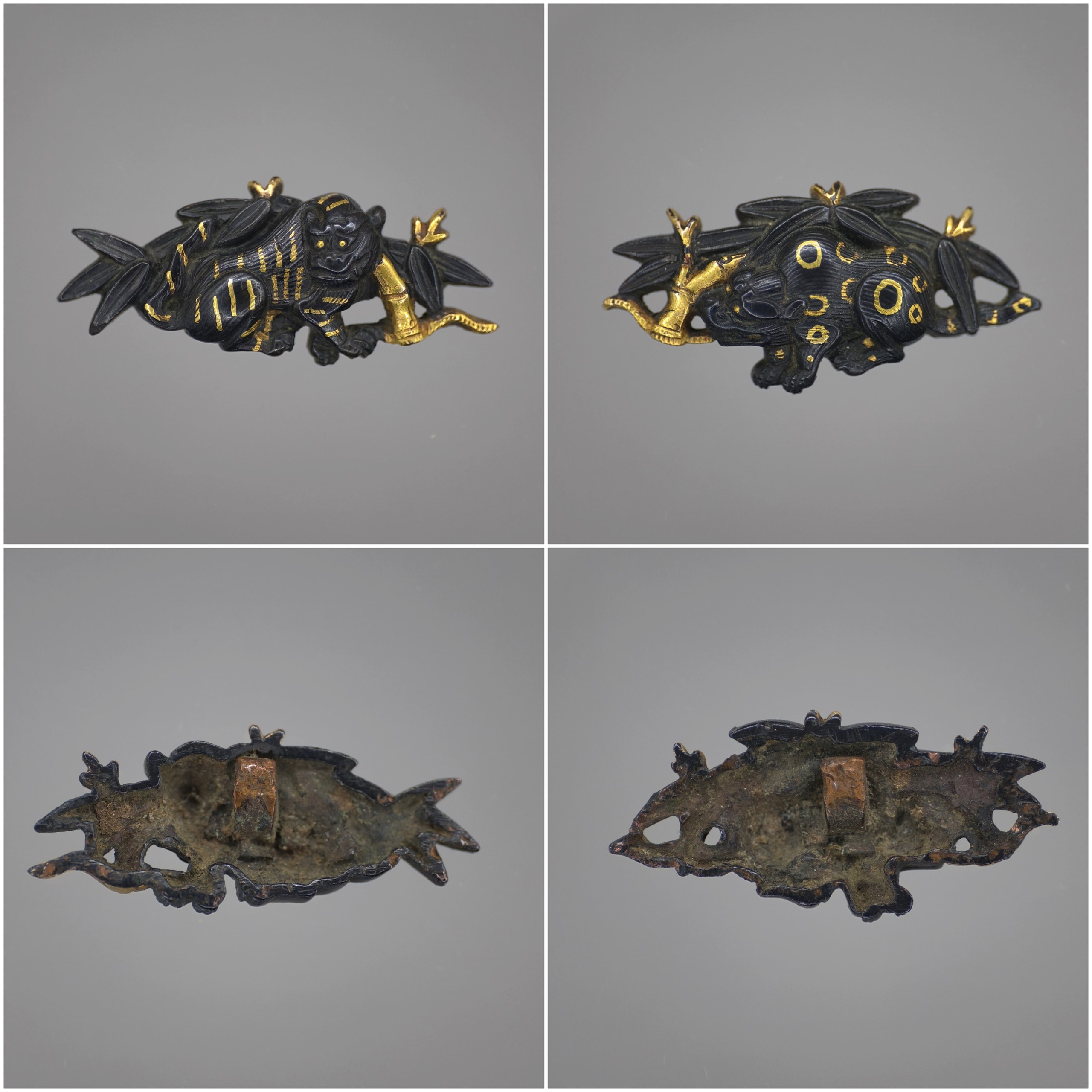
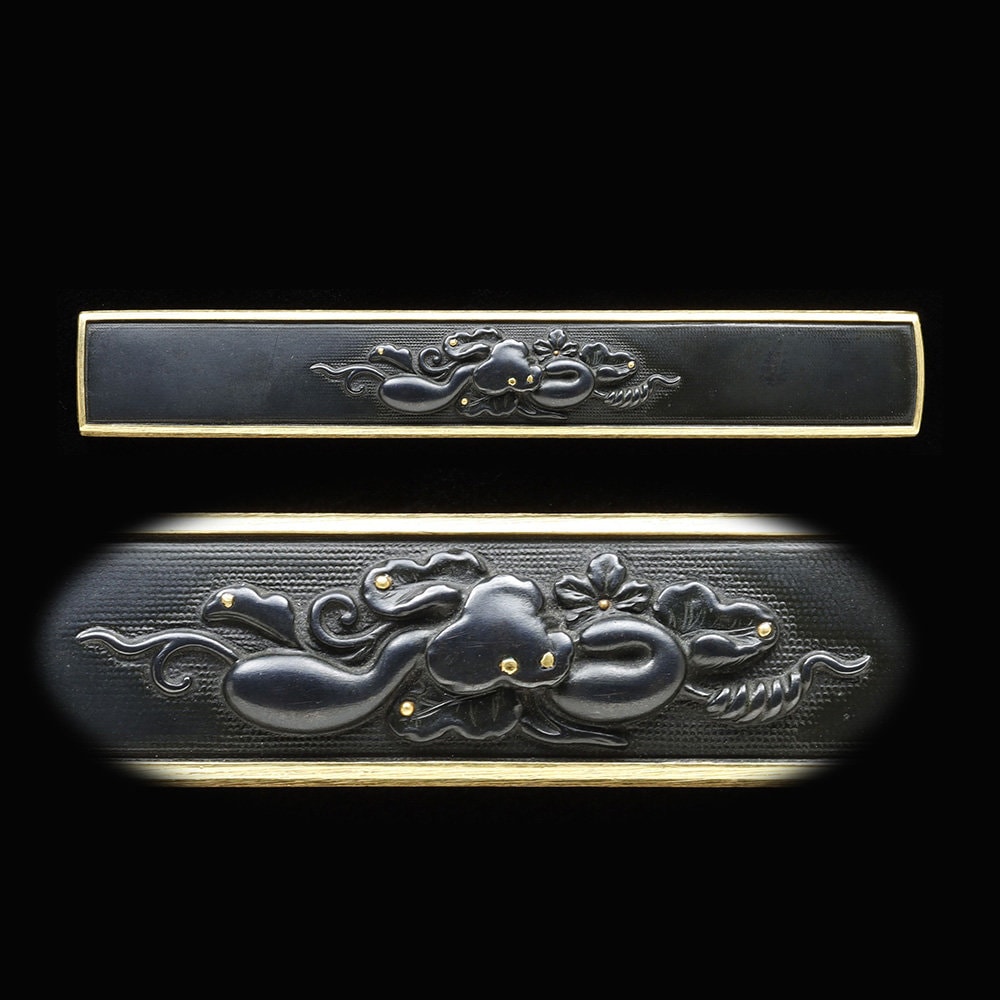
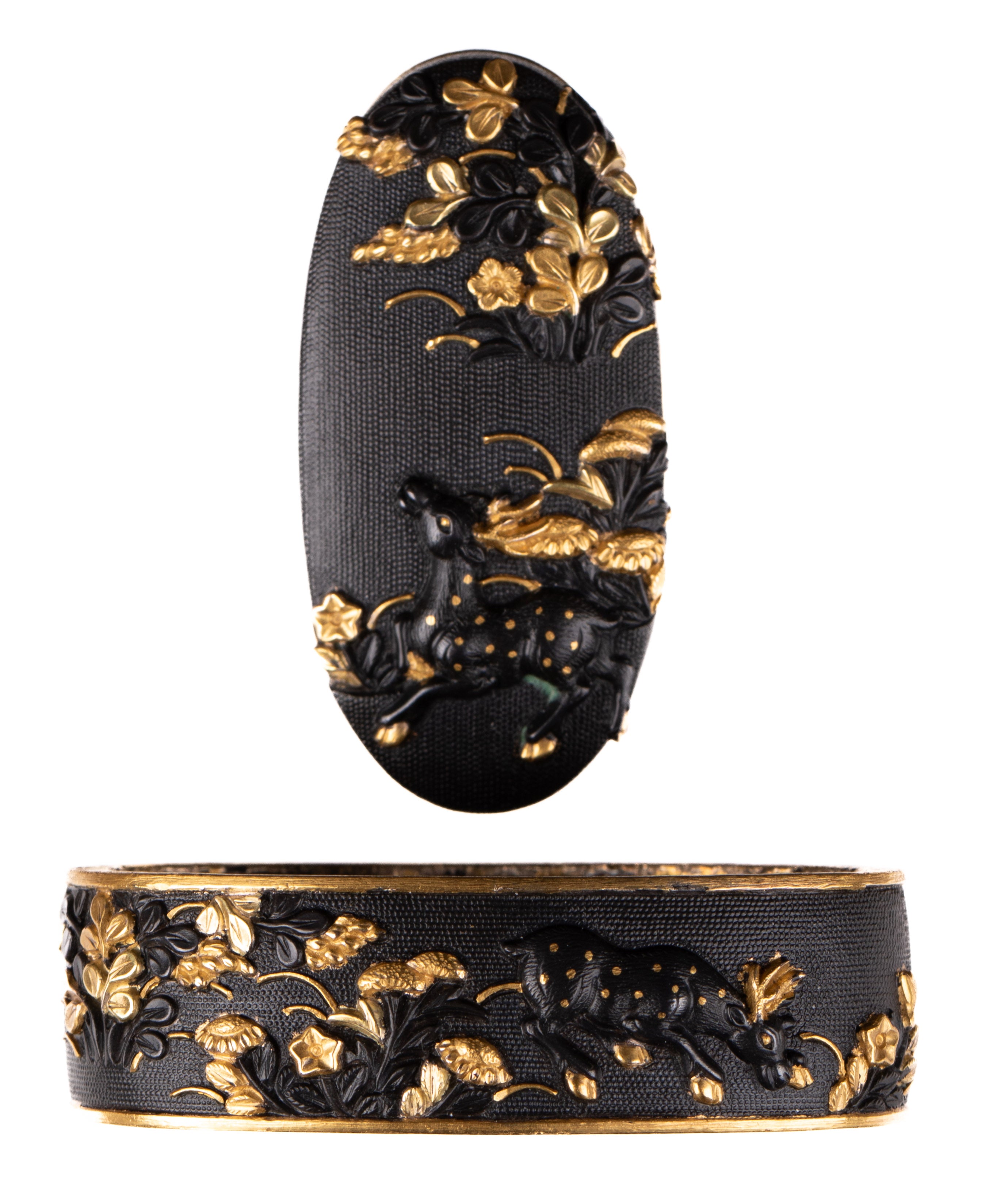
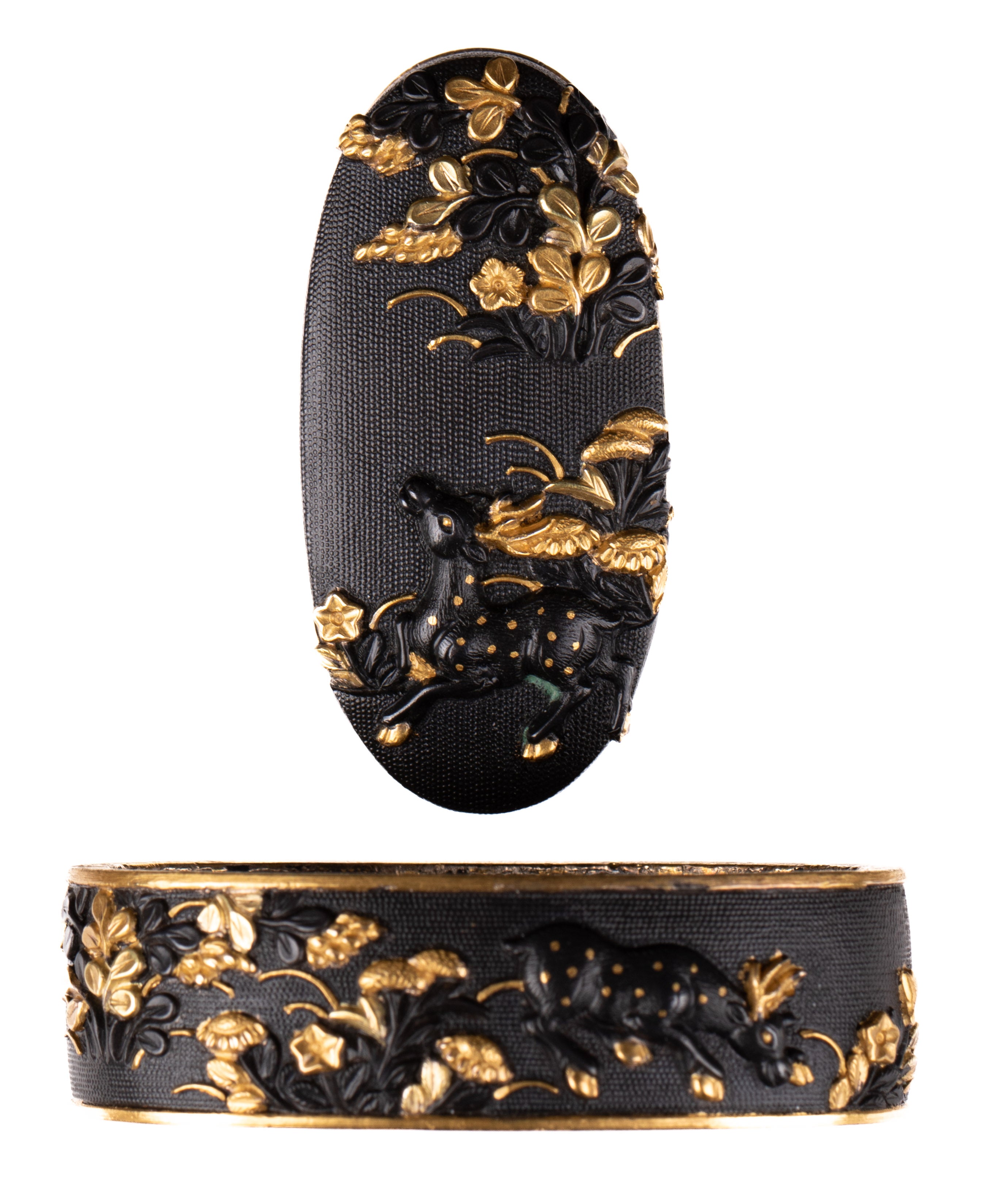
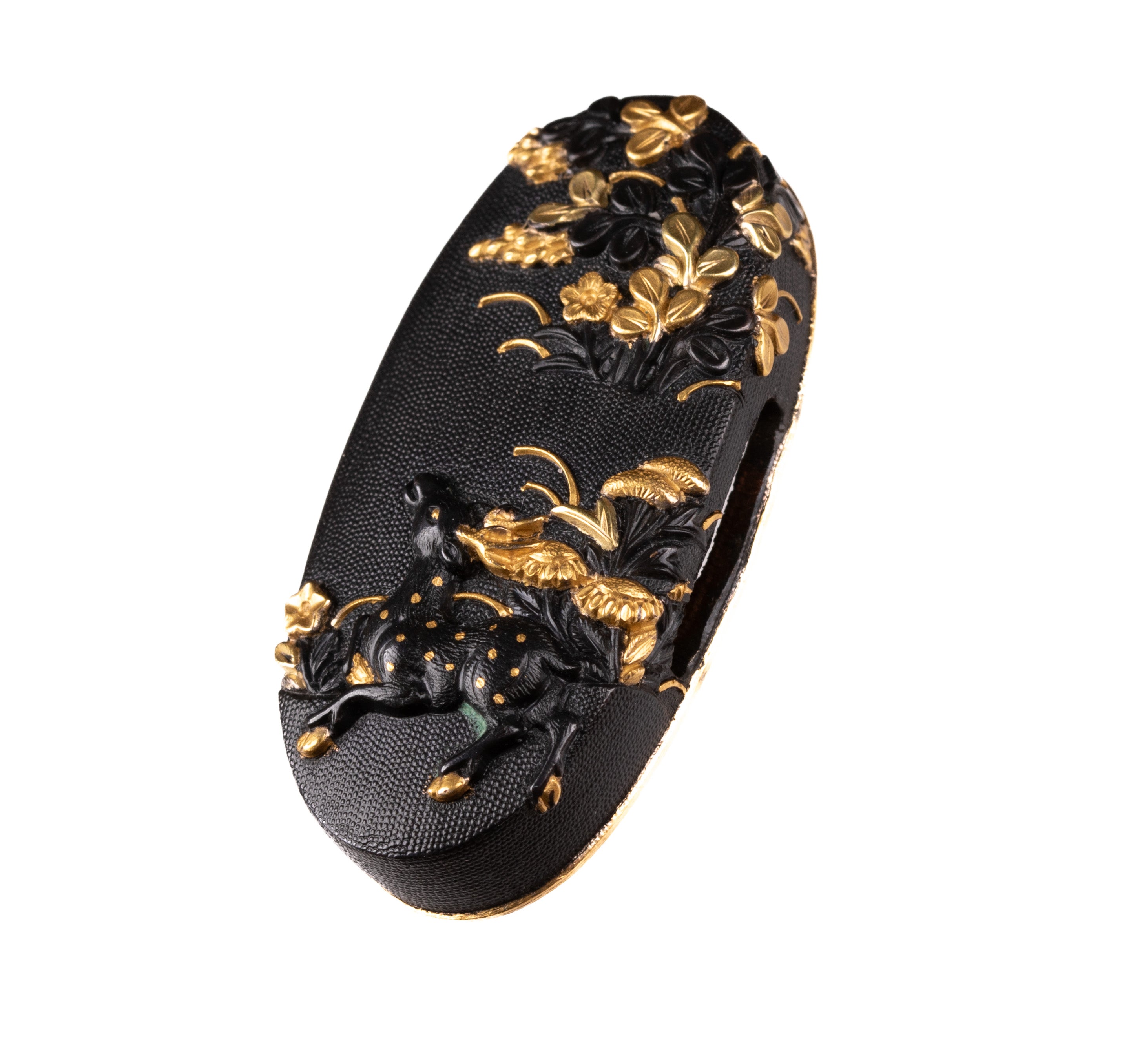
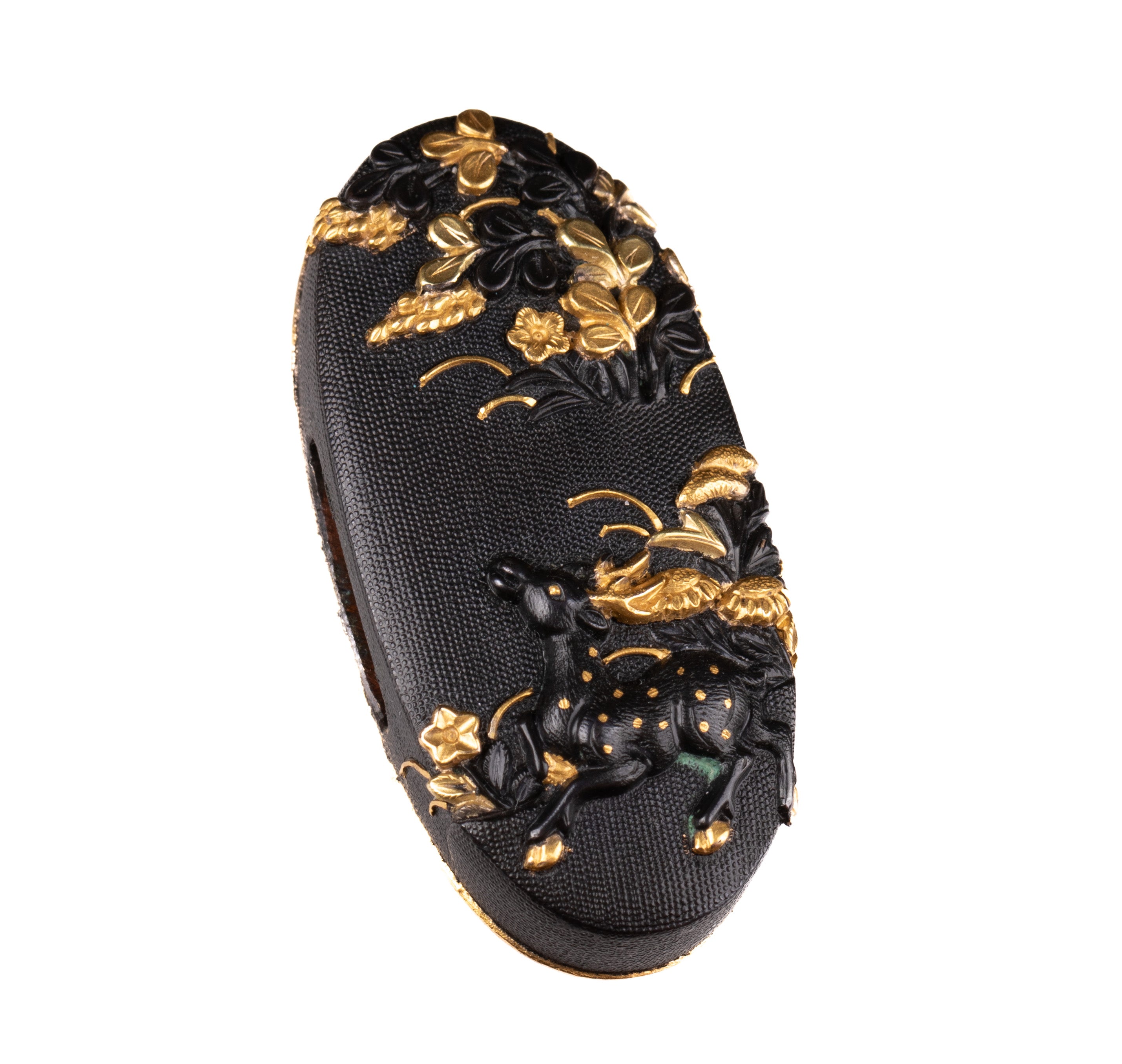
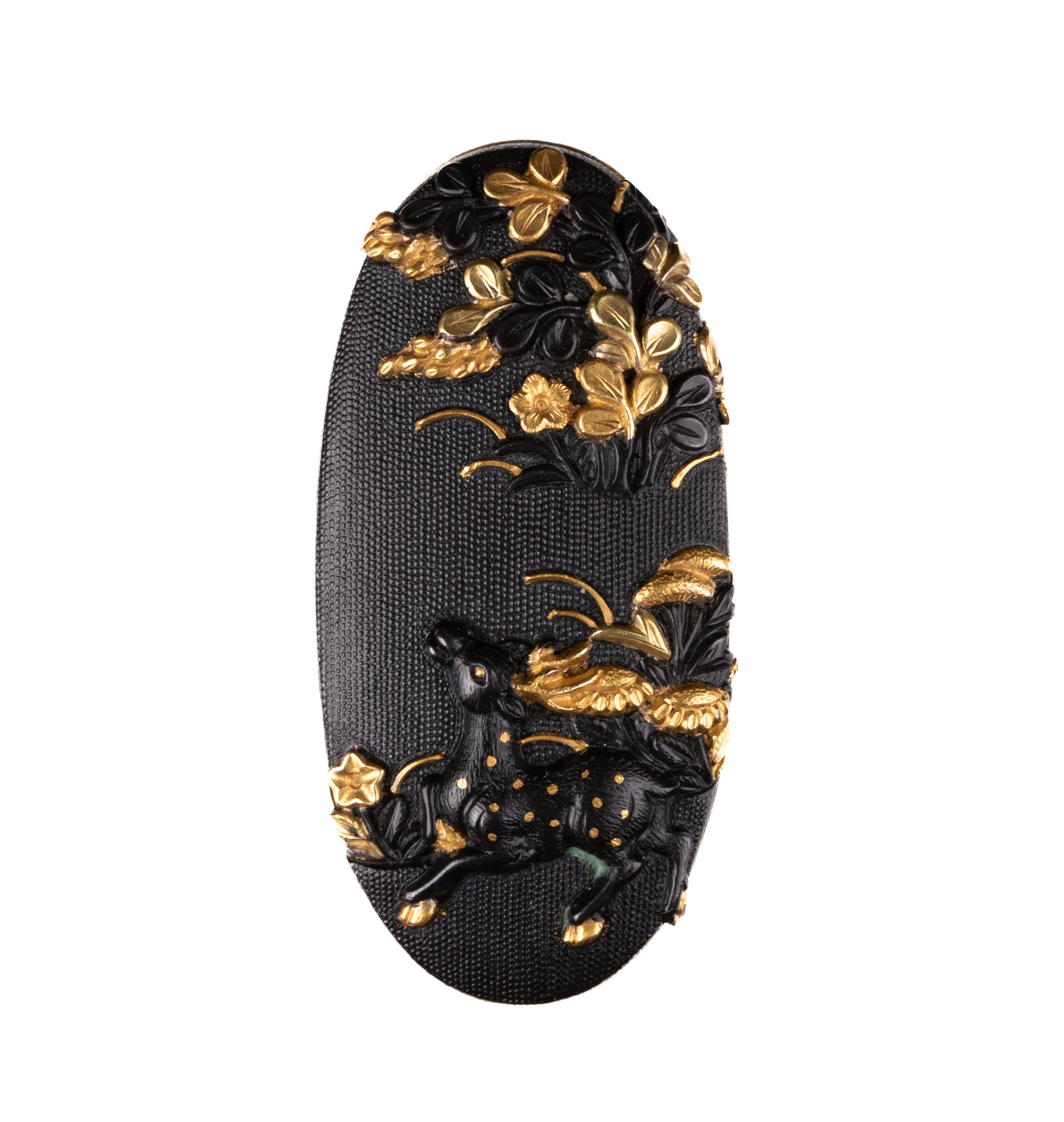
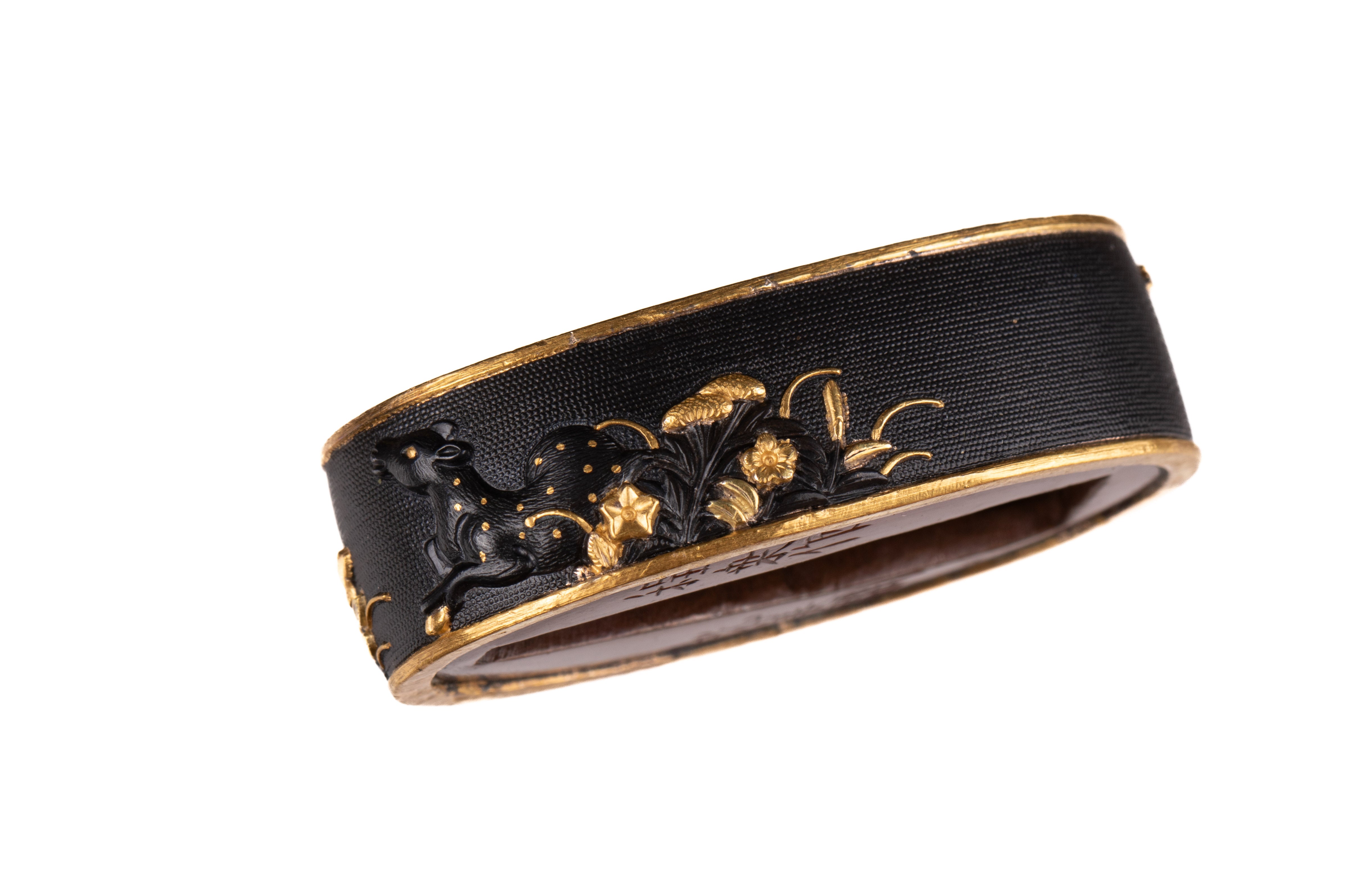
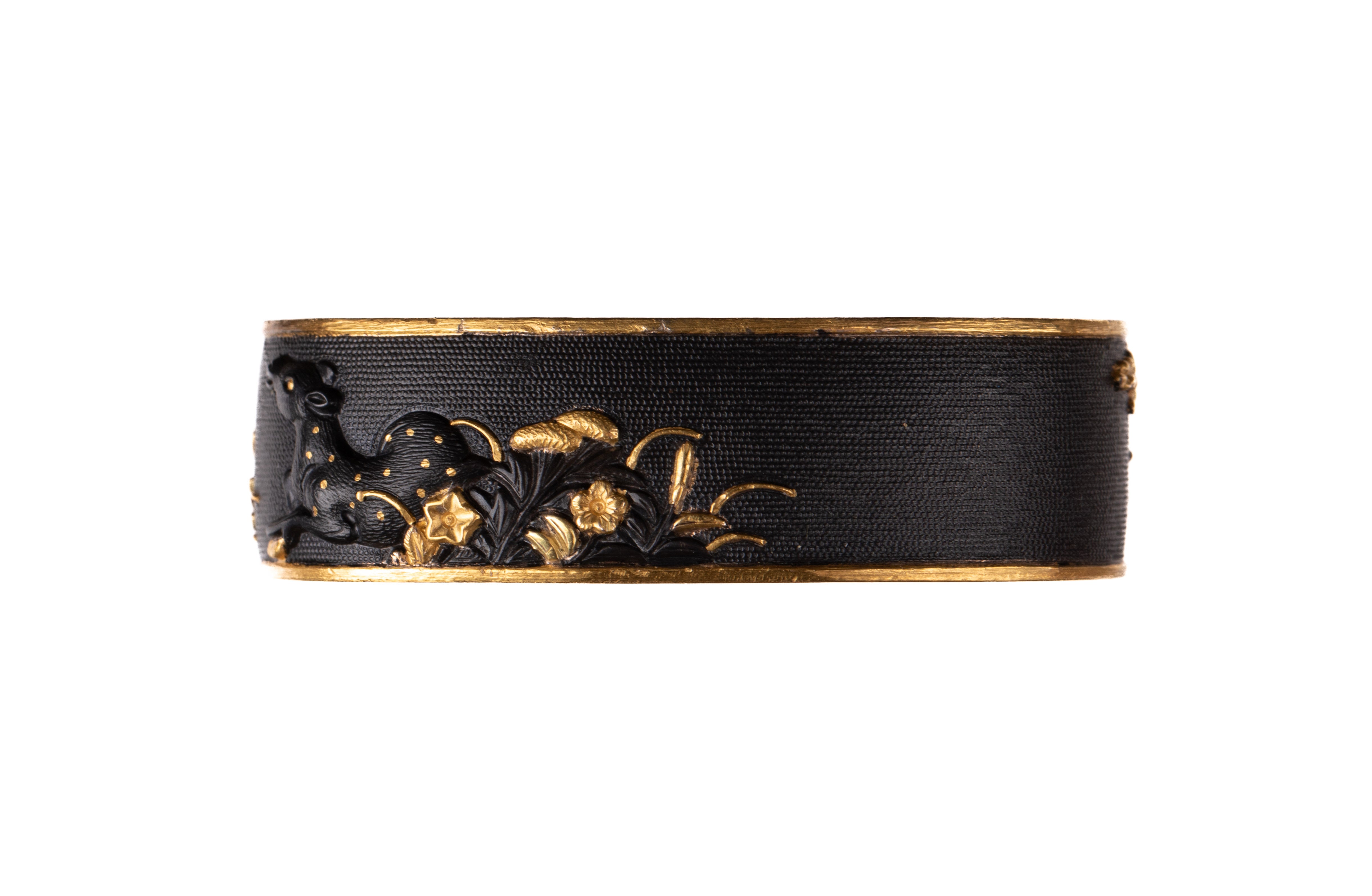
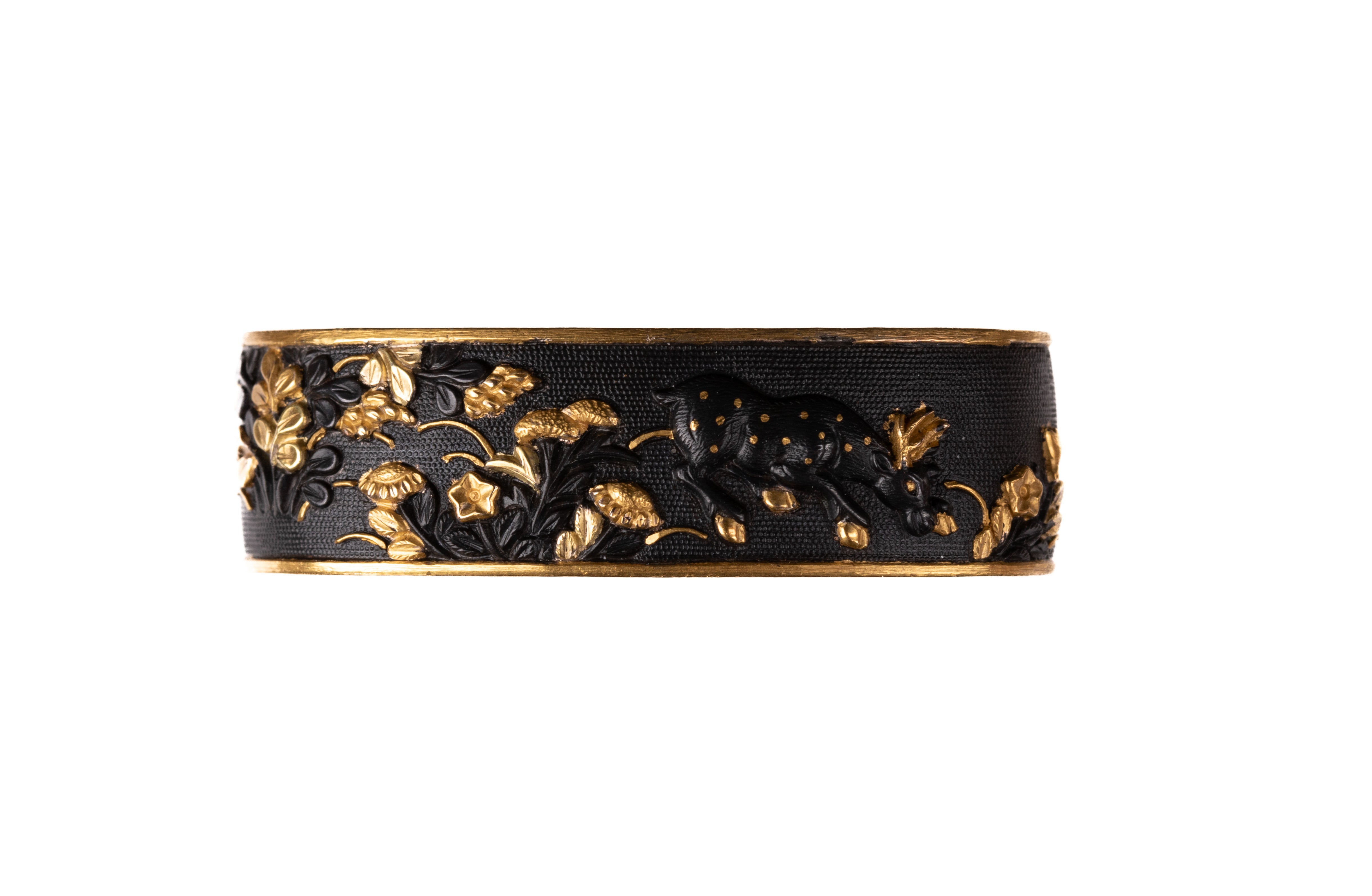
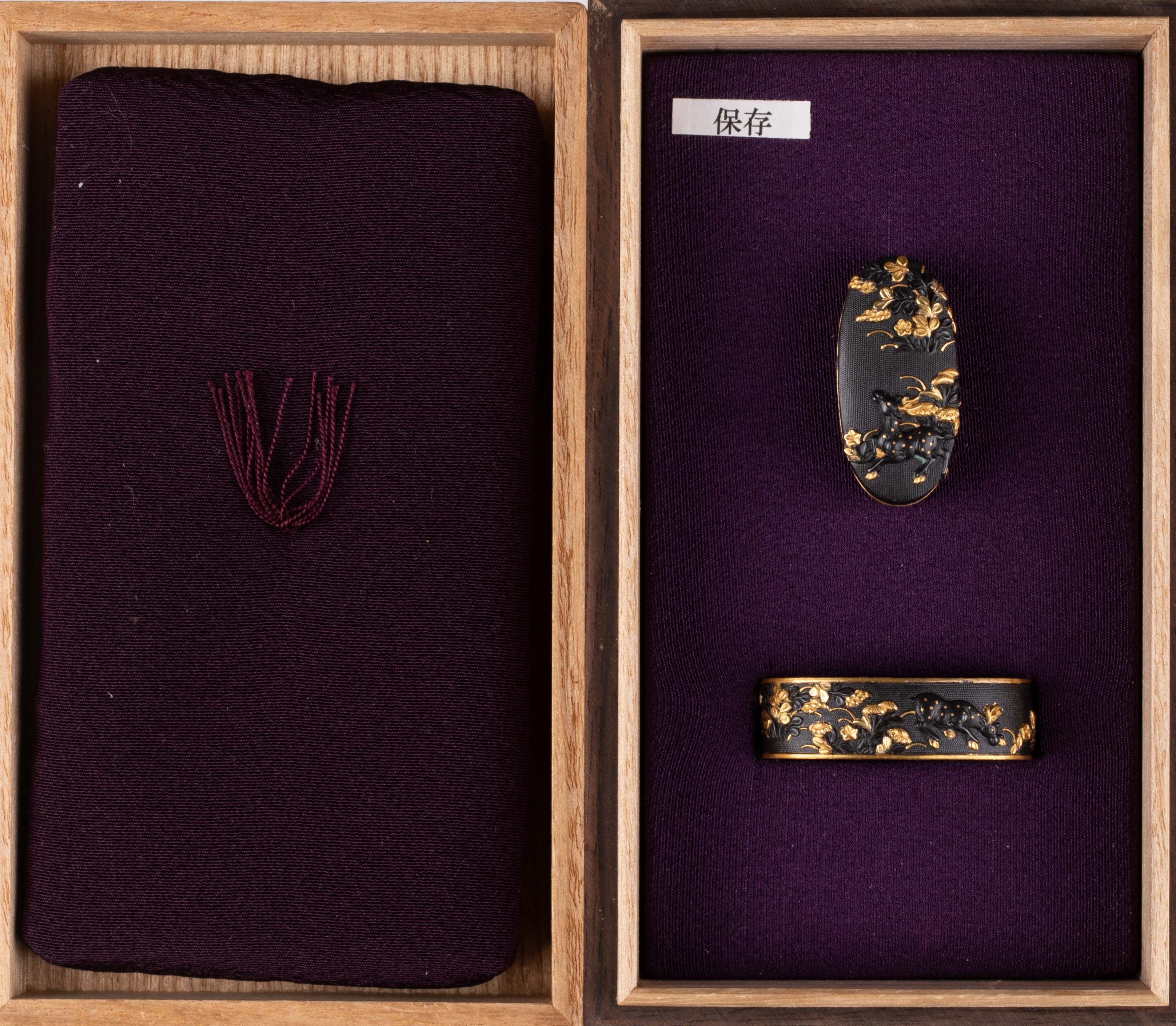
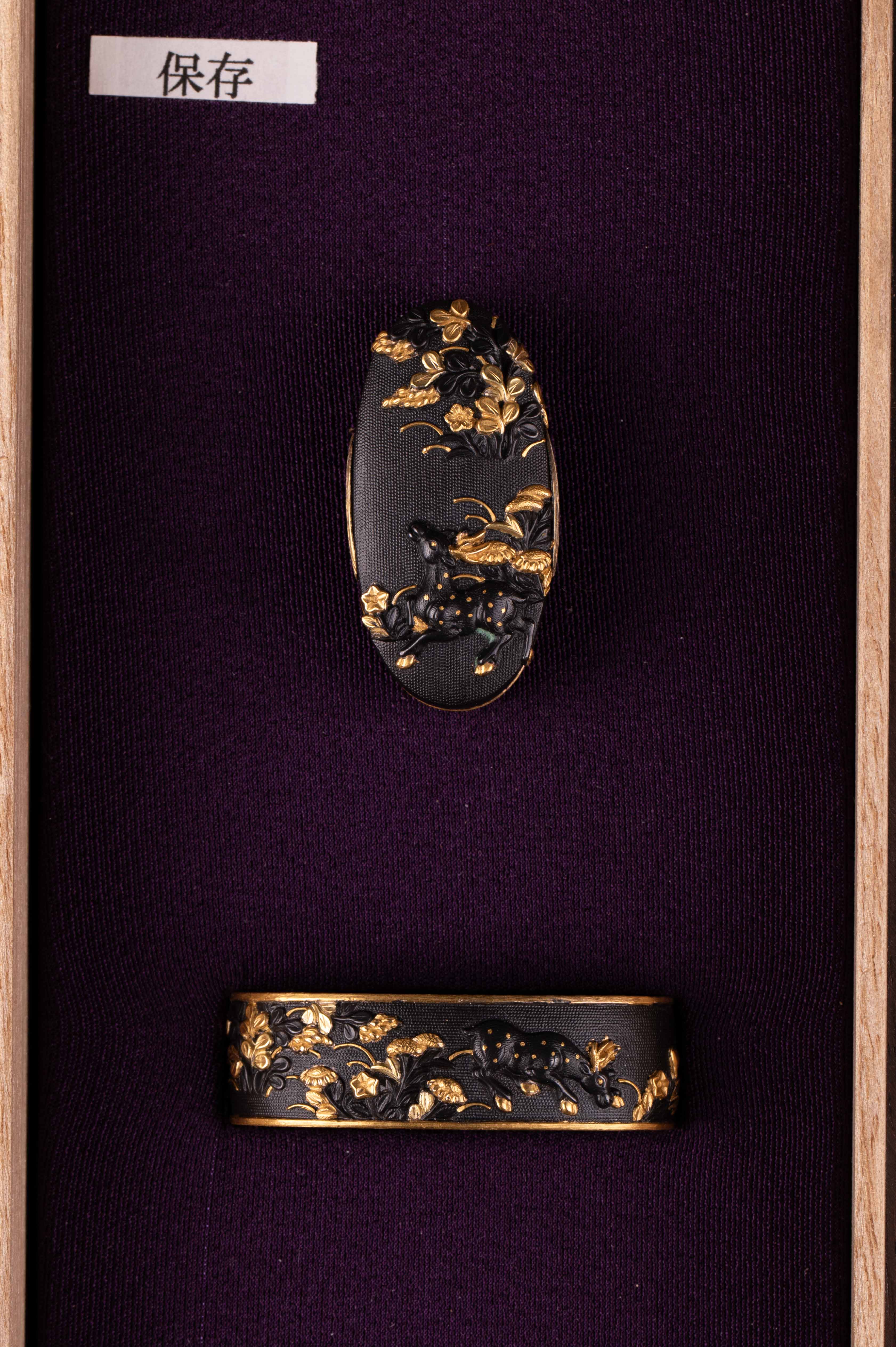
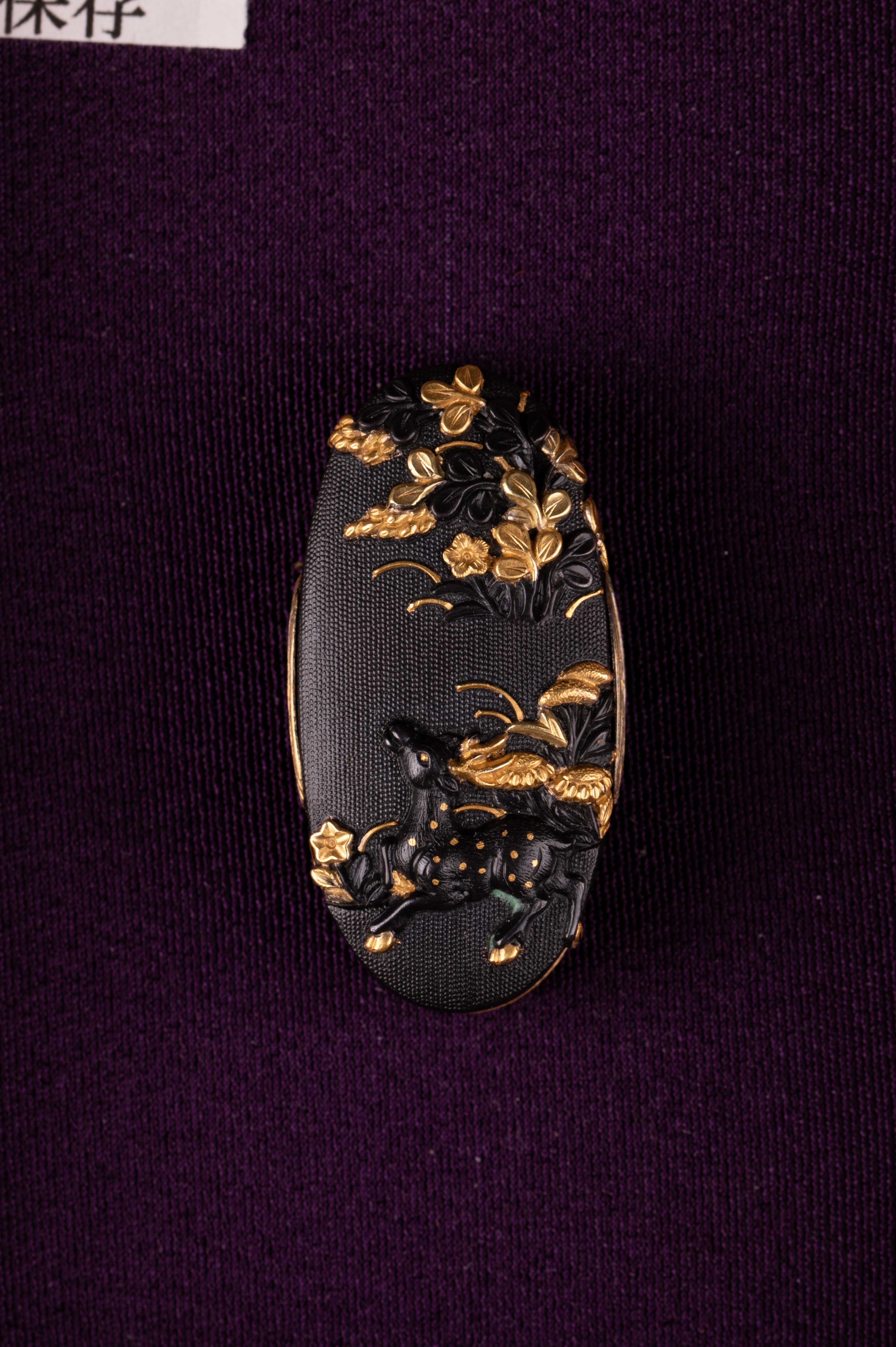
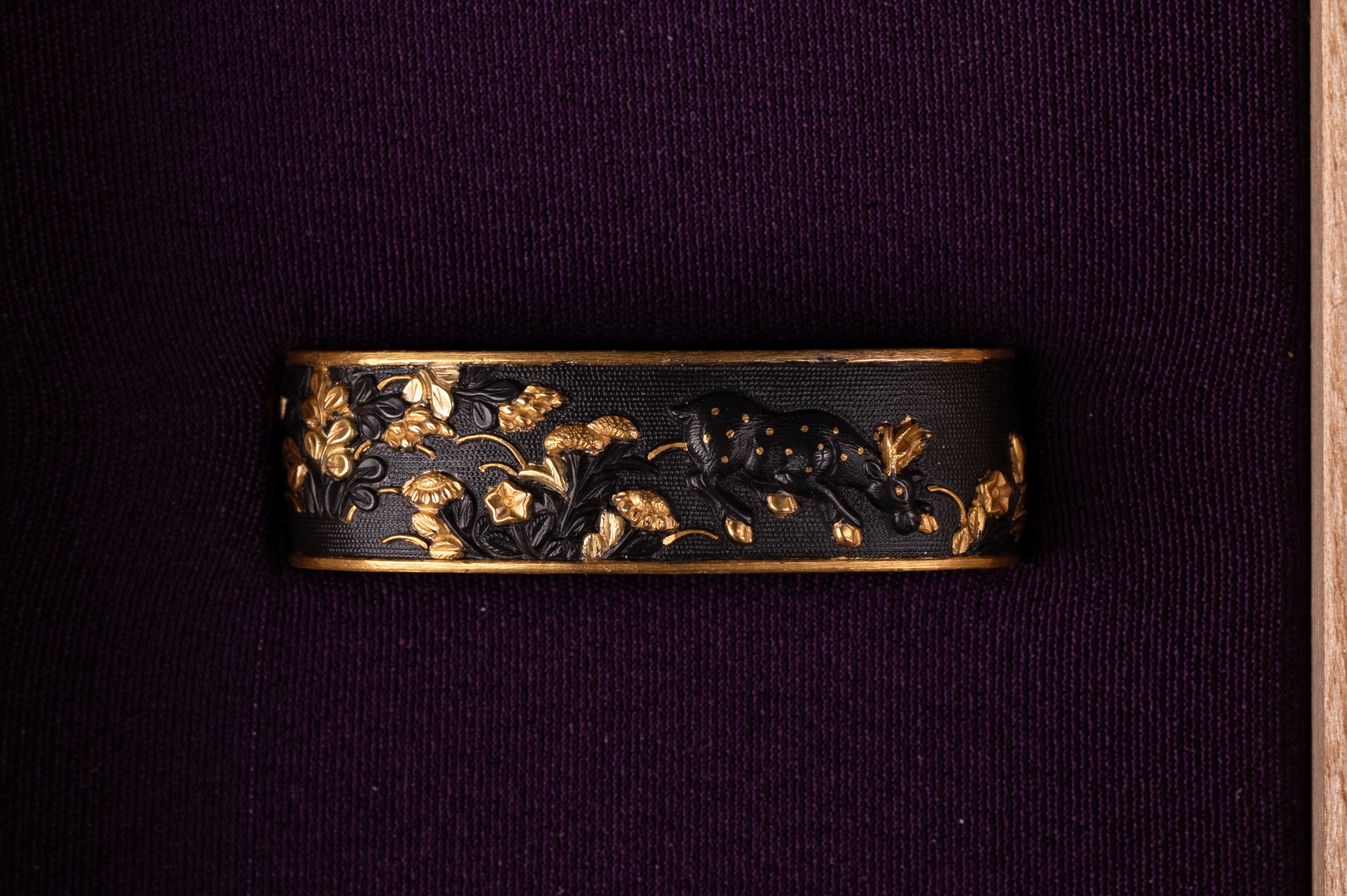
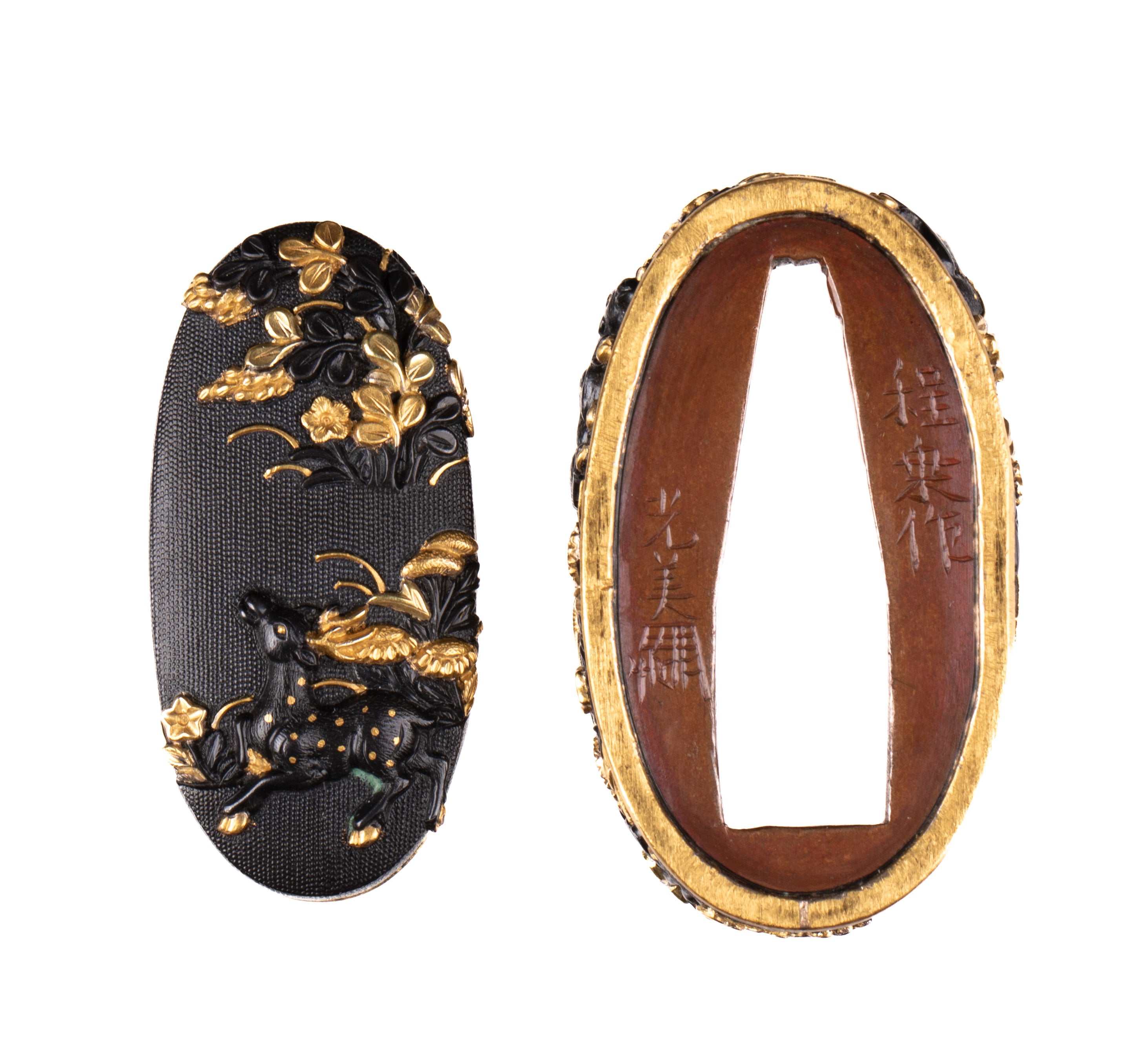
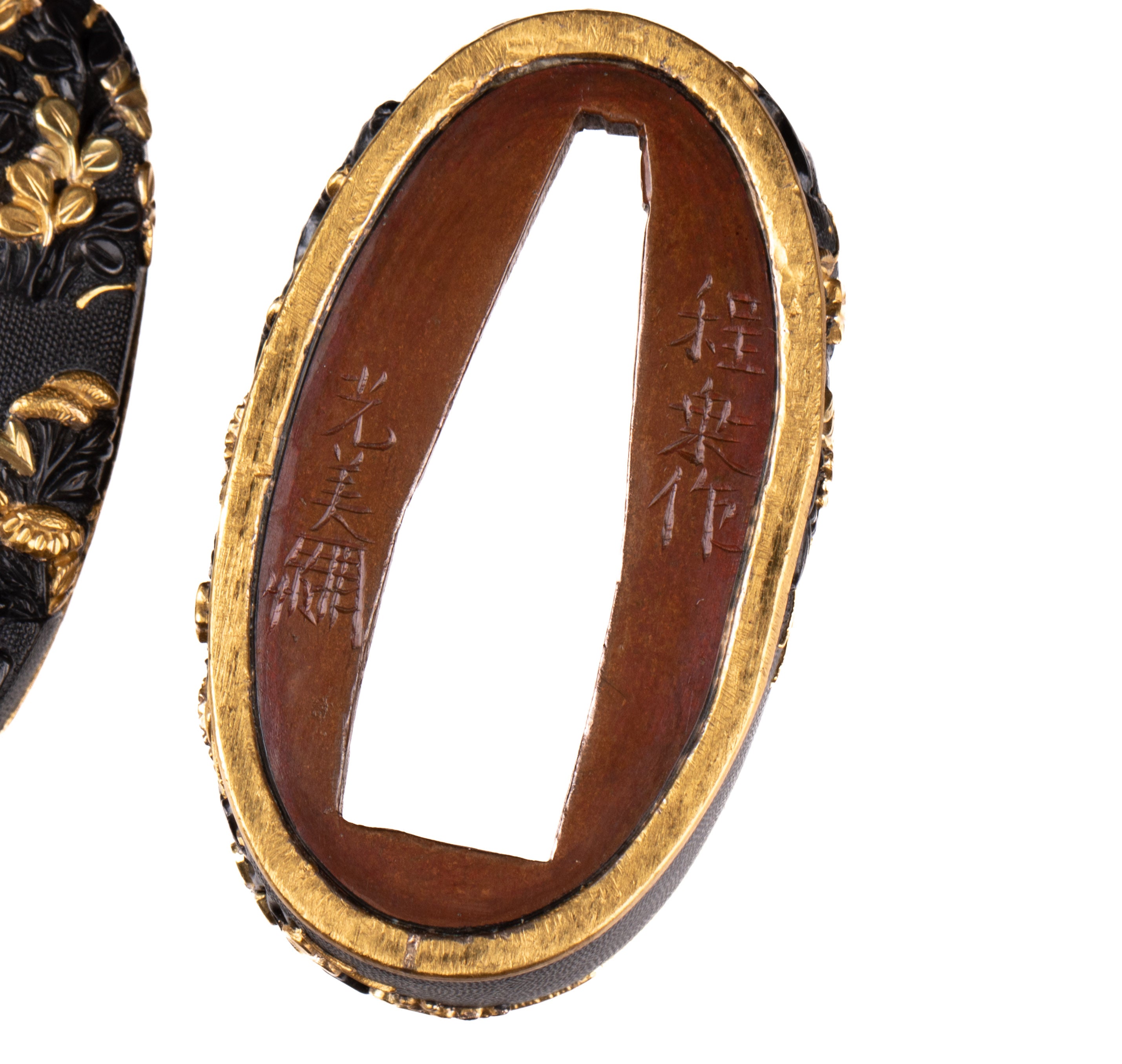
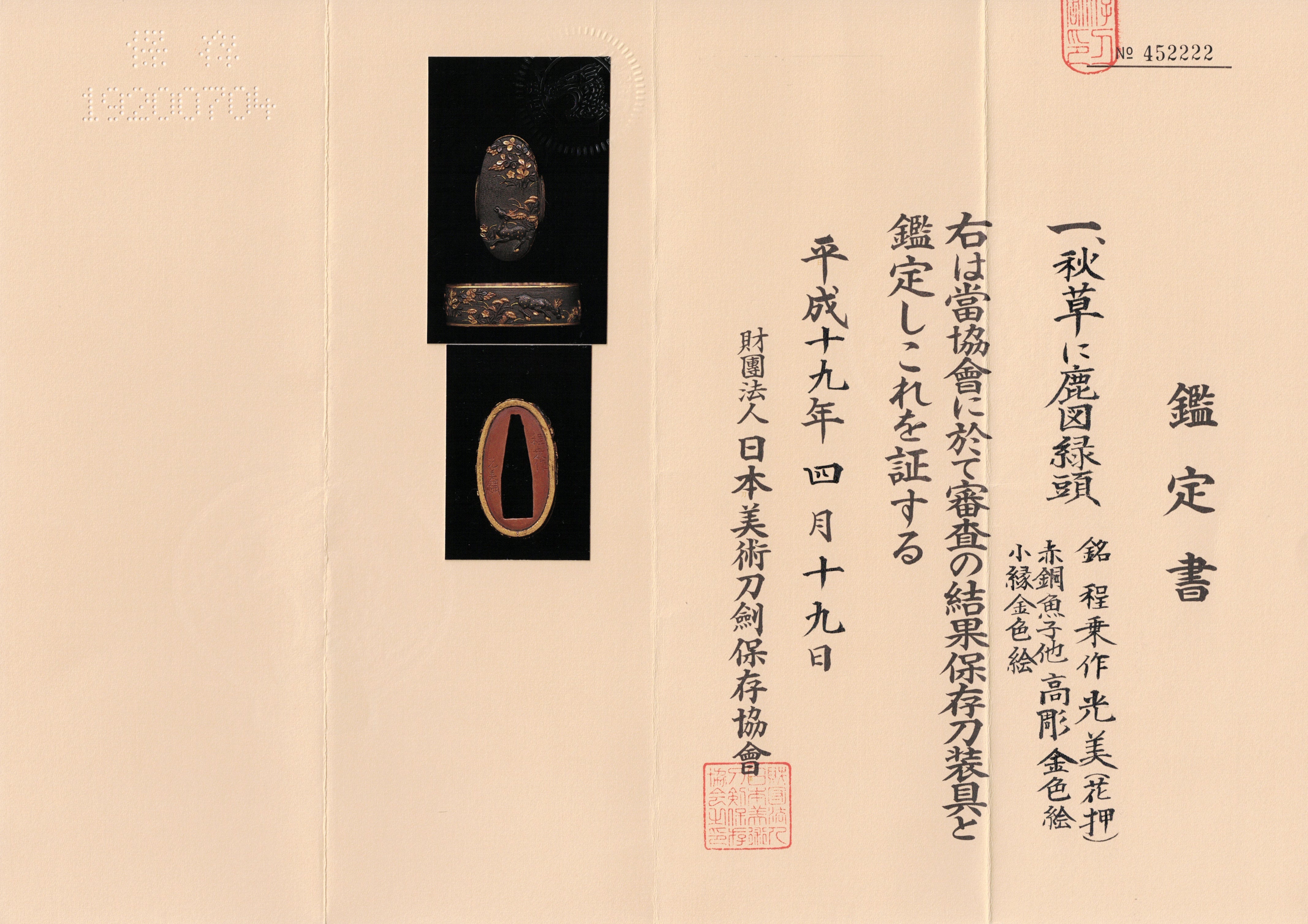
This Fuchikashira is signed "Teijo Saku Mitsuyoshi" and comes with NBTHK Hozon Tosogu certification. The signature indicates that Mitsuyoshi, a 15th generation mainline Goto master, attributed this piece to Teijo Mitsumasa, a 9th generation master. Made of shakudo with a nanako ground and gold iroe, it features a contemporary style with deer motifs, possibly intended to be part of a larger set.
Certificate reading — 銘 程乗作光美(花押)
 NihontoWatch
mei · Goto · Early Edo (1603-1673)
Gotō
Early Edo (1603-1673)
Signed
Hozon (NBTHK)
Iebori · Yamashiro · around 1603-1673
11 pieces on the market now
Gotō Teijō (程乗), whose personal name was Mitsumasa (光昌), was the ninth-generation head of the Gotō main line (sōke) and a pivotal figure in the transition of the house's metalwork tradition into the early Edo period. Born in Keichō 8 (1603) as the second son of the seventh head Kenjō (顕乗), his childhood name was Gen'ichirō. In Kan'ei 1 (1624), when his father Masatsugu took the tonsure and assumed the art name Kenjō, Teijō succeeded as the second head of the Rihei branch house, changing his name to Rihei Mitsumasa. When the eighth head of the main line, Mitsushige (Sokujō), died at the young age of thirty-two and his heir Kameichi was still only four years old, Kenjō temporarily assumed responsibility for the main line, after which Teijō inherited the position as ninth head. He served as guardian to the young tenth head Renjō, transferring the headship when Renjō reached eighteen and continuing as his protector until he turned twenty-five. Teijō also served the Kaga Maeda house, alternating by year with Enjō, a son of Kakujō, and in this way made a major contribution to the development of the refined culture supported by Kaga's "million-koku" domain, where his influence established what became known as the Kaga-Gotō lineage.
Teijō's work is executed predominantly in shakudō nanako-ji grounds with takabori relief carving and polychrome iroe employing gold and silver, though he also produced pieces on solid gold (kinmuku) grounds of exceptional sumptuousness. His carving manner is characterized by a calm, restrained temperament and fine precision[[c:1]]; the chisel work varies freely between measured and rapid passages, and the modeling of forms is full yet taut. He is noted for achieving distinctive coloristic effects through the purposeful deployment of irogane such as silver and copper. His menuki display powerful yōbori rounded relief with pronounced variation in height and depth, and his kozuka and kōgai are consistently finished with gold-backed reverse plates (kin'ura). While Teijō carefully preserved the Gotō house's hereditary design vocabulary -- dragons, lions, and tigers rendered with the sculptural fullness and expressive modeling characteristic of the main line -- he also incorporated novel themes including literary and historical narratives such as the Rashōmon legend, scenes from the Tale of Genji, and the Oxherd and Weaver Maiden, as well as uncommon subjects such as anchors and the rare one-horned dragon, a motif of imperial rank.
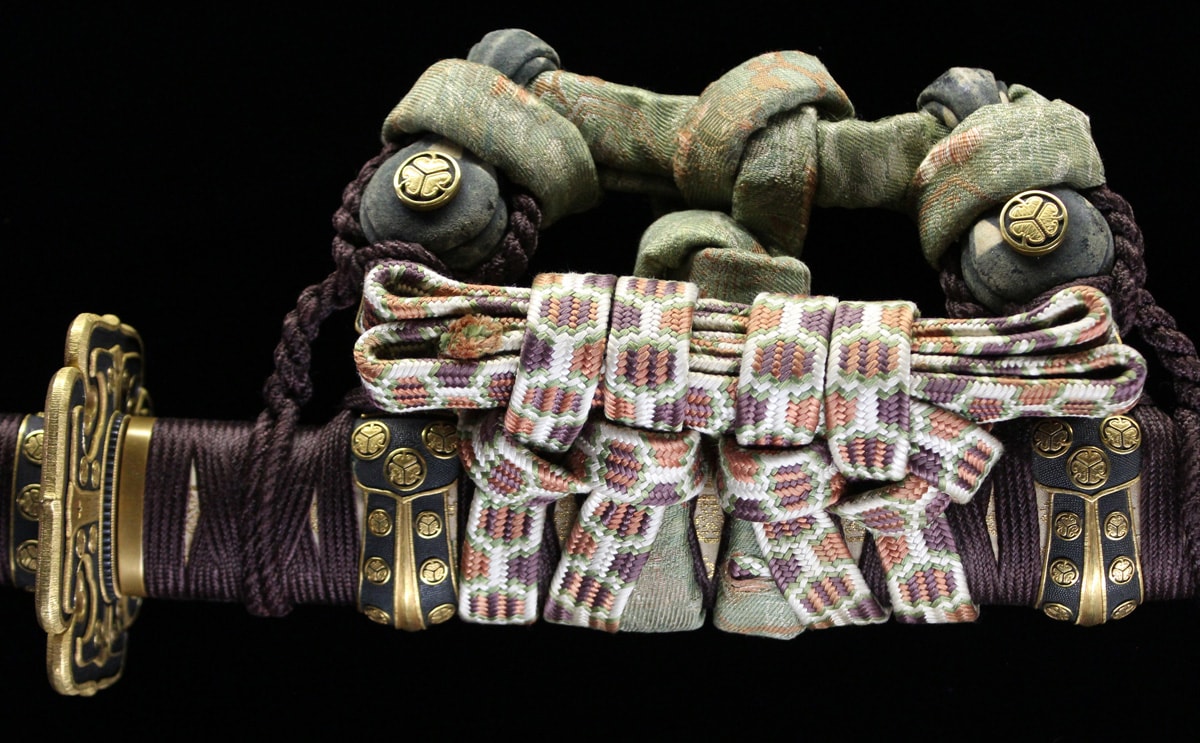
Teijō's output spans the full range of tōsōgu forms, including mitokoromono, sanshōmono, and nisomono sets as well as individual kozuka, menuki, and tsuba. His fittings also appear integrated into formal koshirae mountings of the highest order, including ito-maki tachi transmitted in the great Tokugawa houses. Numerous works bear origami appraisals and authentication inscriptions by later Gotō masters -- the tenth head Renjō, the thirteenth head Enjō Mitsutaka, and the fifteenth head Shinjō Mitsuyoshi among them -- attesting to the esteem in which his production was held within the house's own critical tradition. Several important pieces are recorded as having been handed down in the Kōnoike family, the wealthy Osaka merchants, further demonstrating the regard accorded to his work among the most discriminating collectors of the Edo period. As the master who bridged the Gotō main line's Kyoto heritage and its new role serving the Kaga domain, Teijō occupies a position of particular consequence in the history of the house, and his works consistently manifest the elevated dignity that defines mainline Gotō metalwork at its finest[[c:2]].
Where Goto Teijo stands among comparable artisans: across all of nihontō, and within tradition, era, and period. The tiers (Foremost · Leading · Major · Notable) weigh official designations from the NBTHK and Japan's Agency for Cultural Affairs, together with historical honors of lasting repute such as the Sansaku and Meibutsu-chō.
Select a lens to see how it's measured.
Iebori · Yamashiro
Phase: Goto Main Line後藤宗家· 1573–1900
323 pieces on the market now
| Smith | Era | Designated |
|---|---|---|
| Goto Joshin後藤乗真 | 1512-1562 | 68 |
| Goto Yujo後藤祐乗 | 1440-1512 | 41 |
| Goto Kenjo後藤顕乗 | 1586-1663 | 46 |
| Goto Sojo後藤宗乗 | 1461-1538 | 55 |
| Goto Eijo後藤栄乗 | 1577-1617 | 35 |
Certifies a genuine fitting worth preserving: a correct signature, or, if unsigned, an identifiable era and school, with recognized artistic and craft value.
The NBTHK (Nihon Bijutsu Tōken Hozon Kyōkai, the Society for the Preservation of Japanese Art Swords) is a public-interest incorporated foundation founded in 1948 and supervised by Japan’s Agency for Cultural Affairs (Bunkachō); it is based at the Japanese Sword Museum in Tokyo. Its expert panels physically examine each submitted work (shinsa) and issue a certificate (kanteishō) ranking it by artistic and historical merit. NBTHK papers are the most widely recognized standard of authentication for Japanese swords and fittings.
NBTHK official site30-day refund policy. Items must be returned in original condition and packaging; customized products are non-returnable. 2-week inspection window with full item refund (shipping costs non-refundable). Customer pays return shipping.
$2,800
This Fuchikashira is signed "Teijo Saku Mitsuyoshi" and comes with NBTHK Hozon Tosogu certification. The signature indicates that Mitsuyoshi, a 15th generation mainline Goto master, attributed this piece to Teijo Mitsumasa, a 9th generation master. Made of shakudo with a nanako ground and gold iroe, it features a contemporary style with deer motifs, possibly intended to be part of a larger set.
Certificate reading — 銘 程乗作光美(花押)
NihontoWatchmei · Goto · Early Edo (1603-1673)
Gotō
Early Edo (1603-1673)
Signed
Hozon (NBTHK)
Iebori · Yamashiro · around 1603-1673
11 pieces on the market now
Gotō Teijō (程乗), whose personal name was Mitsumasa (光昌), was the ninth-generation head of the Gotō main line (sōke) and a pivotal figure in the transition of the house's metalwork tradition into the early Edo period. Born in Keichō 8 (1603) as the second son of the seventh head Kenjō (顕乗), his childhood name was Gen'ichirō. In Kan'ei 1 (1624), when his father Masatsugu took the tonsure and assumed the art name Kenjō, Teijō succeeded as the second head of the Rihei branch house, changing his name to Rihei Mitsumasa. When the eighth head of the main line, Mitsushige (Sokujō), died at the young age of thirty-two and his heir Kameichi was still only four years old, Kenjō temporarily assumed responsibility for the main line, after which Teijō inherited the position as ninth head. He served as guardian to the young tenth head Renjō, transferring the headship when Renjō reached eighteen and continuing as his protector until he turned twenty-five. Teijō also served the Kaga Maeda house, alternating by year with Enjō, a son of Kakujō, and in this way made a major contribution to the development of the refined culture supported by Kaga's "million-koku" domain, where his influence established what became known as the Kaga-Gotō lineage.
Teijō's work is executed predominantly in shakudō nanako-ji grounds with takabori relief carving and polychrome iroe employing gold and silver, though he also produced pieces on solid gold (kinmuku) grounds of exceptional sumptuousness. His carving manner is characterized by a calm, restrained temperament and fine precision[[c:1]]; the chisel work varies freely between measured and rapid passages, and the modeling of forms is full yet taut. He is noted for achieving distinctive coloristic effects through the purposeful deployment of irogane such as silver and copper. His menuki display powerful yōbori rounded relief with pronounced variation in height and depth, and his kozuka and kōgai are consistently finished with gold-backed reverse plates (kin'ura). While Teijō carefully preserved the Gotō house's hereditary design vocabulary -- dragons, lions, and tigers rendered with the sculptural fullness and expressive modeling characteristic of the main line -- he also incorporated novel themes including literary and historical narratives such as the Rashōmon legend, scenes from the Tale of Genji, and the Oxherd and Weaver Maiden, as well as uncommon subjects such as anchors and the rare one-horned dragon, a motif of imperial rank.
Teijō's output spans the full range of tōsōgu forms, including mitokoromono, sanshōmono, and nisomono sets as well as individual kozuka, menuki, and tsuba. His fittings also appear integrated into formal koshirae mountings of the highest order, including ito-maki tachi transmitted in the great Tokugawa houses. Numerous works bear origami appraisals and authentication inscriptions by later Gotō masters -- the tenth head Renjō, the thirteenth head Enjō Mitsutaka, and the fifteenth head Shinjō Mitsuyoshi among them -- attesting to the esteem in which his production was held within the house's own critical tradition. Several important pieces are recorded as having been handed down in the Kōnoike family, the wealthy Osaka merchants, further demonstrating the regard accorded to his work among the most discriminating collectors of the Edo period. As the master who bridged the Gotō main line's Kyoto heritage and its new role serving the Kaga domain, Teijō occupies a position of particular consequence in the history of the house, and his works consistently manifest the elevated dignity that defines mainline Gotō metalwork at its finest[[c:2]].
Where Goto Teijo stands among comparable artisans: across all of nihontō, and within tradition, era, and period. The tiers (Foremost · Leading · Major · Notable) weigh official designations from the NBTHK and Japan's Agency for Cultural Affairs, together with historical honors of lasting repute such as the Sansaku and Meibutsu-chō.
Select a lens to see how it's measured.
Iebori · Yamashiro
Phase: Goto Main Line後藤宗家· 1573–1900
323 pieces on the market now
| Smith | Era | Designated |
|---|---|---|
| Goto Joshin後藤乗真 | 1512-1562 | 68 |
| Goto Yujo後藤祐乗 | 1440-1512 | 41 |
| Goto Kenjo後藤顕乗 | 1586-1663 | 46 |
| Goto Sojo後藤宗乗 | 1461-1538 | 55 |
| Goto Eijo後藤栄乗 | 1577-1617 | 35 |
Certifies a genuine fitting worth preserving: a correct signature, or, if unsigned, an identifiable era and school, with recognized artistic and craft value.
The NBTHK (Nihon Bijutsu Tōken Hozon Kyōkai, the Society for the Preservation of Japanese Art Swords) is a public-interest incorporated foundation founded in 1948 and supervised by Japan’s Agency for Cultural Affairs (Bunkachō); it is based at the Japanese Sword Museum in Tokyo. Its expert panels physically examine each submitted work (shinsa) and issue a certificate (kanteishō) ranking it by artistic and historical merit. NBTHK papers are the most widely recognized standard of authentication for Japanese swords and fittings.
NBTHK official site30-day refund policy. Items must be returned in original condition and packaging; customized products are non-returnable. 2-week inspection window with full item refund (shipping costs non-refundable). Customer pays return shipping.
$2,800