 NihontoWatchNihontoWatch
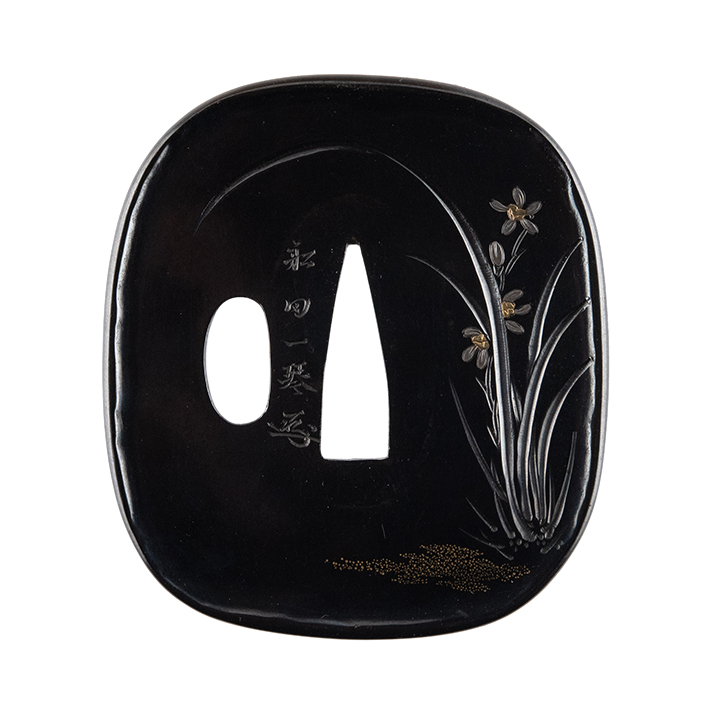
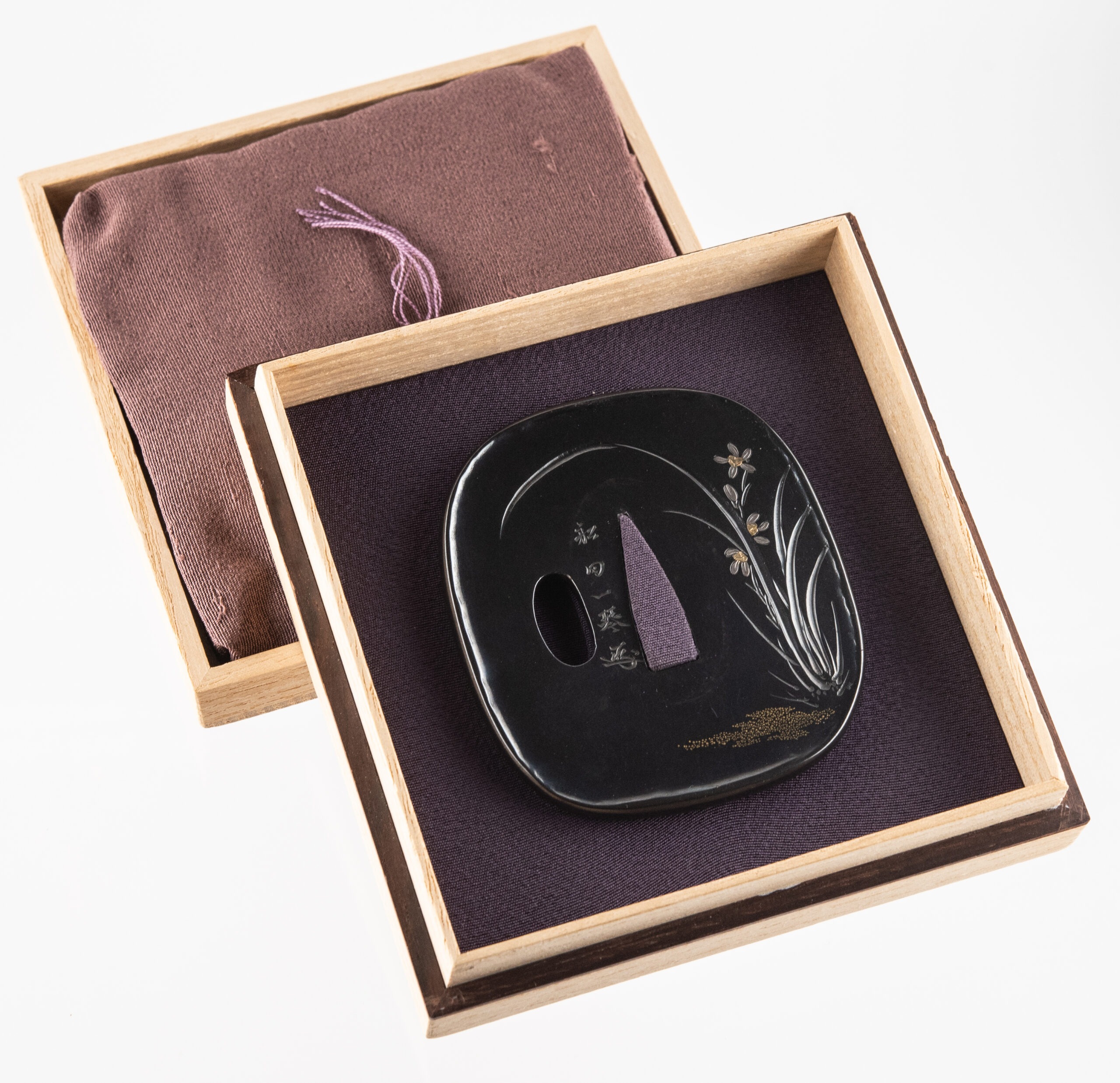
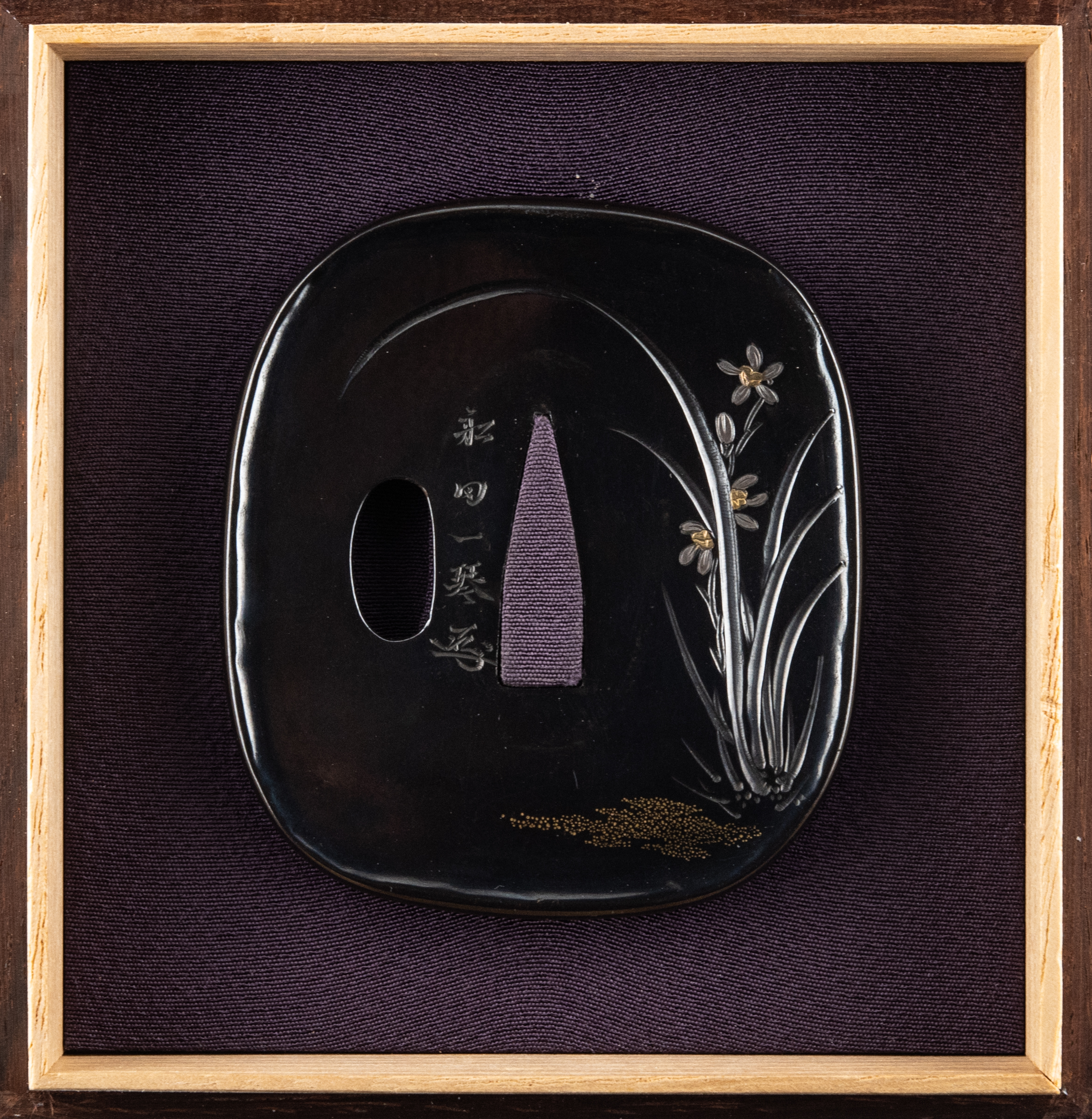
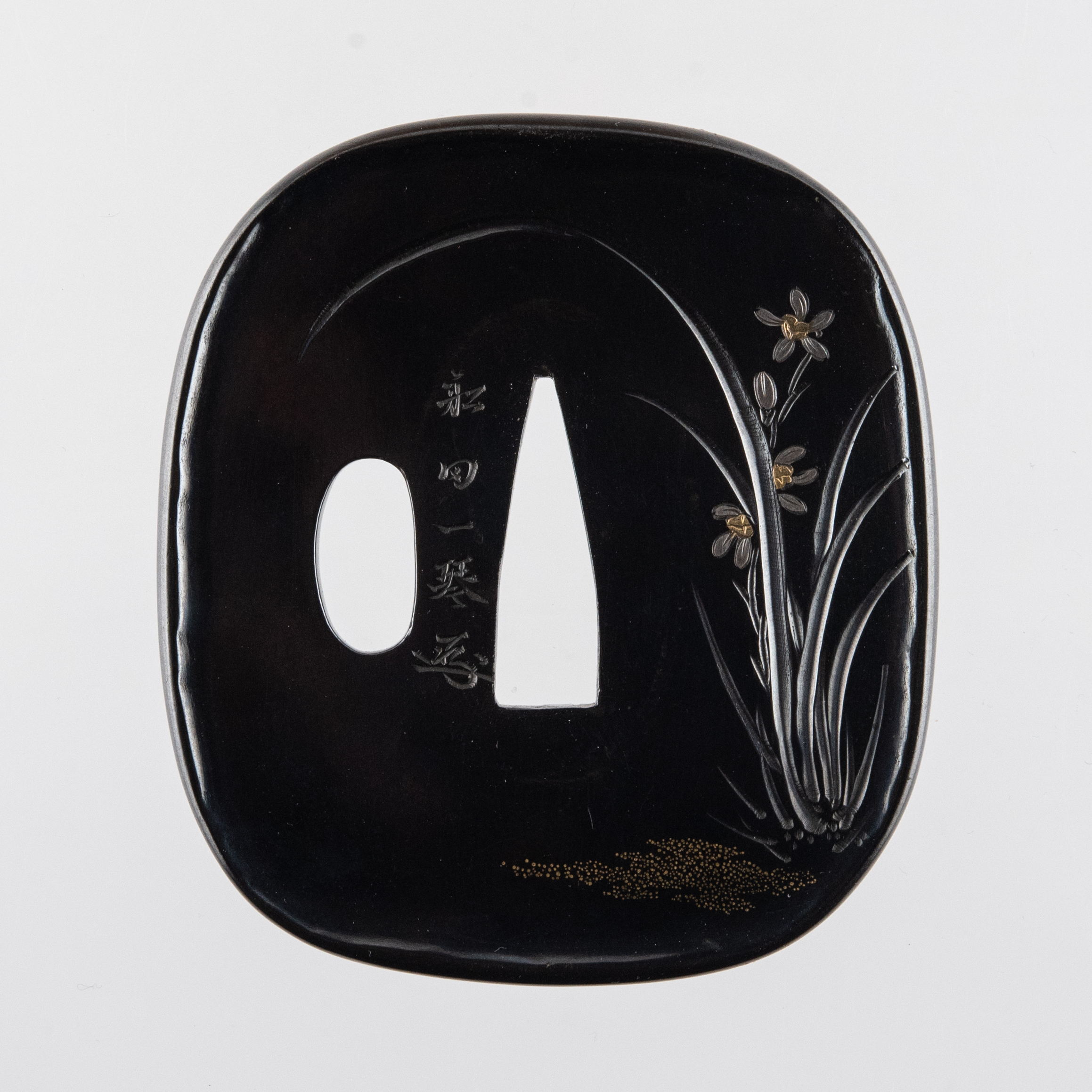
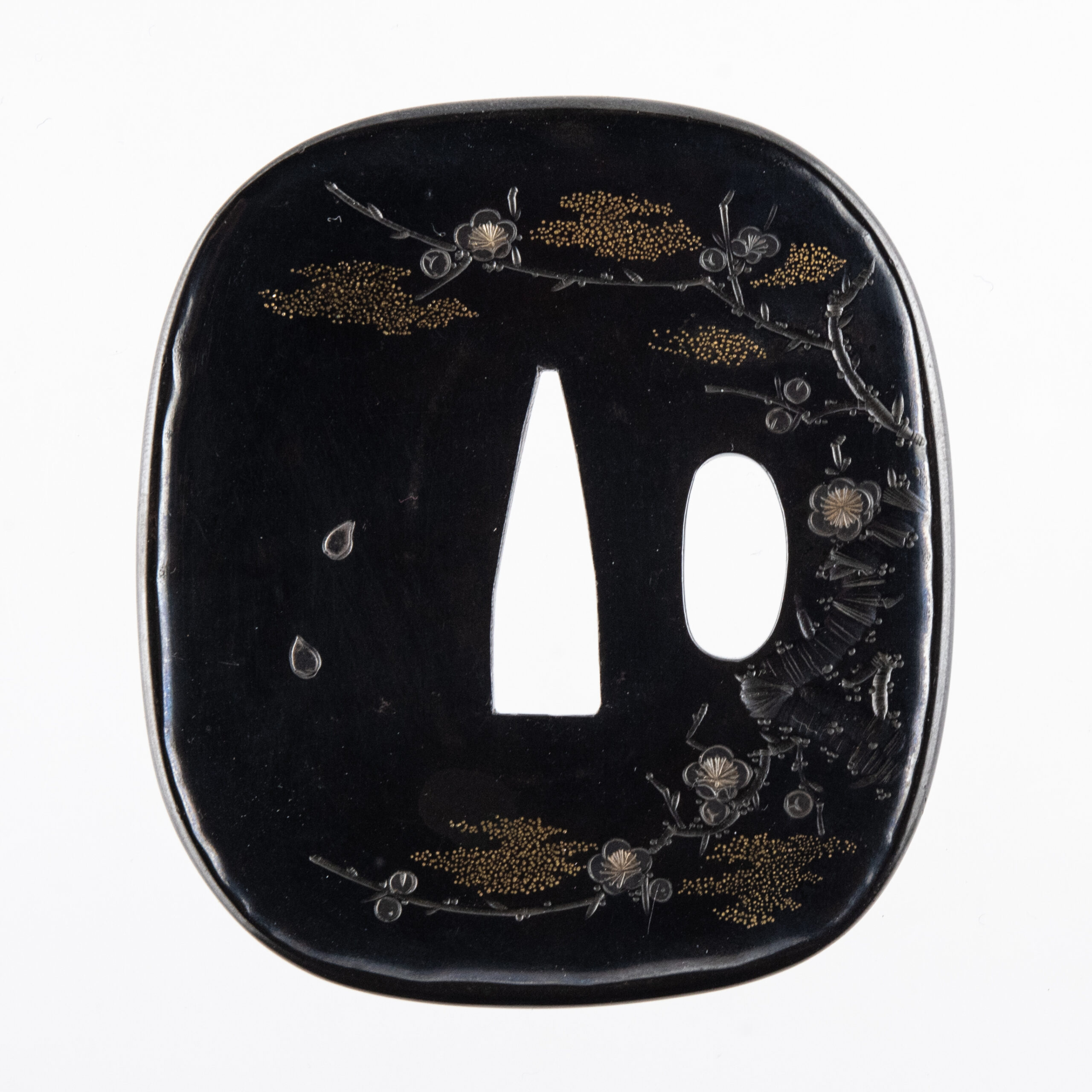
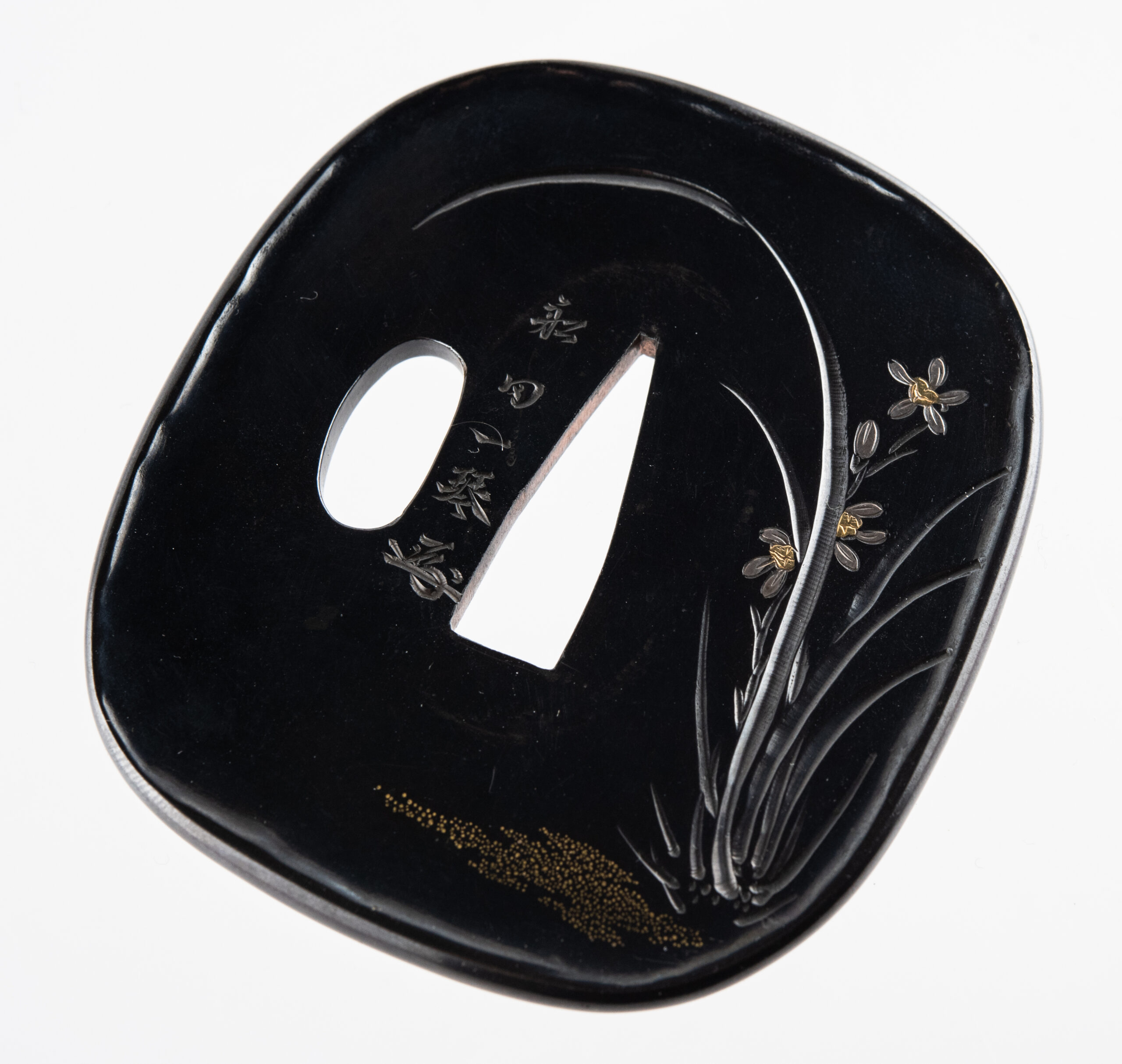
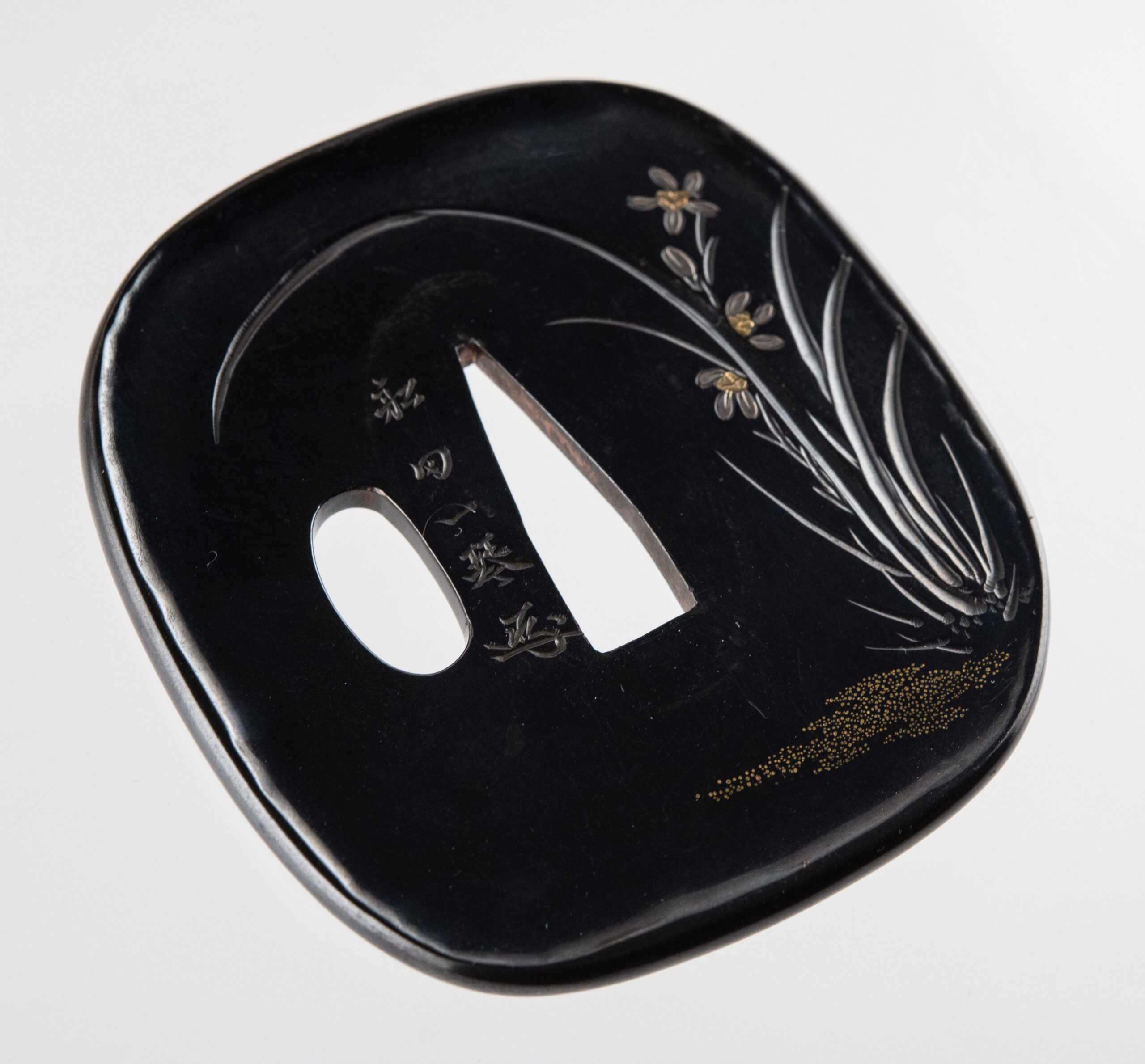
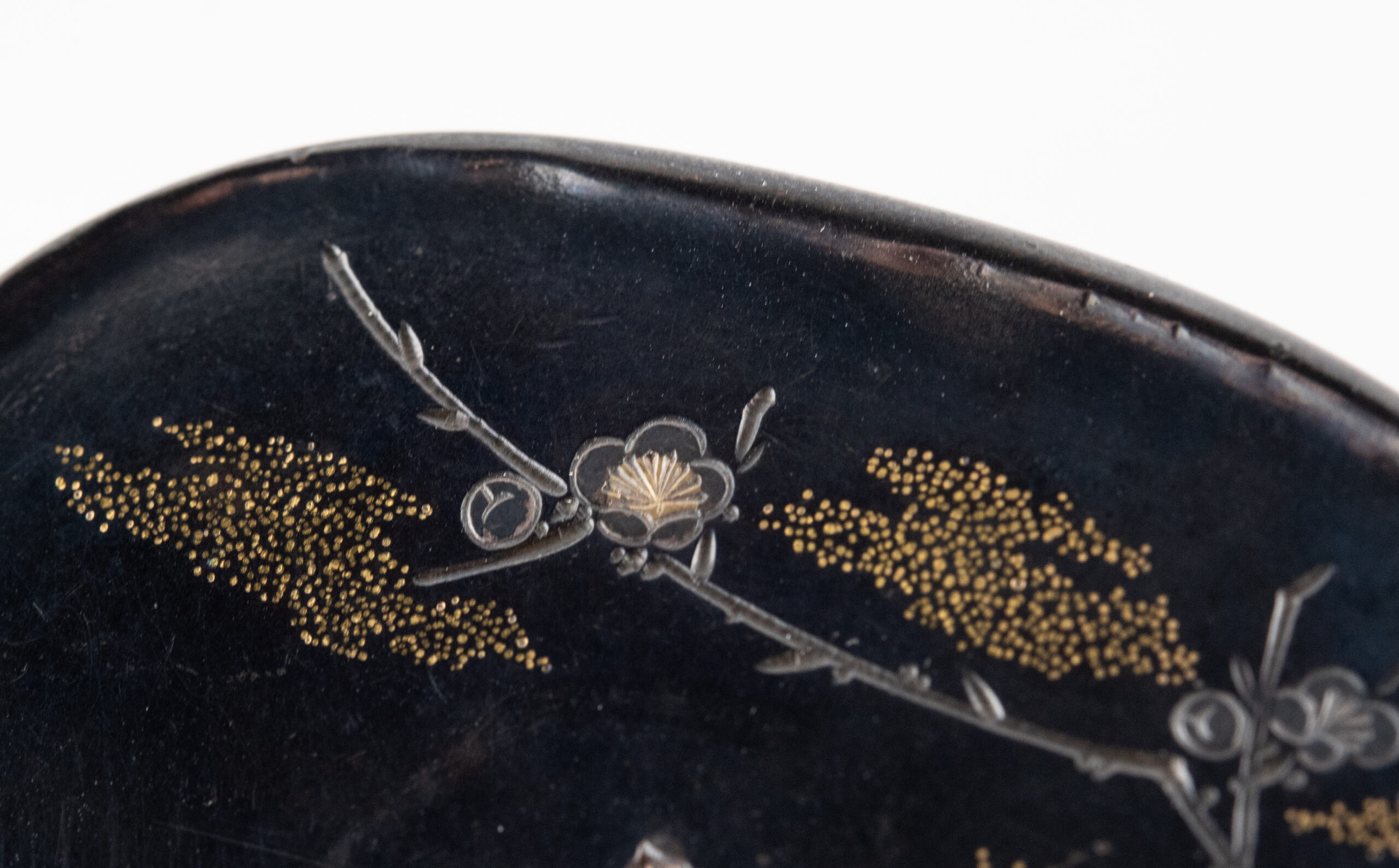
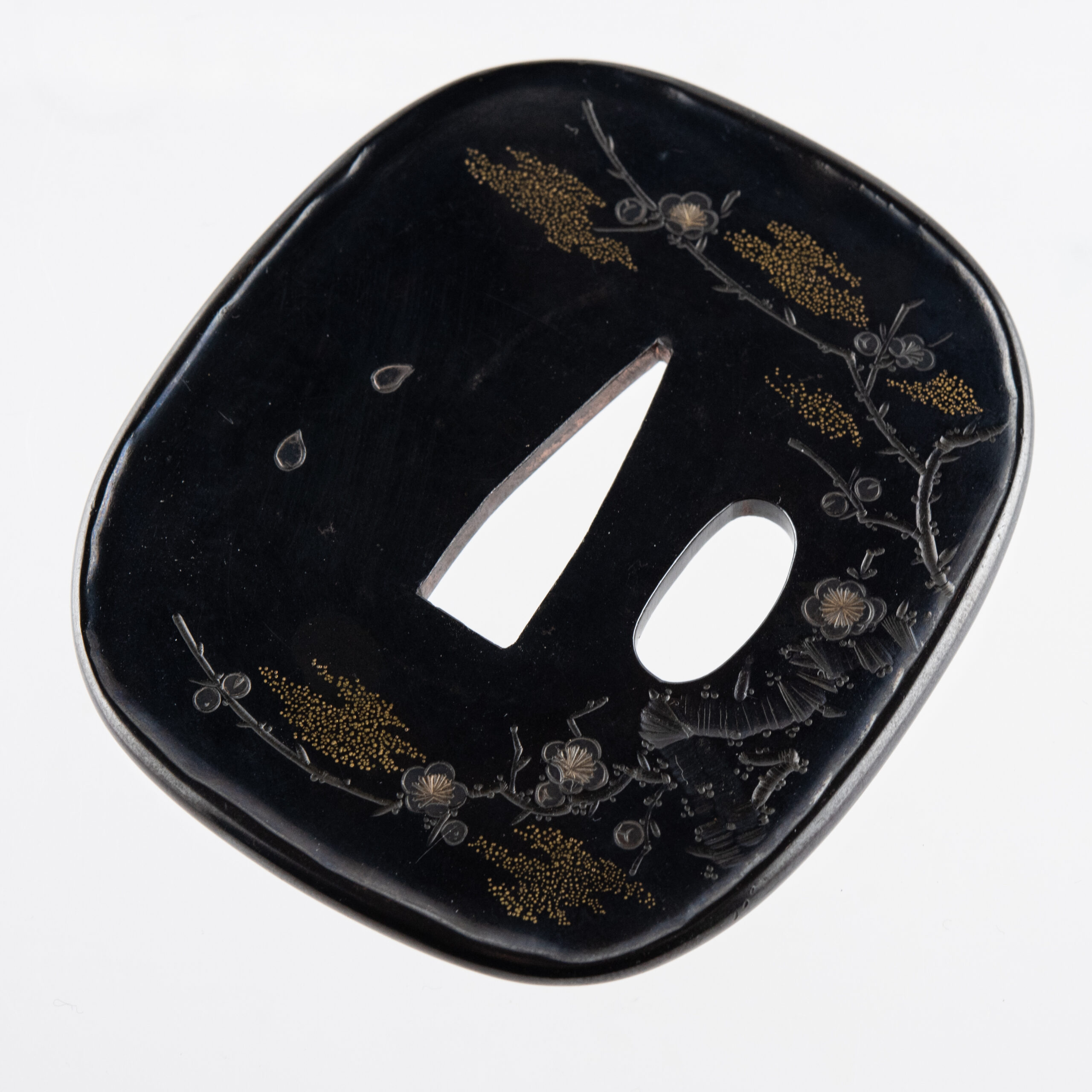
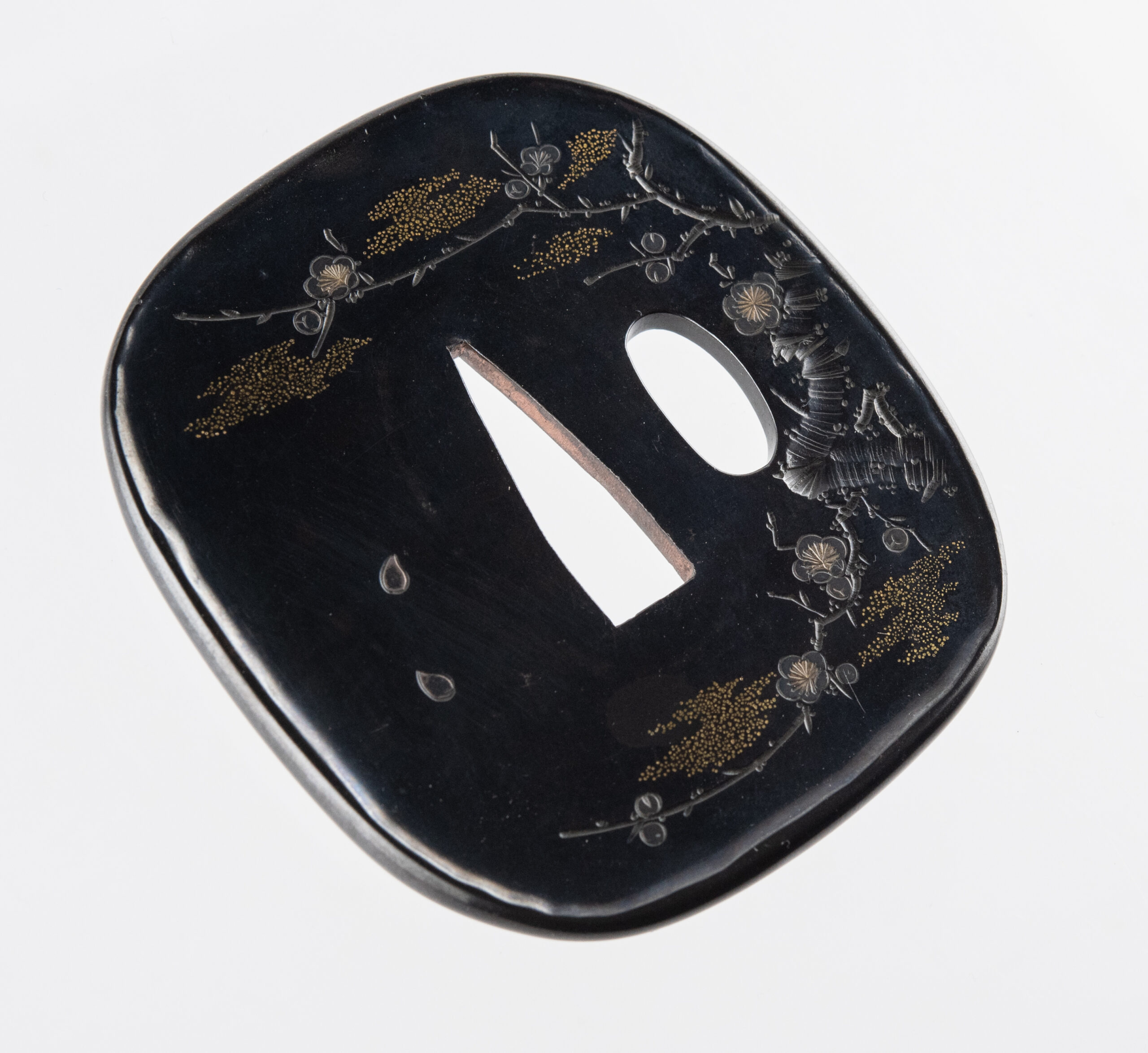
This refined Tsuba is a work by the second-generation Funada Ikkin (ca. 1840–1885), an accomplished metalworker of the Ichijo school. The front bears the signature Funada Ikkin with kao, and the NBTHK awarded the piece Tokubetsu Hozon certification. Workmanship and Design The artist made the Tsuba entirely from shakudo and finished the plate in migaki-ji, creating a smooth, polished surface that emphasizes the deep color of the alloy. The plate has one kozuka-hitsuana and is otherwise solid. Toward the edge, the artist gently hammered the plate upward, producing a subtly raised rim and a restrained three-dimensional profile (uchikaeshi-mimi). On the right side of the front, a delicately rendered lily, probably a water lily, rises against the polished shakudo ground. Silver forms the petals, while gold highlights the flower centers. Fine point-like gold decoration in keshi-komi zogan appears beneath and around the motif, adding a restrained shimmer to the otherwise dark surface. The contrast between the polished black shakudo and the sparse silver and gold details gives the composition an elegant and highly controlled appearance. The reverse depicts a flowering plum branch, a motif closely associated with the work of Ikkin. The artist modeled the branches and twigs with rounded chisel work rather than katakiri-bori, giving them a softly sculptural character. Silver forms the petals of the plum blossoms, while gold accents their centers. Fine point-like gold decoration surrounds the motif and echoes the treatment on the front. About Funada Ikkin II The second-generation Funada Ikkin (ca. 1840–1885) was the son and successor of the first Funada Ikkin. He continued the highly refined metalworking tradition associated with Goto Ichijo and the Ichijo school. His work is known for carefully controlled carving, polished shakudo grounds and sophisticated combinations of precious-metal decoration. Details Comes with a custom Kiri box 一乗派の優れた金工として知られる二代船田一琴(約1840–1885)による上質な鍔です。表には「船田一琴」花押の銘があり、本作にはNBTHK特別保存刀装具鑑定書が付属します。 赤銅磨地 地金は赤銅で、表面は滑らかな磨地に仕上げられています。赤銅特有の深い色調と艶やかな表面が、金銀の装飾を美しく引き立てています。小柄櫃孔を一つ備え、その他は地透かしのない構成です。耳に向かって地板をわずかに打ち上げることで、縁部に穏やかな高さと立体感を持たせています。 睡蓮の意匠 表の右側には、睡蓮と思われる百合の花が繊細に表されています。花弁は銀、花の中心部は金で装飾されています。その下から周囲には微細な点状の金装飾が施され、黒く艶やかな赤銅地の上に控えめな輝きを添えています。 磨き上げられた赤銅の深い黒色と、限られた金銀の色彩との対比が、非常に洗練された構成を生み出しています。 裏面の梅花 裏面には、一琴の作品に特徴的な梅の意匠が表されています。枝や小枝は片切彫ではなく、丸みを持たせた鏨仕事によって立体的に表現されています。梅花の花弁には銀、花芯には金を用い、その周囲には表面と呼応する微細な点状の金装飾が施されています。 二代船田一琴について 二代船田一琴(約1840–1885)は初代船田一琴の子で、その跡を継いだ金工です。後藤一乗に連なる高度な金工技術と美意識を受け継ぎ、精緻な彫技、磨き上げた赤銅地、そして金銀を用いた洗練された色絵表現を特徴とする作品を残しました。
Offered by Tsuba Info
This piece has sold
37 on the market
Get an email when new Ichijo School work hits the market.

Ichijō School
Meiji
Signed
Tokuho (NBTHK)
Iebori · Kyoto
37 pieces on the market now
" Ichijo was the fifth-generation head of the Shichiroemon house, a cadet branch of the Goto family, and trained under Hanzaemon Kamejo before succeeding to the headship at fifteen. His imperial commissions -- fittings for Emperor Kokaku in 1824 and Emperor Komei in 1862 -- earned him the ranks of Hokyo and Hogen respectively, and his atelier in Kyoto attracted a circle of gifted disciples who extended his aesthetic into the Bakumatsu and early Meiji periods. Among them, the celebrated "Five Tigers" (Goko) -- Funada Ikkin, Imai Nagatake, Hashimoto Isshi, Nakagawa Issho, and Wada Isshin -- together with the master's younger brother Goto Koran, constituted one of the most prolific and technically accomplished workshops in the history of Japanese tosogu production. The collective technical identity of the Ichijo school rests upon a foundation of shakudo nanako-ji of surpassing fineness -- described as "minute and orderly, deep and limpid," meriting the appellation kinume-nanako -- upon which elaborate pictorial compositions are built through takabori enriched by polychrome iroe employing gold, silver, shakudo, shibuichi, and suaka. Ichijo himself established the artistic direction by shifting from the canonical iebori subjects of dragons and lions toward compositions centered on close observation (shasei), rendering grasses, flowers, insects, birds, and landscapes with meticulous carving and refined dignity. This painterly sensibility pervades the entire school. Nagatake brought a distinctive ornamental density, arranging seasonal plants across entire surfaces with richly varied colored metals.
" Ikkin developed an unrivaled command of kosuki-bori -- a bold, thick chiseling technique that even Ichijo conceded was "beyond my own reach[[c:1]]" -- and his dragon subjects carried a distinctive forcefulness. " Isshin absorbed the hereditary vocabulary while concentrating creative zeal into individual passages of invention, and Issho achieved works of luxurious, courtly elegance through refined kinu-nanako and precise kebori. Koran, working in a manner akin to his elder brother yet "finished with an even more delicate and nuanced sensibility," brought the Shichiroemon branch to its most accomplished expression. Across the school, the favored tsuba form is the sumi-iri mokko-gata, and many works exhibit chuya shitate -- "day-and-night" construction using contrasting alloys on obverse and reverse. Complete daisho soroe kanagu sets, coordinated around seasonal, auspicious, or literary-historical themes, represent the school's highest format. " This standard was transmitted faithfully through the circle. " The school's productions are consistently praised for an elevated, Kyoto-inflected refinement that balances splendor and restraint in just measure. Learn more →
| Smith | Era | Designated |
|---|---|---|
| Goto Ichijo後藤一乗 | — | 91 |
| Tomei東明 | — | 30 |
| Nagatake永武 | — | 13 |
| Ikkin一琴 | — | 11 |
| Issho一匠 | 1828-1876 | 10 |
A Hozon-certified fitting of notably superior craftsmanship and condition, often with signature or workmanship of high reference value.
The NBTHK (Nihon Bijutsu Tōken Hozon Kyōkai, the Society for the Preservation of Japanese Art Swords) is a public-interest incorporated foundation founded in 1948 and supervised by Japan’s Agency for Cultural Affairs (Bunkachō); it is based at the Japanese Sword Museum in Tokyo. Its expert panels physically examine each submitted work (shinsa) and issue a certificate (kanteishō) ranking it by artistic and historical merit. NBTHK papers are the most widely recognized standard of authentication for Japanese swords and fittings.
NBTHK official siteAll sales are final and no refund will be issued. Individual refund conditions may be offered on request. For items with third-party certificates (e.g. NBTHK), a return is offered if the certificate is proven falsified and claimed within one year after shipment.