 NihontoWatchNihontoWatch
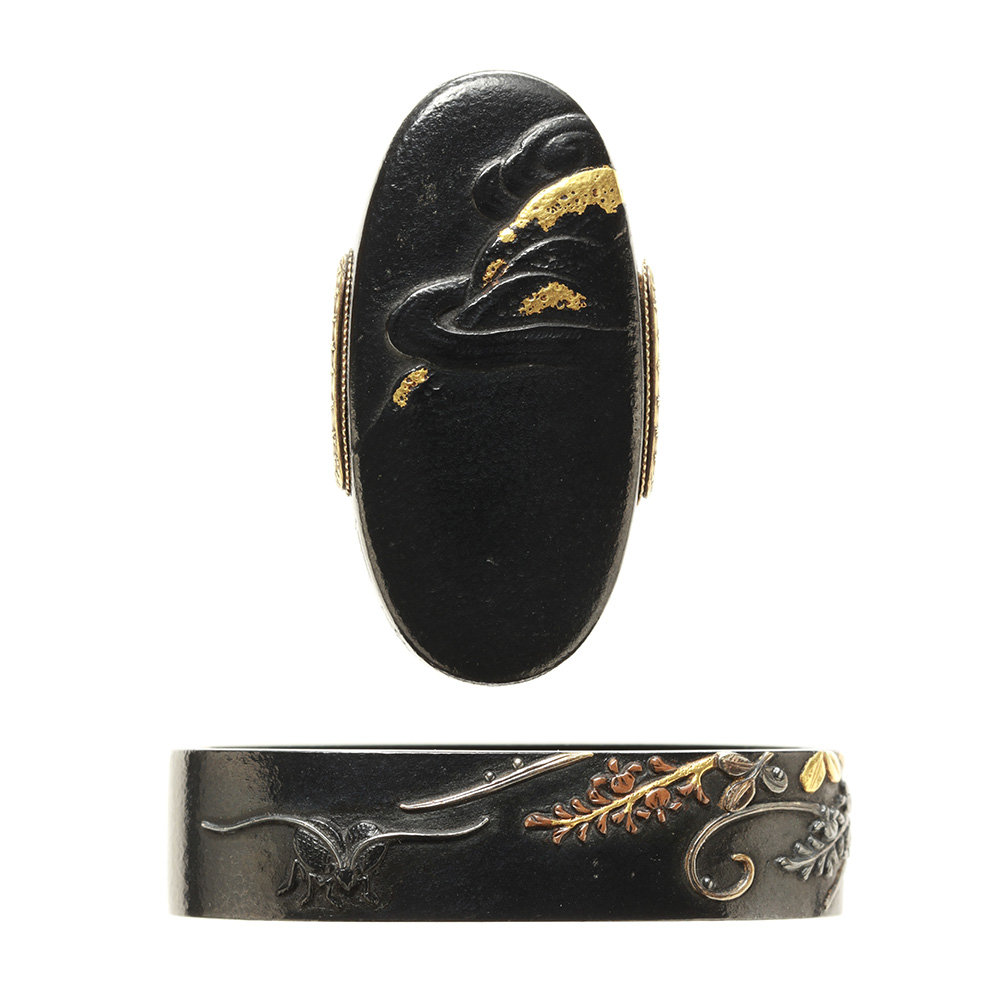
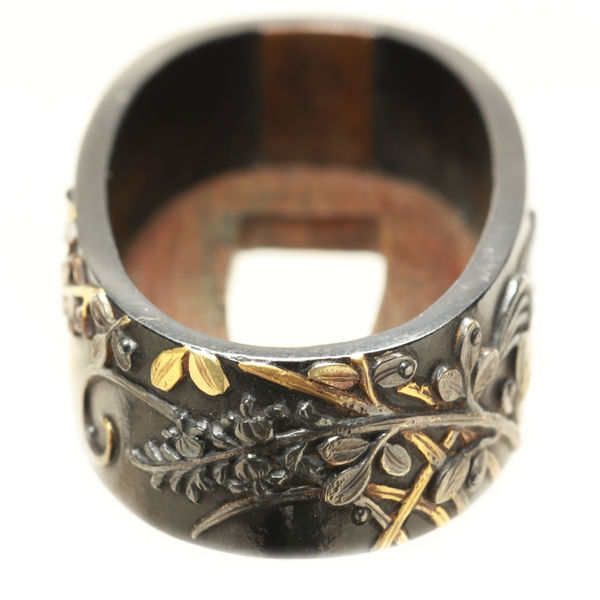
Engraved with a bell cricket in the shade of bush clover, this is a work by the late Edo period master Kono Haruaki. The bell cricket is depicted as a tasteful motif even in the "Tale of Genji." One poem sent from Onna San no Miya to Hikaru Genji is "I have come to know the general autumn as a time of sorrow, yet the voice of the bell cricket is hard to cast aside," to which Genji replied, "Though I intentionally loathe this dwelling of grass, the voice of the bell cricket still does not grow old." With these waka poems likely in the background, distant mountain ranges are engraved on the kashira, expressing the quiet flow of time. The shakudo substrate is finished in a calm ishime-ji, and the bush clover is rendered in clean takabori with kin, gin, and suaka iroe. The bell cricket is also said to be a precise depiction.
NihontoWatchOffered by Choshuya
This piece has sold
Get an email when a new Kono Haruaki piece hits the market.

Edo
Musashi
Signed
Tokuho (NBTHK)
As written by the shop
Machine translation from the shop's Japanese · may contain errors ·
Machibori · Musashi
3 pieces on the market now
Kono Haruaki (春明, also read Shunmei), common name Kono Bunzo, was born in Edo in Tenmei 7 (1787) and at fifteen entered the workshop of Yanagawa Naoharu, of the Yokoya line. He first signed Haruto and changed his name to Haruaki in the Bunka era. Around Bunsei 4 or 5 he was appointed Hokkyo, and soon after he rose to Hogen, the rank that appears in nearly every signature on record. The published sources count him one of the representative Edo metalwork artists of the age of Goto Ichijo, and record that "he was called Haruaki of the East against Ichijo of the West"[[c:1]]. He trained many pupils and died in Echigo in Ansei 4 (1857).
His hand rests on the pictorial carving of the Yanagawa school, yet the published sources hold that "his ideal seems to have lain with the Goto house"[[c:2]]. Taking his teacher Naoharu together with Yokoya Somin and the Goto house as the sources of his method, he went on to a domain of his own. His shakudo is of the quality called "the wet black of a crow's feather"[[c:3]], and on it he sets brilliant gold and a wide range of coloured metals in a realistic, elegant picture, his takabori iro-e outstanding. In the details, the sources note, "the weighty chisel manner of the Goto school can be recognised"[[c:4]].
His techniques range widely. He works shakudo nanako, polished shibuichi and shibuichi ishime, iron, and solid gold, in high relief, sukidashi takabori and katachi-bori menuki, with hira-zogan inlay, katakiri-bori and the fine hairline of shigure rain. A kozuka of chrysanthemums made at fifty-six is called "more minutely and richly worked than usual"[[c:5]]. A tsuba of a kappa reaching for a cucumber, made in Tenpo 14 at fifty-seven, shows gold surihegashi and a tiny frog inlaid in shakudo on the reverse, with shigure kebori and katakiri-bori water. On a fuchi-kashira in solid gold a crowd of tortoises is carved so that each face and each shell differs.
His subjects run from the Goto canon to the playful. A Kurikara dragon mitokoromono is made with the Goto house in mind in both subject and technique, and its rare signature Hogen Haruaki belongs to a few works of his prime in the Bunsei era. Beside it stand the warrior Yoshiie reading an ambush from the broken line of geese, the guardian Nio in red copper with gold and silver, the immortals Gama and Tekkai, a horned owl at night, Okame under the moon, Fukurokuju, and a kozuka of the poet Sogi whose accompanying blade carries his verse on winter rain. The sources find in his work a light, witty Edo taste, and of a tsuba of the Tanabata festival they write that it is "finished as a work brimming with the feeling that only Haruaki commands"[[c:6]].
He was a restless traveller, and his signatures document it. In the Bunsei years he travelled through Tohoku and northern Kanto, making pieces on commission for wealthy patrons and farming families and leaving several fine works in Sendai. The Tanabata tsuba of Bunsei 11 is signed as made at Kamegasaki in the Shonai region, and in his late Kaei and Ansei years he went to Echigo, adding inscriptions that record his travels. He also used the art name Jippo-o, the old man of the ten directions, on menuki and a tsuba. A spring landscape tsuba with swallows and dandelions, made when he was past sixty, is described as fresh and lively despite his age.
For the collector Haruaki is a leading bakumatsu Edo master with a substantial designated record: eighteen works at the Juyo level, among them tsuba, kozuka, menuki, a mitokoromono and two complete wakizashi mountings fitted with his work, one with each fitting dated and signed Hogen. Two kozuka came down through the Ryushido collection. He has no higher designations. Signed pieces of his appear from time to time, and a fine dated work in his richly coloured high relief is a rewarding find for a collector of late Edo metalwork.
Where Haruaki stands among comparable artisans: across all of nihontō, and within tradition, era, and period. The tiers (Foremost · Leading · Major · Notable) weigh official designations from the NBTHK and Japan's Agency for Cultural Affairs, together with historical honors of lasting repute such as the Sansaku and Meibutsu-chō.
Select a lens to see how it's measured.
Machibori · Edo
60 pieces on the market now
The Yanagawa (柳川) school ranks among the principal machibori ("town carving") lineages of Edo metalwork, arising in the mid-Edo period as a direct offshoot of the Yokoya house. Its founder, Yanagawa Naomasa (1692–1757), studied under Yoshioka Inaba-no-suke and under Yokoya Sōmin, and established himself in the Otamagaike district of Edo. The NBTHK setsumei consistently locate the school within this filiation, styling it "the Yanagawa branch within the Yokoya lineage" (横谷門下柳川派) and naming Naomasa as the family founder (家祖). Naomasa had no biological heirs and devoted himself to the training of disciples, and the successive heads of the house inherited the character nao (直). " The collective idiom of the school is the classic Yokoya-derived vocabulary of Edo kinkō work: grounds of shakudō (赤銅) dressed in nanako-ji (魚子地), high-relief carving (takabori) — frequently executed as applied motifs (suemon) — and polychrome inlay (zōgan iroe) in gold, silver, and shibuichi, deployed across kozuka, kōgai, fuchi-kashira, menuki, and tsuba. The school was likewise renowned for excellent katakiribori (single-cut carving), and its repertoire favored classical subjects: shishi (lions) with peonies, tigers, Chinese sages, and figural themes such as the Seven Lucky Gods.
Fidelity to the manner of Sōmin remained the school's touchstone across generations. " Equally characteristic is the school's mode of transmission, whereby pupils composed their art-names from characters granted by the Yanagawa masters. The measure of the Yanagawa school's significance lies as much in what it engendered as in its own production. Ishiguro Masatsune, a pupil of Katō Naotsune of the Yanagawa school, formed his name by combining masa (政) from Naomasa and tsune (常) from Naotsune; the setsumei record that he "moved beyond the manner of the Yanagawa school, devising innovative treatments particularly within bird-and-flower subjects," founding the Ishiguro lineage, which "continued to prosper through successive generations until the Meiji period" and produced the celebrated "twin peaks" Masayoshi and Masaaki. " Through these ramifying lines, the Yanagawa school served as the essential conduit by which the Yokoya manner of takabori iroe on shakudō nanako-ji grounds was disseminated across the late-Edo metalworking world. Learn more →
| Smith | Era | Designated |
|---|---|---|
| Haruaki春明 | — | 18 |
| Naoharu直春 | — | 7 |
| Naomasa直政 | — | 5 |
| Akinori/Meijo明乗 | — | 0 |
| Akio明雄 | — | 0 |
A Hozon-certified fitting of notably superior craftsmanship and condition, often with signature or workmanship of high reference value.
The NBTHK (Nihon Bijutsu Tōken Hozon Kyōkai, the Society for the Preservation of Japanese Art Swords) is a public-interest incorporated foundation founded in 1948 and supervised by Japan’s Agency for Cultural Affairs (Bunkachō); it is based at the Japanese Sword Museum in Tokyo. Its expert panels physically examine each submitted work (shinsa) and issue a certificate (kanteishō) ranking it by artistic and historical merit. NBTHK papers are the most widely recognized standard of authentication for Japanese swords and fittings.
NBTHK official siteIf, due to our fault, the item differs significantly from its proper condition, the item may be returned. Cooling-off is within one week of the item's arrival.