 NihontoWatchNihontoWatch
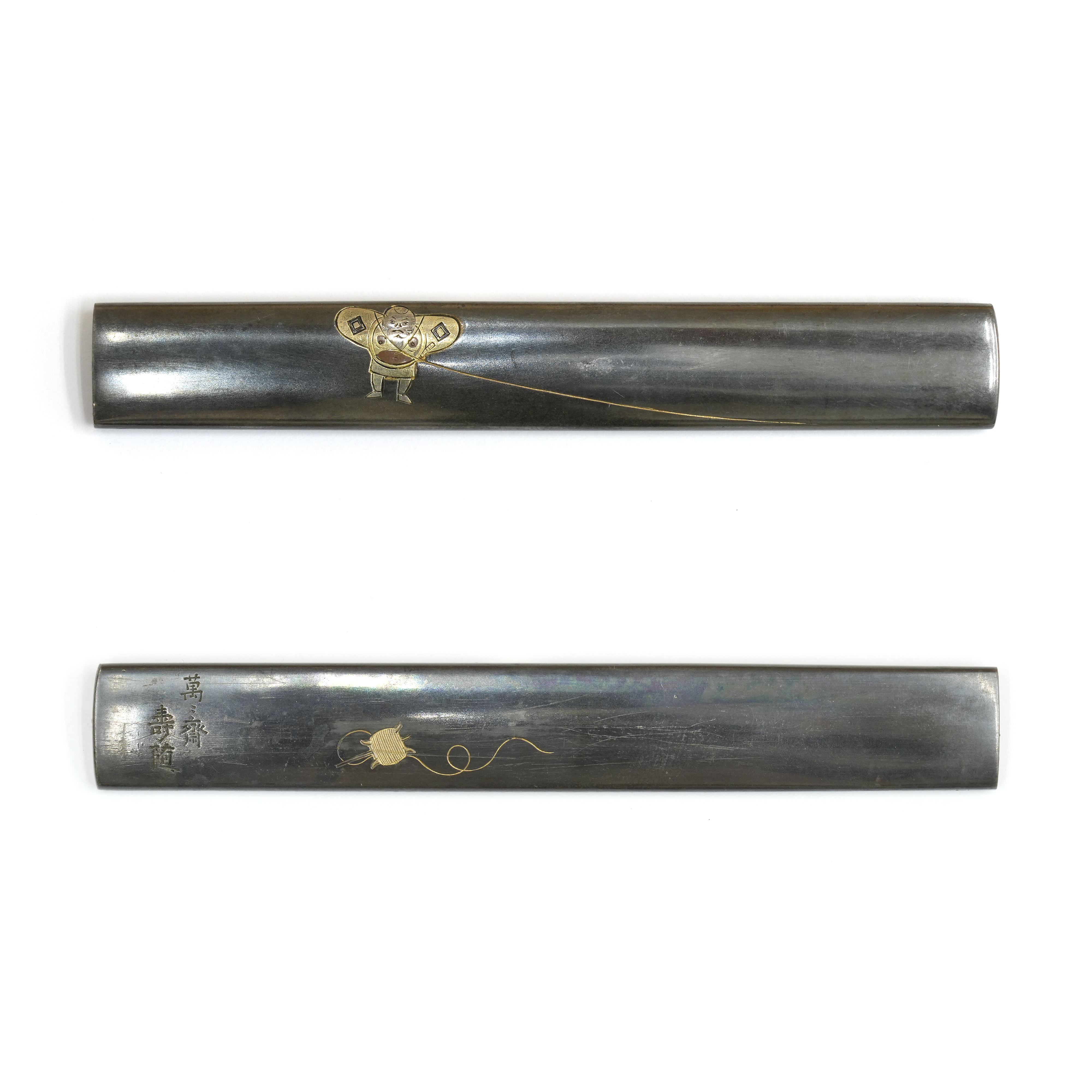
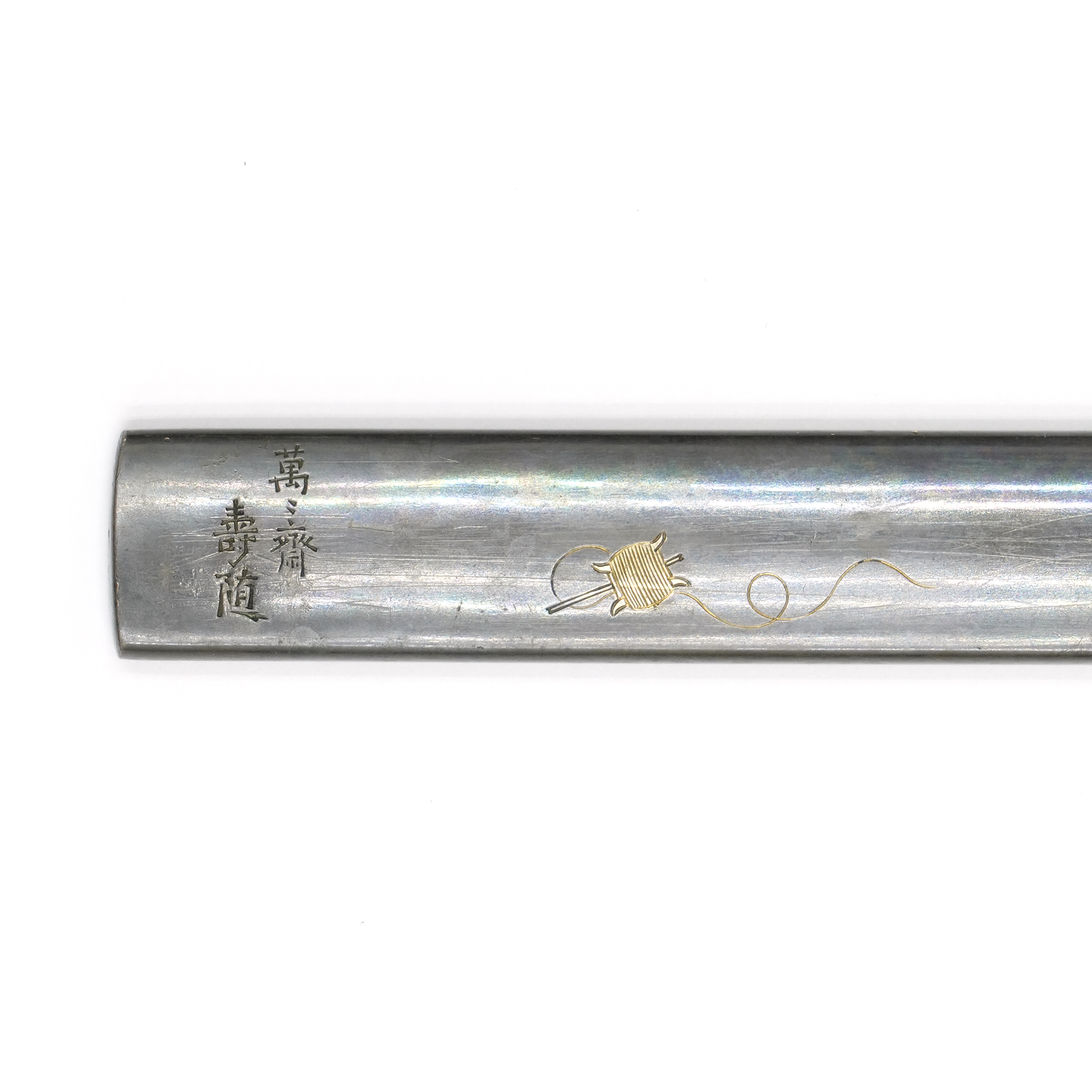
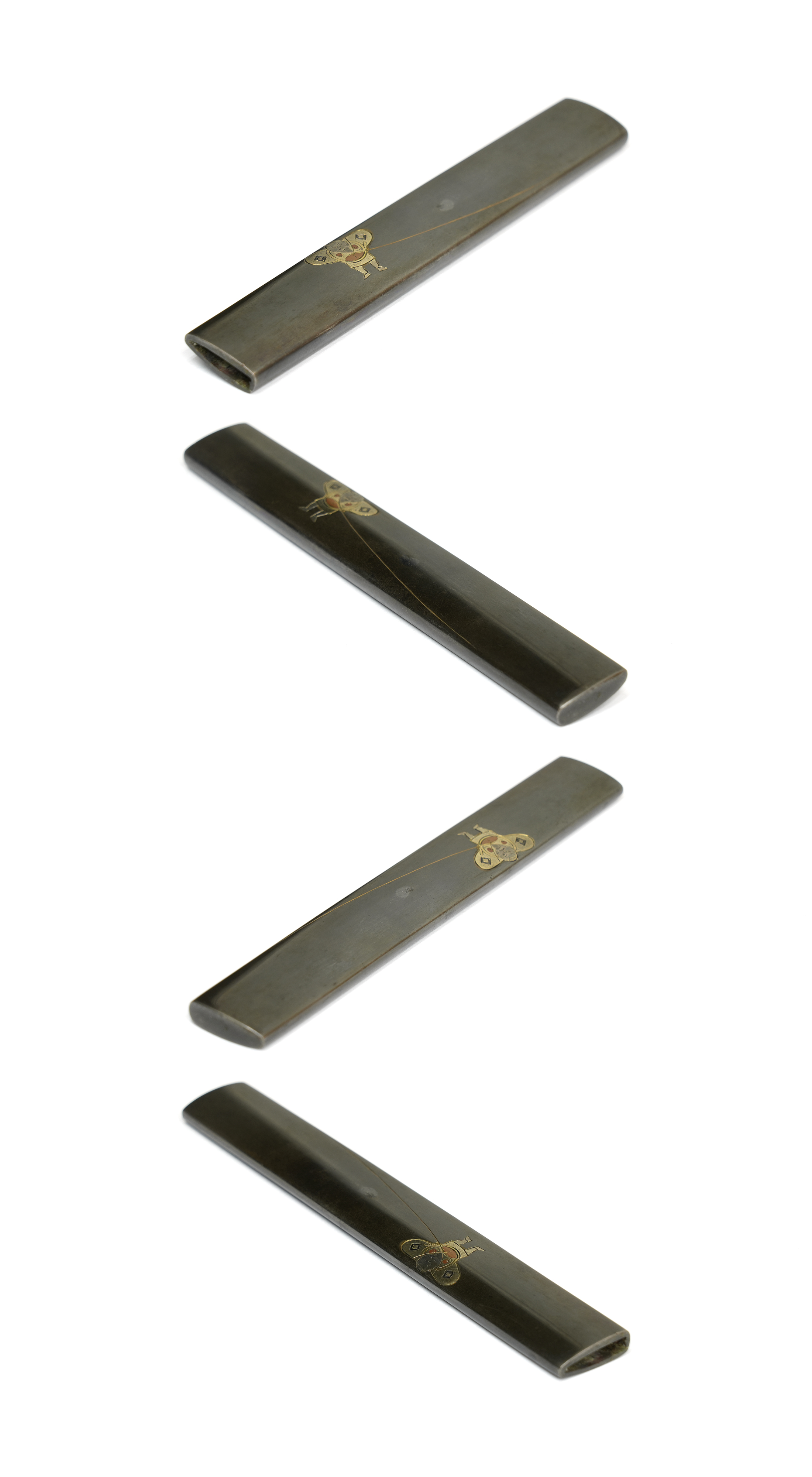
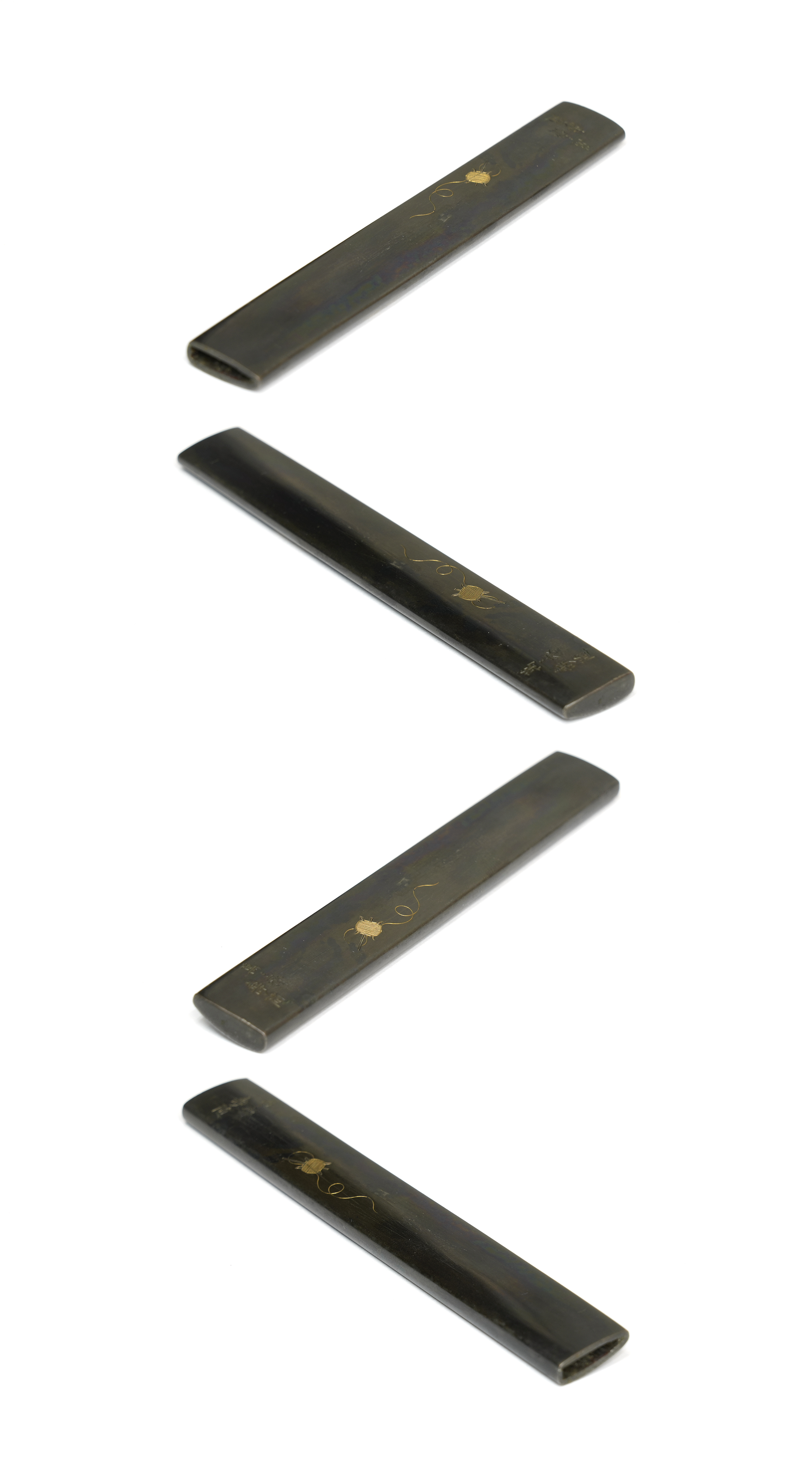
Hisazui was a Hamano school metalworker who studied under Noriyuki, known as a high-ranking disciple of the school's founder Hamano Shozui, and is said to have been active in the mid-18th century; he left works using the go "Manmanzai" that skillfully transferred figures, historical events, and familiar scenery onto metal surfaces, and this piece clearly displays a sophisticated sensibility that, while based on the Hamano school tradition inheriting the Nara school lineage, makes broad use of a deep and calm shibuichi-ji to vividly bring the subject to life with minimal iroe and delicate lines. The yakodako is a representative Edo kite shaped like a yakko with both arms spread wide, cherished as a lucky charm to ward off misfortune and invite fortune due to its brave appearance dancing in the New Year sky, and its spirited form and somewhat charming expression are designs symbolizing the playful spirit of the Edo commoners; in this piece, by intentionally placing a small yakodako to one side of the long, narrow kozuka surface and drawing a single string extending from it to the far edge of the frame with a fine gold line, a concise yet narrative-rich composition is completed that makes one feel the invisible wind and the expanse of the high sky within the yohaku. The surface uses a shibuichi migaki-ji background exhibiting a refined grayish-black color, with the yakodako's face, hair, clothing, and limbs finely depicted through hira-zogan and kebori, condensing the characteristic broad-shouldered silhouette, clothing patterns, colors at the chest, and even the expression of the mouth into the small frame, while the contrast between the blackish sleeve patterns, the gold-shining clothing, and the reddish suaka-iro accents enhances the figure's charm, and the long kite string extending diagonally across the quiet ground creates the lightness of the moment the kite catches the wind and rises, allowing one to enjoy Hisazui's sensibility that creates depth through the precision of hira-zogan and the beauty of lines without relying on the volume of nikubori. On the reverse side, a bobbin for winding the kite string is represented in gold hira-zogan, and by letting the unraveled string play in soft curves, a continuous scene with the yakodako on the front is established; the device where the viewpoint shifts to the kite flying in the great sky when looking at the front and to the tool in hand manipulating it when turning to the back makes excellent use of the nature of the kozuka as an object to be appreciated by moving between front and back, and while leaving gentle rubbing appropriate for its age, the tone of the shibuichi and the charm of the zogan are sufficiently maintained, and since it is accompanied by a Hozon Tosogu Kanteisho, there is a sense of security regarding the mei and the provenance of the work, making it a highly attractive kozuka suitable for both collecting and gifting that allows one to taste the dignified Hamano school technique, Edo playfulness, and New Year-like auspiciousness in a single piece.
Offered by Toushin
32 on the market

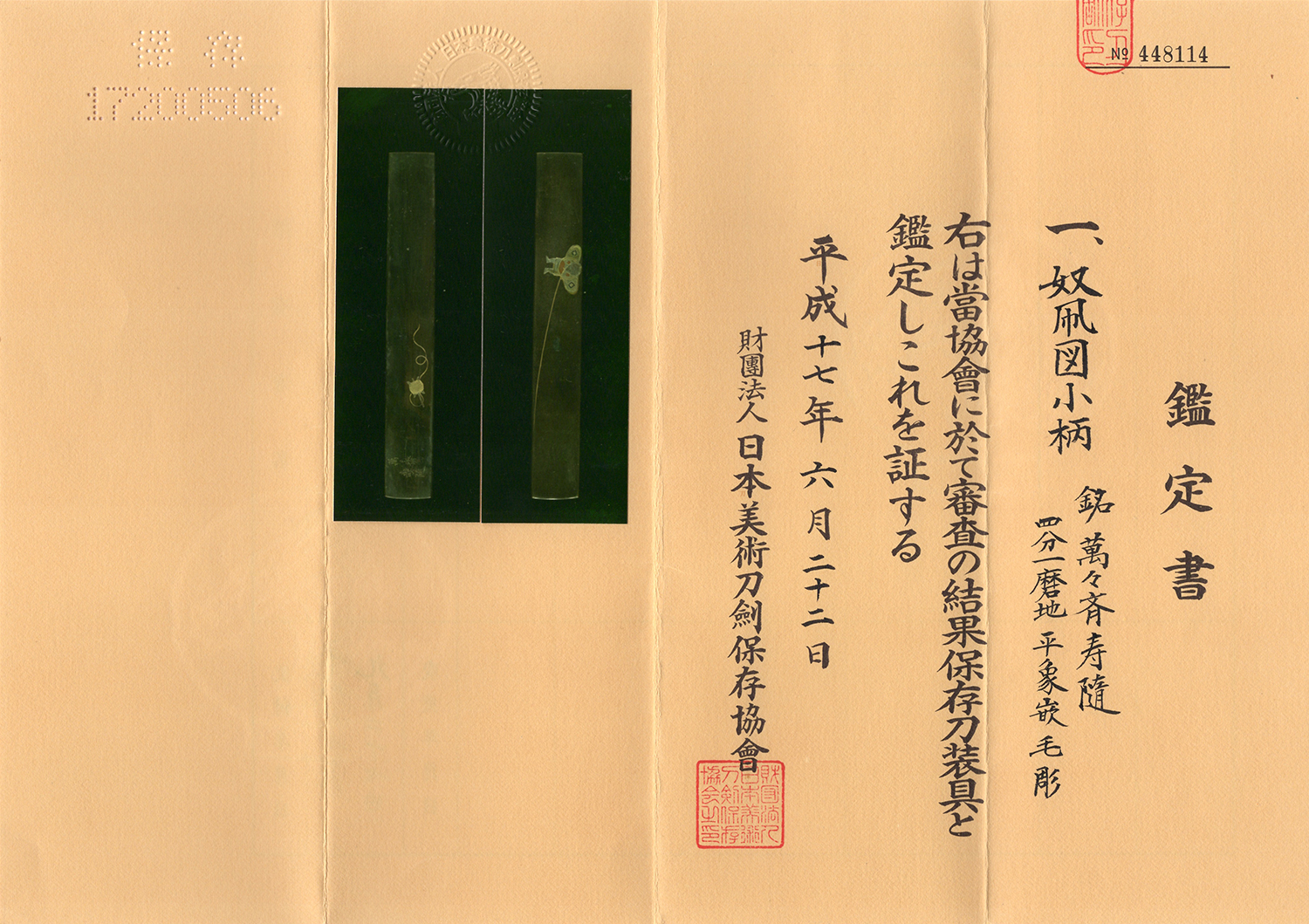
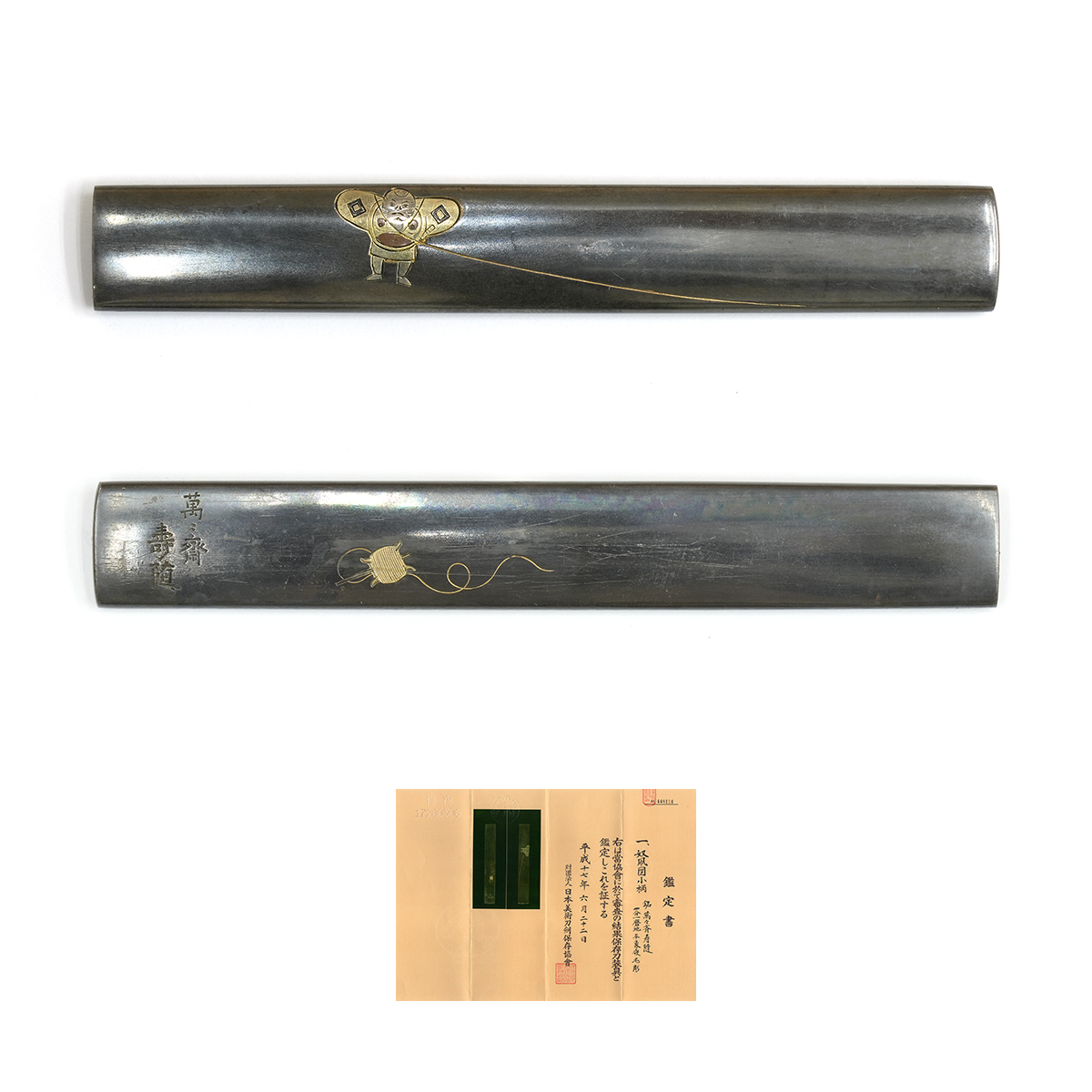
Hamano School
Edo
Signed
Hozon (NBTHK)
As written by the shop
Machine translation from the shop's Japanese · may contain errors ·
Machibori · Edo
32 pieces on the market now
The Hamano school of machibori carving was established in mid-Edo Edo by Hamano Masazui (浜野政隨), commonly known as Tarōbei, an exceptionally gifted pupil of Nara Toshihisa. As the Edo Kinkō Meifu states of him that he "thunders through the world," Masazui won widespread renown as one of the "Four Guardian Kings of Nara" (Nara Shitennō). Training many disciples and employing numerous art names—including Otsuryūken, Aji-zumi, Kankei, Rifūdō, Yūkotei, Shūhōsai, Hankei-shi, and Isshunan—he formed what came to be known as the Hamano school, establishing one of the principal lineages of machibori artistry and founding an independent house. " Works are rendered by means of yōbori (sculptural carving) upon varied grounds—gold-and-silver imo-tsugi-ji, solid gold (kinmuku)—with details frequently treated in the in'yō-kon mode, suggesting the early Gotō masters as models.
The carving is executed with "ample, well-judged volume (nikudori)" and "exceptionally full, weighty presence," while applied metal (okigane) in silver and shakudō with shakudō iroe tightens pictorial fields and imparts additional movement. Later Hamano artists such as Katsurano Akafumi maintained this technical versatility, favoring polychrome inlay applied to high-relief compositions. " The NBTHK repeatedly notes that works "clearly demonstrate the high level of technique," "amply demonstrate advanced technical mastery," and possess "a composed dignity"—attestations to the school's sustained excellence across generations and its enduring place within the broader machibori tradition. Learn more →
| Smith | Era | Designated |
|---|---|---|
| Shozui政随 | — | 17 |
| Sekibun赤文 | 1670 | 8 |
| Noriyuki矩随 | — | 4 |
| Naotoshi直寿 | — | 0 |
| Naoharu直春 | — | 0 |
Certifies a genuine fitting worth preserving: a correct signature, or, if unsigned, an identifiable era and school, with recognized artistic and craft value.
The NBTHK (Nihon Bijutsu Tōken Hozon Kyōkai, the Society for the Preservation of Japanese Art Swords) is a public-interest incorporated foundation founded in 1948 and supervised by Japan’s Agency for Cultural Affairs (Bunkachō); it is based at the Japanese Sword Museum in Tokyo. Its expert panels physically examine each submitted work (shinsa) and issue a certificate (kanteishō) ranking it by artistic and historical merit. NBTHK papers are the most widely recognized standard of authentication for Japanese swords and fittings.
NBTHK official siteAs a rule we do not accept returns, except when we have sent a different item from the one ordered or when there is a significant discrepancy between the description and the item. If you wish to return an item, please contact us within 3 days of its arrival and then send it back.
¥330,000