 NihontoWatchNihontoWatch
Kyokukosai To’un was a metal artist of the late Edo period who followed the lineage of the Nara school, and although details of his biography remain unknown, one source records him as being born in Tenmei 6 (1786). The Nara school was a faction that skillfully transferred pictorial themes onto the base metal using chisel work, combining materials such as tetsu, shakudo, and shibuichi with nikubori and irogane to elegantly express figures, flora and fauna, and historical events; this work also displays the steady ability of To’un to harmonize a powerful tetsu-ji with splendid metalwork decoration. The ho-o is an auspicious bird said to appear in a peaceful world ruled by an excellent monarch, and the kiri is considered the auspicious tree where that ho-o dwells; the Kiri Ho-o zu, which combines the two, has been widely revered from court decorations to samurai furnishings and tosogu as a high-ranking auspicious motif celebrating Tahei, prosperity, and the flourishing of family fortunes. This work features a large nadekaku-gata tetsu-ji with deep and varied tsuchime, arranging a ho-o spreading its wings wide on the upper part of the omote and kiri with leaves and flowers on the lower part; the ho-o's sharp gaze, crest feathers, multiple layers of wings, and tail feathers fluttering long to the left and right are distinguished by sukidashibori and fine carved lines, while kin nunome zogan applied to key points vividly enhances the majestic appearance of the auspicious bird. On the ura, the ho-o is not depicted, and instead, kiri with extending branches and leaves and three flower clusters are spread across the entire screen, showing a calm expansion of plant patterns in contrast to the dynamic composition of the omote; the asymmetrical arrangement skillfully incorporating two kosukashi and the margins surrounding the seppa-dai create a pleasant ma within the dense carving. By turning the omote and ura, the composition allows for the continuous appreciation of the splendid scene where the ho-o alights upon the kiri and the lingering scenery where only the auspicious tree grows quietly. The contrast between the tetsu-ji, which has developed a blackish-brown color, and the old gold color is gorgeous yet composed, and the kin nunome zogan remaining on the tail feathers, kiri stems, flowers, and leaf veins emerges delicately depending on the direction of the light, while the golden border encircling the mimi neatly tightens the entire heavy screen. With its large and voluminous tetsu-ji, the Kyokukosai To’un mei and kao, and an auspicious design utilizing Nara school-like pictorial quality and technique, this is a high-ranking work suitable for taking center stage in a display, possessing a grand presence from the front and allowing one to savor the details of the tsuchime, tagane, and nunome zogan at hand.
Offered by Toushin
79 on the market

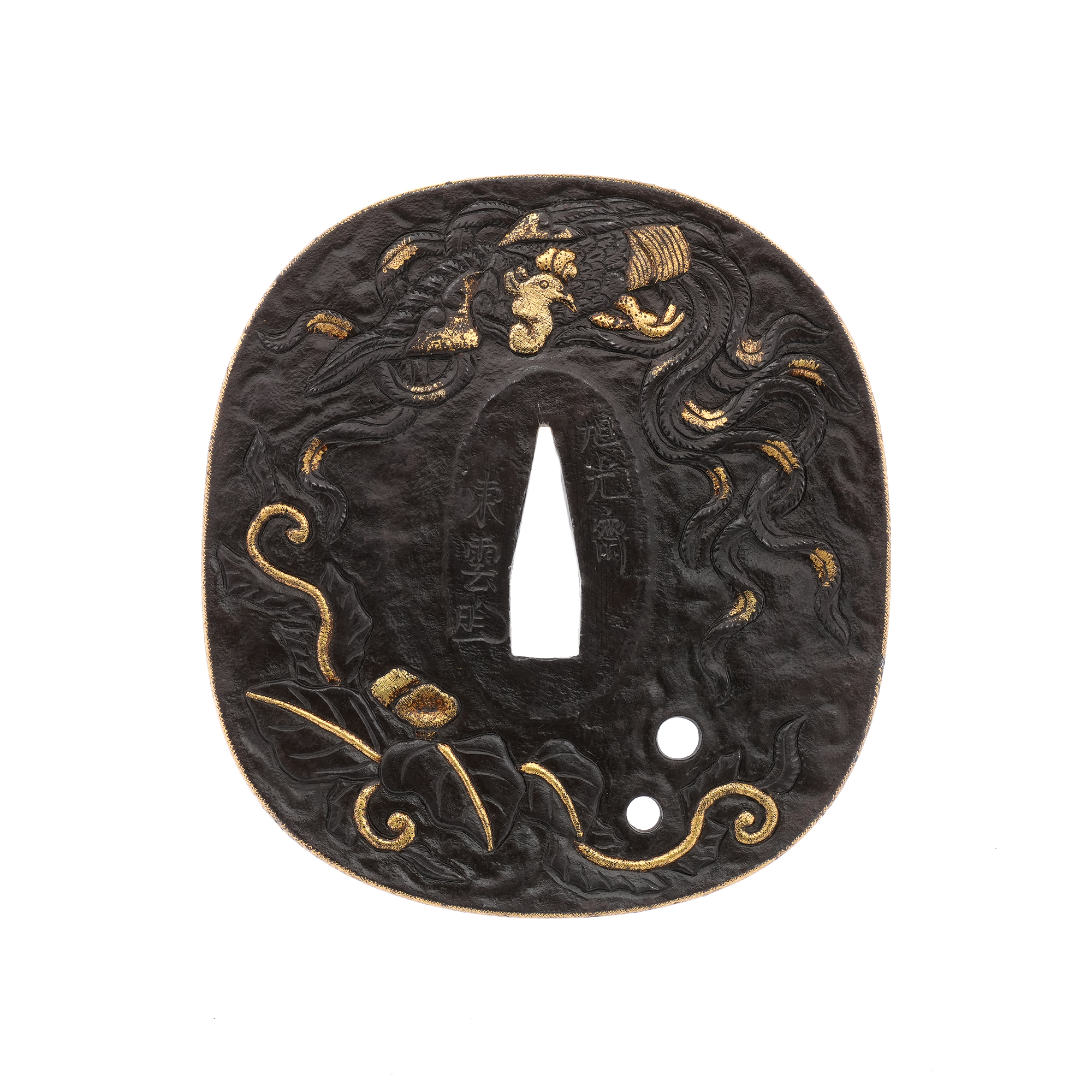
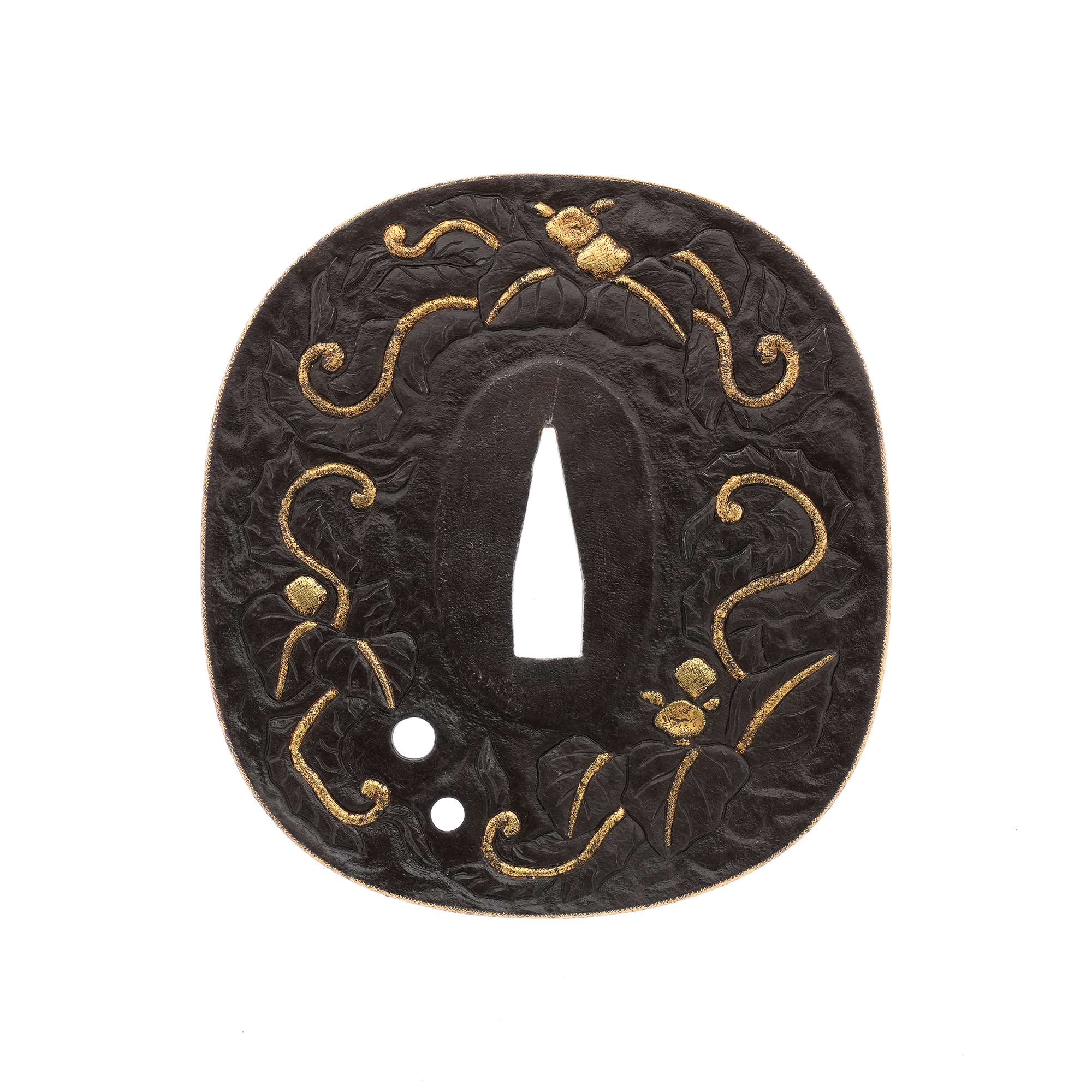
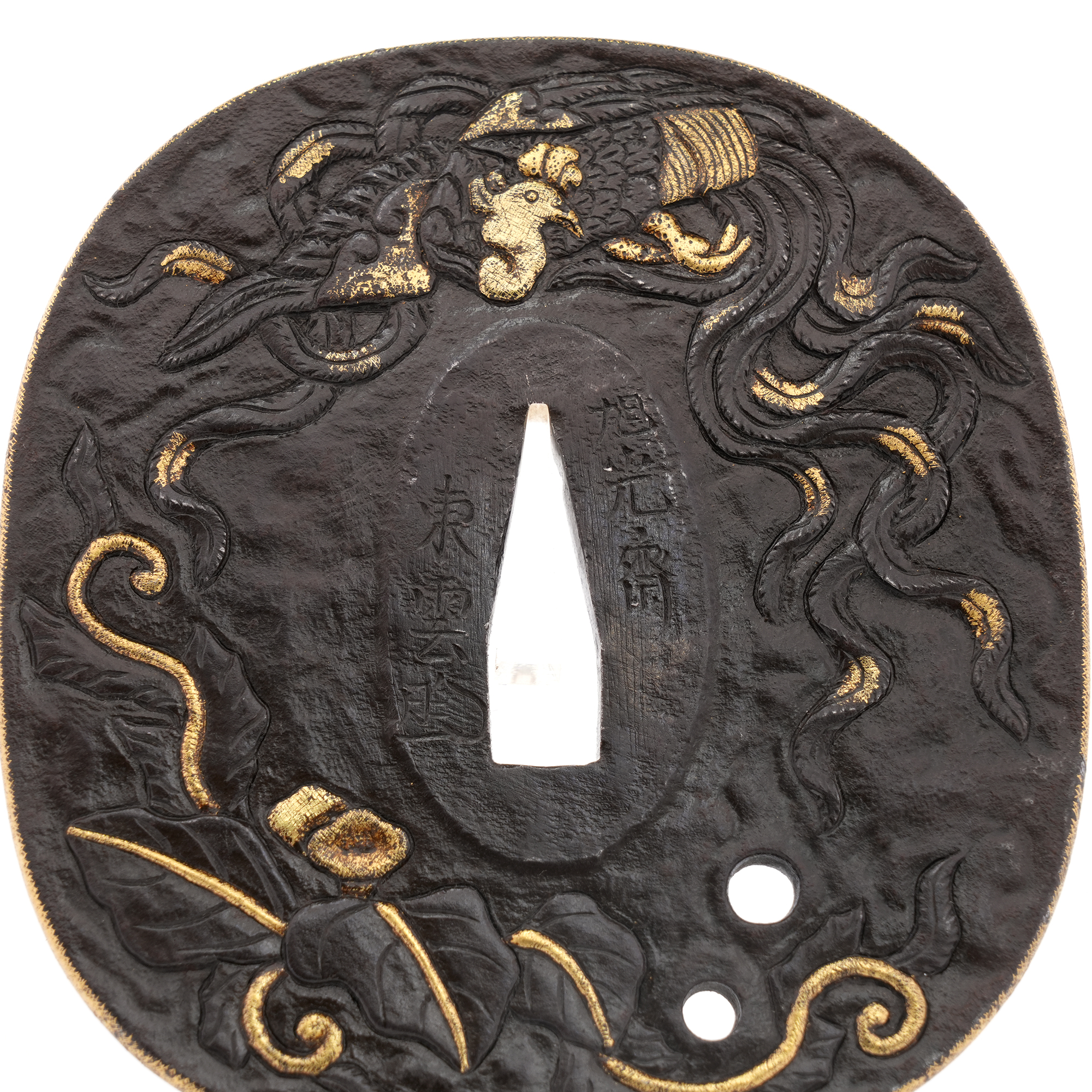
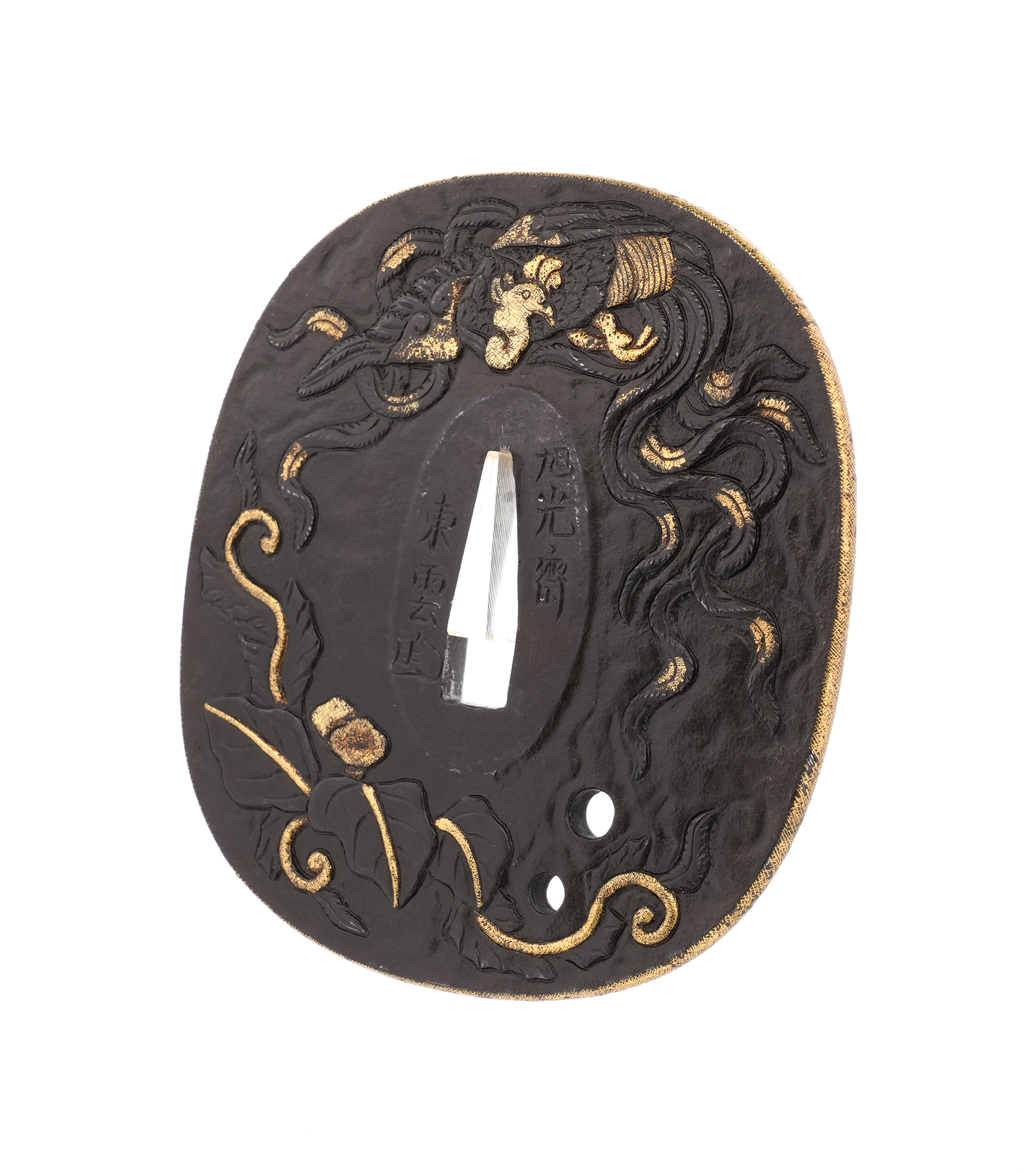
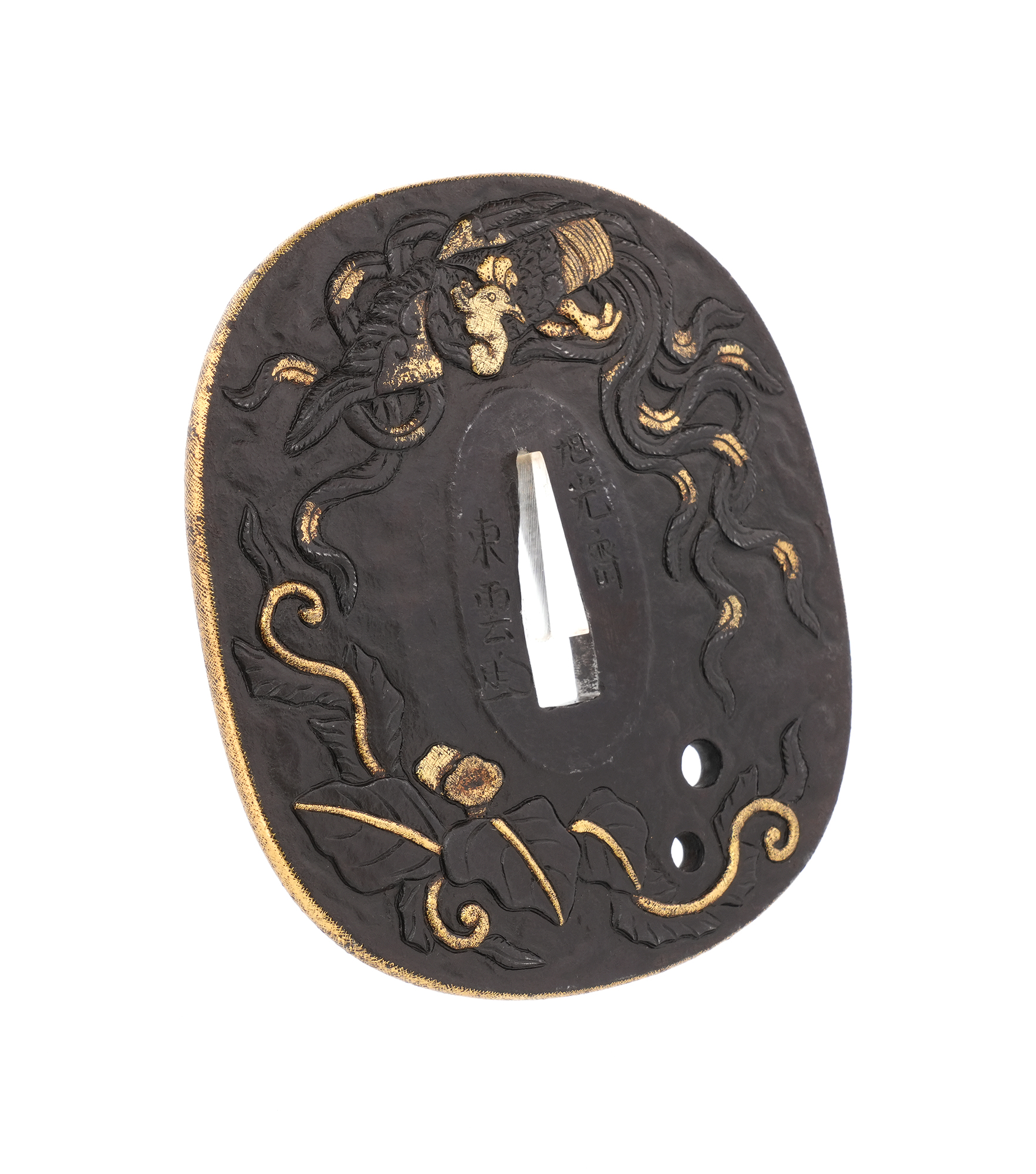
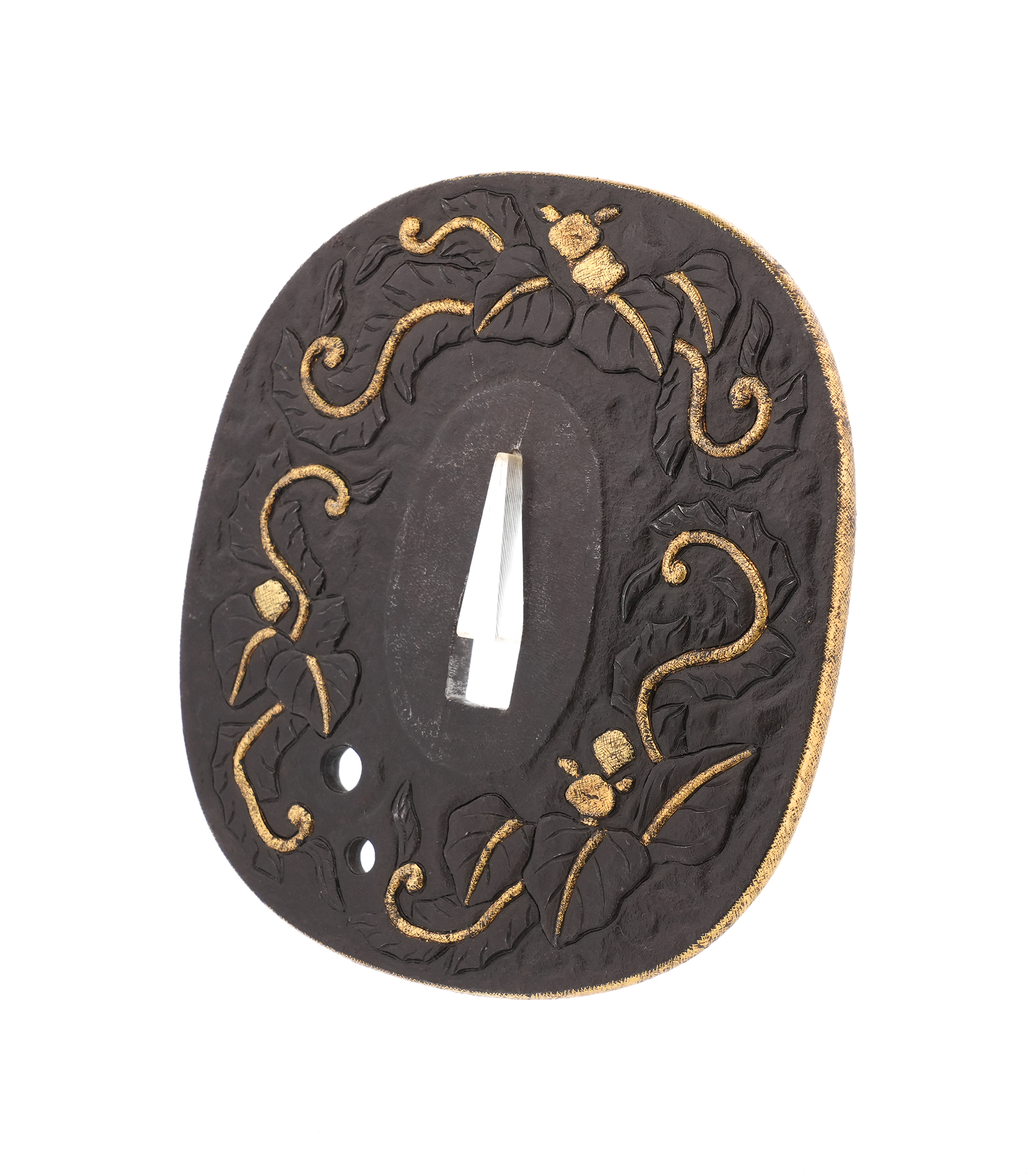
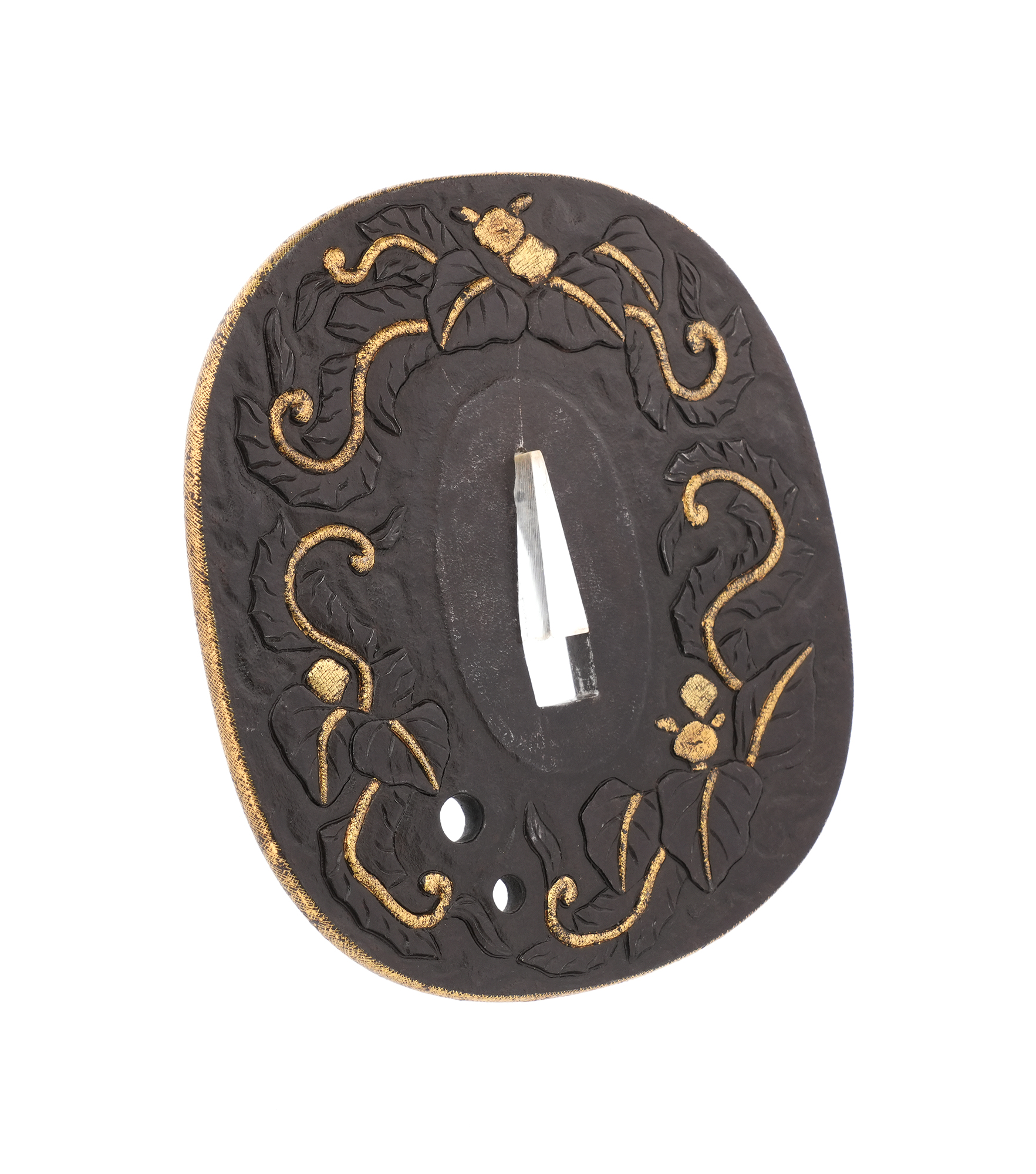
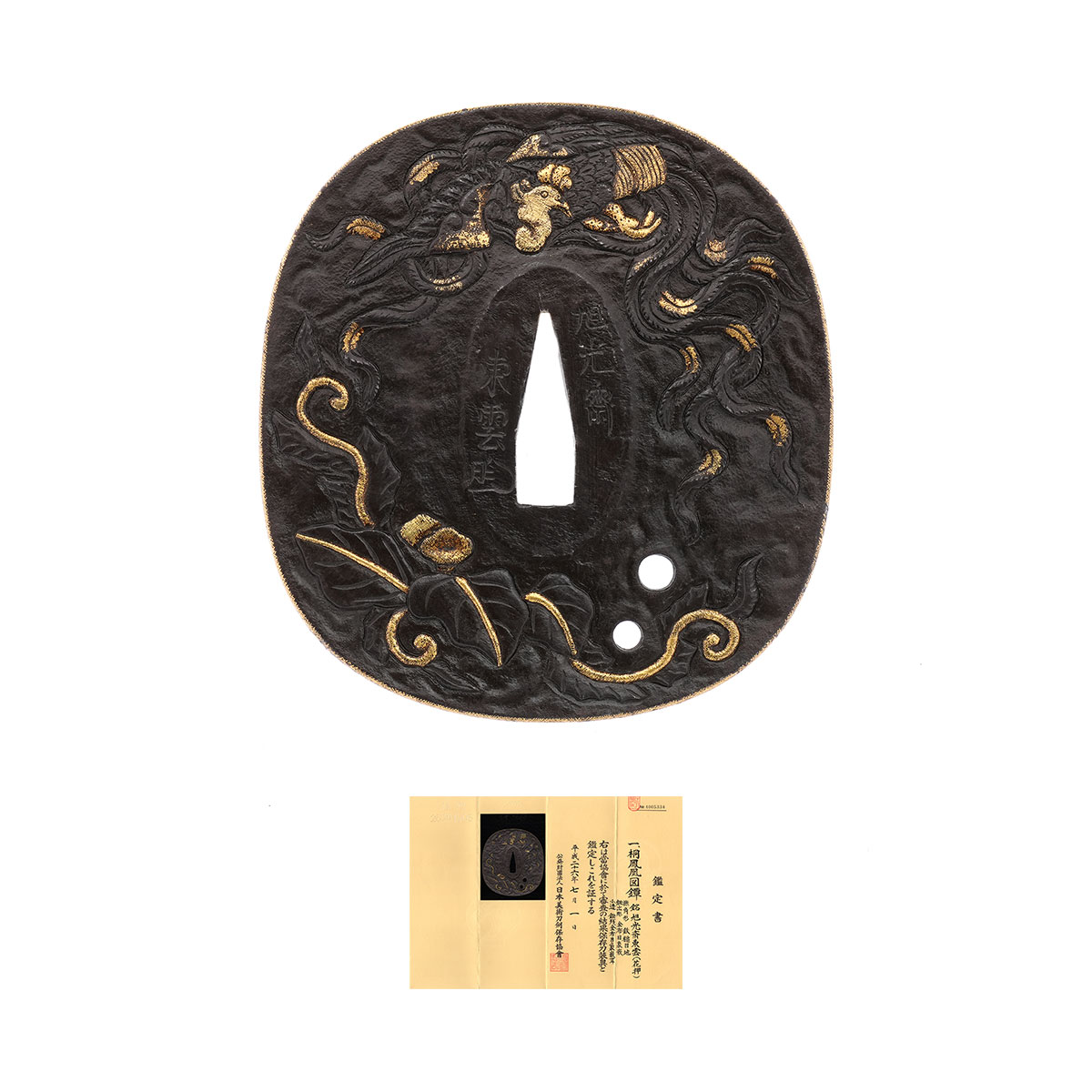
As written by the shop
Machine translation from the shop's Japanese · may contain errors ·
Machibori · Edo
79 pieces on the market now
The Nara school of kinko (metalwork) emerged in the mid-Edo period as one of the most celebrated independent traditions of sword-fitting craftsmanship, its masters working outside the patronage structures that governed the Goto house. The school coalesced around the figure of Nara Toshihisa (1667--1736), also known as Tahee, who as head master during its creative zenith defined the mature idiom of the lineage. Though the school's origins are often traced through the successive generations of the Nara family beginning with Toshiharu, its lasting fame rests upon the Nara sansaku — the Three Masters of Nara: Toshihisa, Tsuchiya Yasuchika, and Sugiura Joi. " Joi (1701--1761), trained under Juei in the lineage of Toshiharu, rose to become the third pillar of this triumvirate. Together, and joined by masters of allied lineages such as Hayashi Shigemitsu of the Higo kinko tradition, the Nara school and its circle represent the highest achievement of independent metalwork in the Edo period. The collective technical vocabulary of the Nara school encompasses an extraordinary breadth of materials and methods. Its masters worked in iron, shakudo, shibuichi, brass (shinchu), refined copper (suaka), and oborogin, treating surfaces as polished grounds (migaki-ji), hammered textures (tsuchime-ji), and stone-grain finishes (ishime-ji) — the latter developed by Toshihisa into a distinctive personal manner. The school's carving methods span the full spectrum: sukidashi-bori modeled relief, takabori high relief, the thread-fine line work of kebori, and the single-stroke katakiribori incision. " Yet individual specialties distinguish the masters within this shared vocabulary.
Toshihisa's art finds its fullest expression in sukidashi takabori — relief carving in which figures are raised with subtly graduated heights to produce an illusion of spatial depth — executed against his richly textured ishime-ji grounds. Joi developed nikuaibori, a modulated relief technique of unrivaled refinement, producing entire compositions through chisel work alone on polished oborogin grounds, dispensing with inlay and colored-metal accents. Yasuchika's range is perhaps the broadest, encompassing the distinctive daigaku-gata iron tsuba conceived for his patron and kozuka that "draw forth a small universe" within a confined surface, while his late works signed with the art name Tou achieve an austere, detached realm the NBTHK terms kotan. The legacy of the Nara school rests on the singular ability of its masters to transcend decorative function and achieve genuine artistic expression within the confines of sword fittings. Toshihisa, as the senior figure among the sansaku, established the standard of dignified, powerfully carved relief against richly textured grounds, and his figural subjects — gamecocks, tigers, Bishamonten — consistently achieve what NBTHK scholarship identifies as the philosophical duality of do (movement) and sei (stillness) within a single composition. " Joi, working primarily in the intimate format of the kozuka, achieved expressive authority through the sheer subtlety of his nikuaibori chisel work — his celebrated lion-and-cub compositions existing in closely related versions across multiple designations and published in the canonical reference Tagane no Hana. That the school also attracted masters of allied provincial traditions — Hayashi Shigemitsu of Higo, whose iron tsuba display the characteristic murasaki-sabi patina and "somewhat gentler feeling" that distinguishes the second generation from the founder Matahichi — attests to its gravitational influence on Edo-period metalwork as a whole. Across the school's production, the NBTHK's evaluative language converges on a consistent theme: compositional intelligence, technical command across the full range of materials and carving methods, and an expressive depth that elevates the finest works from accomplished craft to art of the highest order. Learn more →
| Smith | Era | Designated |
|---|---|---|
| Yasuchika安親 | — | 87 |
| Toshinaga利寿 | — | 30 |
| Joi乗意 | — | 12 |
| Shigeharu重治 | — | 0 |
| Toshiyoshi利善 | — | 0 |
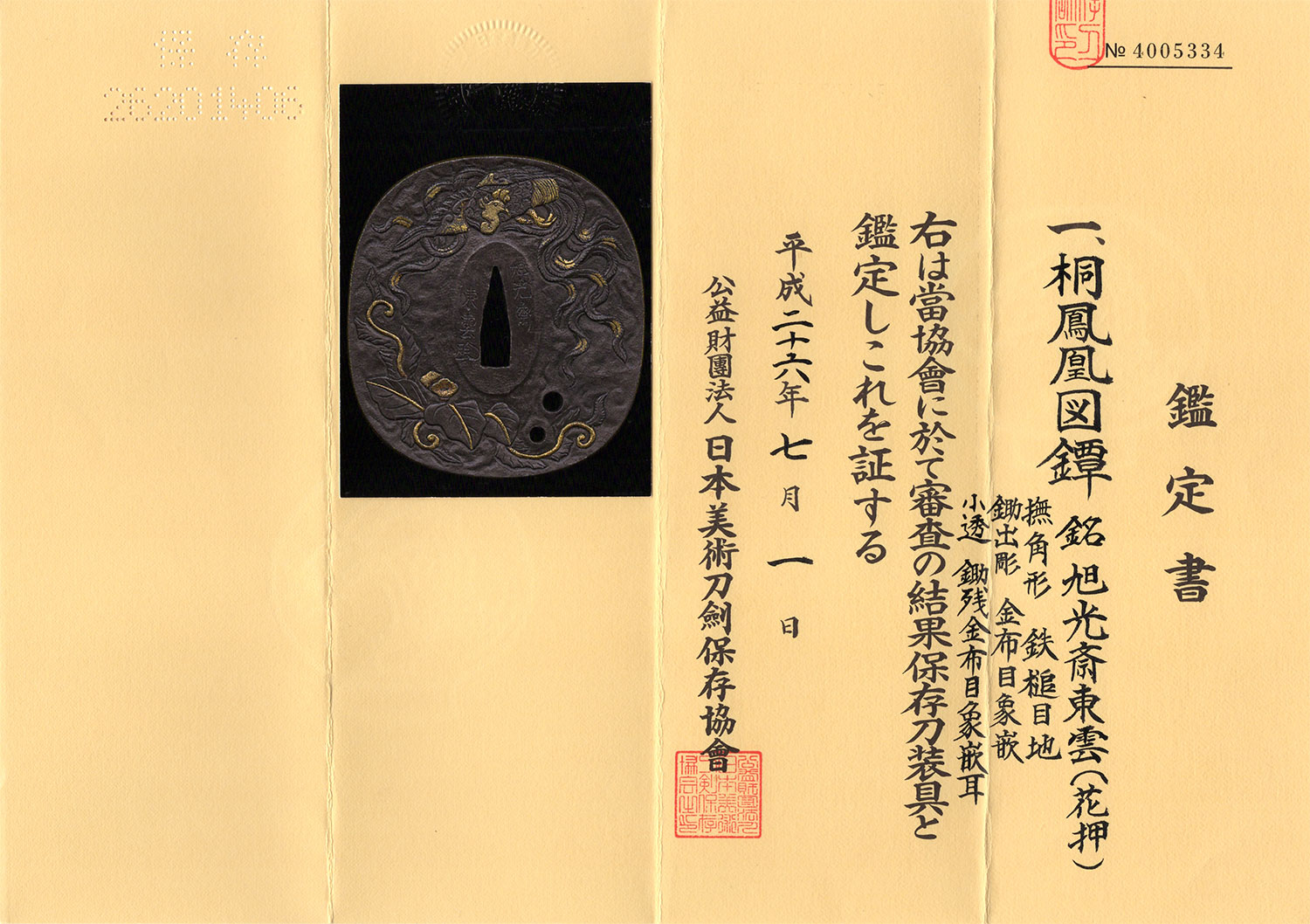
Certifies a genuine fitting worth preserving: a correct signature, or, if unsigned, an identifiable era and school, with recognized artistic and craft value.
The NBTHK (Nihon Bijutsu Tōken Hozon Kyōkai, the Society for the Preservation of Japanese Art Swords) is a public-interest incorporated foundation founded in 1948 and supervised by Japan’s Agency for Cultural Affairs (Bunkachō); it is based at the Japanese Sword Museum in Tokyo. Its expert panels physically examine each submitted work (shinsa) and issue a certificate (kanteishō) ranking it by artistic and historical merit. NBTHK papers are the most widely recognized standard of authentication for Japanese swords and fittings.
NBTHK official siteAs a rule we do not accept returns, except when we have sent a different item from the one ordered or when there is a significant discrepancy between the description and the item. If you wish to return an item, please contact us within 3 days of its arrival and then send it back.
¥236,500