 NihontoWatchNihontoWatch
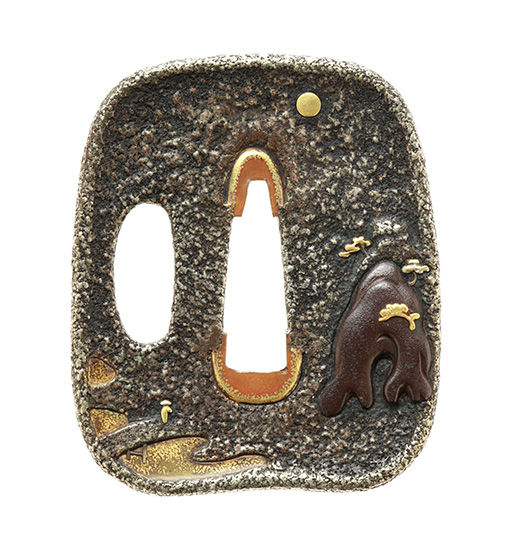
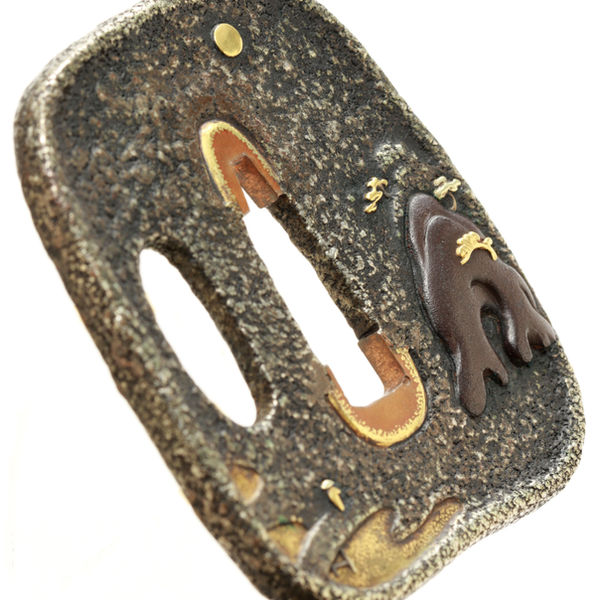
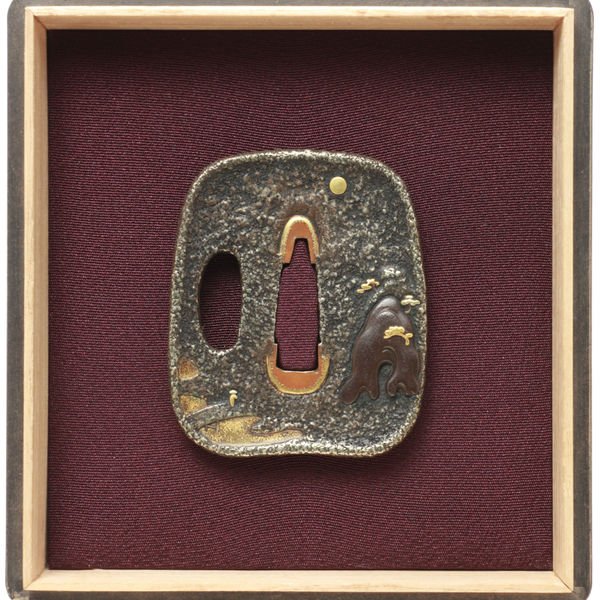
高橋良次は徳次郎と称し、東龍斎清寿の門人。師風に加え、この時代に盛行していた新味のある表現を追求した一人で、古典の山水図を手本としながらも地面を粗めの石目地に仕上げて雪中の景色を想わせる空間描写としている。耳際を厚手に仕立て、石目地に独特の銀色絵を施し、高彫に色合いを違えた金の色絵、老松の小山には茶の漆を施しているのであろうか、常にない色合い。裏面は遠く帆掛舟を眺める岸辺。表と裏の水辺の表情を変えている点も見どころ。
NihontoWatchOffered by Choshuya
This piece has sold
Get an email when a new Toryusai Yoshitsugu piece hits the market.

As written by the shop
Machibori · around 1670
1 piece on the market now
Takahashi Yoshitsugu (高橋良次, read Ryōji in some translations of the published sources) was born in Tenpō 13 (1842) into the family of the Edo metalworker Tōunsai[[c:1]]. He first learned metal carving from his father and from Shibahara Toshiyoshi, and then became a pupil of Tōryūsai Kiyotoshi, the Bakumatsu master of the Tanaka line. The published sources call him one of the skilled hands among Kiyotoshi's pupils[[c:2]], and they name Okada Sekiga as his own pupil. He died young, in Meiji 6 (1873), at the age of thirty-two.
He is known in the designated record through four complete mountings, each fitted with a unified set of his metalwork (issaku kanagu). On a late-Edo uchigatana koshirae every fitting, from the fuchi-kashira, long kojiri, koiguchi and kurikata to the menuki and the tsuba, is of solid gold (kin-muku), worked in nanako with gold, silver and shakudō applied devices, flat inlay, kebori and katakiribori. On a tsukubei mounting of the kind fashionable at the end of the Edo period, his solid-gold fittings are carved in takabori with chrysanthemum sprays, while the tsuba is by Matsuzaki Naritoshi and the lacquer by Rikuyūsai.
His subjects are auspicious and literati themes carried through a whole mounting. On the uchigatana koshirae, scattered fans carry the hermit-poet Lin Hejing, a tortoise, young pine, adonis, orchid, peony, plum, bamboo and chrysanthemum. With the black lacquer scabbard they make up the Three Friends of Winter, the Four Friends and the Four Gentlemen. The published sources write that there the splendour of gold and the elegance of the design are fused to fine effect[[c:3]]. The tsukubei mounting is likewise designed as the Four Gentlemen, and they call it a particularly accomplished example, thoroughly in the Edo taste[[c:4]].
A daishō koshirae shows a quieter register. Its scabbards are of ironwood (tettōgi), the long sword mounted with a tsuba and the short sword as an aikuchi, and his fittings carry a single theme of autumn grasses throughout. The daitō fuchi-kashira are polished solid gold in high relief, the tsuba is polished shakudō with flat gold and silver inlay, and the shōtō fittings are silver with gold and shakudō colour. The published sources call it a refined daishō in which the autumn-grass fittings stand out vividly against the subdued ironwood[[c:5]].
His last recorded work is an aikuchi tantō koshirae inscribed on the koiguchi with a winter day of the year Kōgo (1870). All of its fittings are solid gold carved with chrysanthemum blossoms, the kozuka and wari-kōgai in sukidashi high relief and the menuki split-signed 良 and 次. The published sources call it a powerful work by an artist who died at thirty-two[[c:6]].
All four of his designated works are in the Juyo tier, three of them late-Edo mountings and one of the early Meiji years. His short working life makes his output small, and a complete mounting by him in solid gold is a rare thing for a collector of Bakumatsu metalwork to encounter.
Where Yoshitsugu stands among comparable artisans: across all of nihontō, and within tradition, era, and period. The tiers (Foremost · Leading · Major · Notable) weigh official designations from the NBTHK and Japan's Agency for Cultural Affairs, together with historical honors of lasting repute such as the Sansaku and Meibutsu-chō.
Select a lens to see how it's measured.
Machibori · Edo
15 pieces on the market now
The Toryusai school was established in Edo by Tanaka Seiju (1804--1876), born the son of the Musashi Province tsuba maker Tanaka Fusajiro. Seiju trained formally under Goto Sojiro Masanori but pursued the broader field of kinko largely through self-directed study, ultimately perfecting a stylish, distinctive personal manner that became known as the Toryusai style. Counted among the "three great masters of Bakumatsu metalwork," he rivaled the fame of Goto Ichijo in Kyoto and, like Ichijo, was granted the rank of Hogen. " Kono Shunmei (Haruaki), a master of the Yanagawa lineage who shared Seiju's milieu in Edo, represented a parallel current of late-Edo kinko artistry whose weighty chisel manner and illustrative e-fu carving influenced the broader circle in which the Toryusai school operated. Together, these artists constituted the vital core of Edo-based decorative metalwork during the final decades of the Tokugawa shogunate. The Toryusai school's collective identity rests upon an encyclopedic command of metalworking techniques unified by a distinctly Edo sensibility -- urbane, witty, and decoratively assured. Across the lineage, from Seiju through Kiyoshige and Toshiyoshi, one encounters a shared mastery of takabori with iroe polychrome, sukidashi-bori, suemon-zogan, hira-zogan, and nunome-zogan, deployed across grounds of shakudo, shibuichi, iron, and silver with fluent authority. " Kiyoshige inherited this vocabulary and distinguished himself through exceptional volumetric modeling -- his yobori approaching fully sculptural marubori with what the NBTHK terms outstanding "placement of flesh" (nikuoki).
Toshiyoshi, working primarily on polished shibuichi grounds, synthesized multiple inlay techniques within single compositions, combining suemon-zogan, okigane, and keshi-tokin to achieve chromatic depth and tonal complexity. A hallmark of the school's later production is the neko-kaki yasurime ("cat-scratch" file marks) found on the reverse of kozuka -- a workshop convention that links Toshiyoshi's output to the broader Toryusai lineage. Throughout, the school's pictorial range is vast: figure compositions, birds and animals, literary themes from the Taketori Monogatari and Tsurezuregusa, folk tales, and witty conceits including anthropomorphized frogs and the "Daruma-in-absence" design, all handled with the okashimi (humorous charm) that conveys the school's fashionable Edo flair. The NBTHK's appraisals consistently characterize the Toryusai school's productions as works of notably high dignity and completion, possessing a solemn yet unpretentious taste even when gold inlay is used abundantly. Seiju's mature works display technique and conception operating "in full concert," while Kiyoshige's finest pieces are judged as attaining a level comparable to the founder himself. " The school's significance extends beyond individual virtuosity: the Toryusai lineage represents the most coherent articulation of an independent Edo kinko aesthetic -- one that assimilated the carving methods of the Goto and Yanagawa families yet forged from these an unmistakably personal idiom marked by fresh designs and ingenious, taste-driven sensibility. That the lineage sustained its identity from Seiju's founding through Kiyoshige's succession and into Toshiyoshi's Meiji-era continuation testifies to the robustness of its artistic vision, preserving the refined character of late-Edo metalwork at the moment of its historical transition. Learn more →
| Smith | Era | Designated |
|---|---|---|
| Kiyotoshi清寿 | — | 39 |
| Toshiyoshi寿良 | — | 14 |
| Kiyoshige清重 | — | 5 |
| Yoshitsugu良次 | 1670 | 4 |
| Toshimasa寿政 | — | 0 |
A Hozon-certified fitting of notably superior craftsmanship and condition, often with signature or workmanship of high reference value.
The NBTHK (Nihon Bijutsu Tōken Hozon Kyōkai, the Society for the Preservation of Japanese Art Swords) is a public-interest incorporated foundation founded in 1948 and supervised by Japan’s Agency for Cultural Affairs (Bunkachō); it is based at the Japanese Sword Museum in Tokyo. Its expert panels physically examine each submitted work (shinsa) and issue a certificate (kanteishō) ranking it by artistic and historical merit. NBTHK papers are the most widely recognized standard of authentication for Japanese swords and fittings.
NBTHK official siteIf, due to our fault, the item differs significantly from its proper condition, the item may be returned. Cooling-off is within one week of the item's arrival.