The swordsmith Tanigawa Moriyoshi, whose real name was Tanigawa Matsukichi, was born on February 24, Taisho 9, and forged swords in Yatsushiro City, Kumamoto Prefecture. In Showa 9, he became a disciple of Kongohyoe Moritaka Yasuhiro, and in Showa 15, he received the character "Mori" passed down through the Kongohyoe school and was granted the swordsmith mei of Minamoto Moriyoshi. Furthermore, as he was the successor to Enju Yoshishige, he was also granted the name Enju Yoshitsugu in Showa 16.
In Showa 27, he received the honor of producing a sword to commemorate the peace treaty, and received production approval on July 3, Showa 29. He was selected for the 1st Sakuto Gijutsu Happyokai in the same year, and subsequently selected for the Shinsaku Meito Ten in Showa 42, 43, and 45. In Showa 60, he was designated as Mukansa. Regarding his style, he looked up to Yamaura Kiyomaro, who was praised as the "Yotsuya Masamune" among the master smiths of the Bakumatsu period; he excelled in a powerful style for both the ji and ha, with a spirited dekiguchi incorporating kinsuji and sunagashi.
This work was made in Showa 48 when the swordsmith Tanigawa Moriyoshi was 53 years old, and is a utsushimono modeled after the blade known as a masterpiece by Bizen Nagayoshi titled "O-Nagayoshi" or "Hocho Nagayoshi." Although Nagayoshi was a swordsmith of the Bizen Osafune school, he is known as a representative smith of the so-called Soden Bizen style, which incorporated the Soshu-den style.
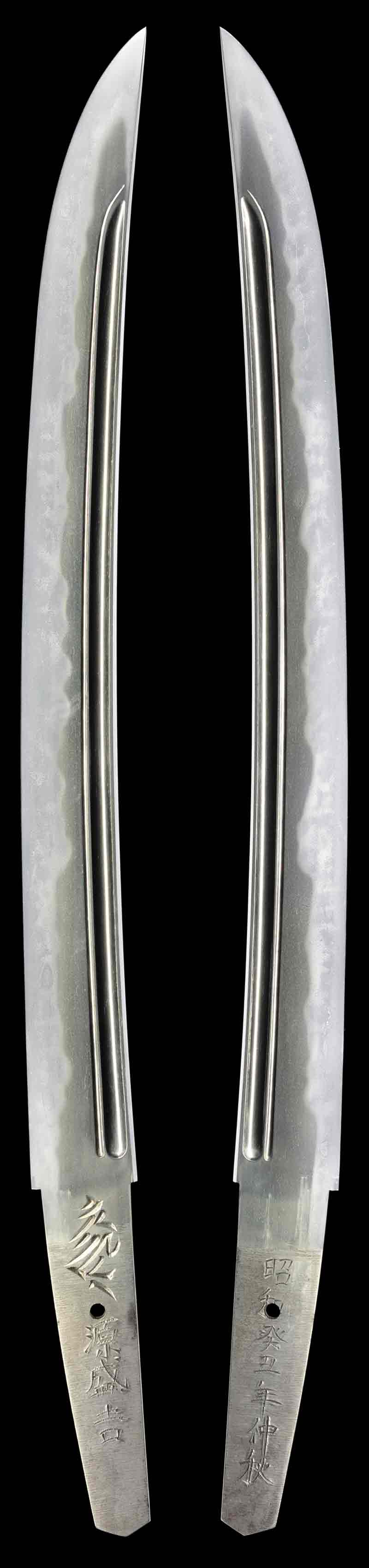
The nagasa is 1 shaku 5 sun 1 bun (45.8 cm); it presents a grand, dabi-style sugata with a wide mihaba, thick kasane, sun-nobi length, and shallow sori. The kitae is itame with fine masame, the hadame stands out slightly, ji-nie attaches minutely and thickly, and chikei enters. The hamon is gunome mixed with ko-gunome and choji-style ha, midare with high yakiba and splendor, ashi enters, nie attaches strongly and is clustered in places, sunagashi is applied actively, small tobiyaki are mixed into the yakigashira, and the boshi shows a dekiguchi that is sugu-cho with shallow notare, returning somewhat long in ko-maru with the tip being heavily hakikake, expressing the fierce Soden Bizen style of the old work by Bizen Nagayoshi. True to the name "O-Nagayoshi" or "Hocho Nagayoshi," combined with the large-scale sugata, it is a powerful work.
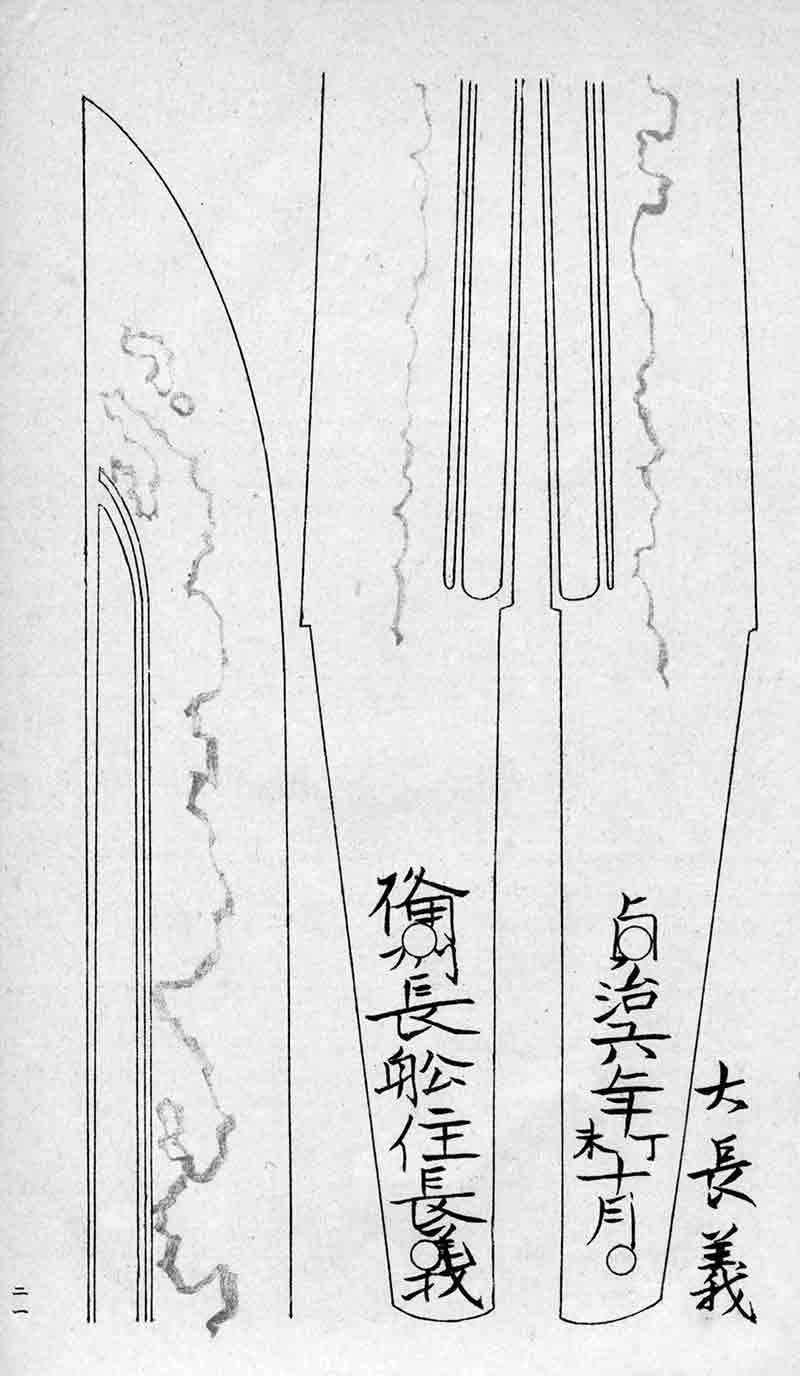
The "O-Nagayoshi" or "Hocho Nagayoshi" was passed down in the Mito Tokugawa family, was used by Lord Tokugawa Nariaki, and was a former National Treasure formerly in the collection of Tokiwa Jinja, but unfortunately, it was destroyed by fire in Taisho 12 (1923) during the Great Kanto Earthquake while being kept at the Marquis Tokugawa residence in Honjo, Tokyo. It is recorded in the Tsuguhira Oshigata, and the meibun is "Bishu Osafune-ju Nagayoshi Joji 6 nen Hinoto-Hitsuji 10 gatsu," and furthermore the go "O-Nagayoshi" is inscribed. Before entering the collection of the Mito Tokugawa family, it was in the Tokugawa Shogunate family around this time, and is thought to have moved to the Mito Tokugawa family thereafter.
On the omote and ura, it has katana-hi with tsure-hi ending in maru-dome, and on the omote, a bonji is engraved in inkoku below it; since the honka does not have a bonji, this is seen as an arrangement by the smith Tanigawa. With a grand sugata measuring a mihaba of 4.1 cm, showing hataraki within the ha with strong nie and active sunagashi, this is an ambitious work by the swordsmith Tanigawa Moriyoshi who challenged the Soden Bizen master Nagayoshi.
Mukansa
Machine translation from the shop's Japanese · may contain errors ·
The swordsmith Tanigawa Moriyoshi, whose real name was Tanigawa Matsukichi, was born on February 24, Taisho 9, and forged swords in Yatsushiro City, Kumamoto Prefecture. In Showa 9, he became a disciple of Kongohyoe Moritaka Yasuhiro, and in Showa 15, he received the character "Mori" passed down through the Kongohyoe school and was granted the swordsmith mei of Minamoto Moriyoshi. Furthermore, as he was the successor to Enju Yoshishige, he was also granted the name Enju Yoshitsugu in Showa 16.
In Showa 27, he received the honor of producing a sword to commemorate the peace treaty, and received production approval on July 3, Showa 29. He was selected for the 1st Sakuto Gijutsu Happyokai in the same year, and subsequently selected for the Shinsaku Meito Ten in Showa 42, 43, and 45. In Showa 60, he was designated as Mukansa. Regarding his style, he looked up to Yamaura Kiyomaro, who was praised as the "Yotsuya Masamune" among the master smiths of the Bakumatsu period; he excelled in a powerful style for both the ji and ha, with a spirited dekiguchi incorporating kinsuji and sunagashi.
This work was made in Showa 48 when the swordsmith Tanigawa Moriyoshi was 53 years old, and is a utsushimono modeled after the blade known as a masterpiece by Bizen Nagayoshi titled "O-Nagayoshi" or "Hocho Nagayoshi." Although Nagayoshi was a swordsmith of the Bizen Osafune school, he is known as a representative smith of the so-called Soden Bizen style, which incorporated the Soshu-den style.
The nagasa is 1 shaku 5 sun 1 bun (45.8 cm); it presents a grand, dabi-style sugata with a wide mihaba, thick kasane, sun-nobi length, and shallow sori. The kitae is itame with fine masame, the hadame stands out slightly, ji-nie attaches minutely and thickly, and chikei enters. The hamon is gunome mixed with ko-gunome and choji-style ha, midare with high yakiba and splendor, ashi enters, nie attaches strongly and is clustered in places, sunagashi is applied actively, small tobiyaki are mixed into the yakigashira, and the boshi shows a dekiguchi that is sugu-cho with shallow notare, returning somewhat long in ko-maru with the tip being heavily hakikake, expressing the fierce Soden Bizen style of the old work by Bizen Nagayoshi. True to the name "O-Nagayoshi" or "Hocho Nagayoshi," combined with the large-scale sugata, it is a powerful work.
The "O-Nagayoshi" or "Hocho Nagayoshi" was passed down in the Mito Tokugawa family, was used by Lord Tokugawa Nariaki, and was a former National Treasure formerly in the collection of Tokiwa Jinja, but unfortunately, it was destroyed by fire in Taisho 12 (1923) during the Great Kanto Earthquake while being kept at the Marquis Tokugawa residence in Honjo, Tokyo. It is recorded in the Tsuguhira Oshigata, and the meibun is "Bishu Osafune-ju Nagayoshi Joji 6 nen Hinoto-Hitsuji 10 gatsu," and furthermore the go "O-Nagayoshi" is inscribed. Before entering the collection of the Mito Tokugawa family, it was in the Tokugawa Shogunate family around this time, and is thought to have moved to the Mito Tokugawa family thereafter.
On the omote and ura, it has katana-hi with tsure-hi ending in maru-dome, and on the omote, a bonji is engraved in inkoku below it; since the honka does not have a bonji, this is seen as an arrangement by the smith Tanigawa. With a grand sugata measuring a mihaba of 4.1 cm, showing hataraki within the ha with strong nie and active sunagashi, this is an ambitious work by the swordsmith Tanigawa Moriyoshi who challenged the Soden Bizen master Nagayoshi.
Mukansa
The twentieth century nearly killed the craft twice: wartime distortion, then the occupation ban. The NBTHK’s founding in 1948 and licensed forging from 1953 rebuilt the sword as an art, crowned by Living National Treasures and the mukansa rank.
We could not find an authenticity certificate on the seller’s listing. Japanese swords and fittings are normally papered by the NBTHK (or the NTHK). Without one, the attribution is the seller’s own assessment and has not been independently verified — treat it with caution and ask the dealer about certification before buying.
Please exercise cooling-off within 8 days of the item's arrival.
(1) We cannot accept items that have been altered or worked on in any way (e.g. test cutting, polishing or other work, display at viewing meetings, photography, taking oshigata rubbings, use for appreciation, copying of books).
(2) Return shipping is at the customer's expense.
(3) Costs other than the item price (bank transfer fees, cash-on-delivery fees, installment fees, etc.) cannot be refunded.
(4) For cash-on-delivery and similar payments, the refund is made after the payment has reached us.
(5) We cannot accept a return when a trade-in item is involved.
(6) Items delivered overseas cannot be returned or refunded (because of the time involved and, for swords, the surrender of the registration certificate and other circumstances).



 NihontoWatch