Modern Gifu
Mukansa Tosho
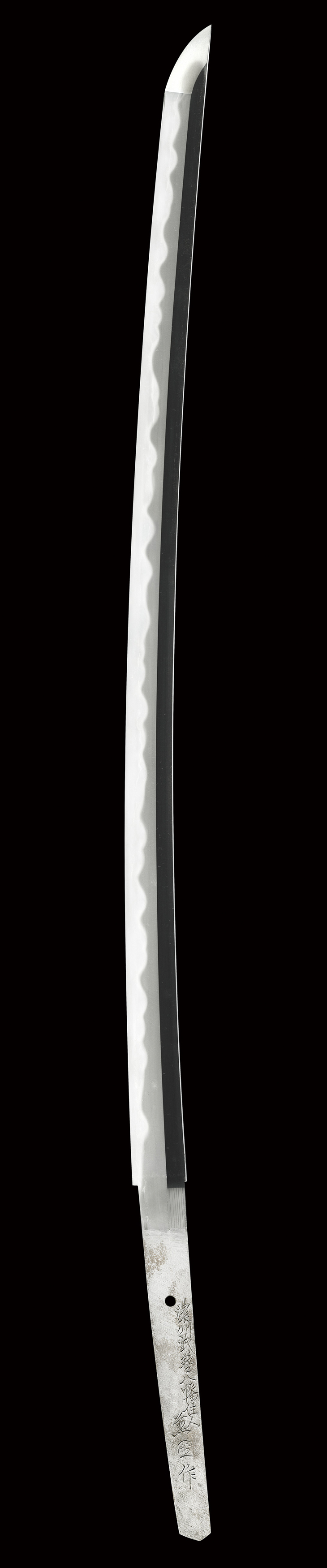
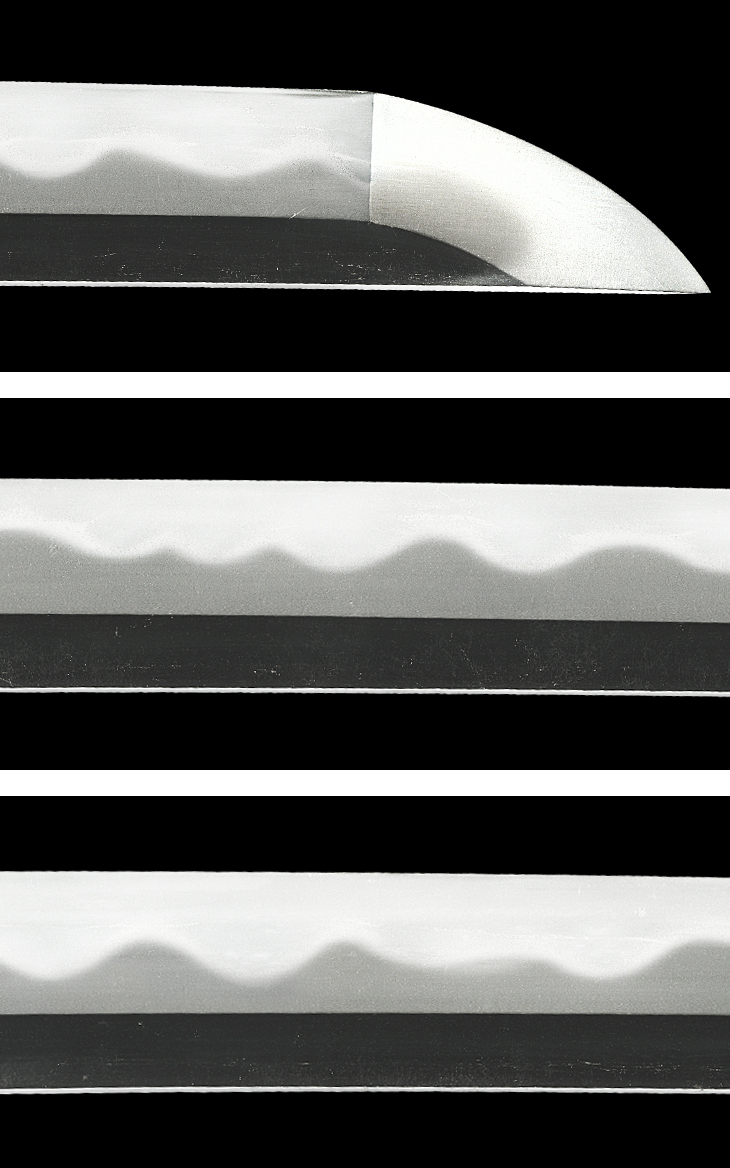
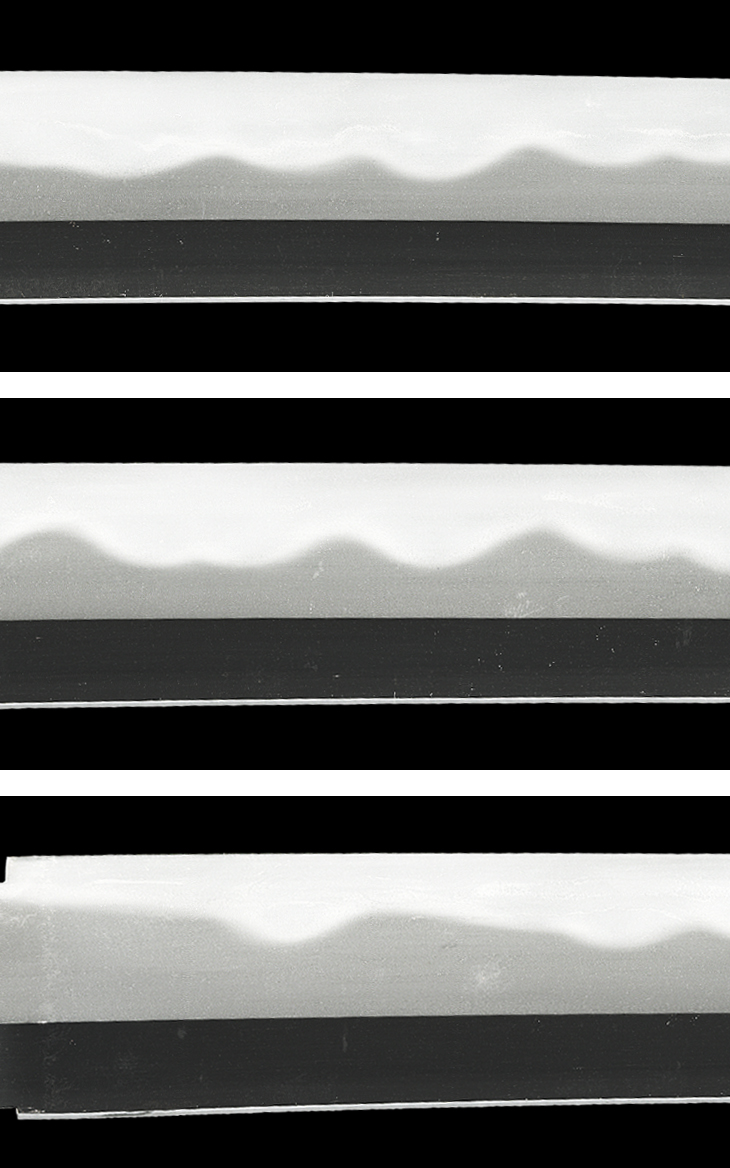
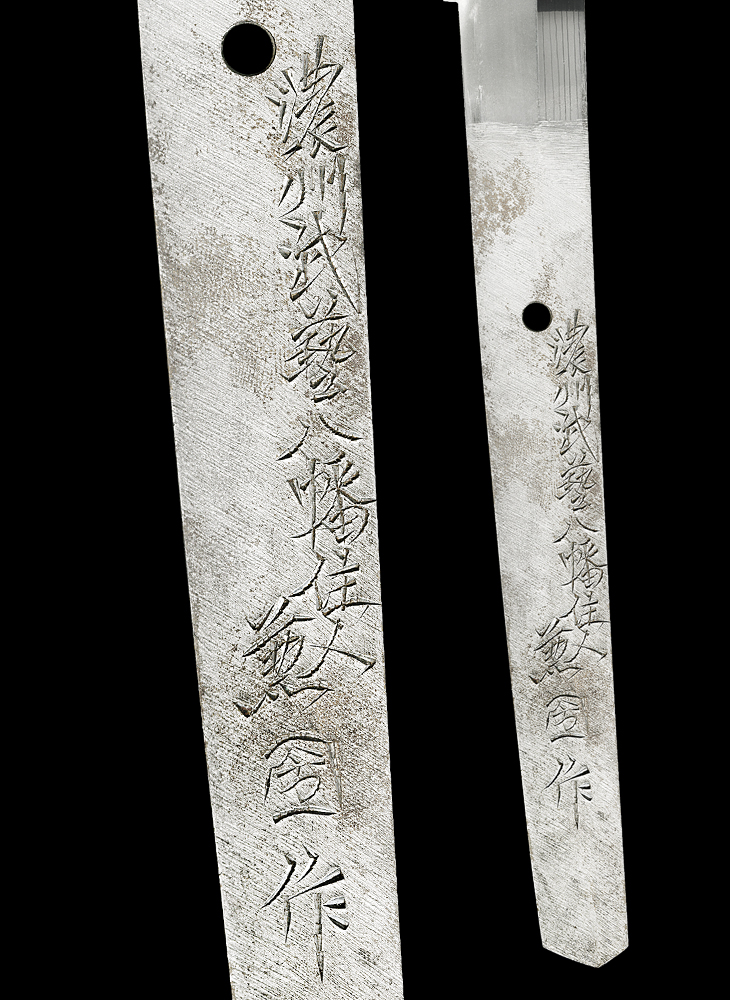
Shinogi-zukuri, shinogi is jinjo, iori-mune is low, chu-kissaki is slightly strongly extended. Kitae is ko-itame hada, slightly sinking but well-packed, ji-nie attaches thickly, and the jitetsu is generally refined. Hamon is o-gunome midare with gunome and notare mixed, connecting in places to become toran-style; the habuchi is well-covered in nie with deep nioi, bright and clear, with gunome ashi entering the ha and thick kinsuji appearing. Boshi is notare-komi with deep yaki and nie, the tip is hakikake and kaeru. Nakago is ubu, tip is iriyama-gata, yasurime is kesho sujikai. Copper with kin-kise habaki. Period polish (rust present). In shirasaya.
Kanekuni, whose name was Ogawa Kunihiko, was born in Taisho 14 and hailed from Hachiman, Mugegawa-cho, Seki City, Gifu Prefecture; before the war he studied under Kato Kanekuni in Tokyo, and after the war he studied under the 27th generation Kanemoto, Kaneko Magoroku Kanemoto. In the "Shinsaku Meito Ten (currently the Gendaito Shoku Ten)" he received numerous prizes, and after reaching his seventies, he won the Kunzan Sho five times from Heisei 10 onwards, was designated Mukansa in Heisei 18, was certified as a Gifu Prefecture Important Intangible Cultural Property in Heisei 20, and in Heisei 22 his son Mitsutoshi (Kanekuni) was also designated Mukansa. The certification of both parent and child as Mukansa is the fourth instance following the Gassan, Miyairi, and So families.
Regarding his style, he looked up to the master of Osaka Shinto, Echizen no Kami Sukehiro, and devoted his heart and soul to reproducing the toran-ba. He passed away in Heisei 24 at the age of 87.
This work was made in Heisei 3 when the smith was 66 years old, with a nagasa of just over 2 shaku 3 sun 8 bu; the ha of o-gunome midare mixed with gunome and notare connects in places to become toran-style, the habuchi is well-covered in nie with deep nioi, bright and clear, and with gunome ashi and thick kinsuji in the ha, it is a Sukehiro-utsushi that can truly be called his masterpiece, showing a workmanship overflowing with spirit.
Not only in the hamon, but also in the nagasa, mihaba, sugata, and so on, the point that he faithfully reproduces the honka allows one to feel his high skill and sense as the leading figure of Sukehiro-utsushi.
This is a work of confidence by the master smith representing modern Mino Seki, Ogawa Kanekuni.
Machine translation from the shop's Japanese · may contain errors ·
Modern Gifu
Mukansa Tosho
Shinogi-zukuri, shinogi is jinjo, iori-mune is low, chu-kissaki is slightly strongly extended. Kitae is ko-itame hada, slightly sinking but well-packed, ji-nie attaches thickly, and the jitetsu is generally refined. Hamon is o-gunome midare with gunome and notare mixed, connecting in places to become toran-style; the habuchi is well-covered in nie with deep nioi, bright and clear, with gunome ashi entering the ha and thick kinsuji appearing. Boshi is notare-komi with deep yaki and nie, the tip is hakikake and kaeru. Nakago is ubu, tip is iriyama-gata, yasurime is kesho sujikai. Copper with kin-kise habaki. Period polish (rust present). In shirasaya.
Kanekuni, whose name was Ogawa Kunihiko, was born in Taisho 14 and hailed from Hachiman, Mugegawa-cho, Seki City, Gifu Prefecture; before the war he studied under Kato Kanekuni in Tokyo, and after the war he studied under the 27th generation Kanemoto, Kaneko Magoroku Kanemoto. In the "Shinsaku Meito Ten (currently the Gendaito Shoku Ten)" he received numerous prizes, and after reaching his seventies, he won the Kunzan Sho five times from Heisei 10 onwards, was designated Mukansa in Heisei 18, was certified as a Gifu Prefecture Important Intangible Cultural Property in Heisei 20, and in Heisei 22 his son Mitsutoshi (Kanekuni) was also designated Mukansa. The certification of both parent and child as Mukansa is the fourth instance following the Gassan, Miyairi, and So families.
Regarding his style, he looked up to the master of Osaka Shinto, Echizen no Kami Sukehiro, and devoted his heart and soul to reproducing the toran-ba. He passed away in Heisei 24 at the age of 87.
This work was made in Heisei 3 when the smith was 66 years old, with a nagasa of just over 2 shaku 3 sun 8 bu; the ha of o-gunome midare mixed with gunome and notare connects in places to become toran-style, the habuchi is well-covered in nie with deep nioi, bright and clear, and with gunome ashi and thick kinsuji in the ha, it is a Sukehiro-utsushi that can truly be called his masterpiece, showing a workmanship overflowing with spirit.
Not only in the hamon, but also in the nagasa, mihaba, sugata, and so on, the point that he faithfully reproduces the honka allows one to feel his high skill and sense as the leading figure of Sukehiro-utsushi.
This is a work of confidence by the master smith representing modern Mino Seki, Ogawa Kanekuni.
The twentieth century nearly killed the craft twice: wartime distortion, then the occupation ban. The NBTHK’s founding in 1948 and licensed forging from 1953 rebuilt the sword as an art, crowned by Living National Treasures and the mukansa rank.
We could not find an authenticity certificate on the seller’s listing. Japanese swords and fittings are normally papered by the NBTHK (or the NTHK). Without one, the attribution is the seller’s own assessment and has not been independently verified — treat it with caution and ask the dealer about certification before buying.
For one-of-a-kind items such as swords, sword fittings and antiques, other customers may be waiting for the item, so please contact us about a return within 3 days of its arrival and ship it back within 8 days. Refunds are made on the day the returned item arrives.

 NihontoWatch