Unification closed the mass market, and Seki’s smiths moved to where the new money was: the Mishina line to Kyōto with court titles, Daidō smiths to castle towns across the provinces. Mino became the great technical ancestor of the Shintō age.
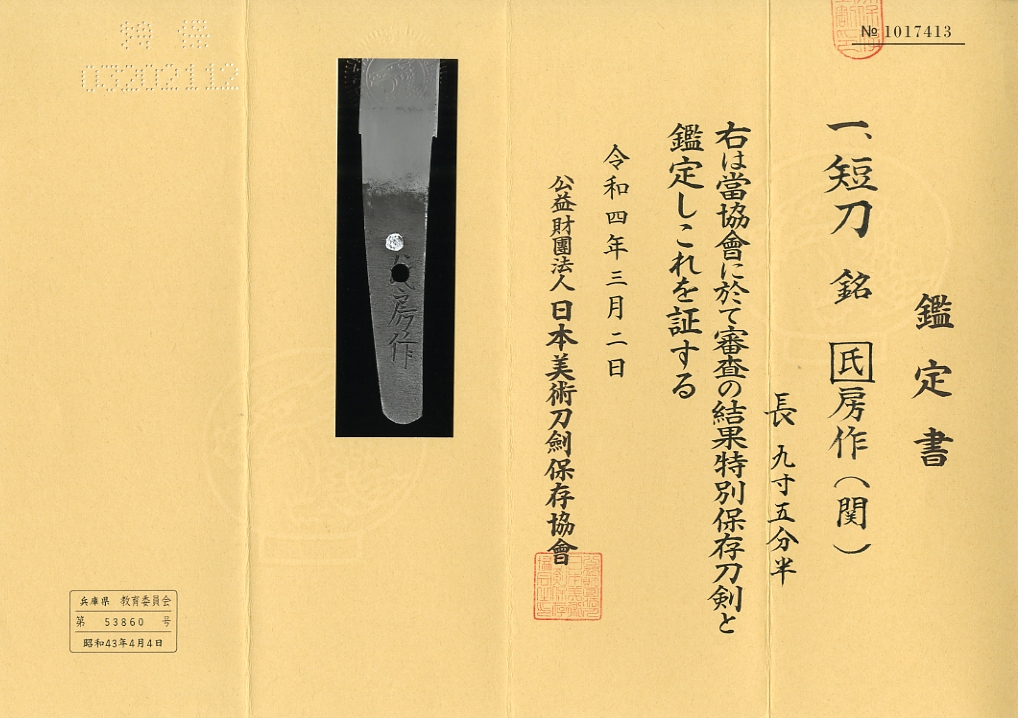
Koto, Mino, Azuchi-Momoyama period Hira-zukuri, low iori-mune. Kitae, mokume with itame and nagare-hada, well-kneaded, ji-nie attaches thickly, the jiron is slightly blackish, round tobiyaki and yubashiri appear, chikei enters frequently, the jitetsu is in good condition. Hamon, gunome-midare, yahazu-style ha, angular ha, mixed with notare, the habuchi is well-covered in nie with deep nioi, bright and clear, kinsuji and sunagashis appear violently within the ha. Boshi, sugu-style, the tip is slightly hakikake with a deep kaeri. Nakago ubu, tip is kurijiri, yasurime is kiri. Copper with kin-kise habaki. Period polish (small rust spots present). In shirasaya. This work has a two-character mei of Ujifusa, and the kanteisho also only states "Ujifusa saku (Seki)", without attributing it to a specific individual smith. The work is judged to be on the boundary between Shinto and Koto, and based on the style of the mei, I do not think it is by Wakasa no Kami or Hida no Kami Ujifusa. However, since the Ujifusa lineage moved to places such as Suruga and Satsuma, it is likely of that lineage. The dimensions are slightly less than 9 sun 6 bu, the mihaba is solid, and the kasane is thin in the Keicho Shinto style. The jitetsu is well-forged in a large pattern, and the Mino-Seki style midare-ba has a bright and clear habuchi, with kinsuji and sunagashi appearing violently within the ha, while tobiyaki and yubashiri are also seen in the ji. There are no major defects, it comes with Tokubetsu Hozon papers, and it is quite an attractive Ujifusa tanto.
Offered by Samurai Nippon
16 on the market


As written by the shop
Machine translation from the shop's Japanese · may contain errors ·
Mino-den · Owari
16 pieces on the market now
Rooted in Owari province at the boundary between the kotō and shintō eras, the Ujifusa line carried Mino-den forging into the late Momoyama and early Edo decades, working under the Tokugawa establishment of Owari at Nagoya. The setsumei here cover several hands of the group. Wakasa no Kami Ujifusa and Hida no Kami Ujifusa stand as the reference points against which the others are read. Echigo no Kami Fujiwara Ujitsune, recorded in the Meikan and the Mino-tō Taikan as the second son of Wakasa no Kami Ujifusa, first signed Ujishige, received the Echigo no Kami title in Genna 6 (1620), and died at Nagoya in Meireki 2 (1656). Ujisada, who took the court title Izumo no Kami and signed Sakon Shōshō and Sakon Gonshōshō, is transmitted as a son of the first-generation Ujifusa and younger brother of the second-generation Wakasa no Kami Ujifusa; one of his tantō carries a date of Tenshō 5 (1577). The shared hand begins in the kitae: a dense itame mixed with mokume and nagare-hada, carrying ji-nie and, in the fuller work, fine chikei. The temper draws on the Mino-den vocabulary, a notare mixed with gunome, ko-gunome in tsure, large gunome, and pointed togari-leaning forms, the notare often taking angular turns (kado-gakari).
Ko-ashi and yō enter; nie attaches, at times slightly coarse and unevenly applied, with kinsuji and sunagashi in the lower body and tobiyaki and muneyaki scattered through, so that some blades verge on hitatsura and minayaki. The nioiguchi can incline toward shizumi. The bōshi is tempered deeply and far down (yakisage) with hakikake, the point sometimes drawn into a sanpin-style sharpness on one face and an ō-maru on the other. Ujitsune's signed katana reads as a near-textbook gathering of these traits; Ujisada's tantō tightens the nioiguchi (shimarigokoro) toward his master's manner. For kantei, the angular notare, the patchy nie, the shizumi-inclined nioiguchi, and the sanpin-pointed bōshi with long yakisage mark the Wakasa no Kami group; the larger work adds broad mihaba, ō-kissaki, and thick kasane. Carving belongs to the record: a "grass" kurikara and gomabashi with rendai appear on Ujisada's tantō. The Ujitsune katana, by a smith the setsumei call a scant producer, is named his representative work, holding coherence across a great nagasa. Learn more →
| Smith | Era | Designated |
|---|---|---|
| Ujifusa氏房 | 1596-1615 | 16 |
| Ujifusa氏房 | 1571-1592 | 9 |
| Ujifusa氏房 | 1624-1644 | 0 |
| Ujitsune氏恒 | 1596-1615 | 1 |
| Ujisada氏貞 | 1558-1592 | 7 |
Mino in the Momoyama period
Unification closed the mass market, and Seki’s smiths moved to where the new money was: the Mishina line to Kyōto with court titles, Daidō smiths to castle towns across the provinces. Mino became the great technical ancestor of the Shintō age.
A Hozon-certified blade judged to show notably superior workmanship and a better state of preservation. The bar is higher: re-tempered blades and most unsigned Muromachi/Edo works are excluded.
The NBTHK (Nihon Bijutsu Tōken Hozon Kyōkai, the Society for the Preservation of Japanese Art Swords) is a public-interest incorporated foundation founded in 1948 and supervised by Japan’s Agency for Cultural Affairs (Bunkachō); it is based at the Japanese Sword Museum in Tokyo. Its expert panels physically examine each submitted work (shinsa) and issue a certificate (kanteishō) ranking it by artistic and historical merit. NBTHK papers are the most widely recognized standard of authentication for Japanese swords and fittings.
NBTHK official siteFor one-of-a-kind items such as swords, sword fittings and antiques, other customers may be waiting for the item, so please contact us about a return within 3 days of its arrival and ship it back within 8 days. Refunds are made on the day the returned item arrives.
¥459,000