Muromachi turned sword making into an industry: the uchigatana rose with massed infantry warfare, Osafune and Seki produced bundle swords beside custom orders, and the Ming trade carried Japanese blades abroad by the tens of thousands.
 NihontoWatchNihontoWatch
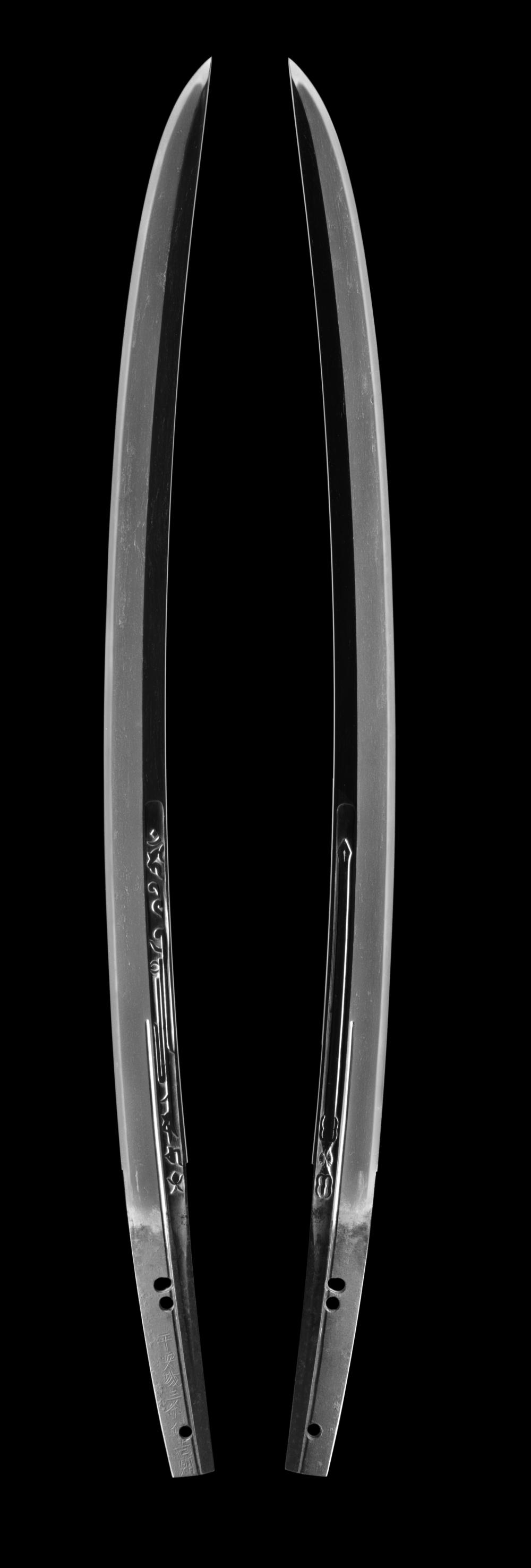
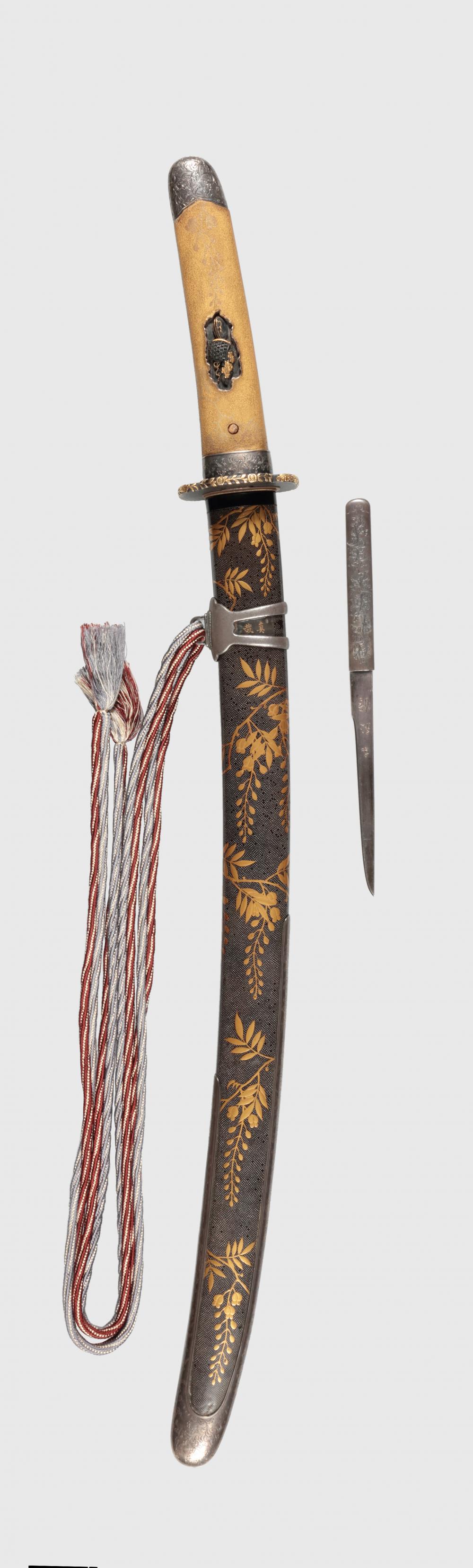
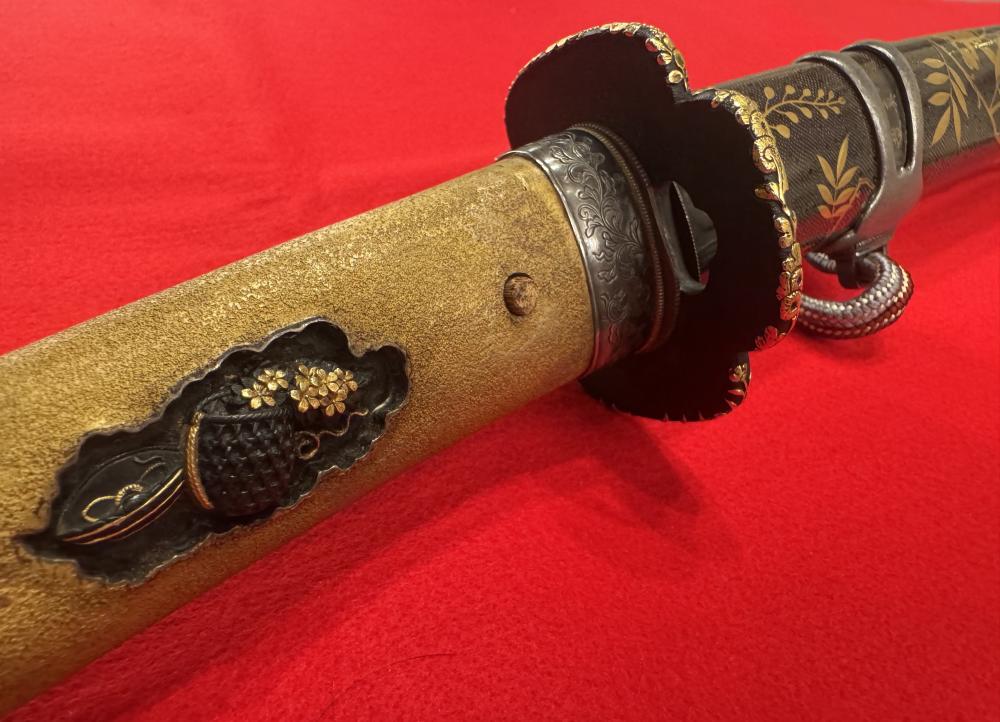
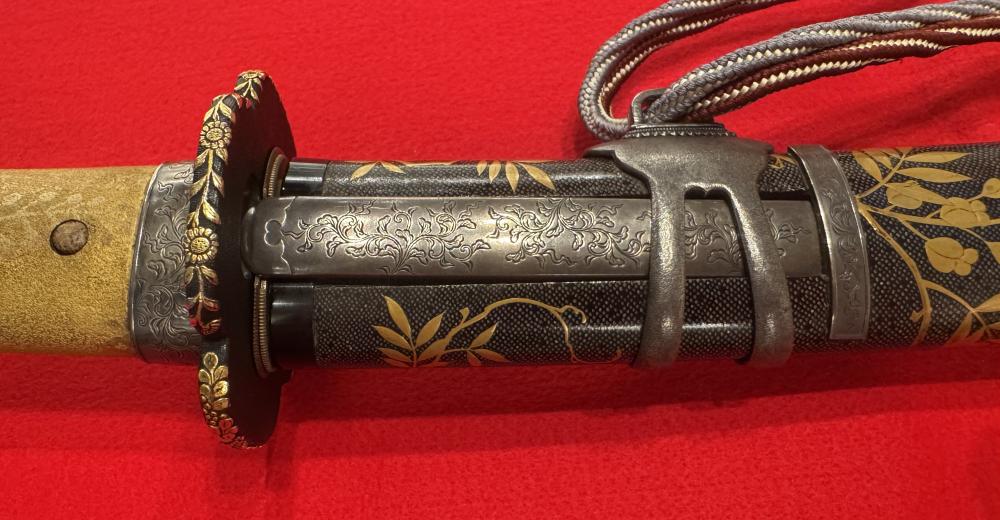
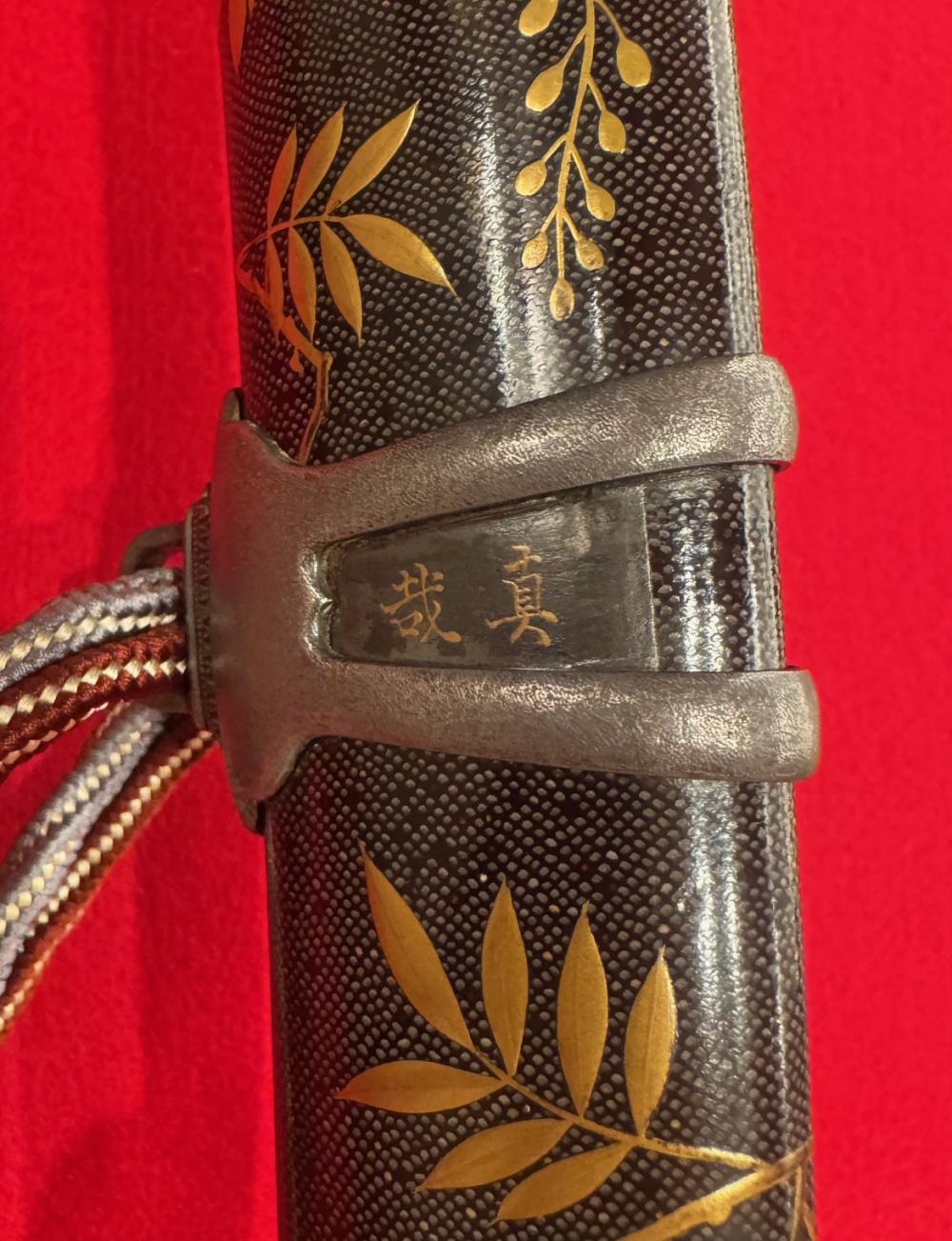
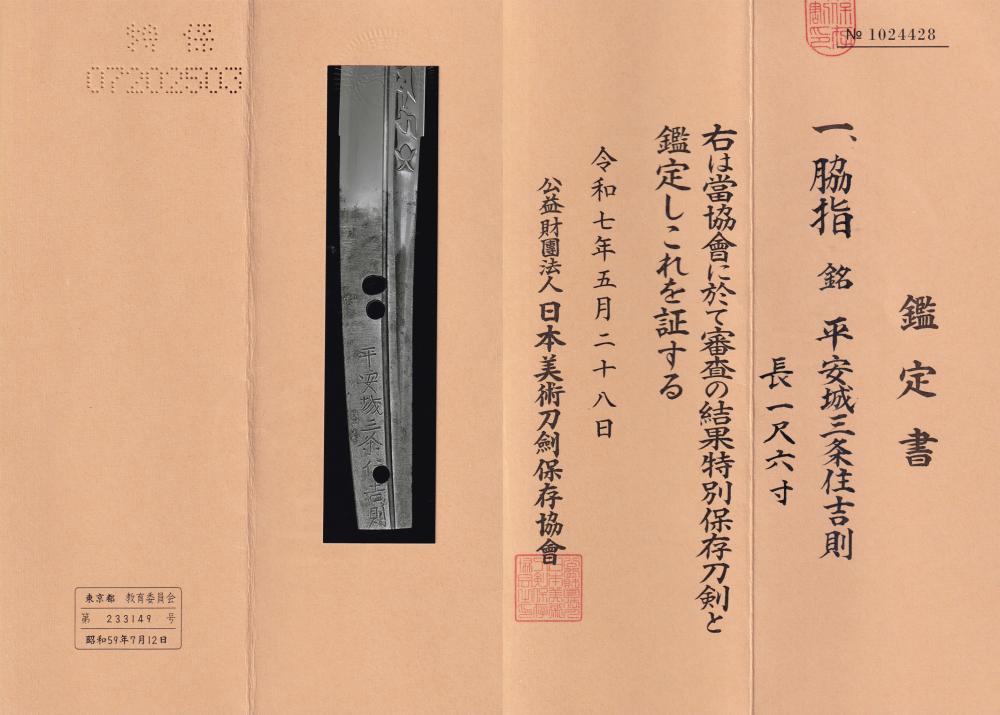
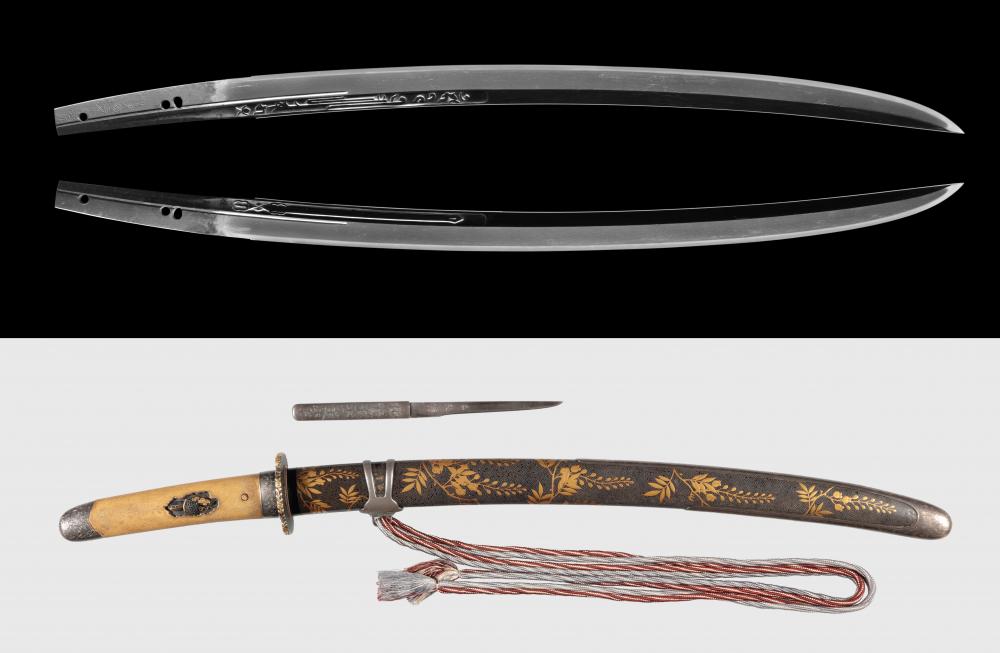
Heianjo Sanjo-ju Yoshinori was a Yamashiro smith who was active in Sanjo, Kyoto, during the mid-Muromachi period (Bunmei to Eisho). Due to movement during times of war, it seems he also made swords in Izumi Province and Echizen Province. The son of Yoshinori was Heianjo Nagayoshi, who is also said to have been the teacher of Muramasa. This work is in shobu-zukuri, long in proportion to the mihaba, with a shape where the shinogi is reduced. There is a bo-hi with soe-hi at the koshimoto; inside the bo-hi on the omote, there are carvings of bonji with zuiun and a linear carving, followed by further carvings of bonji and a rendai, while inside the bo-hi on the ura, there is a carving of a dokko-ken. The jigane is ko-itame with fine ji-nie, mixed with chikei in places, becoming nagare-gokoro, and a faint bo-utsuri stands out. The hamon is a pure suguha dominated by nioi, mixed with a little ko-ashi. The exterior is a sharkskin togidashi-zaya with wisteria makie applied by Shinsai. Shibata Shinsai was a Japanese painter and makie artist active from the Bakumatsu to the Meiji period. The kanagu are silver-ground karakusa designs, and the tsuba is a mokko-gata in shakudo nanako-ji, with the mimi featuring edagiku in kin-zogan. The material of the tsuka surface is unknown, but wisteria flowers are also drawn on the ocher-colored surface, and the menuki area has deep carvings, within which hanakago menuki are placed. The method of attaching the menuki is truly creative, making for a very wonderful koshirae.
NihontoWatchOffered by Shoubudou
2 on the market

As written by the shop
Machine translation from the shop's Japanese · may contain errors ·
Yamashiro-den · Yamashiro · around 1469-1487
Fujishiro Jo saku · Tōken Taikan top 31%
2 pieces on the market now
Where Yoshinori stands among comparable artisans: across all of nihontō, and within tradition, era, and period. The tiers (Foremost · Leading · Major · Notable) weigh official designations from the NBTHK and Japan's Agency for Cultural Affairs, together with historical honors of lasting repute such as the Sansaku and Meibutsu-chō.
Select a lens to see how it's measured.
Yamashiro-den · Kyoto
11 pieces on the market now
The Heianjō school (平安城) of swordsmiths represents the principal lineage of Kyōto sword production during the Muromachi period. "Heianjō" is the classical name for Kyōto (Heian-kyō), and the school's smiths — resident in the Sanjō district of the capital — signed variously with the 平安城 (Heianjō) and 三条 (Sanjō) prefixes, a usage that has often caused them to be confused with the far earlier Sanjō school of Munechika. They are an entirely distinct, late group: its two representative masters, Heianjō Nagayoshi (平安城長吉, also read Chōkichi) and Sanjō Yoshinori (三条吉則, of the Fuse 布施 family), are counted as the leading makers of Muromachi-period Kyō-mono (Kyoto-made blades), carrying forward the capital's swordmaking after the Nanbokuchō-period Nobukuni and Hasebe lineages. Both names continued through several generations from the late Nanbokuchō era into the sixteenth century, and the smiths are known to have travelled to forge (desaku) in provinces such as Izumi, Mikawa, and Echizen during the late Muromachi period. The Heianjō style is dominated by a flamboyant hitatsura (full-temper) idiom adopted from Sōshū tradition: a foundation of large gunome-midare mixed with chōji, togariba, and yahazu-ba, with abundant tobiyaki and muneyaki spreading temper across the entire blade surface, nie adhering strongly, and sunagashi and kinsuji coursing through a bright, clear nioiguchi.
The finest examples are so accomplished that they are difficult to distinguish from late Sōshū (Sue-Sōshū) work. A quieter suguha- and ko-notare-based mode close to the Nobukuni tradition is also seen. High-quality horimono — kurikara, bonji, suken, and gomabashi — frequently accompany the blades. The school is not to be confused with the unrelated Heianjō-zōgan (平安城象嵌) inlay tradition of tōsōgu makers. Learn more →
| Smith | Era | Designated |
|---|---|---|
| Nagayoshi長吉 | 1469-1492 | 15 |
| Yoshinori吉則 | 1469-1487 | 3 |
| Nagayoshi長吉 | 1449-1452 | 0 |
| Nobusada信貞 | 1346-1370 | 0 |
| Yoshinaga吉長 | 1381-1384 | 0 |
The Muromachi period (1392 to 1573)
Muromachi turned sword making into an industry: the uchigatana rose with massed infantry warfare, Osafune and Seki produced bundle swords beside custom orders, and the Ming trade carried Japanese blades abroad by the tens of thousands.
A Hozon-certified blade judged to show notably superior workmanship and a better state of preservation. The bar is higher: re-tempered blades and most unsigned Muromachi/Edo works are excluded.
The NBTHK (Nihon Bijutsu Tōken Hozon Kyōkai, the Society for the Preservation of Japanese Art Swords) is a public-interest incorporated foundation founded in 1948 and supervised by Japan’s Agency for Cultural Affairs (Bunkachō); it is based at the Japanese Sword Museum in Tokyo. Its expert panels physically examine each submitted work (shinsa) and issue a certificate (kanteishō) ranking it by artistic and historical merit. NBTHK papers are the most widely recognized standard of authentication for Japanese swords and fittings.
NBTHK official sitePlease contact us by phone within 3 days of the item's arrival and ship it back the next day. The postage and security service fees are the customer's responsibility.
¥2,500,000