After the Ōnin War broke the Ashikaga order, a century of Sengoku warfare armed nearly every province in Japan. The era rewards a discriminating eye: routine work exists in quantity, and beside it stand custom blades of the first rank.
 NihontoWatchNihontoWatch
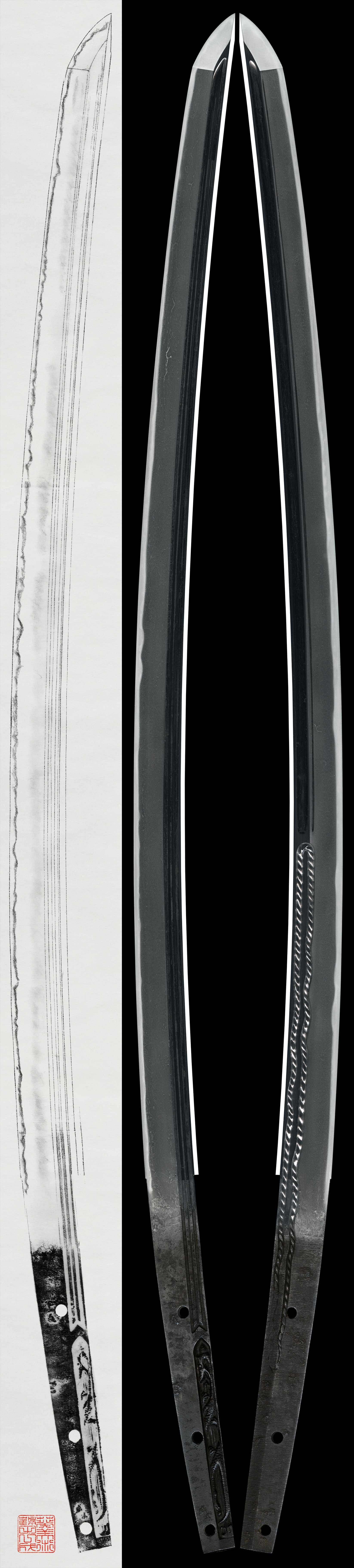
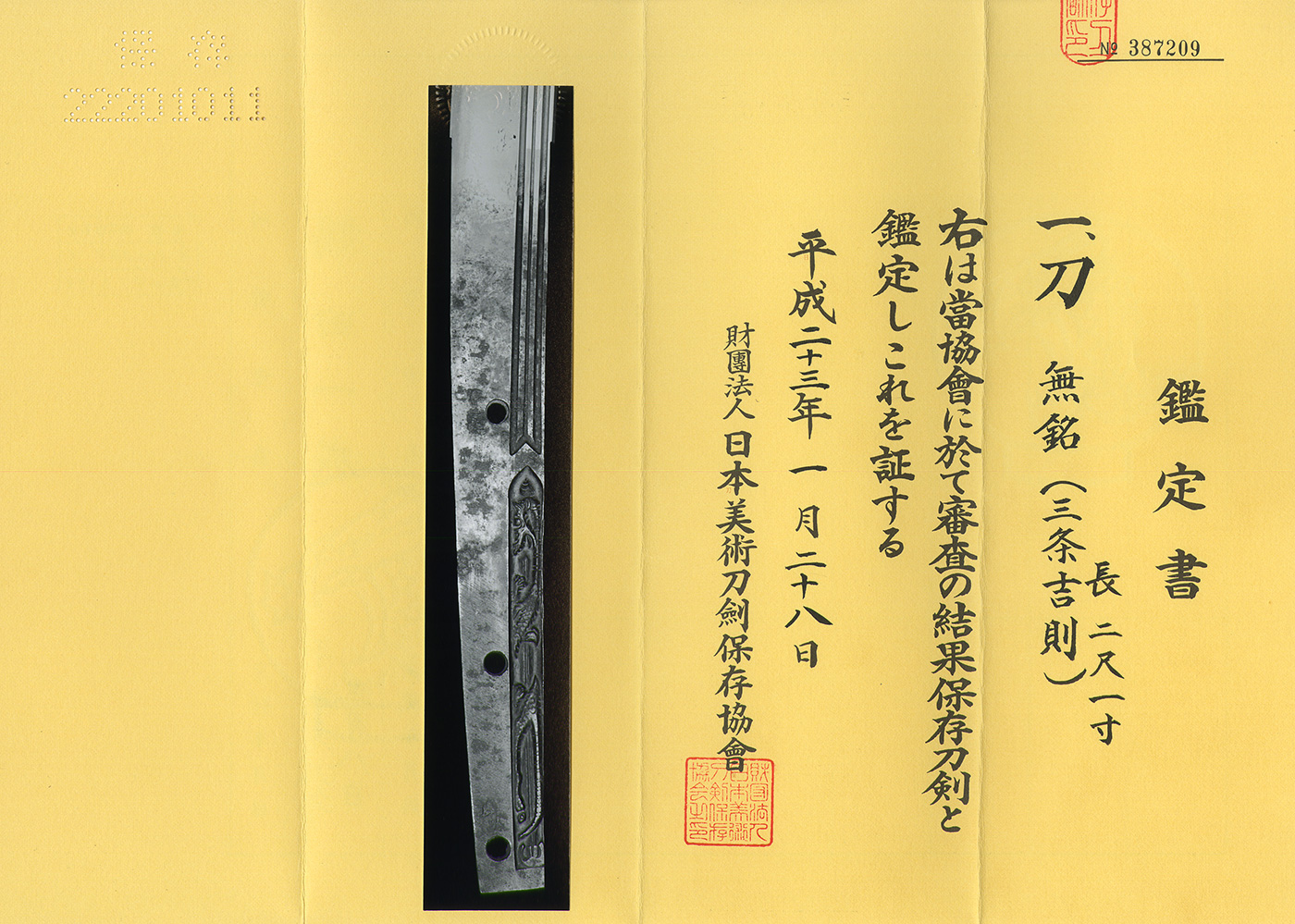
Ordering Number: AS26364Katana in Shirasaya (NBTHK Hozon Token)Signature: Mumei (Attributed to Sanjō Yoshinori)無銘(三条吉則)Sue-Koto: Ryō Wazamono: Jyo Saku: Yamashiro(We divide 4 sections for each sword as Saijyo Saku, Jyojyo Saku, Jyo Saku and Regular Saku).This blade is ranked as Jyojyo Saku among works attributed to Sanjō Yoshinori.Habaki: Single copper habaki.Blade Length: 63.6 cm (25.04 in).Curvature: 1.6 cm (0.63 in).Mekugi Hole: 3.Width at Base (Motohaba): 2.86 cm (1.13 in).Width at Yokote: 2.01 cm (0.79 in).Thickness of rim (Kasane): 0.66 cm (0.26 in).Sword Weight: 670 g.Era: Around the Bunmei era (1469–1487), Muromachi period.Shape: A sturdy katana with substantial mihaba and kasane. Fine carvings are present on both sides of the blade.Jigane: Well-forged ko-itame hada with some areas showing larger grain (ō-hada).Hamon: Nioi-deki gunome-midare.Features: Sanjō Yoshinori belonged to a lineage of swordsmiths dating back to the late Heian period. This blade was forged around the Bunmei era. It has a pronounced koshi-zori curvature. Although some larger grain is visible in the jigane, the carvings on the tang and the rope-pattern carving on the reverse side are particularly distinctive and add considerable interest to the piece.Historical Background: The Bunmei era (1469–1487) fell in the midst of the Ōnin War, which began in 1467 and divided the country. The conflict devastated Kyoto, destroying much of the city, including major temples, shrines, and aristocratic residences. The authority of the Muromachi Shogunate declined sharply, marking the beginning of the gekokujō ("the low overthrow the high") period, in which military power increasingly determined political authority. The war originated from a succession dispute over the 8th Muromachi Shogun, Ashikaga Yoshimasa, combined with rivalries among powerful shugo daimyō, eventually drawing warriors from across Japan into a prolonged civil conflict.NBTHK Hozon Token.AoiArt estimation paper: Whole Oshigata.Overseas
NihontoWatchOffered by Aoi Art
This piece has sold
Get an email when a new Heianjo Yoshinori piece hits the market.



Yamashiro-den · Yamashiro · around 1469-1487
Fujishiro Jo saku · Tōken Taikan top 31%
2 pieces on the market now
Where Yoshinori stands among comparable artisans: across all of nihontō, and within tradition, era, and period. The tiers (Foremost · Leading · Major · Notable) weigh official designations from the NBTHK and Japan's Agency for Cultural Affairs, together with historical honors of lasting repute such as the Sansaku and Meibutsu-chō.
Select a lens to see how it's measured.
Yamashiro-den · Kyoto
11 pieces on the market now
The Heianjō school (平安城) of swordsmiths represents the principal lineage of Kyōto sword production during the Muromachi period. "Heianjō" is the classical name for Kyōto (Heian-kyō), and the school's smiths — resident in the Sanjō district of the capital — signed variously with the 平安城 (Heianjō) and 三条 (Sanjō) prefixes, a usage that has often caused them to be confused with the far earlier Sanjō school of Munechika. They are an entirely distinct, late group: its two representative masters, Heianjō Nagayoshi (平安城長吉, also read Chōkichi) and Sanjō Yoshinori (三条吉則, of the Fuse 布施 family), are counted as the leading makers of Muromachi-period Kyō-mono (Kyoto-made blades), carrying forward the capital's swordmaking after the Nanbokuchō-period Nobukuni and Hasebe lineages. Both names continued through several generations from the late Nanbokuchō era into the sixteenth century, and the smiths are known to have travelled to forge (desaku) in provinces such as Izumi, Mikawa, and Echizen during the late Muromachi period. The Heianjō style is dominated by a flamboyant hitatsura (full-temper) idiom adopted from Sōshū tradition: a foundation of large gunome-midare mixed with chōji, togariba, and yahazu-ba, with abundant tobiyaki and muneyaki spreading temper across the entire blade surface, nie adhering strongly, and sunagashi and kinsuji coursing through a bright, clear nioiguchi.
The finest examples are so accomplished that they are difficult to distinguish from late Sōshū (Sue-Sōshū) work. A quieter suguha- and ko-notare-based mode close to the Nobukuni tradition is also seen. High-quality horimono — kurikara, bonji, suken, and gomabashi — frequently accompany the blades. The school is not to be confused with the unrelated Heianjō-zōgan (平安城象嵌) inlay tradition of tōsōgu makers. Learn more →
| Smith | Era | Designated |
|---|---|---|
| Nagayoshi長吉 | 1469-1492 | 15 |
| Yoshinori吉則 | 1469-1487 | 3 |
| Nagayoshi長吉 | 1449-1452 | 0 |
| Nobusada信貞 | 1346-1370 | 0 |
| Yoshinaga吉長 | 1381-1384 | 0 |
The Muromachi period (1392 to 1573)
After the Ōnin War broke the Ashikaga order, a century of Sengoku warfare armed nearly every province in Japan. The era rewards a discriminating eye: routine work exists in quantity, and beside it stand custom blades of the first rank.
Certifies a genuine blade worth preserving: a signature confirmed correct, or, if unsigned, an era, province, and school that the NBTHK can reliably identify.
The NBTHK (Nihon Bijutsu Tōken Hozon Kyōkai, the Society for the Preservation of Japanese Art Swords) is a public-interest incorporated foundation founded in 1948 and supervised by Japan’s Agency for Cultural Affairs (Bunkachō); it is based at the Japanese Sword Museum in Tokyo. Its expert panels physically examine each submitted work (shinsa) and issue a certificate (kanteishō) ranking it by artistic and historical merit. NBTHK papers are the most widely recognized standard of authentication for Japanese swords and fittings.
NBTHK official siteIf you wish to return an item, please notify us within 3 days of receipt. After this period we cannot accept cancellations. Please ship the return to us within 5 business days. Cancellation is conditional on the item being kept in the same condition as at the time of sale, so please handle it with care.