Muromachi turned sword making into an industry: the uchigatana rose with massed infantry warfare, Osafune and Seki produced bundle swords beside custom orders, and the Ming trade carried Japanese blades abroad by the tens of thousands.
 NihontoWatchNihontoWatch
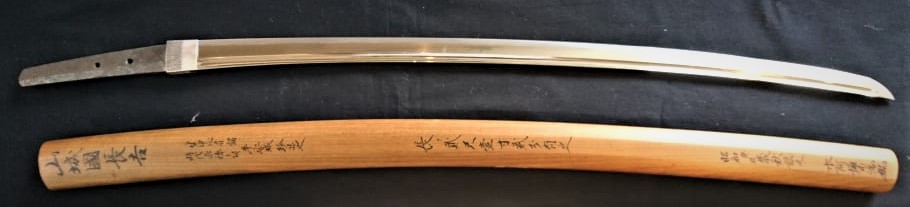
A Very Rare Heianjo Nagayoshi Katana With NBTHK Certificate, Nagayoshi was The Teacher of Muramasa, Shirasaya has Honami sayagaki 山城國⻑吉 生中心在銘 時代延徳之頃 平安城珍品也 ⻑サ貮尺壹寸貮分有之 昭和癸丑歳秋誌之 本阿弥日洲「花押」 Yamashiro no Kuni Nagayoshi Ubu-nakago zaimei Jidai Entoku no goro Heianjō, chinpin nari Nagasa ni-shaku issun ni-bu kore ari Shōwa mizunoto-ushidoshi aki kore o shirusu Hon’ami Nisshū + kaō Nagayoshi from Yamashiro Province Ubu-nakago and signed. Production time around Entoku (1489–1492). Heianjō [School], rare work. Blade length ~ 64.2 cm Written by Hon’ami Nisshū in fall of the year of the ox of the Shōwa era (1973) + monogram. NAGAYOSHI (長吉), 5th gen., Eishō (永正, 1504-1521), Yamashiro – “Heianjō Nagayoshi saku” (平安城長吉作), “Nagayoshi” (長吉), “Sanjō Nagayoshi saku” (三条長吉作), “Heianjō Nagayoshi” (平安城長吉), “Heianjō Nagayoshi Sanshū no Kuni saku” (平安城長吉三州国作), “Yoshinori no ko Nagayoshi saku” (吉則子長吉作, “made by Nagayoshi, son of Yoshinori”), “Sōshū-jū Nagayoshi” (相州住長吉), we know date signatures from the third year of Bunki (文亀, 1503) to the 13th year of Eishō (1516), he mentions in his signatures that he was the son of Yoshinori whereas probably the Bunmei-era (文明, 1469-1487) Sanjō Yoshinori (三条吉則) is meant, during his early years he also worked in Mikawa, Ise, and in Sagami and there exists the tradition that whilst staying in Ise, he acted as master of Muramasa (村正), his horimono show an influence of the Odawara-Sōshū school, that means they are somewhat finer and more detailed as the horimono of earlier Heianjō works, relative many tantō are extant, they measure around 27.3 cm, have a wide mihaba, and some sakizori, or are with 18.2 to 21.2 cm in length somewhat smaller, have a narrow mihaba, and a thick kasane, the hamon is a suguha mixed with gunome-midare which gets wider towards their base or which tends to yahazu, this interpretation reminds of the Sengo school (千子), his ō-gunome-midare on the other hand reminds of the Odawara Sōshū school, the tang tends to a tanagobara and has a ha-agari kurijiri, the yasurime are kiri and when he signed with a naga mei that mentions the production site, he mostly applied katte-sagari yasurime, jō-saku
NihontoWatchOffered by Nihonto Australia
11 on the market

Yamashiro-den · Yamashiro · around 1492-1501
1 piece on the market now
Where Nagayoshi stands among comparable artisans: across all of nihontō, and within tradition, era, and period. The tiers (Foremost · Leading · Major · Notable) weigh official designations from the NBTHK and Japan's Agency for Cultural Affairs, together with historical honors of lasting repute such as the Sansaku and Meibutsu-chō.
Select a lens to see how it's measured.
Yamashiro-den · Kyoto
11 pieces on the market now
The Heianjō school (平安城) of swordsmiths represents the principal lineage of Kyōto sword production during the Muromachi period. "Heianjō" is the classical name for Kyōto (Heian-kyō), and the school's smiths — resident in the Sanjō district of the capital — signed variously with the 平安城 (Heianjō) and 三条 (Sanjō) prefixes, a usage that has often caused them to be confused with the far earlier Sanjō school of Munechika. They are an entirely distinct, late group: its two representative masters, Heianjō Nagayoshi (平安城長吉, also read Chōkichi) and Sanjō Yoshinori (三条吉則, of the Fuse 布施 family), are counted as the leading makers of Muromachi-period Kyō-mono (Kyoto-made blades), carrying forward the capital's swordmaking after the Nanbokuchō-period Nobukuni and Hasebe lineages. Both names continued through several generations from the late Nanbokuchō era into the sixteenth century, and the smiths are known to have travelled to forge (desaku) in provinces such as Izumi, Mikawa, and Echizen during the late Muromachi period. The Heianjō style is dominated by a flamboyant hitatsura (full-temper) idiom adopted from Sōshū tradition: a foundation of large gunome-midare mixed with chōji, togariba, and yahazu-ba, with abundant tobiyaki and muneyaki spreading temper across the entire blade surface, nie adhering strongly, and sunagashi and kinsuji coursing through a bright, clear nioiguchi.
The finest examples are so accomplished that they are difficult to distinguish from late Sōshū (Sue-Sōshū) work. A quieter suguha- and ko-notare-based mode close to the Nobukuni tradition is also seen. High-quality horimono — kurikara, bonji, suken, and gomabashi — frequently accompany the blades. The school is not to be confused with the unrelated Heianjō-zōgan (平安城象嵌) inlay tradition of tōsōgu makers. Learn more →
| Smith | Era | Designated |
|---|---|---|
| Nagayoshi長吉 | 1469-1492 | 15 |
| Yoshinori吉則 | 1469-1487 | 3 |
| Nagayoshi長吉 | 1449-1452 | 0 |
| Nobusada信貞 | 1346-1370 | 0 |
| Yoshinaga吉長 | 1381-1384 | 0 |
The Muromachi period (1392 to 1573)
Muromachi turned sword making into an industry: the uchigatana rose with massed infantry warfare, Osafune and Seki produced bundle swords beside custom orders, and the Ming trade carried Japanese blades abroad by the tens of thousands.
Certifies a genuine blade worth preserving: a signature confirmed correct, or, if unsigned, an era, province, and school that the NBTHK can reliably identify.
The NBTHK (Nihon Bijutsu Tōken Hozon Kyōkai, the Society for the Preservation of Japanese Art Swords) is a public-interest incorporated foundation founded in 1948 and supervised by Japan’s Agency for Cultural Affairs (Bunkachō); it is based at the Japanese Sword Museum in Tokyo. Its expert panels physically examine each submitted work (shinsa) and issue a certificate (kanteishō) ranking it by artistic and historical merit. NBTHK papers are the most widely recognized standard of authentication for Japanese swords and fittings.
NBTHK official sitePrice on request