Gendai, Niigata
Ningen Kokuho
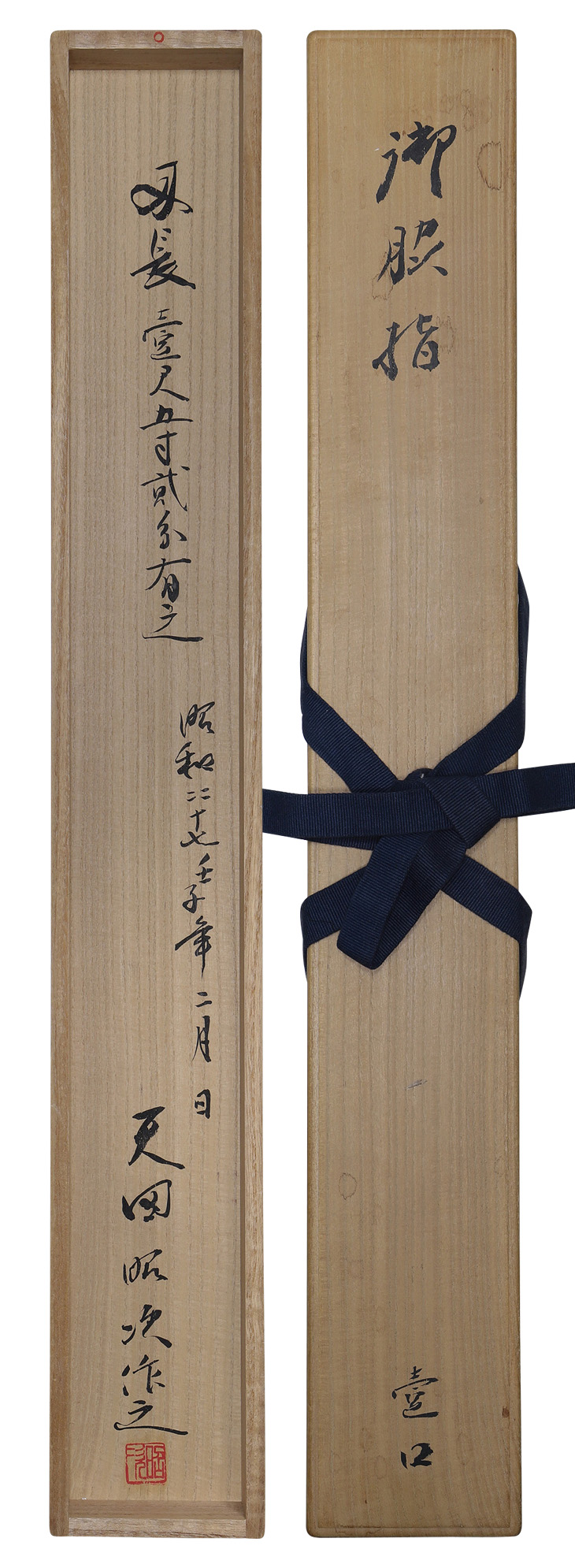
Includes box with autograph inscription
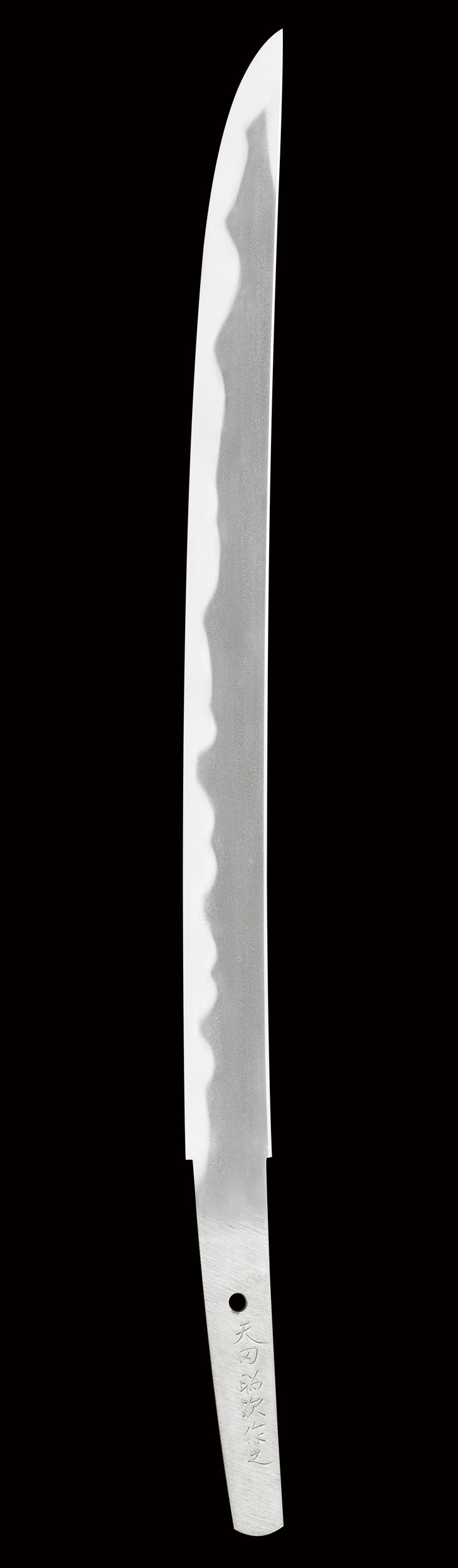
Hira-zukuri, low iori-mune. Kitae: ko-itame, itame, mixed with fine masame-hada, well-tightened, thick ji-nie, chikei enters, mixed with yubashiri, jitetsu is in good condition. Hamon: primarily gunome-midare, mixed with yamagata-no-ha, box-shaped ha, and ko-gunome; the habuchi is covered in ara-nie with deep nioi, gunome-ashi enter the hachu, with kinsuji and sunagashi. Boshi: notare-komi, the tip is tsukiage with a sharp pointed feel, hakikake with a long kaeri. Nakago is ubu, tip is kurijiri, yasurime is sujikai. Silver with gold-foil double habaki. Period polish. In shirasaya. Includes a specially made wooden box.
Akitsugu was born in Showa 2 in Niigata Prefecture, Kitakanbara-gun, Honda-mura (present-day Shibata-shi, Honda); at age nine he was separated from his father Sadayoshi by death, and in Showa 15 he went to Tokyo and became a monjin of Kurihara Hikosaburo at the Nihonto Tanren Denshu-jo. At this time, Miyairi Akihira (Yukihira) was his senior apprentice. Entering the Showa 30s, he began to distinguish himself, receiving the Yushu-sho every year at the Shinsakuto-ten, but just as he was starting out around Showa 35 at age 33, he suffered a serious illness and was forced into an eight-year hiatus. In Showa 43, upon resuming sword forging, he established his home and forge, the "Hogetsusan Tanren-jo," on the outskirts of the Tsukioka Onsen district in Shibata-shi. Akitsugu, who revived with an indomitable spirit, became Mukansa in Showa 47, and in Showa 52, 60, and Heisei 8, he received the Masamune-sho, the highest award in the sword world, three times; receiving this award three times is the third instance following Sumitani Masamine and Osumi Toshihira, but Akitsugu is the only one to receive it for entirely different styles in Yamashiro-den, Soshu-den, and Bizen-den. In Heisei 9 he was designated a Ningen Kokuho, and in Heisei 25 he passed away at age 85.
This work was made in Showa 47 when the smith was 45 years old, with a nagasa of slightly over 1 shaku 3 sun 4 bu, a masterpiece of a brave hira-wakizashi. The jitetsu, well-tightened with ko-itame, itame, and fine masame-hada, has strong ji-nie, with large grains of ara-nie that shine black in parts appearing as yubashiri; the yakiba, primarily gunome-midare mixed with yamagata-no-ha and others, has a habuchi covered in ara-nie with deep nioi, kinsuji and sunagashi in the hachu, and particularly in the hachu of the ura, a thick nie-suji pierces from the moto to the saki, and the boshi also has a pointed tip with hakikake-kaeri.
It is probably a work aiming for Soden Bizen smiths such as Nagayoshi, and the large, grand sugata well displays the period style of the Nanbokucho peak, possessing truly impressive power. This year was the year he was designated Mukansa, a time when his reputation rose all at once.
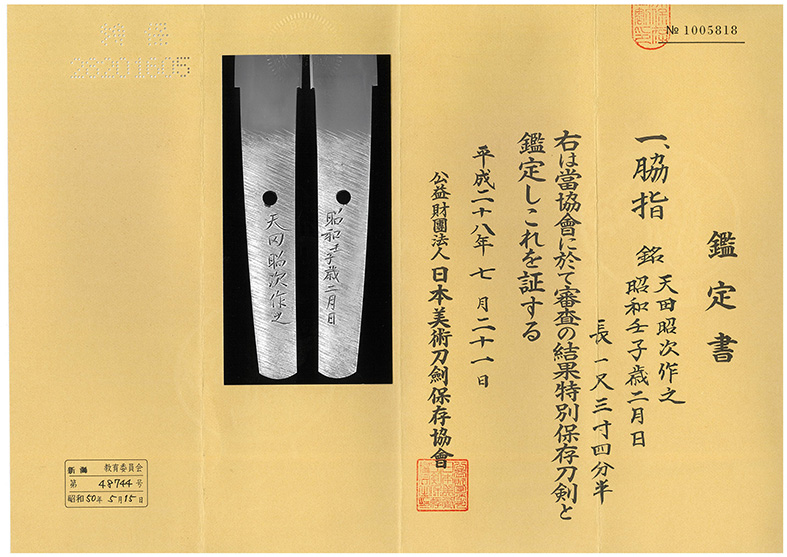
A Tokubetsu Hozon Kanteisho is included, but for gendaito, these are only granted to high-quality works of the Ningen Kokuho or Mukansa swordsmith class. Also, the autograph box inscription is now extremely precious, and I would like it to be kept with great care. This is a masterpiece.
Machine translation from the shop's Japanese · may contain errors ·
Gendai, Niigata
Ningen Kokuho
Includes box with autograph inscription
Hira-zukuri, low iori-mune. Kitae: ko-itame, itame, mixed with fine masame-hada, well-tightened, thick ji-nie, chikei enters, mixed with yubashiri, jitetsu is in good condition. Hamon: primarily gunome-midare, mixed with yamagata-no-ha, box-shaped ha, and ko-gunome; the habuchi is covered in ara-nie with deep nioi, gunome-ashi enter the hachu, with kinsuji and sunagashi. Boshi: notare-komi, the tip is tsukiage with a sharp pointed feel, hakikake with a long kaeri. Nakago is ubu, tip is kurijiri, yasurime is sujikai. Silver with gold-foil double habaki. Period polish. In shirasaya. Includes a specially made wooden box.
Akitsugu was born in Showa 2 in Niigata Prefecture, Kitakanbara-gun, Honda-mura (present-day Shibata-shi, Honda); at age nine he was separated from his father Sadayoshi by death, and in Showa 15 he went to Tokyo and became a monjin of Kurihara Hikosaburo at the Nihonto Tanren Denshu-jo. At this time, Miyairi Akihira (Yukihira) was his senior apprentice. Entering the Showa 30s, he began to distinguish himself, receiving the Yushu-sho every year at the Shinsakuto-ten, but just as he was starting out around Showa 35 at age 33, he suffered a serious illness and was forced into an eight-year hiatus. In Showa 43, upon resuming sword forging, he established his home and forge, the "Hogetsusan Tanren-jo," on the outskirts of the Tsukioka Onsen district in Shibata-shi. Akitsugu, who revived with an indomitable spirit, became Mukansa in Showa 47, and in Showa 52, 60, and Heisei 8, he received the Masamune-sho, the highest award in the sword world, three times; receiving this award three times is the third instance following Sumitani Masamine and Osumi Toshihira, but Akitsugu is the only one to receive it for entirely different styles in Yamashiro-den, Soshu-den, and Bizen-den. In Heisei 9 he was designated a Ningen Kokuho, and in Heisei 25 he passed away at age 85.
This work was made in Showa 47 when the smith was 45 years old, with a nagasa of slightly over 1 shaku 3 sun 4 bu, a masterpiece of a brave hira-wakizashi. The jitetsu, well-tightened with ko-itame, itame, and fine masame-hada, has strong ji-nie, with large grains of ara-nie that shine black in parts appearing as yubashiri; the yakiba, primarily gunome-midare mixed with yamagata-no-ha and others, has a habuchi covered in ara-nie with deep nioi, kinsuji and sunagashi in the hachu, and particularly in the hachu of the ura, a thick nie-suji pierces from the moto to the saki, and the boshi also has a pointed tip with hakikake-kaeri.
It is probably a work aiming for Soden Bizen smiths such as Nagayoshi, and the large, grand sugata well displays the period style of the Nanbokucho peak, possessing truly impressive power. This year was the year he was designated Mukansa, a time when his reputation rose all at once.
A Tokubetsu Hozon Kanteisho is included, but for gendaito, these are only granted to high-quality works of the Ningen Kokuho or Mukansa swordsmith class. Also, the autograph box inscription is now extremely precious, and I would like it to be kept with great care. This is a masterpiece.
The twentieth century nearly killed the craft twice: wartime distortion, then the occupation ban. The NBTHK’s founding in 1948 and licensed forging from 1953 rebuilt the sword as an art, crowned by Living National Treasures and the mukansa rank.
A Hozon-certified blade judged to show notably superior workmanship and a better state of preservation. The bar is higher: re-tempered blades and most unsigned Muromachi/Edo works are excluded.
Signed: 天田昭次作之 昭和壬子歳二月日 (Miyairi Akitsugu)
As written on the certificate
About the NBTHK›
The NBTHK (Nihon Bijutsu Tōken Hozon Kyōkai, the Society for the Preservation of Japanese Art Swords) is a public-interest incorporated foundation founded in 1948 and supervised by Japan’s Agency for Cultural Affairs (Bunkachō); it is based at the Japanese Sword Museum in Tokyo. Its expert panels physically examine each submitted work (shinsa) and issue a certificate (kanteishō) ranking it by artistic and historical merit. NBTHK papers are the most widely recognized standard of authentication for Japanese swords and fittings.
For one-of-a-kind items such as swords, sword fittings and antiques, other customers may be waiting for the item, so please contact us about a return within 3 days of its arrival and ship it back within 8 days. Refunds are made on the day the returned item arrives.

 NihontoWatch