The twentieth century nearly killed the craft twice: wartime distortion, then the occupation ban. The NBTHK’s founding in 1948 and licensed forging from 1953 rebuilt the sword as an art, crowned by Living National Treasures and the mukansa rank.
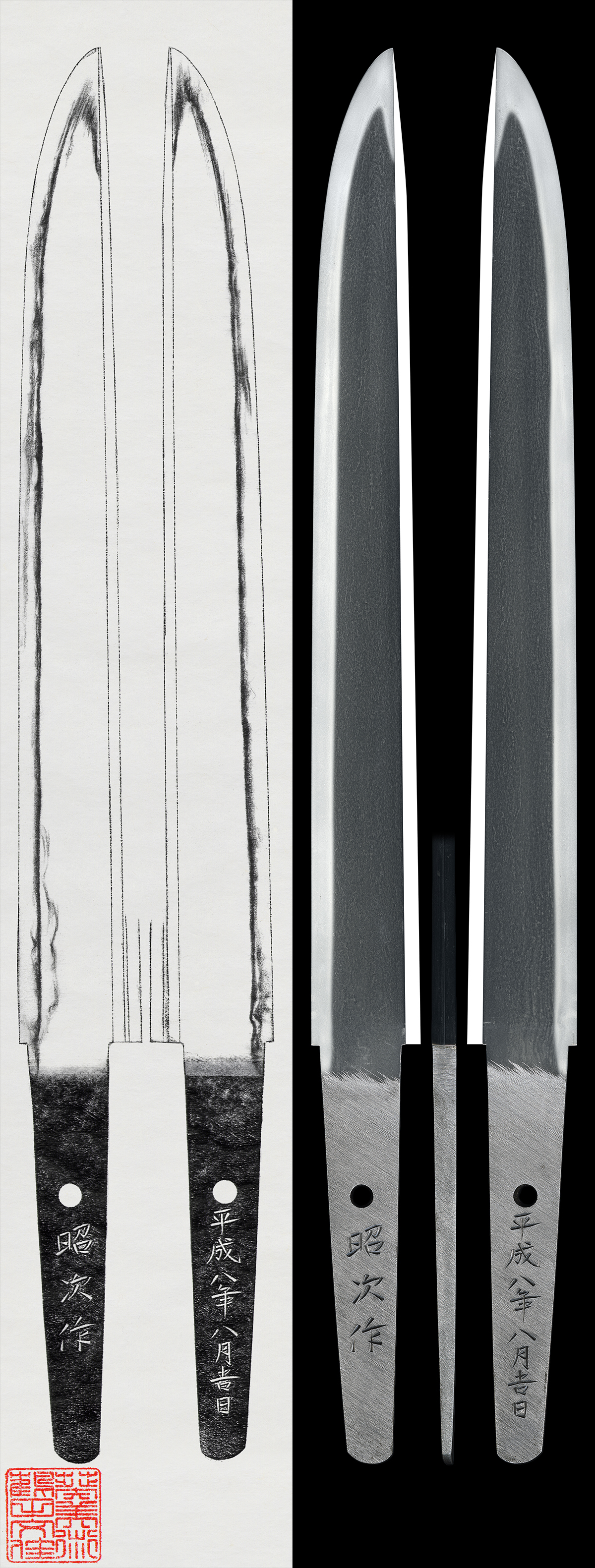
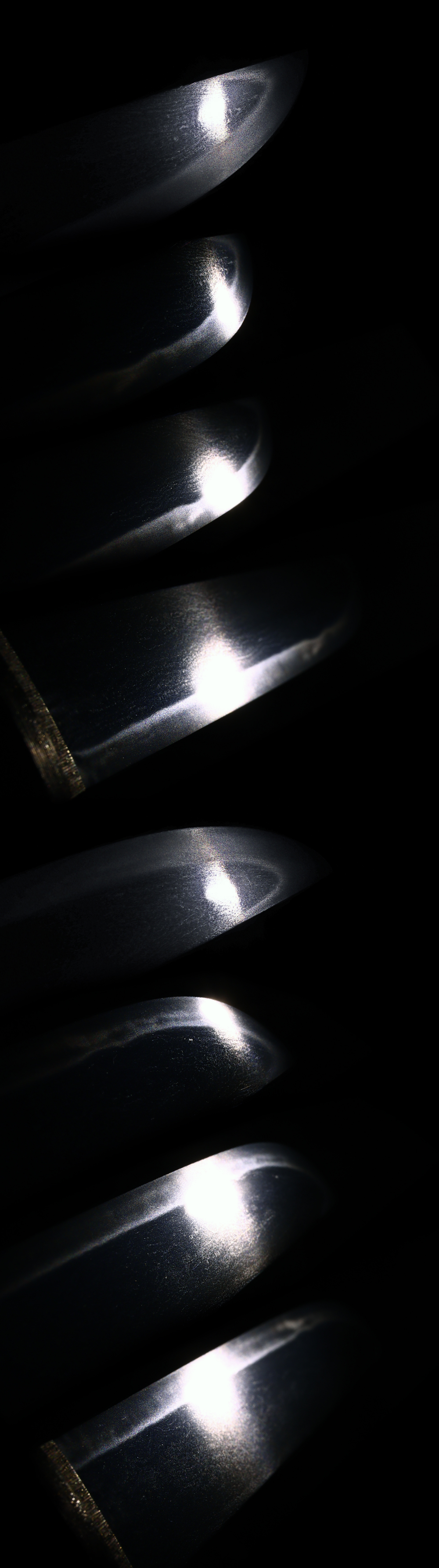
Ordering Number: 25542Tanto in Shirasaya (NBTHK Tokubetsu Hozon Token).Signature: Akitsugu Saku (Amata Akitsugu) (Living National Treasure).A lucky day in August, Heisei 8 (1996).昭次作(天田昭次)(人間国宝)平成八年八月吉日(We divide 4 sections for each sword as Saijyo Saku, Jyojyo Saku, Jyo Saku and Regular Saku).This work ranks as Saijyo Saku among the works of Amata Akitsugu.Habaki: Double gold Habaki (solid gold, 15 g).Blade Length: 25.3 cm (9.96 in).Curvature: 0.0 cm (0.00 in).Mekugi Hole: 1.Width at Base (Motohaba): 2.51 cm (0.99 in).Thickness of rim (Kasane): 0.60 cm (0.24 in).Sword Weight: 170 g.Shape: A healthy tanto with strong masame appearing within the itame hada, active chikei, a mitsu-mune construction, and ubuha remaining.Jigane: Itame hada with strong masame mixed in, and active chikei throughout.Hamon: Nioi-deki suguha with a deep nioiguchi, featuring double temper lines and ko-ashi.The boshi forms a small round turnback.Features: Amata Akitsugu was a swordsmith from Niigata Prefecture and the eldest son of Amata Sadakichi.When Akitsugu was 10 years old, his father passed away, and in 1940 he studied under Kurihara Saburo, devoting himself to the forging of military swords.After the war, sword production was prohibited, but in 1954 (Showa 29) he received permission to resume swordsmithing and began producing works in the Soshu tradition and kotō style, mastering many forging techniques.He later received the Masamune Prize and was recognized in 1997 (Heisei 9) as a Living National Treasure under the designation of Important Intangible Cultural Property, becoming one of the foremost modern swordsmiths.Sadly, he passed away in 2013 (Heisei 25).Aoi Art’s Comment: It is said that after losing his father at the age of 10 while still in elementary school, he studied swordsmithing under Kurihara Saburo.He devoted his entire life to sword production, studying classical masterpieces and creating his own distinctive Japanese swords.This piece displays clearly visible hada and vig
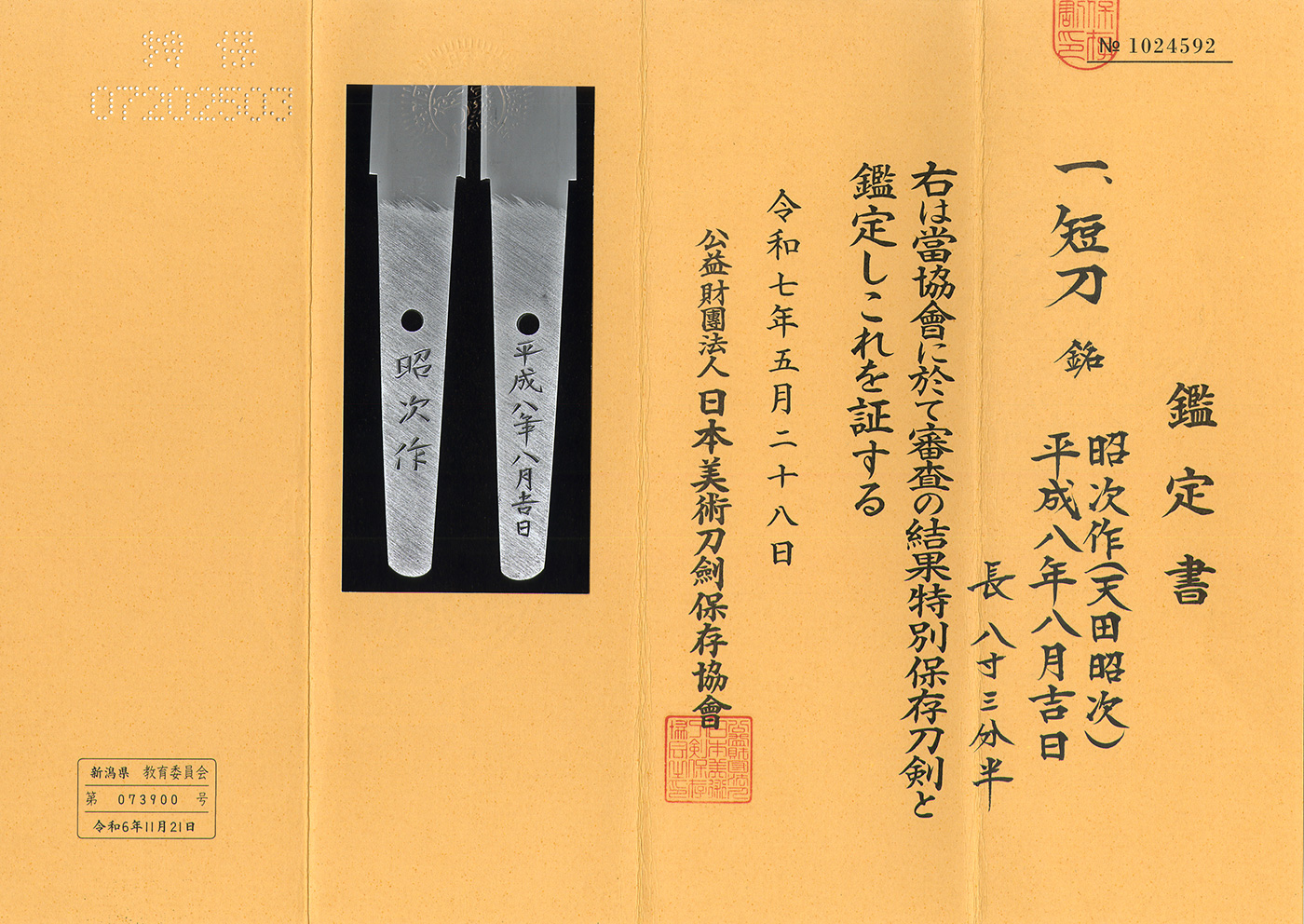
Certificate reading — 銘 昭次作 平成八年八月吉日
Offered by Aoi Art
This piece has sold
Get an email when a new Miyairi Akitsugu piece hits the market.


Niigata · around 1926-1989
Tōken Taikan top 87%
6 pieces on the market now
Shōwa to the present: destruction and revival
The twentieth century nearly killed the craft twice: wartime distortion, then the occupation ban. The NBTHK’s founding in 1948 and licensed forging from 1953 rebuilt the sword as an art, crowned by Living National Treasures and the mukansa rank.
A Hozon-certified blade judged to show notably superior workmanship and a better state of preservation. The bar is higher: re-tempered blades and most unsigned Muromachi/Edo works are excluded.
The NBTHK (Nihon Bijutsu Tōken Hozon Kyōkai, the Society for the Preservation of Japanese Art Swords) is a public-interest incorporated foundation founded in 1948 and supervised by Japan’s Agency for Cultural Affairs (Bunkachō); it is based at the Japanese Sword Museum in Tokyo. Its expert panels physically examine each submitted work (shinsa) and issue a certificate (kanteishō) ranking it by artistic and historical merit. NBTHK papers are the most widely recognized standard of authentication for Japanese swords and fittings.
NBTHK official siteIf you wish to return an item, please notify us within 3 days of receipt. After this period we cannot accept cancellations. Please ship the return to us within 5 business days. Cancellation is conditional on the item being kept in the same condition as at the time of sale, so please handle it with care.