War at home and trade abroad made Muromachi Bizen the busiest forge region in Japan: a century of Sengoku demand after the Ōnin War, and export missions to Ming China carrying blades by the tens of thousands.
 NihontoWatchNihontoWatch
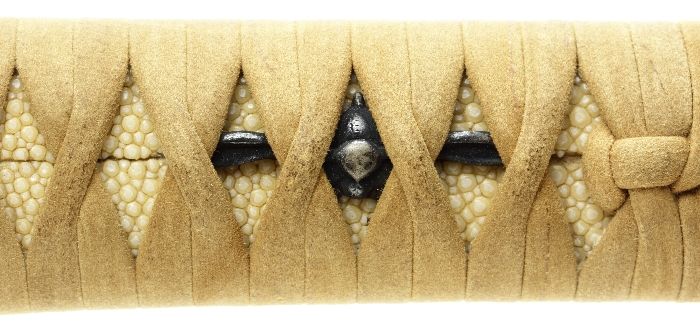
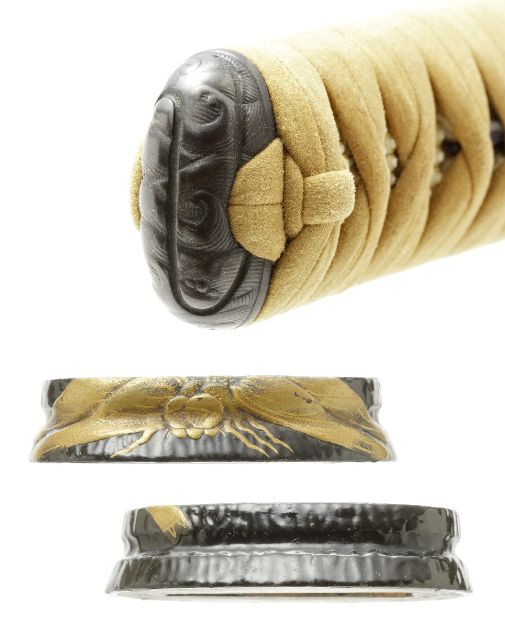
Eikyo 5 (AD1433, early Muromachi period) Moto-haba (Width at Ha-machi) approx. 2.67cm Engraving: "Bo-hi" maru-dome on the both sides Same-gawa togi-dashi saya, Higo wakizashi koshirae 応永に続く備前鍛冶の中でも則光は、微塵に詰んだ柔らか味の感じられる極上質の板目鍛えに腰開き互の目を焼いて格別美しい刀を製作しながら、良業物に指定されているように殊に切れ味鋭く、戦国武将の信頼度が高い刀工であった。抜刀し易く片手で打ち振るに適した二尺前後の打刀が盛んに製作されたこの時代、本作のような一尺五寸前後の脇差も高級武将の太刀の添え差しとして多用されたもので、姿がいかにも引き締まっている。特筆すべきは、応永備前に通じる奇麗な杢目を交えた板目鍛えの地鉄。これに小板目肌が複合されて微塵に詰み、細かな地沸を分け入るように地景で肌目が奇麗に起ち、さらに映りが全面に現れ、焼頭から煙り込むような景色が加わっている。刃文は腰開き互の目に小丁子が交じり、所々尖りごころに複雑な出入りを成し、乱れ込んだ帽子も先端が尖りごころに返ってここも応永備前風。匂口に柔らか味のある焼刃は、刃境に匂のほつれが穏やかに掛かり、小丁子に伴う無数の足が匂の満ちた刃中に射す。わずかに反りの付いた茎に、鑢目も鮮明に銘字が鑽強く刻されている。
NihontoWatchOffered by Choshuya
This piece has sold
Get an email when a new Osafune Norimitsu piece hits the market.










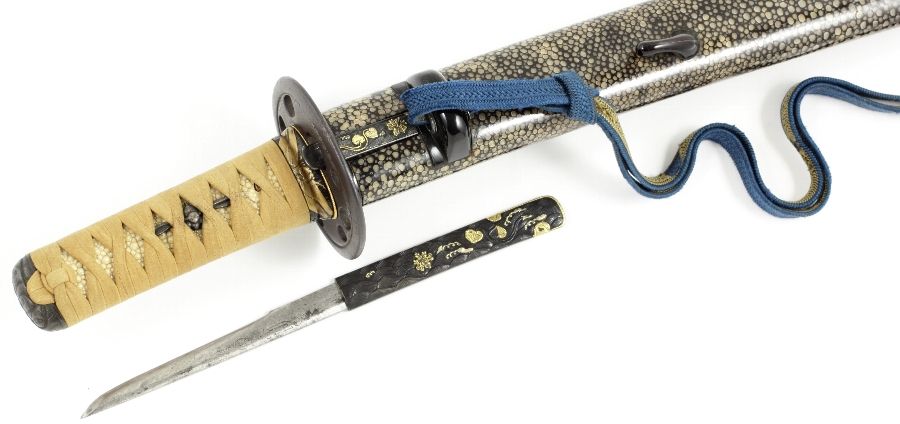
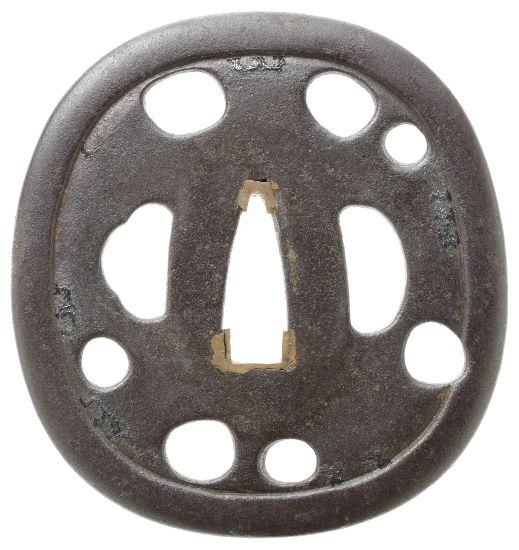
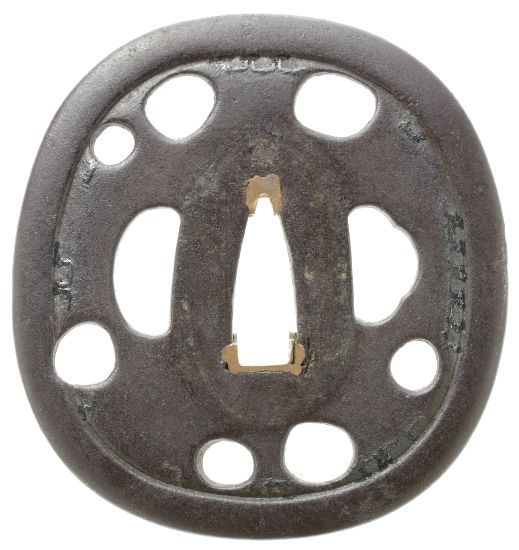
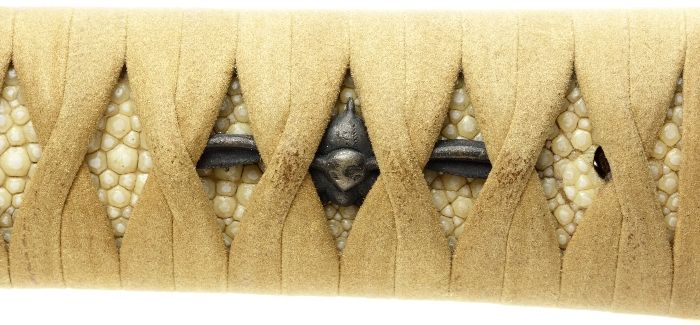




Bizen-den · Bizen · around 1430-1453
Osafune Norimitsu of the Eikyo to Kyotoku eras is known from four dated works: a tanto of Eikyo 2 (1430), tachi of Eikyo 10 (1438) and Bun'an 2 (1445), and a tachi of Kyotoku 2 (1453) that was designated Juyo Token at the 43rd session and raised to Tokubetsu Juyo the following year. The published sources trace the name back to a first Norimitsu said to have been a pupil of Nagamitsu, whose tanto dated Kagen 3 survives. They record the meikan sequence in full: 「銘鑑では, これを初代とし, 二代を延文頃, 三代が応永で家助の子とし, 四代が永享頃, 五代が長禄・寛正頃で, 以後室町末期まで名跡の継承があったことを記している」 (the meikan count that smith as the first generation, a second around Enbun, a third in Oei as the son of Iesuke, a fourth around Eikyo, and a fifth around Choroku and Kansho, with the name carried on to the end of the Muromachi period).
Within that sequence the published sources place the present smith as the fourth. They note that works up to the Oei era at the start of the Muromachi period are very few; one paper puts it that the line lapsed and was revived in the Muromachi period[[c:1]]. By contrast, the maker of the Kyotoku tachi is held to be the fourth generation of the meikan, with comparatively many surviving works, and famed alongside Sukemitsu as one of the two pillars of Eikyo Bizen[[c:2]]. The paper on the Bun'an tachi gives his common name: 「この文安の則光はその四代目にあたり, 五郎左衛門を名のっている」.
His tachi share a recognisable manner. On the Kyotoku tachi the ko-itame is finely forged, with minute ji-nie, fine chikei and a clear midare-utsuri. The hamon is based on gunome open at the base, mixed with angular ko-gunome, ko-choji and pointed elements. Ashi and yo enter freely, the nioiguchi is slightly tight with ko-nie, and there are scattered tobiyaki. The boshi runs in irregular, small and round on the omote and pointed on the ura, with fine hakikake. The published sources find the features of Norimitsu well displayed here. They call it a masterpiece among his works, more varied than usual in the rise and fall of the temper and in its ashi and yo[[c:3]].
The Bun'an tachi shows the same pattern: a midare-utsuri in the ji, gunome open at the base with a choji feeling, ashi and yo, and a boshi that runs in and turns back pointed. Its paper reads this as the inheritance of the Oei Bizen manner, the nioiguchi bright and clear[[c:4]]. The Eikyo 10 tachi, long even after shortening, has a flowing itame with mokume that tends to stand, and a hamon of gunome mixed with choji and ko-choji, deep in nioi. The published sources write 「この太刀は姿・作柄にいまなお応永備前の風を保ち, 地刃の出来が見事である」 (in shape and workmanship this tachi still keeps the manner of Oei Bizen, and its ji and ha are splendid).
The Eikyo 2 tanto is a different register. It is hira-zukuri, without sori and somewhat thick, with Sanskrit characters carved on both faces. Over a well-forged itame with bo-utsuri runs a naka-suguha in nioi-deki with a little ko-nie. The published sources call it one of his representative works and find in it the features of Osafune work of the period[[c:5]].
The Kyotoku tachi comes with a contemporary black-lacquered tachi koshirae, an iron tachi chain fitting, a silver brocade tachi bag woven with large chrysanthemums on a dark blue field, and a vermilion-lacquered box. The published sources describe the mounting as a valuable example of an archaic military black-lacquered tachi koshirae that carries the Nanbokucho style[[c:6]]. They consider the bag a very rare Japanese silver brocade datable to the Muromachi period.
Where Norimitsu stands among comparable artisans: across all of nihontō, and within tradition, era, and period. The tiers (Foremost · Leading · Major · Notable) weigh official designations from the NBTHK and Japan's Agency for Cultural Affairs, together with historical honors of lasting repute such as the Sansaku and Meibutsu-chō.
Select a lens to see how it's measured.
Years he was demonstrably active, proven by signed-and-dated blades
Bizen-den · Bizen
186 pieces on the market now
No single workshop in the history of Japanese swordmaking grew larger or lasted longer than Osafune, the riverside village in Bizen Province whose name became, across three centuries, a byword for the province's mainline. Its de facto founder was Mitsutada (光忠), working at Osafune in the middle Kamakura period; tradition makes him the son of Chikatada, and the genealogies derive his line from the Ko-Bizen Masatsune group already settled in the village. His blades, bold and imposing with a jigane so refined the sources say it can at a glance suggest Kyoto work, were treasured from old as the swords of commanders, and from his hand the school spread immediately: his sons Nagamitsu (長光) and Sanenaga (眞長), his grandson Kagemitsu (景光), and outward through pupils and collaterals until, by the late Kamakura years, Osafune was less a family than an industry. The line is conventionally read as a three-generation spine, Mitsutada founding it, Nagamitsu setting its classical standard, Kagemitsu bringing both temper and forging to their finished form before handing the manner to his pupil Chikakage (近景), whose echo of the master is so close that signed Kagemitsu blades are sometimes read as Chikakage daimei. What binds the membership is a shared steel before any shared temper. The forging is itame mixed with mokume, tightening on the finest blades into a dense ko-itame; fine ji-nie adheres, chikei enter, and over all of it stands the midare-utsuri that anchors even the most Kyoto-like jigane back to Bizen. On that floor the founding generation tempers a flamboyant choji-midare mixed with gunome: Mitsutada's tadpole-headed kawazuko-choji, Nagamitsu's round-topped plump choji, the deep nioi with ko-nie, the bright nioiguchi. From here the school divides by hand and by era. Sanenaga draws the calm pole, a gentle chu-suguha of tightened nioiguchi; Kagemitsu completes the slanting, square-shouldered kataochi-gunome over a suguha base, the family's last great Kamakura invention, carried on by his close kinsman Kagemasa (景政). The Nanbokucho generation then turns toward Soshu-den: Kanemitsu (兼光), fourth master of the mainline, pioneers a broad notare and is read, with Chogi (長義), as the head of Soden-Bizen, the Bizen wing that worked Soshu nie into a jigane that still throws a Bizen utsuri.
Chogi is called the most un-Bizen of Bizen smiths, his ear-shaped mimigata his tell; around him Nagashige (長重), Yoshikage (義景), Tomomitsu (倫光) and Kanenaga (兼長) press the Soshu side by degrees, while Motoshige (元重), of a separate Hatakeda descent, carries an Aoe-tinged squared, slanting ha. Two generations later the Oei revival returns to Kamakura: Yasumitsu (康光) and Morimitsu (盛光), the twin pillars of Oei-Bizen, revive the tachi shape and the choji temper over a wide-waisted koshibiraki-gunome, both finishing in the pointed rosoku-no-shin (candle-wick) boshi that gives the late date away. For the collector the school is a school of discriminations, and to kantei it is to read those fine partitions. The constant midare-utsuri over a bright ko-itame fixes the province; the boshi then sorts the maker, Mitsutada's pointed midare-komi against Nagamitsu's composed ko-maru Sansaku turn, Kagemitsu's contained return, the candle-wick tongue of Oei. Within a single phase the calls turn on a half-step: Nagamitsu's plump crests against Sanenaga's cooler nioiguchi, Kagemasa's freer play against Kagemitsu's tighter order, Nagashige read out of Chogi by a nie that surpasses his brother's. The standing of the best is matched by their patrimony. Mitsutada, Nagamitsu and Kagemitsu each hold National Treasures and stand at the head of Fujishiro's Sai-jo saku; their named blades, the Daihannya Nagamitsu, the Kogaryu Kagemitsu, the O-Kanemitsu, passed through Nobunaga, Ieyasu, Uesugi Kenshin and the great daimyo houses. Because Nagamitsu and the Nanbokucho masters signed and survived in number, Osafune offers what most peerage names cannot, a deep field of Tokubetsu Juyo and Juyo work that a patient collector may still realistically hold. Through every register the same hand declares itself: the bright steel, the vivid reflection, and a temper that runs, across three centuries, as the spine of Bizen. Learn more →
| Smith | Era | Designated |
|---|---|---|
| Mitsutada光忠 | 1238-1239 | 60 |
| Nagamitsu長光 | 1274-1304 | 254 |
| Kagemitsu景光 | 1303-1336 | 142 |
| Sanenaga眞長 | 1299-1309 | 68 |
| Kanemitsu兼光 | 1323-1370 | 235 |
Bizen in the Muromachi period
War at home and trade abroad made Muromachi Bizen the busiest forge region in Japan: a century of Sengoku demand after the Ōnin War, and export missions to Ming China carrying blades by the tens of thousands.
Certifies a genuine blade worth preserving: a signature confirmed correct, or, if unsigned, an era, province, and school that the NBTHK can reliably identify.
The NBTHK (Nihon Bijutsu Tōken Hozon Kyōkai, the Society for the Preservation of Japanese Art Swords) is a public-interest incorporated foundation founded in 1948 and supervised by Japan’s Agency for Cultural Affairs (Bunkachō); it is based at the Japanese Sword Museum in Tokyo. Its expert panels physically examine each submitted work (shinsa) and issue a certificate (kanteishō) ranking it by artistic and historical merit. NBTHK papers are the most widely recognized standard of authentication for Japanese swords and fittings.
NBTHK official siteIf, due to our fault, the item differs significantly from its proper condition, the item may be returned. Cooling-off is within one week of the item's arrival.