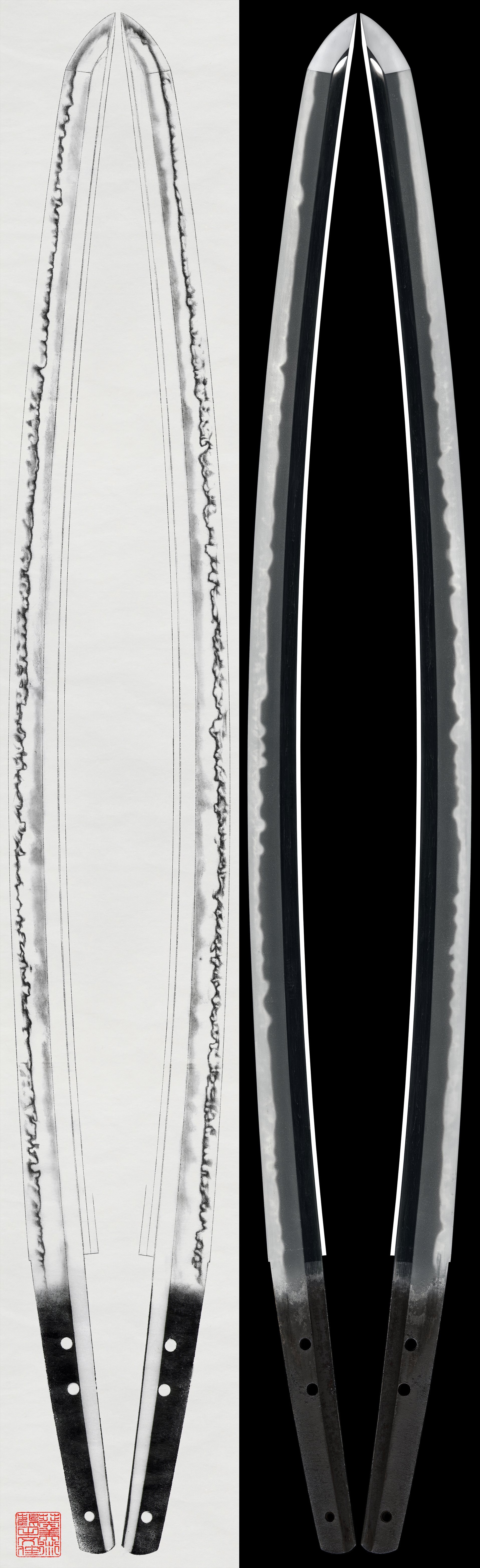
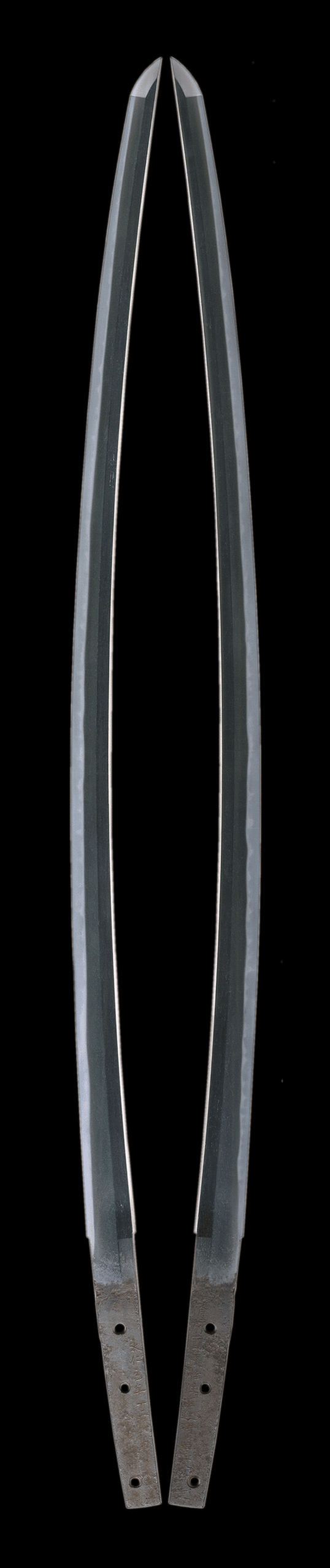
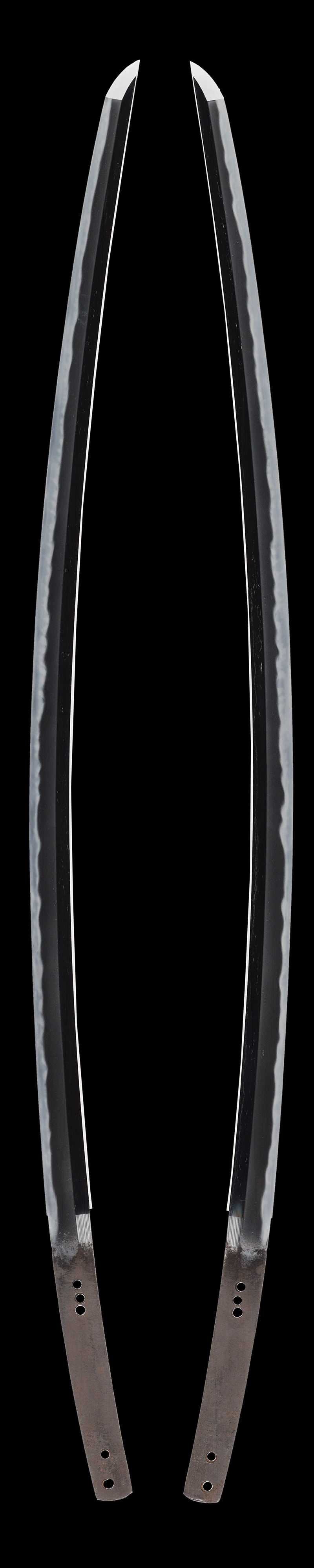
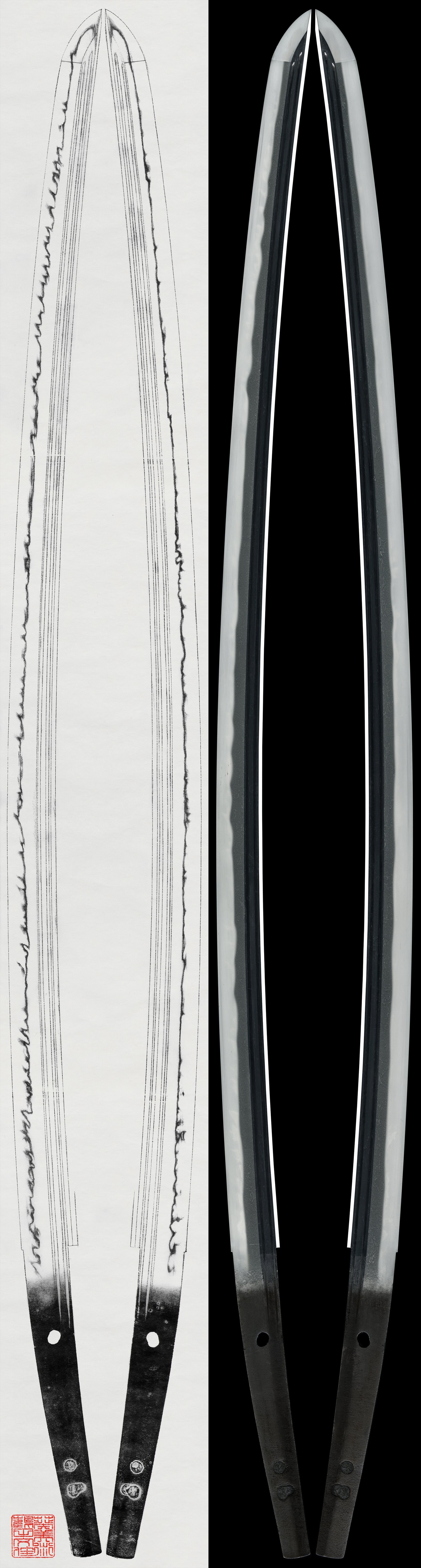
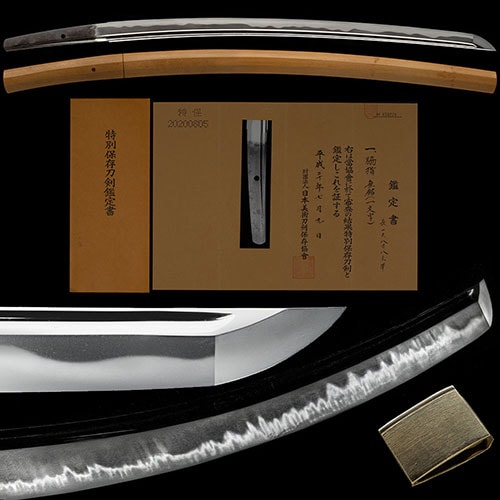
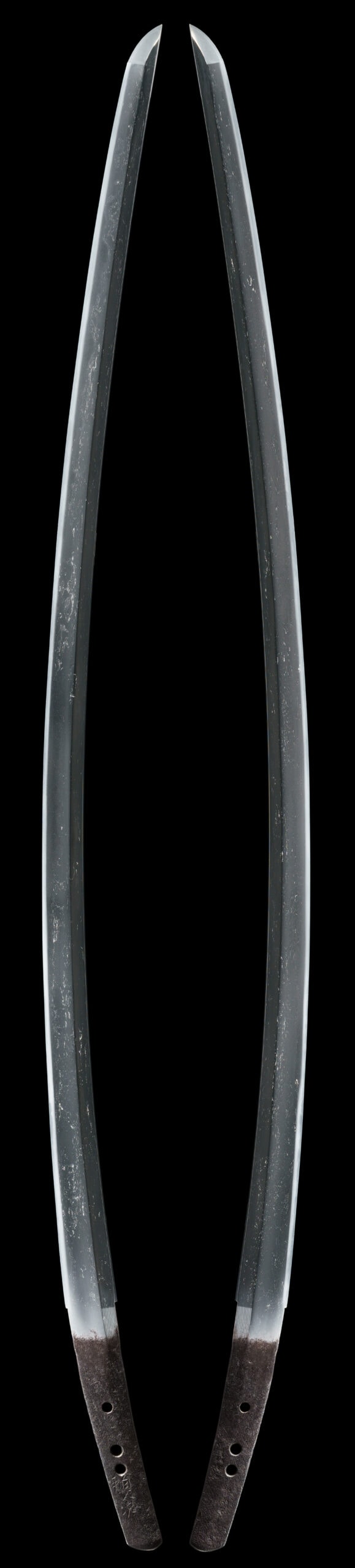
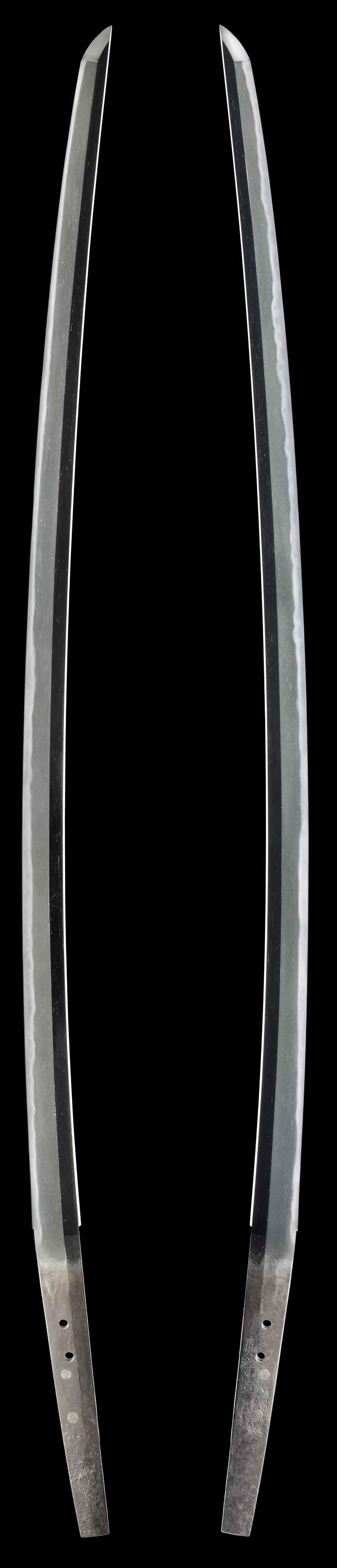
Kagemitsu is the third master of the mainline, the son of Nagamitsu and grandson of Mitsutada. The published sources put the matter plainly: he 'is the son of Nagamitsu and the third generation of , famed for having completed the '. Where his grandfather set the school's flamboyant standard and his father gave it the round , Kagemitsu took the saw-tooth temper that had only budded in his father's and made it the family's last great invention.
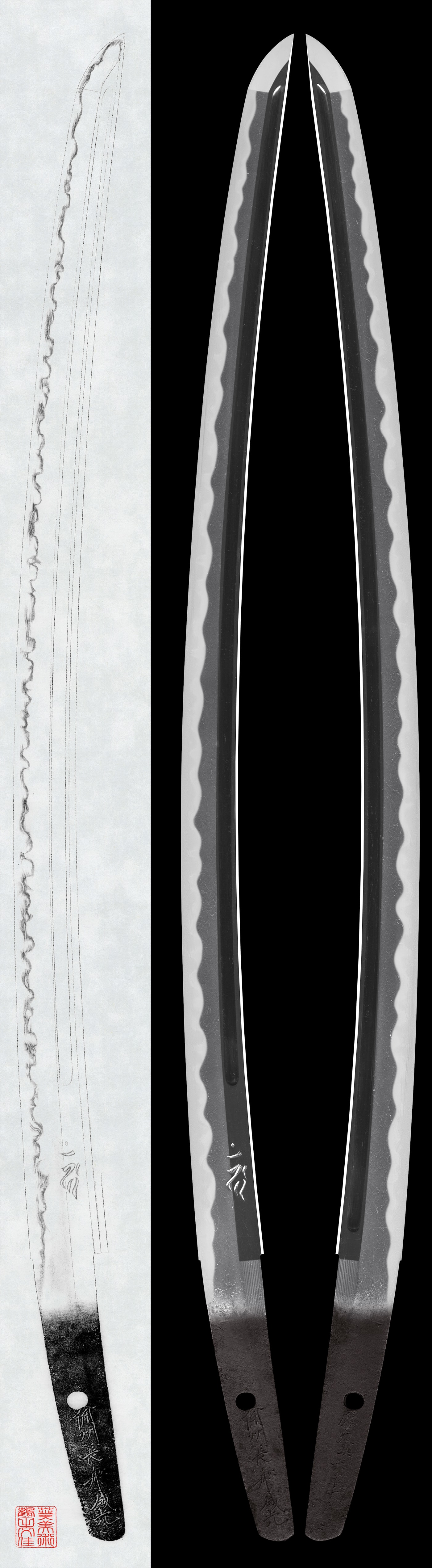
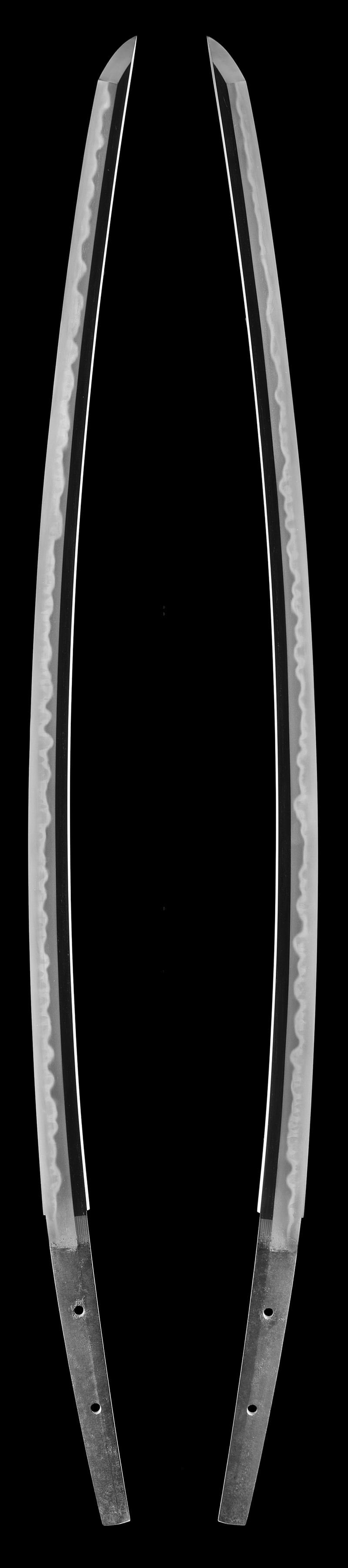
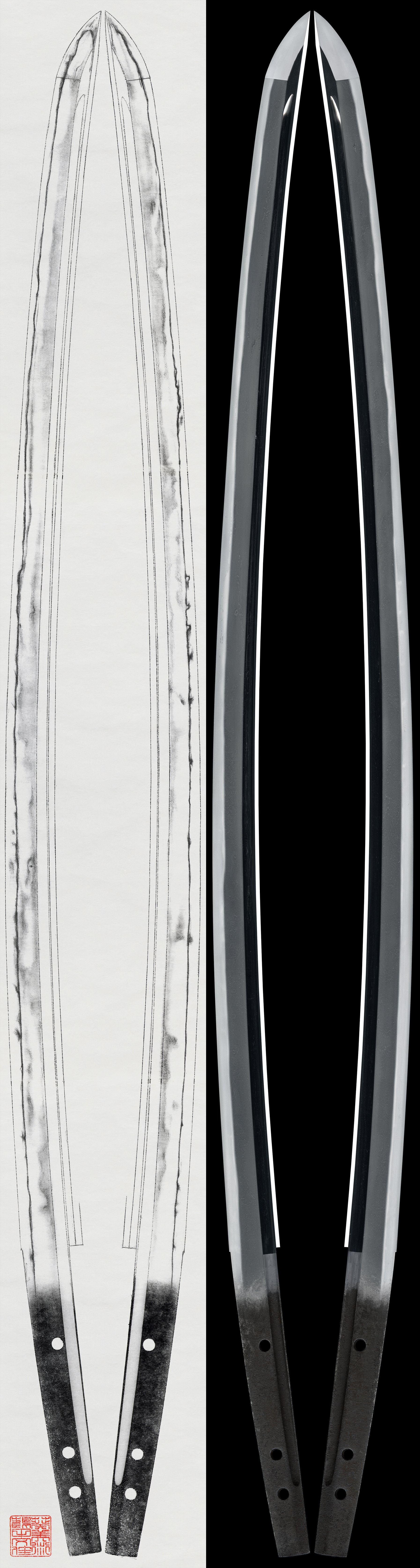
Recognize him first by that temper. The , a whose shoulders drop away in even steps, runs over a base, its and leaning back in the slanting (逆がかり) that is his personal hallmark, the heads of the teeth squared rather than rounded. The published record frames his hand as the quieter one in the family: his style 'has little of his father's flamboyance, being on the whole milder than Nagamitsu, whether a base with mixed in and slanting back, or a temper led by '. On the the is at its most regular, an angular with worked in.
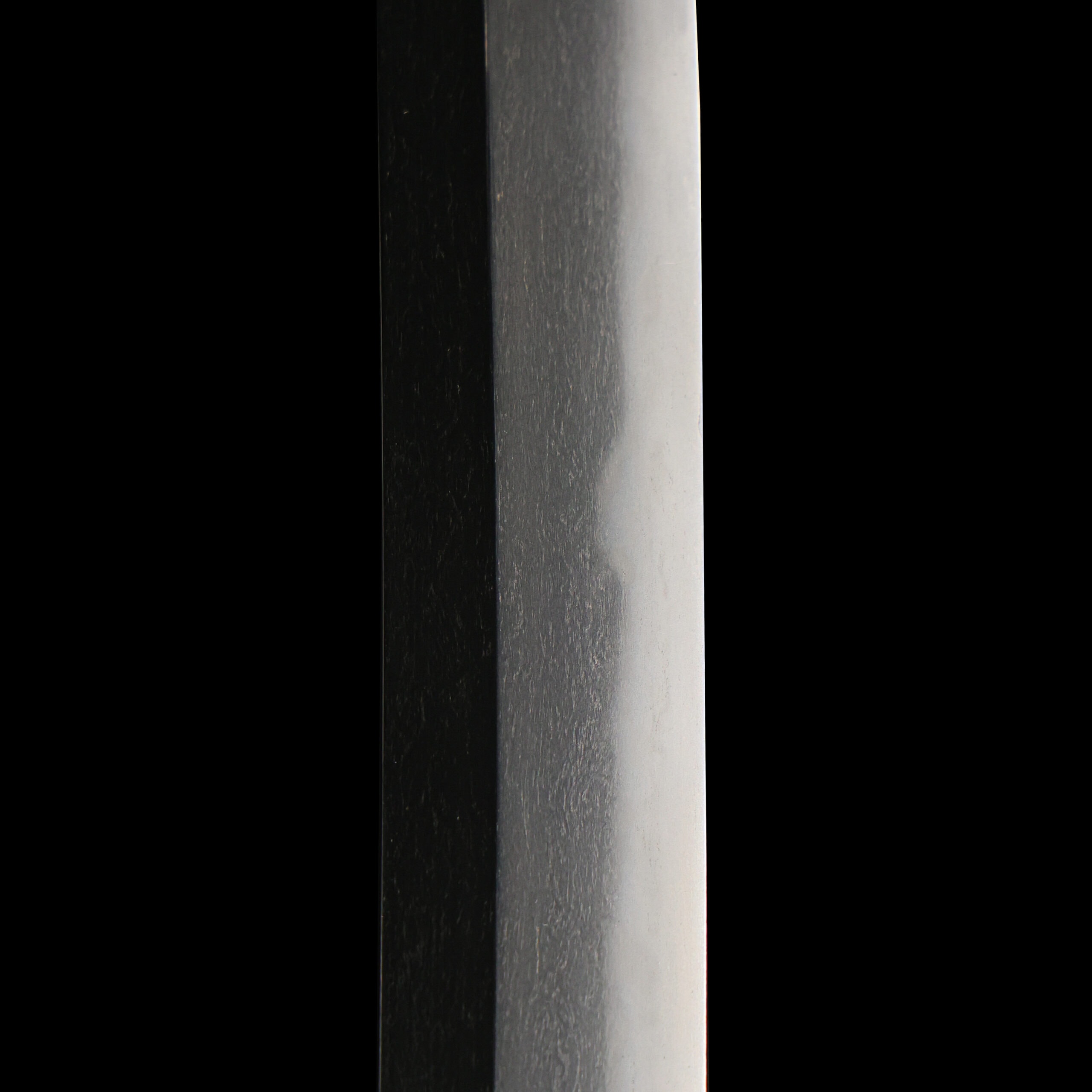
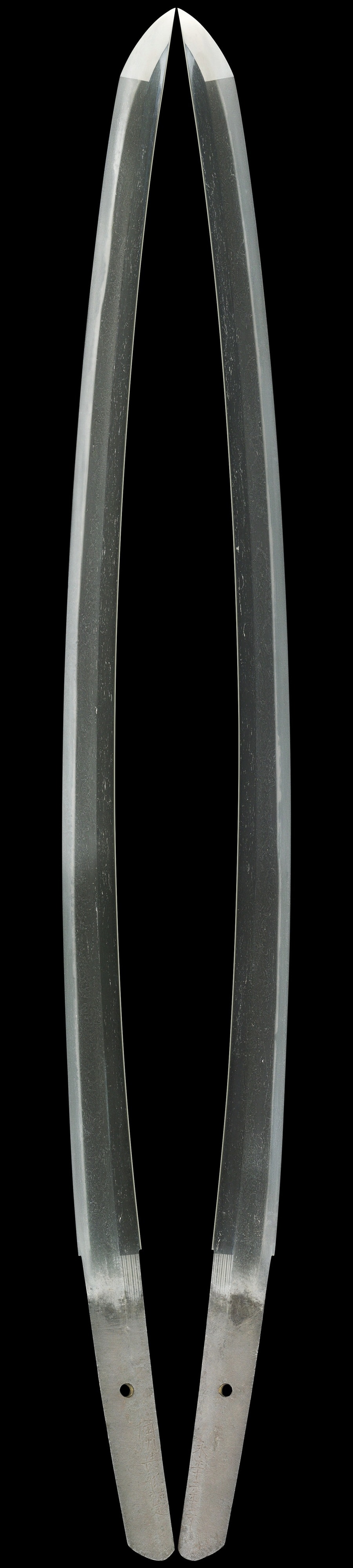
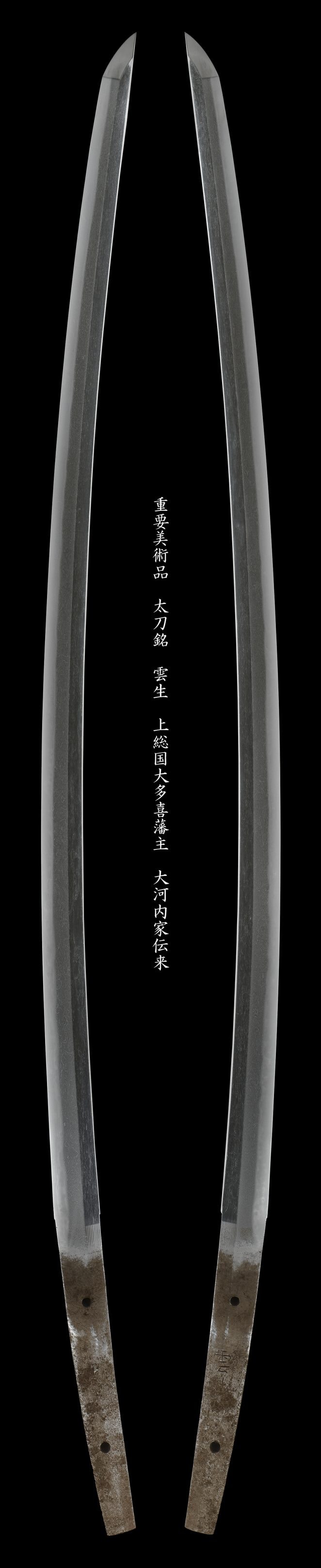
His matches that precision. The and are tight and well worked, the fine, present. Quiet though the temper is, the sources reserve their highest note for his forging: 'in the quality of the forging, pieces are seen that in particular surpass even his father, and this is worthy of note'. Across the runs not his father's flowing alone but, at his best, an orderly (棒映り) and a banded, stepped reflection that the connoisseurs liken to the school, where one Tokuju blade is said to 'show the flavour of '.
The follows the temper rather than overruling it. On the it is small and runs in , returning on the and pointed in feeling on the , the published account reading 'the is small and runs in , the tip on the , turning back with a pointed feeling on the '. On the the recurs out of a shallow , sometimes with a touch of . It is the unforced, contained of a maker whose drama is carried by the body of the .
His output divides cleanly by form. The carry the pure, regular and the most elaborate carving in the family, with (梵字), (倶利迦羅) and (三鈷剣) cut far beyond anything his grandfather or father attempted; the keep a base with only in part. He is also among the most precisely datable of all smiths, his signed and dated chronology running across more than thirty years, and the published sources add that, unlike his father, 'many survive, which is also among his distinctions'.
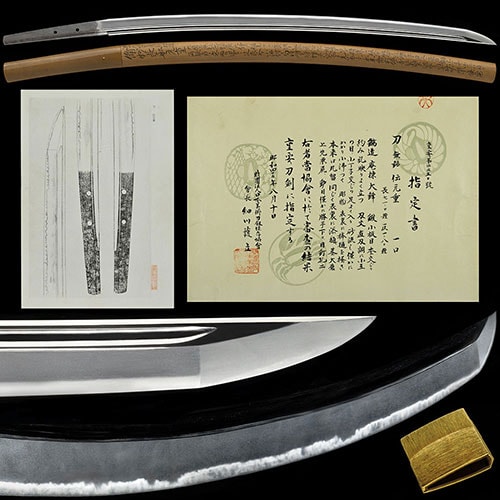
Kagemitsu completes the three-generation arc that defines , his grandfather Mitsutada founding the school, his father Nagamitsu setting its classical standard, and Kagemitsu bringing both temper and forging to their finished form before handing the manner to his pupil Chikakage, whose work is close enough that some signed Kagemitsu blades are read as Chikakage's . For the collector he is Sai-jo in Fujishiro's grading, with three National Treasures, fifteen Important Cultural Properties and eleven on record. The most famous of his blades is the Kogaryu Kagemitsu, a National Treasure named for the little dragon of its carved , carried by tradition by Kusunoki Masashige and in modern times held by the Meiji Emperor; other blades passed through Uesugi Kenshin, the Tokugawa shoguns, and the Date, Maeda and Shimazu houses. Of the three masters he is the one whose hand can be followed most exactly, signed, dated and carved more fully than either his father or his grandfather.