NihontoWatch MonNihontoWatch
Market
Encyclopedia
Kantei
NihontoWatch MonNihontoWatch
Market
Encyclopedia
Kantei

Description

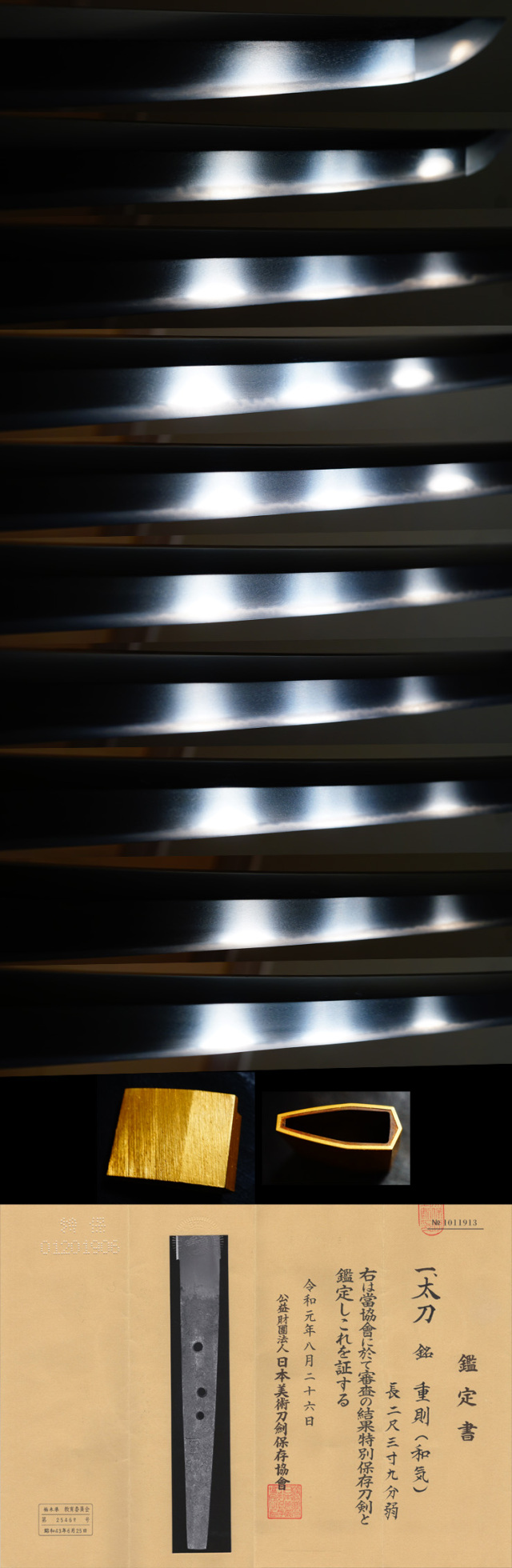
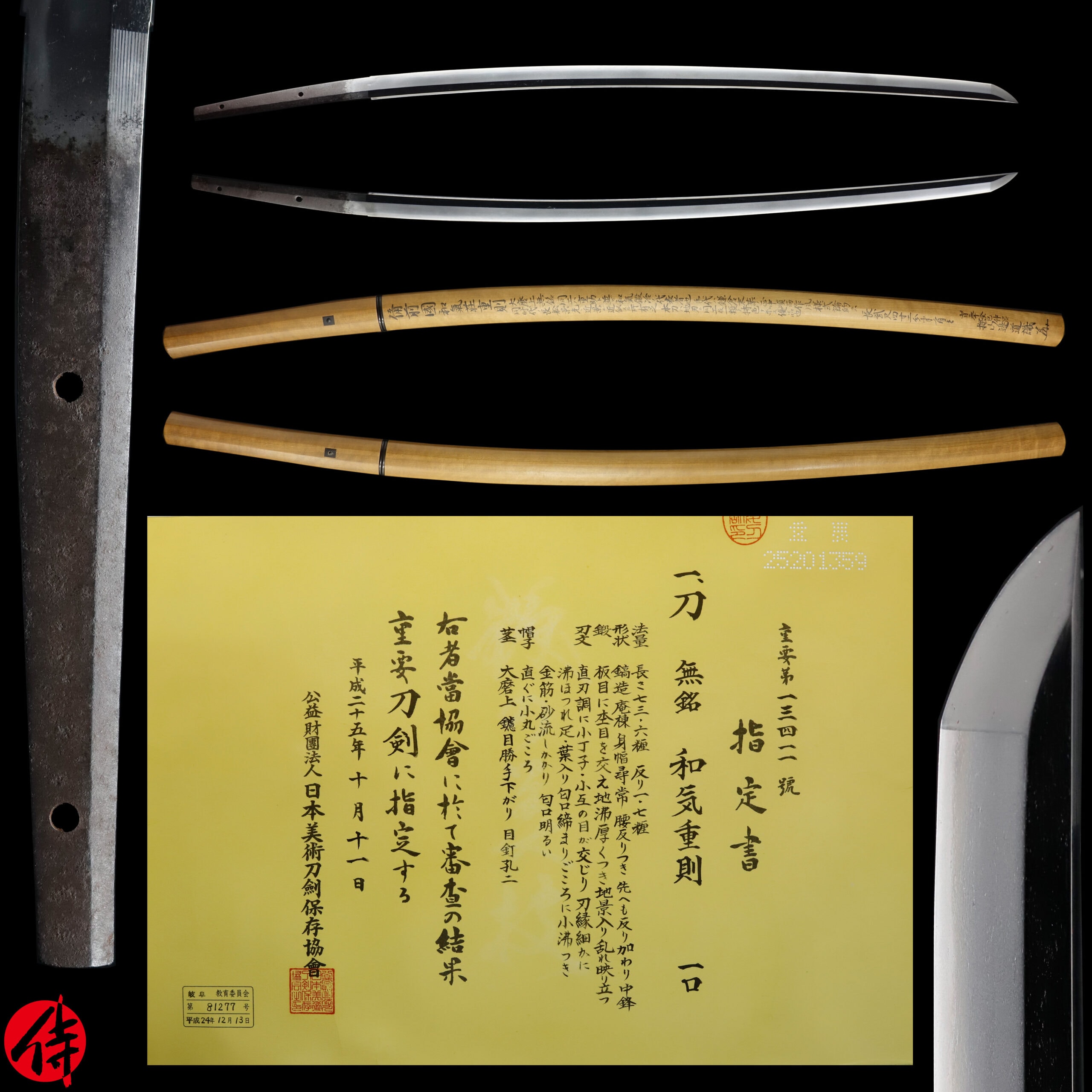
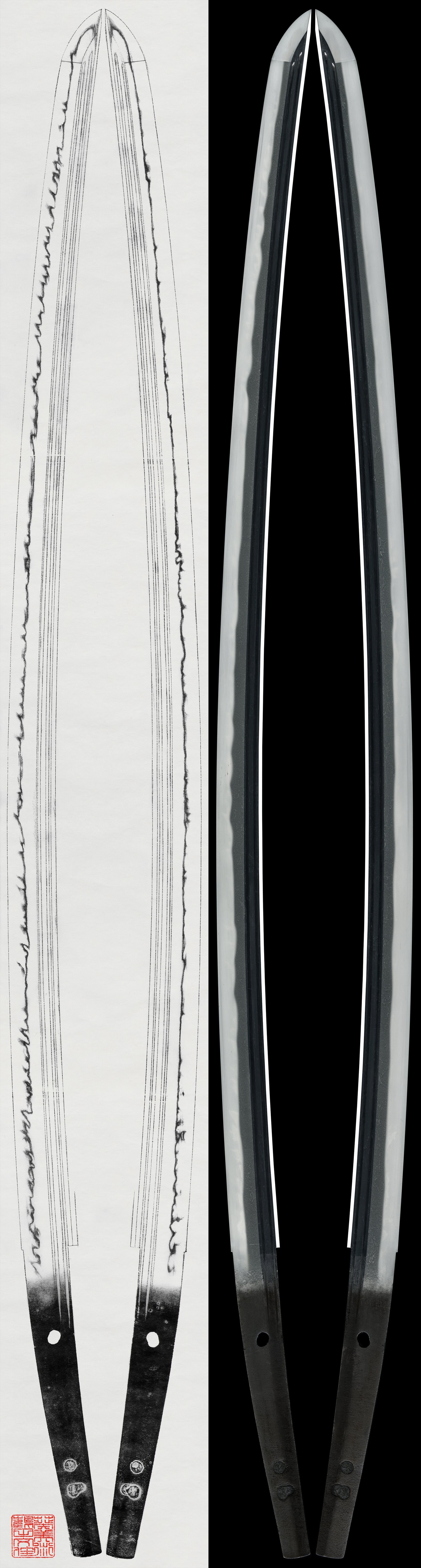
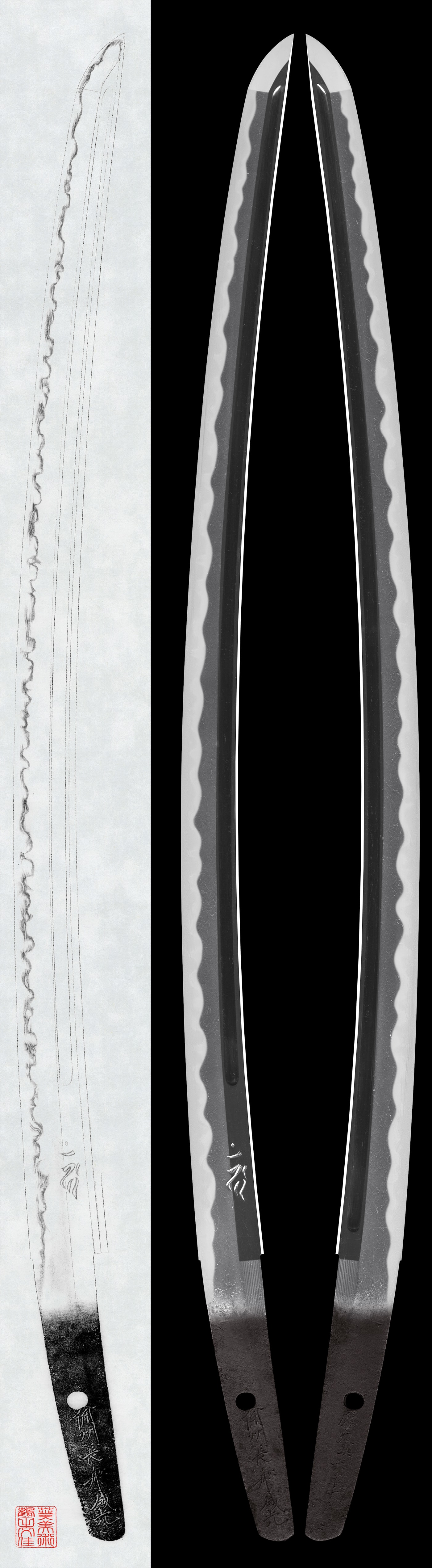
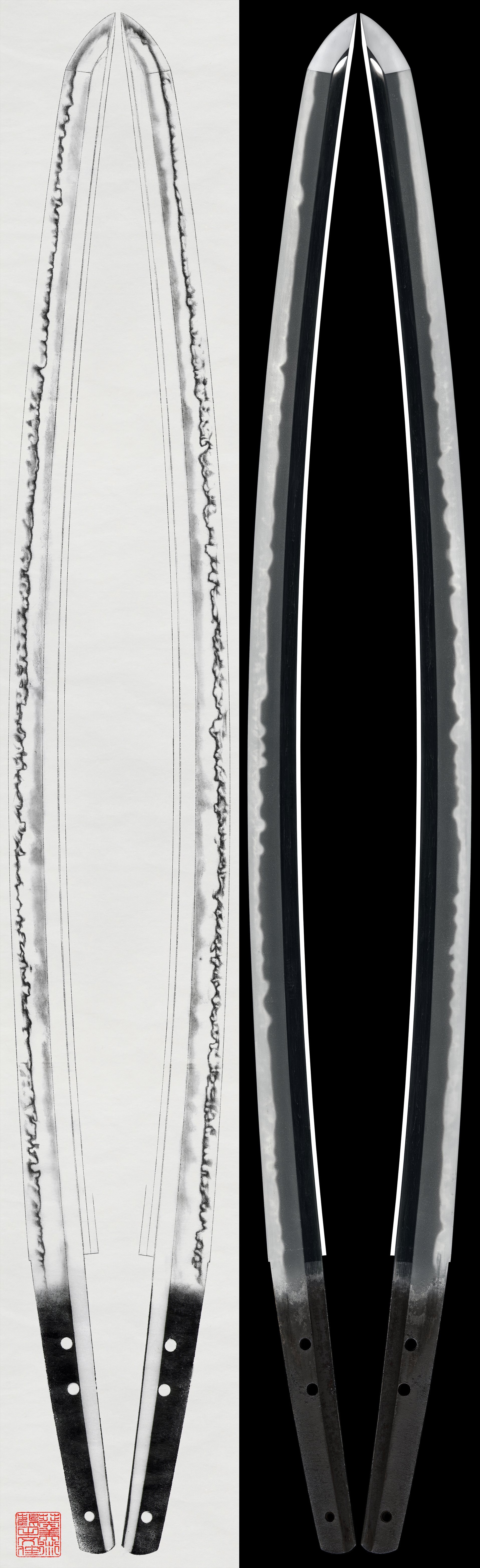
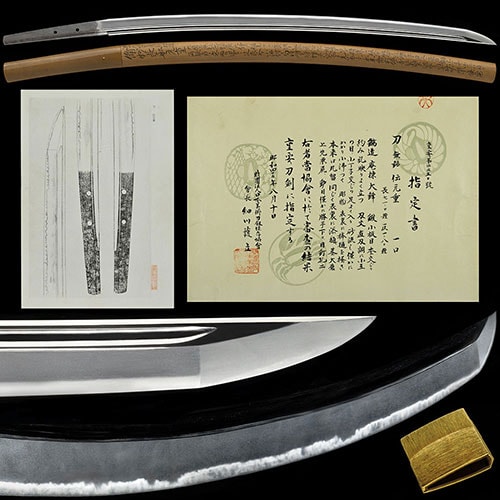
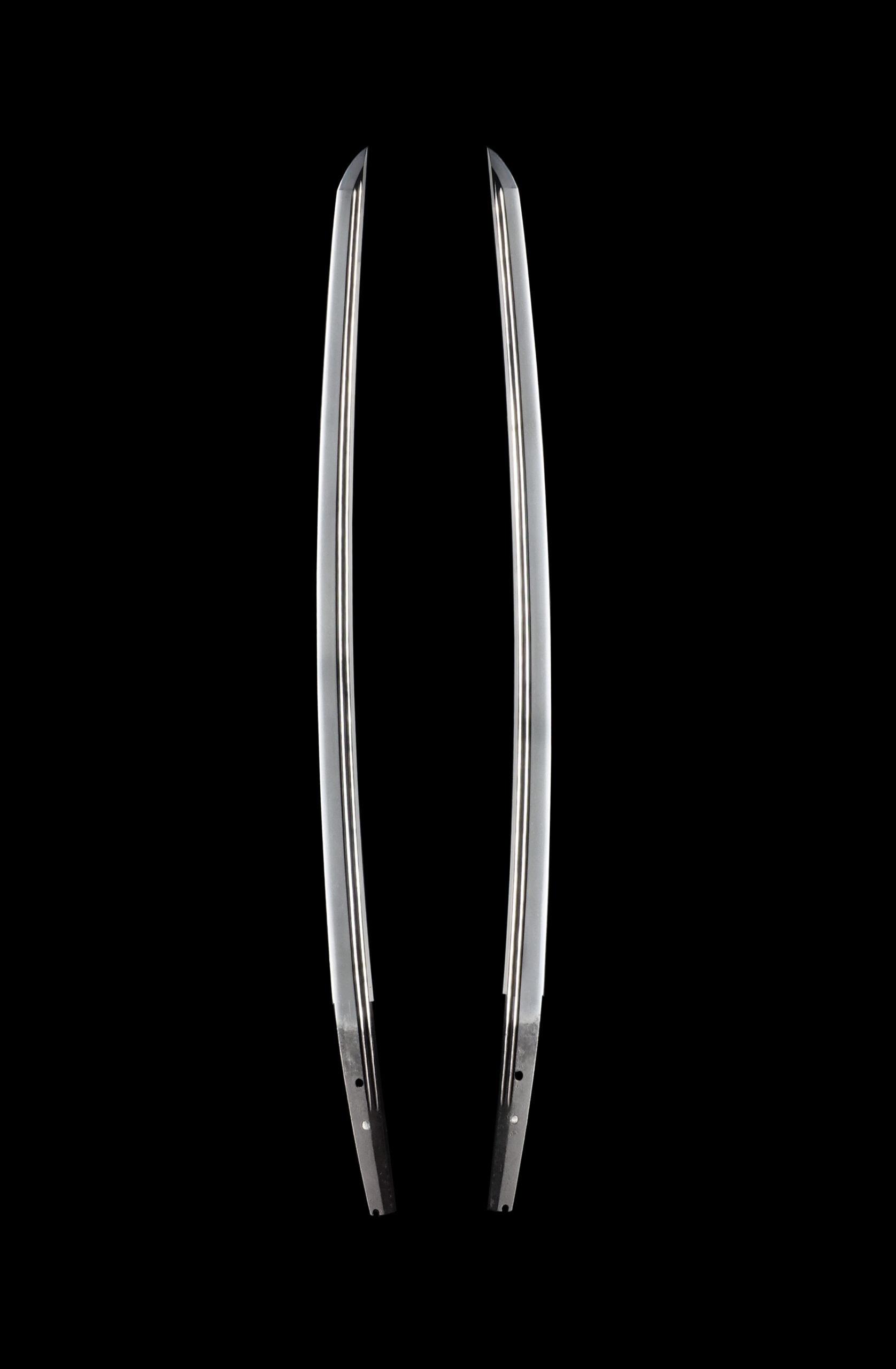
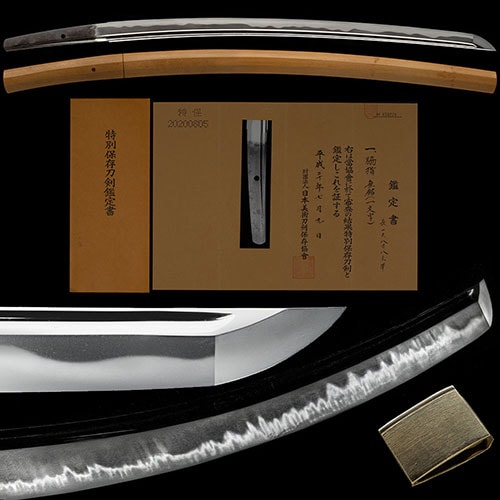
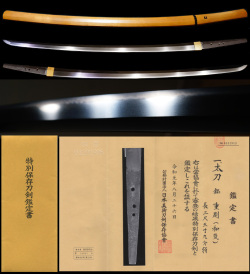
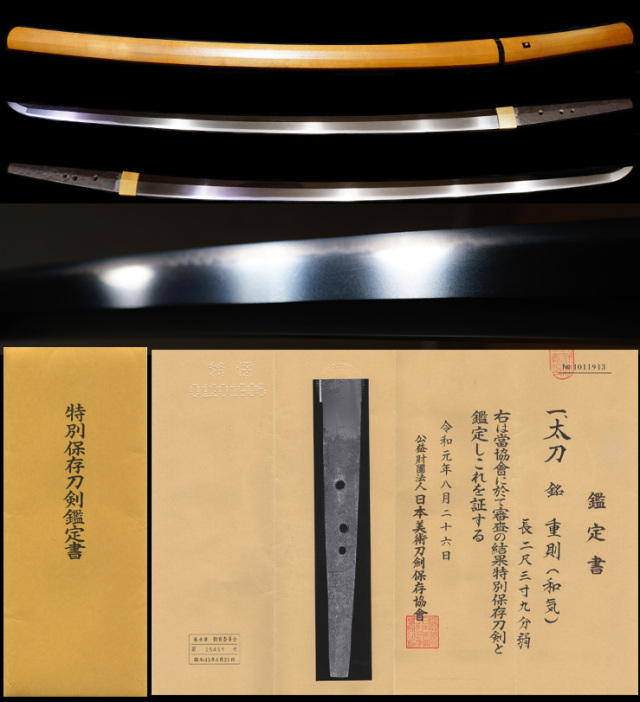
金象嵌銘『本多平八郎忠為所持之』光忠の子『長船真長』古伝に特別保存 『和気』極め種別 刀  長さ 二尺五寸五分 反り 六分 元幅32ミリ 元重7.9ミリ 先幅19ミリ 先重5.3ミリ 刀身重量893グラム (すべて約です) 千葉県教育委員会 徳川四天王である本多平八郎忠勝の孫で豊臣家滅亡後、豊臣家の当主である豊臣秀頼の正室千姫を娶って直接将軍家の娘婿となりその化粧料として姫路に10万石を賜った大大名の『本多平八郎忠為所持之』と金象嵌名が入っております。 本多平八郎忠為(忠刻)は宮本武蔵を迎えて師事し家士をしてその流儀を学ばせたというのだから、宮本武蔵を家臣にしている。また、その養子宮本三木之助を小姓として出仕させ、自身が亡くなった際に宮本三木之助が殉死しているというのだから余程の大名であったことは間違いがない。 また、娘の勝姫は池田光政の正室となっていることからも10万石よりも立場ははるかに上だったように思われる。 認定書が一部焼けてしまっているほど特別貴重の時代からずっと放置されてきており、古研磨の状態になってしまっているが、そこまで直ぐに研磨が必要というわけではない。この状態で売却のため審査に出して簡単に特別保存になってしまうのだから余程の刀であることはお判りいただけるであろう。 私が審査に出したわけではないので刀剣の(と金象嵌がある)の解釈について日本美術刀剣保存協会の学芸員の方に聞いたところ「現在保存の審査段階では折紙などは基本受け付けない。当刀剣については人間国宝本阿弥日洲先生の折紙などは審査時に提出があったということはない。また金象嵌も新しいとは判断しておらず、あくまで現段階では根拠が少ないのでそう記載している」という答えでした。また、刀剣の時代については「鎌倉時代」と明確に答えていただいております。さらに和気の極めについては「色々な特徴が出ていてその場ではわけが分からない鎌倉時代の備前刀ということで和気と極めている(実際に審査でそういう行為はあるそうです)」との話でした。恐らく、特別貴重と折紙を提出していれば内容は変わっていたと思います。 なお、重要審査には折紙や特別貴重は付帯で提出してもらえればとも云われております。個人的には出世を狙うなら最上研磨をかけてあげてほしいと思っています。 地肌は淡く映りが立ち、非常に繊細な地肌で刃文はのたれ調の直刃を基調に小乱れ、小互の目、小丁子を交えて小足がよく入り、出来は古一文字を彷彿させ、古趣な働きを示した大傑作の刀で大変貴重な一振りです。また、茎の形も平安時代の流れを汲んでおり、そのうえで大豪壮なゴリゴリの刀ですので出世が非常に楽しみです。私は持っておりませんが場合によっては徳川実紀にこの刀が載っているかもしれません。象嵌が入る前など 和気は鎌倉時代に備前国和気荘に在住した刀工で、重則、重助がおり和気の地は古備前刀工の故地で古備前の流れを汲み現存作は稀有で重則は元享四年紀(鎌倉時代)の作が現存し鎌倉時代の長船物に近似した作を残しております。 現状和気極めの特別保存ということでの特別プライスです 1,800,000円 (税込)

NihontoWatch MonNihontoWatch
MarketEncyclopediaKantei
Swords›Bizen-den›Wake›Shigenori›豊臣秀頼の正室千姫を後に娶った徳川四天王本多忠勝の孫本多平八郎忠為(忠刻)所持と金象嵌名の『真長』『和気』人間国宝本阿弥日洲折紙に薫山鞘書き鎌倉時代うぶ茎超ゴリゴリ特別保存刀剣
katanaTokubetsu Hozon
Wake Shigenori

豊臣秀頼の正室千姫を後に娶った徳川四天王本多忠勝の孫本多平八郎忠為(忠刻)所持と金象嵌名の『真長』『和気』人間国宝本阿弥日洲折紙に薫山鞘書き鎌倉時代うぶ茎超ゴリゴリ特別保存刀剣

Heian

SOLD
Wake Shigenori (重則) · HeianView artist page →
Katana
Could you name the smith from the blade alone? Today’s kantei →
Wake Shigenori — 1 of 4
Wake Shigenori — 2 of 4
Wake Shigenori — 3 of 4
Wake Shigenori — 4 of 4
1 / 4
1 / 4
Wake Shigenori — 1 of 4Wake Shigenori — 2 of 4Wake Shigenori — 3 of 4Wake Shigenori — 4 of 4
Wake Shigenori (重則) · HeianView artist page →
Katana
Could you name the smith from the blade alone? Today’s kantei →
Measurements & details
Smith
Wake Shigenori
Type
Katana
School
Wake
Period
Around 1324–1326(Late Kamakura)
Province
武蔵
Measurements
Motohaba 3.2cmSakihaba 1.9cmKasane 0.79cmWeight 893g
Description

金象嵌銘『本多平八郎忠為所持之』光忠の子『長船真長』古伝に特別保存 『和気』極め種別 刀  長さ 二尺五寸五分 反り 六分 元幅32ミリ 元重7.9ミリ 先幅19ミリ 先重5.3ミリ 刀身重量893グラム (すべて約です) 千葉県教育委員会 徳川四天王である本多平八郎忠勝の孫で豊臣家滅亡後、豊臣家の当主である豊臣秀頼の正室千姫を娶って直接将軍家の娘婿となりその化粧料として姫路に10万石を賜った大大名の『本多平八郎忠為所持之』と金象嵌名が入っております。 本多平八郎忠為(忠刻)は宮本武蔵を迎えて師事し家士をしてその流儀を学ばせたというのだから、宮本武蔵を家臣にしている。また、その養子宮本三木之助を小姓として出仕させ、自身が亡くなった際に宮本三木之助が殉死しているというのだから余程の大名であったことは間違いがない。 また、娘の勝姫は池田光政の正室となっていることからも10万石よりも立場ははるかに上だったように思われる。 認定書が一部焼けてしまっているほど特別貴重の時代からずっと放置されてきており、古研磨の状態になってしまっているが、そこまで直ぐに研磨が必要というわけではない。この状態で売却のため審査に出して簡単に特別保存になってしまうのだから余程の刀であることはお判りいただけるであろう。 私が審査に出したわけではないので刀剣の(と金象嵌がある)の解釈について日本美術刀剣保存協会の学芸員の方に聞いたところ「現在保存の審査段階では折紙などは基本受け付けない。当刀剣については人間国宝本阿弥日洲先生の折紙などは審査時に提出があったということはない。また金象嵌も新しいとは判断しておらず、あくまで現段階では根拠が少ないのでそう記載している」という答えでした。また、刀剣の時代については「鎌倉時代」と明確に答えていただいております。さらに和気の極めについては「色々な特徴が出ていてその場ではわけが分からない鎌倉時代の備前刀ということで和気と極めている(実際に審査でそういう行為はあるそうです)」との話でした。恐らく、特別貴重と折紙を提出していれば内容は変わっていたと思います。 なお、重要審査には折紙や特別貴重は付帯で提出してもらえればとも云われております。個人的には出世を狙うなら最上研磨をかけてあげてほしいと思っています。 地肌は淡く映りが立ち、非常に繊細な地肌で刃文はのたれ調の直刃を基調に小乱れ、小互の目、小丁子を交えて小足がよく入り、出来は古一文字を彷彿させ、古趣な働きを示した大傑作の刀で大変貴重な一振りです。また、茎の形も平安時代の流れを汲んでおり、そのうえで大豪壮なゴリゴリの刀ですので出世が非常に楽しみです。私は持っておりませんが場合によっては徳川実紀にこの刀が載っているかもしれません。象嵌が入る前など 和気は鎌倉時代に備前国和気荘に在住した刀工で、重則、重助がおり和気の地は古備前刀工の故地で古備前の流れを汲み現存作は稀有で重則は元享四年紀(鎌倉時代)の作が現存し鎌倉時代の長船物に近似した作を残しております。 現状和気極めの特別保存ということでの特別プライスです 1,800,000円 (税込)

About the maker

Shigenori

重則

Bizen Wake (和気), a Ko-Bizen-descended group near Osafune · Bizen · around 1324-1326

Tōken Taikan top 11%

›

Shigenori was a swordsmith of the late Kamakura period who lived at Wake Manor, Wake-shō, in Bizen province, his activity fixed by dated works of Shōchū 3, also read as Genkō 4 (1324), and Karyaku 3 (1328). The published sources record him beside a second Wake smith, Shigesuke, the two known together from this handful of dated pieces, and they cite Wake as one of the proposed homelands of the old Ko-Bizen smiths. One view holds that Shigenori too descended from the Ko-Bizen line, though the published record holds the matter not clearly settled. Four of his blades have passed the Jūyō shinsa: three signed tachi and one greatly shortened mumei katana attributed to Wake Shigenori. They are enough to read one steady hand, a smith whose work stands so close to the Osafune main line of his own day that the published sources liken his best to that of Sanenaga and Kagemitsu, yet whose ji and ha carry a quieter, slightly rustic character that marks him as a man of Wake rather than of Osafune proper.

The temper is the heart of his recognition. Over a calm base of narrow suguha, hoso-suguha, he mixes only small forms: ko-gunome, ko-midare and ko-chōji, never the tall clove-midare of the Osafune main line. Ko-ashi enter the line well, with yō on the mumei katana, and the temper runs nioi-dominant, nioi-gachi, with ko-nie added. The nioiguchi is tight, shimari, and at moments takes on an urumi, a soft, moist tone, and is bright on the latest of his blades; kinsuji and sunagashi appear, the kinsuji set near the base on his earliest tachi. The published sources name precisely this controlled, somewhat huddled midare, mixed with ko-gunome, as the place where the distinctive character of the Wake group shows, the temper that closely resembles late-Kamakura Osafune work but stops short of its full flowering.

The jigane carries the other half of the reading. He forges a ko-itame to itame that takes in mokume and stands faintly open, hada-tachi, gathering ji-nie, with chikei entering and patches of jifu, ō-hada and clear sumi-hada. Across this jigane a midare-utsuri rises distinctly, the speckled reflection of old Bizen steel and the feature that seats him beside the Osafune main line. On the mumei katana the forging is overall fine yet slightly standing, and along the habuchi a minute nie breaks into hotsure, giving the ji and ha a small rustic vigor, yashu; it is exactly here that the published sources find the attribution to Wake affirmed, writing that on this point 「ここに和気の極めが首肯される」[[c:1]]. The bōshi answers the calm of the temper, running shallowly notare or sugu and turning back in ko-maru.

The four blades draw a single manner rather than a sequence of phases. The shape is the late-Kamakura tachi throughout: shinogi-zukuri, mostly slender, with koshizori and funbari and a small to medium point, every example shortened, suriage or ō-suriage, as such early Bizen tachi almost always are. The signed pieces carry their inscriptions toward the mune: a two-character mei, simply Shigenori, on the 24th- and 56th-session tachi, and on the 31st a somewhat fine-chiseled long signature, Bishū Wake-jū Shigenori, partly corroded by age. The 56th-session tachi, slender and signed, the published sources prize less for its scale than for its testimony, calling signed work by Wake Shigenori exceptionally rare and the blade therefore extremely valuable material for understanding this smith and his group. The mumei katana of the 59th session is the counter-case, a strong, long blade of standard width whose Wake attribution rests not on a signature but on the connoisseur's reading of that rustic habuchi.

What distinguishes Shigenori is therefore a matter of degree against a close model. His midare-utsuri jigane and ko-gunome in suguha set him squarely among the late-Kamakura Bizen smiths, and the published sources twice describe his work as close to the Osafune smiths of the time, reading the 31st-session tachi as workmanship 「真長・景光さながらの出来」[[c:2]], much like Sanenaga and Kagemitsu, and judging it 「重則の上々作と称してよく」[[c:3]], fit to be called an especially fine work by Shigenori, adding that the corroded inscription is no real concern. Yet the same sources are careful to hold him apart: the subdued, slightly huddled midare, the persistent ko-gunome, and the rustic vigor of the habuchi are where the Wake hand reveals itself, the marks of a Ko-Bizen-descended satellite working alongside, and in the manner of, the orthodox Osafune line without quite belonging to it.

Four blades on record, all at the Jūyō level and none designated above it, are the whole of Shigenori's preserved corpus, and signed examples are rarer still: of the four, three bear his name and one is a mumei attribution. The published sources record no daimyō provenance and name no holding institution for these pieces, and signed Wake Shigenori is by their own account exceptionally rare, so the survival of even three signed tachi is itself the point of interest. A blade by this smith is not a thing the collector encounters often; when one appears it is at the Jūyō tier, valued less as a famous name than as evidence of a small, half-documented Bizen group whose hand the published record can still recover. For the student of late Kamakura Bizen, that scarcity is the attraction: each surviving Shigenori is a primary witness to the Wake workshop, and the mumei katana of the 59th session, where 「刃縁には一際光の強い刃沸がきらめき」[[c:4]], the habuchi glittering with particularly intense ha-nie, is the finest demonstration of what that recovered hand could do.

Historical importance

Where Shigenori stands among comparable artisans: across all of nihontō, and within tradition, era, and period. The tiers (Foremost · Leading · Major · Notable) weigh official designations from the NBTHK and Japan's Agency for Cultural Affairs, together with historical honors of lasting repute such as the Sansaku and Meibutsu-chō.

随一
Foremost
屈指
Leading
有数
Major
著名
Notable

Select a lens to see how it's measured.

Designation record
4 designated works
Jūyō
4
Shigenori — full profileBizen Wake (和気), a Ko-Bizen-descended group near Osafune school

Study this maker →

About the school

Wake

和気

Bizen-den · Bizen

1 piece on the market now

›

Among the swordsmiths of late Kamakura Bizen, the setsumei place the Wake group at Wake-shō (和気庄), a manor in Bizen Province, and the names that recur across the blades are two: Shigenori (重則) and Shigesuke (重助). Their working dates are fixed by surviving signed and dated pieces, with Shigenori represented by inscriptions of Genkō 4 (1324), Shōchū 3 (1326) and Karyaku 3 (1328), and Shigesuke by a Karyaku 1 (1326) tantō and a Karyaku 3 (1328) tachi. The setsumei repeatedly note that Wake is cited as one of the presumed locales of the old Ko-Bizen smiths, and that one view holds these makers drew upon the Ko-Bizen lineage, while cautioning in each case that the details are not clearly known. Throughout, the register frames the group not as a single transmitted house but as two distinct contemporary hands working the same district within the broader Bizen-den sphere. The shared vocabulary the blades present is consistent. The forging is ko-itame or itame, often mixed with mokume and a nagare (flowing) tendency, with a slightly standing grain (hada-dachi), dense ji-nie, chikei, and areas of jifu; across nearly every piece midare-utsuri stands out distinctly, though a few works show only a faint utsuri. The hamon rests on a suguha-chō base into which ko-gunome enters, joined variously by ko-chōji, saka-ashi, and pointed or angular gunome; ko-ashi enter well, the temper is nioi-predominant with ko-nie, and the nioiguchi tends toward a tight or urumi (moist) character, with kinsuji and sunagashi appearing in places. The bōshi characteristically runs shallowly notare and turns back in ko-maru, though yakitsume and hakikake finishes are recorded on individual blades.

The setsumei state plainly that this workmanship lies close to contemporary Osafune; the points of divergence they single out are a somewhat subdued midare, the persistent intermixture of ko-gunome, and a slight rustic vigor in ji and ha, which is where the distinctive character of the Wake line is said to be revealed. One Shigesuke tachi carries a gunome-dominant temper with kawazu-ko and a notably crisp nioiguchi, and a Shigesuke tantō shows a kataochi-style gunome. For kantei, the blades supply concrete anchors. Signed works by both smiths are described as exceedingly rare, so the dated tachi and the truncated-but-attributed tantō serve as reference material for the group, and several mumei ō-suriage katana are appraised to Shigesuke on the strength of these shared traits. The setsumei draw direct comparison to the Osafune masters Kagemitsu and Sanenaga, noting that one Shigesuke blade is judged not inferior to, and possibly exceeding, Kagemitsu's customary work, and one Shigenori tachi is likened to Sanenaga and Kagemitsu and rated a jōjō-saku. The careful discriminator they give is that a Wake piece can at first glance suggest the orthodox Osafune main line, yet close inspection of the fine, slightly standing grain and the minute nie hotsure along the habuchi affirms the Wake attribution. In provenance, a Shigesuke tachi bears a former-scabbard account that in the eleventh month of Genroku 14 (1701) Tokugawa Tsunayoshi bestowed it upon Mizuno Katsunaga, after which it was transmitted in the Mizuno family, lords of Yūki Domain in Shimōsa Province. The standing the setsumei accord the group is that of a Bizen line working at the level of, and easily confused with, late Kamakura Osafune, known chiefly through Shigenori and Shigesuke. Learn more →

2 recorded smiths16 designated works
Leading smiths
SmithEraDesignated
Shigesuke重助1326-132912
Shigenori重則1324-13264
Explore the Wake school →

Historical context

Bizen in the Heian period

›

The Bizen tradition begins where iron sand, charcoal forests, and the Inland Sea shipping lanes met. By the late Heian period the Ko-Bizen smiths were forging tachi for court nobles and the rising warrior houses, and both sides of the Genpei War carried Bizen steel.

Bizen in the Heian period →

NBTHK Certificate
Tokubetsu Hozon Tōken特別保存刀剣
Sword Especially Worthy of Preservation
›

A Hozon-certified blade judged to show notably superior workmanship and a better state of preservation. The bar is higher: re-tempered blades and most unsigned Muromachi/Edo works are excluded.

About the NBTHK›

The NBTHK (Nihon Bijutsu Tōken Hozon Kyōkai, the Society for the Preservation of Japanese Art Swords) is a public-interest incorporated foundation founded in 1948 and supervised by Japan’s Agency for Cultural Affairs (Bunkachō); it is based at the Japanese Sword Museum in Tokyo. Its expert panels physically examine each submitted work (shinsa) and issue a certificate (kanteishō) ranking it by artistic and historical merit. NBTHK papers are the most widely recognized standard of authentication for Japanese swords and fittings.

NBTHK official site→
Seller
K
Kusanagi
🇯🇵Ships from Japan
›
✓Verified dealerkusanaginosya.com
✓Ships worldwideWire transfer
Return policy

Please notify us of your intention to return, by email or fax, no later than the day after the item's arrival. Return shipping, insurance, and refund transfer fees are the customer's responsibility.

View all of Kusanagi’s listings→View this item on the dealer’s site→

Previously sold by Wake Shigenori

View all →
World Seiyudo
Jūyō
Katana - Jūyō - by Wake Shigenori - Shigenori - Juyo TokenKatana - Jūyō - by Wake Shigenori - Shigenori - Juyo Token
Sold

Katana

ByWake Shigenori
SOLD
Samurai Museum
Jūyō
Katana - Jūyō - by Wake Shigenori - Attributed to Wake Shigenori with NBTHK Juyo Token CertificateKatana - Jūyō - by Wake Shigenori - Attributed to Wake Shigenori with NBTHK Juyo Token Certificate
Sold

Katana

ByWake Shigenori
SOLD

More from the Wake school

View all →
Nipponto
Hozon
Katana - Hozon - by Wake School - Mumei Wake (Bizen no Kuni Wake-ju Shigenori) (Kamakura period)Katana - Hozon - by Wake School - Mumei Wake (Bizen no Kuni Wake-ju Shigenori) (Kamakura period)

Katana

ByWake School
¥880,000

More from the Bizen tradition

View all →
Aoi Art
Jūyō
Katana - Jūyō - by Osafune Shigezane - Mumei (Attributed to Shigezane) - 27th NBTHK Juyo TokenKatana - Jūyō - by Osafune Shigezane - Mumei (Attributed to Shigezane) - 27th NBTHK Juyo Token

Katana

ByOsafune Shigezane
Starting Bid¥4,600,000
Hyozaemon
Tokuho
Tokuho - by Fukuoka Ichimonji Yoshifusa - Naginata Naoshi Wakizashi by Fukuoka Ichimonji Yoshifusa, a Master of IchimonjiTokuho - by Fukuoka Ichimonji Yoshifusa - Naginata Naoshi Wakizashi by Fukuoka Ichimonji Yoshifusa, a Master of Ichimonji

Naginata Naoshi Wakizashi by Fukuoka Ichimonji Yoshifusa, a Master of Ichimonji

ByFukuoka Ichimonji Yoshifusa
Ask
Aoi Art
Tokuho
Wakizashi - Tokuho - by Oei-Bizen Morimitsu - Bishū Osafune Morimitsu, dated Ōei 26 (1419) - NBTHK Tokubetsu Hozon TokenWakizashi - Tokuho - by Oei-Bizen Morimitsu - Bishū Osafune Morimitsu, dated Ōei 26 (1419) - NBTHK Tokubetsu Hozon Token

Wakizashi

ByOei-Bizen Morimitsu
Starting Bid¥1,500,000
Aoi Art
Jūyō Bijutsuhin
Daisho - Jubi - by Osafune Nagamitsu - Dai Sho: Katana (Important Art Object): Mumei (Attributed to Nagamitsu) / Wakizashi: Mumei (Attributed to Sekishu Naotsuna)Daisho - Jubi - by Osafune Nagamitsu - Dai Sho: Katana (Important Art Object): Mumei (Attributed to Nagamitsu) / Wakizashi: Mumei (Attributed to Sekishu Naotsuna)

Daishō

ByOsafune Nagamitsu
Ask
Eirakudo
Jūyō
Katana - Jūyō - by Motoshige - Motoshige - Juyo TokenKatana - Jūyō - by Motoshige - Motoshige - Juyo Token

Katana

ByMotoshige
¥6,000,000
Samurai Museum
Tokuho
Wakizashi - Tokuho - by Osafune Kagemitsu - Antique Japanese Sword Wakizashi Attributed to Den Osafune Kagemitsu NBTHK Tokubetsu Hozon CertificateWakizashi - Tokuho - by Osafune Kagemitsu - Antique Japanese Sword Wakizashi Attributed to Den Osafune Kagemitsu NBTHK Tokubetsu Hozon Certificate

Wakizashi

ByOsafune Kagemitsu
¥3,200,000
Eirakudo
Tokuho
Katana - Tokuho - by Katayama Ichimonji School - Katayama Ichimonji - Tokubetsu Hozon TokenKatana - Tokuho - by Katayama Ichimonji School - Katayama Ichimonji - Tokubetsu Hozon Token

Katana

ByKatayama Ichimonji School
¥4,500,000
Eirakudo
Tokuho
Wakizashi - Tokuho - by Ichimonji School - Fukuoka Ichimonji Wakizashi Tokubetsu Hozon TokenWakizashi - Tokuho - by Ichimonji School - Fukuoka Ichimonji Wakizashi Tokubetsu Hozon Token

Wakizashi

ByIchimonji School
¥3,500,000

Swords

  • Katana
  • Wakizashi
  • Tantō
  • Tachi
  • Naginata
  • Yari
  • Japanese Swords
  • Samurai Swords

Fittings

  • Tsuba
  • Fuchi-Kashira
  • Kozuka
  • Menuki
  • Sword Guards (Tsuba)

Armor

  • Kabuto
  • Samurai Armor
  • All Samurai Armor

By Certification

  • Tokujū
  • Jūyō
  • Tokuho
  • Hozon

Resources

  • Dealer Directory
  • Artist Directory
  • The Daily Kantei
  • Glossary
  • Browse All
Nihontowatch© 2026
TermsPrivacyCookiesAbout
Sold

Description

金象嵌銘『本多平八郎忠為所持之』光忠の子『長船真長』古伝に特別保存 『和気』極め種別 刀  長さ 二尺五寸五分 反り 六分 元幅32ミリ 元重7.9ミリ 先幅19ミリ 先重5.3ミリ 刀身重量893グラム (すべて約です) 千葉県教育委員会 徳川四天王である本多平八郎忠勝の孫で豊臣家滅亡後、豊臣家の当主である豊臣秀頼の正室千姫を娶って直接将軍家の娘婿となりその化粧料として姫路に10万石を賜った大大名の『本多平八郎忠為所持之』と金象嵌名が入っております。 本多平八郎忠為(忠刻)は宮本武蔵を迎えて師事し家士をしてその流儀を学ばせたというのだから、宮本武蔵を家臣にしている。また、その養子宮本三木之助を小姓として出仕させ、自身が亡くなった際に宮本三木之助が殉死しているというのだから余程の大名であったことは間違いがない。 また、娘の勝姫は池田光政の正室となっていることからも10万石よりも立場ははるかに上だったように思われる。 認定書が一部焼けてしまっているほど特別貴重の時代からずっと放置されてきており、古研磨の状態になってしまっているが、そこまで直ぐに研磨が必要というわけではない。この状態で売却のため審査に出して簡単に特別保存になってしまうのだから余程の刀であることはお判りいただけるであろう。 私が審査に出したわけではないので刀剣の(と金象嵌がある)の解釈について日本美術刀剣保存協会の学芸員の方に聞いたところ「現在保存の審査段階では折紙などは基本受け付けない。当刀剣については人間国宝本阿弥日洲先生の折紙などは審査時に提出があったということはない。また金象嵌も新しいとは判断しておらず、あくまで現段階では根拠が少ないのでそう記載している」という答えでした。また、刀剣の時代については「鎌倉時代」と明確に答えていただいております。さらに和気の極めについては「色々な特徴が出ていてその場ではわけが分からない鎌倉時代の備前刀ということで和気と極めている(実際に審査でそういう行為はあるそうです)」との話でした。恐らく、特別貴重と折紙を提出していれば内容は変わっていたと思います。 なお、重要審査には折紙や特別貴重は付帯で提出してもらえればとも云われております。個人的には出世を狙うなら最上研磨をかけてあげてほしいと思っています。 地肌は淡く映りが立ち、非常に繊細な地肌で刃文はのたれ調の直刃を基調に小乱れ、小互の目、小丁子を交えて小足がよく入り、出来は古一文字を彷彿させ、古趣な働きを示した大傑作の刀で大変貴重な一振りです。また、茎の形も平安時代の流れを汲んでおり、そのうえで大豪壮なゴリゴリの刀ですので出世が非常に楽しみです。私は持っておりませんが場合によっては徳川実紀にこの刀が載っているかもしれません。象嵌が入る前など 和気は鎌倉時代に備前国和気荘に在住した刀工で、重則、重助がおり和気の地は古備前刀工の故地で古備前の流れを汲み現存作は稀有で重則は元享四年紀(鎌倉時代)の作が現存し鎌倉時代の長船物に近似した作を残しております。 現状和気極めの特別保存ということでの特別プライスです 1,800,000円 (税込)

NihontoWatch MonNihontoWatch
MarketEncyclopediaKantei
Swords›Bizen-den›Wake›Shigenori›豊臣秀頼の正室千姫を後に娶った徳川四天王本多忠勝の孫本多平八郎忠為(忠刻)所持と金象嵌名の『真長』『和気』人間国宝本阿弥日洲折紙に薫山鞘書き鎌倉時代うぶ茎超ゴリゴリ特別保存刀剣
katanaTokubetsu Hozon
Wake Shigenori

豊臣秀頼の正室千姫を後に娶った徳川四天王本多忠勝の孫本多平八郎忠為(忠刻)所持と金象嵌名の『真長』『和気』人間国宝本阿弥日洲折紙に薫山鞘書き鎌倉時代うぶ茎超ゴリゴリ特別保存刀剣

Heian

SOLD
Wake Shigenori (重則) · HeianView artist page →
Katana
Could you name the smith from the blade alone? Today’s kantei →
Wake Shigenori — 1 of 4
Wake Shigenori — 2 of 4
Wake Shigenori — 3 of 4
Wake Shigenori — 4 of 4
1 / 4
1 / 4
Wake Shigenori — 1 of 4Wake Shigenori — 2 of 4Wake Shigenori — 3 of 4Wake Shigenori — 4 of 4
Wake Shigenori (重則) · HeianView artist page →
Katana
Could you name the smith from the blade alone? Today’s kantei →
Measurements & details
Smith
Wake Shigenori
Type
Katana
School
Wake
Period
Around 1324–1326(Late Kamakura)
Province
武蔵
Measurements
Motohaba 3.2cmSakihaba 1.9cmKasane 0.79cmWeight 893g
Description

金象嵌銘『本多平八郎忠為所持之』光忠の子『長船真長』古伝に特別保存 『和気』極め種別 刀  長さ 二尺五寸五分 反り 六分 元幅32ミリ 元重7.9ミリ 先幅19ミリ 先重5.3ミリ 刀身重量893グラム (すべて約です) 千葉県教育委員会 徳川四天王である本多平八郎忠勝の孫で豊臣家滅亡後、豊臣家の当主である豊臣秀頼の正室千姫を娶って直接将軍家の娘婿となりその化粧料として姫路に10万石を賜った大大名の『本多平八郎忠為所持之』と金象嵌名が入っております。 本多平八郎忠為(忠刻)は宮本武蔵を迎えて師事し家士をしてその流儀を学ばせたというのだから、宮本武蔵を家臣にしている。また、その養子宮本三木之助を小姓として出仕させ、自身が亡くなった際に宮本三木之助が殉死しているというのだから余程の大名であったことは間違いがない。 また、娘の勝姫は池田光政の正室となっていることからも10万石よりも立場ははるかに上だったように思われる。 認定書が一部焼けてしまっているほど特別貴重の時代からずっと放置されてきており、古研磨の状態になってしまっているが、そこまで直ぐに研磨が必要というわけではない。この状態で売却のため審査に出して簡単に特別保存になってしまうのだから余程の刀であることはお判りいただけるであろう。 私が審査に出したわけではないので刀剣の(と金象嵌がある)の解釈について日本美術刀剣保存協会の学芸員の方に聞いたところ「現在保存の審査段階では折紙などは基本受け付けない。当刀剣については人間国宝本阿弥日洲先生の折紙などは審査時に提出があったということはない。また金象嵌も新しいとは判断しておらず、あくまで現段階では根拠が少ないのでそう記載している」という答えでした。また、刀剣の時代については「鎌倉時代」と明確に答えていただいております。さらに和気の極めについては「色々な特徴が出ていてその場ではわけが分からない鎌倉時代の備前刀ということで和気と極めている(実際に審査でそういう行為はあるそうです)」との話でした。恐らく、特別貴重と折紙を提出していれば内容は変わっていたと思います。 なお、重要審査には折紙や特別貴重は付帯で提出してもらえればとも云われております。個人的には出世を狙うなら最上研磨をかけてあげてほしいと思っています。 地肌は淡く映りが立ち、非常に繊細な地肌で刃文はのたれ調の直刃を基調に小乱れ、小互の目、小丁子を交えて小足がよく入り、出来は古一文字を彷彿させ、古趣な働きを示した大傑作の刀で大変貴重な一振りです。また、茎の形も平安時代の流れを汲んでおり、そのうえで大豪壮なゴリゴリの刀ですので出世が非常に楽しみです。私は持っておりませんが場合によっては徳川実紀にこの刀が載っているかもしれません。象嵌が入る前など 和気は鎌倉時代に備前国和気荘に在住した刀工で、重則、重助がおり和気の地は古備前刀工の故地で古備前の流れを汲み現存作は稀有で重則は元享四年紀(鎌倉時代)の作が現存し鎌倉時代の長船物に近似した作を残しております。 現状和気極めの特別保存ということでの特別プライスです 1,800,000円 (税込)

About the maker

Shigenori

重則

Bizen Wake (和気), a Ko-Bizen-descended group near Osafune · Bizen · around 1324-1326

Tōken Taikan top 11%

›

Shigenori was a swordsmith of the late Kamakura period who lived at Wake Manor, Wake-shō, in Bizen province, his activity fixed by dated works of Shōchū 3, also read as Genkō 4 (1324), and Karyaku 3 (1328). The published sources record him beside a second Wake smith, Shigesuke, the two known together from this handful of dated pieces, and they cite Wake as one of the proposed homelands of the old Ko-Bizen smiths. One view holds that Shigenori too descended from the Ko-Bizen line, though the published record holds the matter not clearly settled. Four of his blades have passed the Jūyō shinsa: three signed tachi and one greatly shortened mumei katana attributed to Wake Shigenori. They are enough to read one steady hand, a smith whose work stands so close to the Osafune main line of his own day that the published sources liken his best to that of Sanenaga and Kagemitsu, yet whose ji and ha carry a quieter, slightly rustic character that marks him as a man of Wake rather than of Osafune proper.

The temper is the heart of his recognition. Over a calm base of narrow suguha, hoso-suguha, he mixes only small forms: ko-gunome, ko-midare and ko-chōji, never the tall clove-midare of the Osafune main line. Ko-ashi enter the line well, with yō on the mumei katana, and the temper runs nioi-dominant, nioi-gachi, with ko-nie added. The nioiguchi is tight, shimari, and at moments takes on an urumi, a soft, moist tone, and is bright on the latest of his blades; kinsuji and sunagashi appear, the kinsuji set near the base on his earliest tachi. The published sources name precisely this controlled, somewhat huddled midare, mixed with ko-gunome, as the place where the distinctive character of the Wake group shows, the temper that closely resembles late-Kamakura Osafune work but stops short of its full flowering.

The jigane carries the other half of the reading. He forges a ko-itame to itame that takes in mokume and stands faintly open, hada-tachi, gathering ji-nie, with chikei entering and patches of jifu, ō-hada and clear sumi-hada. Across this jigane a midare-utsuri rises distinctly, the speckled reflection of old Bizen steel and the feature that seats him beside the Osafune main line. On the mumei katana the forging is overall fine yet slightly standing, and along the habuchi a minute nie breaks into hotsure, giving the ji and ha a small rustic vigor, yashu; it is exactly here that the published sources find the attribution to Wake affirmed, writing that on this point 「ここに和気の極めが首肯される」[[c:1]]. The bōshi answers the calm of the temper, running shallowly notare or sugu and turning back in ko-maru.

The four blades draw a single manner rather than a sequence of phases. The shape is the late-Kamakura tachi throughout: shinogi-zukuri, mostly slender, with koshizori and funbari and a small to medium point, every example shortened, suriage or ō-suriage, as such early Bizen tachi almost always are. The signed pieces carry their inscriptions toward the mune: a two-character mei, simply Shigenori, on the 24th- and 56th-session tachi, and on the 31st a somewhat fine-chiseled long signature, Bishū Wake-jū Shigenori, partly corroded by age. The 56th-session tachi, slender and signed, the published sources prize less for its scale than for its testimony, calling signed work by Wake Shigenori exceptionally rare and the blade therefore extremely valuable material for understanding this smith and his group. The mumei katana of the 59th session is the counter-case, a strong, long blade of standard width whose Wake attribution rests not on a signature but on the connoisseur's reading of that rustic habuchi.

What distinguishes Shigenori is therefore a matter of degree against a close model. His midare-utsuri jigane and ko-gunome in suguha set him squarely among the late-Kamakura Bizen smiths, and the published sources twice describe his work as close to the Osafune smiths of the time, reading the 31st-session tachi as workmanship 「真長・景光さながらの出来」[[c:2]], much like Sanenaga and Kagemitsu, and judging it 「重則の上々作と称してよく」[[c:3]], fit to be called an especially fine work by Shigenori, adding that the corroded inscription is no real concern. Yet the same sources are careful to hold him apart: the subdued, slightly huddled midare, the persistent ko-gunome, and the rustic vigor of the habuchi are where the Wake hand reveals itself, the marks of a Ko-Bizen-descended satellite working alongside, and in the manner of, the orthodox Osafune line without quite belonging to it.

Four blades on record, all at the Jūyō level and none designated above it, are the whole of Shigenori's preserved corpus, and signed examples are rarer still: of the four, three bear his name and one is a mumei attribution. The published sources record no daimyō provenance and name no holding institution for these pieces, and signed Wake Shigenori is by their own account exceptionally rare, so the survival of even three signed tachi is itself the point of interest. A blade by this smith is not a thing the collector encounters often; when one appears it is at the Jūyō tier, valued less as a famous name than as evidence of a small, half-documented Bizen group whose hand the published record can still recover. For the student of late Kamakura Bizen, that scarcity is the attraction: each surviving Shigenori is a primary witness to the Wake workshop, and the mumei katana of the 59th session, where 「刃縁には一際光の強い刃沸がきらめき」[[c:4]], the habuchi glittering with particularly intense ha-nie, is the finest demonstration of what that recovered hand could do.
Historical importance

Where Shigenori stands among comparable artisans: across all of nihontō, and within tradition, era, and period. The tiers (Foremost · Leading · Major · Notable) weigh official designations from the NBTHK and Japan's Agency for Cultural Affairs, together with historical honors of lasting repute such as the Sansaku and Meibutsu-chō.

随一
Foremost
屈指
Leading
有数
Major
著名
Notable

Select a lens to see how it's measured.

Designation record
4 designated works
Jūyō
4
Shigenori — full profileBizen Wake (和気), a Ko-Bizen-descended group near Osafune school

Study this maker →

About the school

Wake

和気

Bizen-den · Bizen

1 piece on the market now

›

Among the swordsmiths of late Kamakura Bizen, the setsumei place the Wake group at Wake-shō (和気庄), a manor in Bizen Province, and the names that recur across the blades are two: Shigenori (重則) and Shigesuke (重助). Their working dates are fixed by surviving signed and dated pieces, with Shigenori represented by inscriptions of Genkō 4 (1324), Shōchū 3 (1326) and Karyaku 3 (1328), and Shigesuke by a Karyaku 1 (1326) tantō and a Karyaku 3 (1328) tachi. The setsumei repeatedly note that Wake is cited as one of the presumed locales of the old Ko-Bizen smiths, and that one view holds these makers drew upon the Ko-Bizen lineage, while cautioning in each case that the details are not clearly known. Throughout, the register frames the group not as a single transmitted house but as two distinct contemporary hands working the same district within the broader Bizen-den sphere. The shared vocabulary the blades present is consistent. The forging is ko-itame or itame, often mixed with mokume and a nagare (flowing) tendency, with a slightly standing grain (hada-dachi), dense ji-nie, chikei, and areas of jifu; across nearly every piece midare-utsuri stands out distinctly, though a few works show only a faint utsuri. The hamon rests on a suguha-chō base into which ko-gunome enters, joined variously by ko-chōji, saka-ashi, and pointed or angular gunome; ko-ashi enter well, the temper is nioi-predominant with ko-nie, and the nioiguchi tends toward a tight or urumi (moist) character, with kinsuji and sunagashi appearing in places. The bōshi characteristically runs shallowly notare and turns back in ko-maru, though yakitsume and hakikake finishes are recorded on individual blades.

The setsumei state plainly that this workmanship lies close to contemporary Osafune; the points of divergence they single out are a somewhat subdued midare, the persistent intermixture of ko-gunome, and a slight rustic vigor in ji and ha, which is where the distinctive character of the Wake line is said to be revealed. One Shigesuke tachi carries a gunome-dominant temper with kawazu-ko and a notably crisp nioiguchi, and a Shigesuke tantō shows a kataochi-style gunome. For kantei, the blades supply concrete anchors. Signed works by both smiths are described as exceedingly rare, so the dated tachi and the truncated-but-attributed tantō serve as reference material for the group, and several mumei ō-suriage katana are appraised to Shigesuke on the strength of these shared traits. The setsumei draw direct comparison to the Osafune masters Kagemitsu and Sanenaga, noting that one Shigesuke blade is judged not inferior to, and possibly exceeding, Kagemitsu's customary work, and one Shigenori tachi is likened to Sanenaga and Kagemitsu and rated a jōjō-saku. The careful discriminator they give is that a Wake piece can at first glance suggest the orthodox Osafune main line, yet close inspection of the fine, slightly standing grain and the minute nie hotsure along the habuchi affirms the Wake attribution. In provenance, a Shigesuke tachi bears a former-scabbard account that in the eleventh month of Genroku 14 (1701) Tokugawa Tsunayoshi bestowed it upon Mizuno Katsunaga, after which it was transmitted in the Mizuno family, lords of Yūki Domain in Shimōsa Province. The standing the setsumei accord the group is that of a Bizen line working at the level of, and easily confused with, late Kamakura Osafune, known chiefly through Shigenori and Shigesuke. Learn more →

2 recorded smiths16 designated works
Leading smiths
SmithEraDesignated
Shigesuke重助1326-132912
Shigenori重則1324-13264
Explore the Wake school →

Historical context

Bizen in the Heian period

›

The Bizen tradition begins where iron sand, charcoal forests, and the Inland Sea shipping lanes met. By the late Heian period the Ko-Bizen smiths were forging tachi for court nobles and the rising warrior houses, and both sides of the Genpei War carried Bizen steel.

Bizen in the Heian period →

NBTHK Certificate
Tokubetsu Hozon Tōken特別保存刀剣
Sword Especially Worthy of Preservation
›

A Hozon-certified blade judged to show notably superior workmanship and a better state of preservation. The bar is higher: re-tempered blades and most unsigned Muromachi/Edo works are excluded.

About the NBTHK›

The NBTHK (Nihon Bijutsu Tōken Hozon Kyōkai, the Society for the Preservation of Japanese Art Swords) is a public-interest incorporated foundation founded in 1948 and supervised by Japan’s Agency for Cultural Affairs (Bunkachō); it is based at the Japanese Sword Museum in Tokyo. Its expert panels physically examine each submitted work (shinsa) and issue a certificate (kanteishō) ranking it by artistic and historical merit. NBTHK papers are the most widely recognized standard of authentication for Japanese swords and fittings.

NBTHK official site→
Seller
K
Kusanagi
🇯🇵Ships from Japan
›
✓Verified dealerkusanaginosya.com
✓Ships worldwideWire transfer
Return policy

Please notify us of your intention to return, by email or fax, no later than the day after the item's arrival. Return shipping, insurance, and refund transfer fees are the customer's responsibility.

View all of Kusanagi’s listings→View this item on the dealer’s site→

Previously sold by Wake Shigenori

View all →
World Seiyudo
Jūyō
Katana - Jūyō - by Wake Shigenori - Shigenori - Juyo TokenKatana - Jūyō - by Wake Shigenori - Shigenori - Juyo Token
Sold

Katana

ByWake Shigenori
SOLD
Samurai Museum
Jūyō
Katana - Jūyō - by Wake Shigenori - Attributed to Wake Shigenori with NBTHK Juyo Token CertificateKatana - Jūyō - by Wake Shigenori - Attributed to Wake Shigenori with NBTHK Juyo Token Certificate
Sold

Katana

ByWake Shigenori
SOLD

More from the Wake school

View all →
Nipponto
Hozon
Katana - Hozon - by Wake School - Mumei Wake (Bizen no Kuni Wake-ju Shigenori) (Kamakura period)Katana - Hozon - by Wake School - Mumei Wake (Bizen no Kuni Wake-ju Shigenori) (Kamakura period)

Katana

ByWake School
¥880,000

More from the Bizen tradition

View all →
Aoi Art
Jūyō
Katana - Jūyō - by Osafune Shigezane - Mumei (Attributed to Shigezane) - 27th NBTHK Juyo TokenKatana - Jūyō - by Osafune Shigezane - Mumei (Attributed to Shigezane) - 27th NBTHK Juyo Token

Katana

ByOsafune Shigezane
Starting Bid¥4,600,000
Hyozaemon
Tokuho
Tokuho - by Fukuoka Ichimonji Yoshifusa - Naginata Naoshi Wakizashi by Fukuoka Ichimonji Yoshifusa, a Master of IchimonjiTokuho - by Fukuoka Ichimonji Yoshifusa - Naginata Naoshi Wakizashi by Fukuoka Ichimonji Yoshifusa, a Master of Ichimonji

Naginata Naoshi Wakizashi by Fukuoka Ichimonji Yoshifusa, a Master of Ichimonji

ByFukuoka Ichimonji Yoshifusa
Ask
Aoi Art
Tokuho
Wakizashi - Tokuho - by Oei-Bizen Morimitsu - Bishū Osafune Morimitsu, dated Ōei 26 (1419) - NBTHK Tokubetsu Hozon TokenWakizashi - Tokuho - by Oei-Bizen Morimitsu - Bishū Osafune Morimitsu, dated Ōei 26 (1419) - NBTHK Tokubetsu Hozon Token

Wakizashi

ByOei-Bizen Morimitsu
Starting Bid¥1,500,000
Aoi Art
Jūyō Bijutsuhin
Daisho - Jubi - by Osafune Nagamitsu - Dai Sho: Katana (Important Art Object): Mumei (Attributed to Nagamitsu) / Wakizashi: Mumei (Attributed to Sekishu Naotsuna)Daisho - Jubi - by Osafune Nagamitsu - Dai Sho: Katana (Important Art Object): Mumei (Attributed to Nagamitsu) / Wakizashi: Mumei (Attributed to Sekishu Naotsuna)

Daishō

ByOsafune Nagamitsu
Ask
Eirakudo
Jūyō
Katana - Jūyō - by Motoshige - Motoshige - Juyo TokenKatana - Jūyō - by Motoshige - Motoshige - Juyo Token

Katana

ByMotoshige
¥6,000,000
Samurai Museum
Tokuho
Wakizashi - Tokuho - by Osafune Kagemitsu - Antique Japanese Sword Wakizashi Attributed to Den Osafune Kagemitsu NBTHK Tokubetsu Hozon CertificateWakizashi - Tokuho - by Osafune Kagemitsu - Antique Japanese Sword Wakizashi Attributed to Den Osafune Kagemitsu NBTHK Tokubetsu Hozon Certificate

Wakizashi

ByOsafune Kagemitsu
¥3,200,000
Eirakudo
Tokuho
Katana - Tokuho - by Katayama Ichimonji School - Katayama Ichimonji - Tokubetsu Hozon TokenKatana - Tokuho - by Katayama Ichimonji School - Katayama Ichimonji - Tokubetsu Hozon Token

Katana

ByKatayama Ichimonji School
¥4,500,000
Eirakudo
Tokuho
Wakizashi - Tokuho - by Ichimonji School - Fukuoka Ichimonji Wakizashi Tokubetsu Hozon TokenWakizashi - Tokuho - by Ichimonji School - Fukuoka Ichimonji Wakizashi Tokubetsu Hozon Token

Wakizashi

ByIchimonji School
¥3,500,000

Swords

  • Katana
  • Wakizashi
  • Tantō
  • Tachi
  • Naginata
  • Yari
  • Japanese Swords
  • Samurai Swords

Fittings

  • Tsuba
  • Fuchi-Kashira
  • Kozuka
  • Menuki
  • Sword Guards (Tsuba)

Armor

  • Kabuto
  • Samurai Armor
  • All Samurai Armor

By Certification

  • Tokujū
  • Jūyō
  • Tokuho
  • Hozon

Resources

  • Dealer Directory
  • Artist Directory
  • The Daily Kantei
  • Glossary
  • Browse All
Nihontowatch© 2026
TermsPrivacyCookiesAbout
Sold
NihontoWatch MonNihontoWatch
Market
Encyclopedia
Kantei
NihontoWatch MonNihontoWatch
Market
Encyclopedia
Kantei