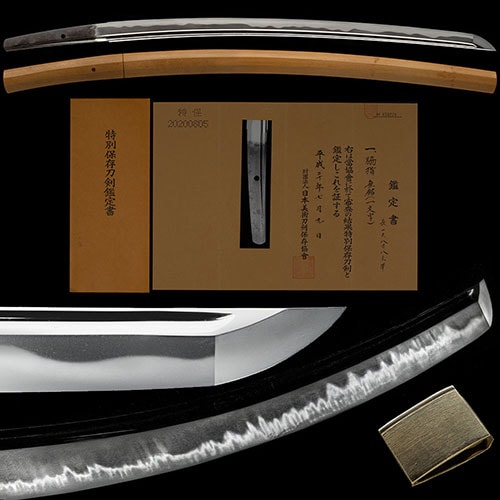
NihontoWatch MonNihontoWatchBETA
MarketEncyclopedia
NihontoWatch Mon

NihontoWatchBETA

Market
Encyclopedia
Overview·Kantei·Dated Works·Designations·Provenance·Blade Forms·Signatures·School
OverviewKanteiDated WorksDesignationsProvenanceBlade FormsSignaturesSchool
  1. Schools
  2. Wake
  3. Shigesuke

Wake Shigesuke

重助

Tokujū
Vol. 12, No. 32 · Tachi

Wake Shigesuke

重助

12 ranked works

ProvinceBizenEraLate Kamakura (Karyaku 3/1328 dated work)PeriodKamakuraSchoolWakeTraditionBizen-denToko Taikan850(top 11%)TypeSwordsmithCodeSHI477
2Jūyō Bijutsuhin
1Tokubetsu Jūyō9Jūyō Tōken

Overview

Two bearing dates in the Karyaku era, one inscribed in the first month of Karyaku 3 (1328) and the other in the tenth, fix almost everything that is known of Shigesuke. He was a swordsmith of the Wake group, a small line working at Wake-shō in Province a short way from in the closing years of the period. The published sources name him together with Shigenori as the Wake smiths, dating the pair by these few surviving signed pieces, and record the local tradition that "Wake is said to have been the former homeland of the smiths" (和気の地は古備前刀工の故地であると伝え), with the cautious addition that the line may have drawn on the lineage, though the matter is not clear. His is a peripheral hand, set against the great workshops a few miles to the west, and read very much in their light.

His recognized manner is the signed , slender and small in scale, one carrying a -tinged curvature and another a feeling despite its compact size, running to a . Over a tightly packed with and a standing he tempers not the clove-flower of mainstream but a restrained , into which he sets small and small , with entering and intermingled. The tends tight, with and . This quieter, -based line, carried over the rich , is the spine of his hand and the feature that separates the Wake group from the flamboyant temper of the decades.

The is the constant across his work. A standing rises on nearly every blade, signed and alike, over an that in the tightens to a fine and in the shortened stands a little, mixed with and . On the most fully described pieces the steel carries in fine particles, entering, and a slightly mottled -like complexion, the old the Wake line keeps from its supposed root. Over that the runs a shallow and turns back in , sometimes finishing in or with a touch of ; on the a is frequently carved through.

Within this one hand the published sources draw two further registers. A , its five-character signature cut away after "Bishū Wake-jū" and judged Shigesuke from a dated reverse of Karyaku 1, is forged in a flowing with conspicuous o- and tempered in a with reverse-slanting elements and a -style ; the commentary calls it a piece that "tempers a -like blade reminiscent of Kagemitsu" (景光を思わせるような肩落互の目風の刃を焼き), good in workmanship and valuable as source material for the study of the Wake smiths even with the signature truncated. The larger part of his record, the , is attributed to him as the typical Wake hand, affirmed from era, school and the standard set by the surviving signed rather than from any personal flourish.

What sets him apart from his neighbours is exactly what the judges keep returning to. The Jūyō Bijutsuhin commentary, examining one of the dated , finds that "in comparison with the activity of the near-contemporary Kagemitsu, there is variation" (同時代の長船景光に比して変化がある), and of the other that its workmanship is in no way inferior to, and may even surpass, the standard work of that master. The modern judges read the the way, calling their , with and shallow close to contemporary work, the affinity that justifies the attribution. He stands, then, as a quiet satellite of the school, his name preserved because a hand of this date, distinct from the clove-flower mainstream, is worth keeping straight.

For the collector he is a rare peripheral name rather than a great one, and the record is honest about it. There are no National Treasures and no Important Cultural Properties on it; his standing rests instead on a single , nine blades, and two prewar Jūyō Bijutsuhin, twelve designated works on record in all. The published commentary calls the signed "an outstanding achievement among his works" (彼の作品中傑出の出来映え), of particularly fine preservation, and one of the "an excellent piece attributed to Shigesuke, with no breakdown in either or " (地刃共に破綻のない重助極めの優品). His blades sit in collections grounded in their own provenance: the finest signed was bestowed by the shōgun Tokugawa Tsunayoshi on Mizuno Katsunaga in 1701 and long held by the Mizuno house, lords of Yūki Domain in Shimōsa; the Mitsui family owned one of the dated Jūyō Bijutsuhin , and the Tsukamoto Museum of Art holds the other. With so few signed works in existence and most of the attributions long held, a Shigesuke comes to market only rarely, and a signed example is among the scarcer documents a collector could hope to encounter, a record of how the old Wake line worked in the shadow of .

Kantei

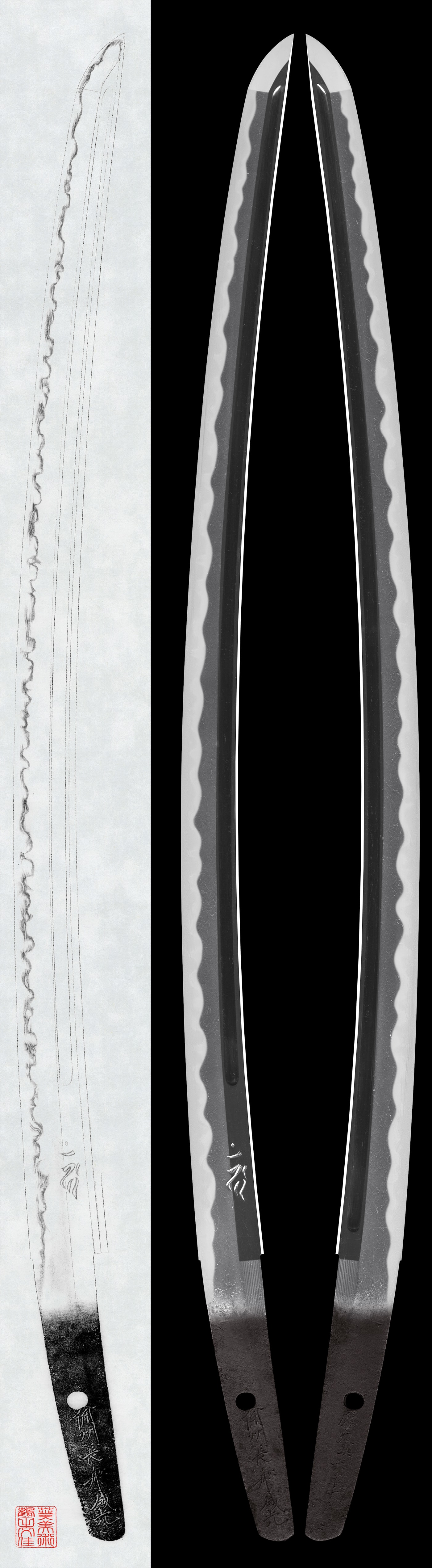
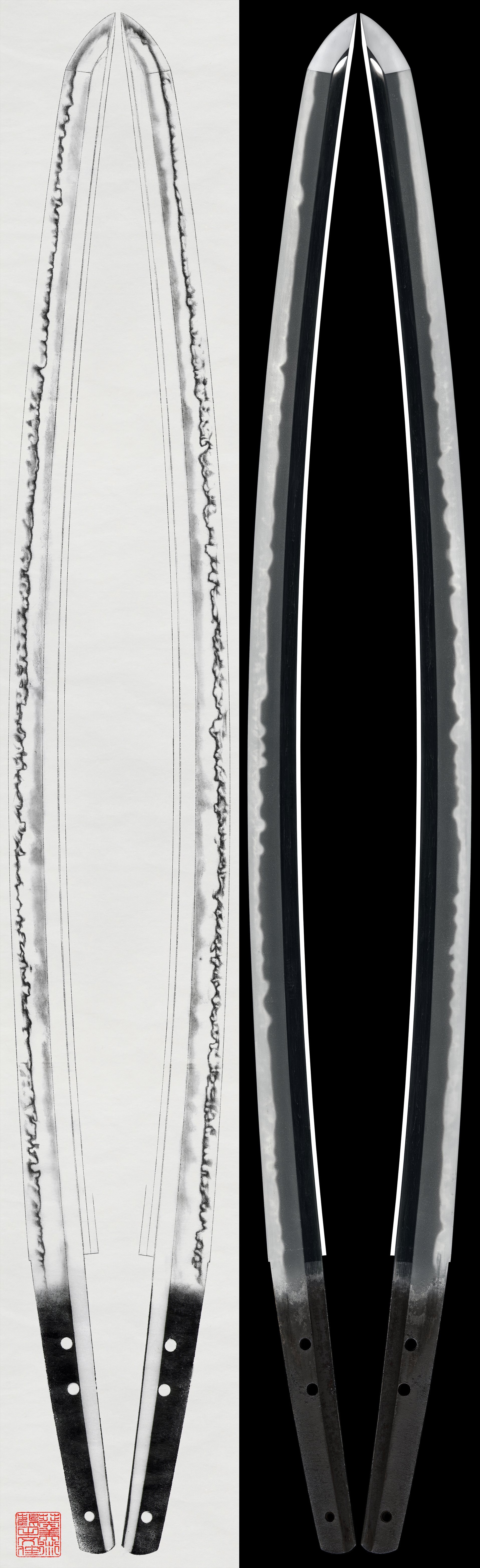
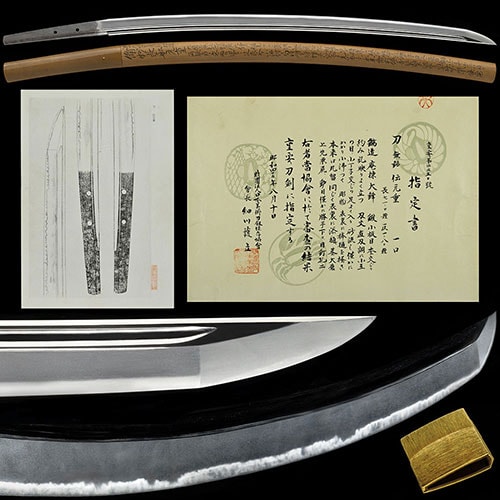
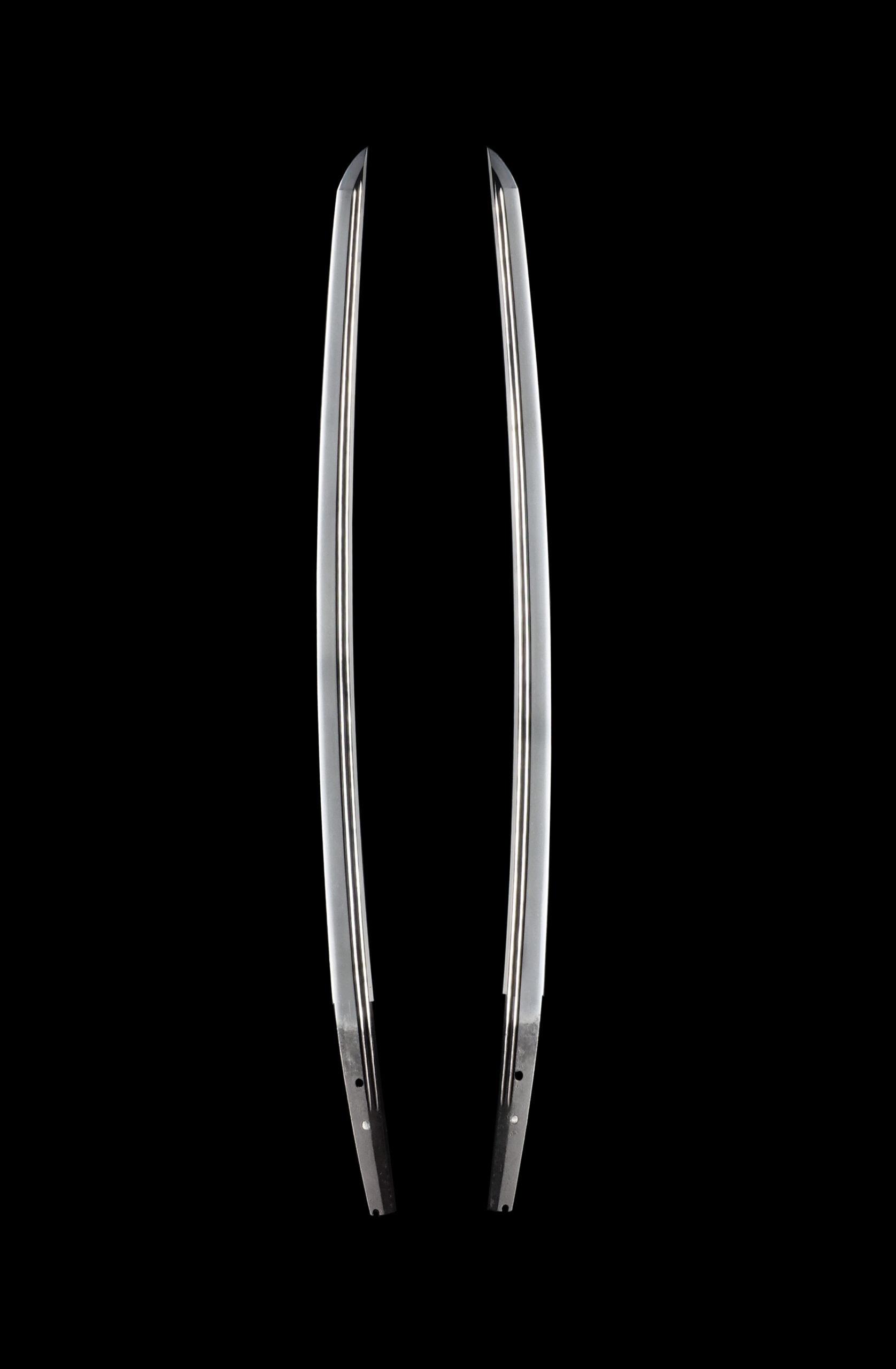
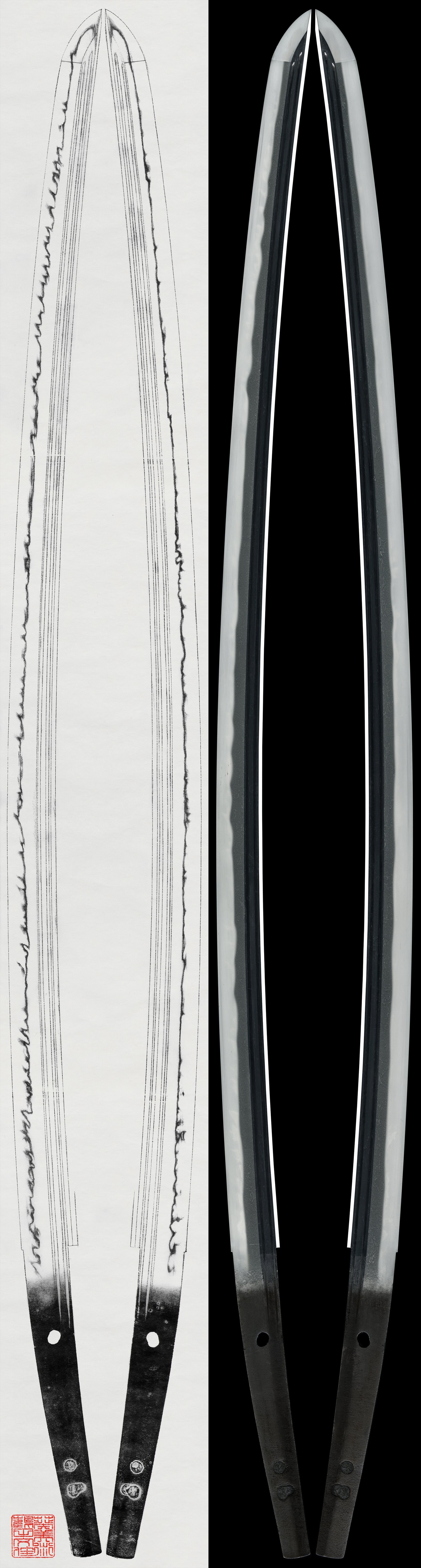
one Wake hand read across three registers: the few dated signed tachi that anchor the manner; the kataochi-style tanto the published sources call reminiscent of Kagemitsu; and the o-suriage mumei katana attributed to him as the typical Osafune-near Wake work

Shigesuke is a late- swordsmith of the Wake group, a small line working at Wake-shō a short way from , whose surviving signed work is reduced to a handful of dated of the Karyaku era. The published sources name Shigenori and Shigesuke together as the Wake smiths, note that Wake is held to be one of the proposed homelands of the smiths, and add the cautious view that the line may have drawn on the lineage, though the matter is not clear. His recognized hand is the signed : a tightly packed with and a standing , over which he tempers a mixed with small , and entering, the tight, the a shallow turning back in . The published sources read this as workmanship close to contemporary . A truncated-signature carries a -style the judges call reminiscent of Kagemitsu, and a body of is attributed to him as the typical Wake hand.

Diagnostic discriminators

unique vs mainstream Osafune (choji-midare base)

unique vs his own mumei katana without reverse ashi

Observation by phase

The dated signed tachi (his recognized hand)

His securely recognized work is the signed , several dated to the Karyaku era, slender in build and small in scale, one carrying a -tinged curvature, another a feeling despite its compact size, all running to a . The ground is a tightly packed with and a standing . Over it he tempers a mixed with small and small , entering with intermingled, the tending tight, with and . The is a shallow turning back in . The published sources read the whole as workmanship close to a superior production, and call the an outstanding achievement among his works whose preservation is particularly fine. One Bijutsuhin entry sets his activity beside that of the near-contemporary Kagemitsu and finds it in no way inferior, and may even surpass, the standard work of that master.

Sugata 姿
Jigane 地鉄
Hamon 刃文
Bōshi 帽子

The kataochi tanto (the Kagemitsu echo)

A single , its five-character signature truncated after Bishu Wake-ju and judged Shigesuke, carries a dated reverse for Karyaku 1. It is forged in a flowing mixed with conspicuous o-, appearing, and is tempered in a with reverse-slanting elements and a -style in . The published sources call this -tinged reminiscent of Kagemitsu, and rate the workmanship good, valuable as source material for the study of the Wake smiths even with the signature cut.

Jigane 地鉄
Hamon 刃文
Bōshi 帽子

The o-suriage mumei katana (typical Wake attribution)

The larger part of his record is the attributed to him as the typical Wake hand. These run over an , at times standing in grain () and mixed with and , and a , sometimes with and a -like complexion; the temper is a or mixed with small , angular and pointed elements, entering, with , and fine , the at times bright, at times moist (), the a shallow into or a -like finish, often carved through. The published sources affirm these from era, school and the surviving signed standard, calling the workmanship close to ; where one carries an exceptionally bright the judges note even his signed works rarely run so bright.

Jigane 地鉄
Hamon 刃文
Bōshi 帽子
Scholarship

The published sources record that Wake is one of the proposed homelands of the old Ko-Bizen smiths and that one view holds the Wake makers to have drawn on the Ko-Bizen lineage, while granting the details are not clear; they note that extant signed Wake work is exceedingly few, that two long-signed tachi bearing Karyaku dates establish the standard as a suguha base mixed with small choji, and on that ground accept the o-suriage mumei katana as Wake work close to Osafune.

On the truncated-signature tanto the published sources find a kataochi-style gunome reminiscent of Kagemitsu and rate the workmanship good, calling it valuable source material for the study of the Wake smiths despite the cut signature; one Juyo Bijutsuhin entry sets his hamon activity beside Kagemitsu's standard work and judges it in no way inferior.

Dated Works

Years he was demonstrably active, proven by signed-and-dated blades

Active period
1328Editorial estimate: 1326–1329
1 of 4 designated works carry a date
  1. 1328
    嘉暦三年Juyo Bijutsuhin vol. 4, item 563

Designations

Kokuhō—
Jūyō Bunkazai—
Jūyō Bijutsuhin2
Gyobutsu—
Tokubetsu Jūyō1
Jūyō Tōken9

Elite Standing

0.15 across 12 designated works

Top 14% among smiths

Provenance

5 documented provenances across certified works by Shigesuke

Provenance Standing

1 works held in elite collections across 5 documented provenances

Top 77% among smiths

Raw score: 1.87 / 10

Blade Forms

Distribution across 12 ranked works

Signatures

Signature types across 12 ranked works

Currently Available

Wake School

Other artisans of the Wake school

  1. 1.Shigenori重則1 for sale4designated

Shigesuke

Shigesuke(重助) was a Japanese swordsmith of the Wake school in Bizen province, active during the Late Kamakura (Karyaku 3/1328 dated work) period.

The work follows the Bizen-den tradition.

Designated works by Shigesuke include 1 Tokubetsu Jūyō, 9 Jūyō.