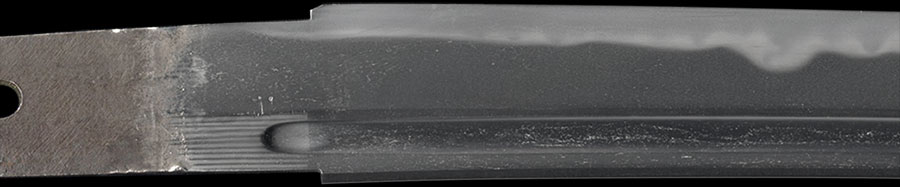
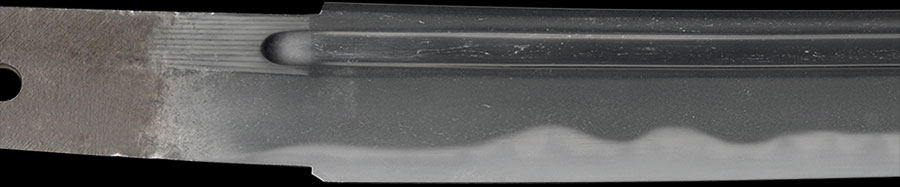
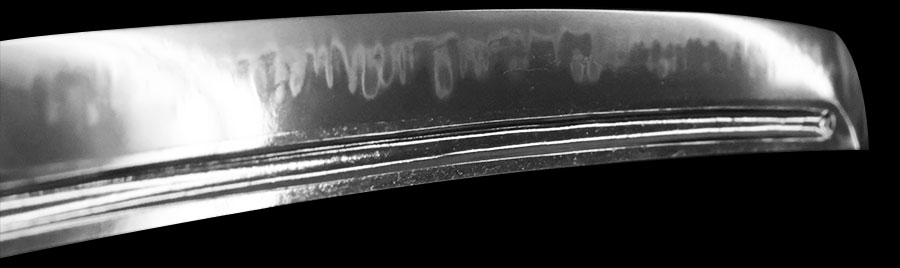
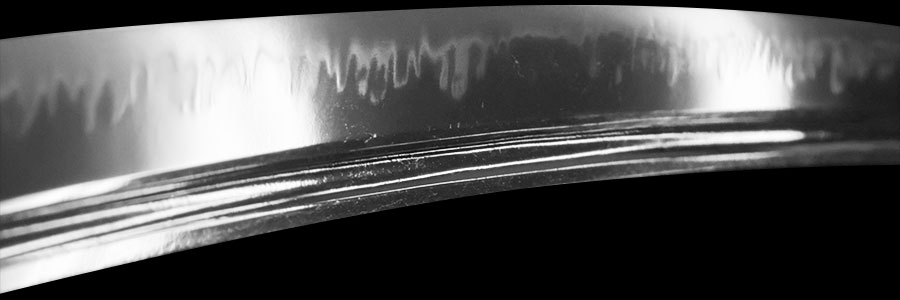
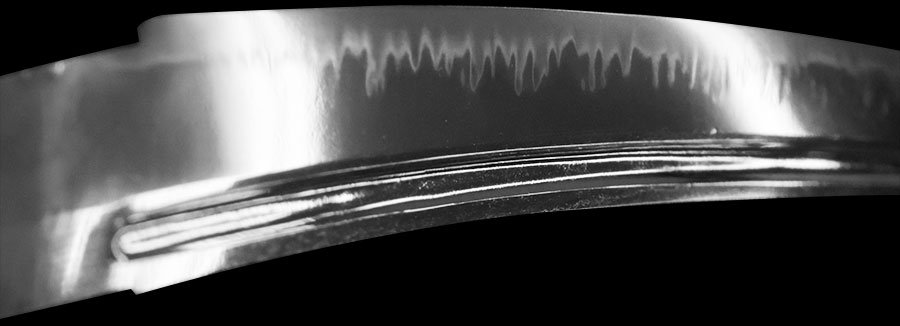
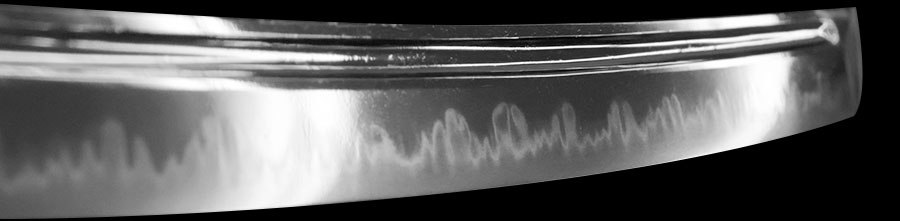
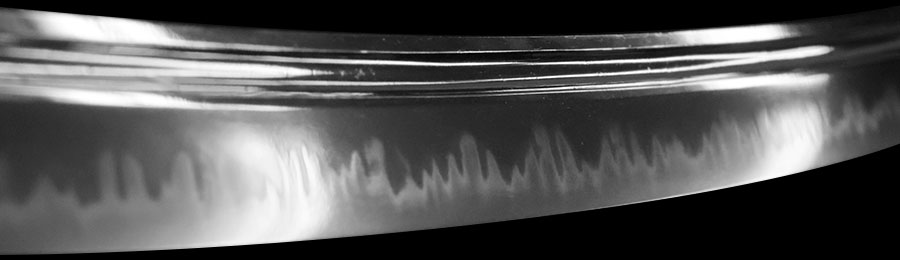
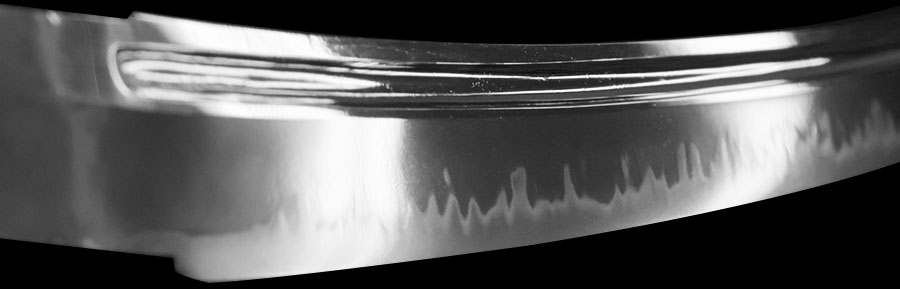
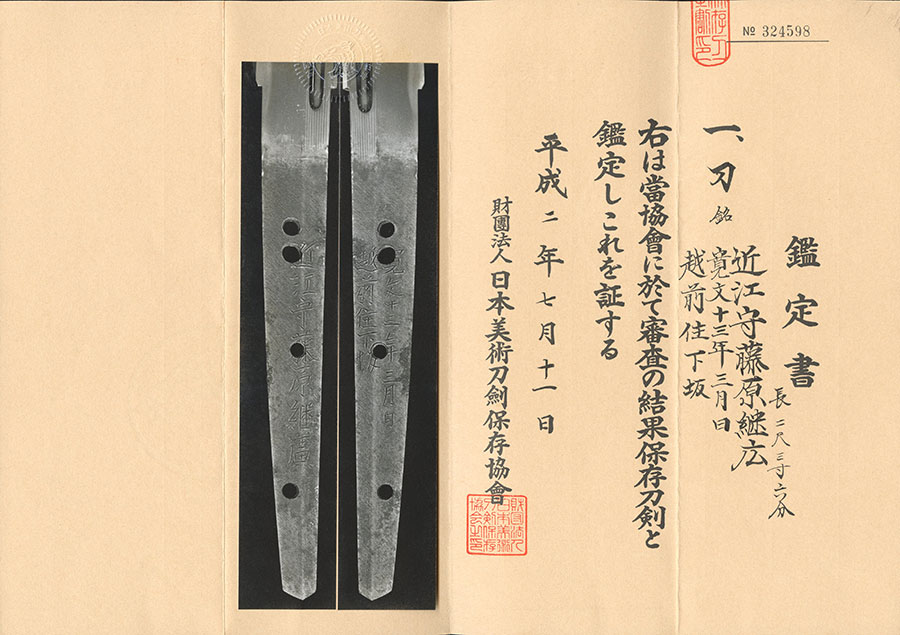
It has appeared, it has appeared; a meito by Omi no Kami Fujiwara Tsuguhiro made in the early Edo period, Kanbun 13 (1673) (389 years ago), has appeared. Kanbun 13 is also a memorable year as the era name was changed and it is originally called Enpo 1. Omi no Kami Tsuguhiro was the second son of the first generation Echizen Yasutsugu and the younger brother of the second generation Yasutsugu, belonging to the school of the first generation Echizen Yasutsugu; he was also a daisaku maker for Yasutsugu's swords, and since he went out of his way to cut the mei "Echizen Ju Shimosaka," it is because Nagahama City, Shiga Prefecture, the birthplace of the Shimosaka family of powerful local clans continuing from the Kamakura period, is likewise the birthplace of the Shimosaka smiths, meaning Yasutsugu, Kotetsu, and Tsuguhiro were all of the same clan and school and were relatives. The swordsmith Tsuguhiro later went to Echizen Fukui, Omi Zeze, and Edo. Chronologically, he is a swordsmith who was a senior smith to Nagasone Kotetsu. This katana shows a Kanbun Shinto sugata identical to Kotetsu, with a wide motohaba and a difference with the sakihaba and little sori; the jigane shows a bright, good jigane with itame hada mixed with masame hada, and the horimono has a skillfully carved bo-hi. The hamon is nioi-deki with konie, starting with a sugu-cho yakidashi, mixing gunome-ba with rounded heads, gunome-ba with pointed heads, gunome-ba with heads split in two like crab claws, and yahazu-ba that seem to point left and right; it also has tobiyaki, and with sunagashu and kiesuji in the ha, it fires a spirited, bright blade that is magnificent; the boshi also returns deeply in komaru, and being famous as a wazamono, it is wonderfully well-made. Having received this on consignment from an elderly doctor and sukiyosha who said, "We have grown old, so please pass this on cheaply to someone who will cherish it," we are offering it at a special, ultra-low price the same as a Gendaito; please by all means enjoy it.
Machine translation from the shop's Japanese · may contain errors ·
It has appeared, it has appeared; a meito by Omi no Kami Fujiwara Tsuguhiro made in the early Edo period, Kanbun 13 (1673) (389 years ago), has appeared. Kanbun 13 is also a memorable year as the era name was changed and it is originally called Enpo 1. Omi no Kami Tsuguhiro was the second son of the first generation Echizen Yasutsugu and the younger brother of the second generation Yasutsugu, belonging to the school of the first generation Echizen Yasutsugu; he was also a daisaku maker for Yasutsugu's swords, and since he went out of his way to cut the mei "Echizen Ju Shimosaka," it is because Nagahama City, Shiga Prefecture, the birthplace of the Shimosaka family of powerful local clans continuing from the Kamakura period, is likewise the birthplace of the Shimosaka smiths, meaning Yasutsugu, Kotetsu, and Tsuguhiro were all of the same clan and school and were relatives. The swordsmith Tsuguhiro later went to Echizen Fukui, Omi Zeze, and Edo. Chronologically, he is a swordsmith who was a senior smith to Nagasone Kotetsu. This katana shows a Kanbun Shinto sugata identical to Kotetsu, with a wide motohaba and a difference with the sakihaba and little sori; the jigane shows a bright, good jigane with itame hada mixed with masame hada, and the horimono has a skillfully carved bo-hi. The hamon is nioi-deki with konie, starting with a sugu-cho yakidashi, mixing gunome-ba with rounded heads, gunome-ba with pointed heads, gunome-ba with heads split in two like crab claws, and yahazu-ba that seem to point left and right; it also has tobiyaki, and with sunagashu and kiesuji in the ha, it fires a spirited, bright blade that is magnificent; the boshi also returns deeply in komaru, and being famous as a wazamono, it is wonderfully well-made. Having received this on consignment from an elderly doctor and sukiyosha who said, "We have grown old, so please pass this on cheaply to someone who will cherish it," we are offering it at a special, ultra-low price the same as a Gendaito; please by all means enjoy it.
For two and a half centuries of peace the sword was the warrior’s legal badge rather than his weapon. Each great city developed its own manner, Edo’s tested strength against Ōsaka’s polished brilliance, until demand thinned in the era’s last decades.
Certifies a genuine blade worth preserving: a signature confirmed correct, or, if unsigned, an era, province, and school that the NBTHK can reliably identify.
About the NBTHK›
The NBTHK (Nihon Bijutsu Tōken Hozon Kyōkai, the Society for the Preservation of Japanese Art Swords) is a public-interest incorporated foundation founded in 1948 and supervised by Japan’s Agency for Cultural Affairs (Bunkachō); it is based at the Japanese Sword Museum in Tokyo. Its expert panels physically examine each submitted work (shinsa) and issue a certificate (kanteishō) ranking it by artistic and historical merit. NBTHK papers are the most widely recognized standard of authentication for Japanese swords and fittings.
For returns due to customer circumstances, the cost is the customer's responsibility. For returns due to our mis-shipment or a defective item, we bear the cost.













 NihontoWatch