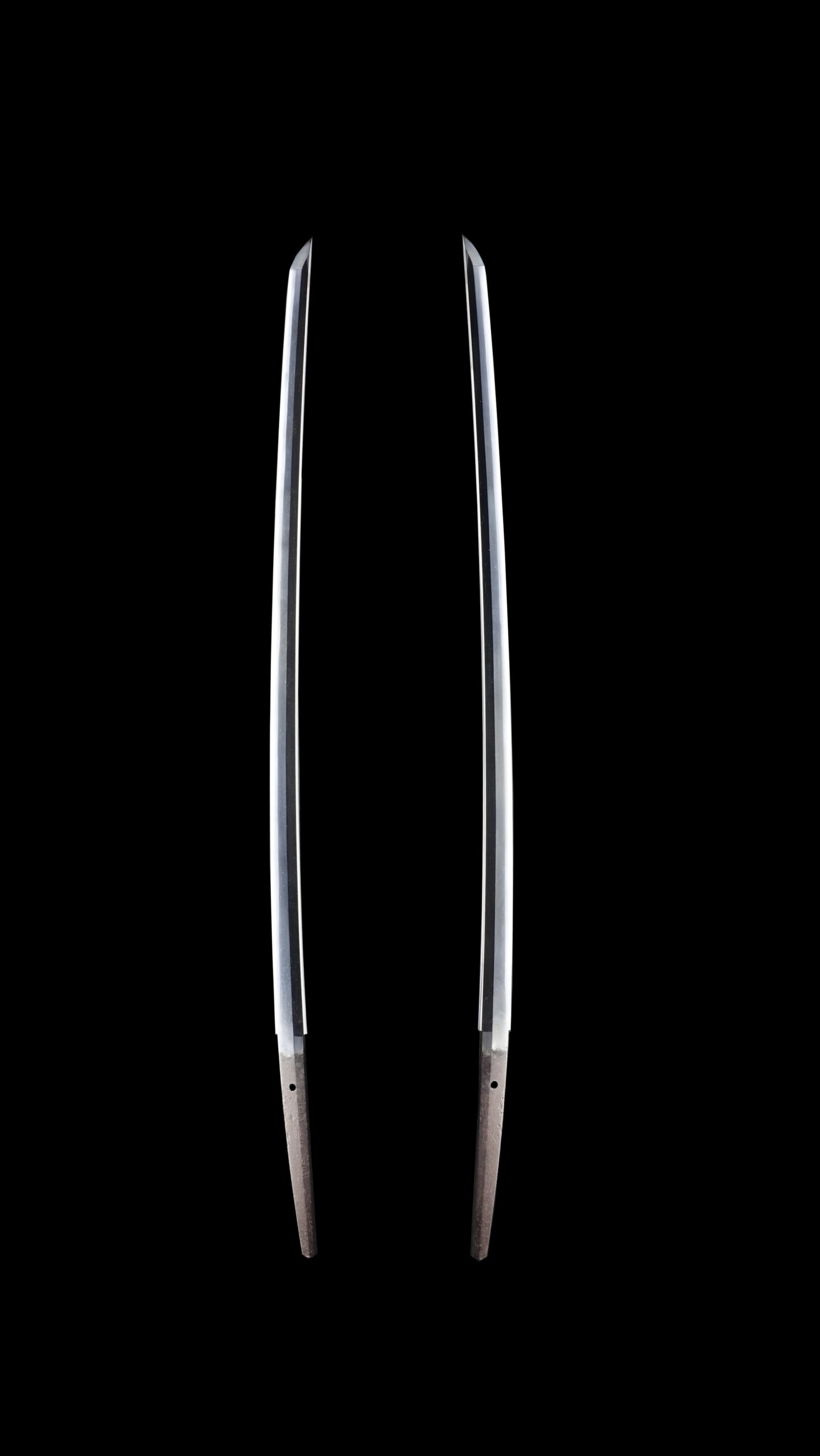
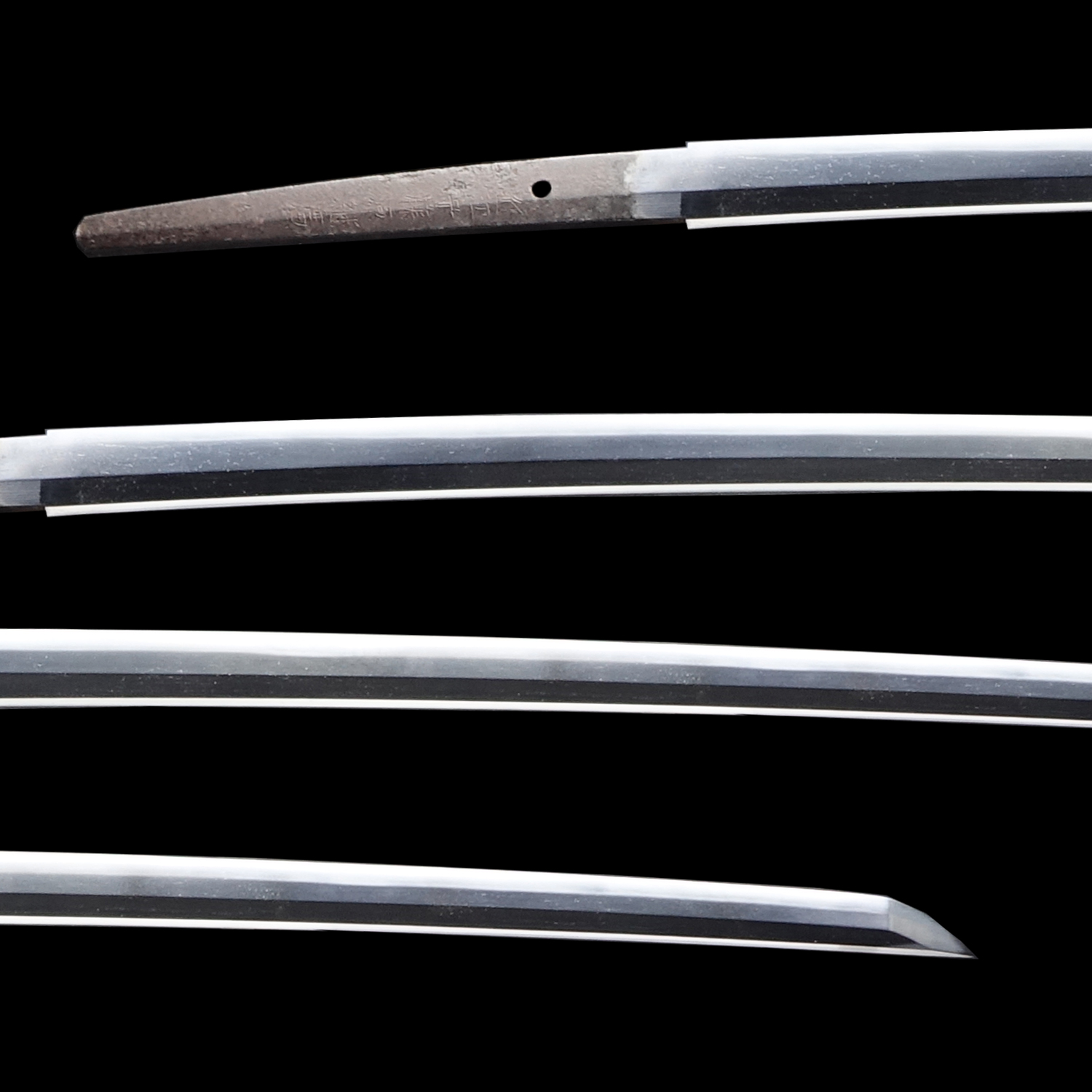
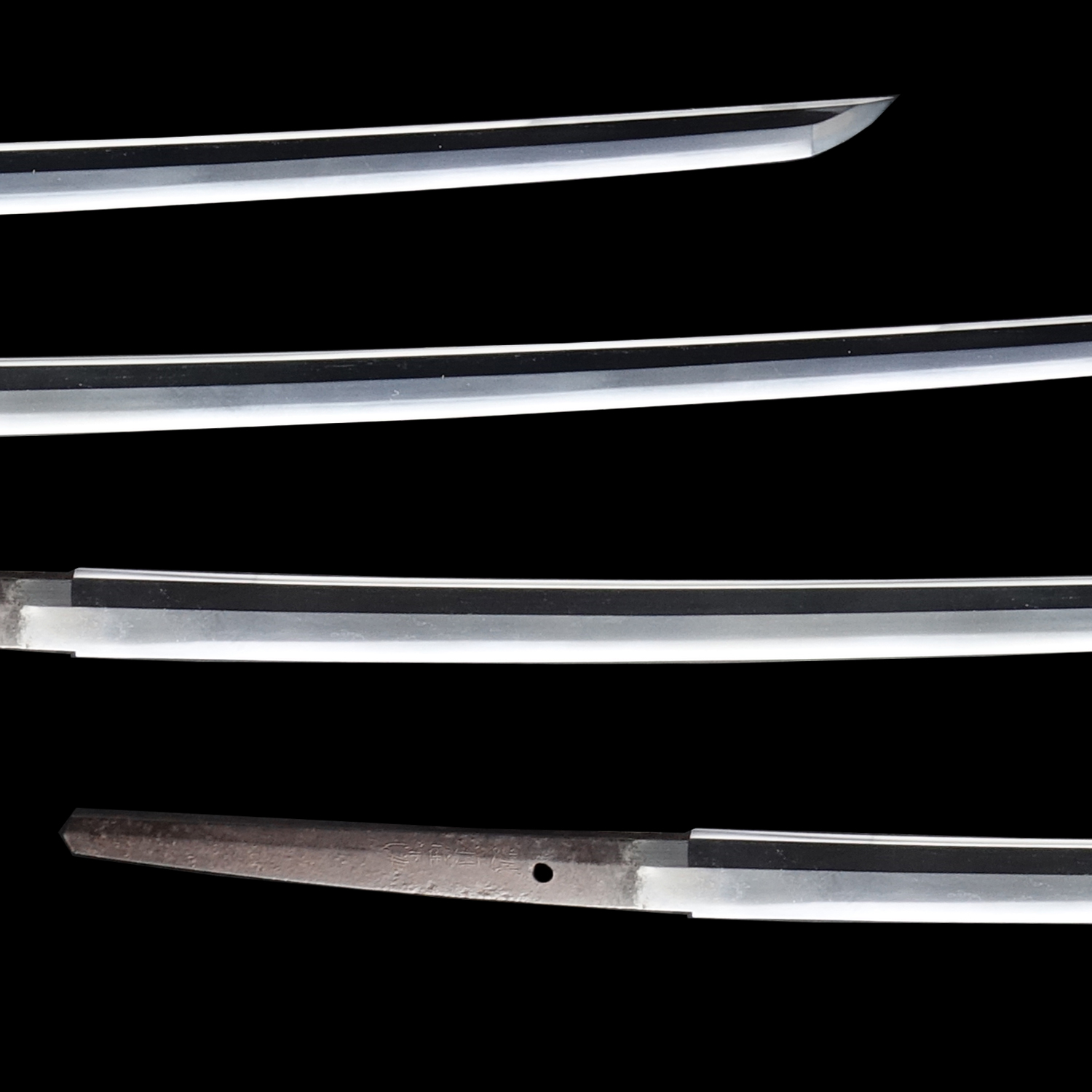
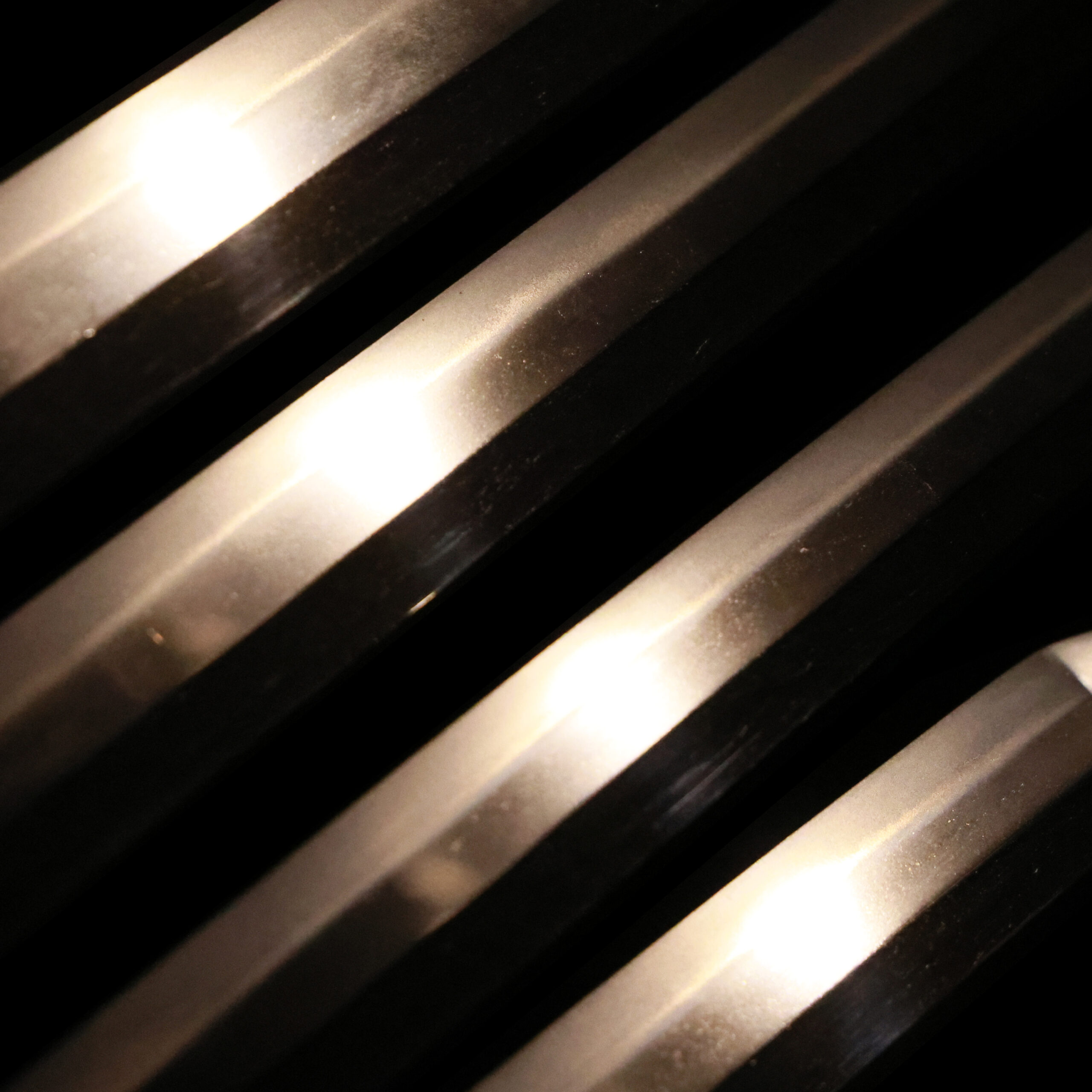
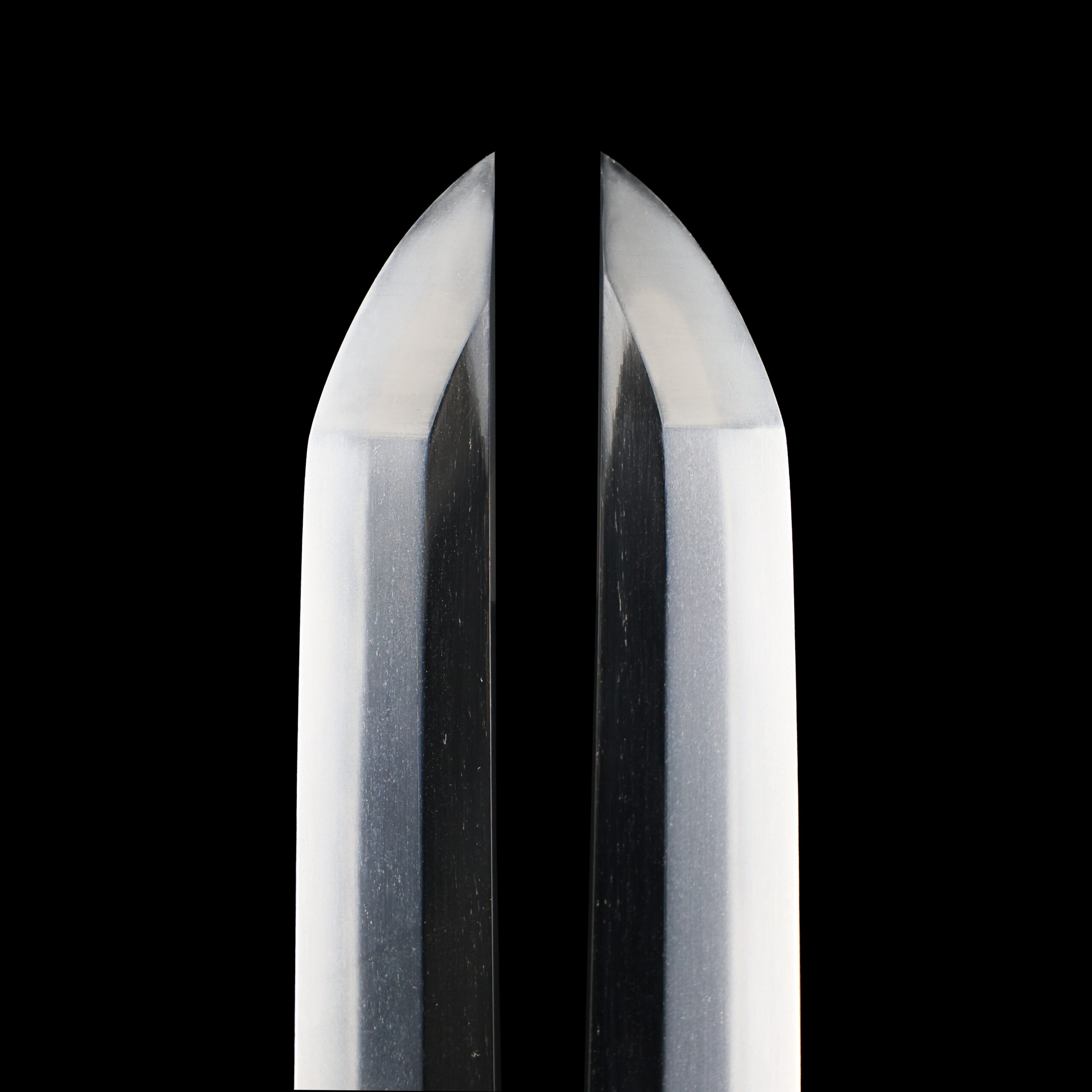
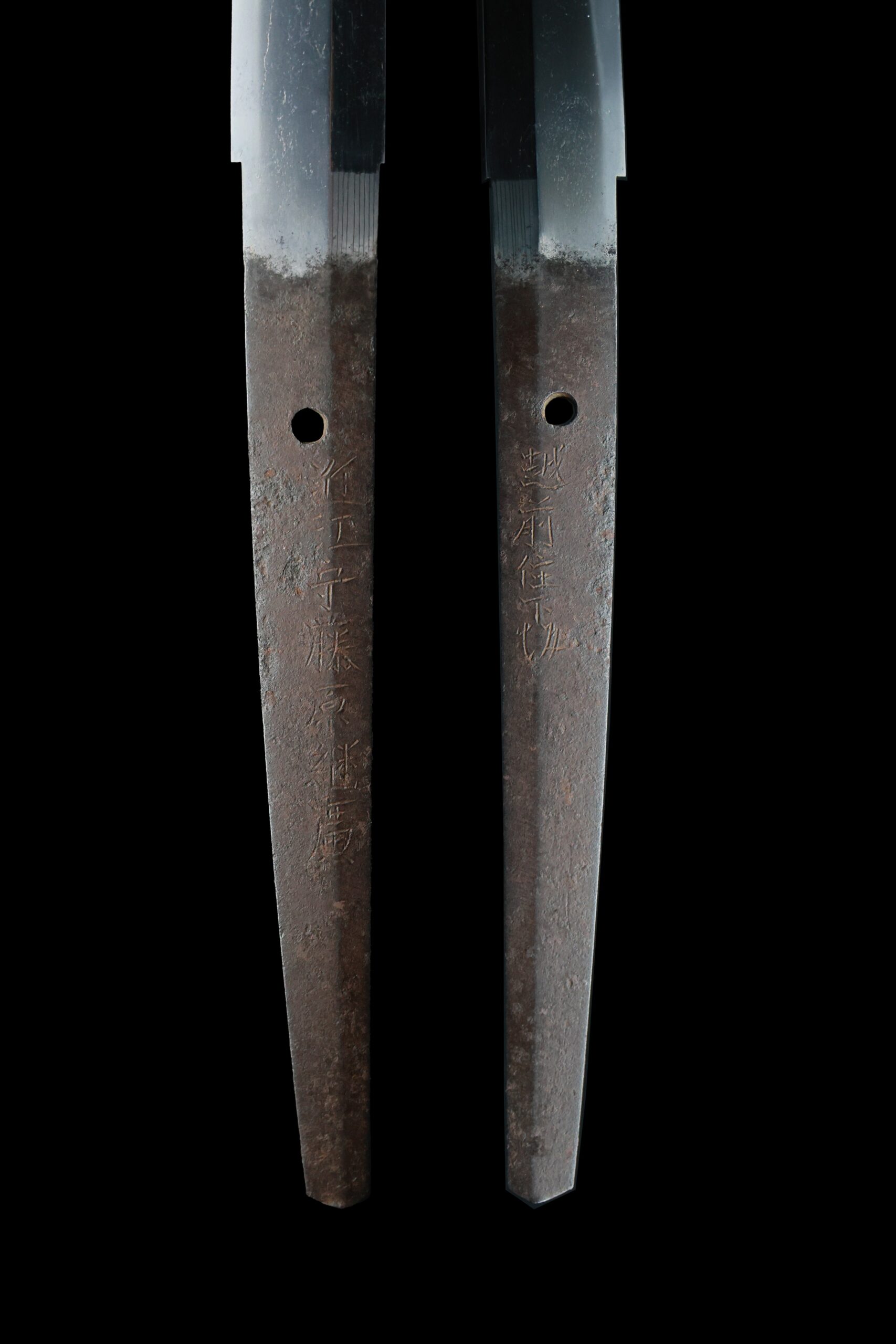
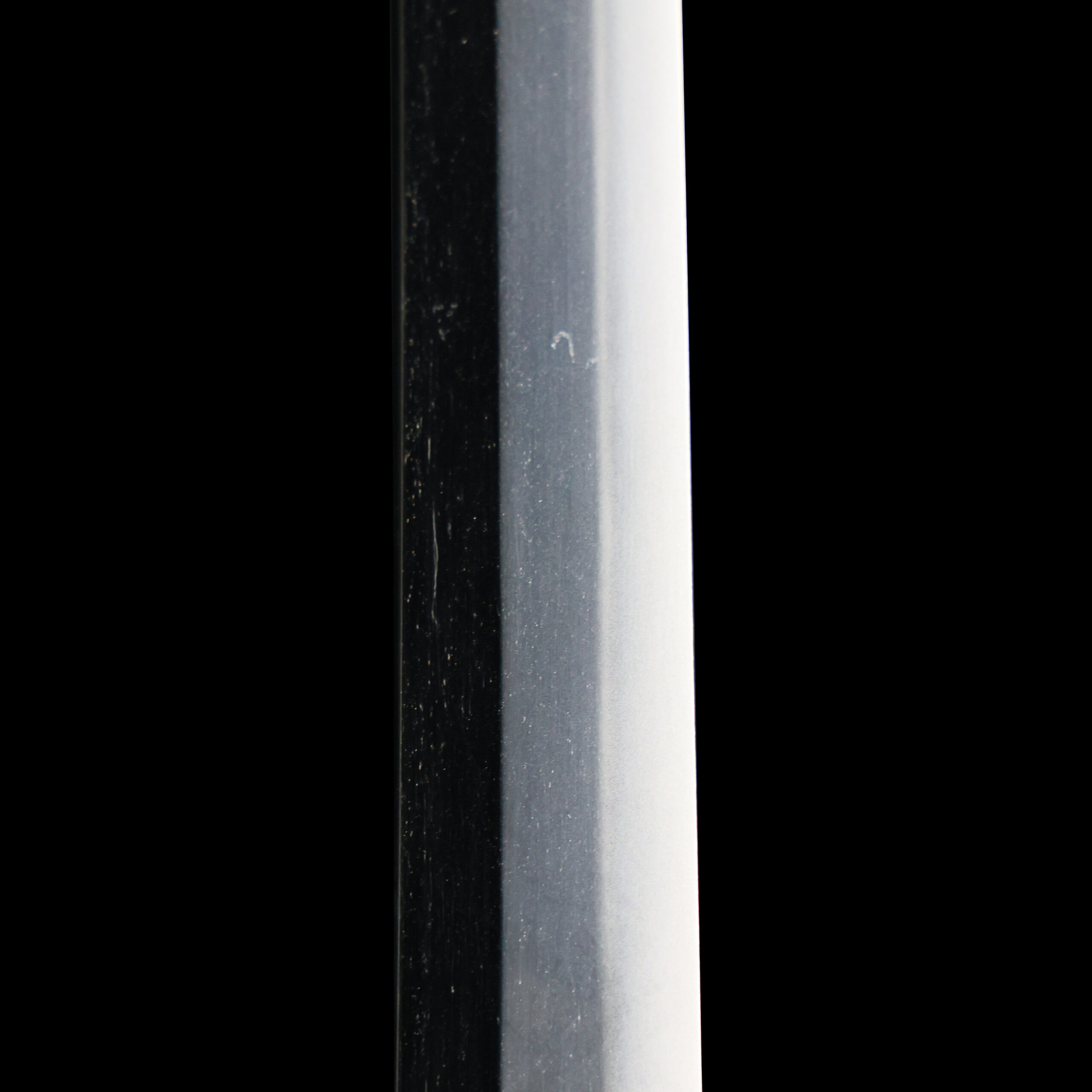
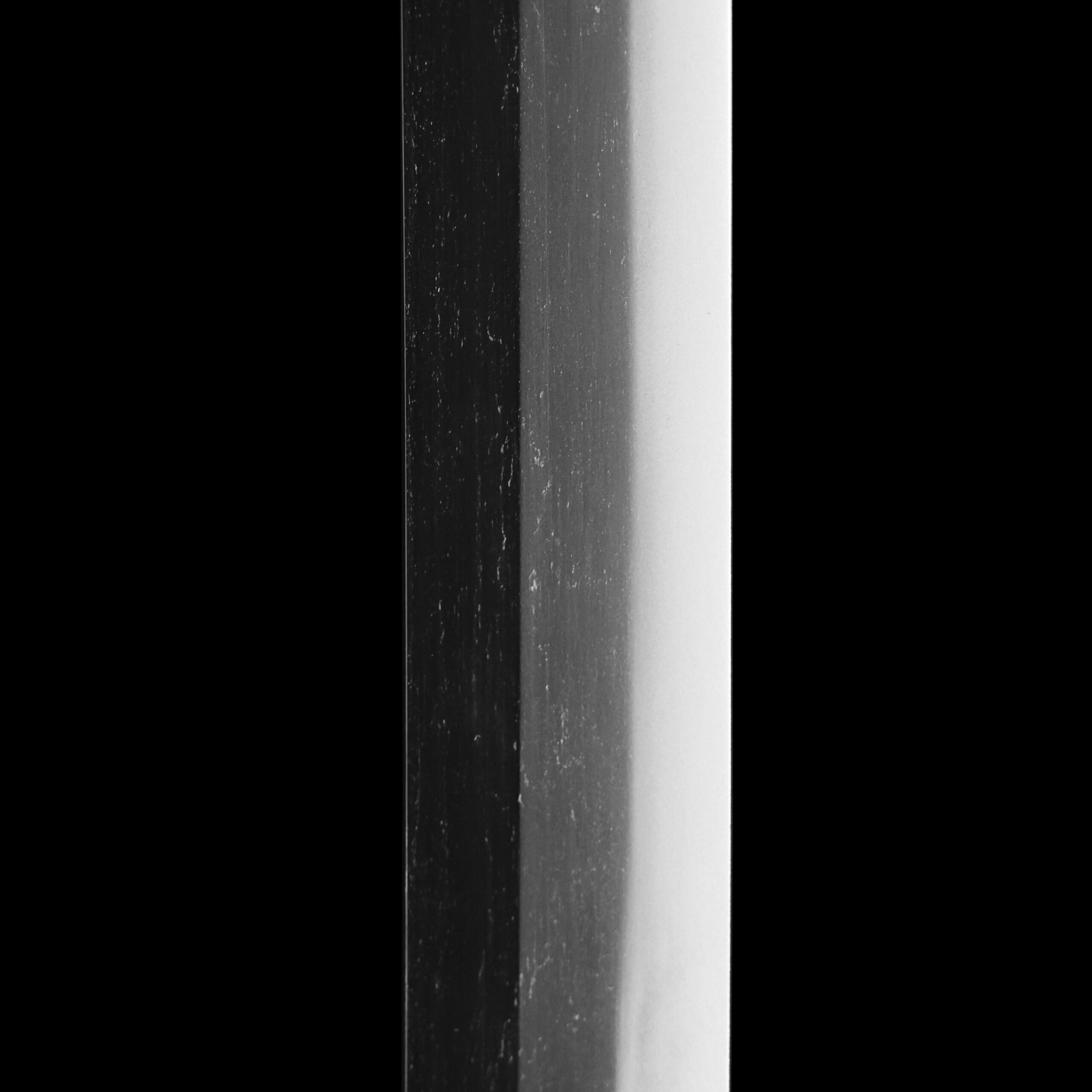
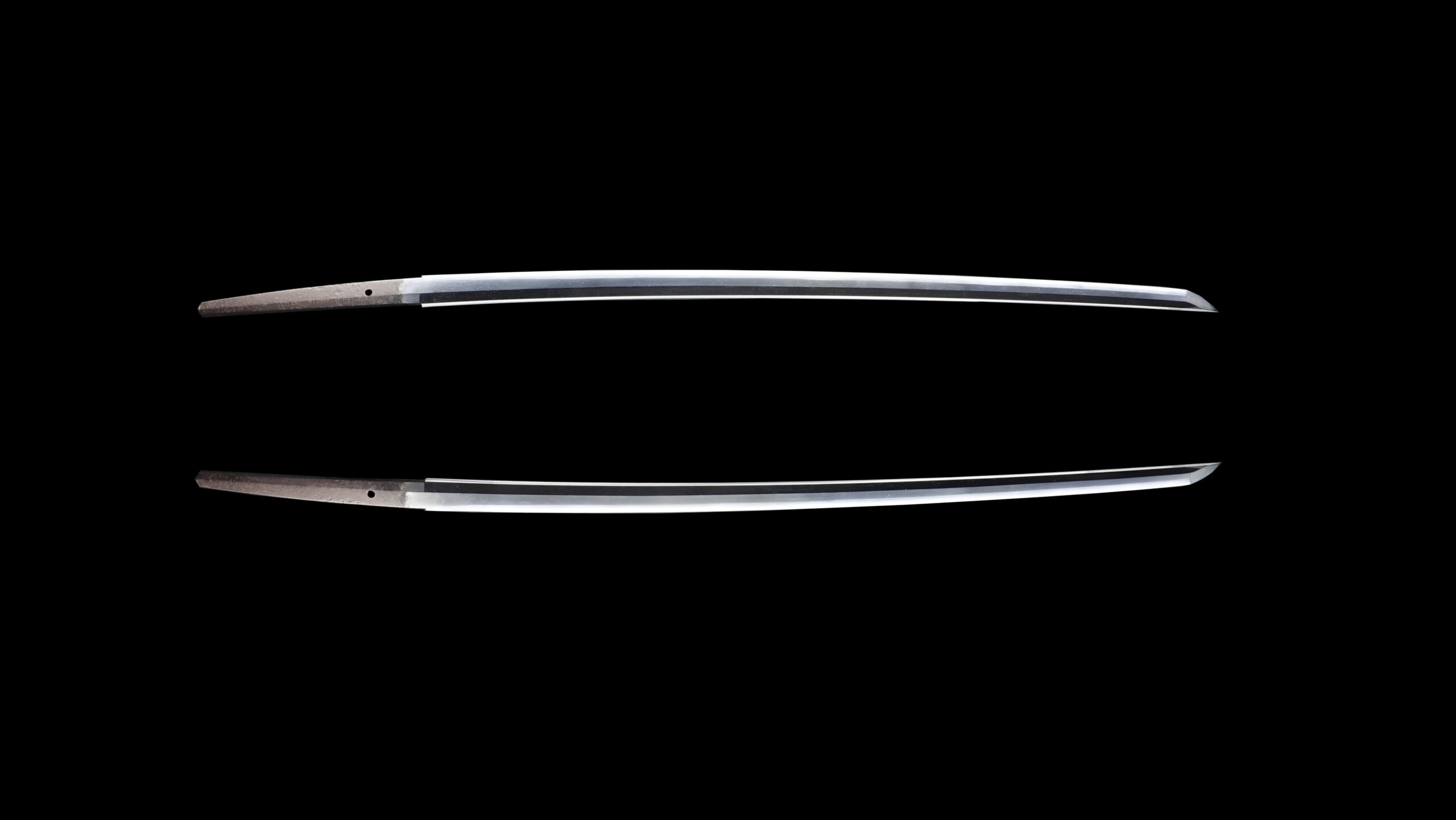
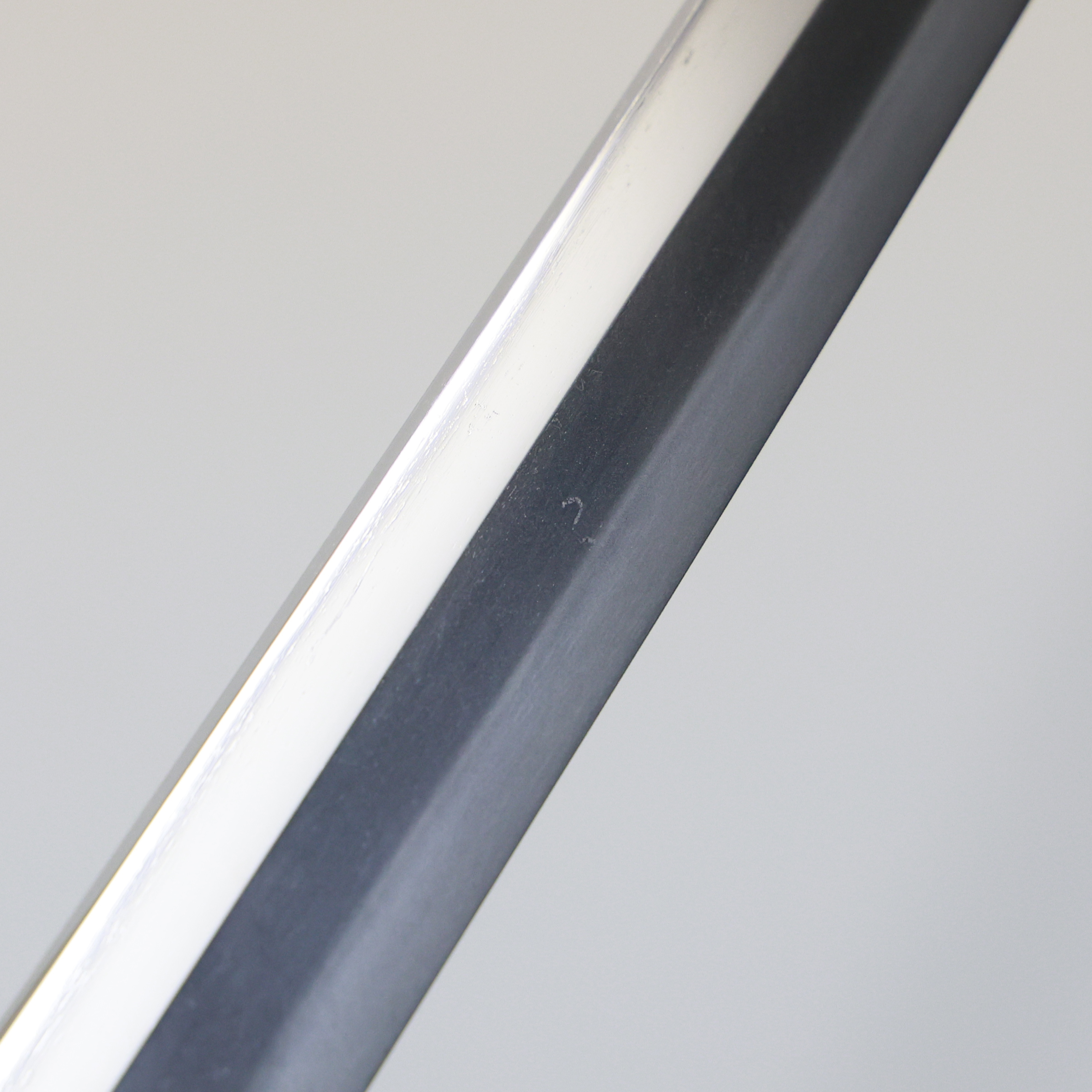
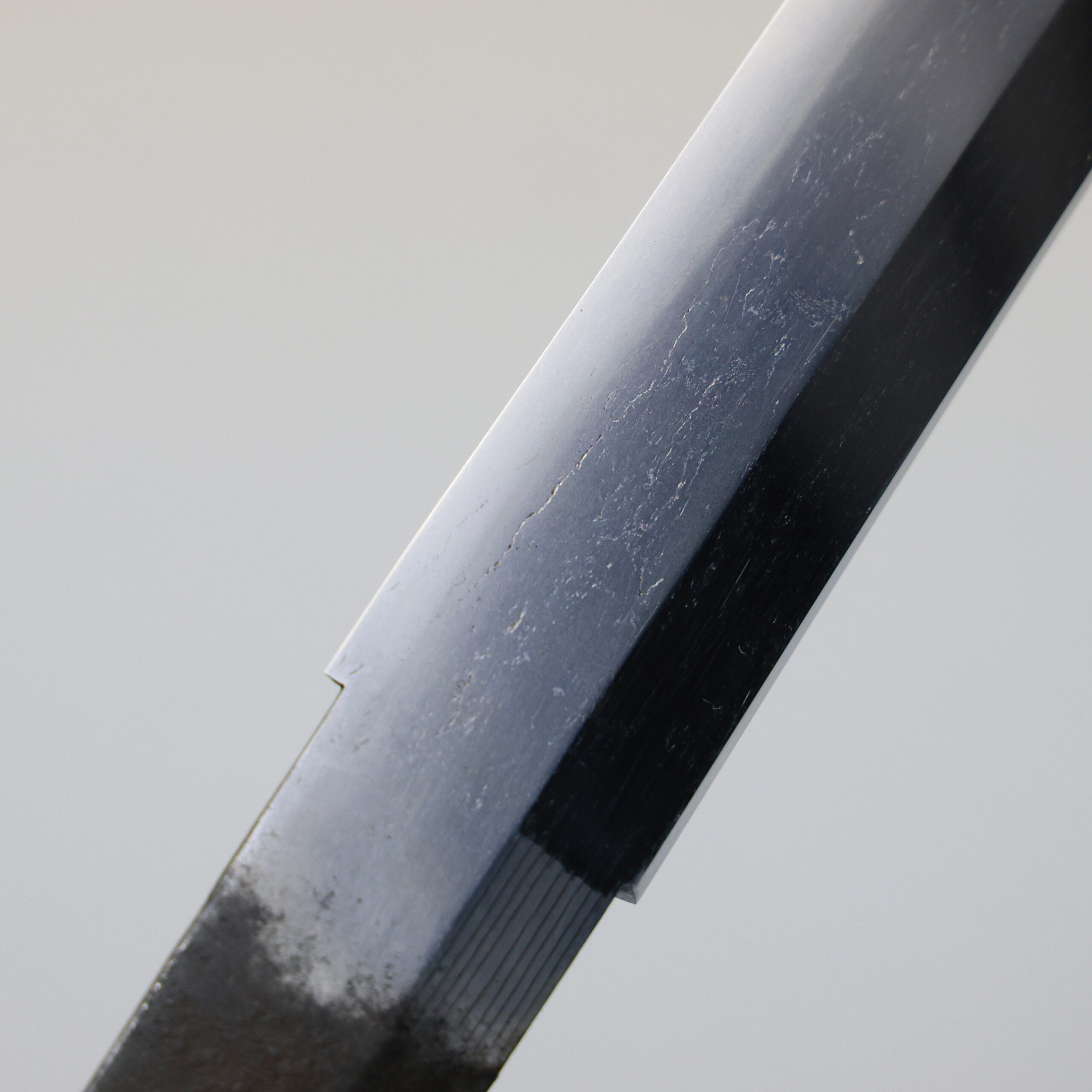
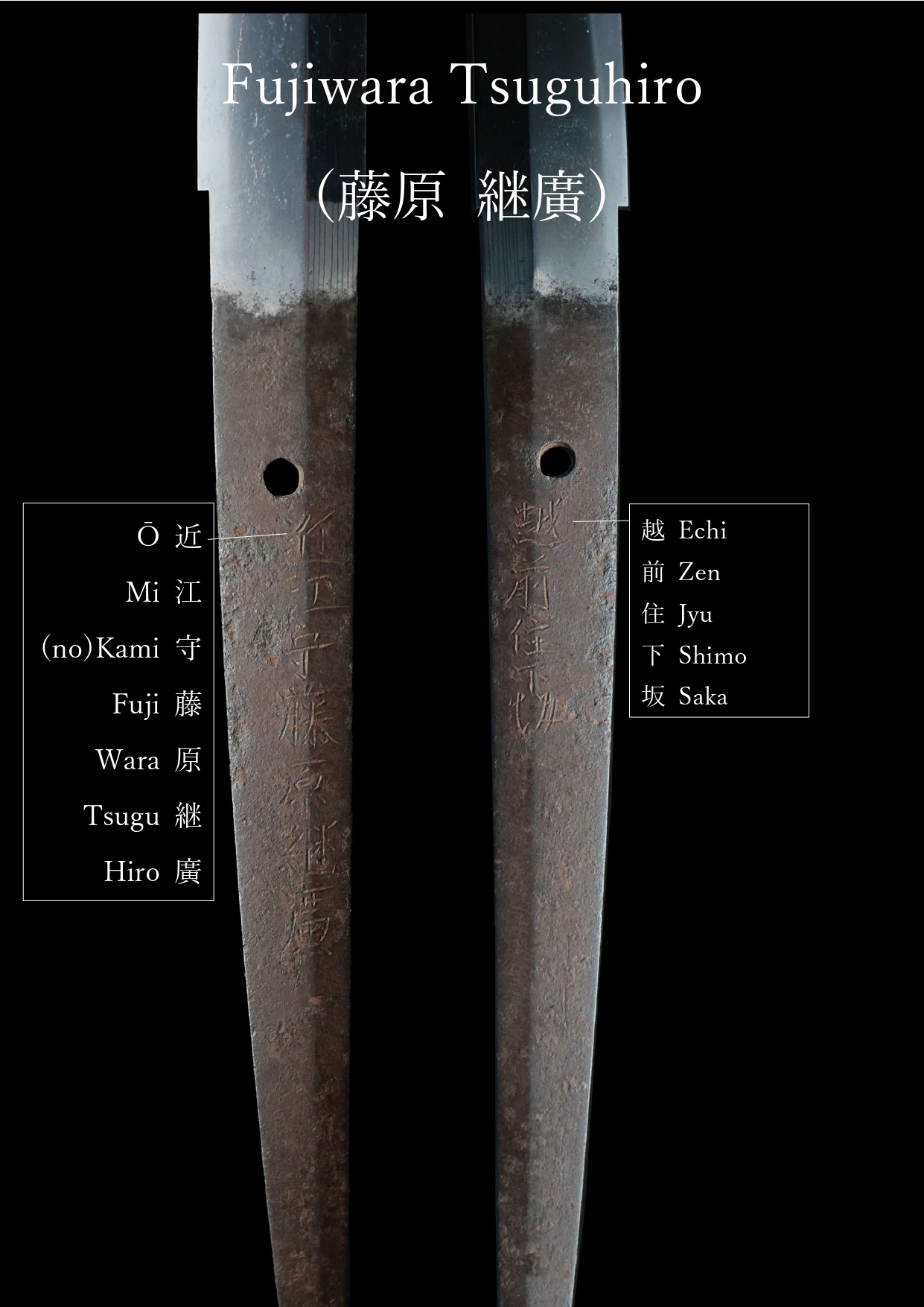
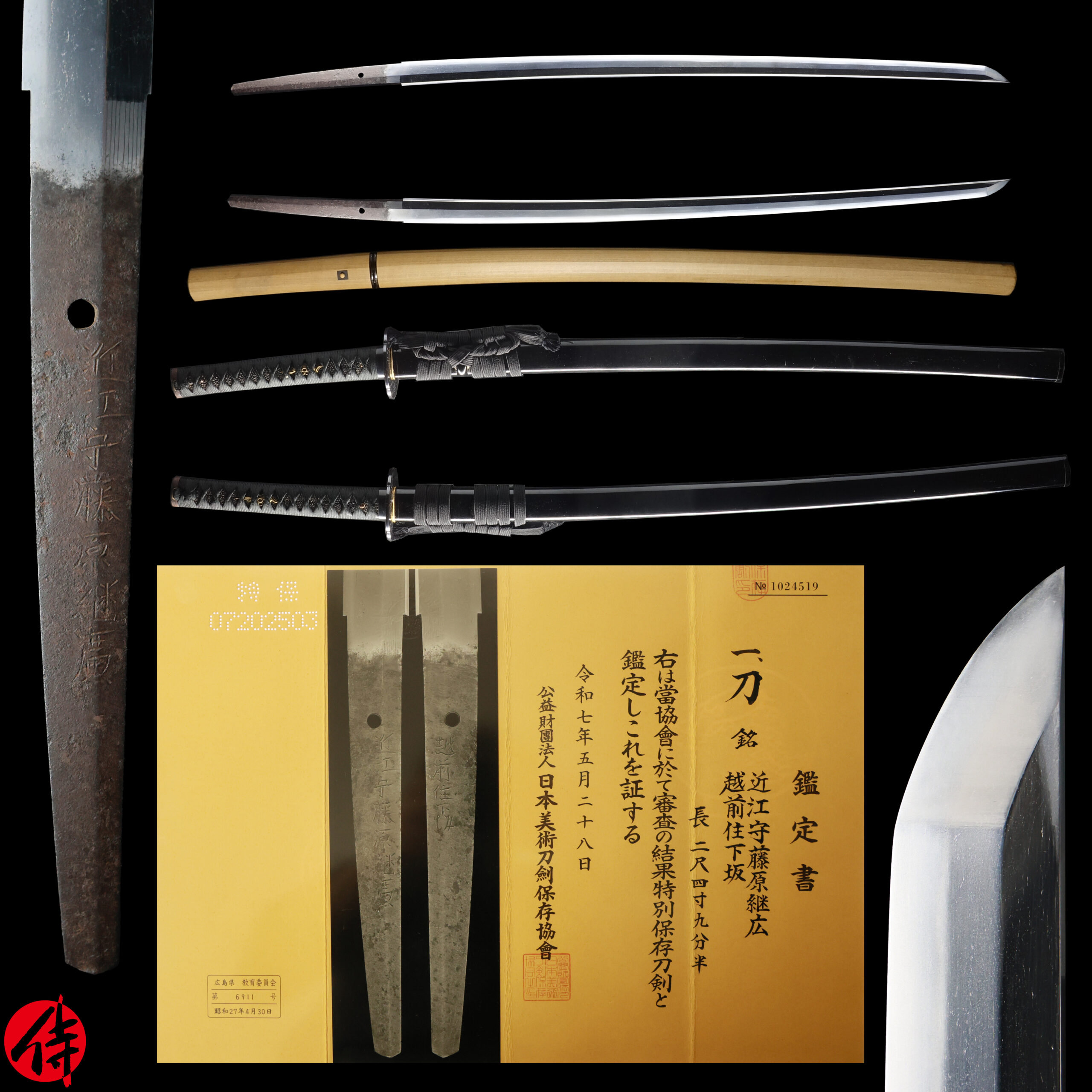
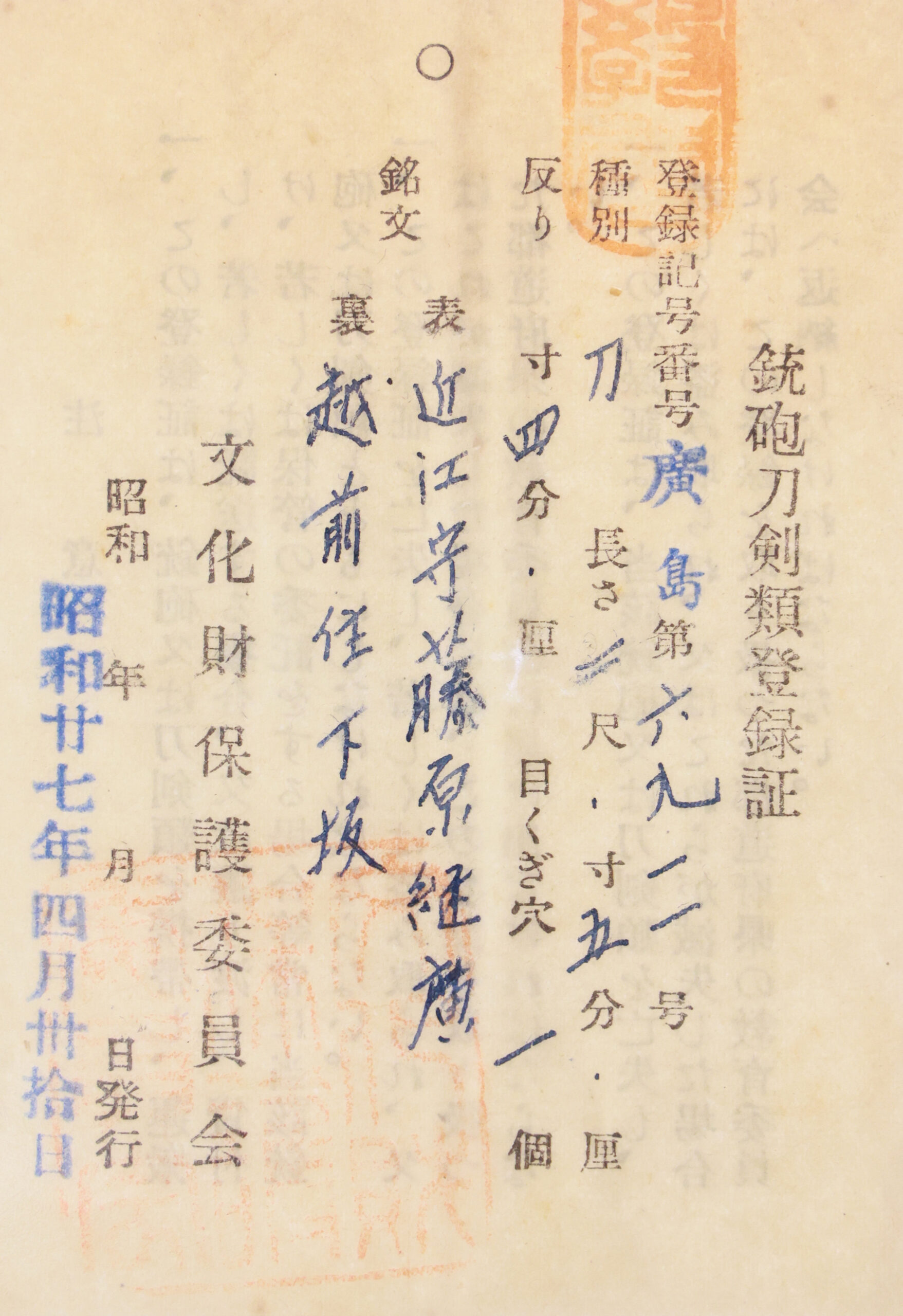
This blade was signed by Ōmi no Kami Fujiwara Tsuguhiro (近江守藤原継広), who was a swordsmith of the Echizen Shimosaka school, especially active from around the Kanbun era (1661–1673). Though originally based in Echizen Province (modern-day Fukui Prefecture), he also worked in Edo (Tokyo) and Omi province (today’s Shiga prefecture), reflecting his broad appeal and high demand among samurai clientele. He was known as an apprentice of the third-gen Echizen Yasutsugu, who was the head of Ezhizen Shimosaka school (越前下坂派). He received an honorable official title of Omi no Kami in his career. Kami is an honorable official title given by the imperial court for one’s excellent craftsmanship.
Shimosaka school
It is said that the first-gen Yasutsugu was the founder of the Echizen Shimoasaka school. He was born in Shimosaka town in Shiga prefecture at the end of the Muromachi period(Late 16 century ). He built his career there until the beginning of the Keicho era(1596). However, he moved to Echizen province due to the relocation of the lord he served. He eventually was noticed and supported by Matsudaira Hideyasu, the third son of Tokugawa Ieyasu, who was the founder of the Edo government.
Hideysu was the feudal lord of Echizen province during the early Edo period. With the support of Hideyasu, the first-gen Yasutsugu was able to establish the Echizen Shimosaka school. And his school’s fame became nationwide. By Hideyasu’s recommendation, the first-gen Yasutsugu became Okakaekaji for the Tokugawa shogun family, meaning that he exclusively forged swords for the Shogun family. Yasutsu was acknowledged by the first and second Tokugawa Shoguns, Tokugawa Ieyasu, and Tokugawa Hidetada.
The first-gen Yasutsugu received 康(YASU) from Tokugawa Ieyasu and changed his maker’s name. He was also allowed to inscribe the holly oak symbol(family crest of Tokugawa) on the tang. The school flourished during the Edo period and trained many skilled apprentices. Third-gen Yasutsugu, the master of Tsuguhiro, was a successor of the first-gen.
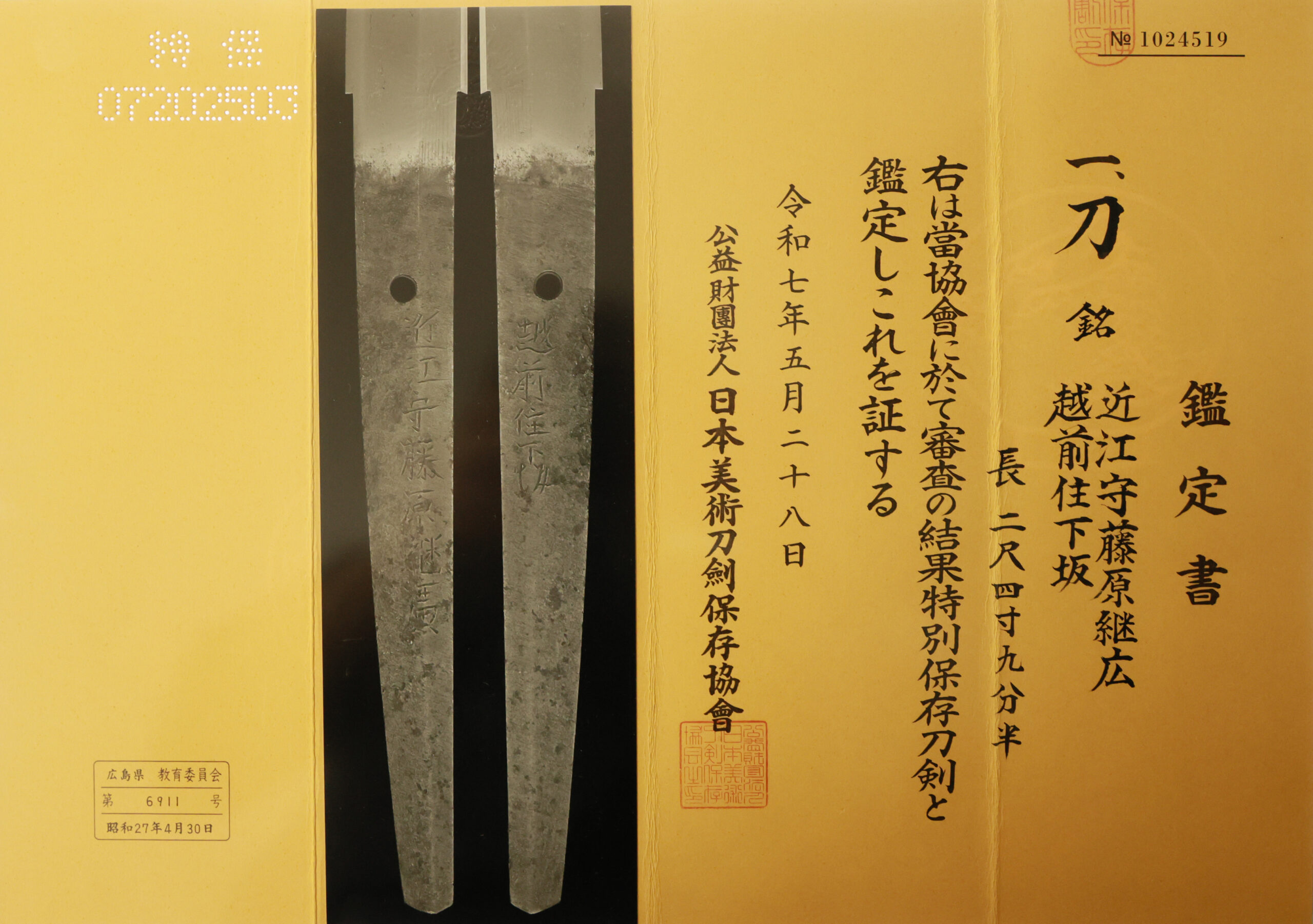
It is appraised as a Tokubetsu Hozon Token (特別保存刀剣) issued by NBTHK (Nihon Bijutsu Touken Hozon Kyokai:日本美術刀剣保存協会).
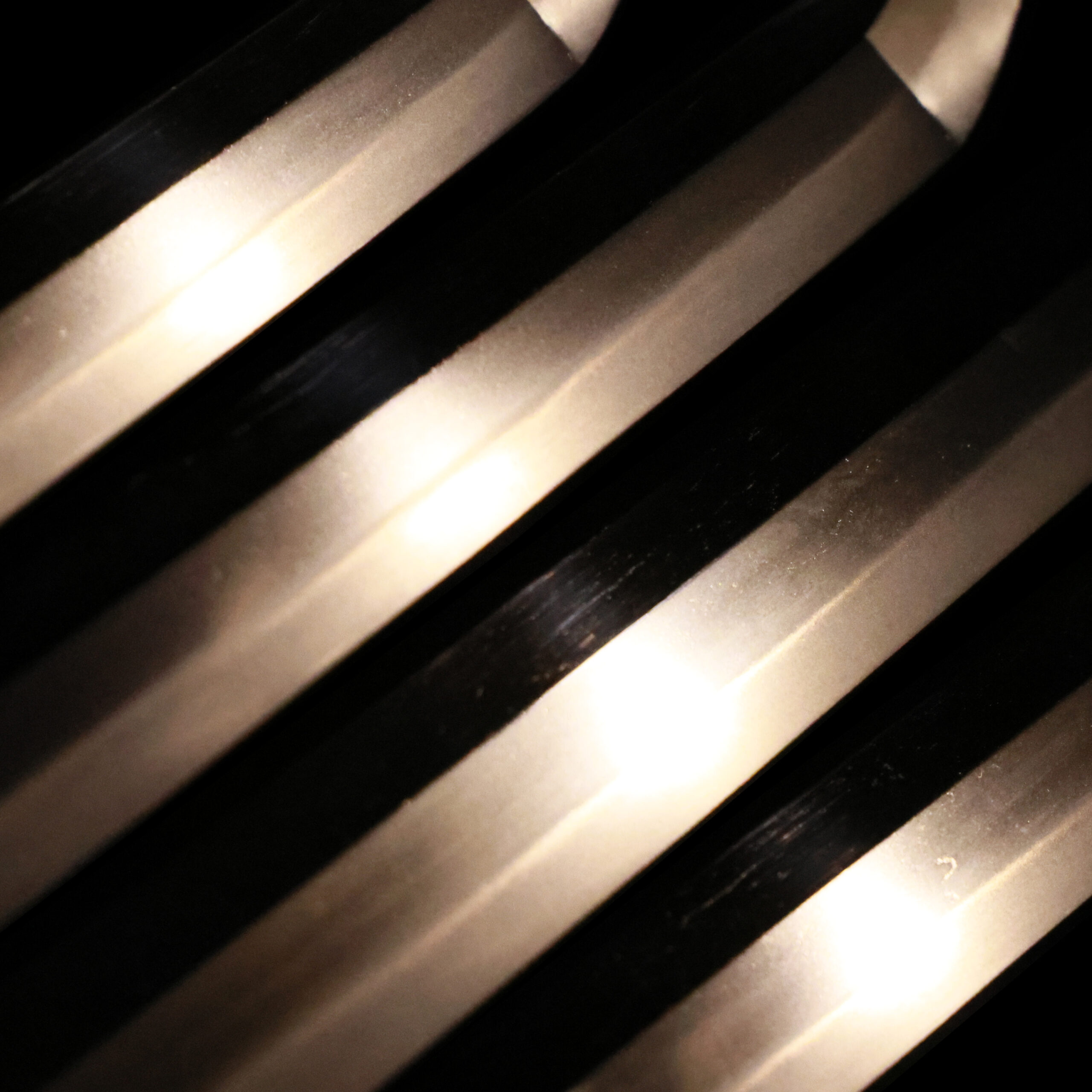
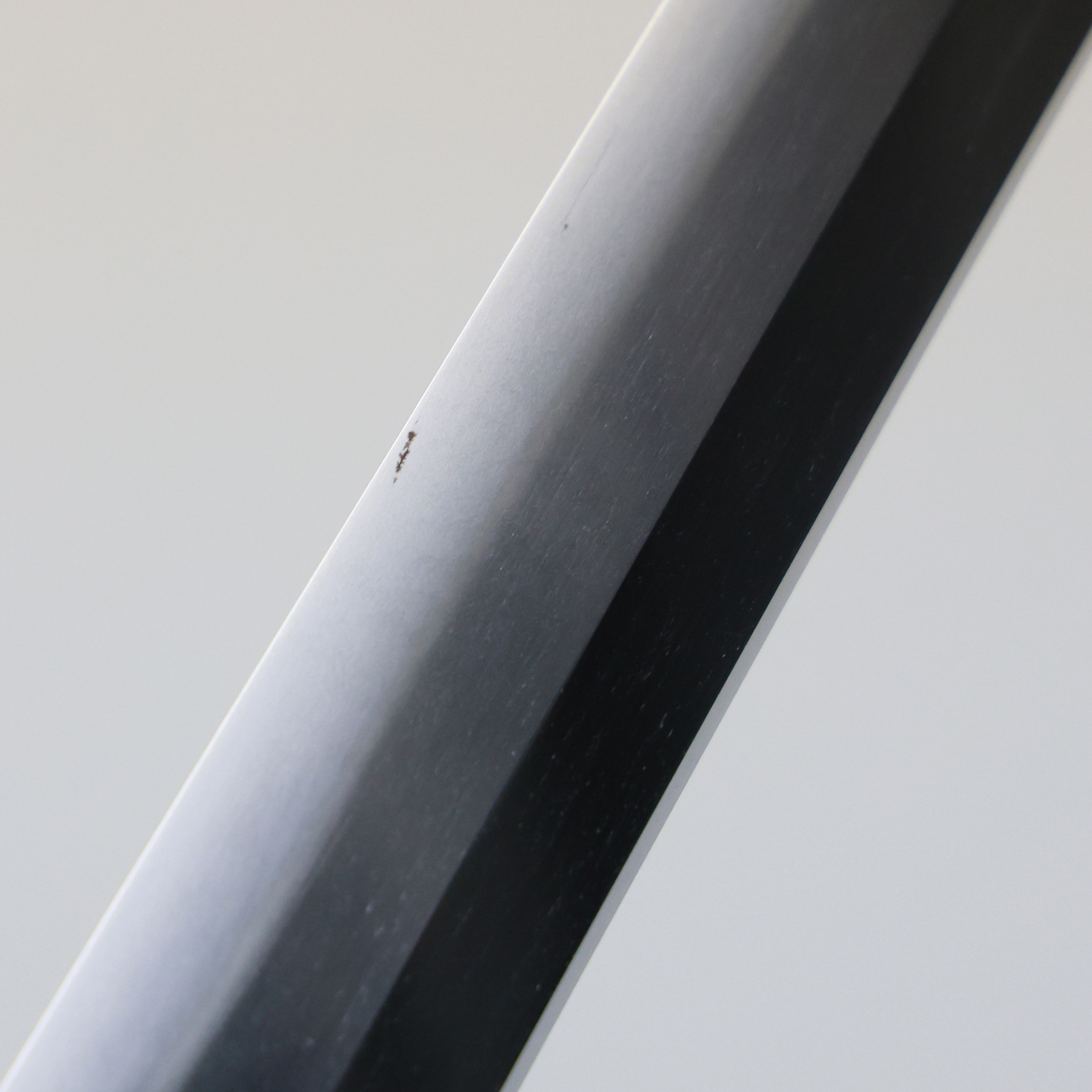
*Please keep in mind that there are a couple of Kitae Kizu on this blade.
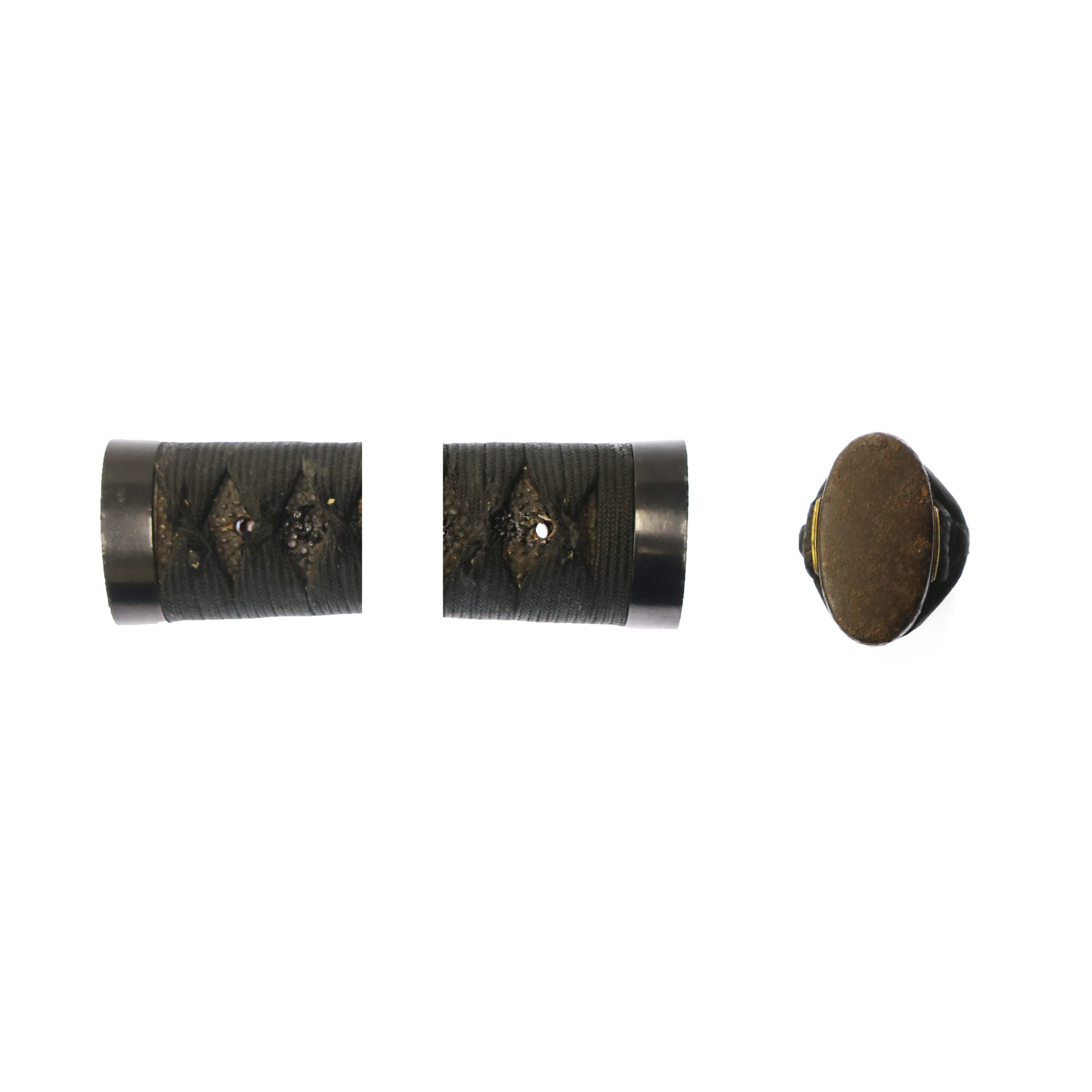
Fuchi-Kashira
This Fuchi-kashira has a clean appearance. The dark metal shows a natural aged patina, with minimal decoration that highlights its simple and functional design.
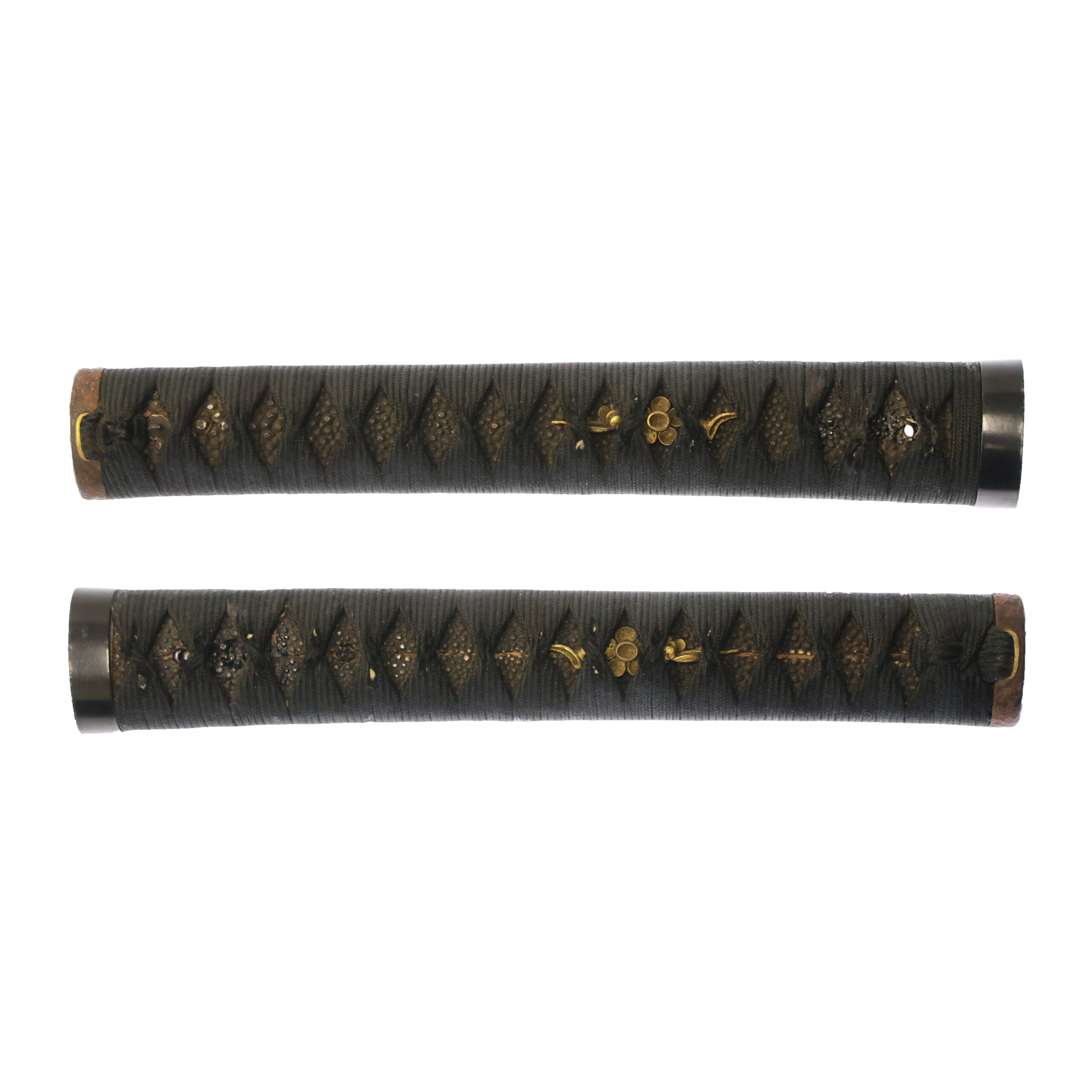
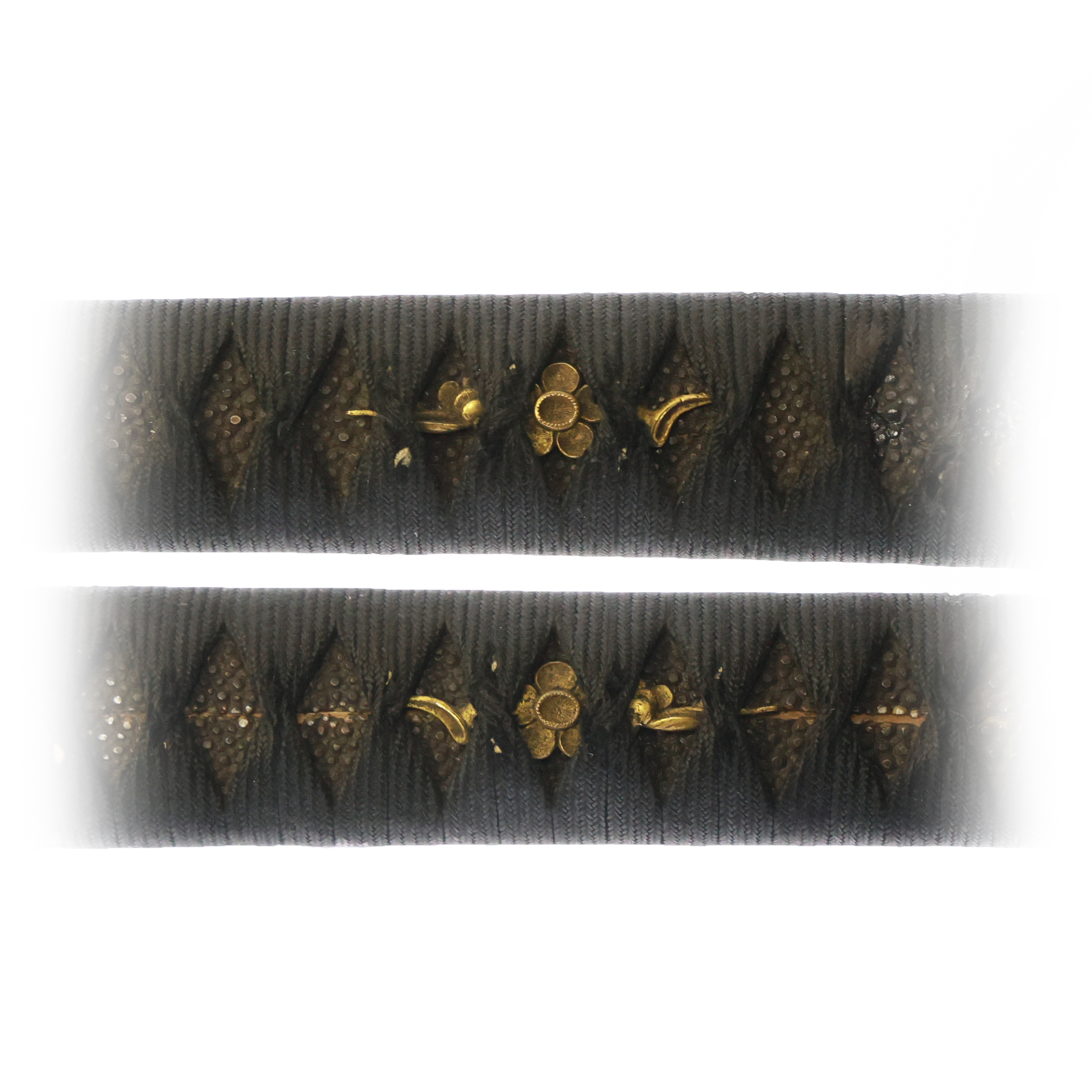
Tsuka and Menuki
*Please keep in mind that Due to age-related deterioration, the tsuka-ito is fragile, and the black dye may transfer onto the hand upon contact.
The theme of this Menuki is Japanese apricot blossom (梅, ume). Japanese apricot blossoms begin to bloom in winter that snow still covers its tree so that people thought this flower tells the arrival of spring. Same as cherry blossom, it has been appreciated for a long time in Japan. People enjoy its adorable petal shape and scent, gracefully branched tree, and compose many poems. As it comes out in the cold season, it symbolizes the power of perseverance and vitality.
Tsuba and Habaki
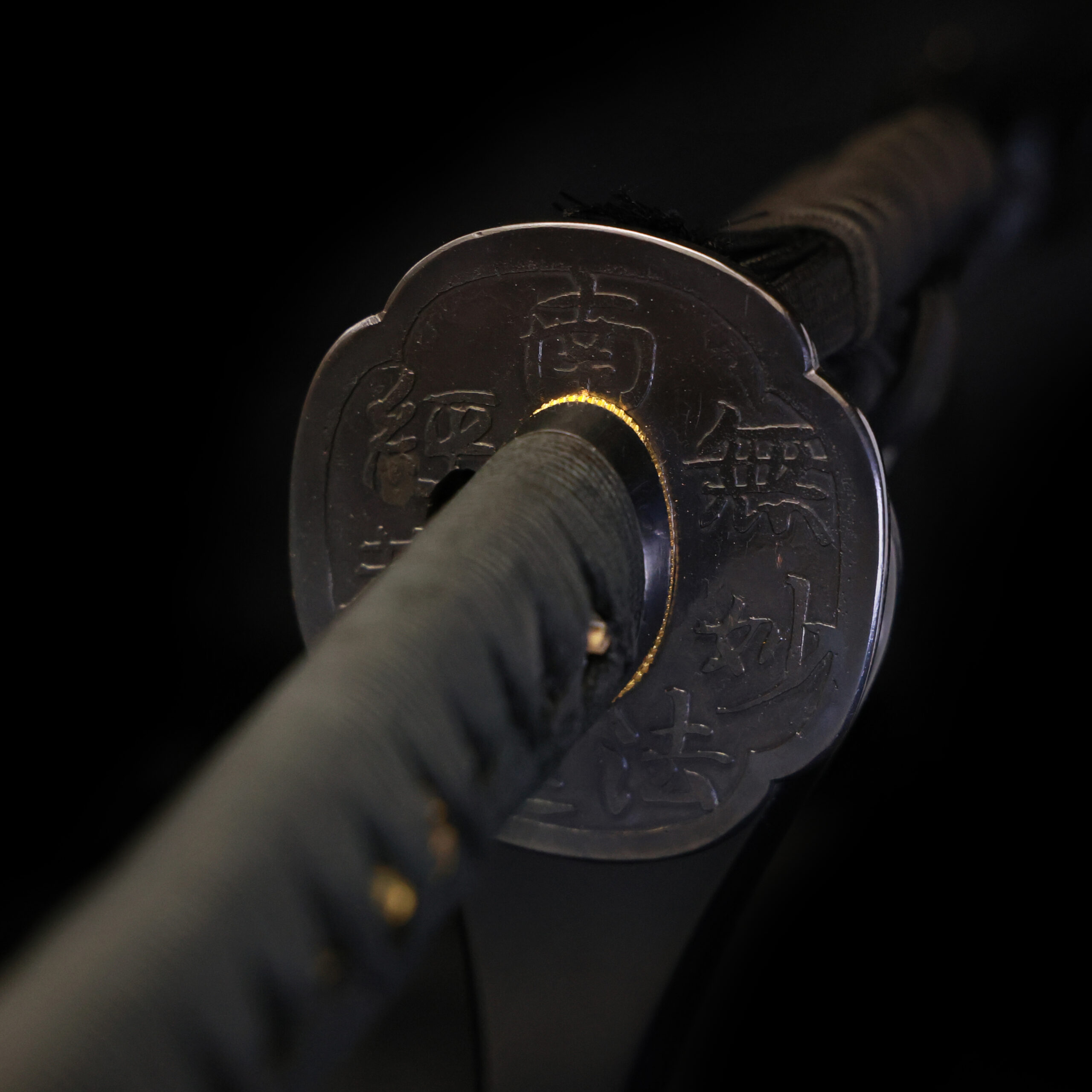
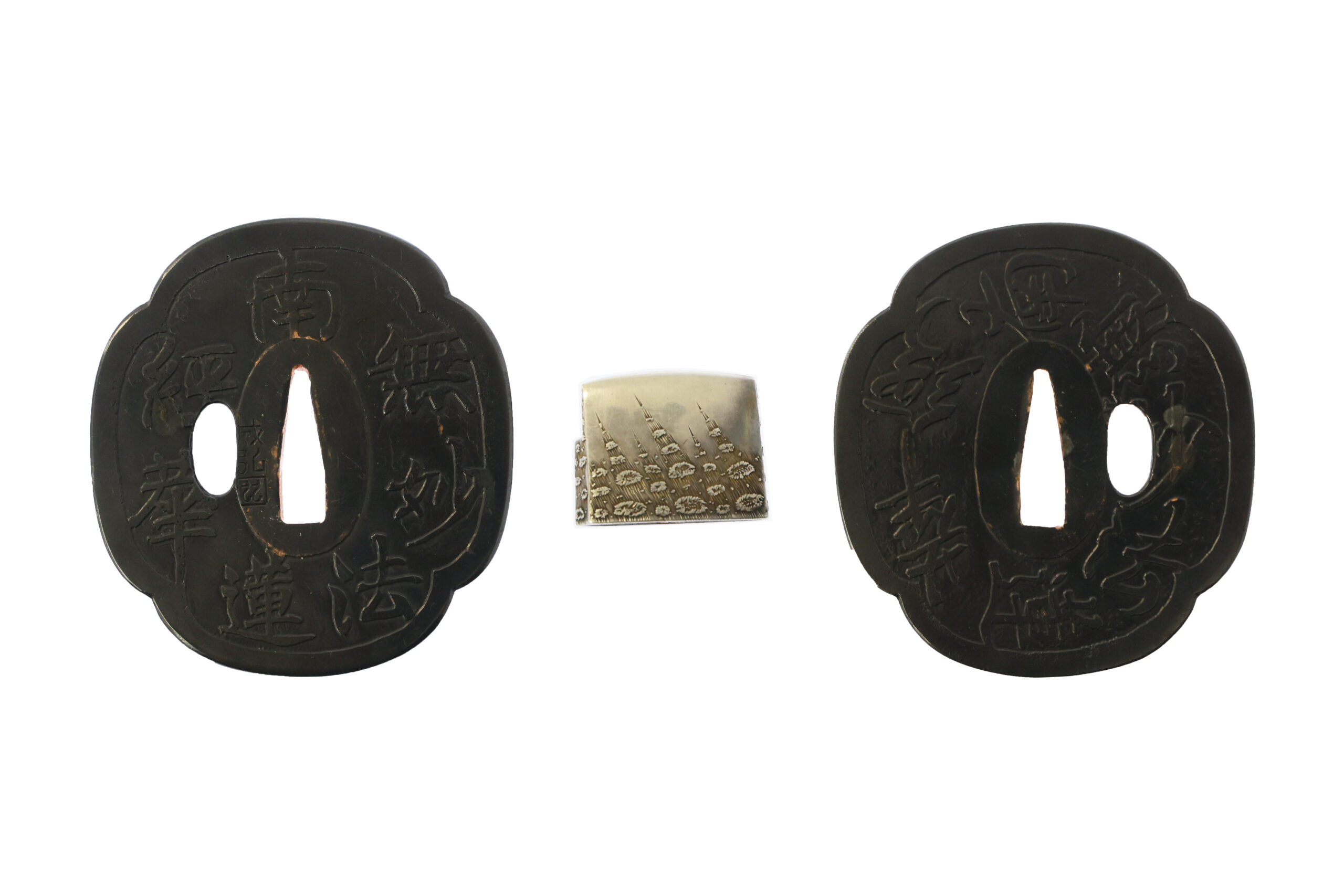
*We assume this Tsuba was made in modern times.
The religious concept of Buddhism is expressed in this Tsuba. You would find Kanji (漢字, a system of Japanese writing using Chinese characters) letters engraved on it. While the font is slightly different, the same word expression is engraved on both the front and backside. It is written as follows: 南無妙法蓮華経 (Na-Mu-Myou-Hou-Ren-Ge-Kyou). This is the phrase used in the Hoke (法華) system of Buddhism. It means to worship the Buddha and follow the teachings of the Hoke Kyou (法華経, sutra of Hoke). There are many examples of Samurai incorporating religious beliefs into the design of armor, helmets, and sword fittings. We estimate this Tsuba was probably born in such a trend.
Saya
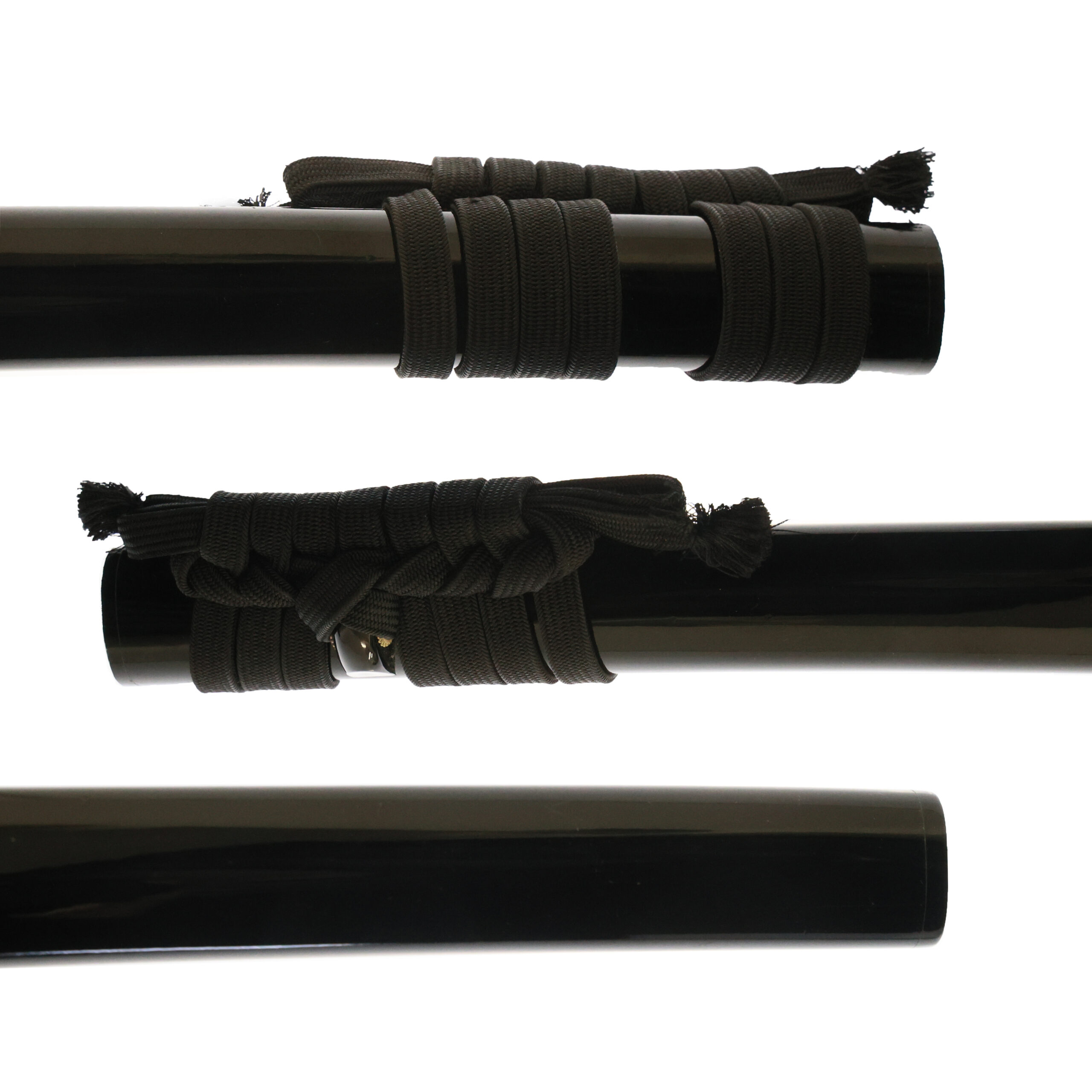
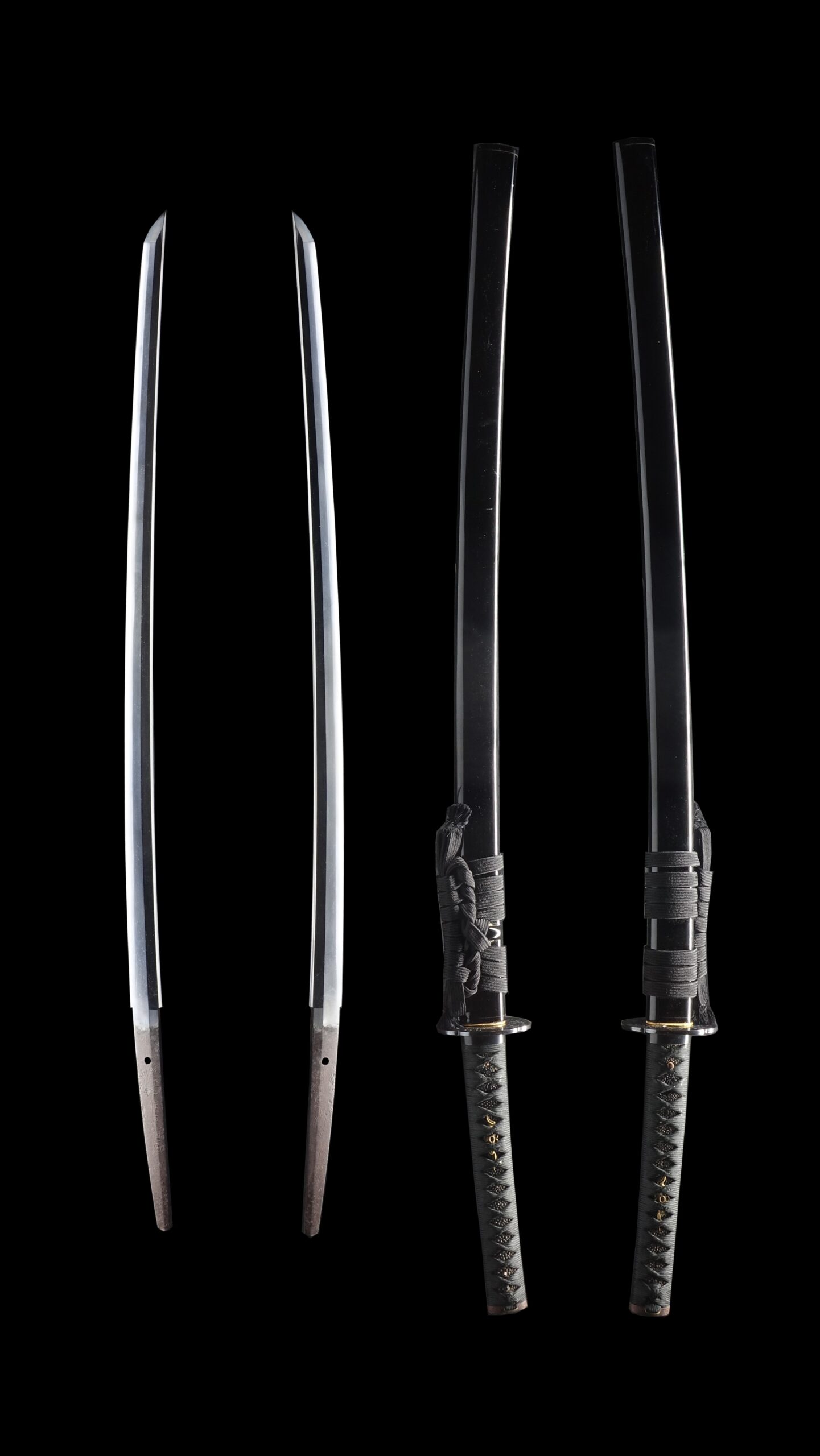
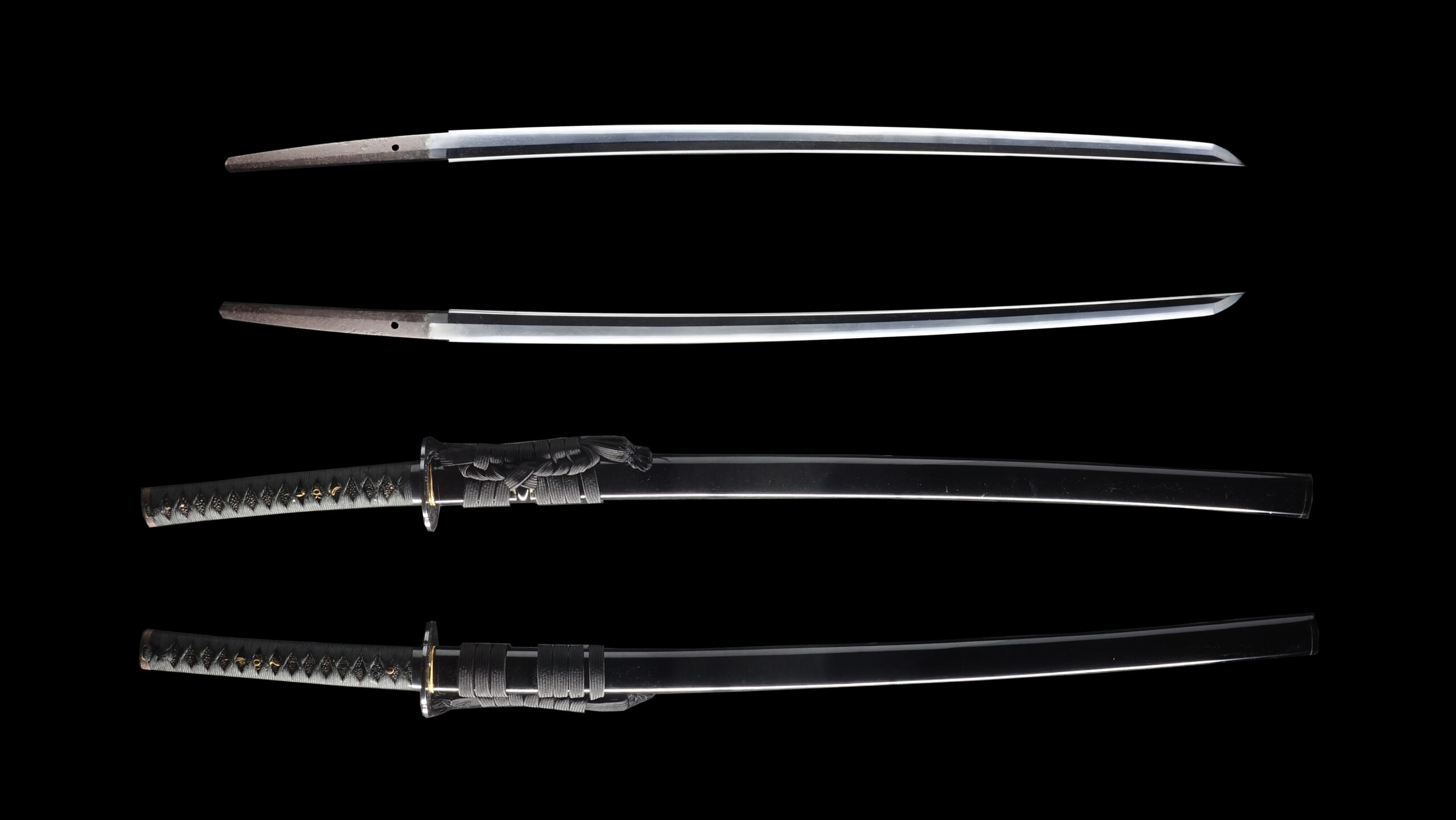
This Saya is covered with black lacquer. Due to its high waterproof effect, lacquer has been used since ancient times in Asia. The blade of a Japanese sword is made of iron, and moisture is the greatest enemy of iron. For the purpose of carrying the blade without degrading it, people devised a method of coating the scabbard with lacquer. To prevent not only moisture but also rain and snow from penetrating the inside of the scabbard, it was necessary to apply multiple layers of lacquer. The Nushi (塗師, lacquerers) was born precisely because advanced techniques were required to handle the complicated processes.
Authentication Paper
They authenticated the blade on May 28th in the 7th year of Reiwa (2025). They appraised it as Tokubetsu Hozon Touken, the blade especially worth preserving for Japanese society.

 NihontoWatch