Horii Toshihide was born in Meiji 19 (1886) in Shimosakamoto, Shiga Prefecture, as the third son of Tokuda Hirokichi; his childhood name was Kaneyoshi, and he was a distant relative of the Horii family. In Meiji 34 (1901), he became an apprentice to Matsuda Tanekatsu, a student of Horii Taneyoshi and a smith of agricultural tools. In Meiji 37 (1904), he became a pupil of Horii Taneaki within the Takanawa residence of Baron Sannomiya and changed his name to Kaneaki. In the following year, Meiji 38 (1905), Baron Sannomiya passed away, the sword smithy at that location was closed, and he moved with his master to the Kamakura Zuisenji Sword Smithy, relying on Sakurai Masatsugu, who had a close relationship with Taneaki. The first generation head of the Horii family, Taneyoshi, was a disciple of both Gassan Sadayoshi and Taikei Naotane, both of whom were disciples of Suishinshi Masahide. Following that lineage as a disciple of Taneaki, the smith received the character "Hide" from Suishinshi Masahide in Taisho 2 (1913) and changed his mei to Hideaki. In Taisho 7 (1918), in response to a call from the Imperial Household Ministry for the preservation of Japanese sword technology and the protection of swordsmiths, the Horii family head Taneaki and the smith were invited to join the Muroran Works of Japan Steel Works (now The Japan Steel Works, Ltd.), and the Zuisen Sword Smithy was established. In Showa 3 (1928), the smith began producing the so-called "Mikasa-to" using the remaining steel from the gun barrels of the battleship Mikasa, which was the flagship of the Imperial Combined Fleet during the Russo-Japanese War. In Showa 8 (1933), His Imperial Highness the Crown Prince (Prince Akihito) was born, and in the following year, Showa 9 (1934), the smith felt it was disrespectful to use the character "Aki" at the end of his sword mei and changed his name to Toshihide. In Showa 17 (1942), along with Living National Treasure Takahashi Sadatsugu, the smith produced commemorative swords for the 10th anniversary of the founding of Manchukuo, and he passed away the following year, Showa 18 (1943).
The style of this smith includes many Bizen-den works in the Suishinshi tradition, with choji midare and gunome midare. In the Seidai Tosho Iretsu Hyo by Kurihara Hikosaburo, who is known for contributing to the restoration of Japanese sword traditions, he was listed first among the twelve names in the "Shinpin no Retsu, Saijo Owaza, Torishimariyaku-kaku," making him a representative smith of the early Showa era and one of the four individuals ordered to forge Gensui-to.
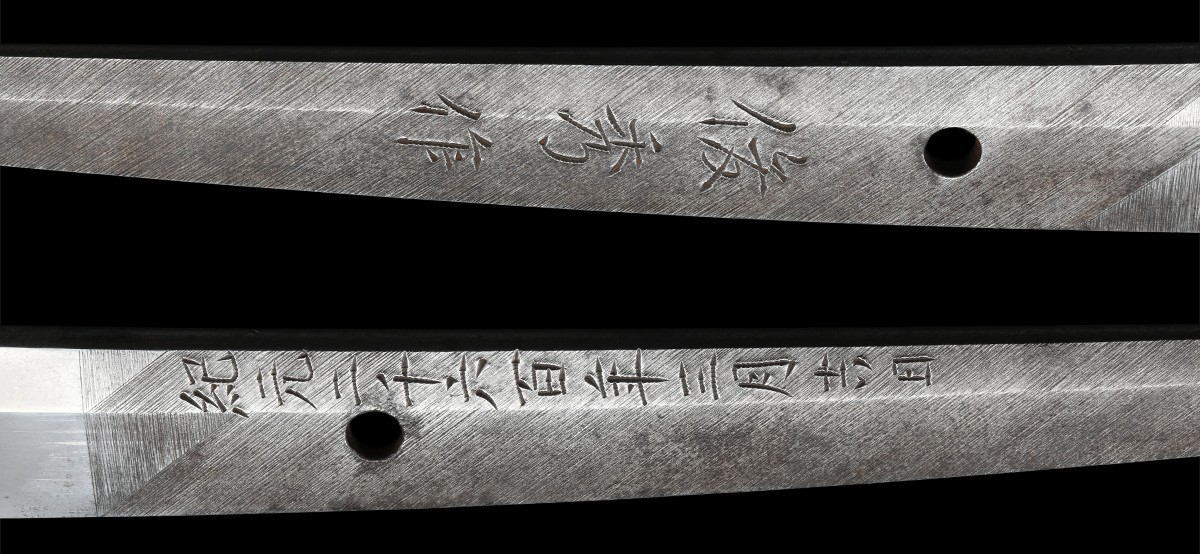
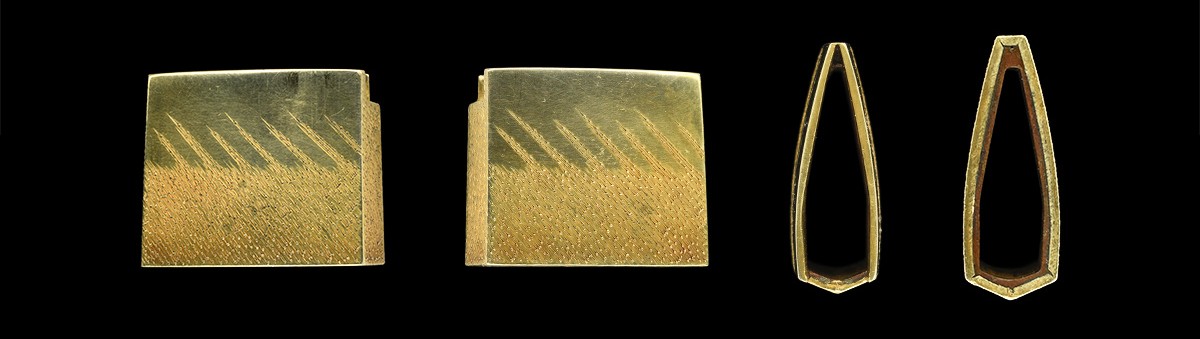
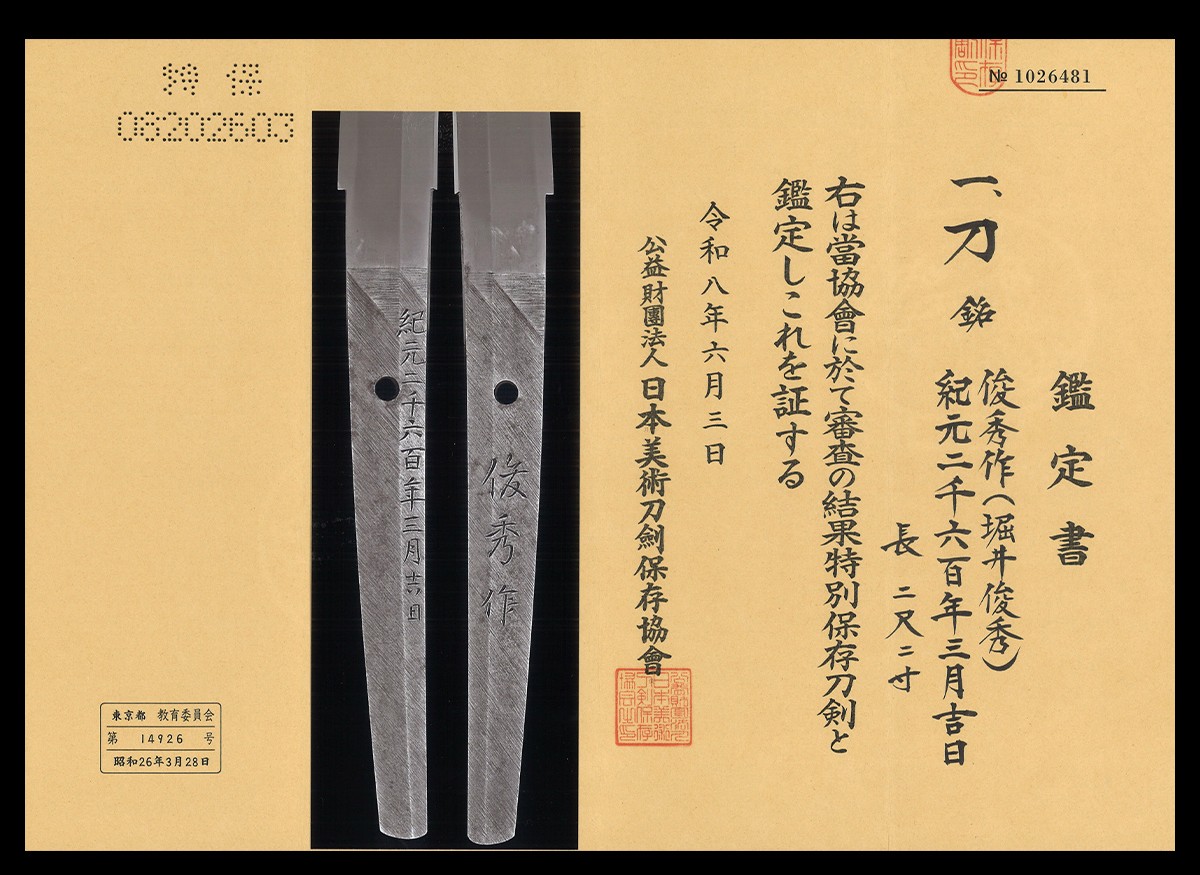
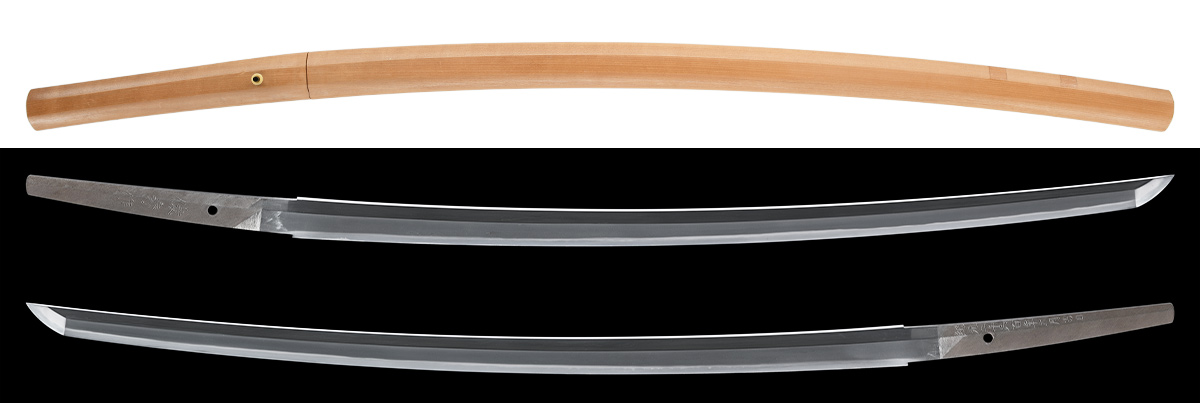
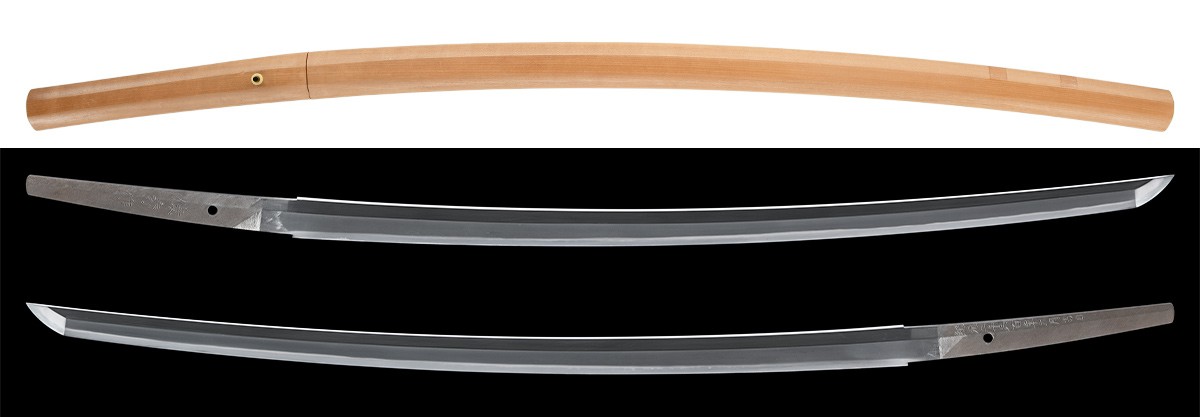
The kitae of this work is a well-kneaded itame hada with jinie, and the hamon is suguha with ashi and gunome-ashi inside the ha; it is nioi-gachi, and the nioiguchi is soft, bright, and clear. The boshi continues straight and returns in komaru. The nakago is ubu with careful kesho-yasuri, and the toko-mei and date are chiseled. Horii Toshihide was a famous master smith of the early Showa era who worked on Gensui-to and Mikasa-to. This work is a sword forged by the smith in Kigen 2600 (1940). Shirasaya, gold-clad single habaki, Tokubetsu Hozon Token Kanteisho.
*As shown in the photographs, there are hike and small spots of rust, but they do not significantly interfere with appreciation.
Machine translation from the shop's Japanese · may contain errors ·
Horii Toshihide was born in Meiji 19 (1886) in Shimosakamoto, Shiga Prefecture, as the third son of Tokuda Hirokichi; his childhood name was Kaneyoshi, and he was a distant relative of the Horii family. In Meiji 34 (1901), he became an apprentice to Matsuda Tanekatsu, a student of Horii Taneyoshi and a smith of agricultural tools. In Meiji 37 (1904), he became a pupil of Horii Taneaki within the Takanawa residence of Baron Sannomiya and changed his name to Kaneaki. In the following year, Meiji 38 (1905), Baron Sannomiya passed away, the sword smithy at that location was closed, and he moved with his master to the Kamakura Zuisenji Sword Smithy, relying on Sakurai Masatsugu, who had a close relationship with Taneaki. The first generation head of the Horii family, Taneyoshi, was a disciple of both Gassan Sadayoshi and Taikei Naotane, both of whom were disciples of Suishinshi Masahide. Following that lineage as a disciple of Taneaki, the smith received the character "Hide" from Suishinshi Masahide in Taisho 2 (1913) and changed his mei to Hideaki. In Taisho 7 (1918), in response to a call from the Imperial Household Ministry for the preservation of Japanese sword technology and the protection of swordsmiths, the Horii family head Taneaki and the smith were invited to join the Muroran Works of Japan Steel Works (now The Japan Steel Works, Ltd.), and the Zuisen Sword Smithy was established. In Showa 3 (1928), the smith began producing the so-called "Mikasa-to" using the remaining steel from the gun barrels of the battleship Mikasa, which was the flagship of the Imperial Combined Fleet during the Russo-Japanese War. In Showa 8 (1933), His Imperial Highness the Crown Prince (Prince Akihito) was born, and in the following year, Showa 9 (1934), the smith felt it was disrespectful to use the character "Aki" at the end of his sword mei and changed his name to Toshihide. In Showa 17 (1942), along with Living National Treasure Takahashi Sadatsugu, the smith produced commemorative swords for the 10th anniversary of the founding of Manchukuo, and he passed away the following year, Showa 18 (1943).
The style of this smith includes many Bizen-den works in the Suishinshi tradition, with choji midare and gunome midare. In the Seidai Tosho Iretsu Hyo by Kurihara Hikosaburo, who is known for contributing to the restoration of Japanese sword traditions, he was listed first among the twelve names in the "Shinpin no Retsu, Saijo Owaza, Torishimariyaku-kaku," making him a representative smith of the early Showa era and one of the four individuals ordered to forge Gensui-to.
The kitae of this work is a well-kneaded itame hada with jinie, and the hamon is suguha with ashi and gunome-ashi inside the ha; it is nioi-gachi, and the nioiguchi is soft, bright, and clear. The boshi continues straight and returns in komaru. The nakago is ubu with careful kesho-yasuri, and the toko-mei and date are chiseled. Horii Toshihide was a famous master smith of the early Showa era who worked on Gensui-to and Mikasa-to. This work is a sword forged by the smith in Kigen 2600 (1940). Shirasaya, gold-clad single habaki, Tokubetsu Hozon Token Kanteisho.
*As shown in the photographs, there are hike and small spots of rust, but they do not significantly interfere with appreciation.
About the maker
Toshihide
俊秀
Hokkaido · around 1926-1989
5 pieces on the market now
›
Historical importance
Where Toshihide stands among comparable artisans: across all of nihontō, and within tradition, era, and period. The tiers (Foremost · Leading · Major · Notable) weigh official designations from the NBTHK and Japan's Agency for Cultural Affairs, together with historical honors of lasting repute such as the Sansaku and Meibutsu-chō.
The twentieth century nearly killed the craft twice: wartime distortion, then the occupation ban. The NBTHK’s founding in 1948 and licensed forging from 1953 rebuilt the sword as an art, crowned by Living National Treasures and the mukansa rank.
A Hozon-certified blade judged to show notably superior workmanship and a better state of preservation. The bar is higher: re-tempered blades and most unsigned Muromachi/Edo works are excluded.
About the NBTHK›
The NBTHK (Nihon Bijutsu Tōken Hozon Kyōkai, the Society for the Preservation of Japanese Art Swords) is a public-interest incorporated foundation founded in 1948 and supervised by Japan’s Agency for Cultural Affairs (Bunkachō); it is based at the Japanese Sword Museum in Tokyo. Its expert panels physically examine each submitted work (shinsa) and issue a certificate (kanteishō) ranking it by artistic and historical merit. NBTHK papers are the most widely recognized standard of authentication for Japanese swords and fittings.
No cooling-off period or returns; refund only if the purchased sword is proven fake, capped at purchase price (excludes commission sales, accessories, auction items).


 NihontoWatch