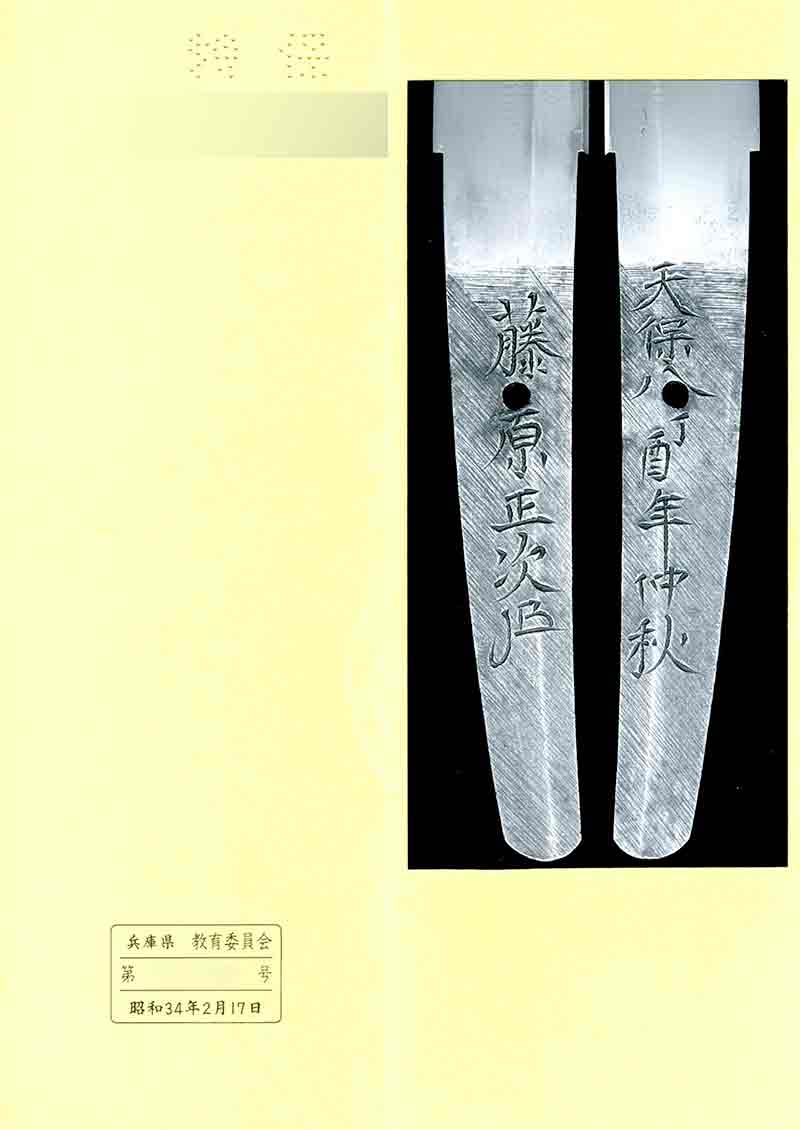
Suishinshi Masatsugu, known as Kawabe Hokuji, is said to have studied under Taikei Naotane and become his son-in-law, while another theory suggests he was the son of the second generation Suishinshi Masahide (Hakuma Nyudo). Masatsugu used the Suishinshi go, and from this fact, it is clear that he effectively succeeded as the third generation of the Kawabe family. It is recorded that Masatsugu lived and worked in Shitaya Okachimachi and passed away on the 11th day of the 3rd month of Manyen 1. His style, even down to the mei characters, follows the Naotane style rather than the Suishinshi style, and he excelled in Soshu-den and Bizen-den.
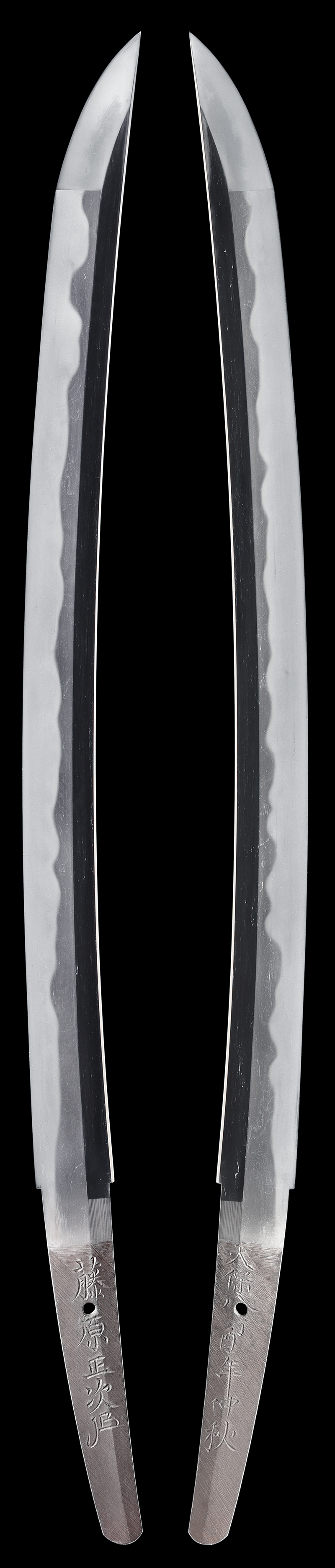
This wakizashi has a wide mihaba with little difference between the width at the moto and saki, forming a grand taihai ending in an o-kissaki, with a kitae of itame that is tight, mixed in places with o-mokume-gokoro and an uzumaki-hada style, with thick ji-nie and bold chikei. The hamon is gunome-midare mixed with ko-gunome and choji-style ha, becoming high-set and flamboyant, with ashi, deep nioiguchi, the interior of the ha well-covered in nie, with kinsuji and active sunagashi, mixed with yubashiri in a tobiyaki style, presenting a bright finish. It is a work in the Soden-Bizen style at which he excelled, and as expected, the ji and ha are well-covered in nie with abundant hataraki within the blade. Additionally, it is noteworthy that both the ji and ha are bright and clear. It is conjectured that he modeled this after the Nanbokucho period master Bizen Nagayoshi; with a ha-dori based on high-set gunome-midare, strong ha-nie, and the hadame intertwining with the ha in multiple layers to show varied hataraki, it is a masterpiece of Soden-Bizen. This single blade calls to mind the style of his teacher, Naotane, and even the mei characters faithfully inherit the Naotane style. It is a superior work among his output that fully demonstrates the true ability of Suishinshi Masatsugu, and can be called a representative example of his Soden-Bizen.
Shinshinto Josaku
Due to the old polishi, thin rust can be seen in places along the edge, near the ko-shinogi of the boshi on the sashi-omote, and on the lower part of the mune.
There are marks on the saya where the Juho Token-rui Torokusho was attached with cellophane tape.
Machine translation from the shop's Japanese · may contain errors ·
Suishinshi Masatsugu, known as Kawabe Hokuji, is said to have studied under Taikei Naotane and become his son-in-law, while another theory suggests he was the son of the second generation Suishinshi Masahide (Hakuma Nyudo). Masatsugu used the Suishinshi go, and from this fact, it is clear that he effectively succeeded as the third generation of the Kawabe family. It is recorded that Masatsugu lived and worked in Shitaya Okachimachi and passed away on the 11th day of the 3rd month of Manyen 1. His style, even down to the mei characters, follows the Naotane style rather than the Suishinshi style, and he excelled in Soshu-den and Bizen-den.
This wakizashi has a wide mihaba with little difference between the width at the moto and saki, forming a grand taihai ending in an o-kissaki, with a kitae of itame that is tight, mixed in places with o-mokume-gokoro and an uzumaki-hada style, with thick ji-nie and bold chikei. The hamon is gunome-midare mixed with ko-gunome and choji-style ha, becoming high-set and flamboyant, with ashi, deep nioiguchi, the interior of the ha well-covered in nie, with kinsuji and active sunagashi, mixed with yubashiri in a tobiyaki style, presenting a bright finish. It is a work in the Soden-Bizen style at which he excelled, and as expected, the ji and ha are well-covered in nie with abundant hataraki within the blade. Additionally, it is noteworthy that both the ji and ha are bright and clear. It is conjectured that he modeled this after the Nanbokucho period master Bizen Nagayoshi; with a ha-dori based on high-set gunome-midare, strong ha-nie, and the hadame intertwining with the ha in multiple layers to show varied hataraki, it is a masterpiece of Soden-Bizen. This single blade calls to mind the style of his teacher, Naotane, and even the mei characters faithfully inherit the Naotane style. It is a superior work among his output that fully demonstrates the true ability of Suishinshi Masatsugu, and can be called a representative example of his Soden-Bizen.
Shinshinto Josaku
Due to the old polishi, thin rust can be seen in places along the edge, near the ko-shinogi of the boshi on the sashi-omote, and on the lower part of the mune.
There are marks on the saya where the Juho Token-rui Torokusho was attached with cellophane tape.
For two and a half centuries of peace the sword was the warrior’s legal badge rather than his weapon. Each great city developed its own manner, Edo’s tested strength against Ōsaka’s polished brilliance, until demand thinned in the era’s last decades.
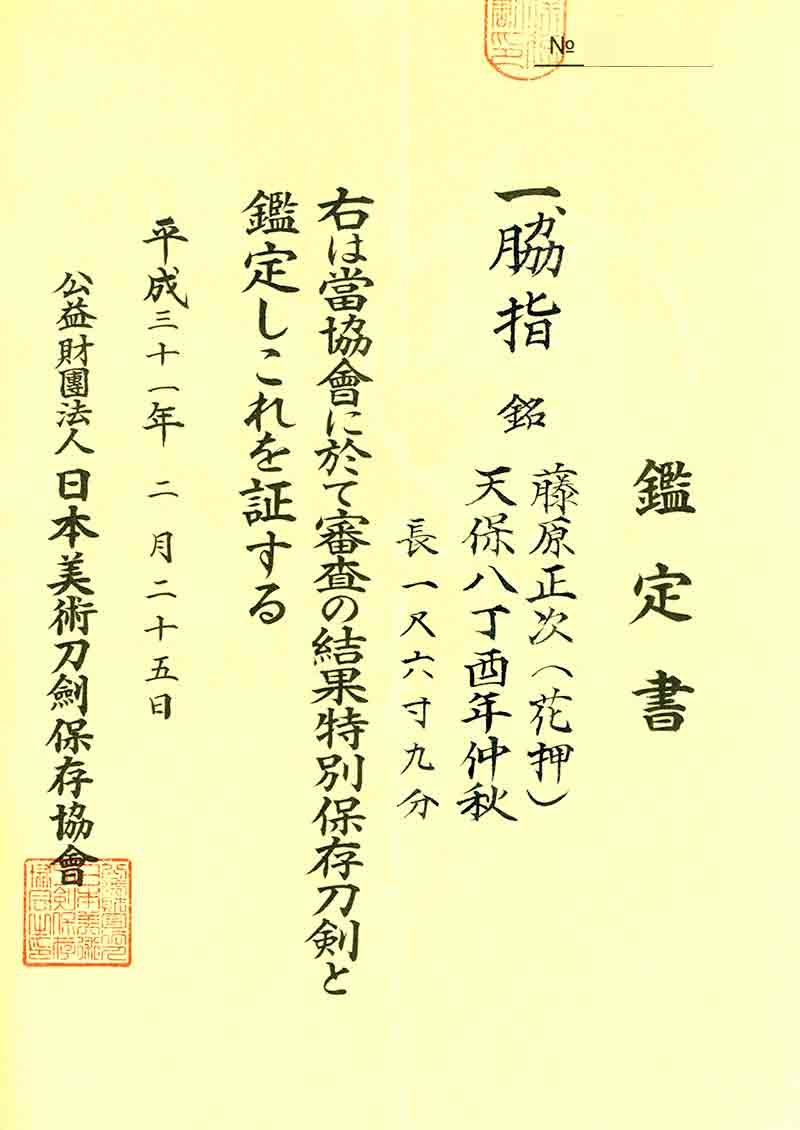
A Hozon-certified blade judged to show notably superior workmanship and a better state of preservation. The bar is higher: re-tempered blades and most unsigned Muromachi/Edo works are excluded.
About the NBTHK›
The NBTHK (Nihon Bijutsu Tōken Hozon Kyōkai, the Society for the Preservation of Japanese Art Swords) is a public-interest incorporated foundation founded in 1948 and supervised by Japan’s Agency for Cultural Affairs (Bunkachō); it is based at the Japanese Sword Museum in Tokyo. Its expert panels physically examine each submitted work (shinsa) and issue a certificate (kanteishō) ranking it by artistic and historical merit. NBTHK papers are the most widely recognized standard of authentication for Japanese swords and fittings.
Please exercise cooling-off within 8 days of the item's arrival.
(1) We cannot accept items that have been altered or worked on in any way (e.g. test cutting, polishing or other work, display at viewing meetings, photography, taking oshigata rubbings, use for appreciation, copying of books).
(2) Return shipping is at the customer's expense.
(3) Costs other than the item price (bank transfer fees, cash-on-delivery fees, installment fees, etc.) cannot be refunded.
(4) For cash-on-delivery and similar payments, the refund is made after the payment has reached us.
(5) We cannot accept a return when a trade-in item is involved.
(6) Items delivered overseas cannot be returned or refunded (because of the time involved and, for swords, the surrender of the registration certificate and other circumstances).




 NihontoWatch