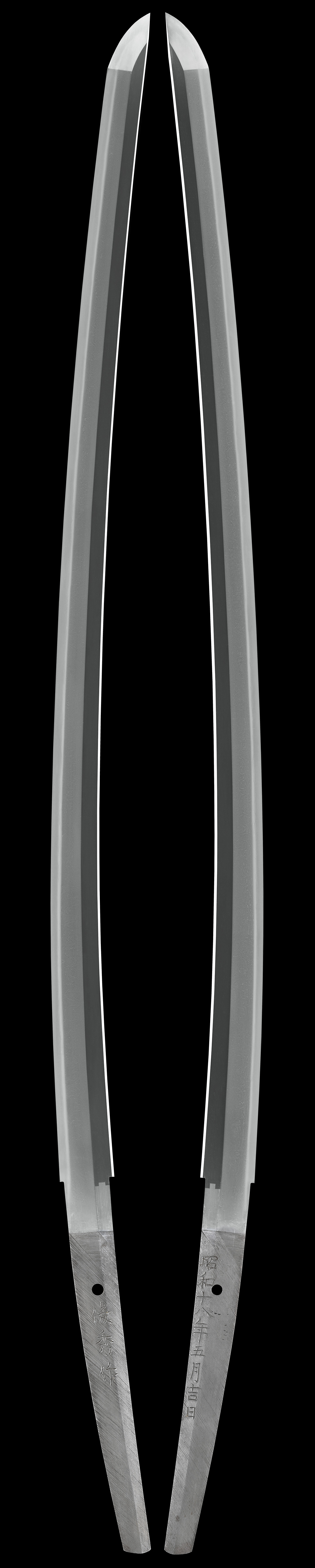
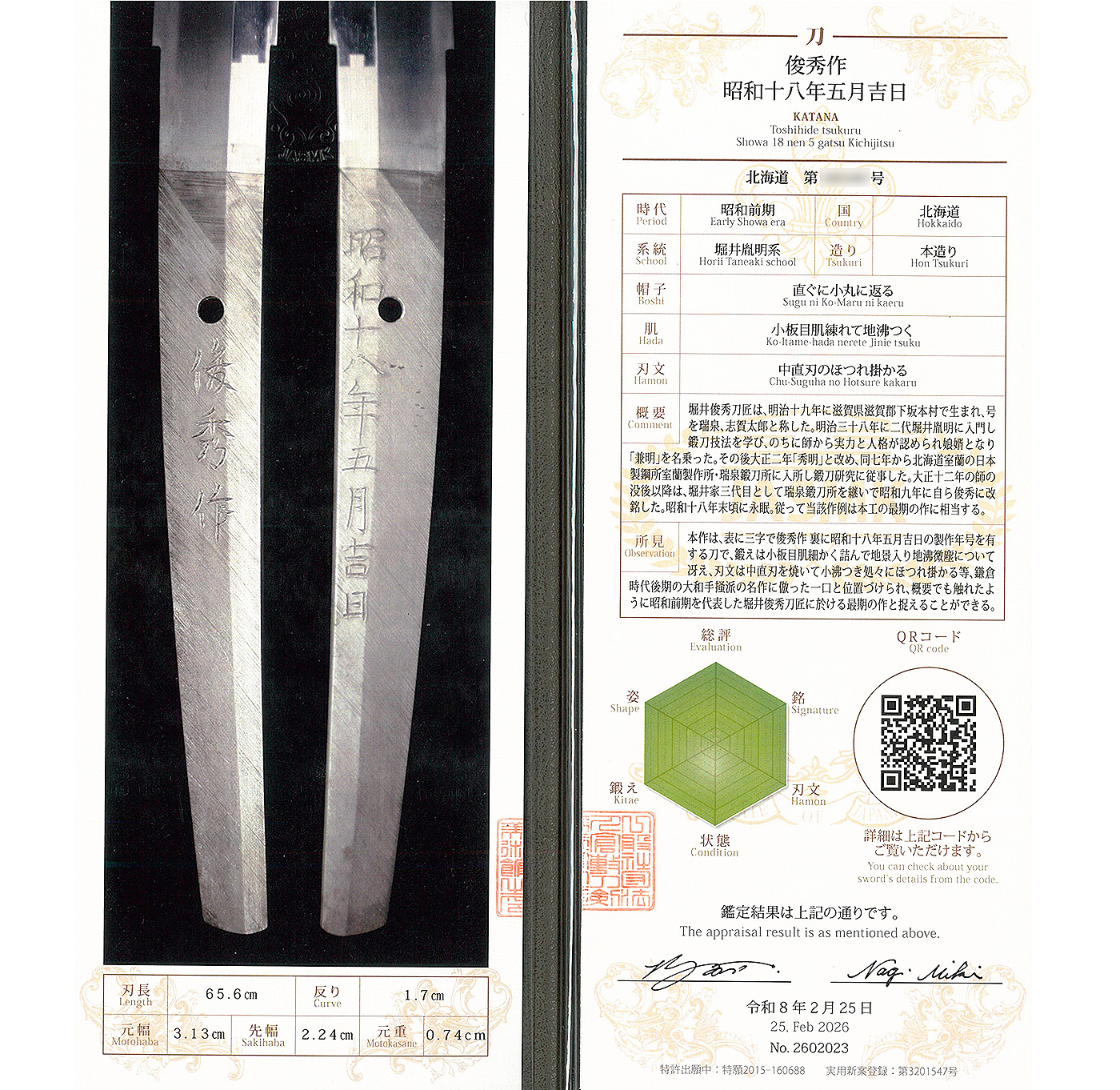
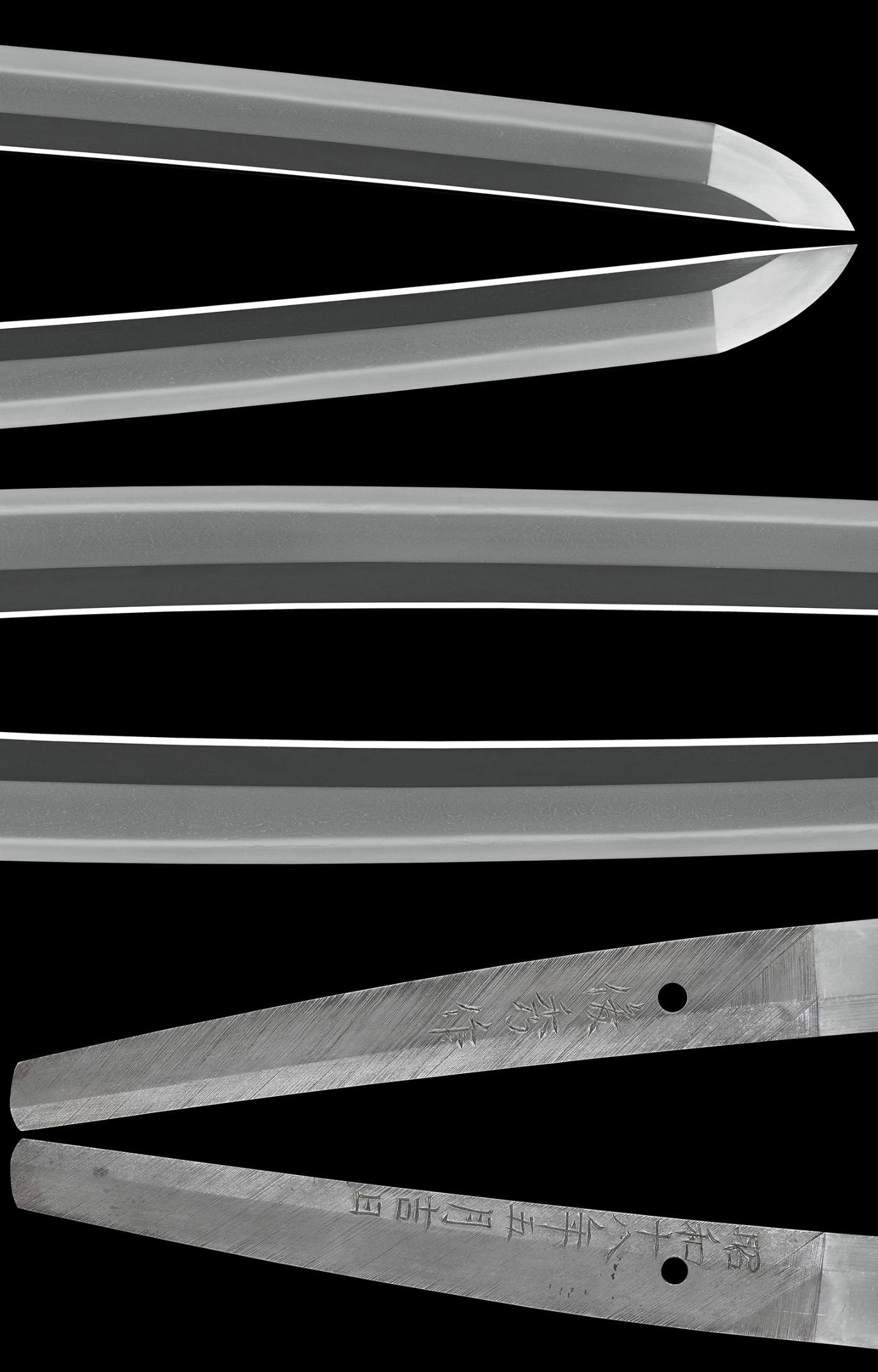
Characteristics: Horii Toshihide, whose real name was Horii Kaneyoshi, used the first mei Kaneaki; in Meiji 37 he became a student of Horii Taneyoshi's son, Horii Otaneaki, and in Meiji 44 he became the adopted son and son-in-law of Taneaki. Later, he became the third generation of the Horii school, and in Taisho 2 he was granted the name Hideaki, taking the character Hide from Suishinshi Masahide, by the Token Hozonkai; in Taisho 7 he moved to Hokkaido upon joining the Japan Steel Works Muroran Plant by invitation, and in Showa 8, because the Crown Prince was born and named "Prince Akihito," he changed his name to Toshihide out of deference to this. Horii Toshihide was a swordsmith representing the early Showa period who forged gunto for Prince Chichibu, Prince Takamatsu, and Prince Higashikuni, as well as tanto bestowed by the Imperial Household Ministry. In the Seidai Tosho Iretsu, he was ranked at the highest level, Shinpin no Retsu, Saijo O-wazamono, and head of the Torishimariyaku-kaku; at the Showa 16 Shinsaku Nihonto Tenrankai, he received the Special Honorary Seat, the Prime Minister's Award, and the Minister of Education's Award, and was granted the title of Kokko, making him the highest-ranking swordsmith during the war.
Machine translation from the shop's Japanese · may contain errors ·
Characteristics: Horii Toshihide, whose real name was Horii Kaneyoshi, used the first mei Kaneaki; in Meiji 37 he became a student of Horii Taneyoshi's son, Horii Otaneaki, and in Meiji 44 he became the adopted son and son-in-law of Taneaki. Later, he became the third generation of the Horii school, and in Taisho 2 he was granted the name Hideaki, taking the character Hide from Suishinshi Masahide, by the Token Hozonkai; in Taisho 7 he moved to Hokkaido upon joining the Japan Steel Works Muroran Plant by invitation, and in Showa 8, because the Crown Prince was born and named "Prince Akihito," he changed his name to Toshihide out of deference to this. Horii Toshihide was a swordsmith representing the early Showa period who forged gunto for Prince Chichibu, Prince Takamatsu, and Prince Higashikuni, as well as tanto bestowed by the Imperial Household Ministry. In the Seidai Tosho Iretsu, he was ranked at the highest level, Shinpin no Retsu, Saijo O-wazamono, and head of the Torishimariyaku-kaku; at the Showa 16 Shinsaku Nihonto Tenrankai, he received the Special Honorary Seat, the Prime Minister's Award, and the Minister of Education's Award, and was granted the title of Kokko, making him the highest-ranking swordsmith during the war.
About the maker
Toshihide
俊秀
Hokkaido · around 1926-1989
5 pieces on the market now
›
Historical importance
Where Toshihide stands among comparable artisans: across all of nihontō, and within tradition, era, and period. The tiers (Foremost · Leading · Major · Notable) weigh official designations from the NBTHK and Japan's Agency for Cultural Affairs, together with historical honors of lasting repute such as the Sansaku and Meibutsu-chō.
The twentieth century nearly killed the craft twice: wartime distortion, then the occupation ban. The NBTHK’s founding in 1948 and licensed forging from 1953 rebuilt the sword as an art, crowned by Living National Treasures and the mukansa rank.
We could not find an authenticity certificate on the seller’s listing. Japanese swords and fittings are normally papered by the NBTHK (or the NTHK). Without one, the attribution is the seller’s own assessment and has not been independently verified — treat it with caution and ask the dealer about certification before buying.
Returns are possible within 3 days of the item's arrival; however, cooling-off may not apply if any of the notes below applies.
Notes:
- The item's condition differs from the time of sale
- 3 or more days have passed since the item's arrival
- A trade-in item was part of the purchase
- Items delivered overseas cannot be returned
- The item was purchased in our shop
- Return shipping and the bank transfer fee for the refund are at the customer's expense
Please also note that bank transfer fees, credit card fees and cash-on-delivery fees cannot be refunded.
(Refunds for credit card, cash-on-delivery and similar payments are made after the payment has reached us.)

 NihontoWatch