Blade construction: Shinogi-zukuri, Iori-mune. The blade has well-balanced width and thickness, with a harmonized somewhat deep curvature, terminating in an Ikubi-kissaki.
Forging (Hada): The Jihada is a refined Iitame-hada (wood grain pattern), densely forged with Ji-nie surface particles. The Shinogi-ji shows a delicate Masame-hada (straight grain pattern).
Temper(hamon): The temper line starts in low near the base, consisting of small Gunome and Chōji (clove-shaped) patterns made with Nie-based style, with intermittent Tobiyaki (jumping temper marks). The interior of the blade shows Ashi (leg-like patterns) and Yō (leaf-like formations), with abundant Sunagashi (sweeping lines). Near the Monouchi (striking area), the Hamon rises higher, incorporating complex multi-layered Chōji patterns so calloed Juka-Chōji creating a vibrant appearance.
Bōshi (Tip temper Pattern): The Hamon continues into a high, irregular Midare pattern with Mune-yaki (tempering on the back ridge).
Nakago (Tang): Ubu (unaltered), with a prominent Kesho-yasurime (decorative file marks) in a greatly slanting left Ō-sujikai pattern. One mekugi-ana (peg hole). The Nakago-jiri heel is shaped in a double-bevelled kurijiri. The mune of the nakago is flat and features Ō-sujikai Yasurime.
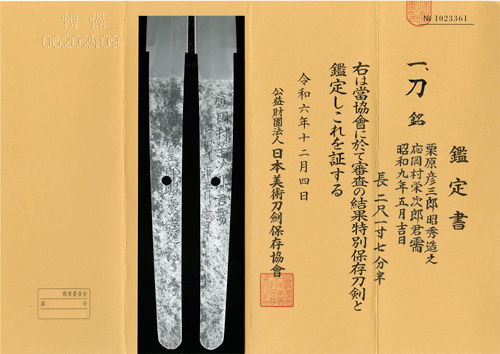
On the Omote (outer side), along the Shinogi-suji (ridge line), there is a long signature reading “Kurihara Hikosaburō AKIHIDE saku kore” 栗原彦三郎昭秀造之.
On the ura (reverse side), in the Hiraji surface, there is an inscription “Made to the order of Mr. Okamura Eijirō” 應岡村栄次郎君需 and on the Shinogi-suji, the date inscription “Shōwa 9-nen 5-gatsu kichijitsu” (An auspicious day in May, 1934) 昭和九年五月吉日.
Kurihara Hikosaburō 栗原彦三郎 was born in March of 1879 (Meiji 12) in Kanma, Aso District, Tochigi Prefecture (present-day Sano city), as the second son of Kurihara Yoshizō 栗原喜蔵, the head of a respected old family well-regarded in the local community. Raised in a privileged environment, he displayed ambition early at the age of ten, he visited Tanaka Shōzō 田中正造, a member of the Tochigi Prefectural Assembly, and had asked to become his disciple. Three years later, he fled home again to seek out Tanaka once more, further a year after that incident he moved to Tokyo. Accompanied by Tanaka, he came to reside in the home of Ōkuma Shigenobu 大隈重信.
Realizing his dream of studying in Tokyo, Kurihara attended the Tokyo Eiwa School (now Aoyama Gakuin). While still a student, in the autumn of 1896 (Meiji 29), the Watarase River flooded in his home prefecture of Tochigi, causing widespread damage due to pollution from the Ashio Copper Mine. Tanaka Shōzō, with Kurihara at his side, worked tirelessly to help the victims, even attempting to directly petition Emperor Meiji about the conditions at the Ashio mine.
After Tanaka’s death in 1913 (Taishō 2), Kurihara became increasingly active in politics. He served as a member of the Akasaka Ward Assembly and later the Tokyo City Assembly. In February 1928 (Shōwa 3), during the 16th General Election—the first conducted under universal male suffrage—he ran as an unaffiliated candidate from Tochigi’s 2nd District and was elected to the House of Representatives. He was re-elected in the 17th and 18th general elections, serving three consecutive terms in the House.
However, he lost the 19th General Election held in February 1936 (Shōwa 11) and decided to retire from politics. From then on, Kurihara devoted himself to the revival of Japanese swordsmithing, a passion he had pursued in parallel with his political career. Taking the advice of Ōkuma Shigenobu 大隈重信, who had encouraged the revival of the traditional Japanese sword, Kurihara developed a strong network within the sword-making world.
His commitment to swordsmithing was rooted in an earlier experience: in 1893 (Meiji 26), his father Kurihara Yoshizō 栗原喜蔵 had invited the swordsmith Inagaki Masanori 稲垣将応 and his family to their home in Tochigi to establish a Japanese Sword Forging Workshop. Building on this, Kurihara opened the first "Japanese Sword Training Institute" in Tokyo in March 1907 (Meiji 40). Although the school closed only two years laater, and his two subsequent revival attempts also ended in failure, he persevered. On July 5, 1933 (Shōwa 8), during his third term as a Diet member, he finally succeeded in opening the Japanese Sword Forging Training Institute on the grounds of his home in Akasaka (28 Hikawa-chō, Akasaka Ward, Tokyo) – Former Residence of Katsu Kaishū 勝海舟.
He invited notable smiths like Kasama Shigetsugu 笠間繁継 as instructors and opened the door to training students. Among his disciples were many renowned swordsmiths, including Living National Treasures Miyairi Akihira (Yukihira) 宮入昭平(行平)and Amata Akitsugu 天田昭次.
In 1935 (Shōwa 10), he founded the Great Japan Swordsmith Association and, with support from the Ministry of Education, held exhibitions of newly made Japanese swords. Kurihara is remembered as a key figure who greatly contributed to the advancement of craftsmanship among swordsmiths, polishers, scabbard makers, and others in the world of traditional Japanese swords.
Even during the challenging post-Meiji Restoration era, following the decree banning swords, Kurihara dedicated himself to reviving the Japanese sword. It is said that even during his busy political life as a Diet member, he would find time to study swordsmithing at his training institute.
Inagaki Masanori 稲垣将応, mentioned earlier, was the third-generation successor in the lineage of the great Edo-period smith Suishinshi Masahide 水心子正秀. Thus, Kurihara Hikosaburō 栗原彦三郎 also belonged to the lineage of Masahide’s tradition.
The sword introduced here is modeled after the classic Ichimonji style of the Kamakura period. The blade features small gunome mixed with Chōji, with prominent Nie along the edge, and is richly adorned with Sunagashi and Chōji-ashi within the boundary area. It splendidly and elegantly embodies the dignified character of the Bizen tradition of the Kamakura era.
Gold foiled single layer habaki, preserved in Shirasaya with Sayagaki written by Amata Akitsugu 天田昭次 Living National treasure.
(note) Okamura Eijirō was the founder of Pinocchio Okamura Co., Ltd. A pioneer in the adoption of Western fashion, he established the "Tokyo Women's and Children's Clothing Manufacturing and Wholesale Association" and worked to popularize Western-style clothing. Later, he founded the Okamura Scholarship Foundation (Incorporated Association) and contributed greatly to the promotion of education through a scholarship program.
reference: Akitsugu Amata, "The Man Who Revived the Japanese Sword Twice: The Complete Record of Kurihara Hikosaburō Akihide", September, Heisei 12 (2000)
 NihontoWatch