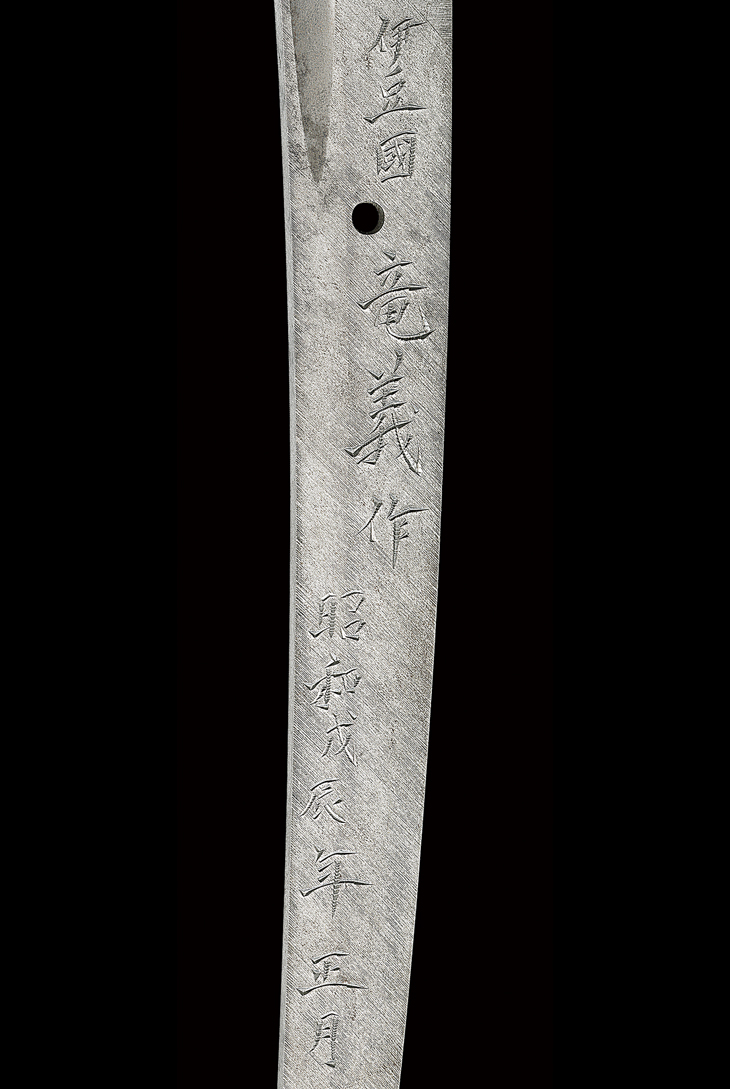
Tatsuyoshi, whose real name was Enomoto Eiichiro, was born in Showa 26; he was the son of the Mukansa smith Yusuisin Sadayoshi, and first used the mei Sadayoshi before later changing it to Tatsuyoshi, and his younger brother is Sadahito. He forged swords alongside his father at a workshop near Komoike in Omiya-cho, Mishima City, Shizuoka Prefecture, and like his father, he was a master smith who excelled in Soshu-den and Soden Bizen, but he passed away in Heisei 25 at the age of 62.
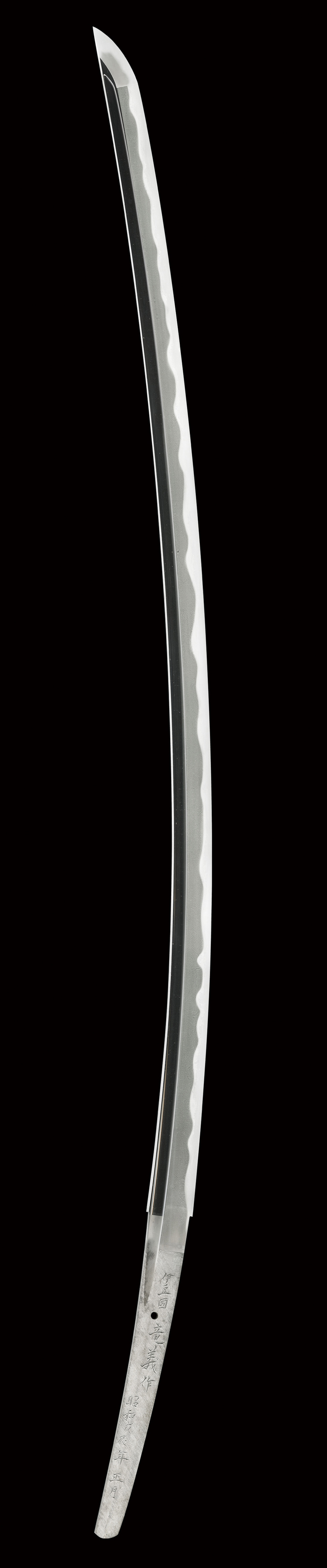
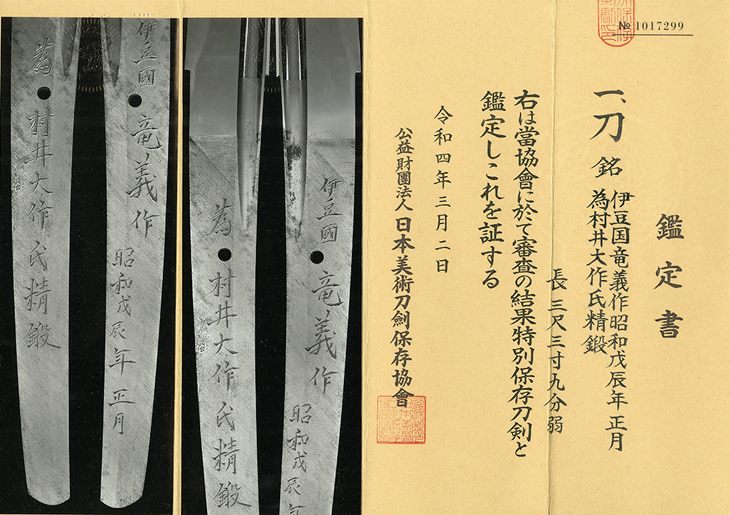
This work has a nagasa of just under 3 shaku 3 sun 9 bu, and is a carefully crafted hono otachi made by special order in Showa 63 (1988) when the smith was 37 years old.
The toshin alone weighs approximately 1,400g, and approximately 2,000g when housed in the shirasaya; I have never seen such a magnificent work by this smith.
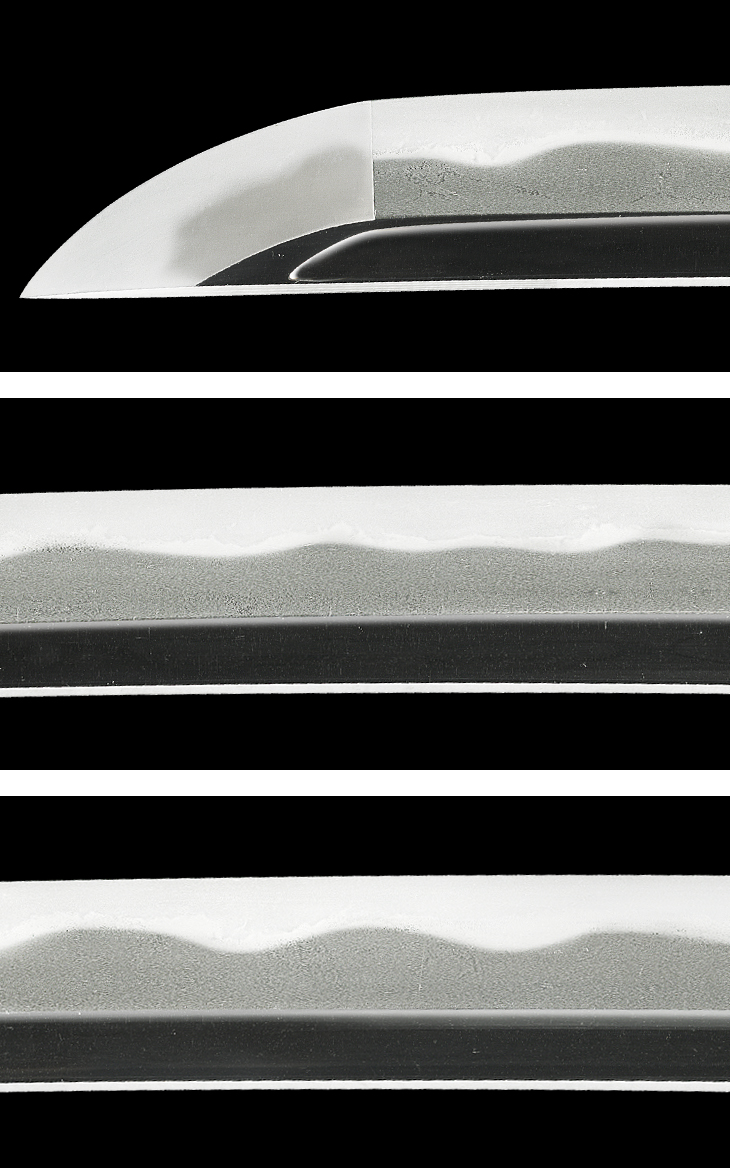
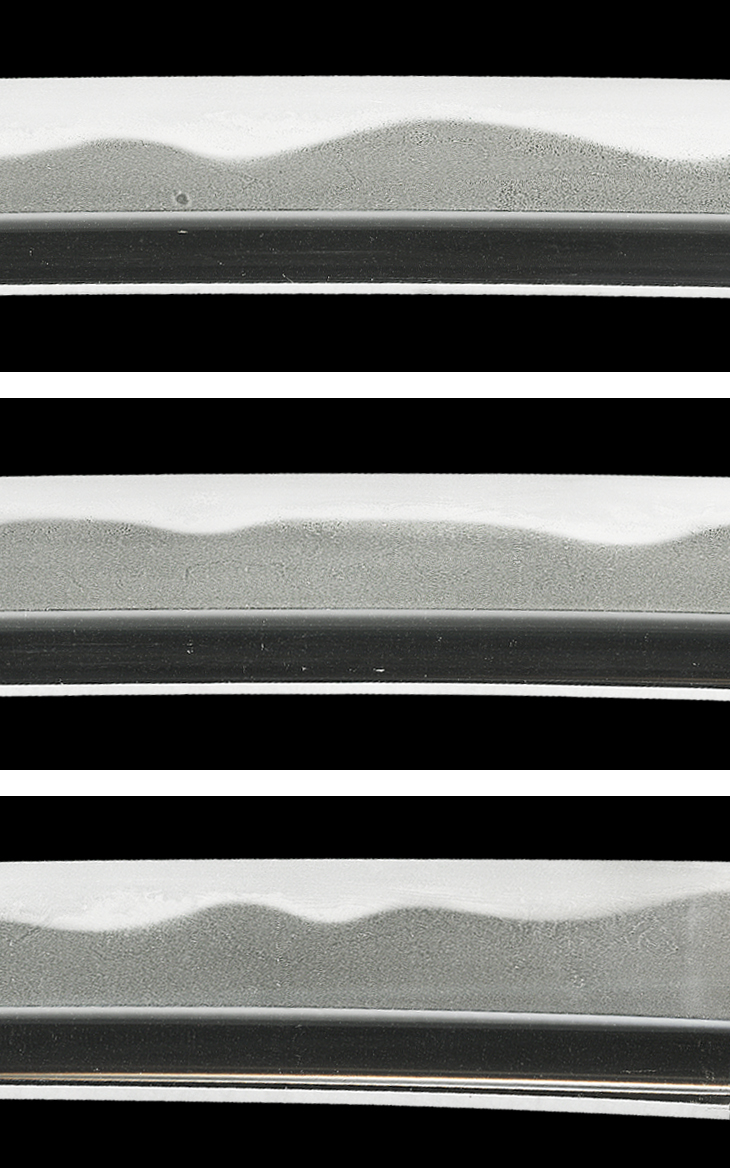
The jitetsu is a well-tightened ko-itame mixed with itame and mokume, with the hada standing out in large patterns in places, and the ha is gunome mixed with ko-gunome, notare, and ko-midare, with nijuba-style nie-suji, fine tobiyaki, and within the ha, ko-ashi and yo enter frequently with kinsuji.
Based on this deki, dimensions, and style, it is thought to have been modeled after something like a Bizen Kanemitsu tachi designated as an Important Cultural Property, the pinnacle of Soden Bizen, and despite being such a long and massive tachi, there are no major defects.
Since the smith himself has already passed away, it will likely become quite difficult to obtain pieces in such good condition as this one in the future.
With Tokubetsu Hozon papers firmly attached, this is a formidable otachi that could become a representative work of Tatsuyoshi.
Machine translation from the shop's Japanese · may contain errors ·
Tatsuyoshi, whose real name was Enomoto Eiichiro, was born in Showa 26; he was the son of the Mukansa smith Yusuisin Sadayoshi, and first used the mei Sadayoshi before later changing it to Tatsuyoshi, and his younger brother is Sadahito. He forged swords alongside his father at a workshop near Komoike in Omiya-cho, Mishima City, Shizuoka Prefecture, and like his father, he was a master smith who excelled in Soshu-den and Soden Bizen, but he passed away in Heisei 25 at the age of 62.
This work has a nagasa of just under 3 shaku 3 sun 9 bu, and is a carefully crafted hono otachi made by special order in Showa 63 (1988) when the smith was 37 years old.
The toshin alone weighs approximately 1,400g, and approximately 2,000g when housed in the shirasaya; I have never seen such a magnificent work by this smith.
The jitetsu is a well-tightened ko-itame mixed with itame and mokume, with the hada standing out in large patterns in places, and the ha is gunome mixed with ko-gunome, notare, and ko-midare, with nijuba-style nie-suji, fine tobiyaki, and within the ha, ko-ashi and yo enter frequently with kinsuji.
Based on this deki, dimensions, and style, it is thought to have been modeled after something like a Bizen Kanemitsu tachi designated as an Important Cultural Property, the pinnacle of Soden Bizen, and despite being such a long and massive tachi, there are no major defects.
Since the smith himself has already passed away, it will likely become quite difficult to obtain pieces in such good condition as this one in the future.
With Tokubetsu Hozon papers firmly attached, this is a formidable otachi that could become a representative work of Tatsuyoshi.
The twentieth century nearly killed the craft twice: wartime distortion, then the occupation ban. The NBTHK’s founding in 1948 and licensed forging from 1953 rebuilt the sword as an art, crowned by Living National Treasures and the mukansa rank.
A Hozon-certified blade judged to show notably superior workmanship and a better state of preservation. The bar is higher: re-tempered blades and most unsigned Muromachi/Edo works are excluded.
About the NBTHK›
The NBTHK (Nihon Bijutsu Tōken Hozon Kyōkai, the Society for the Preservation of Japanese Art Swords) is a public-interest incorporated foundation founded in 1948 and supervised by Japan’s Agency for Cultural Affairs (Bunkachō); it is based at the Japanese Sword Museum in Tokyo. Its expert panels physically examine each submitted work (shinsa) and issue a certificate (kanteishō) ranking it by artistic and historical merit. NBTHK papers are the most widely recognized standard of authentication for Japanese swords and fittings.
For one-of-a-kind items such as swords, sword fittings and antiques, other customers may be waiting for the item, so please contact us about a return within 3 days of its arrival and ship it back within 8 days. Refunds are made on the day the returned item arrives.

 NihontoWatch