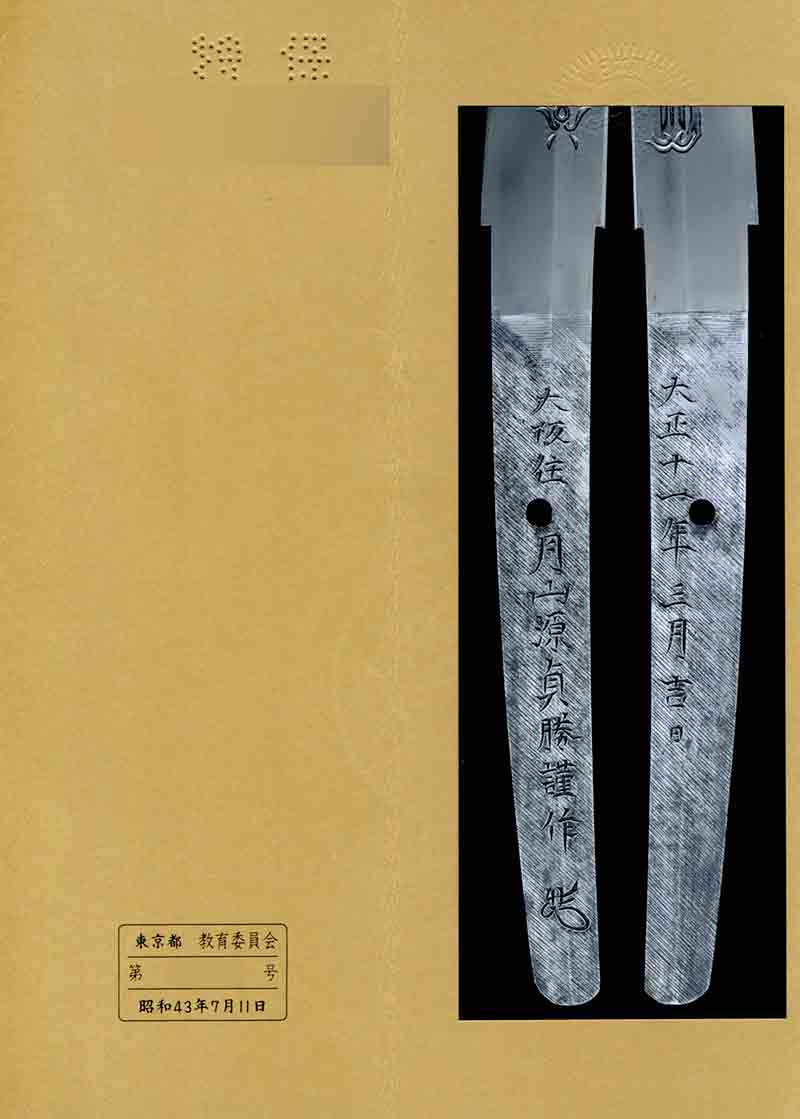
Gassan Sadakatsu was born in Meiji 2 (1869) in Yariya-machi, Osaka, as the eldest son of the Imperial Court Artist: Gassan Sadakazu (the first generation). His name was Eitaro, and from early childhood, he mastered sword-forging techniques under his father: Sadakazu. His skill approached that of Sadakazu, and after Sadakazu's death, he succeeded the Osaka Gassan family; from among his students, he produced two Living National Treasures, his third son Gassan Sadakazu and Takahashi Sadatsugu, as well as many fine smiths, before passing away at the age of 74 on December 24, Showa 18 (1943). Because he served as his father Sadakazu's assistant (aizuchi) until around Taisho 7 (1918), there are almost no works with his own mei; as for works from this period, only the chokuto for the Investiture of the Crown Prince (Emperor Showa) is slightly known. The wakizashi dated Taisho 10 (1921) in the possession of the Dewa Sanzan Jinja is in Ayasugi-den, and this is likely the oldest dated work by Sadakatsu in existence. From around Taisho 10, Sadakatsu received the patronage of Minister of the Imperial Household Ichiki Kitokuro, and received orders for the Daigensui-to for His Majesty the Emperor, as well as orders from various Imperial Families and the Imperial Household Ministry, and was engaged in the production of swords bestowed upon Army and Navy Generals. Sadakatsu's style, in addition to Ayasugi-den, excelled in Bizen-den, and there are also noteworthy examples in Soshu-den. Many of his swords have a graceful sugata with a slender body and ko-kissaki, which is thought to be deeply related to the aforementioned fact that he produced many swords related to the Imperial Household Ministry.
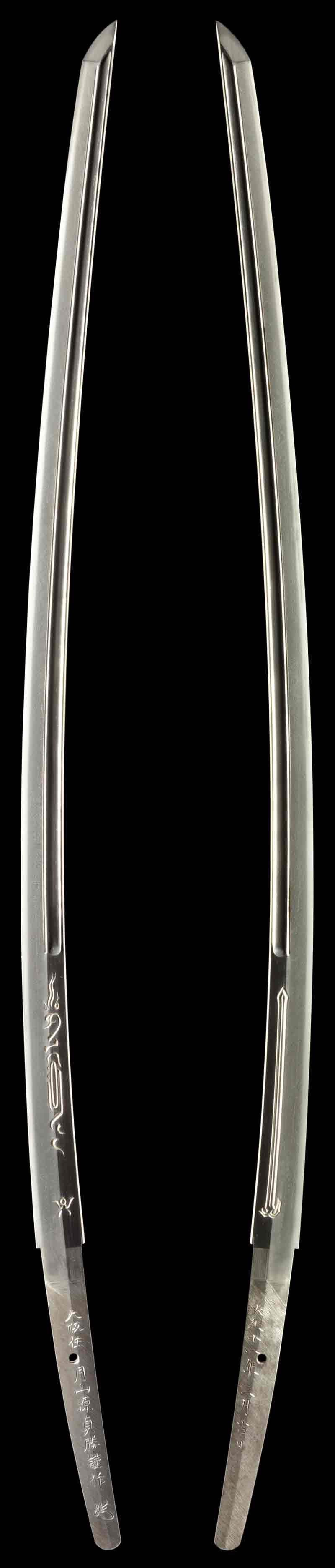
As for the shape of this work, it is shinogi-zukuri, iori-mune, the mihaba is somewhat narrow, the kasane is ordinary, with a shallow sori and chu-kissaki. The kitae is mokume alternating repeatedly, becoming ayasugi-jo, with ji-nie and chikei entering. The hamon is chu-suguha with ko-nie, the habuchi is slightly hotsure, with fine sunagashi appearing well; the boshi is sugu returning in ko-maru, with the tip being hakikake. As for horimono, bo-hi and soe-hi are carved on the omote and ura with maru-dome, and below them, a kusa-no-kurikara and rendai are carved in nikubori on the omote, and a ryakutsuki-suken on the ura.
The characteristic ayasugi-hada of the Gassan school is well expressed with a beautiful texture, arranging mokume continuously and alternately, with ji-nie and thick chikei entering well. In the tranquil chu-suguha, ko-nie is well-attached, and the ha-hada intertwines with the ayasugi-hada at the habuchi, allowing one to observe various keshiki such as fine sunagashi and hotsure. The horimono of kusa-no-kurikara and rendai on the omote, and ryakutsuki-suken on the ura, are also magnificent and harmonize well with the toshin.
Sayagaki by Hon'ami Koson Sensei
"Osaka Gassan Sadakatsu, nagasa 2 shaku 3 sun 1 bu 5 rin, Showa Mizunoto-Mi Shogatsu, Hon'ami Koson (kaō)"
Due to the old polish, there are partial light rust, hike, and small ha-makure.
Machine translation from the shop's Japanese · may contain errors ·
Gassan Sadakatsu was born in Meiji 2 (1869) in Yariya-machi, Osaka, as the eldest son of the Imperial Court Artist: Gassan Sadakazu (the first generation). His name was Eitaro, and from early childhood, he mastered sword-forging techniques under his father: Sadakazu. His skill approached that of Sadakazu, and after Sadakazu's death, he succeeded the Osaka Gassan family; from among his students, he produced two Living National Treasures, his third son Gassan Sadakazu and Takahashi Sadatsugu, as well as many fine smiths, before passing away at the age of 74 on December 24, Showa 18 (1943). Because he served as his father Sadakazu's assistant (aizuchi) until around Taisho 7 (1918), there are almost no works with his own mei; as for works from this period, only the chokuto for the Investiture of the Crown Prince (Emperor Showa) is slightly known. The wakizashi dated Taisho 10 (1921) in the possession of the Dewa Sanzan Jinja is in Ayasugi-den, and this is likely the oldest dated work by Sadakatsu in existence. From around Taisho 10, Sadakatsu received the patronage of Minister of the Imperial Household Ichiki Kitokuro, and received orders for the Daigensui-to for His Majesty the Emperor, as well as orders from various Imperial Families and the Imperial Household Ministry, and was engaged in the production of swords bestowed upon Army and Navy Generals. Sadakatsu's style, in addition to Ayasugi-den, excelled in Bizen-den, and there are also noteworthy examples in Soshu-den. Many of his swords have a graceful sugata with a slender body and ko-kissaki, which is thought to be deeply related to the aforementioned fact that he produced many swords related to the Imperial Household Ministry.
As for the shape of this work, it is shinogi-zukuri, iori-mune, the mihaba is somewhat narrow, the kasane is ordinary, with a shallow sori and chu-kissaki. The kitae is mokume alternating repeatedly, becoming ayasugi-jo, with ji-nie and chikei entering. The hamon is chu-suguha with ko-nie, the habuchi is slightly hotsure, with fine sunagashi appearing well; the boshi is sugu returning in ko-maru, with the tip being hakikake. As for horimono, bo-hi and soe-hi are carved on the omote and ura with maru-dome, and below them, a kusa-no-kurikara and rendai are carved in nikubori on the omote, and a ryakutsuki-suken on the ura.
The characteristic ayasugi-hada of the Gassan school is well expressed with a beautiful texture, arranging mokume continuously and alternately, with ji-nie and thick chikei entering well. In the tranquil chu-suguha, ko-nie is well-attached, and the ha-hada intertwines with the ayasugi-hada at the habuchi, allowing one to observe various keshiki such as fine sunagashi and hotsure. The horimono of kusa-no-kurikara and rendai on the omote, and ryakutsuki-suken on the ura, are also magnificent and harmonize well with the toshin.
Sayagaki by Hon'ami Koson Sensei
"Osaka Gassan Sadakatsu, nagasa 2 shaku 3 sun 1 bu 5 rin, Showa Mizunoto-Mi Shogatsu, Hon'ami Koson (kaō)"
Due to the old polish, there are partial light rust, hike, and small ha-makure.
The twentieth century nearly killed the craft twice: wartime distortion, then the occupation ban. The NBTHK’s founding in 1948 and licensed forging from 1953 rebuilt the sword as an art, crowned by Living National Treasures and the mukansa rank.
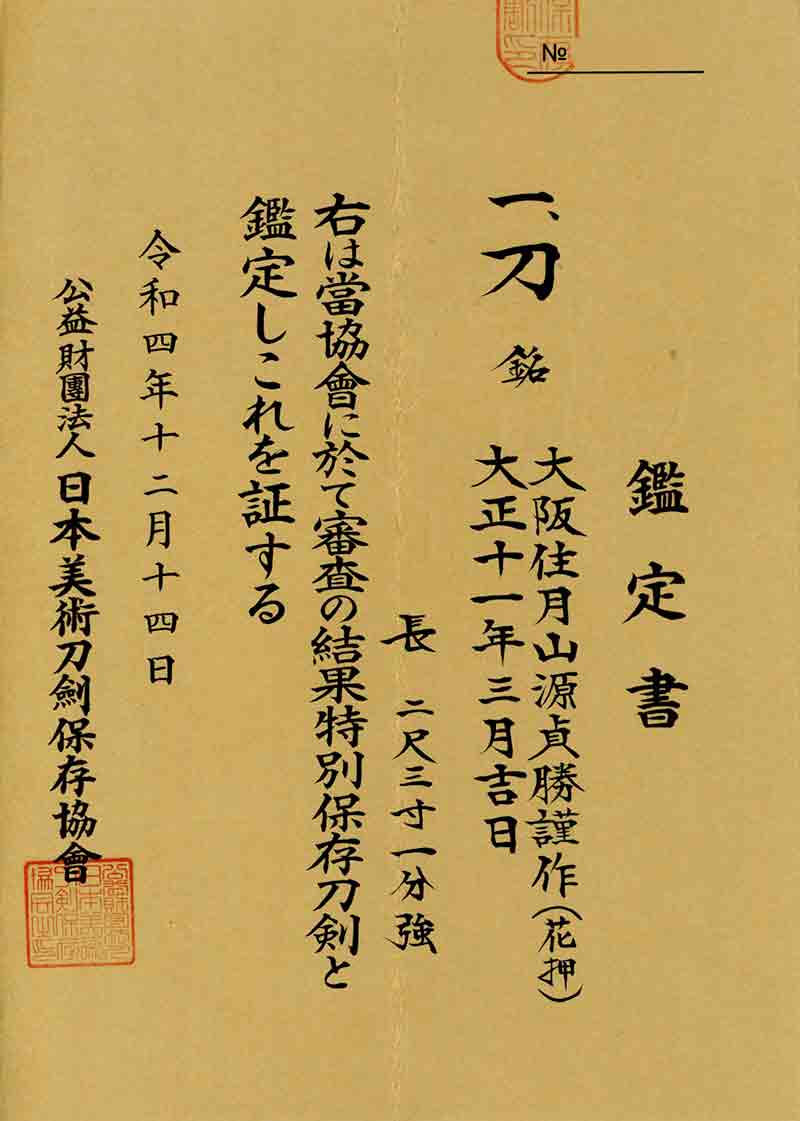
A Hozon-certified blade judged to show notably superior workmanship and a better state of preservation. The bar is higher: re-tempered blades and most unsigned Muromachi/Edo works are excluded.
About the NBTHK›
The NBTHK (Nihon Bijutsu Tōken Hozon Kyōkai, the Society for the Preservation of Japanese Art Swords) is a public-interest incorporated foundation founded in 1948 and supervised by Japan’s Agency for Cultural Affairs (Bunkachō); it is based at the Japanese Sword Museum in Tokyo. Its expert panels physically examine each submitted work (shinsa) and issue a certificate (kanteishō) ranking it by artistic and historical merit. NBTHK papers are the most widely recognized standard of authentication for Japanese swords and fittings.
Please exercise cooling-off within 8 days of the item's arrival.
(1) We cannot accept items that have been altered or worked on in any way (e.g. test cutting, polishing or other work, display at viewing meetings, photography, taking oshigata rubbings, use for appreciation, copying of books).
(2) Return shipping is at the customer's expense.
(3) Costs other than the item price (bank transfer fees, cash-on-delivery fees, installment fees, etc.) cannot be refunded.
(4) For cash-on-delivery and similar payments, the refund is made after the payment has reached us.
(5) We cannot accept a return when a trade-in item is involved.
(6) Items delivered overseas cannot be returned or refunded (because of the time involved and, for swords, the surrender of the registration certificate and other circumstances).



 NihontoWatch