NihontoWatch MonNihontoWatch
Market
Encyclopedia
Kantei
NihontoWatch MonNihontoWatch
Market
Encyclopedia
Kantei

Description

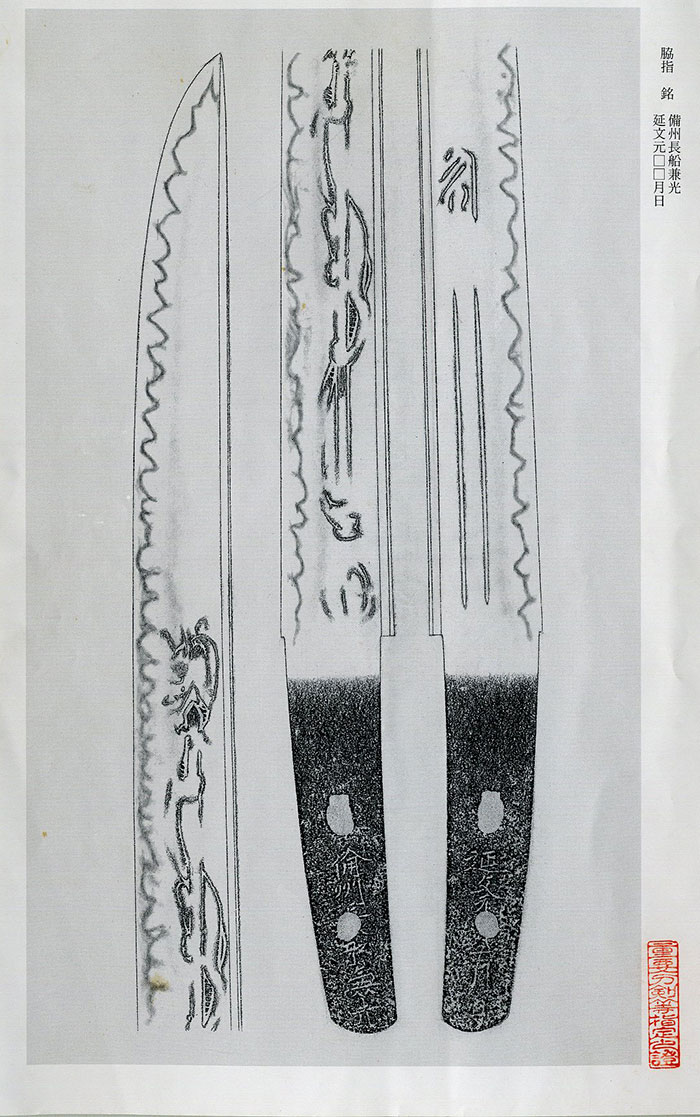
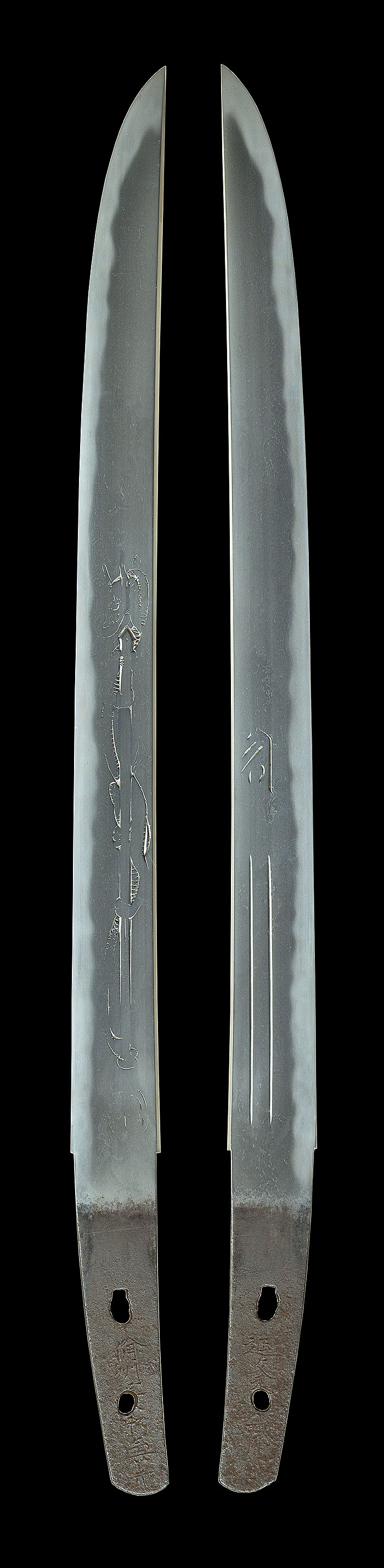
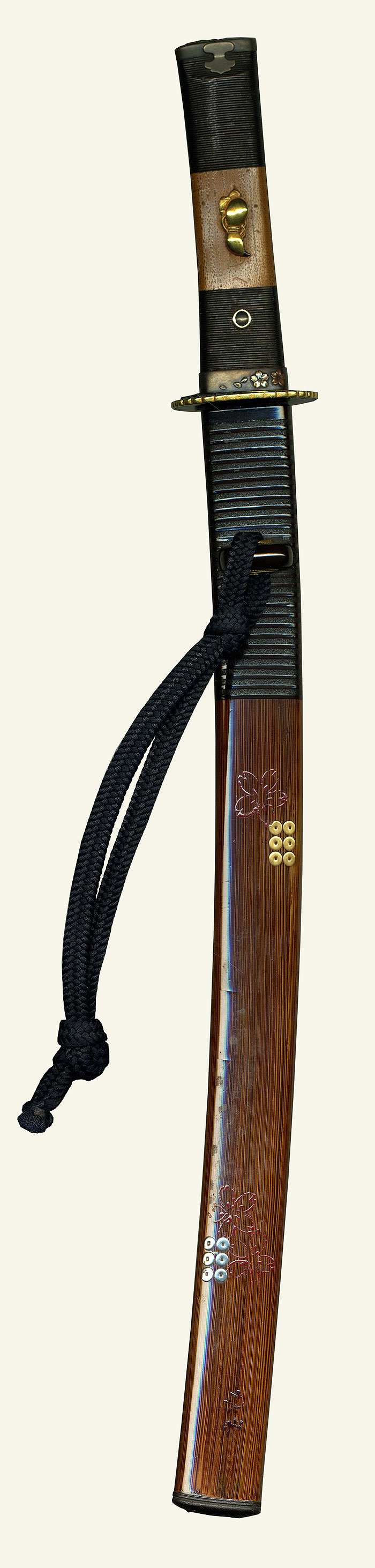
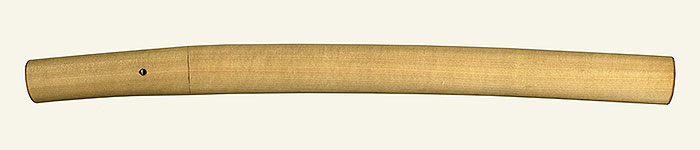
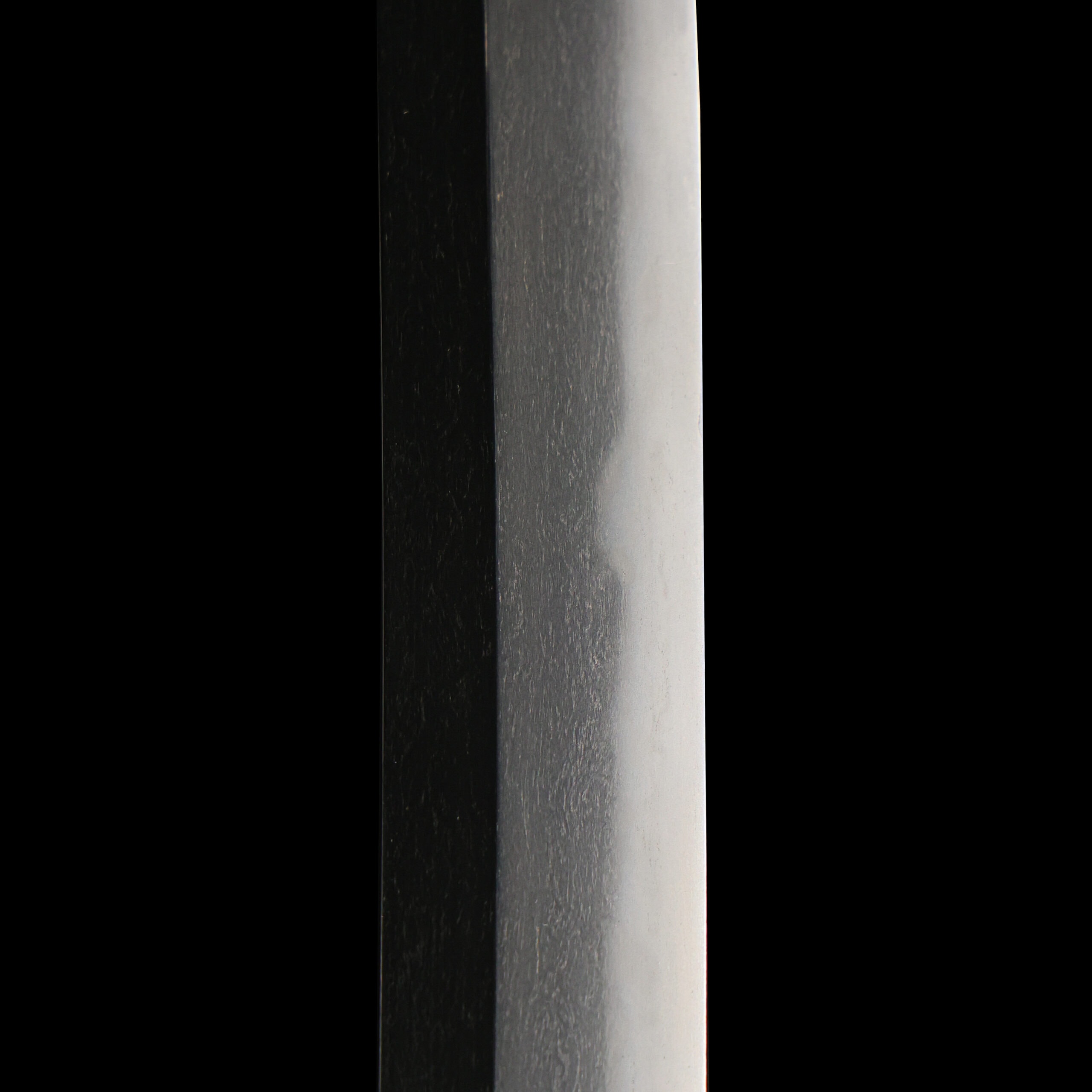
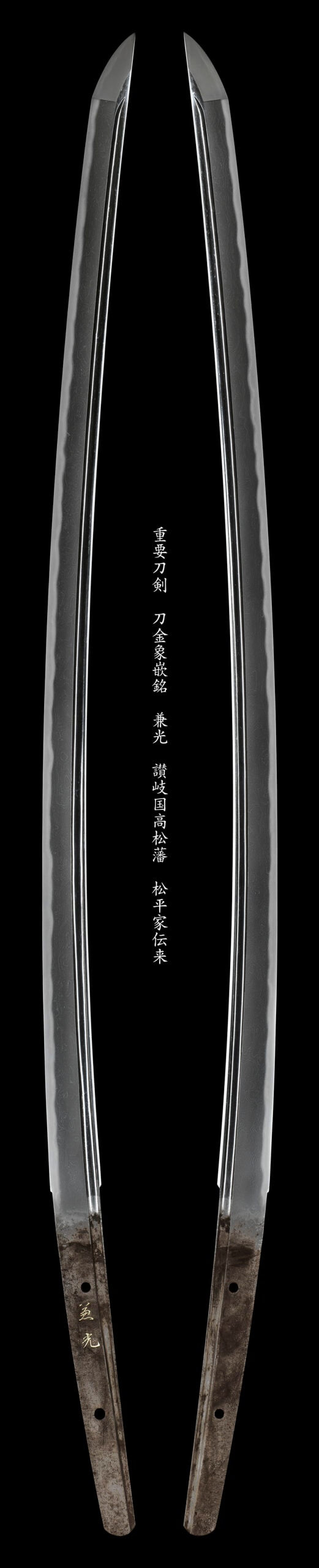
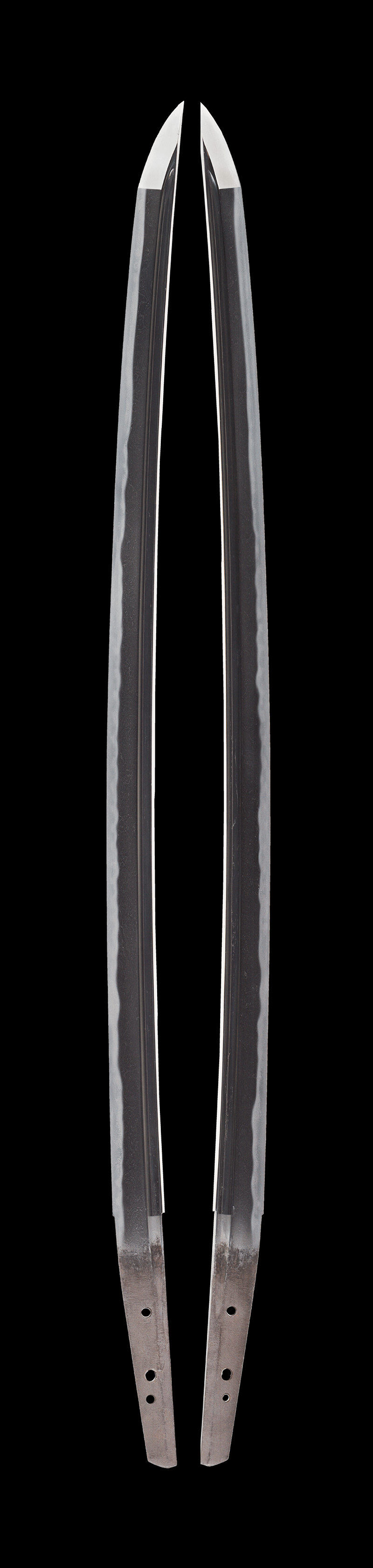
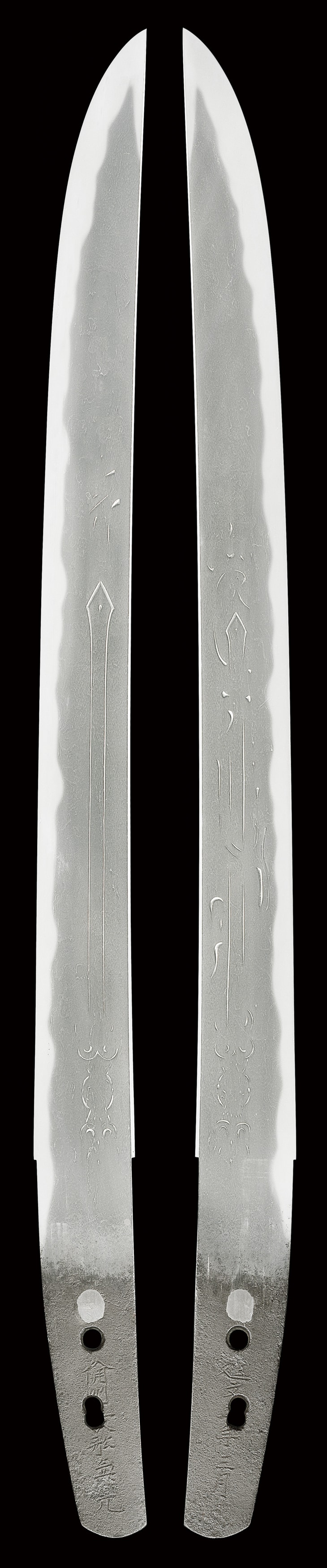
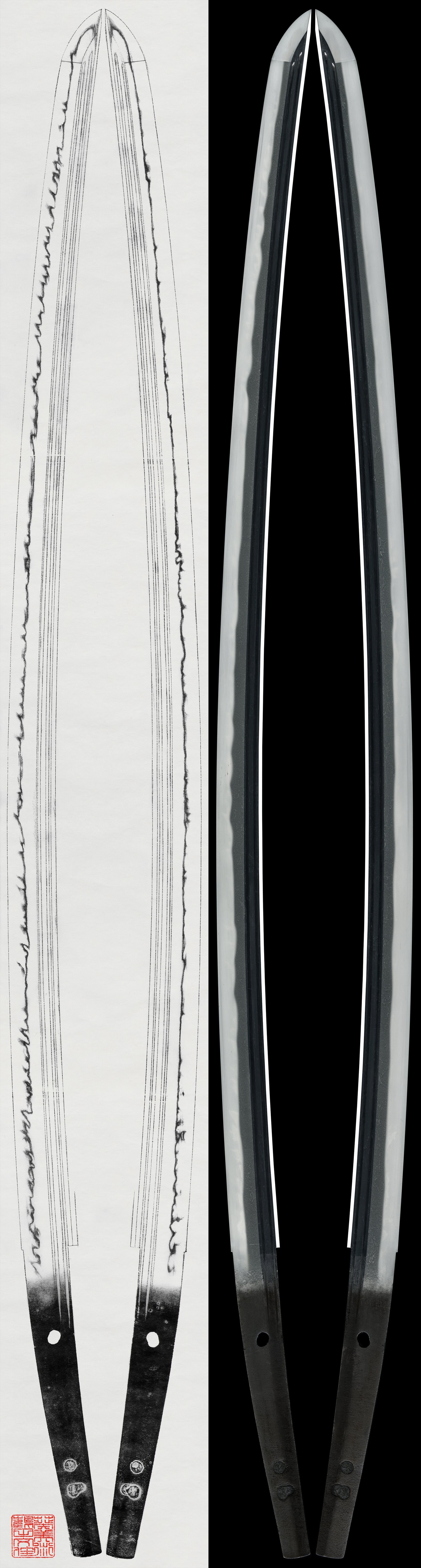
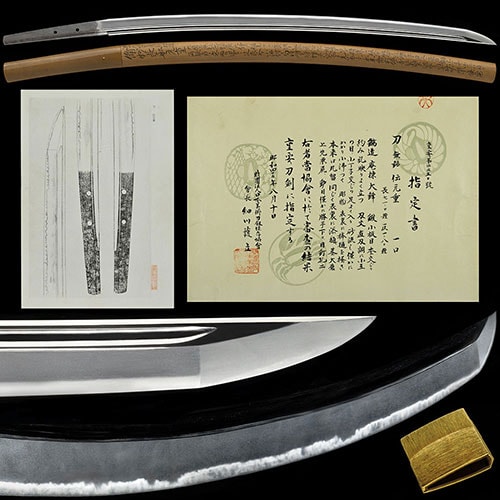
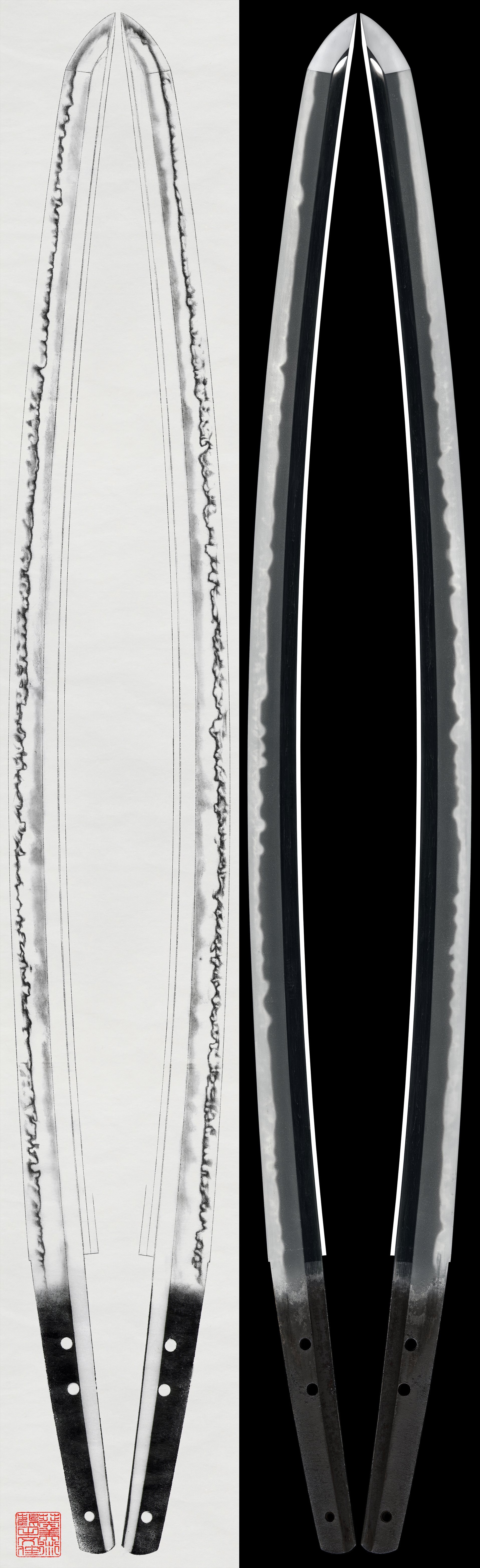
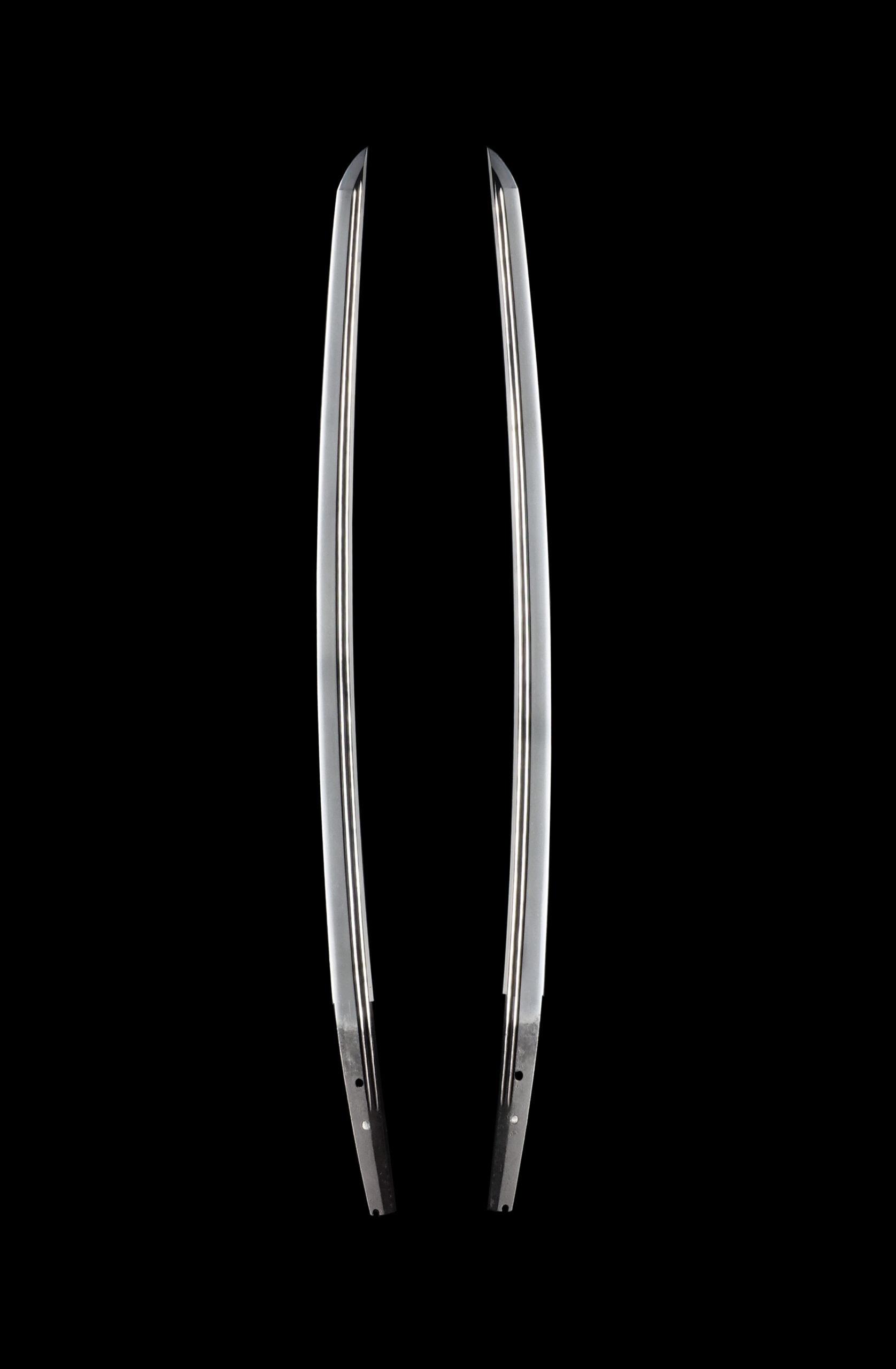
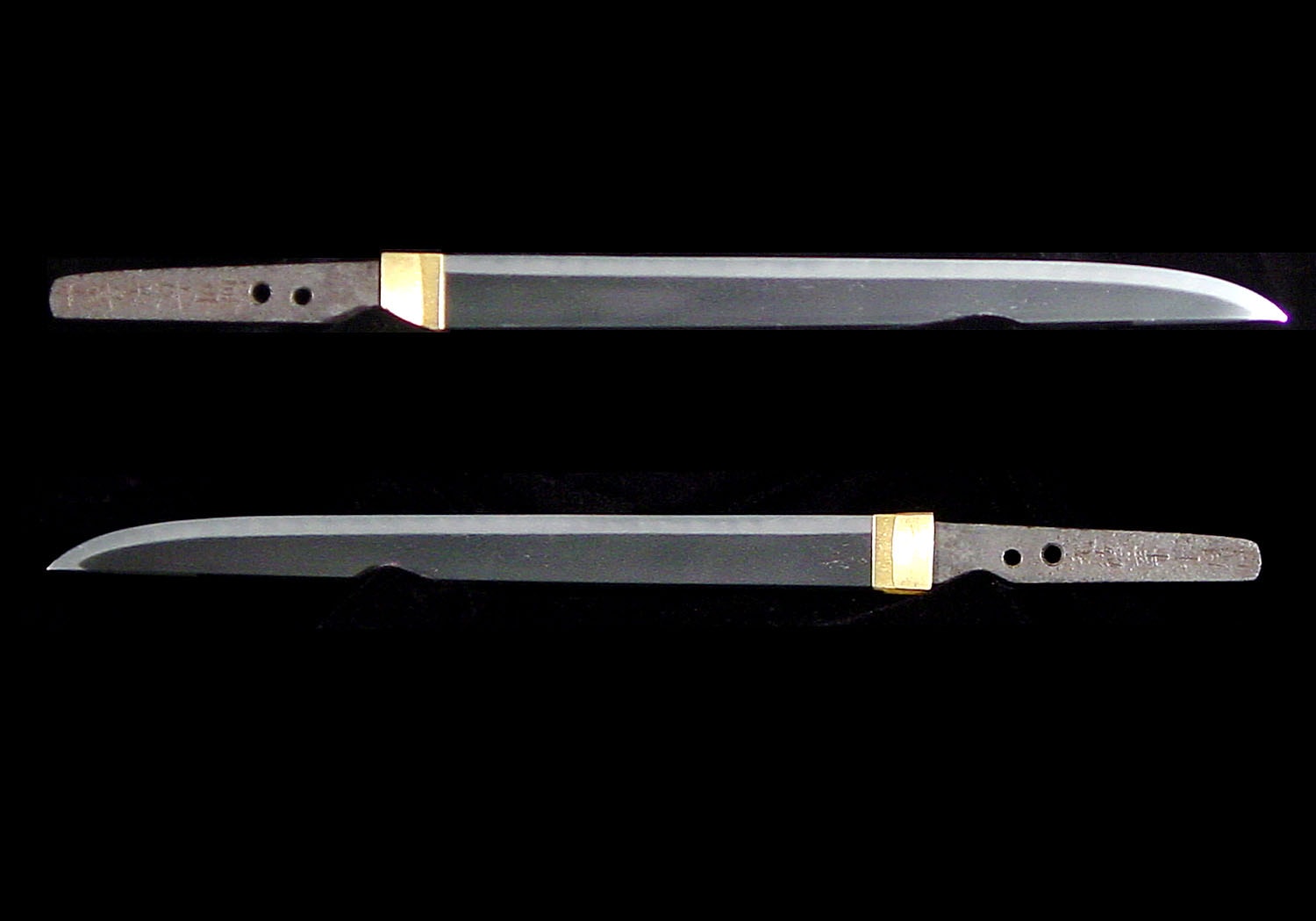
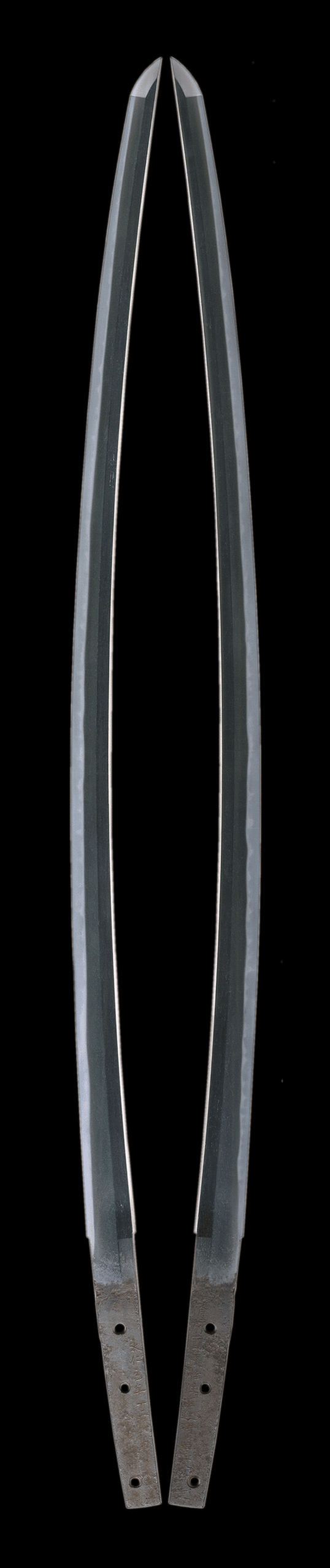
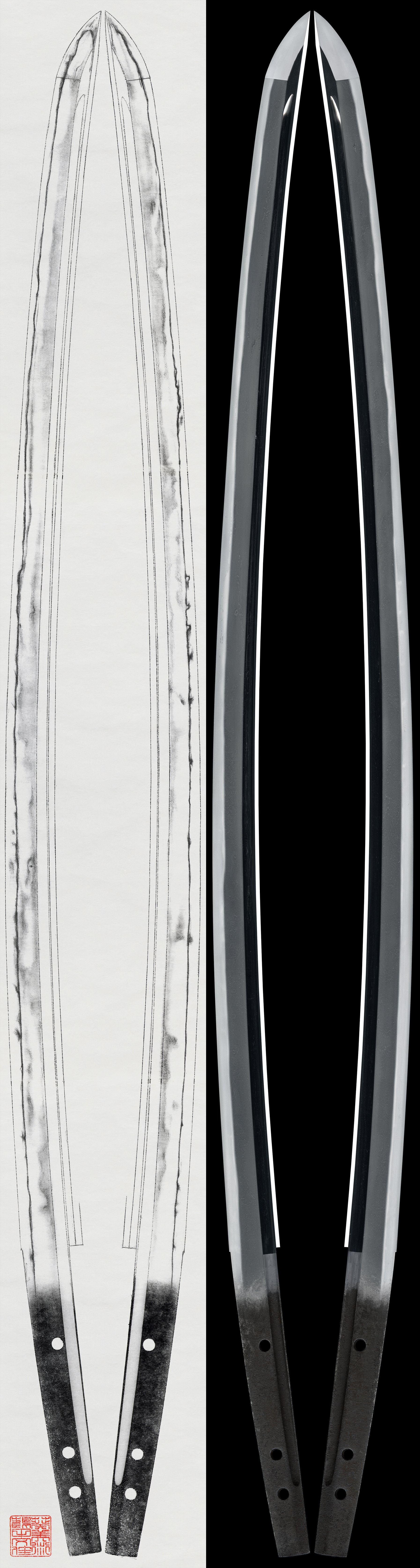
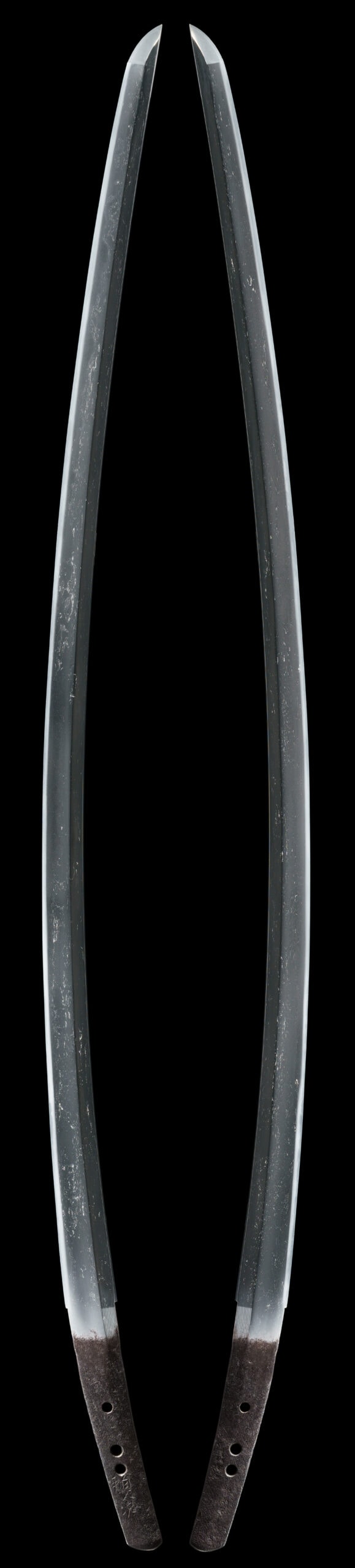
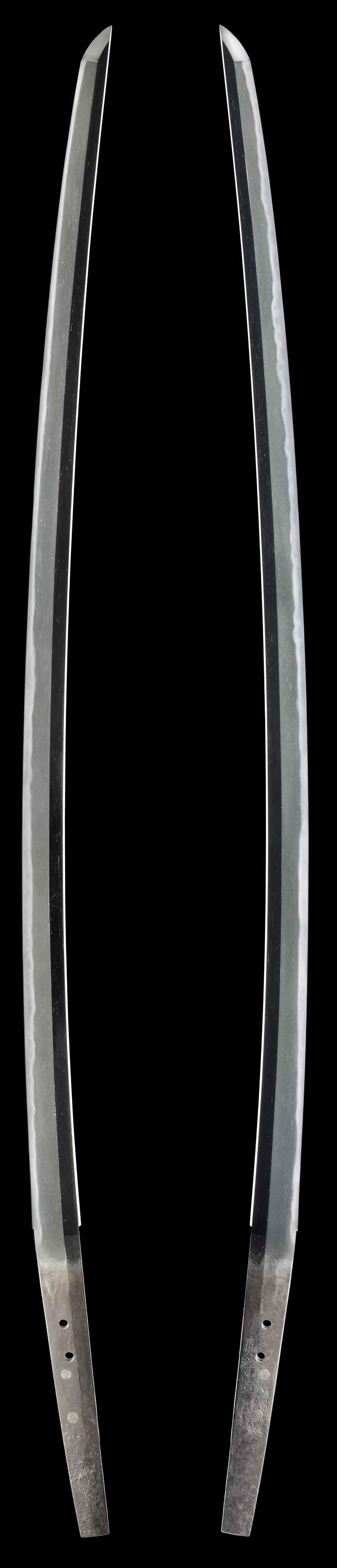
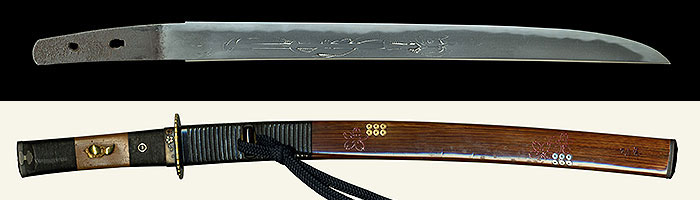
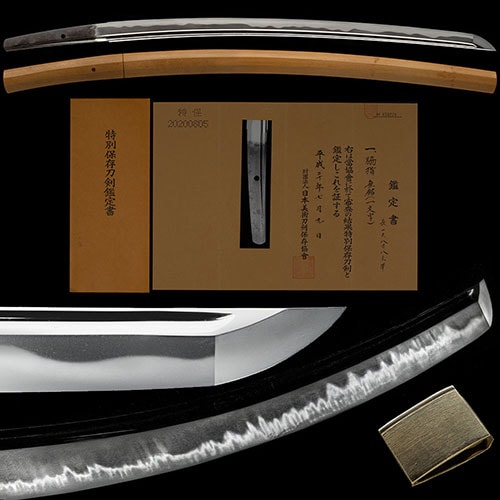
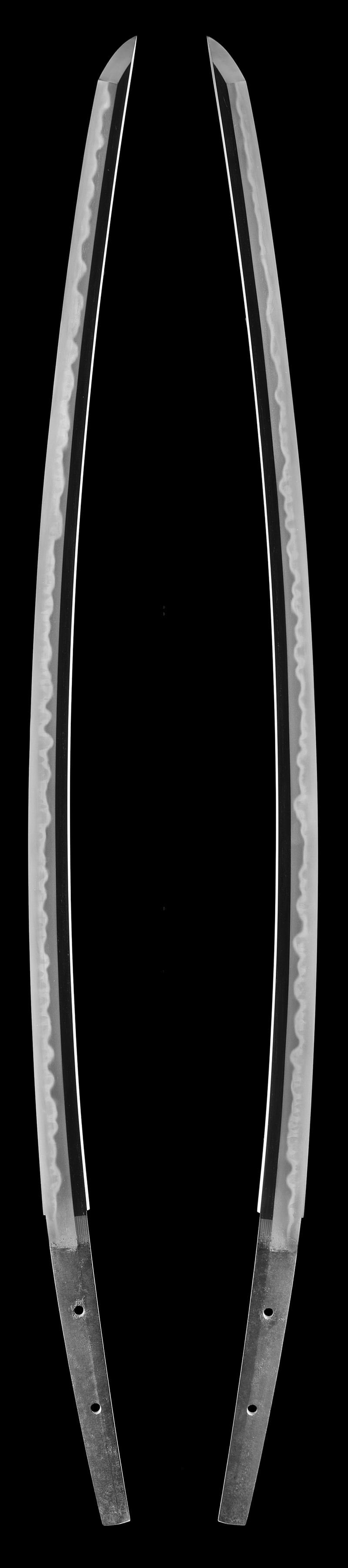
This is a wakizashi by Kanemitsu, the 4th generation of the Osafune school, active in Bizen Province during the Nanbokucho period. It features a distinctive large form, tight itame hada with utsuri, and a hamon of kataochi gunome with strong nie, kinsuji, and sunagashi. The blade is dated Enbun 1 (1356) and comes with a koshirae featuring a Rokumonsen and cherry blossom design, traditionally associated with the Sanada family.

NBTHK Setsumei

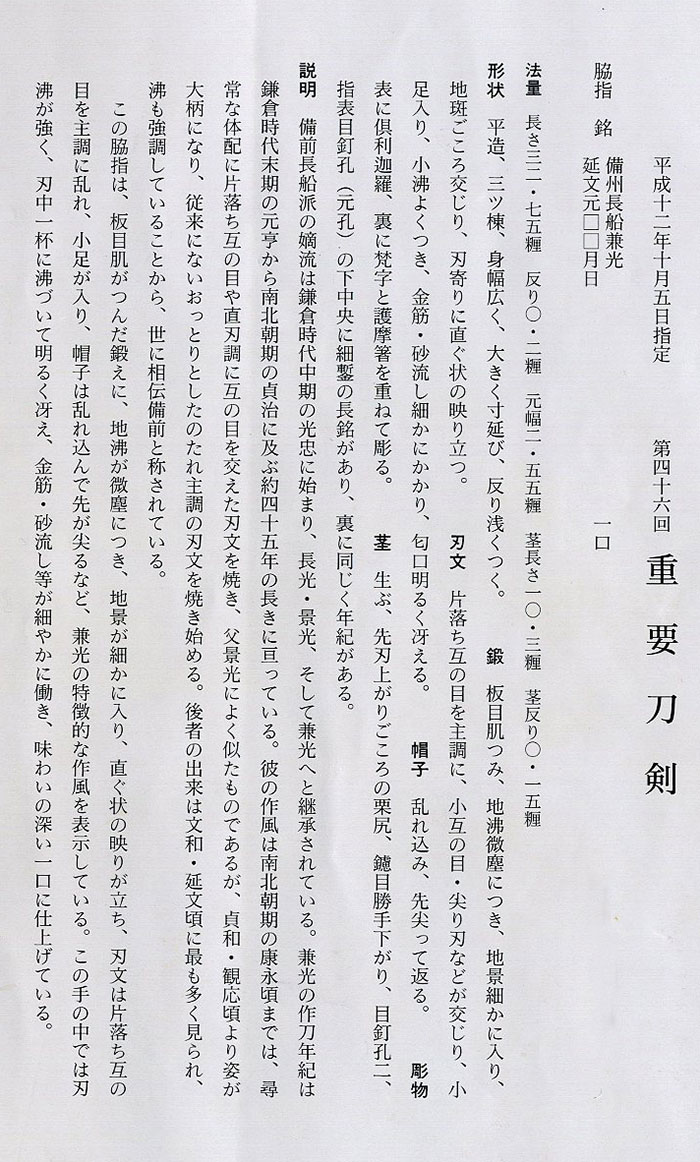
Jūyō-Tōken, 46th Session — Designated October 5, 2000 Wakizashi, mei: Bishū Osafune Kanemitsu (備州長船兼光) Measurements Nagasa 32.75 cm, sori 0.2 cm, motohaba 2.55 cm, nakago-nagasa 10.3 cm, nakago-sori 0.15 cm Description Keijō: hira-zukuri, mitsu-mune; wide mihaba, overall large with slightly elongated proportions (sun-nobi), and a shallow sori. Kitae: compact itame-hada; very fine ji-nie; fine chikei interwoven; mixed with a jifu-like tendency; toward the edge a straight (sugu)-like utsuri stands out. Hamon: based on kataochi-gunome, mixed with ko-gunome and togariba; with ko-ashi; ko-nie adheres well; fine kinsuji and sunagashi run through it; the nioiguchi is bright and clear. Bōshi: midare-komi, with a pointed turn-back. Horimono: on the omote, a kurikara; on the ura, a bonji and gomabashi carved in overlapping composition. Nakago: ubu; ha-agari-gokoro kurijiri; katte-sagari yasurime; two mekugi-ana; below the central area beneath the omote mekugi-ana (the original hole) is a long signature cut with fine chisel-work, and on the ura there is likewise a date inscription. Artisan Kanemitsu (兼光) Era Nanbokuchō period; dated Enbun 1 (1356), month and day not fully legible Explanation Within the Bizen Osafune tradition, the main line begins with Mitsutada in the mid-Kamakura period and is transmitted through Nagamitsu and Kagemitsu, and then to Kanemitsu. Kanemitsu’s dated works extend over a long span of roughly forty-five years, from the Genkō era at the end of the Kamakura period through the Jōji era of the Nanbokuchō period. In terms of style, up through around the Kōei era of the Nanbokuchō period, he forges swords of ordinary, orthodox taihai, tempering kataochi-gunome and also suguha-leaning gunome-midare; these closely resemble the work of his father, Kagemitsu. From around the eras of Teiwa and Kōō, however, his sugata becomes larger in scale, and he begins to temper a previously unseen, relaxed notare-dominant hamon. Works of this latter type are most frequently encountered around the Bunna and Enbun eras; because they also emphasize nie, they are known in the world as “Sōden-Bizen.” This wakizashi displays Kanemitsu’s characteristic style: a tightly forged itame-hada with very fine ji-nie and intricate chikei, a straight (sugu)-like utsuri standing out, and a hamon in kataochi-gunome as the principal theme, with ko-ashi and a bōshi that turns in midare-komi and becomes pointed at the tip. Among works of this general type, the ha-nie here is particularly strong; the hardened edge is filled with nie and appears bright and clear, while fine kinsuji and sunagashi perform delicately throughout, producing a blade of deep interest and flavor.

NihontoWatch MonNihontoWatch
MarketEncyclopediaKantei
Swords›Bizen-den›Osafune›Sōden-Bizen›Kanemitsu›Wakizashi: Kanemitsu - Enbun 1st Year, 2nd Month
wakizashiJūyō
Osafune Kanemitsu

Wakizashi: Kanemitsu - Enbun 1st Year, 2nd Month

mei · Osafune · Nanbokucho · nagasa 32.7cm · sori 0.2cm

SOLD
Osafune Kanemitsu (兼光) · Osafune · Nanbokucho3 works for sale →
WakizashiJūyō
Could you name the smith from the blade alone? Today’s kantei →
Osafune Kanemitsu — 1 of 6
Osafune Kanemitsu — 2 of 6
Osafune Kanemitsu — 3 of 6
Osafune Kanemitsu — 4 of 6
Osafune Kanemitsu — 5 of 6
Osafune Kanemitsu — 6 of 6
1 / 6
1 / 6
Osafune Kanemitsu — 1 of 6Osafune Kanemitsu — 2 of 6Osafune Kanemitsu — 3 of 6Osafune Kanemitsu — 4 of 6Osafune Kanemitsu — 5 of 6Osafune Kanemitsu — 6 of 6
Osafune Kanemitsu (兼光) · Osafune · Nanbokucho3 works for sale →
WakizashiJūyō
Could you name the smith from the blade alone? Today’s kantei →
Measurements & details
Smith
Osafune Kanemitsu
Type
Wakizashi
School
Osafune
Period
Around 1323–1370(Shohei)
Province
Bizen
Signature
Signed(45% of this smith's designated works are signed)
Measurements
Nagasa 32.7cmSori 0.2cmMotohaba 2.5cmKasane 0.5cm
Description

This is a wakizashi by Kanemitsu, the 4th generation of the Osafune school, active in Bizen Province during the Nanbokucho period. It features a distinctive large form, tight itame hada with utsuri, and a hamon of kataochi gunome with strong nie, kinsuji, and sunagashi. The blade is dated Enbun 1 (1356) and comes with a koshirae featuring a Rokumonsen and cherry blossom design, traditionally associated with the Sanada family.

NBTHK Zufu Commentary

Juyo #46

AI translation — may contain errors

-, 46th Session — Designated October 5, 2000

, : Bishū Kanemitsu (備州長船兼光)

Measurements 32.75 cm, 0.2 cm, 2.55 cm, 10.3 cm, 0.15 cm

Description Keijō: , ; wide , overall large with slightly elongated proportions (), and a shallow . : compact ; very fine ; fine interwoven; mixed with a -like tendency; toward the edge a straight ()-like stands out. : based on , mixed with and ; with ; adheres well; fine and run through it; the is bright and clear. : , with a pointed turn-back. : on the , a ; on the , a and carved in overlapping composition. : ; ; ; two ; below the central area beneath the (the original hole) is a long signature cut with fine chisel-work, and on the there is likewise a date inscription.

Artisan Kanemitsu (兼光)

Era period; dated Enbun 1 (1356), month and day not fully legible

Explanation Within the tradition, the main line begins with Mitsutada in the mid- period and is transmitted through Nagamitsu and Kagemitsu, and then to Kanemitsu. Kanemitsu’s dated works extend over a long span of roughly forty-five years, from the Genkō era at the end of the period through the Jōji era of the period.

In terms of style, up through around the Kōei era of the period, he forges swords of ordinary, orthodox , tempering and also -leaning ; these closely resemble the work of his father, Kagemitsu. From around the eras of Teiwa and Kōō, however, his becomes larger in scale, and he begins to temper a previously unseen, relaxed -dominant . Works of this latter type are most frequently encountered around the Bunna and Enbun eras; because they also emphasize , they are known in the world as “Sōden-Bizen.”

This displays Kanemitsu’s characteristic style: a tightly forged with very fine and intricate , a straight ()-like standing out, and a in as the principal theme, with and a that turns in and becomes pointed at the tip. Among works of this general type, the here is particularly strong; the hardened edge is filled with and appears bright and clear, while fine and perform delicately throughout, producing a blade of deep interest and flavor.

About the maker

Kanemitsu

兼光

Osafune (Bizen) · Bizen · around 1323-1370

Fujishiro Sai-jo saku

3 pieces on the market now

›

The published sources open their account of Kanemitsu with one fixed sentence: he is "the mainline heir of the Osafune school, following Kagemitsu"[[c:1]]. Son of Kagemitsu and fourth master of the line that runs from Mitsutada through Nagamitsu and Kagemitsu, he stands as the leading Bizen smith of the Nanbokucho period. His dated works span what the NBTHK calls an unusually long period, roughly forty-five years from Genko 1 (1321) at the close of the Kamakura period through the Joji era (1362-1368), and some designations carry the span to Oan and read it as fully fifty years. So long a working life raises, in the sources' own framing, the question of a first and a second generation, with no settled view as to where the division should fall; the later master is known to the record as "Enbun Kanemitsu"[[c:2]].

His hand divides at a watershed the published sources place in the Jowa and Kan'o eras (1345-1352). Until around Koei both tachi and tanto keep standard proportions, tempered either in a suguha tone mixed with gunome or in the kataochi-gunome he inherited from his father, work that in the recurring judgment of the designations "wholly follows the father Kagemitsu's manner"[[c:3]]. From Jowa and Kan'o the build turns grand, and the sentence nearly every later designation repeats takes over: "a notare-dominant hamon that had not existed before appears, and is met most often around Bunna and Enbun"[[c:4]]. The broad, unhurried notare and the angular kaku-gunome are alike singled out as "what Kanemitsu excelled in"[[c:5]], and one Tokubetsu Juyo description calls the angular gunome "the construction he favored from first to last"[[c:6]]. Against the rounder returns of the earlier mainline, his boshi runs in midare, often thrusting up before a pointed tip.

Even at the grand scale the forging holds. The jigane is itame mixed with mokume, and the NBTHK remarks of one Tokubetsu Juyo katana that it shows not the slightest loosening or coarseness of the surface pattern from base through tip. Fine ji-nie adheres thickly, fine chikei enter, and a midare-utsuri stands out, often called vivid, the steel bright; on the early ubu-signed pieces the reflection is rather a sugu-utsuri or bo-utsuri over a tight ko-itame. The temper is for the most part nioi-dominant with ko-nie. Kinsuji and sunagashi gather toward the koshimoto, small tobiyaki and yubashiri-like effects appear in places, and ashi and yo enter freely. To this he adds a distinctive program of carving: bonji, gomabashi and suken, and above all the cursive grass-style kurikara[[c:7]], a composition the sources note recurs on works of Kanemitsu and Tomomitsu, and at times Chikakage.

Most of what survives from the late phase is the o-suriage mumei katana of the Enbun-Joji build: wide in mihaba with little taper from base to tip, the kissaki large, the sori shallow or moderately deep. Beside it stand the sunnobi hira-zukuri tanto and ko-wakizashi, broad and thin with shallow sori, and the long hira-zukuri blades signed on the sashi-omote, made as uchigatana from the outset, of which the Uesugi "Suijin-giri"[[c:8]] is the recorded example. Signed work is plentiful for so heavily shortened an oeuvre, one hundred ten signed against ninety-eight unsigned among the blades gathered here, the long signatures reading Bizen no Kuni Osafune-ju Kanemitsu[[c:9]] or Bishu Osafune-ju Kanemitsu[[c:10]], many with dates. The strengthened nie of the late manner the sources read with their own hedge, "possibly under the influence of the Soshu tradition"[[c:11]], adding that "since the nie also is emphasized, the work is known in the world as Soden-Bizen"[[c:12]]. The older designations go further only as a question: one Juyo note finds in the turn to notare "the relation to Soshu Masamune, together with the succession of a first and second generation"[[c:13]], the Masamune-pupil tradition held open, never asserted. The many shortened mumei blades carry kinzogan attributions of the Honami line, Kotoku and Koson among them, which the NBTHK in case after case upholds.

Within Bizen his place is fixed by what he carried and what he introduced. The kataochi-gunome descends to him through Kagemitsu alone within the school's mainline, and the notare is his own addition, the broad, unforced midare that, in the words of one Tokubetsu Juyo description, this smith pioneered among Bizen craftsmen. His grand manner passes into late Osafune through his circle: the published sources read related blades as work of the sphere surrounding Kanemitsu, and the cursive kurikara he favored recurs in Tomomitsu.

Fujishiro grades him Sai-jo saku, and two hundred thirty-seven designated works stand on record. No National Treasure is among them, but thirteen blades hold the rank of Important Cultural Property, and the named swords cluster there: the meibutsu O-Kanemitsu (大兼光) and the tachi of Uesugi Kagekatsu's hand-picked thirty-five, both cited in the record as Important Cultural Properties, and the meibutsu Nami-oyogi Kanemitsu (波游兼光), whose gold inlay records the ownership of Hashiba Okayama Chunagon Hideakira, identified as Kobayakawa Hideaki. Forty of his blades hold the Tokubetsu Juyo rank, the most of any swordsmith, and with the Juyo blades the two tiers carry two hundred two. The provenance roll is deep, sixty-nine blades with recorded histories: Ashikaga Takauji, Uesugi Kenshin and Uesugi Kagekatsu, Toyotomi Hideyoshi, Todo Takatora, and the Kuroda, Date, Hosokawa, Maeda and Owari Tokugawa houses; one Juyo katana went to Tokugawa Iemitsu as the bequest of Sugihara Hoki no Kami Shigenaga, and another descended in the Masuda family, hereditary elders of the Choshu domain. The Important Cultural Property and Juyo Bijutsuhin pieces rest as patrimony in shrines, museums and long-held collections, the Tokugawa Art Museum, the Sano Art Museum and Eisei Bunko among recorded holders. For the collector the field is less closed than with most names of this rank: blades of the Tokubetsu Juyo and Juyo tiers, many of recorded private whereabouts, appear from time to time. Yet most are held rather than traded, and a signed and dated piece of either phase is a landmark when it comes.

Historical importance

Where Kanemitsu stands among comparable artisans: across all of nihontō, and within tradition, era, and period. The tiers (Foremost · Leading · Major · Notable) weigh official designations from the NBTHK and Japan's Agency for Cultural Affairs, together with historical honors of lasting repute such as the Sansaku and Meibutsu-chō.

随一
Foremost
屈指
Leading
有数
Major
著名
Notable

Select a lens to see how it's measured.

Designation record
231 designated works
Jūyō Bunkazai
13
Jūyō Bijutsuhin
12
Gyobutsu (Imperial)
6
Tokubetsu Jūyō
40
Jūyō
160
3 works by Kanemitsu on the market→
Kanemitsu — full profileOsafune (Bizen) school

Dated Works

Years he was demonstrably active, proven by signed-and-dated blades

Active period
1323–1361Editorial estimate: 1323–1370
39 of 95 designated works carry a date
1320
1330
1340
1350
1360
1370

Study this maker →

About the school

Osafune

長船

Bizen-den · Bizen

237 pieces on the market now

›

No single workshop in the history of Japanese swordmaking grew larger or lasted longer than Osafune, the riverside village in Bizen Province whose name became, across three centuries, a byword for the province's mainline. Its de facto founder was Mitsutada (光忠), working at Osafune in the middle Kamakura period; tradition makes him the son of Chikatada, and the genealogies derive his line from the Ko-Bizen Masatsune group already settled in the village. His blades, bold and imposing with a jigane so refined the sources say it can at a glance suggest Kyoto work, were treasured from old as the swords of commanders, and from his hand the school spread immediately: his sons Nagamitsu (長光) and Sanenaga (眞長), his grandson Kagemitsu (景光), and outward through pupils and collaterals until, by the late Kamakura years, Osafune was less a family than an industry. The line is conventionally read as a three-generation spine, Mitsutada founding it, Nagamitsu setting its classical standard, Kagemitsu bringing both temper and forging to their finished form before handing the manner to his pupil Chikakage (近景), whose echo of the master is so close that signed Kagemitsu blades are sometimes read as Chikakage daimei. What binds the membership is a shared steel before any shared temper. The forging is itame mixed with mokume, tightening on the finest blades into a dense ko-itame; fine ji-nie adheres, chikei enter, and over all of it stands the midare-utsuri that anchors even the most Kyoto-like jigane back to Bizen. On that floor the founding generation tempers a flamboyant choji-midare mixed with gunome: Mitsutada's tadpole-headed kawazuko-choji, Nagamitsu's round-topped plump choji, the deep nioi with ko-nie, the bright nioiguchi. From here the school divides by hand and by era. Sanenaga draws the calm pole, a gentle chu-suguha of tightened nioiguchi; Kagemitsu completes the slanting, square-shouldered kataochi-gunome over a suguha base, the family's last great Kamakura invention, carried on by his close kinsman Kagemasa (景政). The Nanbokucho generation then turns toward Soshu-den: Kanemitsu (兼光), fourth master of the mainline, pioneers a broad notare and is read, with Chogi (長義), as the head of Soden-Bizen, the Bizen wing that worked Soshu nie into a jigane that still throws a Bizen utsuri.

Chogi is called the most un-Bizen of Bizen smiths, his ear-shaped mimigata his tell; around him Nagashige (長重), Yoshikage (義景), Tomomitsu (倫光) and Kanenaga (兼長) press the Soshu side by degrees, while Motoshige (元重), of a separate Hatakeda descent, carries an Aoe-tinged squared, slanting ha. Two generations later the Oei revival returns to Kamakura: Yasumitsu (康光) and Morimitsu (盛光), the twin pillars of Oei-Bizen, revive the tachi shape and the choji temper over a wide-waisted koshibiraki-gunome, both finishing in the pointed rosoku-no-shin (candle-wick) boshi that gives the late date away. For the collector the school is a school of discriminations, and to kantei it is to read those fine partitions. The constant midare-utsuri over a bright ko-itame fixes the province; the boshi then sorts the maker, Mitsutada's pointed midare-komi against Nagamitsu's composed ko-maru Sansaku turn, Kagemitsu's contained return, the candle-wick tongue of Oei. Within a single phase the calls turn on a half-step: Nagamitsu's plump crests against Sanenaga's cooler nioiguchi, Kagemasa's freer play against Kagemitsu's tighter order, Nagashige read out of Chogi by a nie that surpasses his brother's. The standing of the best is matched by their patrimony. Mitsutada, Nagamitsu and Kagemitsu each hold National Treasures and stand at the head of Fujishiro's Sai-jo saku; their named blades, the Daihannya Nagamitsu, the Kogaryu Kagemitsu, the O-Kanemitsu, passed through Nobunaga, Ieyasu, Uesugi Kenshin and the great daimyo houses. Because Nagamitsu and the Nanbokucho masters signed and survived in number, Osafune offers what most peerage names cannot, a deep field of Tokubetsu Juyo and Juyo work that a patient collector may still realistically hold. Through every register the same hand declares itself: the bright steel, the vivid reflection, and a temper that runs, across three centuries, as the spine of Bizen. Learn more →

113 recorded smiths2013 designated works
Leading smiths
SmithEraDesignated
Mitsutada光忠1238-123960
Nagamitsu長光1274-1304244
Kagemitsu景光1303-1336143
Kanemitsu兼光1323-1370231
Sanenaga眞長1299-130964
Explore the Osafune school →

Historical context

Bizen in the Nanbokuchō period

›

Sixty years of war between two courts drove blades long and broad, and Osafune met the demand: Kanemitsu and Chōgi led forges serving the provincial warriors who did the fighting, while Sōshū influence arrived with the armies to create Sōden-Bizen.

Bizen in the Nanbokuchō period →

NBTHK Certificate
Jūyō Tōken重要刀剣
Important Sword
›

A blade of top-grade workmanship and condition, formally judged to rank with a nationally recognized Important Art Object (Jūyō Bijutsuhin). Awarded only at the NBTHK’s competitive annual examination.

About the NBTHK›

The NBTHK (Nihon Bijutsu Tōken Hozon Kyōkai, the Society for the Preservation of Japanese Art Swords) is a public-interest incorporated foundation founded in 1948 and supervised by Japan’s Agency for Cultural Affairs (Bunkachō); it is based at the Japanese Sword Museum in Tokyo. Its expert panels physically examine each submitted work (shinsa) and issue a certificate (kanteishō) ranking it by artistic and historical merit. NBTHK papers are the most widely recognized standard of authentication for Japanese swords and fittings.

NBTHK official site→
Seller
I
Iida Koendo
Established 1880 · 146 yrs on the market
🇯🇵Ships from Japan
›
✓Verified dealeriidakoendo.com
✓Ships worldwide✓English supportWire transfer
Return policy

Customer-initiated returns accepted within two days of arrival; return shipping paid by customer and fees non-refundable. Returns/refunds unavailable for overseas deliveries.

View all of Iida Koendo’s listings→View this item on the dealer’s site→

More works by Osafune Kanemitsu

View all →
Samurai Museum
Katana - by Osafune Kanemitsu - Attributed to Den Osafune Kanemitsu - NTHK Yushu Saku Kanteisho CertificateKatana - by Osafune Kanemitsu - Attributed to Den Osafune Kanemitsu - NTHK Yushu Saku Kanteisho Certificate

Katana

ByOsafune Kanemitsu
¥4,300,000
Goushuya
Jūyō
Katana - Jūyō - by Osafune Kanemitsu - Kanemitsu with Gold Inlay InscriptionKatana - Jūyō - by Osafune Kanemitsu - Kanemitsu with Gold Inlay Inscription

Katana

ByOsafune Kanemitsu
Ask
Iida Koendo
Jūyō
Katana - Jūyō - by Osafune Kanemitsu - KanemitsuKatana - Jūyō - by Osafune Kanemitsu - Kanemitsu

Katana

ByOsafune Kanemitsu
¥11,000,000

Previously sold by Osafune Kanemitsu

View all →
Nipponto
Jūyō
Katana - Jūyō - by Osafune Kanemitsu - Juyo Katana by Osafune Kanemitsu (O-Kanemitsu), MumeiKatana - Jūyō - by Osafune Kanemitsu - Juyo Katana by Osafune Kanemitsu (O-Kanemitsu), Mumei
Sold

Katana

ByOsafune Kanemitsu
SOLD
Aoi Art
Tokuho
Tanto - Tokuho - by Osafune Kanemitsu - Bishu Osafune Kanemitsu - A day in August, Enbun eraTanto - Tokuho - by Osafune Kanemitsu - Bishu Osafune Kanemitsu - A day in August, Enbun era
Sold

Tantō

ByOsafune Kanemitsu
SOLD
Gallery Youyou
Jūyō
Tanto - Jūyō - by Osafune Kanemitsu - Bishu Osafune Kanemitsu, Dated Jowa 2 (1346) - With KoshiraeTanto - Jūyō - by Osafune Kanemitsu - Bishu Osafune Kanemitsu, Dated Jowa 2 (1346) - With Koshirae
Sold

Tantō

ByOsafune Kanemitsu
SOLD
Choshuya
Tanto - by Osafune Kanemitsu - Bizen Osafune KanemitsuTanto - by Osafune Kanemitsu - Bizen Osafune Kanemitsu
Sold

Tantō

ByOsafune Kanemitsu
SOLD
Eirakudo
Tokuho
Katana - Tokuho - by Osafune Kanemitsu - Kanemitsu - Tokubetsu Hozon TokenKatana - Tokuho - by Osafune Kanemitsu - Kanemitsu - Tokubetsu Hozon Token
Sold

Katana

ByOsafune Kanemitsu
SOLD
Choshuya
Tanto - by Osafune Kanemitsu - Bishu Osafune Kanemitsu (Saijo O-Wazamono)Tanto - by Osafune Kanemitsu - Bishu Osafune Kanemitsu (Saijo O-Wazamono)
Sold

Tantō

ByOsafune Kanemitsu
SOLD
Samurai Nippon
Jūyō
Wakizashi - Jūyō - by Osafune Kanemitsu - Bishu Osafune KanemitsuWakizashi - Jūyō - by Osafune Kanemitsu - Bishu Osafune Kanemitsu
Sold

Wakizashi

ByOsafune Kanemitsu
SOLD
Unique Japan
Tokuho
Tanto - Tokuho - by Osafune Kanemitsu - A Shodai Kanemitsu TantoTanto - Tokuho - by Osafune Kanemitsu - A Shodai Kanemitsu Tanto
Sold

Tantō

ByOsafune Kanemitsu
SOLD

More Sōden-Bizen works

View all →
Aoi Art
Jūyō
Katana - Jūyō - by Osafune Shigezane - Mumei (Attributed to Shigezane) - 27th NBTHK Juyo TokenKatana - Jūyō - by Osafune Shigezane - Mumei (Attributed to Shigezane) - 27th NBTHK Juyo Token

Katana

ByOsafune Shigezane
Starting Bid¥4,600,000
Eirakudo
Jūyō
Katana - Jūyō - by Motoshige - Motoshige - Juyo TokenKatana - Jūyō - by Motoshige - Motoshige - Juyo Token

Katana

ByMotoshige
¥6,000,000
Aoi Art
Tokuho
Katana - Tokuho - by Osafune Shigezane - Mumei (Osafune Shigezane) - NBTHK Tokubetsu Hozon TokenKatana - Tokuho - by Osafune Shigezane - Mumei (Osafune Shigezane) - NBTHK Tokubetsu Hozon Token

Katana

ByOsafune Shigezane
¥1,650,000
Nihonto Australia
Tokujū
Katana - Tokuju - by Chogi Yoshikage - A Tokubetsu Juyo Masterpiece Yoshikage KatanaKatana - Tokuju - by Chogi Yoshikage - A Tokubetsu Juyo Masterpiece Yoshikage Katana

Katana

ByChogi Yoshikage
Ask
Choshuya
Jūyō
Tachi - Jūyō - by Osafune Masamitsu - Bishu Osafune (Ika-kire Masamitsu) Meitoku 3 nen 8 gatsu (Ika-kire)Tachi - Jūyō - by Osafune Masamitsu - Bishu Osafune (Ika-kire Masamitsu) Meitoku 3 nen 8 gatsu (Ika-kire)

Tachi

ByOsafune Masamitsu
¥4,300,000
Tsuruginoya
Jūyō
Tachi - Jūyō - by Osafune Masamitsu - Bizen Osafune MasamitsuTachi - Jūyō - by Osafune Masamitsu - Bizen Osafune Masamitsu

Tachi

ByOsafune Masamitsu
¥4,800,000
Eirakudo
Tokuho
Tachi - Tokuho - by Osafune Chikakage - Zaimei Chikakage Tachi Tokubetsu Hozon TokenTachi - Tokuho - by Osafune Chikakage - Zaimei Chikakage Tachi Tokubetsu Hozon Token

Tachi

ByOsafune Chikakage
¥5,500,000
Hyozaemon
Jūyō
Tachi - Jūyō - by Motoshige - Tachi by Osafune MotoshigeTachi - Jūyō - by Motoshige - Tachi by Osafune Motoshige

Tachi

ByMotoshige
Ask

More from the Osafune school

View all →
Aoi Art
Tokuho
Wakizashi - Tokuho - by Oei-Bizen Morimitsu - Bishū Osafune Morimitsu, dated Ōei 26 (1419) - NBTHK Tokubetsu Hozon TokenWakizashi - Tokuho - by Oei-Bizen Morimitsu - Bishū Osafune Morimitsu, dated Ōei 26 (1419) - NBTHK Tokubetsu Hozon Token

Wakizashi

ByOei-Bizen Morimitsu
Starting Bid¥1,500,000
Aoi Art
Jūyō Bijutsuhin
Daisho - Jubi - by Osafune Nagamitsu - Dai Sho: Katana (Important Art Object): Mumei (Attributed to Nagamitsu) / Wakizashi: Mumei (Attributed to Sekishu Naotsuna)Daisho - Jubi - by Osafune Nagamitsu - Dai Sho: Katana (Important Art Object): Mumei (Attributed to Nagamitsu) / Wakizashi: Mumei (Attributed to Sekishu Naotsuna)

Daishō

ByOsafune Nagamitsu
Ask
Samurai Museum
Tokuho
Wakizashi - Tokuho - by Osafune Kagemitsu - Antique Japanese Sword Wakizashi Attributed to Den Osafune Kagemitsu NBTHK Tokubetsu Hozon CertificateWakizashi - Tokuho - by Osafune Kagemitsu - Antique Japanese Sword Wakizashi Attributed to Den Osafune Kagemitsu NBTHK Tokubetsu Hozon Certificate

Wakizashi

ByOsafune Kagemitsu
¥3,200,000
Nihonto.com
Jūyō
Tanto - Jūyō - by Osafune Kagemitsu - Juyo Tanto by Bizen KagemitsuTanto - Jūyō - by Osafune Kagemitsu - Juyo Tanto by Bizen Kagemitsu

Tantō

ByOsafune Kagemitsu
¥89,500
Touken Matsumoto
Tokuho
Katana - Tokuho - by Sukesada School - Bishu Osafune SukesadaKatana - Tokuho - by Sukesada School - Bishu Osafune Sukesada

Katana

BySukesada School
¥650,000
Goushuya
Tokujū
Tachi - Tokuju - by Oei-Bizen Morimitsu - Morimitsu - Tokubetsu Juyo TokenTachi - Tokuju - by Oei-Bizen Morimitsu - Morimitsu - Tokubetsu Juyo Token

Tachi

ByOei-Bizen Morimitsu
Ask
Nipponto
Tokuho
Wakizashi - Tokuho - by Oei-Bizen Yasumitsu - Japanese Sword: Bishu Osafune Yasumitsu, Oei 33rd Year, February (O-wazamono) - WakizashiWakizashi - Tokuho - by Oei-Bizen Yasumitsu - Japanese Sword: Bishu Osafune Yasumitsu, Oei 33rd Year, February (O-wazamono) - Wakizashi

Wakizashi

ByOei-Bizen Yasumitsu
¥1,200,000
Iida Koendo
Jūyō
Tachi - Jūyō - by Osafune Nagamitsu - Bizenkoku Osafune ju Sakonshogen Nagamitsu tsukuru, Einin Gannen Junigatsu HiTachi - Jūyō - by Osafune Nagamitsu - Bizenkoku Osafune ju Sakonshogen Nagamitsu tsukuru, Einin Gannen Junigatsu Hi

Tachi

ByOsafune Nagamitsu
¥55,000,000

More from the Bizen tradition

View all →
Hyozaemon
Tokuho
Tokuho - by Fukuoka Ichimonji Yoshifusa - Naginata Naoshi Wakizashi by Fukuoka Ichimonji Yoshifusa, a Master of IchimonjiTokuho - by Fukuoka Ichimonji Yoshifusa - Naginata Naoshi Wakizashi by Fukuoka Ichimonji Yoshifusa, a Master of Ichimonji

Naginata Naoshi Wakizashi by Fukuoka Ichimonji Yoshifusa, a Master of Ichimonji

ByFukuoka Ichimonji Yoshifusa
Ask
Eirakudo
Tokuho
Katana - Tokuho - by Katayama Ichimonji School - Katayama Ichimonji - Tokubetsu Hozon TokenKatana - Tokuho - by Katayama Ichimonji School - Katayama Ichimonji - Tokubetsu Hozon Token

Katana

ByKatayama Ichimonji School
¥4,500,000
Eirakudo
Tokuho
Wakizashi - Tokuho - by Ichimonji School - Fukuoka Ichimonji Wakizashi Tokubetsu Hozon TokenWakizashi - Tokuho - by Ichimonji School - Fukuoka Ichimonji Wakizashi Tokubetsu Hozon Token

Wakizashi

ByIchimonji School
¥3,500,000
Tsuruginoya
Jūyō
Katana - Jūyō - by Fukuoka Ichimonji School - Mumei Fukuoka IchimonjiKatana - Jūyō - by Fukuoka Ichimonji School - Mumei Fukuoka Ichimonji

Katana

ByFukuoka Ichimonji School
Ask
Goushuya
Jūyō Bijutsuhin
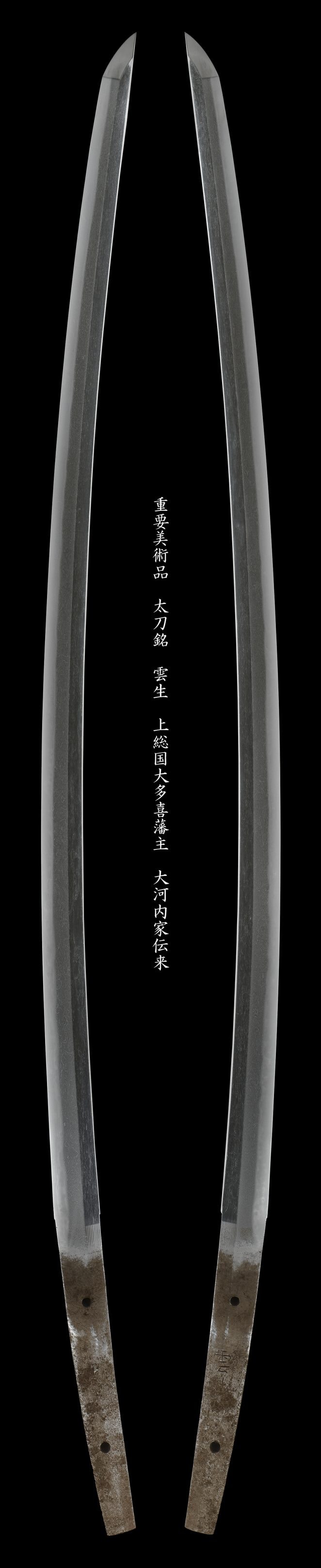
Tachi - Jubi - by Ukai Unsho - Kumoio - From the collection of the Okouchi family, lord of Otaki Domain, Kazusa ProvinceTachi - Jubi - by Ukai Unsho - Kumoio - From the collection of the Okouchi family, lord of Otaki Domain, Kazusa Province

Tachi

ByUkai Unsho
Ask
Aoi Art
Jūyō
Katana - Jūyō - by Aoe School - Mumei (Aoe school)Katana - Jūyō - by Aoe School - Mumei (Aoe school)

Katana

ByAoe School
¥3,200,000
Hyozaemon
Tokuho
Tachi - Tokuho - by Ko-Aoe Yoritsugu - Ko-Aoe YoritsuguTachi - Tokuho - by Ko-Aoe Yoritsugu - Ko-Aoe Yoritsugu

Tachi

ByKo-Aoe Yoritsugu
¥5,800,000
Tsuruginoya
Jūyō
Tachi - Jūyō - by Hatakeda Sanemori - Hatakeda Sanemori - Formerly owned by General Sadao ArakiTachi - Jūyō - by Hatakeda Sanemori - Hatakeda Sanemori - Formerly owned by General Sadao Araki

Tachi

ByHatakeda Sanemori
¥14,500,000

Swords

  • Katana
  • Wakizashi
  • Tantō
  • Tachi
  • Naginata
  • Yari
  • Japanese Swords
  • Samurai Swords

Fittings

  • Tsuba
  • Fuchi-Kashira
  • Kozuka
  • Menuki
  • Sword Guards (Tsuba)

Armor

  • Kabuto
  • Samurai Armor
  • All Samurai Armor

By Certification

  • Tokujū
  • Jūyō
  • Tokuho
  • Hozon

Resources

  • Dealer Directory
  • Artist Directory
  • The Daily Kantei
  • Glossary
  • Browse All
Nihontowatch© 2026
TermsPrivacyCookiesAbout
Sold

Description

This is a wakizashi by Kanemitsu, the 4th generation of the Osafune school, active in Bizen Province during the Nanbokucho period. It features a distinctive large form, tight itame hada with utsuri, and a hamon of kataochi gunome with strong nie, kinsuji, and sunagashi. The blade is dated Enbun 1 (1356) and comes with a koshirae featuring a Rokumonsen and cherry blossom design, traditionally associated with the Sanada family.

NBTHK Setsumei

Jūyō-Tōken, 46th Session — Designated October 5, 2000 Wakizashi, mei: Bishū Osafune Kanemitsu (備州長船兼光) Measurements Nagasa 32.75 cm, sori 0.2 cm, motohaba 2.55 cm, nakago-nagasa 10.3 cm, nakago-sori 0.15 cm Description Keijō: hira-zukuri, mitsu-mune; wide mihaba, overall large with slightly elongated proportions (sun-nobi), and a shallow sori. Kitae: compact itame-hada; very fine ji-nie; fine chikei interwoven; mixed with a jifu-like tendency; toward the edge a straight (sugu)-like utsuri stands out. Hamon: based on kataochi-gunome, mixed with ko-gunome and togariba; with ko-ashi; ko-nie adheres well; fine kinsuji and sunagashi run through it; the nioiguchi is bright and clear. Bōshi: midare-komi, with a pointed turn-back. Horimono: on the omote, a kurikara; on the ura, a bonji and gomabashi carved in overlapping composition. Nakago: ubu; ha-agari-gokoro kurijiri; katte-sagari yasurime; two mekugi-ana; below the central area beneath the omote mekugi-ana (the original hole) is a long signature cut with fine chisel-work, and on the ura there is likewise a date inscription. Artisan Kanemitsu (兼光) Era Nanbokuchō period; dated Enbun 1 (1356), month and day not fully legible Explanation Within the Bizen Osafune tradition, the main line begins with Mitsutada in the mid-Kamakura period and is transmitted through Nagamitsu and Kagemitsu, and then to Kanemitsu. Kanemitsu’s dated works extend over a long span of roughly forty-five years, from the Genkō era at the end of the Kamakura period through the Jōji era of the Nanbokuchō period. In terms of style, up through around the Kōei era of the Nanbokuchō period, he forges swords of ordinary, orthodox taihai, tempering kataochi-gunome and also suguha-leaning gunome-midare; these closely resemble the work of his father, Kagemitsu. From around the eras of Teiwa and Kōō, however, his sugata becomes larger in scale, and he begins to temper a previously unseen, relaxed notare-dominant hamon. Works of this latter type are most frequently encountered around the Bunna and Enbun eras; because they also emphasize nie, they are known in the world as “Sōden-Bizen.” This wakizashi displays Kanemitsu’s characteristic style: a tightly forged itame-hada with very fine ji-nie and intricate chikei, a straight (sugu)-like utsuri standing out, and a hamon in kataochi-gunome as the principal theme, with ko-ashi and a bōshi that turns in midare-komi and becomes pointed at the tip. Among works of this general type, the ha-nie here is particularly strong; the hardened edge is filled with nie and appears bright and clear, while fine kinsuji and sunagashi perform delicately throughout, producing a blade of deep interest and flavor.

NihontoWatch MonNihontoWatch
MarketEncyclopediaKantei
Swords›Bizen-den›Osafune›Sōden-Bizen›Kanemitsu›Wakizashi: Kanemitsu - Enbun 1st Year, 2nd Month
wakizashiJūyō
Osafune Kanemitsu

Wakizashi: Kanemitsu - Enbun 1st Year, 2nd Month

mei · Osafune · Nanbokucho · nagasa 32.7cm · sori 0.2cm

SOLD
Osafune Kanemitsu (兼光) · Osafune · Nanbokucho3 works for sale →
WakizashiJūyō
Could you name the smith from the blade alone? Today’s kantei →
Osafune Kanemitsu — 1 of 6
Osafune Kanemitsu — 2 of 6
Osafune Kanemitsu — 3 of 6
Osafune Kanemitsu — 4 of 6
Osafune Kanemitsu — 5 of 6
Osafune Kanemitsu — 6 of 6
1 / 6
1 / 6
Osafune Kanemitsu — 1 of 6Osafune Kanemitsu — 2 of 6Osafune Kanemitsu — 3 of 6Osafune Kanemitsu — 4 of 6Osafune Kanemitsu — 5 of 6Osafune Kanemitsu — 6 of 6
Osafune Kanemitsu (兼光) · Osafune · Nanbokucho3 works for sale →
WakizashiJūyō
Could you name the smith from the blade alone? Today’s kantei →
Measurements & details
Smith
Osafune Kanemitsu
Type
Wakizashi
School
Osafune
Period
Around 1323–1370(Shohei)
Province
Bizen
Signature
Signed(45% of this smith's designated works are signed)
Measurements
Nagasa 32.7cmSori 0.2cmMotohaba 2.5cmKasane 0.5cm
Description

This is a wakizashi by Kanemitsu, the 4th generation of the Osafune school, active in Bizen Province during the Nanbokucho period. It features a distinctive large form, tight itame hada with utsuri, and a hamon of kataochi gunome with strong nie, kinsuji, and sunagashi. The blade is dated Enbun 1 (1356) and comes with a koshirae featuring a Rokumonsen and cherry blossom design, traditionally associated with the Sanada family.

NBTHK Zufu Commentary

Juyo #46

AI translation — may contain errors

-, 46th Session — Designated October 5, 2000

, : Bishū Kanemitsu (備州長船兼光)

Measurements 32.75 cm, 0.2 cm, 2.55 cm, 10.3 cm, 0.15 cm

Description Keijō: , ; wide , overall large with slightly elongated proportions (), and a shallow . : compact ; very fine ; fine interwoven; mixed with a -like tendency; toward the edge a straight ()-like stands out. : based on , mixed with and ; with ; adheres well; fine and run through it; the is bright and clear. : , with a pointed turn-back. : on the , a ; on the , a and carved in overlapping composition. : ; ; ; two ; below the central area beneath the (the original hole) is a long signature cut with fine chisel-work, and on the there is likewise a date inscription.

Artisan Kanemitsu (兼光)

Era period; dated Enbun 1 (1356), month and day not fully legible

Explanation Within the tradition, the main line begins with Mitsutada in the mid- period and is transmitted through Nagamitsu and Kagemitsu, and then to Kanemitsu. Kanemitsu’s dated works extend over a long span of roughly forty-five years, from the Genkō era at the end of the period through the Jōji era of the period.

In terms of style, up through around the Kōei era of the period, he forges swords of ordinary, orthodox , tempering and also -leaning ; these closely resemble the work of his father, Kagemitsu. From around the eras of Teiwa and Kōō, however, his becomes larger in scale, and he begins to temper a previously unseen, relaxed -dominant . Works of this latter type are most frequently encountered around the Bunna and Enbun eras; because they also emphasize , they are known in the world as “Sōden-Bizen.”

This displays Kanemitsu’s characteristic style: a tightly forged with very fine and intricate , a straight ()-like standing out, and a in as the principal theme, with and a that turns in and becomes pointed at the tip. Among works of this general type, the here is particularly strong; the hardened edge is filled with and appears bright and clear, while fine and perform delicately throughout, producing a blade of deep interest and flavor.

About the maker

Kanemitsu

兼光

Osafune (Bizen) · Bizen · around 1323-1370

Fujishiro Sai-jo saku

3 pieces on the market now

›

The published sources open their account of Kanemitsu with one fixed sentence: he is "the mainline heir of the Osafune school, following Kagemitsu"[[c:1]]. Son of Kagemitsu and fourth master of the line that runs from Mitsutada through Nagamitsu and Kagemitsu, he stands as the leading Bizen smith of the Nanbokucho period. His dated works span what the NBTHK calls an unusually long period, roughly forty-five years from Genko 1 (1321) at the close of the Kamakura period through the Joji era (1362-1368), and some designations carry the span to Oan and read it as fully fifty years. So long a working life raises, in the sources' own framing, the question of a first and a second generation, with no settled view as to where the division should fall; the later master is known to the record as "Enbun Kanemitsu"[[c:2]].

His hand divides at a watershed the published sources place in the Jowa and Kan'o eras (1345-1352). Until around Koei both tachi and tanto keep standard proportions, tempered either in a suguha tone mixed with gunome or in the kataochi-gunome he inherited from his father, work that in the recurring judgment of the designations "wholly follows the father Kagemitsu's manner"[[c:3]]. From Jowa and Kan'o the build turns grand, and the sentence nearly every later designation repeats takes over: "a notare-dominant hamon that had not existed before appears, and is met most often around Bunna and Enbun"[[c:4]]. The broad, unhurried notare and the angular kaku-gunome are alike singled out as "what Kanemitsu excelled in"[[c:5]], and one Tokubetsu Juyo description calls the angular gunome "the construction he favored from first to last"[[c:6]]. Against the rounder returns of the earlier mainline, his boshi runs in midare, often thrusting up before a pointed tip.

Even at the grand scale the forging holds. The jigane is itame mixed with mokume, and the NBTHK remarks of one Tokubetsu Juyo katana that it shows not the slightest loosening or coarseness of the surface pattern from base through tip. Fine ji-nie adheres thickly, fine chikei enter, and a midare-utsuri stands out, often called vivid, the steel bright; on the early ubu-signed pieces the reflection is rather a sugu-utsuri or bo-utsuri over a tight ko-itame. The temper is for the most part nioi-dominant with ko-nie. Kinsuji and sunagashi gather toward the koshimoto, small tobiyaki and yubashiri-like effects appear in places, and ashi and yo enter freely. To this he adds a distinctive program of carving: bonji, gomabashi and suken, and above all the cursive grass-style kurikara[[c:7]], a composition the sources note recurs on works of Kanemitsu and Tomomitsu, and at times Chikakage.

Most of what survives from the late phase is the o-suriage mumei katana of the Enbun-Joji build: wide in mihaba with little taper from base to tip, the kissaki large, the sori shallow or moderately deep. Beside it stand the sunnobi hira-zukuri tanto and ko-wakizashi, broad and thin with shallow sori, and the long hira-zukuri blades signed on the sashi-omote, made as uchigatana from the outset, of which the Uesugi "Suijin-giri"[[c:8]] is the recorded example. Signed work is plentiful for so heavily shortened an oeuvre, one hundred ten signed against ninety-eight unsigned among the blades gathered here, the long signatures reading Bizen no Kuni Osafune-ju Kanemitsu[[c:9]] or Bishu Osafune-ju Kanemitsu[[c:10]], many with dates. The strengthened nie of the late manner the sources read with their own hedge, "possibly under the influence of the Soshu tradition"[[c:11]], adding that "since the nie also is emphasized, the work is known in the world as Soden-Bizen"[[c:12]]. The older designations go further only as a question: one Juyo note finds in the turn to notare "the relation to Soshu Masamune, together with the succession of a first and second generation"[[c:13]], the Masamune-pupil tradition held open, never asserted. The many shortened mumei blades carry kinzogan attributions of the Honami line, Kotoku and Koson among them, which the NBTHK in case after case upholds.

Within Bizen his place is fixed by what he carried and what he introduced. The kataochi-gunome descends to him through Kagemitsu alone within the school's mainline, and the notare is his own addition, the broad, unforced midare that, in the words of one Tokubetsu Juyo description, this smith pioneered among Bizen craftsmen. His grand manner passes into late Osafune through his circle: the published sources read related blades as work of the sphere surrounding Kanemitsu, and the cursive kurikara he favored recurs in Tomomitsu.

Fujishiro grades him Sai-jo saku, and two hundred thirty-seven designated works stand on record. No National Treasure is among them, but thirteen blades hold the rank of Important Cultural Property, and the named swords cluster there: the meibutsu O-Kanemitsu (大兼光) and the tachi of Uesugi Kagekatsu's hand-picked thirty-five, both cited in the record as Important Cultural Properties, and the meibutsu Nami-oyogi Kanemitsu (波游兼光), whose gold inlay records the ownership of Hashiba Okayama Chunagon Hideakira, identified as Kobayakawa Hideaki. Forty of his blades hold the Tokubetsu Juyo rank, the most of any swordsmith, and with the Juyo blades the two tiers carry two hundred two. The provenance roll is deep, sixty-nine blades with recorded histories: Ashikaga Takauji, Uesugi Kenshin and Uesugi Kagekatsu, Toyotomi Hideyoshi, Todo Takatora, and the Kuroda, Date, Hosokawa, Maeda and Owari Tokugawa houses; one Juyo katana went to Tokugawa Iemitsu as the bequest of Sugihara Hoki no Kami Shigenaga, and another descended in the Masuda family, hereditary elders of the Choshu domain. The Important Cultural Property and Juyo Bijutsuhin pieces rest as patrimony in shrines, museums and long-held collections, the Tokugawa Art Museum, the Sano Art Museum and Eisei Bunko among recorded holders. For the collector the field is less closed than with most names of this rank: blades of the Tokubetsu Juyo and Juyo tiers, many of recorded private whereabouts, appear from time to time. Yet most are held rather than traded, and a signed and dated piece of either phase is a landmark when it comes.
Historical importance

Where Kanemitsu stands among comparable artisans: across all of nihontō, and within tradition, era, and period. The tiers (Foremost · Leading · Major · Notable) weigh official designations from the NBTHK and Japan's Agency for Cultural Affairs, together with historical honors of lasting repute such as the Sansaku and Meibutsu-chō.

随一
Foremost
屈指
Leading
有数
Major
著名
Notable

Select a lens to see how it's measured.

Designation record
231 designated works
Jūyō Bunkazai
13
Jūyō Bijutsuhin
12
Gyobutsu (Imperial)
6
Tokubetsu Jūyō
40
Jūyō
160
3 works by Kanemitsu on the market→
Kanemitsu — full profileOsafune (Bizen) school

Dated Works

Years he was demonstrably active, proven by signed-and-dated blades

Active period
1323–1361Editorial estimate: 1323–1370
39 of 95 designated works carry a date
1320
1330
1340
1350
1360
1370

Study this maker →

About the school

Osafune

長船

Bizen-den · Bizen

237 pieces on the market now

›

No single workshop in the history of Japanese swordmaking grew larger or lasted longer than Osafune, the riverside village in Bizen Province whose name became, across three centuries, a byword for the province's mainline. Its de facto founder was Mitsutada (光忠), working at Osafune in the middle Kamakura period; tradition makes him the son of Chikatada, and the genealogies derive his line from the Ko-Bizen Masatsune group already settled in the village. His blades, bold and imposing with a jigane so refined the sources say it can at a glance suggest Kyoto work, were treasured from old as the swords of commanders, and from his hand the school spread immediately: his sons Nagamitsu (長光) and Sanenaga (眞長), his grandson Kagemitsu (景光), and outward through pupils and collaterals until, by the late Kamakura years, Osafune was less a family than an industry. The line is conventionally read as a three-generation spine, Mitsutada founding it, Nagamitsu setting its classical standard, Kagemitsu bringing both temper and forging to their finished form before handing the manner to his pupil Chikakage (近景), whose echo of the master is so close that signed Kagemitsu blades are sometimes read as Chikakage daimei. What binds the membership is a shared steel before any shared temper. The forging is itame mixed with mokume, tightening on the finest blades into a dense ko-itame; fine ji-nie adheres, chikei enter, and over all of it stands the midare-utsuri that anchors even the most Kyoto-like jigane back to Bizen. On that floor the founding generation tempers a flamboyant choji-midare mixed with gunome: Mitsutada's tadpole-headed kawazuko-choji, Nagamitsu's round-topped plump choji, the deep nioi with ko-nie, the bright nioiguchi. From here the school divides by hand and by era. Sanenaga draws the calm pole, a gentle chu-suguha of tightened nioiguchi; Kagemitsu completes the slanting, square-shouldered kataochi-gunome over a suguha base, the family's last great Kamakura invention, carried on by his close kinsman Kagemasa (景政). The Nanbokucho generation then turns toward Soshu-den: Kanemitsu (兼光), fourth master of the mainline, pioneers a broad notare and is read, with Chogi (長義), as the head of Soden-Bizen, the Bizen wing that worked Soshu nie into a jigane that still throws a Bizen utsuri.

Chogi is called the most un-Bizen of Bizen smiths, his ear-shaped mimigata his tell; around him Nagashige (長重), Yoshikage (義景), Tomomitsu (倫光) and Kanenaga (兼長) press the Soshu side by degrees, while Motoshige (元重), of a separate Hatakeda descent, carries an Aoe-tinged squared, slanting ha. Two generations later the Oei revival returns to Kamakura: Yasumitsu (康光) and Morimitsu (盛光), the twin pillars of Oei-Bizen, revive the tachi shape and the choji temper over a wide-waisted koshibiraki-gunome, both finishing in the pointed rosoku-no-shin (candle-wick) boshi that gives the late date away. For the collector the school is a school of discriminations, and to kantei it is to read those fine partitions. The constant midare-utsuri over a bright ko-itame fixes the province; the boshi then sorts the maker, Mitsutada's pointed midare-komi against Nagamitsu's composed ko-maru Sansaku turn, Kagemitsu's contained return, the candle-wick tongue of Oei. Within a single phase the calls turn on a half-step: Nagamitsu's plump crests against Sanenaga's cooler nioiguchi, Kagemasa's freer play against Kagemitsu's tighter order, Nagashige read out of Chogi by a nie that surpasses his brother's. The standing of the best is matched by their patrimony. Mitsutada, Nagamitsu and Kagemitsu each hold National Treasures and stand at the head of Fujishiro's Sai-jo saku; their named blades, the Daihannya Nagamitsu, the Kogaryu Kagemitsu, the O-Kanemitsu, passed through Nobunaga, Ieyasu, Uesugi Kenshin and the great daimyo houses. Because Nagamitsu and the Nanbokucho masters signed and survived in number, Osafune offers what most peerage names cannot, a deep field of Tokubetsu Juyo and Juyo work that a patient collector may still realistically hold. Through every register the same hand declares itself: the bright steel, the vivid reflection, and a temper that runs, across three centuries, as the spine of Bizen. Learn more →
113 recorded smiths2013 designated works
Leading smiths
SmithEraDesignated
Mitsutada光忠1238-123960
Nagamitsu長光1274-1304244
Kagemitsu景光1303-1336143
Kanemitsu兼光1323-1370231
Sanenaga眞長1299-130964
Explore the Osafune school →

Historical context

Bizen in the Nanbokuchō period

›

Sixty years of war between two courts drove blades long and broad, and Osafune met the demand: Kanemitsu and Chōgi led forges serving the provincial warriors who did the fighting, while Sōshū influence arrived with the armies to create Sōden-Bizen.

Bizen in the Nanbokuchō period →

NBTHK Certificate
Jūyō Tōken重要刀剣
Important Sword
›

A blade of top-grade workmanship and condition, formally judged to rank with a nationally recognized Important Art Object (Jūyō Bijutsuhin). Awarded only at the NBTHK’s competitive annual examination.

About the NBTHK›

The NBTHK (Nihon Bijutsu Tōken Hozon Kyōkai, the Society for the Preservation of Japanese Art Swords) is a public-interest incorporated foundation founded in 1948 and supervised by Japan’s Agency for Cultural Affairs (Bunkachō); it is based at the Japanese Sword Museum in Tokyo. Its expert panels physically examine each submitted work (shinsa) and issue a certificate (kanteishō) ranking it by artistic and historical merit. NBTHK papers are the most widely recognized standard of authentication for Japanese swords and fittings.
NBTHK official site→
Seller
I
Iida Koendo
Established 1880 · 146 yrs on the market
🇯🇵Ships from Japan
›
✓Verified dealeriidakoendo.com
✓Ships worldwide✓English supportWire transfer
Return policy

Customer-initiated returns accepted within two days of arrival; return shipping paid by customer and fees non-refundable. Returns/refunds unavailable for overseas deliveries.
View all of Iida Koendo’s listings→View this item on the dealer’s site→

More works by Osafune Kanemitsu

View all →
Samurai Museum
Katana - by Osafune Kanemitsu - Attributed to Den Osafune Kanemitsu - NTHK Yushu Saku Kanteisho CertificateKatana - by Osafune Kanemitsu - Attributed to Den Osafune Kanemitsu - NTHK Yushu Saku Kanteisho Certificate

Katana

ByOsafune Kanemitsu
¥4,300,000
Goushuya
Jūyō
Katana - Jūyō - by Osafune Kanemitsu - Kanemitsu with Gold Inlay InscriptionKatana - Jūyō - by Osafune Kanemitsu - Kanemitsu with Gold Inlay Inscription

Katana

ByOsafune Kanemitsu
Ask
Iida Koendo
Jūyō
Katana - Jūyō - by Osafune Kanemitsu - KanemitsuKatana - Jūyō - by Osafune Kanemitsu - Kanemitsu

Katana

ByOsafune Kanemitsu
¥11,000,000

Previously sold by Osafune Kanemitsu

View all →
Nipponto
Jūyō
Katana - Jūyō - by Osafune Kanemitsu - Juyo Katana by Osafune Kanemitsu (O-Kanemitsu), MumeiKatana - Jūyō - by Osafune Kanemitsu - Juyo Katana by Osafune Kanemitsu (O-Kanemitsu), Mumei
Sold

Katana

ByOsafune Kanemitsu
SOLD
Aoi Art
Tokuho
Tanto - Tokuho - by Osafune Kanemitsu - Bishu Osafune Kanemitsu - A day in August, Enbun eraTanto - Tokuho - by Osafune Kanemitsu - Bishu Osafune Kanemitsu - A day in August, Enbun era
Sold

Tantō

ByOsafune Kanemitsu
SOLD
Gallery Youyou
Jūyō
Tanto - Jūyō - by Osafune Kanemitsu - Bishu Osafune Kanemitsu, Dated Jowa 2 (1346) - With KoshiraeTanto - Jūyō - by Osafune Kanemitsu - Bishu Osafune Kanemitsu, Dated Jowa 2 (1346) - With Koshirae
Sold

Tantō

ByOsafune Kanemitsu
SOLD
Choshuya
Tanto - by Osafune Kanemitsu - Bizen Osafune KanemitsuTanto - by Osafune Kanemitsu - Bizen Osafune Kanemitsu
Sold

Tantō

ByOsafune Kanemitsu
SOLD
Eirakudo
Tokuho
Katana - Tokuho - by Osafune Kanemitsu - Kanemitsu - Tokubetsu Hozon TokenKatana - Tokuho - by Osafune Kanemitsu - Kanemitsu - Tokubetsu Hozon Token
Sold

Katana

ByOsafune Kanemitsu
SOLD
Choshuya
Tanto - by Osafune Kanemitsu - Bishu Osafune Kanemitsu (Saijo O-Wazamono)Tanto - by Osafune Kanemitsu - Bishu Osafune Kanemitsu (Saijo O-Wazamono)
Sold

Tantō

ByOsafune Kanemitsu
SOLD
Samurai Nippon
Jūyō
Wakizashi - Jūyō - by Osafune Kanemitsu - Bishu Osafune KanemitsuWakizashi - Jūyō - by Osafune Kanemitsu - Bishu Osafune Kanemitsu
Sold

Wakizashi

ByOsafune Kanemitsu
SOLD
Unique Japan
Tokuho
Tanto - Tokuho - by Osafune Kanemitsu - A Shodai Kanemitsu TantoTanto - Tokuho - by Osafune Kanemitsu - A Shodai Kanemitsu Tanto
Sold

Tantō

ByOsafune Kanemitsu
SOLD

More Sōden-Bizen works

View all →
Aoi Art
Jūyō
Katana - Jūyō - by Osafune Shigezane - Mumei (Attributed to Shigezane) - 27th NBTHK Juyo TokenKatana - Jūyō - by Osafune Shigezane - Mumei (Attributed to Shigezane) - 27th NBTHK Juyo Token

Katana

ByOsafune Shigezane
Starting Bid¥4,600,000
Eirakudo
Jūyō
Katana - Jūyō - by Motoshige - Motoshige - Juyo TokenKatana - Jūyō - by Motoshige - Motoshige - Juyo Token

Katana

ByMotoshige
¥6,000,000
Aoi Art
Tokuho
Katana - Tokuho - by Osafune Shigezane - Mumei (Osafune Shigezane) - NBTHK Tokubetsu Hozon TokenKatana - Tokuho - by Osafune Shigezane - Mumei (Osafune Shigezane) - NBTHK Tokubetsu Hozon Token

Katana

ByOsafune Shigezane
¥1,650,000
Nihonto Australia
Tokujū
Katana - Tokuju - by Chogi Yoshikage - A Tokubetsu Juyo Masterpiece Yoshikage KatanaKatana - Tokuju - by Chogi Yoshikage - A Tokubetsu Juyo Masterpiece Yoshikage Katana

Katana

ByChogi Yoshikage
Ask
Choshuya
Jūyō
Tachi - Jūyō - by Osafune Masamitsu - Bishu Osafune (Ika-kire Masamitsu) Meitoku 3 nen 8 gatsu (Ika-kire)Tachi - Jūyō - by Osafune Masamitsu - Bishu Osafune (Ika-kire Masamitsu) Meitoku 3 nen 8 gatsu (Ika-kire)

Tachi

ByOsafune Masamitsu
¥4,300,000
Tsuruginoya
Jūyō
Tachi - Jūyō - by Osafune Masamitsu - Bizen Osafune MasamitsuTachi - Jūyō - by Osafune Masamitsu - Bizen Osafune Masamitsu

Tachi

ByOsafune Masamitsu
¥4,800,000
Eirakudo
Tokuho
Tachi - Tokuho - by Osafune Chikakage - Zaimei Chikakage Tachi Tokubetsu Hozon TokenTachi - Tokuho - by Osafune Chikakage - Zaimei Chikakage Tachi Tokubetsu Hozon Token

Tachi

ByOsafune Chikakage
¥5,500,000
Hyozaemon
Jūyō
Tachi - Jūyō - by Motoshige - Tachi by Osafune MotoshigeTachi - Jūyō - by Motoshige - Tachi by Osafune Motoshige

Tachi

ByMotoshige
Ask

More from the Osafune school

View all →
Aoi Art
Tokuho
Wakizashi - Tokuho - by Oei-Bizen Morimitsu - Bishū Osafune Morimitsu, dated Ōei 26 (1419) - NBTHK Tokubetsu Hozon TokenWakizashi - Tokuho - by Oei-Bizen Morimitsu - Bishū Osafune Morimitsu, dated Ōei 26 (1419) - NBTHK Tokubetsu Hozon Token

Wakizashi

ByOei-Bizen Morimitsu
Starting Bid¥1,500,000
Aoi Art
Jūyō Bijutsuhin
Daisho - Jubi - by Osafune Nagamitsu - Dai Sho: Katana (Important Art Object): Mumei (Attributed to Nagamitsu) / Wakizashi: Mumei (Attributed to Sekishu Naotsuna)Daisho - Jubi - by Osafune Nagamitsu - Dai Sho: Katana (Important Art Object): Mumei (Attributed to Nagamitsu) / Wakizashi: Mumei (Attributed to Sekishu Naotsuna)

Daishō

ByOsafune Nagamitsu
Ask
Samurai Museum
Tokuho
Wakizashi - Tokuho - by Osafune Kagemitsu - Antique Japanese Sword Wakizashi Attributed to Den Osafune Kagemitsu NBTHK Tokubetsu Hozon CertificateWakizashi - Tokuho - by Osafune Kagemitsu - Antique Japanese Sword Wakizashi Attributed to Den Osafune Kagemitsu NBTHK Tokubetsu Hozon Certificate

Wakizashi

ByOsafune Kagemitsu
¥3,200,000
Nihonto.com
Jūyō
Tanto - Jūyō - by Osafune Kagemitsu - Juyo Tanto by Bizen KagemitsuTanto - Jūyō - by Osafune Kagemitsu - Juyo Tanto by Bizen Kagemitsu

Tantō

ByOsafune Kagemitsu
¥89,500
Touken Matsumoto
Tokuho
Katana - Tokuho - by Sukesada School - Bishu Osafune SukesadaKatana - Tokuho - by Sukesada School - Bishu Osafune Sukesada

Katana

BySukesada School
¥650,000
Goushuya
Tokujū
Tachi - Tokuju - by Oei-Bizen Morimitsu - Morimitsu - Tokubetsu Juyo TokenTachi - Tokuju - by Oei-Bizen Morimitsu - Morimitsu - Tokubetsu Juyo Token

Tachi

ByOei-Bizen Morimitsu
Ask
Nipponto
Tokuho
Wakizashi - Tokuho - by Oei-Bizen Yasumitsu - Japanese Sword: Bishu Osafune Yasumitsu, Oei 33rd Year, February (O-wazamono) - WakizashiWakizashi - Tokuho - by Oei-Bizen Yasumitsu - Japanese Sword: Bishu Osafune Yasumitsu, Oei 33rd Year, February (O-wazamono) - Wakizashi

Wakizashi

ByOei-Bizen Yasumitsu
¥1,200,000
Iida Koendo
Jūyō
Tachi - Jūyō - by Osafune Nagamitsu - Bizenkoku Osafune ju Sakonshogen Nagamitsu tsukuru, Einin Gannen Junigatsu HiTachi - Jūyō - by Osafune Nagamitsu - Bizenkoku Osafune ju Sakonshogen Nagamitsu tsukuru, Einin Gannen Junigatsu Hi

Tachi

ByOsafune Nagamitsu
¥55,000,000

More from the Bizen tradition

View all →
Hyozaemon
Tokuho
Tokuho - by Fukuoka Ichimonji Yoshifusa - Naginata Naoshi Wakizashi by Fukuoka Ichimonji Yoshifusa, a Master of IchimonjiTokuho - by Fukuoka Ichimonji Yoshifusa - Naginata Naoshi Wakizashi by Fukuoka Ichimonji Yoshifusa, a Master of Ichimonji

Naginata Naoshi Wakizashi by Fukuoka Ichimonji Yoshifusa, a Master of Ichimonji

ByFukuoka Ichimonji Yoshifusa
Ask
Eirakudo
Tokuho
Katana - Tokuho - by Katayama Ichimonji School - Katayama Ichimonji - Tokubetsu Hozon TokenKatana - Tokuho - by Katayama Ichimonji School - Katayama Ichimonji - Tokubetsu Hozon Token

Katana

ByKatayama Ichimonji School
¥4,500,000
Eirakudo
Tokuho
Wakizashi - Tokuho - by Ichimonji School - Fukuoka Ichimonji Wakizashi Tokubetsu Hozon TokenWakizashi - Tokuho - by Ichimonji School - Fukuoka Ichimonji Wakizashi Tokubetsu Hozon Token

Wakizashi

ByIchimonji School
¥3,500,000
Tsuruginoya
Jūyō
Katana - Jūyō - by Fukuoka Ichimonji School - Mumei Fukuoka IchimonjiKatana - Jūyō - by Fukuoka Ichimonji School - Mumei Fukuoka Ichimonji

Katana

ByFukuoka Ichimonji School
Ask
Goushuya
Jūyō Bijutsuhin
Tachi - Jubi - by Ukai Unsho - Kumoio - From the collection of the Okouchi family, lord of Otaki Domain, Kazusa ProvinceTachi - Jubi - by Ukai Unsho - Kumoio - From the collection of the Okouchi family, lord of Otaki Domain, Kazusa Province

Tachi

ByUkai Unsho
Ask
Aoi Art
Jūyō
Katana - Jūyō - by Aoe School - Mumei (Aoe school)Katana - Jūyō - by Aoe School - Mumei (Aoe school)

Katana

ByAoe School
¥3,200,000
Hyozaemon
Tokuho
Tachi - Tokuho - by Ko-Aoe Yoritsugu - Ko-Aoe YoritsuguTachi - Tokuho - by Ko-Aoe Yoritsugu - Ko-Aoe Yoritsugu

Tachi

ByKo-Aoe Yoritsugu
¥5,800,000
Tsuruginoya
Jūyō
Tachi - Jūyō - by Hatakeda Sanemori - Hatakeda Sanemori - Formerly owned by General Sadao ArakiTachi - Jūyō - by Hatakeda Sanemori - Hatakeda Sanemori - Formerly owned by General Sadao Araki

Tachi

ByHatakeda Sanemori
¥14,500,000

Swords

  • Katana
  • Wakizashi
  • Tantō
  • Tachi
  • Naginata
  • Yari
  • Japanese Swords
  • Samurai Swords

Fittings

  • Tsuba
  • Fuchi-Kashira
  • Kozuka
  • Menuki
  • Sword Guards (Tsuba)

Armor

  • Kabuto
  • Samurai Armor
  • All Samurai Armor

By Certification

  • Tokujū
  • Jūyō
  • Tokuho
  • Hozon

Resources

  • Dealer Directory
  • Artist Directory
  • The Daily Kantei
  • Glossary
  • Browse All
Nihontowatch© 2026
TermsPrivacyCookiesAbout
Sold
NihontoWatch MonNihontoWatch
Market
Encyclopedia
Kantei
NihontoWatch MonNihontoWatch
Market
Encyclopedia
Kantei