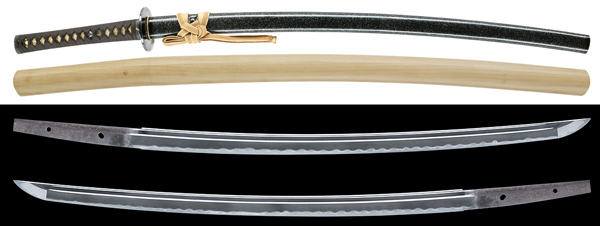
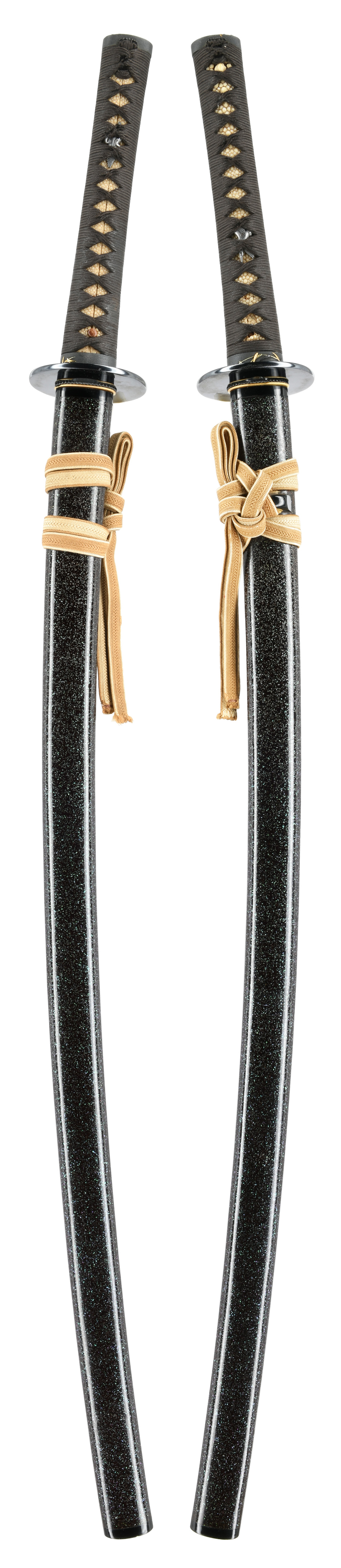
Sixty years of war between two courts drove blades long and broad, and Osafune met the demand: Kanemitsu and Chōgi led forges serving the provincial warriors who did the fighting, while Sōshū influence arrived with the armies to create Sōden-Bizen.
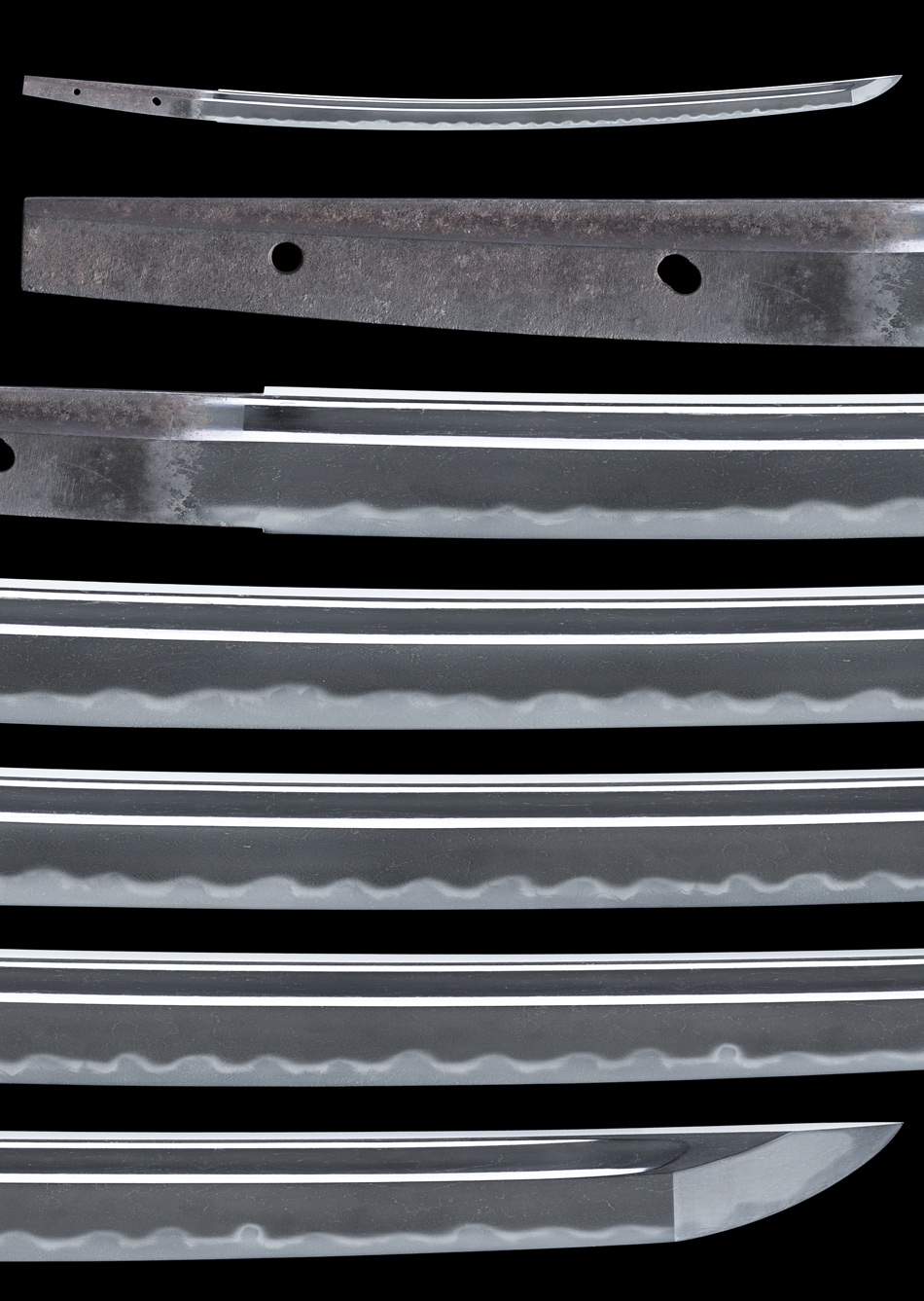
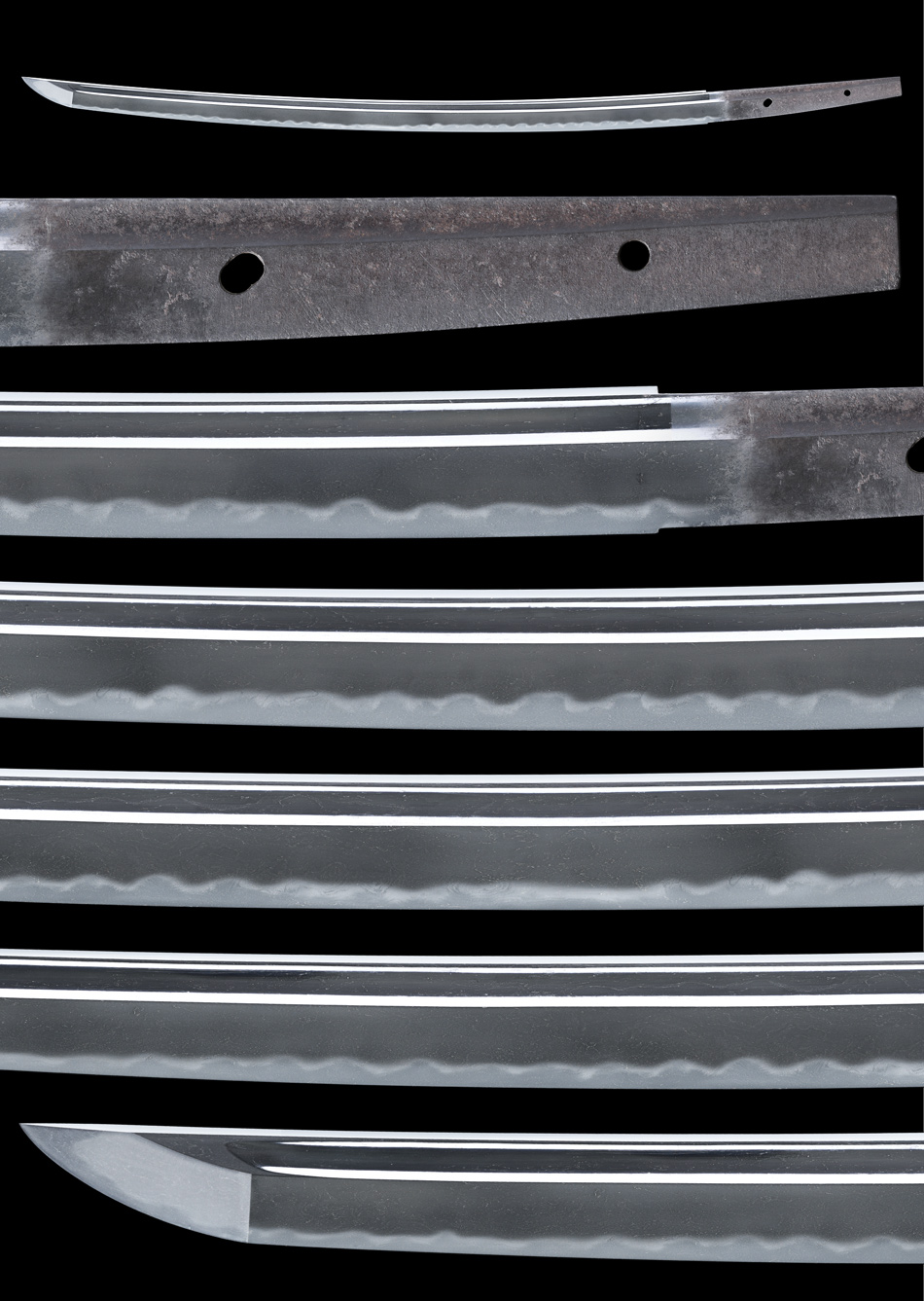
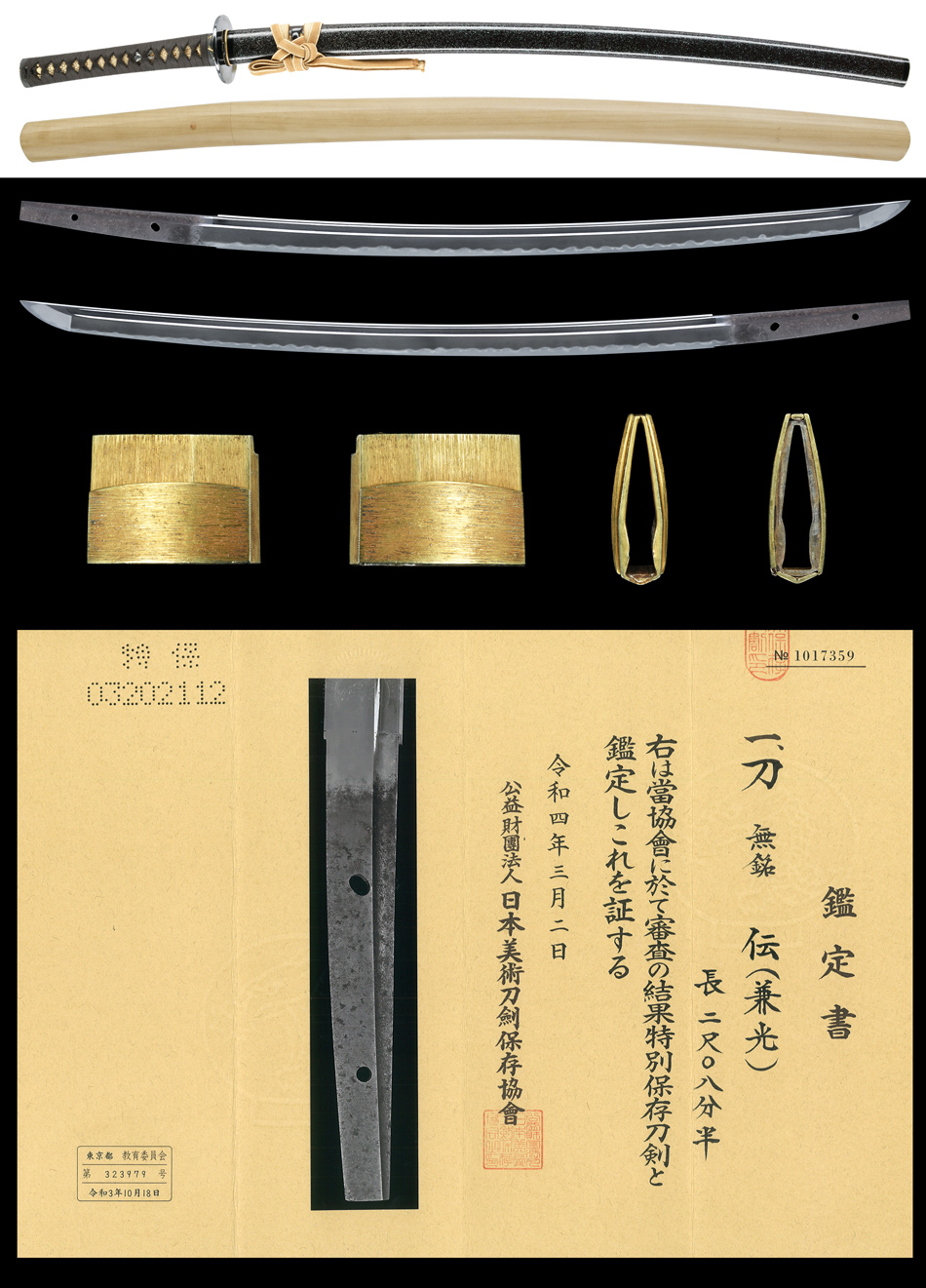
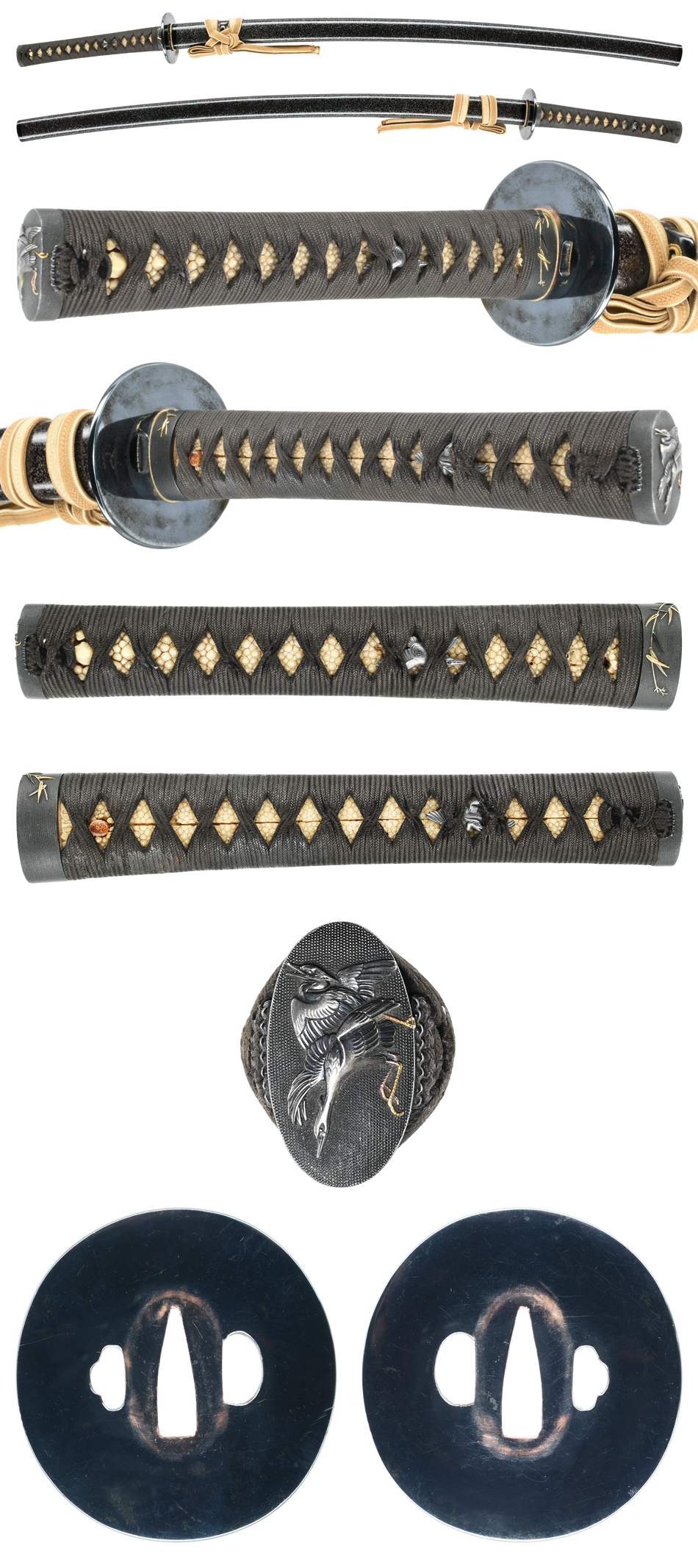
The Nanbokucho period was an era of conflict that divided the Imperial Court into two, and its influence spread to nihonto without exception. Regarding the sugata of tachi, a wider mihaba and a greatly extended kissaki were favored, and similarly for tanto, those with a wide mihaba were preferred. It is said that these trends were caused by the social and cultural fashion of the time known as "Basara," an aesthetic of meritocracy that favored stylish, flashy, and flamboyant clothing and items. Within the Osafune school of that time, the maker of this work, Kanemitsu, the fourth generation counting from the founder Mitsutada and the legitimate lineage of the Osafune school, wielded his hammer as the head of the school. His sakuto period is seen to be from around Genko (1321) to around Joji (1362), and within that span, a great transformation in style is seen around the border of the Jowa era (1350). Compared to his previous style which followed or resembled the works of his father Kagemitsu, such as suguha-cho, kaku-gunome, and kataochi-gunome, his style changed toward large-sized works inheriting the style of Soshu Masamune, with notare as the main theme. These works that incorporate Soshu-den and emphasize nie in the ji-ba are called "Soden Bizen." While introducing a new wind into the forging methods of the time, this smith, who led not only the Osafune school but the entire era, has been famous since ancient times as a representative swordsmith of Soden Bizen alongside Osafune Nagayoshi, and is counted as one of the 14 smiths in the Chokoto Saijo-saku and Saijo O-wazamono ranks. The taihai of this katana has a nagasa of 2 shaku 0 sun 8 bu 5 rin. The mihaba is wide, the kasane is thin, the sori is moderately effective, and the chu-kissaki is extended, forming a grand and powerful sword sugata of the Nanbokucho period. Bo-hi are carved through on the omote and ura. The jigane is itame-hada with a flowing feeling mixed with mokume, and the hada appears well overall. Ji-nie attaches well, fine chikei enters along the hada-me, and midare-utsuri stands out, presenting an extremely finely forged jigane. The hamon is based on gunome-midare in ko-nie honi, mixed with togari-ba, ko-choji, and kataochi-style gunome which is the style of his father Kagemitsu; in places it becomes koshi-hiraki in spirit, showing a flamboyant midare, and the nioiguchi is extremely bright and clear. Inside the ha, ko-ashi and yo enter, and the activities in the ji reach the habuchi, appearing as kinsan, making for active hataraki. The boshi is notare-kokoro, midare-komi, and returns to a ko-maru saki. The koshirae is an aogai mijin-nuri saya where the aogai shines beautifully overall and is flamboyant, and combined with high-quality kanagu, a dignified work is attached. This work is a production by Osafune Kanemitsu, who represents Soden Bizen, and from the deki of the ji-ba, it is conjectured to be a blade from a transitional period just before his sakuto changed toward a style strongly conscious of Soshu-den. The change in style of the same swordsmith and the forging techniques showing the color of the era can be felt remarkably, making it a supreme masterpiece where the original interest of the "nihonto" can be strongly felt. Shirasaya, kin-paku niju habaki, aogai mijin-nuri saya uchigatana koshirae, Tokubetsu Hozon Token Kanteisho.
Offered by World Seiyudo
This piece has sold
Get an email when a new Osafune Kanemitsu piece hits the market.


Machine translation from the shop's Japanese · may contain errors ·
Osafune (Bizen) · Bizen · around 1323-1370
Fujishiro Sai-jo saku
3 pieces on the market now
The published sources open their account of Kanemitsu with one fixed sentence: he is "the mainline heir of the Osafune school, following Kagemitsu"[[c:1]]. Son of Kagemitsu and fourth master of the line that runs from Mitsutada through Nagamitsu and Kagemitsu, he stands as the leading Bizen smith of the Nanbokucho period. His dated works span what the NBTHK calls an unusually long period, roughly forty-five years from Genko 1 (1321) at the close of the Kamakura period through the Joji era (1362-1368), and some designations carry the span to Oan and read it as fully fifty years. So long a working life raises, in the sources' own framing, the question of a first and a second generation, with no settled view as to where the division should fall; the later master is known to the record as "Enbun Kanemitsu"[[c:2]].
His hand divides at a watershed the published sources place in the Jowa and Kan'o eras (1345-1352). Until around Koei both tachi and tanto keep standard proportions, tempered either in a suguha tone mixed with gunome or in the kataochi-gunome he inherited from his father, work that in the recurring judgment of the designations "wholly follows the father Kagemitsu's manner"[[c:3]]. From Jowa and Kan'o the build turns grand, and the sentence nearly every later designation repeats takes over: "a notare-dominant hamon that had not existed before appears, and is met most often around Bunna and Enbun"[[c:4]]. The broad, unhurried notare and the angular kaku-gunome are alike singled out as "what Kanemitsu excelled in"[[c:5]], and one Tokubetsu Juyo description calls the angular gunome "the construction he favored from first to last"[[c:6]]. Against the rounder returns of the earlier mainline, his boshi runs in midare, often thrusting up before a pointed tip.
Even at the grand scale the forging holds. The jigane is itame mixed with mokume, and the NBTHK remarks of one Tokubetsu Juyo katana that it shows not the slightest loosening or coarseness of the surface pattern from base through tip. Fine ji-nie adheres thickly, fine chikei enter, and a midare-utsuri stands out, often called vivid, the steel bright; on the early ubu-signed pieces the reflection is rather a sugu-utsuri or bo-utsuri over a tight ko-itame. The temper is for the most part nioi-dominant with ko-nie. Kinsuji and sunagashi gather toward the koshimoto, small tobiyaki and yubashiri-like effects appear in places, and ashi and yo enter freely. To this he adds a distinctive program of carving: bonji, gomabashi and suken, and above all the cursive grass-style kurikara[[c:7]], a composition the sources note recurs on works of Kanemitsu and Tomomitsu, and at times Chikakage.
Most of what survives from the late phase is the o-suriage mumei katana of the Enbun-Joji build: wide in mihaba with little taper from base to tip, the kissaki large, the sori shallow or moderately deep. Beside it stand the sunnobi hira-zukuri tanto and ko-wakizashi, broad and thin with shallow sori, and the long hira-zukuri blades signed on the sashi-omote, made as uchigatana from the outset, of which the Uesugi "Suijin-giri"[[c:8]] is the recorded example. Signed work is plentiful for so heavily shortened an oeuvre, one hundred seven signed against ninety-five unsigned among the blades gathered here, the long signatures reading Bizen no Kuni Osafune-ju Kanemitsu[[c:9]] or Bishu Osafune-ju Kanemitsu[[c:10]], many with dates. The strengthened nie of the late manner the sources read with their own hedge, "possibly under the influence of the Soshu tradition"[[c:11]], adding that "since the nie also is emphasized, the work is known in the world as Soden-Bizen"[[c:12]]. The older designations go further only as a question: one Juyo note finds in the turn to notare "the relation to Soshu Masamune, together with the succession of a first and second generation"[[c:13]], the Masamune-pupil tradition held open, never asserted. Honma's inventory of the Imperial collection frames the same question from dated work: a Koei tanto reads almost like Kagemitsu, while a Bunna wakizashi is already a grand hira-zukuri in a notare suggesting the Soshu tradition, so that where to divide a first and second generation remains a problem[[c:14]], since such work exists with a Bunna date. The many shortened mumei blades carry kinzogan attributions of the Honami line, Kotoku and Koson among them, which the NBTHK in case after case upholds.
Within Bizen his place is fixed by what he carried and what he introduced. The kataochi-gunome descends to him through Kagemitsu alone within the school's mainline, and the notare is his own addition, the broad, unforced midare that, in the words of one Tokubetsu Juyo description, this smith pioneered among Bizen craftsmen. His grand manner passes into late Osafune through his circle: the published sources read related blades as work of the sphere surrounding Kanemitsu, and the cursive kurikara he favored recurs in Tomomitsu.
Fujishiro grades him Sai-jo saku, and two hundred thirty-five designated works stand on record, four of them recorded in Honma's inventory of the Imperial collection. No National Treasure is among them, but thirteen blades hold the rank of Important Cultural Property, and the named swords cluster there: the meibutsu O-Kanemitsu (大兼光) and the tachi of Uesugi Kagekatsu's hand-picked thirty-five, both cited in the record as Important Cultural Properties, and the meibutsu Nami-oyogi Kanemitsu (波游兼光), whose gold inlay records the ownership of Hashiba Okayama Chunagon Hideakira, identified as Kobayakawa Hideaki. Forty of his blades hold the Tokubetsu Juyo rank, the most of any swordsmith, and with the Juyo blades the two tiers carry two hundred two. The provenance roll is deep, sixty-four blades with recorded histories: Ashikaga Takauji, Uesugi Kenshin and Uesugi Kagekatsu, Toyotomi Hideyoshi, Todo Takatora, and the Kuroda, Date, Hosokawa, Maeda and Owari Tokugawa houses; one Juyo katana went to Tokugawa Iemitsu as the bequest of Sugihara Hoki no Kami Shigenaga, and another descended in the Masuda family, hereditary elders of the Choshu domain, and a Kanno tanto of the Honma inventory was formerly held at Danzan Shrine. The Important Cultural Property and Juyo Bijutsuhin pieces rest as patrimony in shrines, museums and long-held collections, the Tokugawa Art Museum, the Sano Art Museum and Eisei Bunko among recorded holders. For the collector the field is less closed than with most names of this rank: blades of the Tokubetsu Juyo and Juyo tiers, many of recorded private whereabouts, appear from time to time. Yet most are held rather than traded, and a signed and dated piece of either phase is a landmark when it comes.
Where Kanemitsu stands among comparable artisans: across all of nihontō, and within tradition, era, and period. The tiers (Foremost · Leading · Major · Notable) weigh official designations from the NBTHK and Japan's Agency for Cultural Affairs, together with historical honors of lasting repute such as the Sansaku and Meibutsu-chō.
Select a lens to see how it's measured.
Years he was demonstrably active, proven by signed-and-dated blades
Bizen-den · Bizen
186 pieces on the market now
No single workshop in the history of Japanese swordmaking grew larger or lasted longer than Osafune, the riverside village in Bizen Province whose name became, across three centuries, a byword for the province's mainline. Its de facto founder was Mitsutada (光忠), working at Osafune in the middle Kamakura period; tradition makes him the son of Chikatada, and the genealogies derive his line from the Ko-Bizen Masatsune group already settled in the village. His blades, bold and imposing with a jigane so refined the sources say it can at a glance suggest Kyoto work, were treasured from old as the swords of commanders, and from his hand the school spread immediately: his sons Nagamitsu (長光) and Sanenaga (眞長), his grandson Kagemitsu (景光), and outward through pupils and collaterals until, by the late Kamakura years, Osafune was less a family than an industry. The line is conventionally read as a three-generation spine, Mitsutada founding it, Nagamitsu setting its classical standard, Kagemitsu bringing both temper and forging to their finished form before handing the manner to his pupil Chikakage (近景), whose echo of the master is so close that signed Kagemitsu blades are sometimes read as Chikakage daimei. What binds the membership is a shared steel before any shared temper. The forging is itame mixed with mokume, tightening on the finest blades into a dense ko-itame; fine ji-nie adheres, chikei enter, and over all of it stands the midare-utsuri that anchors even the most Kyoto-like jigane back to Bizen. On that floor the founding generation tempers a flamboyant choji-midare mixed with gunome: Mitsutada's tadpole-headed kawazuko-choji, Nagamitsu's round-topped plump choji, the deep nioi with ko-nie, the bright nioiguchi. From here the school divides by hand and by era. Sanenaga draws the calm pole, a gentle chu-suguha of tightened nioiguchi; Kagemitsu completes the slanting, square-shouldered kataochi-gunome over a suguha base, the family's last great Kamakura invention, carried on by his close kinsman Kagemasa (景政). The Nanbokucho generation then turns toward Soshu-den: Kanemitsu (兼光), fourth master of the mainline, pioneers a broad notare and is read, with Chogi (長義), as the head of Soden-Bizen, the Bizen wing that worked Soshu nie into a jigane that still throws a Bizen utsuri.
Chogi is called the most un-Bizen of Bizen smiths, his ear-shaped mimigata his tell; around him Nagashige (長重), Yoshikage (義景), Tomomitsu (倫光) and Kanenaga (兼長) press the Soshu side by degrees, while Motoshige (元重), of a separate Hatakeda descent, carries an Aoe-tinged squared, slanting ha. Two generations later the Oei revival returns to Kamakura: Yasumitsu (康光) and Morimitsu (盛光), the twin pillars of Oei-Bizen, revive the tachi shape and the choji temper over a wide-waisted koshibiraki-gunome, both finishing in the pointed rosoku-no-shin (candle-wick) boshi that gives the late date away. For the collector the school is a school of discriminations, and to kantei it is to read those fine partitions. The constant midare-utsuri over a bright ko-itame fixes the province; the boshi then sorts the maker, Mitsutada's pointed midare-komi against Nagamitsu's composed ko-maru Sansaku turn, Kagemitsu's contained return, the candle-wick tongue of Oei. Within a single phase the calls turn on a half-step: Nagamitsu's plump crests against Sanenaga's cooler nioiguchi, Kagemasa's freer play against Kagemitsu's tighter order, Nagashige read out of Chogi by a nie that surpasses his brother's. The standing of the best is matched by their patrimony. Mitsutada, Nagamitsu and Kagemitsu each hold National Treasures and stand at the head of Fujishiro's Sai-jo saku; their named blades, the Daihannya Nagamitsu, the Kogaryu Kagemitsu, the O-Kanemitsu, passed through Nobunaga, Ieyasu, Uesugi Kenshin and the great daimyo houses. Because Nagamitsu and the Nanbokucho masters signed and survived in number, Osafune offers what most peerage names cannot, a deep field of Tokubetsu Juyo and Juyo work that a patient collector may still realistically hold. Through every register the same hand declares itself: the bright steel, the vivid reflection, and a temper that runs, across three centuries, as the spine of Bizen. Learn more →
| Smith | Era | Designated |
|---|---|---|
| Mitsutada光忠 | 1238-1239 | 60 |
| Nagamitsu長光 | 1274-1304 | 254 |
| Kagemitsu景光 | 1303-1336 | 142 |
| Sanenaga眞長 | 1299-1309 | 68 |
| Kanemitsu兼光 | 1323-1370 | 235 |
Bizen in the Nanbokuchō period
Sixty years of war between two courts drove blades long and broad, and Osafune met the demand: Kanemitsu and Chōgi led forges serving the provincial warriors who did the fighting, while Sōshū influence arrived with the armies to create Sōden-Bizen.
A Hozon-certified blade judged to show notably superior workmanship and a better state of preservation. The bar is higher: re-tempered blades and most unsigned Muromachi/Edo works are excluded.
The NBTHK (Nihon Bijutsu Tōken Hozon Kyōkai, the Society for the Preservation of Japanese Art Swords) is a public-interest incorporated foundation founded in 1948 and supervised by Japan’s Agency for Cultural Affairs (Bunkachō); it is based at the Japanese Sword Museum in Tokyo. Its expert panels physically examine each submitted work (shinsa) and issue a certificate (kanteishō) ranking it by artistic and historical merit. NBTHK papers are the most widely recognized standard of authentication for Japanese swords and fittings.
NBTHK official siteNo cooling-off period or returns; refund only if the purchased sword is proven fake, capped at purchase price (excludes commission sales, accessories, auction items).