Hizen swords were a domain enterprise: the Nabeshima sent Tadayoshi to study under Umetada Myōju around 1596, then built a licensed school around him. Nine generations carried its famously consistent konuka-hada work into the Meiji era.
 NihontoWatchNihontoWatch
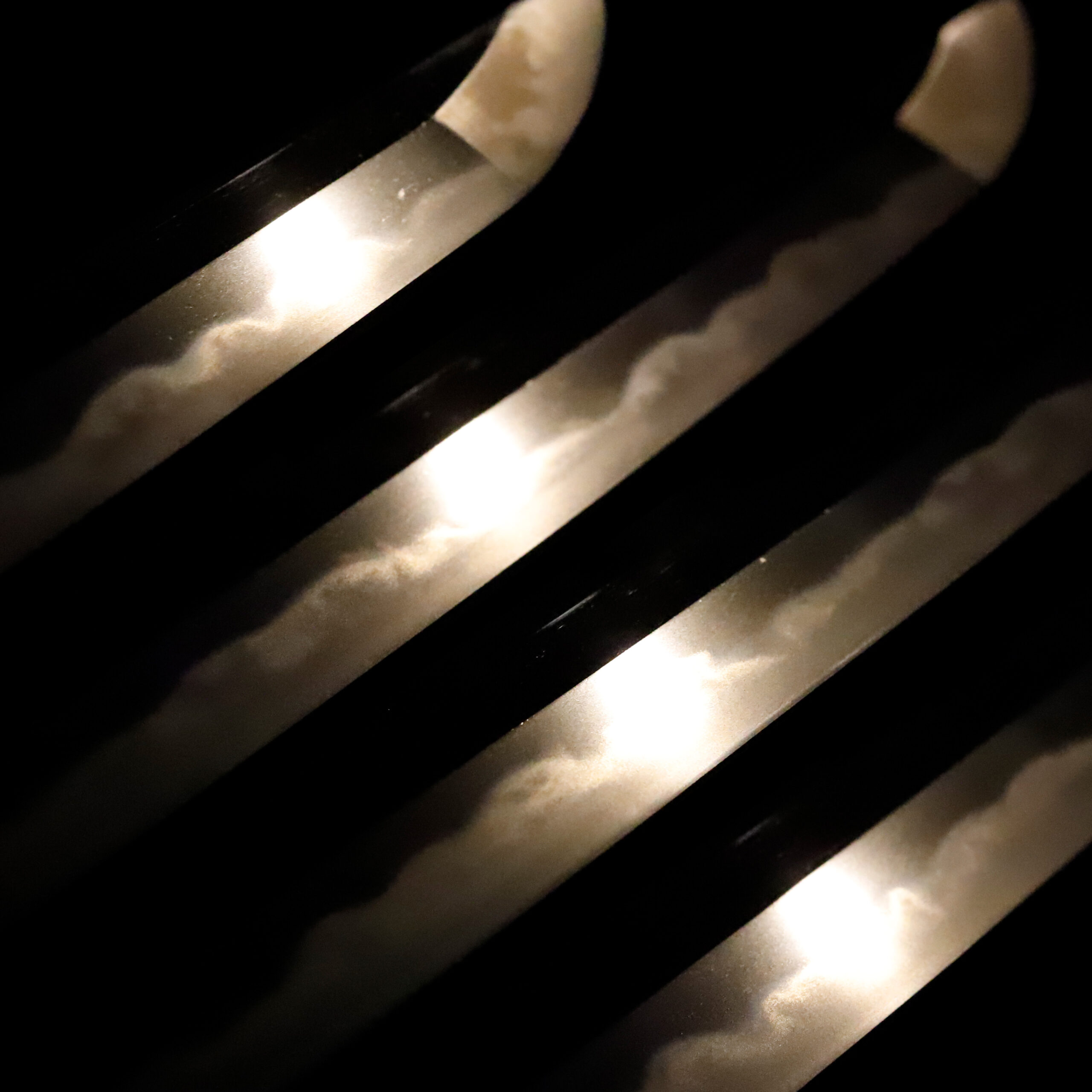
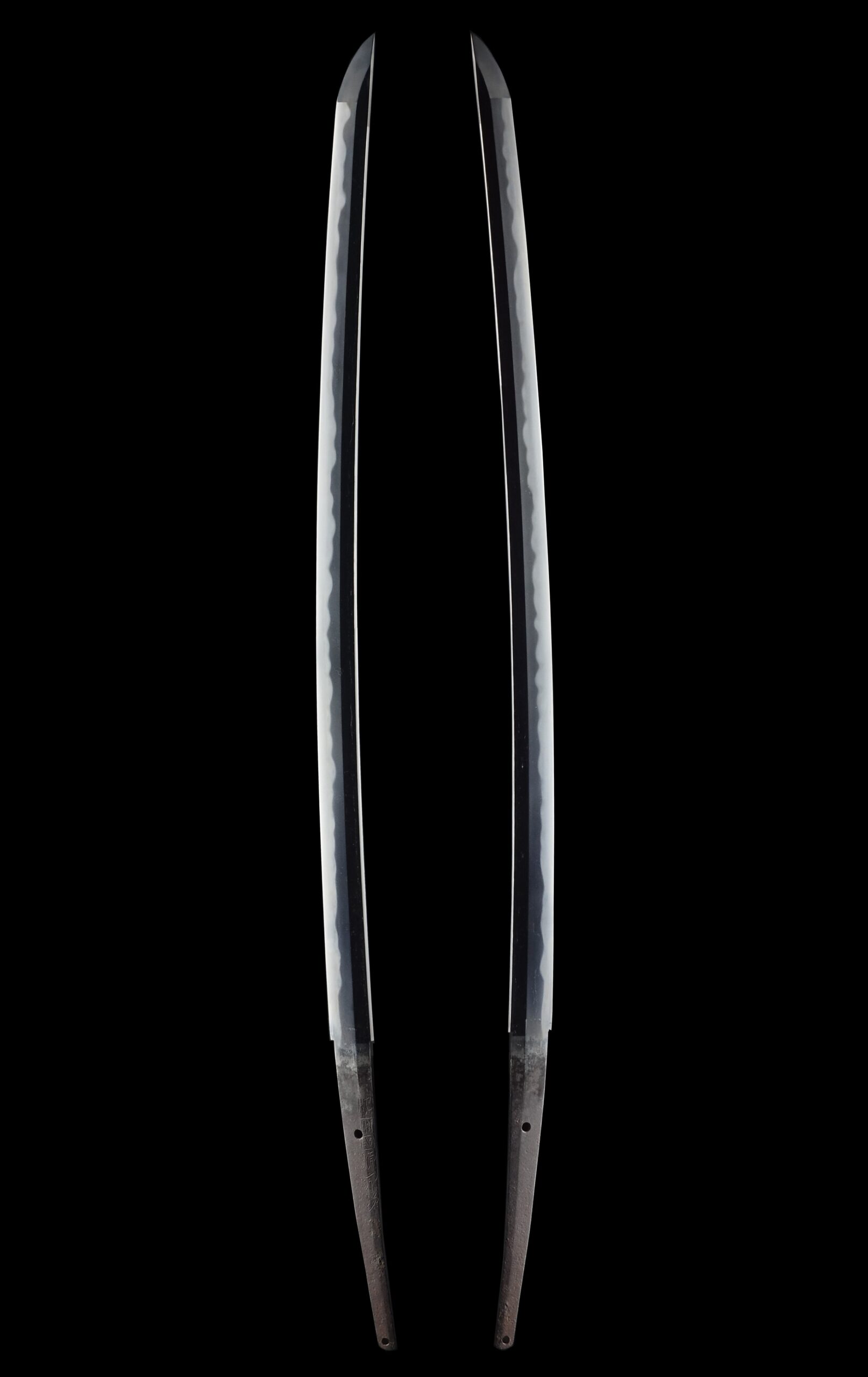
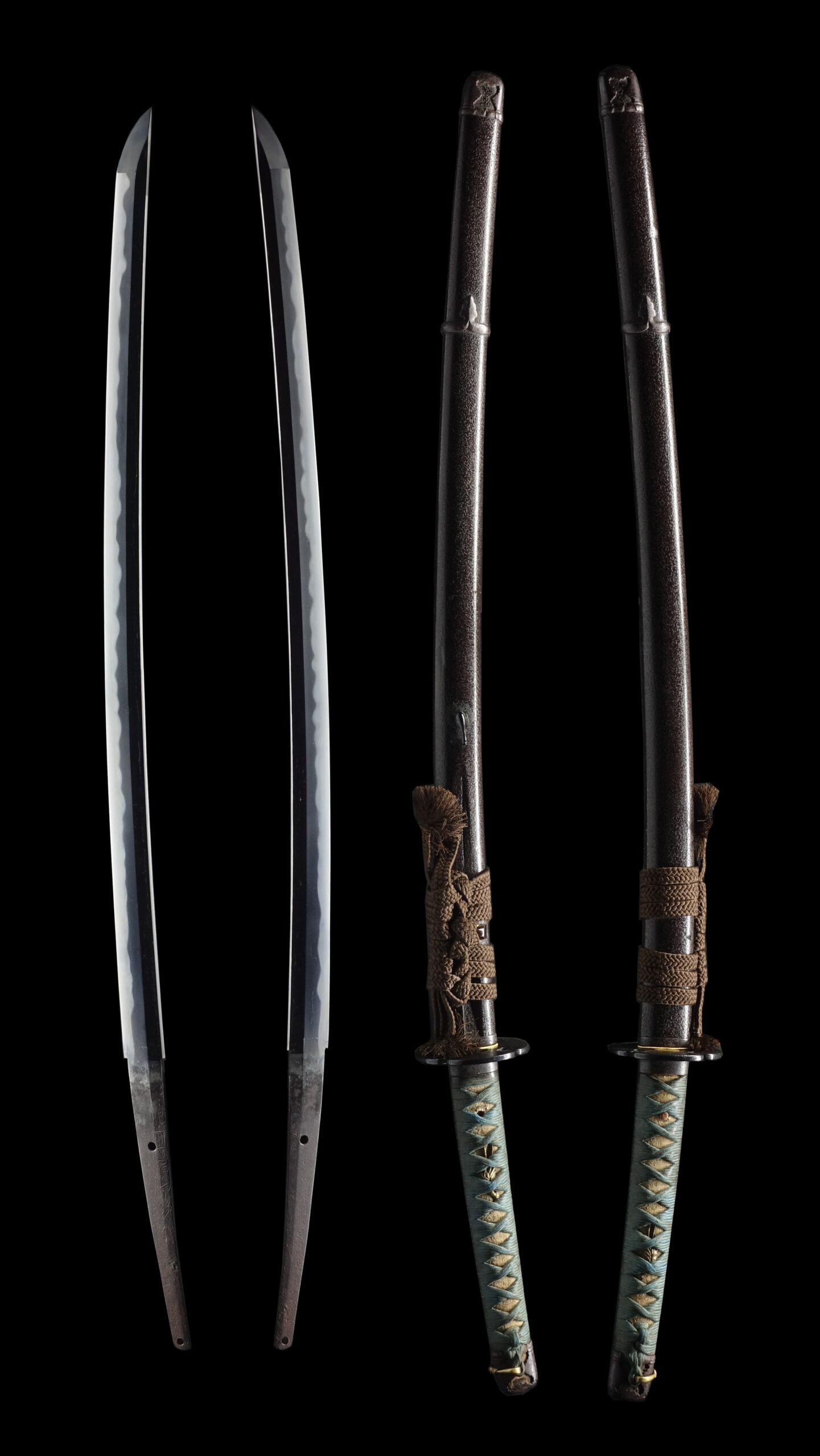
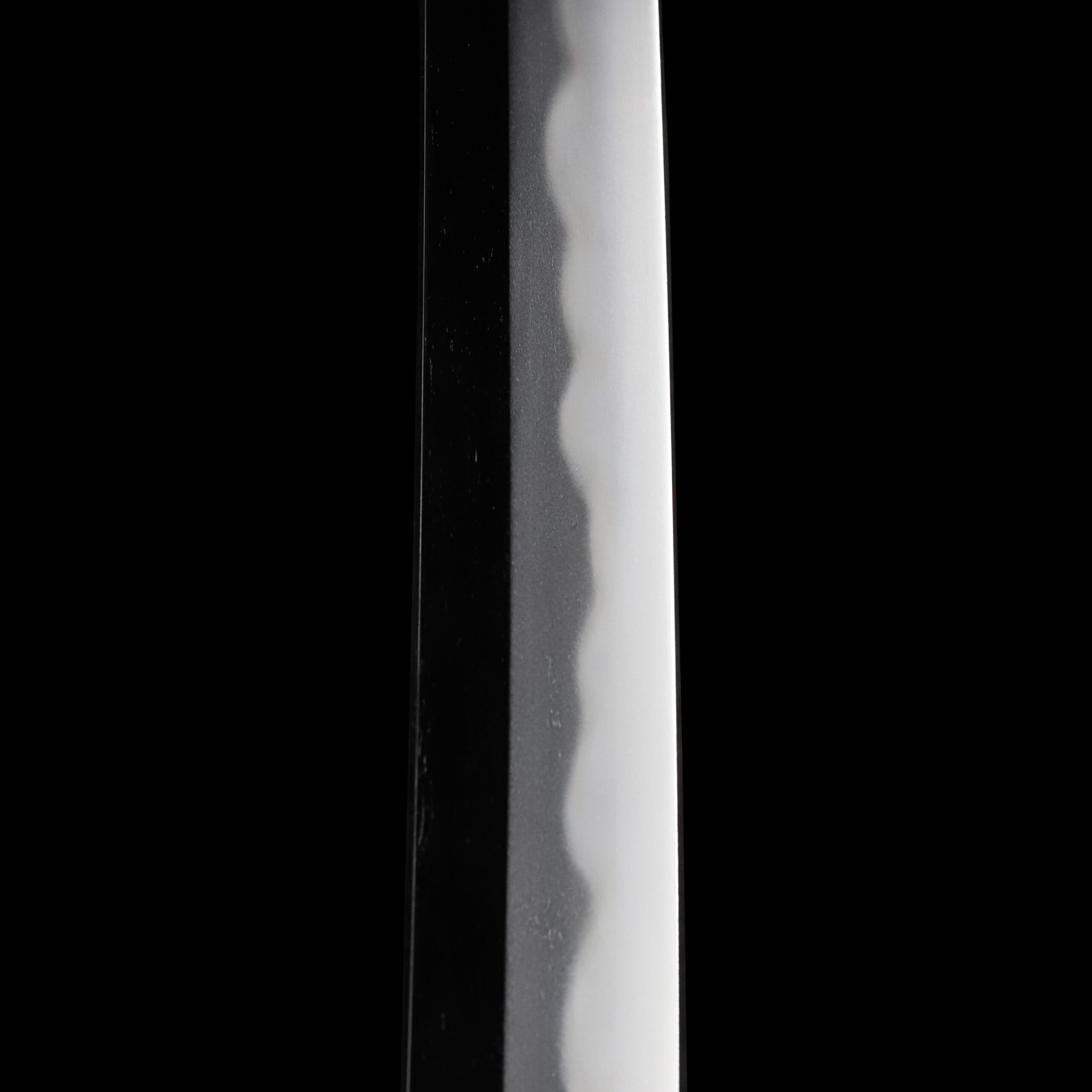
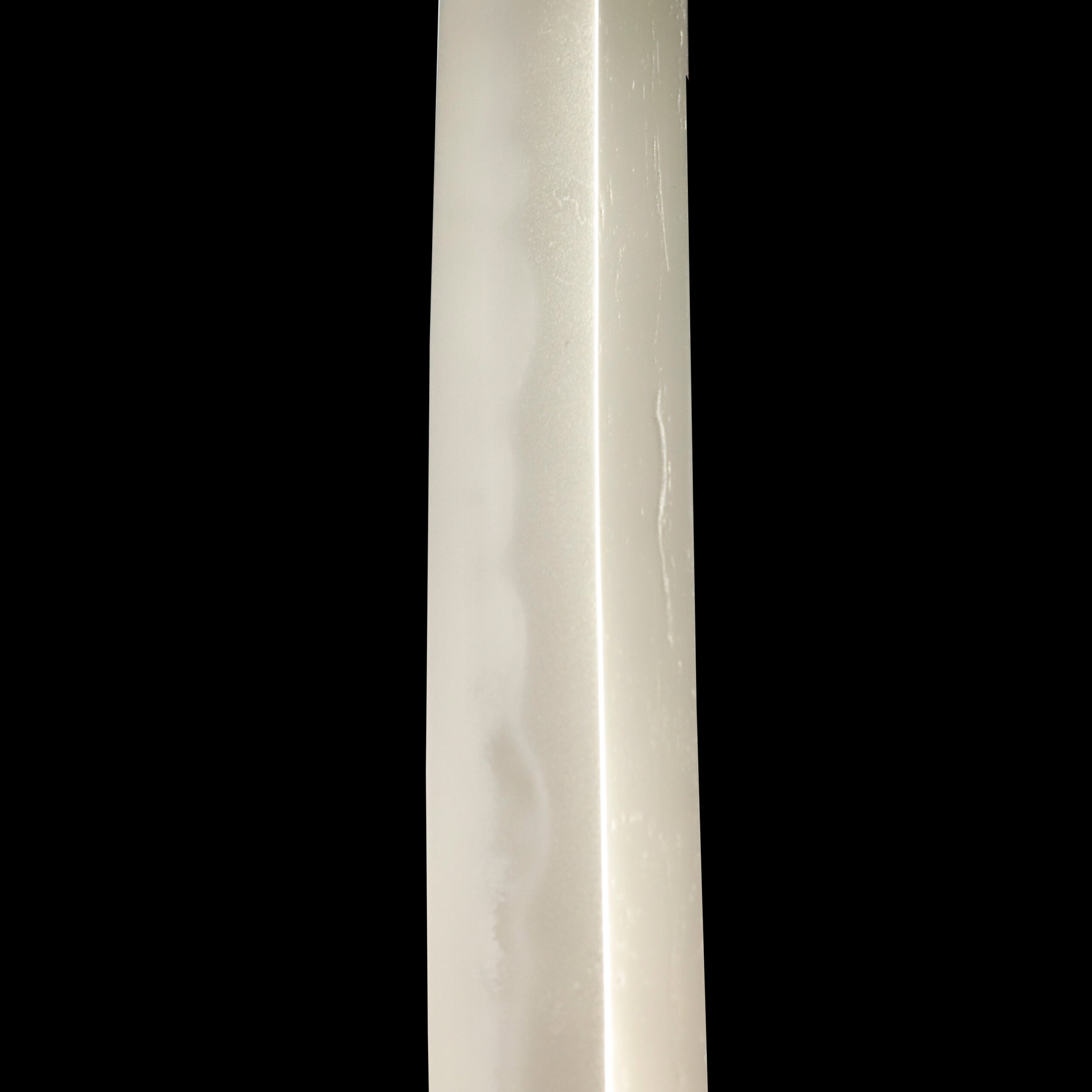
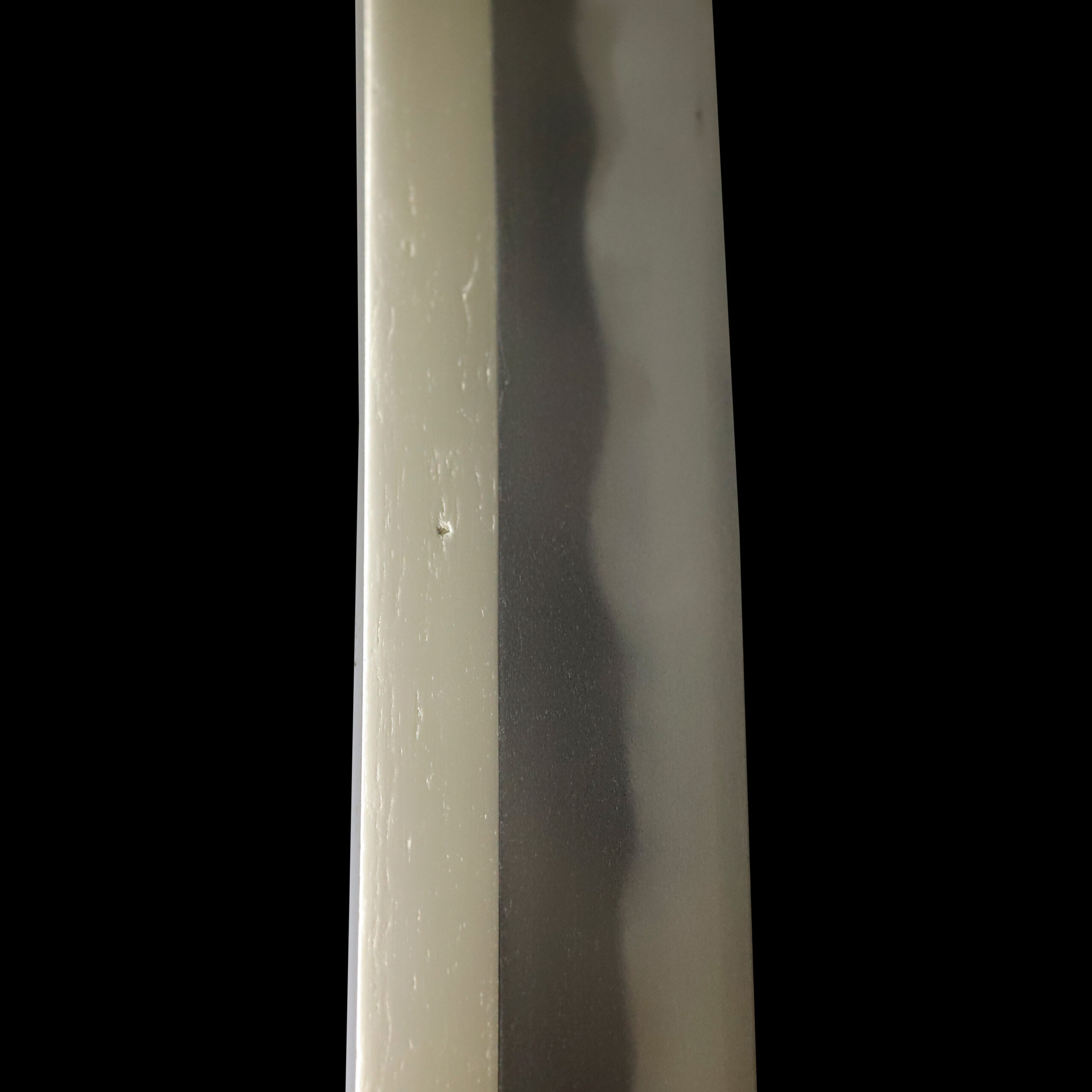
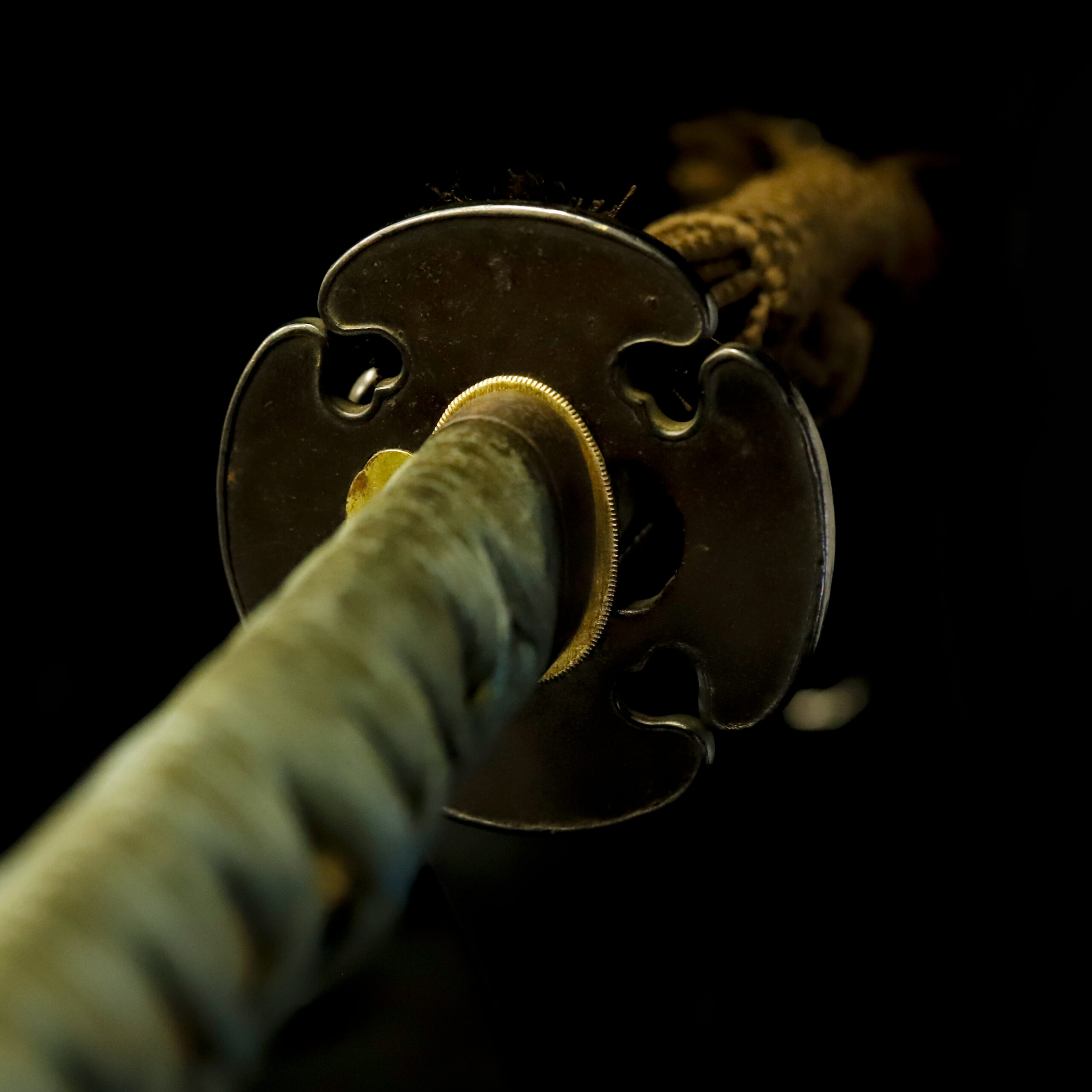
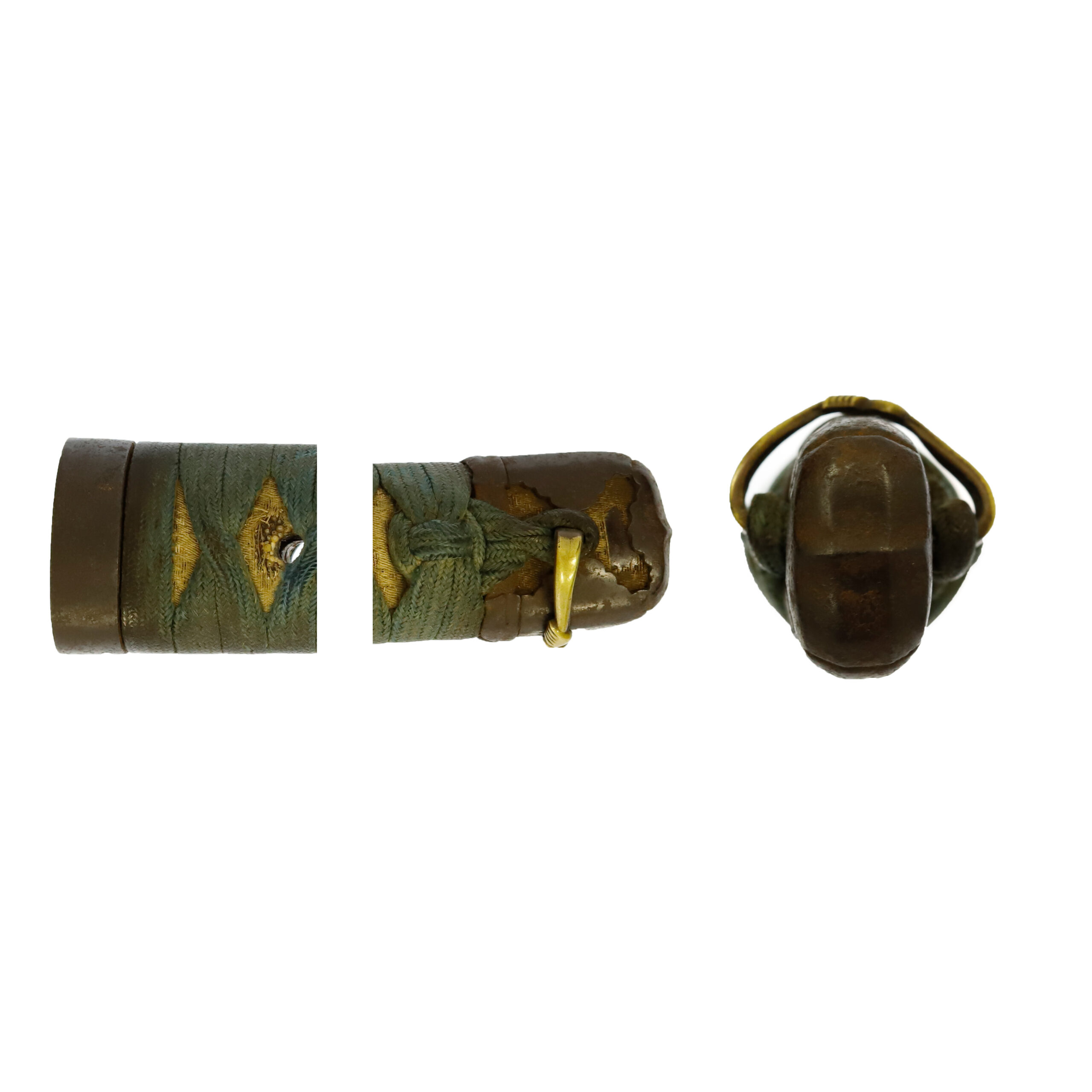
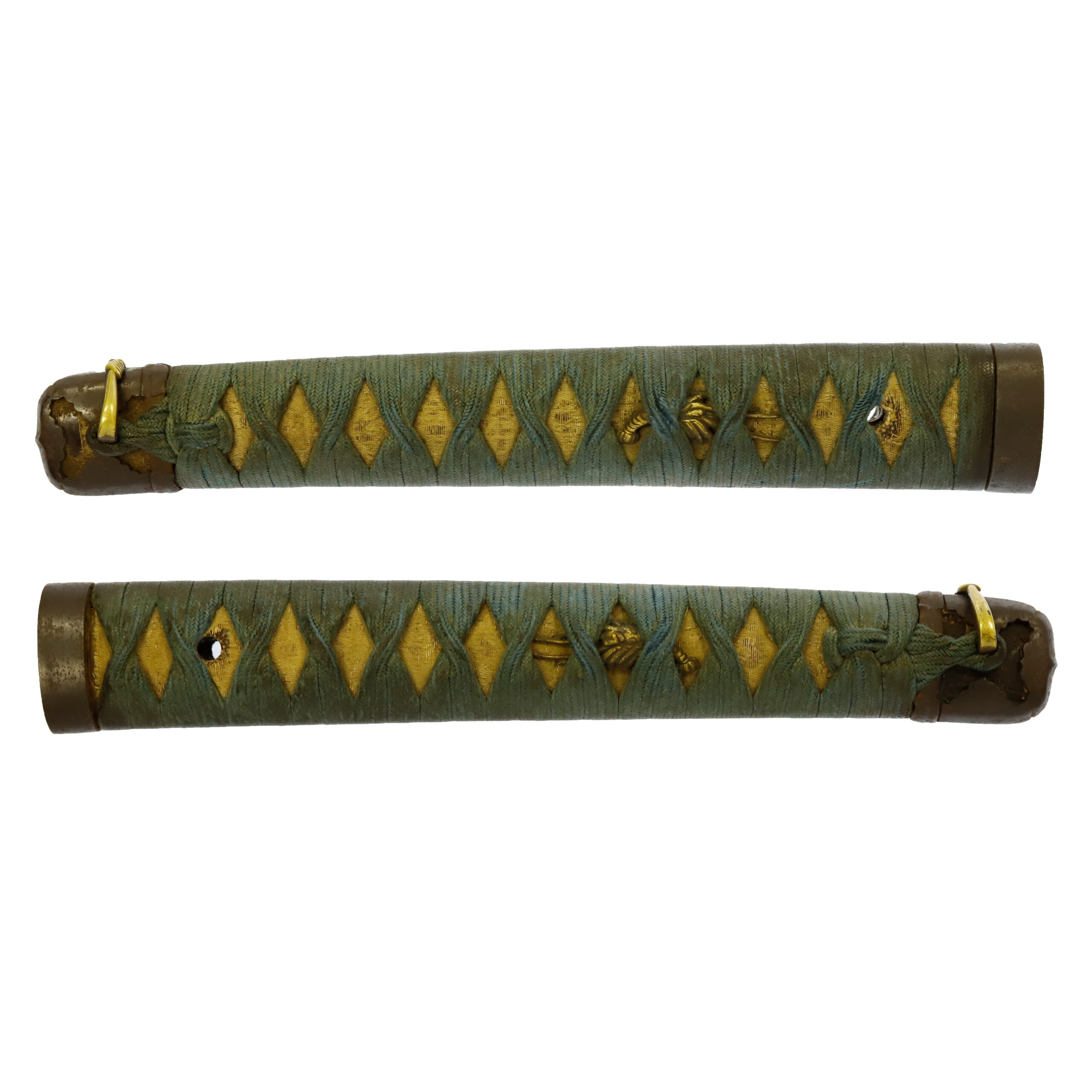
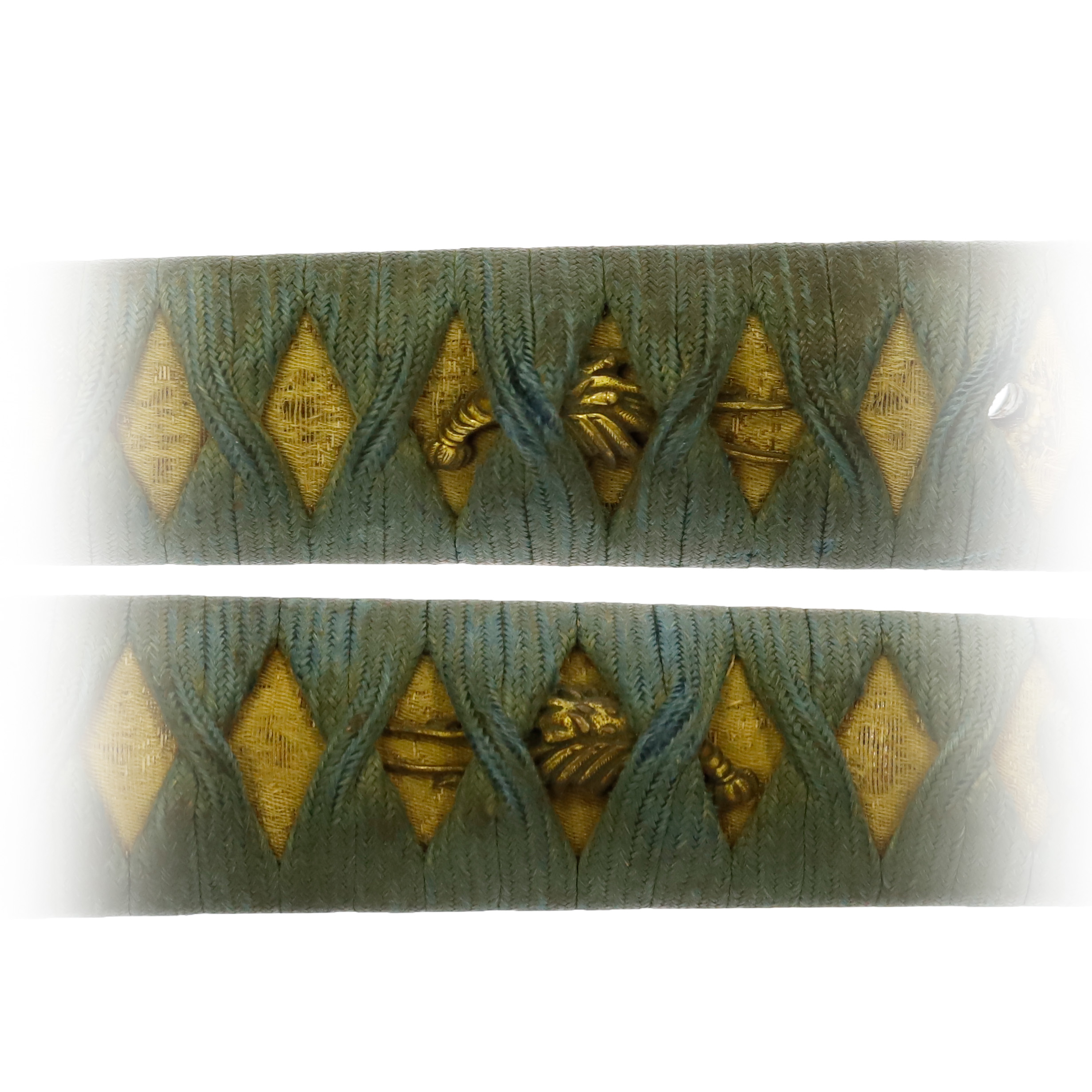
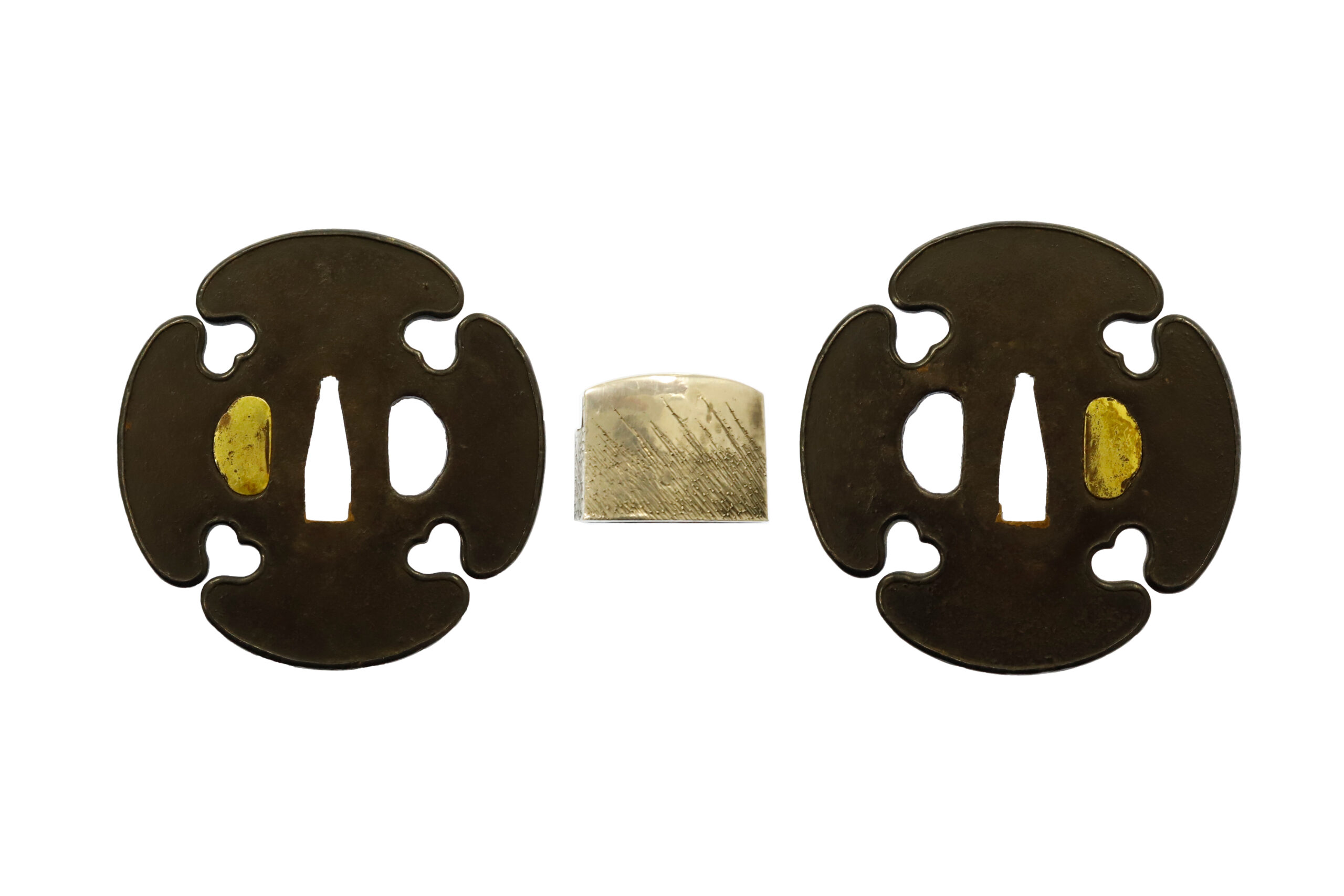
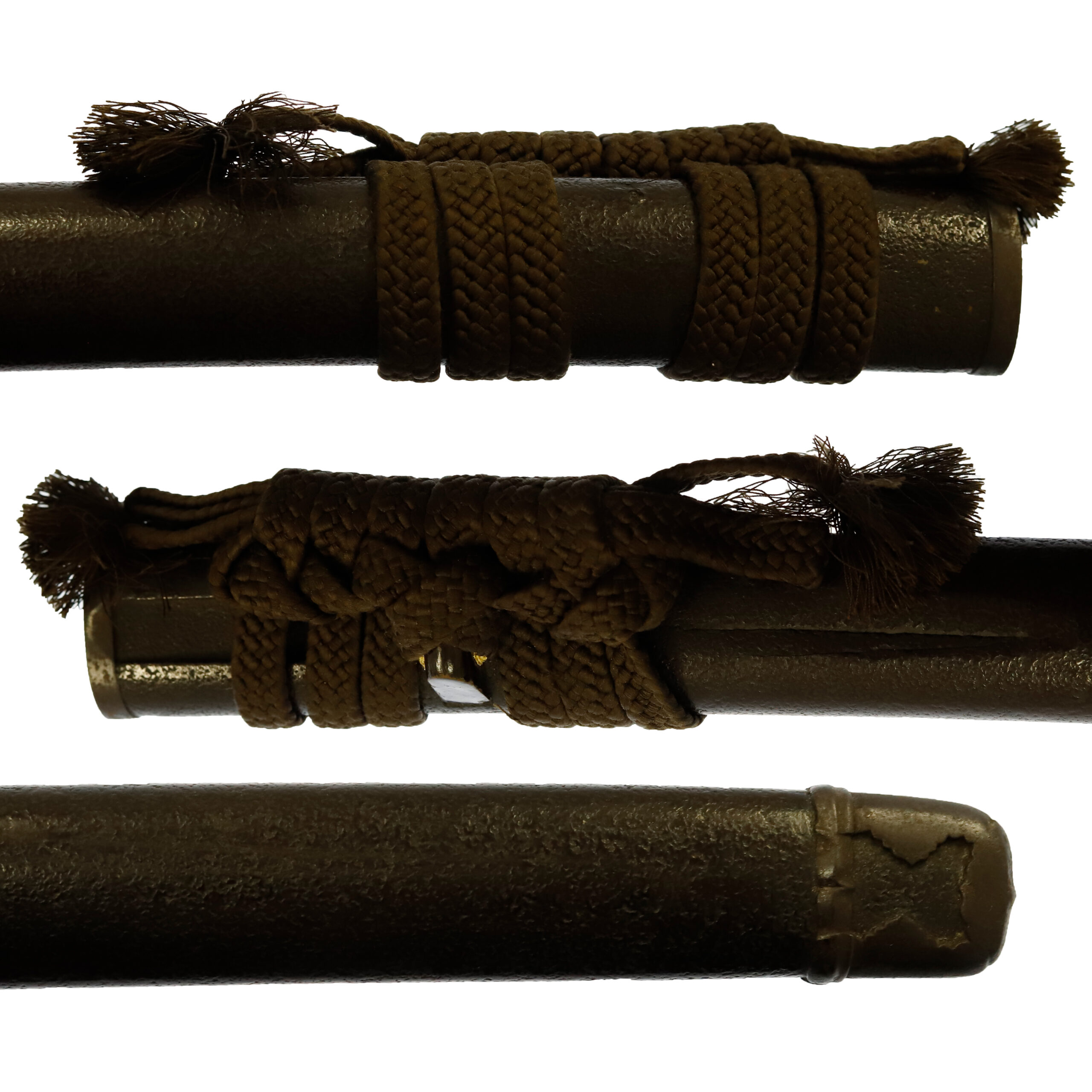
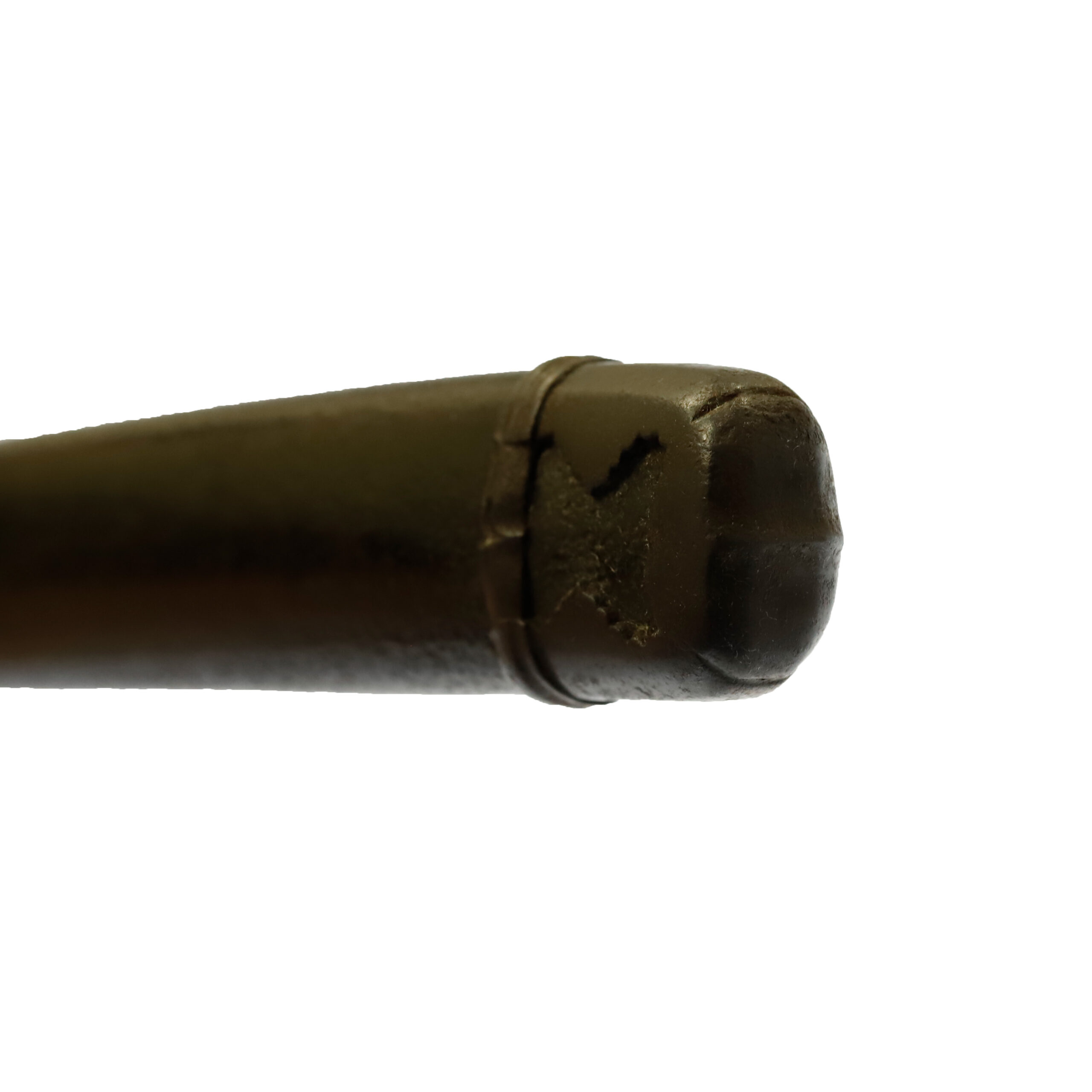
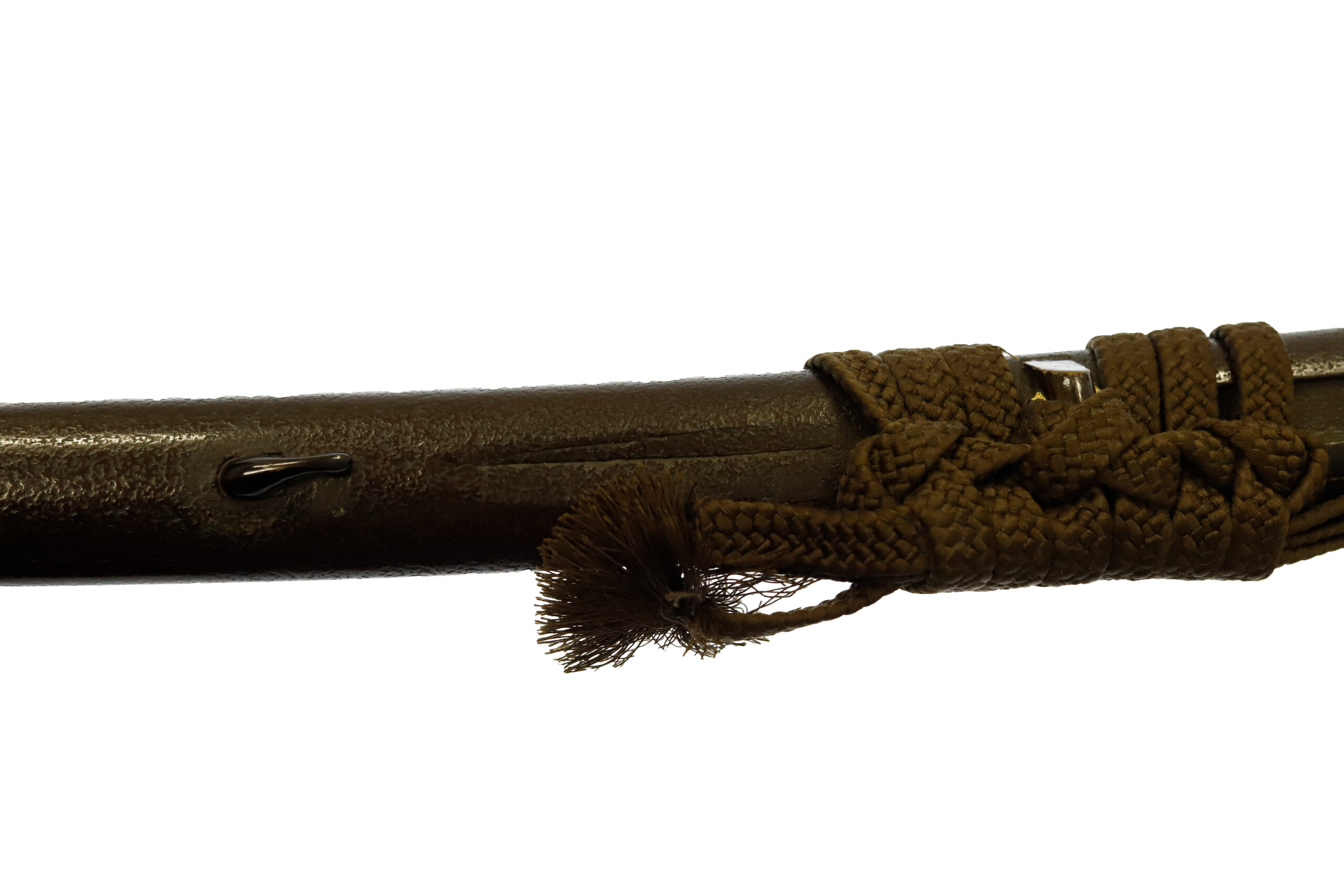
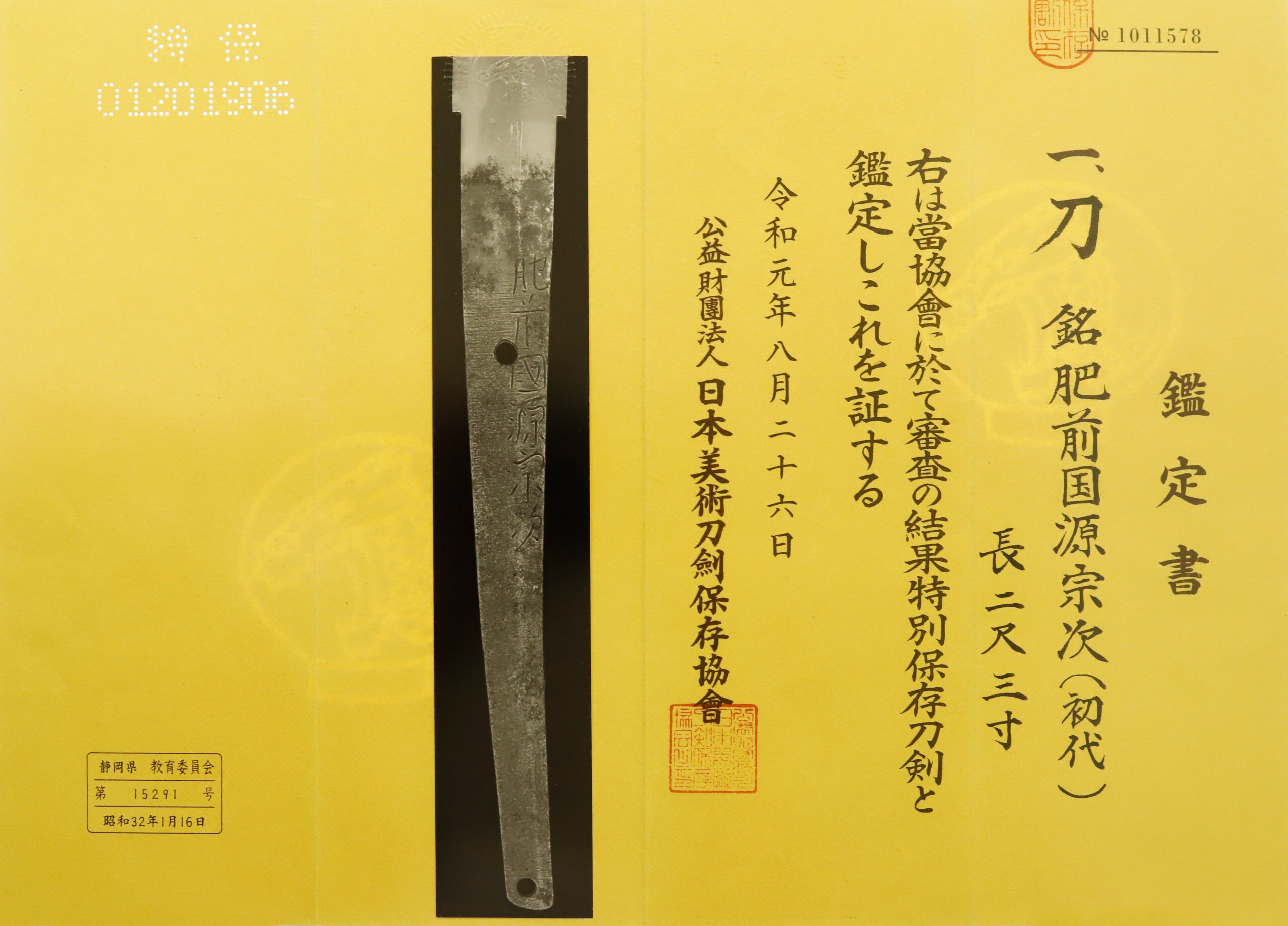
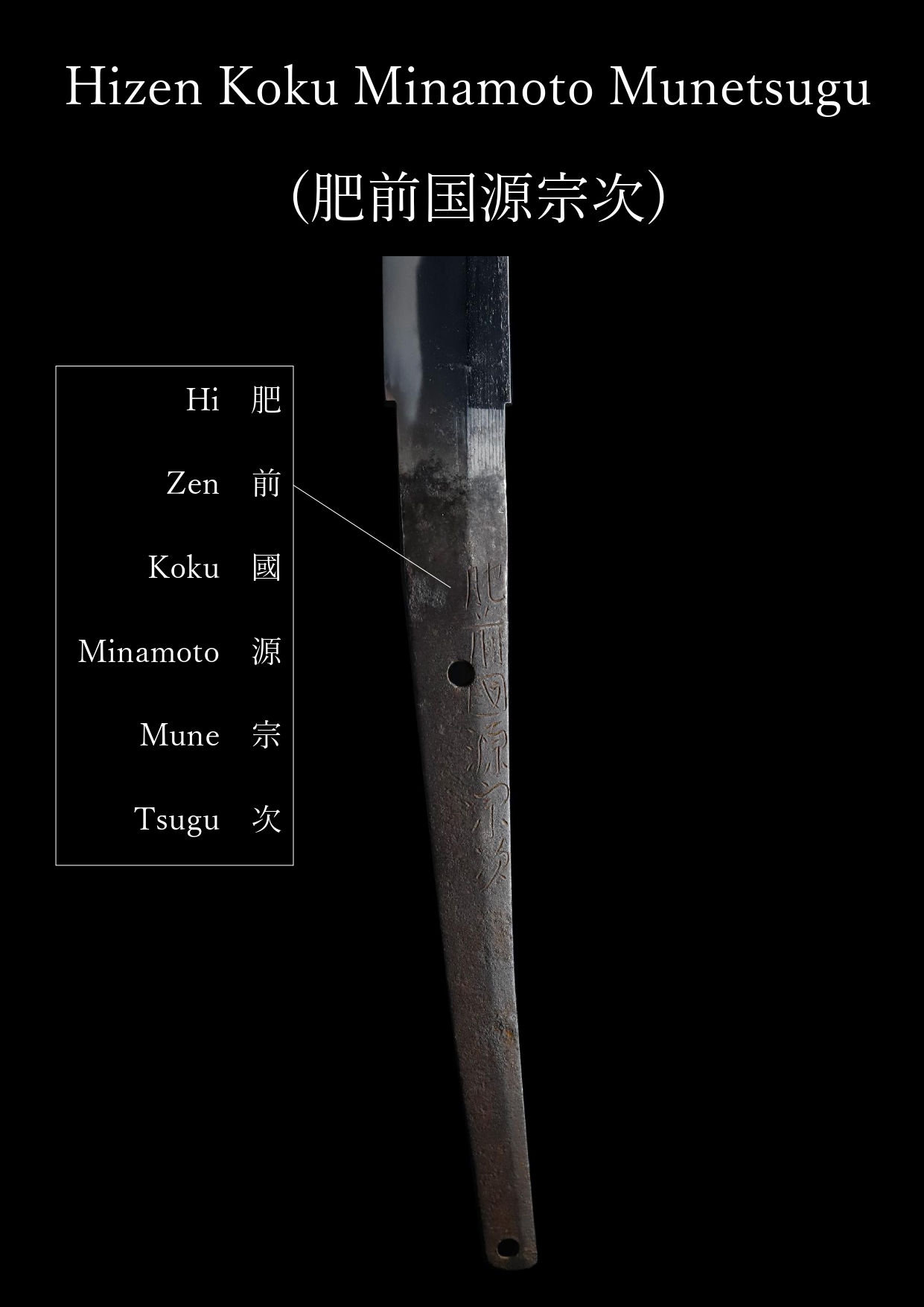
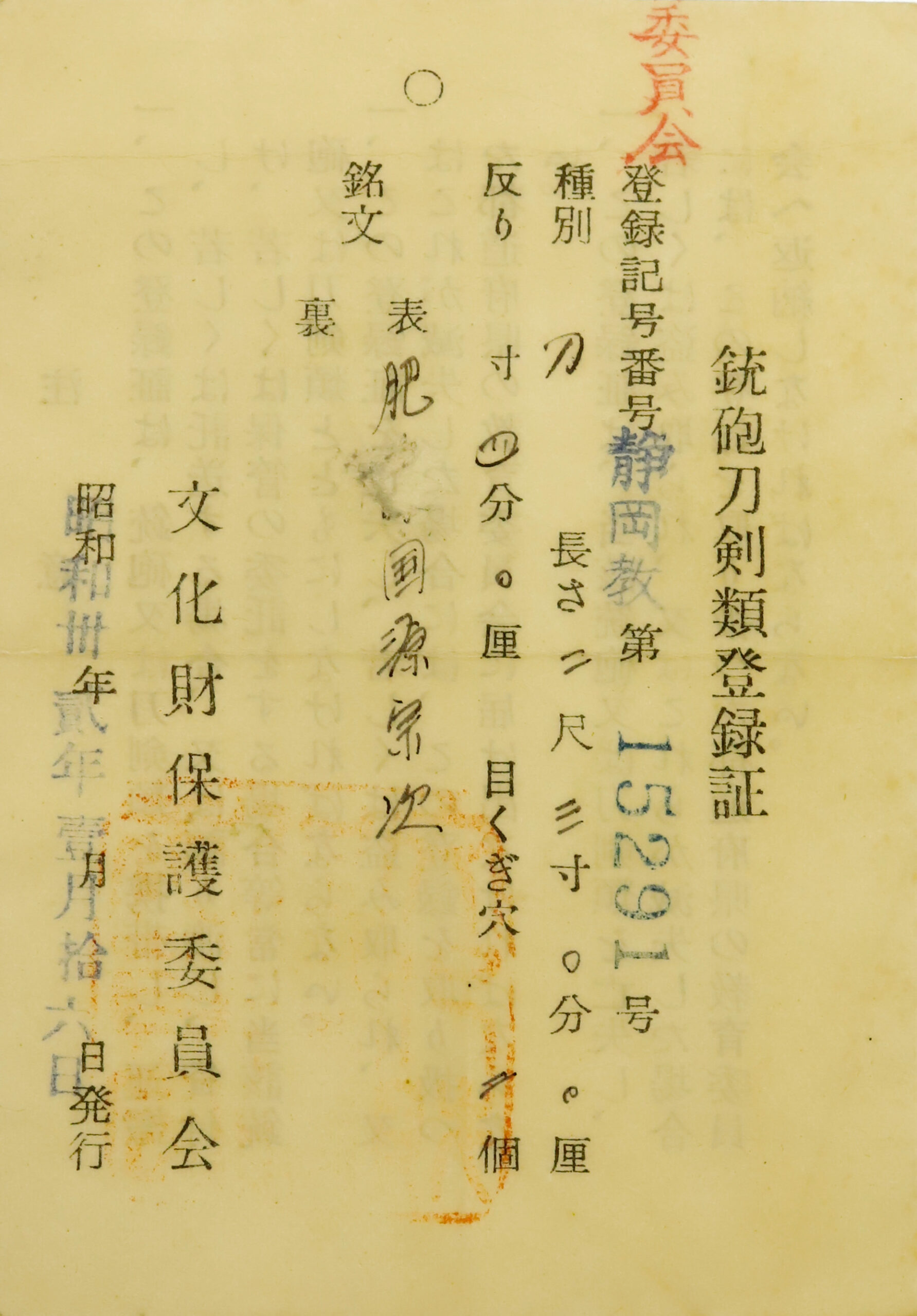
This blade was signed by Hizen Koku Minamoto Munetsugu (肥前国源宗次). Hizen Koku is the province’s name in today’s Saga prefecture. The maker’s name Munetsugu lasted eight generations, and according to NBTHK that appraised this blade, it was made by the first-gen Munetsugu judging from its characteristics. The first-gen Munetsugu was one of the most famous swordsmiths during the early Edo period in Hizen province. The first-gen Munetsugu was born in a household that served the Tenmangu shrine as priests for generations in Nagase village in Hizen province. His birth name was Sakai Sanuemon. And he first signed Masatsugu. He took over his father’s school in the 12th year of the Tensho era (1584). In the 11th year of the Keicho era (1606), he received Iyo Jyo title for his excellent craftsmanship. Additionally, in the 16th year of the Keicho era (1611), he was hired to forge blades for Nameshima Katsushige, the first head of Nameshima clan, who ruled Hizen province. And he became a Hanko (藩工), a swordsmith exclusively working for a specific clan or domain. He passed his name to the second-gen Munetsugu in the 9th year of the Kan-Ei era (1632). Considering his title isn’t engraved on this blade, we assume it was made before 1606. One of the most famous episodes related to the first-gen Munetsugu is that he forged a blade to commemorate the visit of the Shogun Tokugawa Iemitsu to Kyoto in July, the 11th year of the Kan-Ei era (1634). This fact indicates that the first-gen Munetsugu was a highly regarded swordsmith nationwide back then. One of the most noticeable differences between Munetsugu’s works and the other swordsmiths in Hizen province is that he mastered Soshu Den tradition. In contrast, others created blades with Yamato Den tradition. Both traditions are among five Japanese sword forging traditions. Others are Yamashiro Den, Bizen Den, and Mino Den. The generations of Munetsugu preserved this Soshu Den technique until the end of the Edo period. Hizen province was especially active in sword-forging during the early-mid Edo period, and the first-gen Munetsu was the head of all swordsmiths living in the region. He was allowed to live in a mansion house located near Saga castle. His fame was close to that of Tadayoshi, the founder of Hizen Tadayoshi school. According to one theory, there was a good rivalry between Munetsugu and Tadayoshi schools to improve their craftsmanship. It is appraised as a Tokubetsu Hozon Token(特別保存刀剣) issued by NBTHK(Nihon Bijutsu Touken Hozon Kyokai:日本美術刀剣保存協会). Fuchi-Kashira This Koshira’s Fuchi Kashira is similar to the sword mountings of the Tachi Koshirae (太刀拵). In the Tachi Koshirae, these sword mountings are called the Kabutogane (冑金/兜金) and the Fuchi Kanamono (縁金物). The Kabutogane is a metal fitting attached to a handle’s end. It corresponds to the Kashira (頭) part of the Fuchi Kashira (縁頭). And the Fuchi Kanamono (縁金物) is also a metal fitting attached to the handle but on the opposite side of the Kabutogane. It corresponds to the Fuchi (縁) part of the Fuchi Kashira. In addition, a Sarute/Sarude (猿手) is attached to this Kashira part (equivalent to the Kabutogane in Tachi Koshirae). The user of a sword passed the Udenukio (腕貫緒, a cord wrapped around the wrist to prevent a sword from falling out of the hand, mainly used when riding a horse) through this ring. Tsuka and Menuki *We will be happy to rewrap the Tsuka Maki without any additional cost. Seeing from the gaps of the Tsukamaki thread, you would find the figure of a shrimp. Golden paint is applied to each Menuki, and its coloring remains relatively in good condition. We estimate this Menuki’s motif is the Iseebi (伊勢海老, spiny lobster). According to a theory, Japanese people already ate shrimp in the Heian period (794-1185). However, it was an expensive ingredient for ordinary citizens, so only the nobility and high-class people could enjoy it. People started using shrimp as a good-omen pattern and appreciated designing it for their family crests in the Muromachi period (1336-1573). In the Samurai’s society, as shrimp is covered with a hard shell, it was thought that a shrimp represents the figure of a brave Samurai who wears armor. It has the meaning that wishes the fate of a Samurai will last for a long time. Shrimp has been likened to an older adult because of its long feelers. Also, shrimps actively jump even though they are bowed. That is the reason why the shrimp pattern is treated as a symbol of perpetual youth and longevity. This animal shed its molt several times to grow up; therefore, some people have considered it to be a symbol of success in life. In this way, the Iseebi design has a deep relationship with the Samurai culture. Tsuba and Habaki This Yotsu-Mokkou-shaped-Tsuba has a similar look to a Tachi Goshirae Tsuba (太刀拵鐔). The difference between Tachi Tsuba (太刀鐔) and Katana Tsuba (刀鐔) is that the top and bottom positions of the Nakago hole (茎櫃, center hole) are reversed. The Mimi (耳, edge) of this Tsuba is covered with a soft metal plate; it gives sturdiness and enhances the decorativeness of this Tsuba. If you focus on four corners, you will find a heart mark-shaped hole is engraved on each edge. It is called the Inome (猪の目) pattern. The Inome pattern has been used since ancient times. As its name implies, the boar’s eyes are the origin of this pattern. Some people believed the Inome design would work as an amulet to protect them from evil spirits or fire. Also, it is said it would bring good luck. Saya *Please keep in mind that there is visible damage near the Sageo due to aging. Authentication Paper They authenticated the blade on August 26th in the first year of Reiwa (2019). They appraised it as Tokubetsu Hozon Touken, the blade especially worth preserving for Japanese society.
Offered by Samurai Museum
This piece has sold
Get an email when a new Hizen Munetsugu piece hits the market.

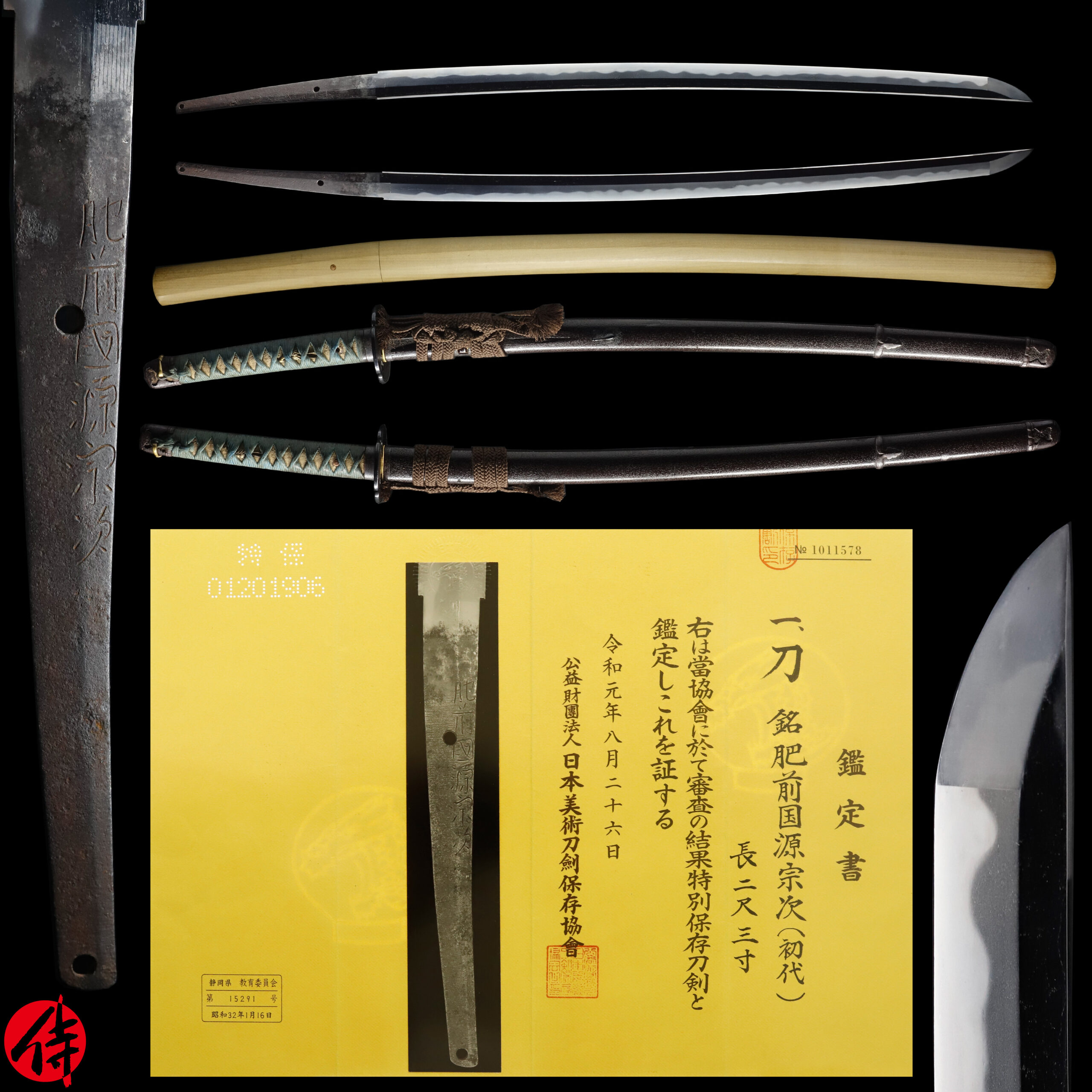
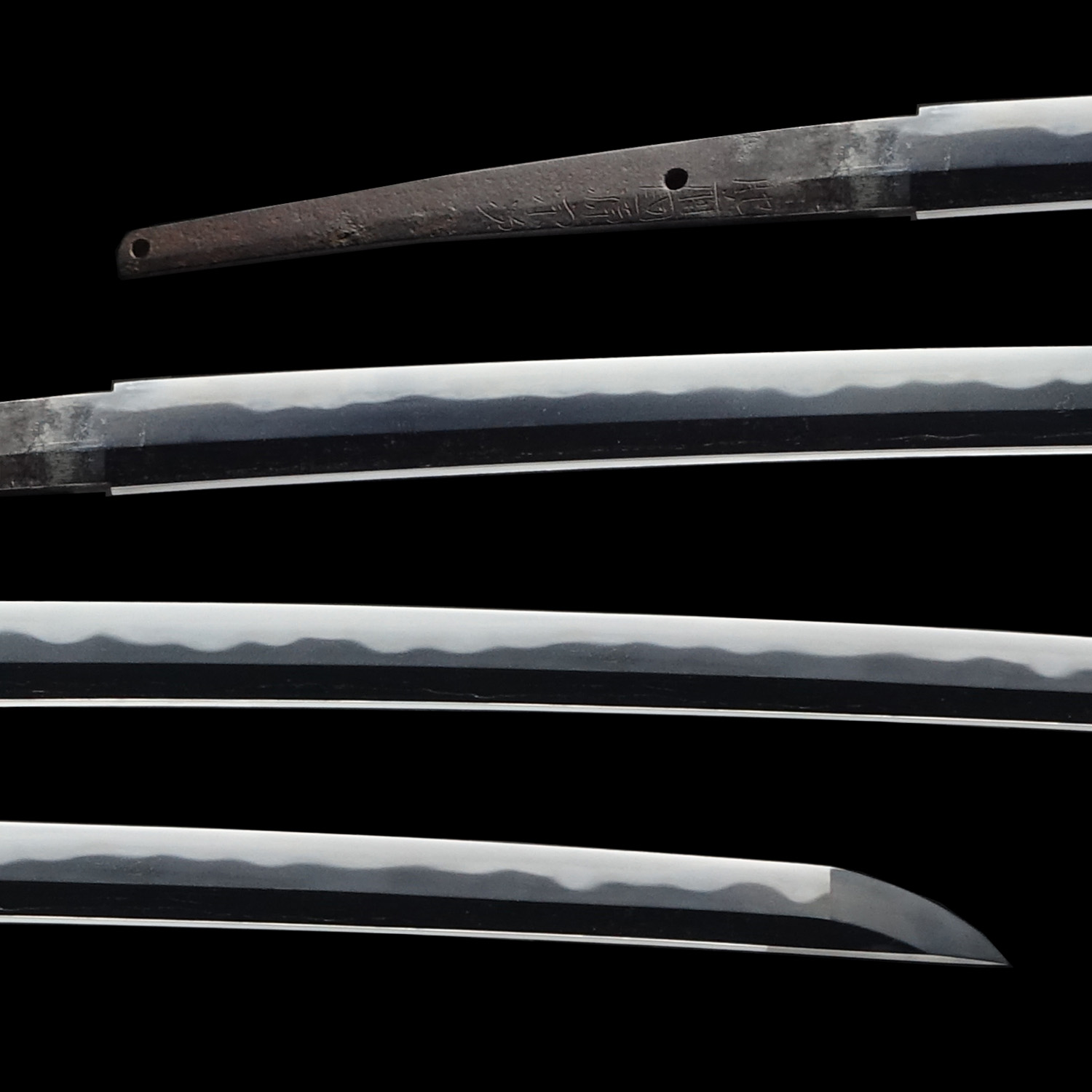
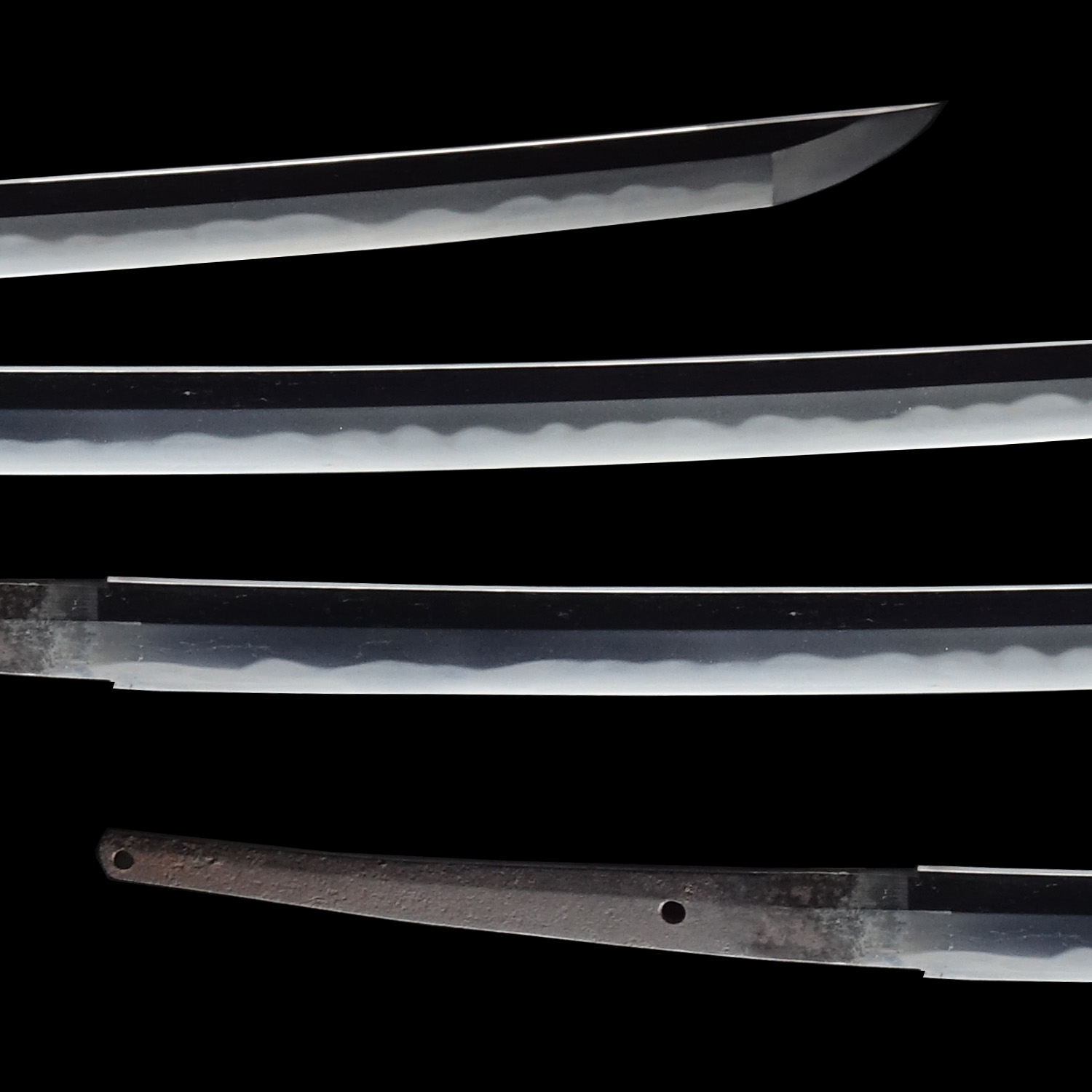
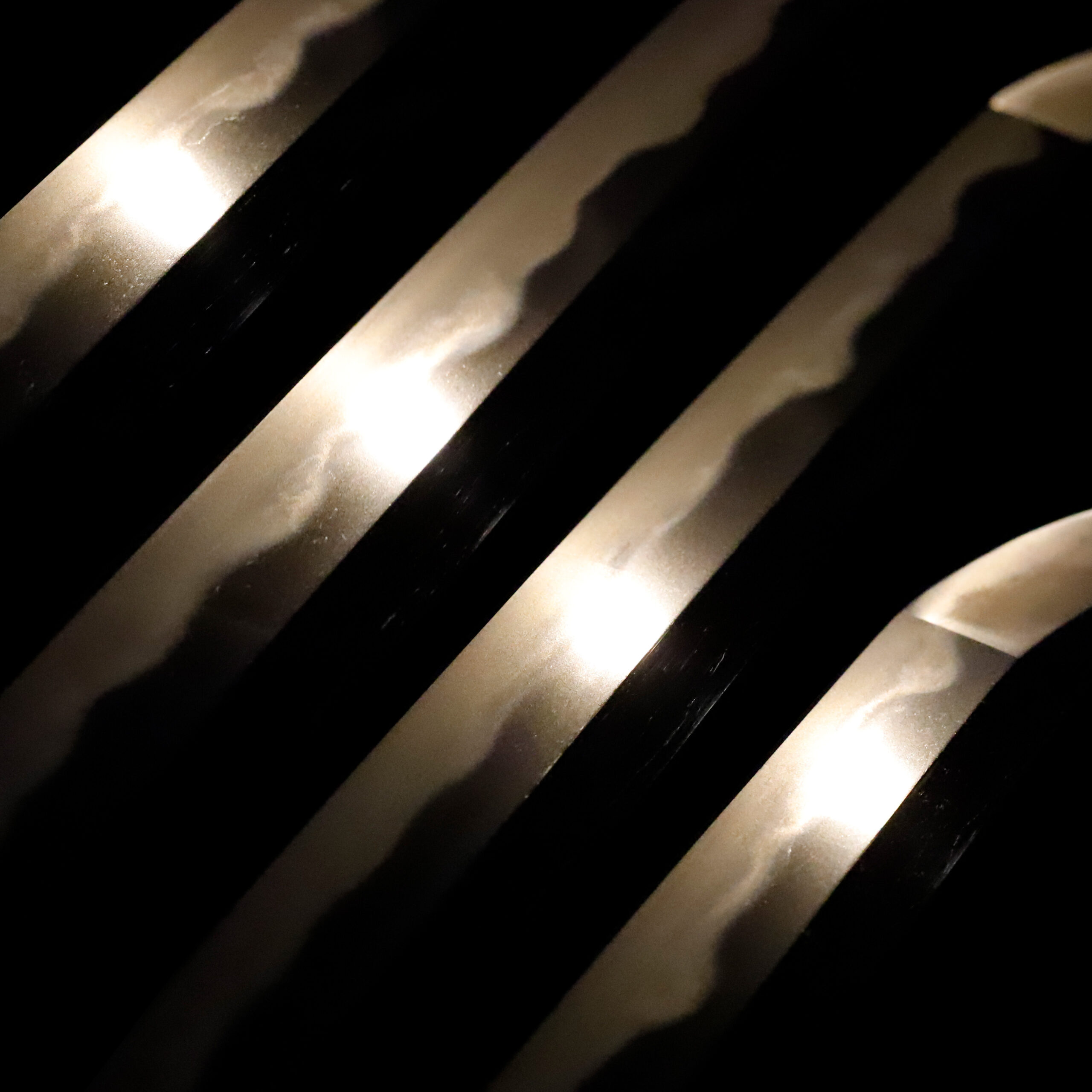
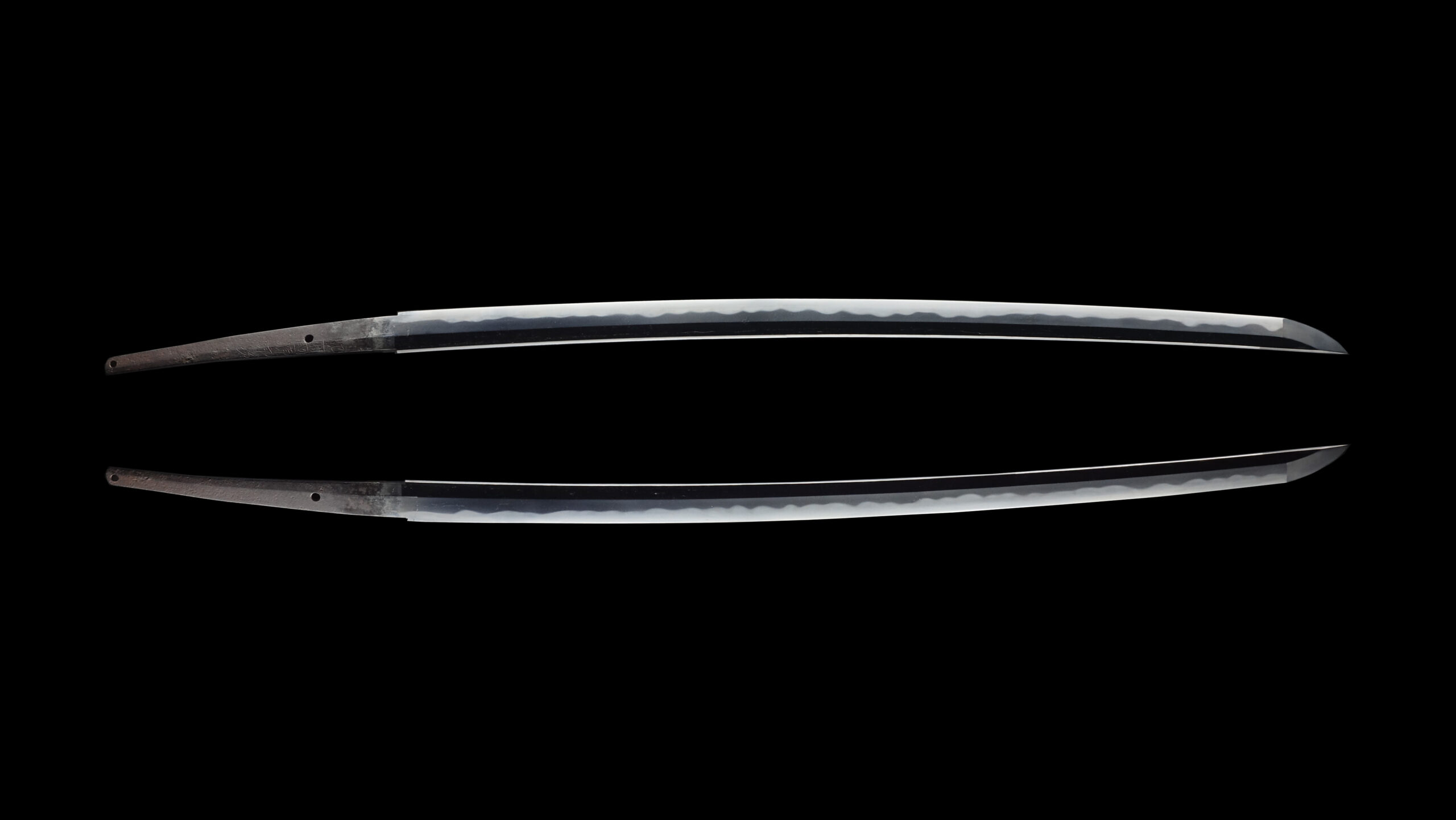
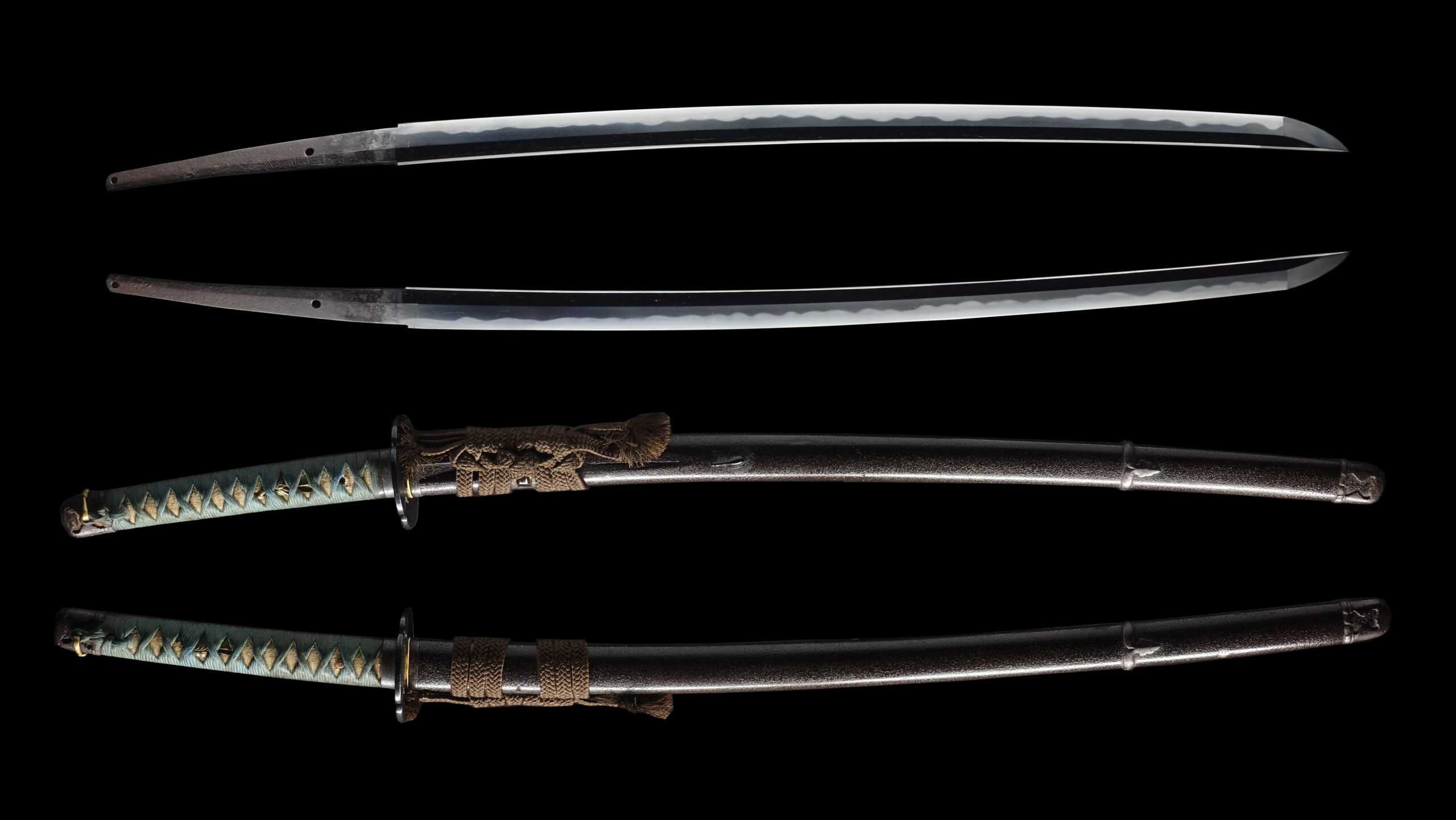
Hizen (Iyo no Jo Munetsugu line, out of the Tadayoshi school) · Hizen · around 1596-1615
Fujishiro Jo saku · Tōken Taikan top 26%
2 pieces on the market now
The first-generation Iyo no Jo Minamoto Munetsugu was called Sakai San'emon, and his family is said to have served for generations as priests of the Tenmangu shrine at Nagase village, the birthplace of Tadayoshi. He forged at Nagase-machi in the castle town of Saga and later moved to Isahaya in Hizen. The published sources make him a pupil of the first-generation Tadayoshi and set him beside that founder as "the very pioneer of early-modern Hizen smithing"[[c:1]]. A genealogy of the Iyo no Jo line kept by his descendants places his Iyo no Jo title in Keicho 11, and a surviving work dated Keicho 12 that already bears the title bears it out.
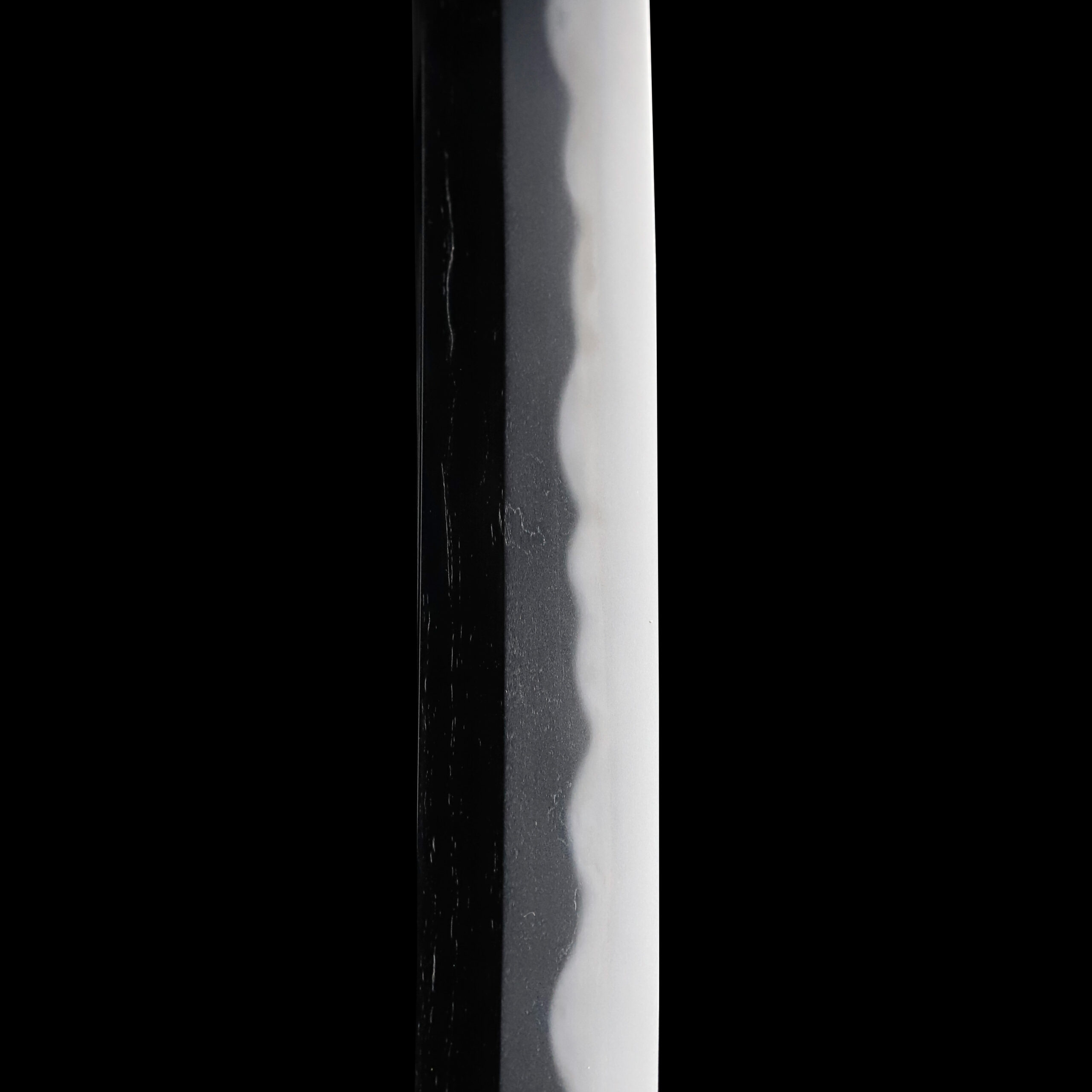
Within the Hizen group he is the exception, and the published sources say so plainly. Hizen swords in general temper the boshi straight and turn it in a small round ko-maru; nearly all of his enter midare-komi and sweep back in hakikake, at times flame-like, so that his work is "not to be confused with other Hizen swords"[[c:2]]. His hamon is a gunome-midare mixed with ko-notare, angular elements and pointed togariba. Ashi and yo enter freely, the nioi is deep and the nie thick, with rough nie gathering in places. Sunagashi runs through nearly every blade and long kinsuji enter many of them. Above the temper appear tobiyaki and yubashiri, and on some pieces muneyaki.
The jigane is an itame that tends to stand, mixed with mokume and flowing grain. The ji-nie is extremely fine and thick, the chikei enter finely and abundantly, and on several blades the steel takes on a slightly dark tone. The forms are broad and robust, often with little taper and a long chu-kissaki or an o-kissaki, and one commentary finds an archaic flavour in the forging itself. Even the tang belongs to the portrait. Perhaps with the Soshu tradition in mind, the texts suggest, he thinned the flesh on the edge side to give a tanago-bara form, and against the usual Hizen practice of signing the ura he cut a bold long signature in a distinctive hand on the sashi-omote.
The published sources name his model as Soshu-den and above all Shizu, "the Shizu manner he most excelled in"[[c:3]]. Within that manner his work runs across a range. On some blades the temper is kept to a smaller, calmer pattern, yet the jiba remain thickly covered in nie, and the small tobiyaki and yubashiri-like effects above the temper carry an old flavour. At the other end stands a broad wakizashi of the Juyo 70th session, its large midare, flame-like boshi and strong nie described as bold and powerful, burning with a fierce intensity. A hira-zukuri wakizashi with a hitatsura-like temper departs further still, and the texts ask whether he took Soshu Tsunahiro as its model. Dated works are very rare. The earlier commentaries regretted that none were known, and a katana dated Kan'ei 7 is valued for exactly that reason.
His place in the school follows from this. Among the Hizen smiths he is the one who "devoted his passion to re-creating the Soshu-den"[[c:4]], where the main line settled into a refined suguha. The name ran for several generations. The published sources read the generation off the tang, assigning blades with reverse sujikai file marks to the second generation, who worked first under the name Muneyasu before taking the Iyo no Jo Munetsugu title.
Fujishiro rates him Jo saku, and fourteen of his blades stand in the Tokubetsu Juyo and Juyo tiers, two in the former and twelve in the latter. The summit of that record is a Tokubetsu Juyo katana dated Kan'ei 11 whose inscription tells its own commission. Nawa Sotan, of the lineage of Nawa Doen, a senior retainer of Tokugawa Yorinobu of Kii, applied part of the silver that the third shogun Iemitsu bestowed on the capital during his visit that year to have Munetsugu forge it. The published sources call it the finest work of his lifetime, its order inscription and date both rare and of great documentary value. Beyond that sword, provenance is not recorded for his blades. For a private collector a signed Munetsugu in the Juyo tier is a realistic, if occasional, encounter, an individual early Hizen hand that surfaces from time to time and rewards patience, while his Tokubetsu Juyo works appear only rarely.
Where Munetsugu stands among comparable artisans: across all of nihontō, and within tradition, era, and period. The tiers (Foremost · Leading · Major · Notable) weigh official designations from the NBTHK and Japan's Agency for Cultural Affairs, together with historical honors of lasting repute such as the Sansaku and Meibutsu-chō.
Select a lens to see how it's measured.
Years he was demonstrably active, proven by signed-and-dated blades
Shinto · Hizen
105 pieces on the market now
The Hizen school began with a single domain commission. In Keicho 1 (1596) the Nabeshima of Hizen ordered Hashimoto Shinzaemon, the smith who would sign Tadayoshi, up to Kyoto with the carver Munenaga; there he entered the gate of Umetada Myoju and studied forging while Munenaga learned the chisel. The two returned to the province in Keicho 3 (1598), and Tadayoshi settled in the castle town below Saga, where under the domain's patronage the line grew into the dominant sword-making house of Kyushu. His own work runs from Keicho 5 (1600) to his death in Kan'ei 9 (1632); in Genna 10 (1624) he received the court title Musashi Daijo, changed his name to Tadahiro, and shifted his clan name from Minamoto to Fujiwara, so that the late Musashi Daijo blades are the founder under a second name. From him the house became a true generational institution: his son the second-generation Omi Daijo Tadahiro carried it forward as its most prolific hand, the third-generation Mutsu no Kami Tadayoshi returned its highest finish, and a Tosa no Kami branch took the founder's signature when he set it aside. Around this main line grew a circle of disciples and collateral hands, the waki-Hizen or Soba-Hizen smiths, several of them, like Yoshiie and Hironori, working as daisaku substitute makers whose own signed pieces are therefore scarce. The school's signature is its steel. Over a ko-itame forged so tightly it shows no slackness, fine ji-nie gathers in minute particles until the surface takes on the rice-bran konuka-hada (also written komenuka-hada) that no other school produces, fine chikei entering throughout and the ji notably clear and bright.
The orthodox temper laid upon it is a chu-suguha or hiro-suguha, sometimes tinged with a shallow notare and ko-gunome, the nioiguchi deep with finely clustered ko-nie and tightened to a bright clarity, the boshi running straight to a quiet ko-maru. The founder aimed this suguha toward the Rai school yet departed from it, his nioiguchi tighter and his forging carrying more vigor; the third generation refined it to what the published sources call the strongest and most precise hand of the first three generations. Against that calm register the house also worked a showier one, the Hizen choji-midare mixing gunome, long ashi, kinsuji and sunagashi, a manner the published sources already find more often in the founder's late Musashi Daijo work than in his Tadayoshi years, and one the second generation made his own. The branches pushed further from the suguha standard: Tadakuni of the Ogi domain ran sunagashi more conspicuously than any other Hizen hand and reached toward old Ichimonji in his o-choji; Masahiro and Yukihiro favored a flamboyant long-ashi choji over the calm main line; and the Iyo no Jo Munetsugu line worked apart in the Soshu-den, building a midareba on notare with a pointed togariba and a jihada that tends to stand and tone slightly blackish. A collector seeks Hizen-to first for that steel, and reads it the same way the appraiser does: a bright suguha lying over a clear, tight konuka-hada identifies the school before the signature is consulted, and the quiet ko-maru boshi on the ura-signed tang confirms the main-line practice. Generation and branch are then told within that frame, the third generation's powerful sugata recalling not his father but his grandfather, the waki-Hizen hands set apart by their irregular temper, their sujikai file marks and a sashi-ura signature, the Munetsugu line by its Soshu togari. The main line, made in real numbers across so long a span, reaches the market more readily than any Kamakura master, so a papered example is within reach of a patient collector, while the founder's own work and the finest konuka-suguha of the third generation come to open hands only from time to time. Provenance runs back through the house the school served, blades recorded to Nabeshima Katsushige and Nabeshima Naomoto and passing onward to the Owari Tokugawa, the Satake and the Imperial families; documentary inscriptions sharpen the picture further, a Myoju soemei attesting the founder's discipleship, Umetada carving adding flowers to brocade on his late blades, and the gold-inlaid cutting tests of Yamano Kanjuro and Yamano Ka'emon, rare on Hizen work, naming the edge as well as the hand. Learn more →
| Smith | Era | Designated |
|---|---|---|
| Tadayoshi忠吉 | 1596-1632 | 155 |
| Tadayoshi忠吉 | 1660-1686 | 61 |
| Tadahiro忠廣 | 1633-1693 | 133 |
| Masahiro正廣 | 1624-1655 | 30 |
| Tadakuni忠國 | 1648-1652 | 32 |
Hizen: a domain enterprise
Hizen swords were a domain enterprise: the Nabeshima sent Tadayoshi to study under Umetada Myōju around 1596, then built a licensed school around him. Nine generations carried its famously consistent konuka-hada work into the Meiji era.
A Hozon-certified blade judged to show notably superior workmanship and a better state of preservation. The bar is higher: re-tempered blades and most unsigned Muromachi/Edo works are excluded.
The NBTHK (Nihon Bijutsu Tōken Hozon Kyōkai, the Society for the Preservation of Japanese Art Swords) is a public-interest incorporated foundation founded in 1948 and supervised by Japan’s Agency for Cultural Affairs (Bunkachō); it is based at the Japanese Sword Museum in Tokyo. Its expert panels physically examine each submitted work (shinsa) and issue a certificate (kanteishō) ranking it by artistic and historical merit. NBTHK papers are the most widely recognized standard of authentication for Japanese swords and fittings.
NBTHK official siteReturns/exchanges limited to defects caused by shipping (except willful misconduct or gross negligence by the company); customers must contact within 72 hours of receiving the product.