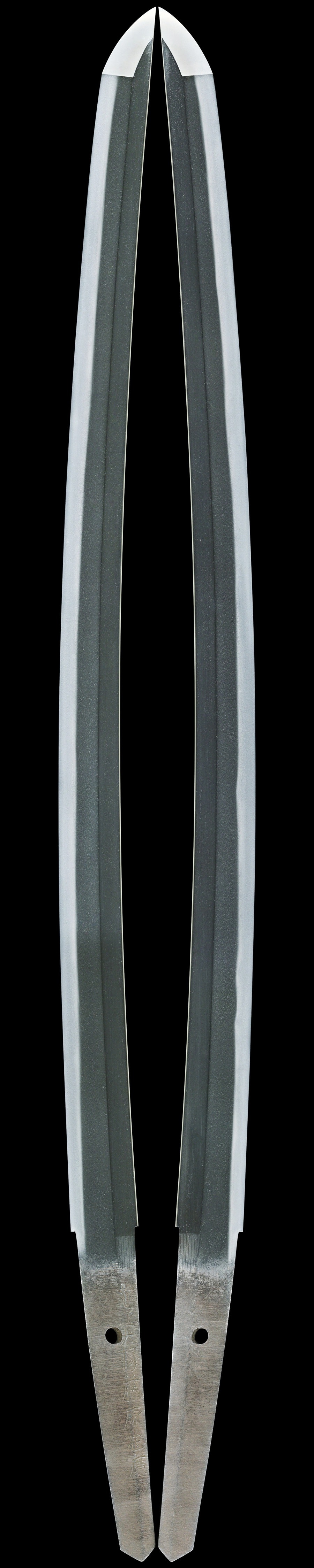
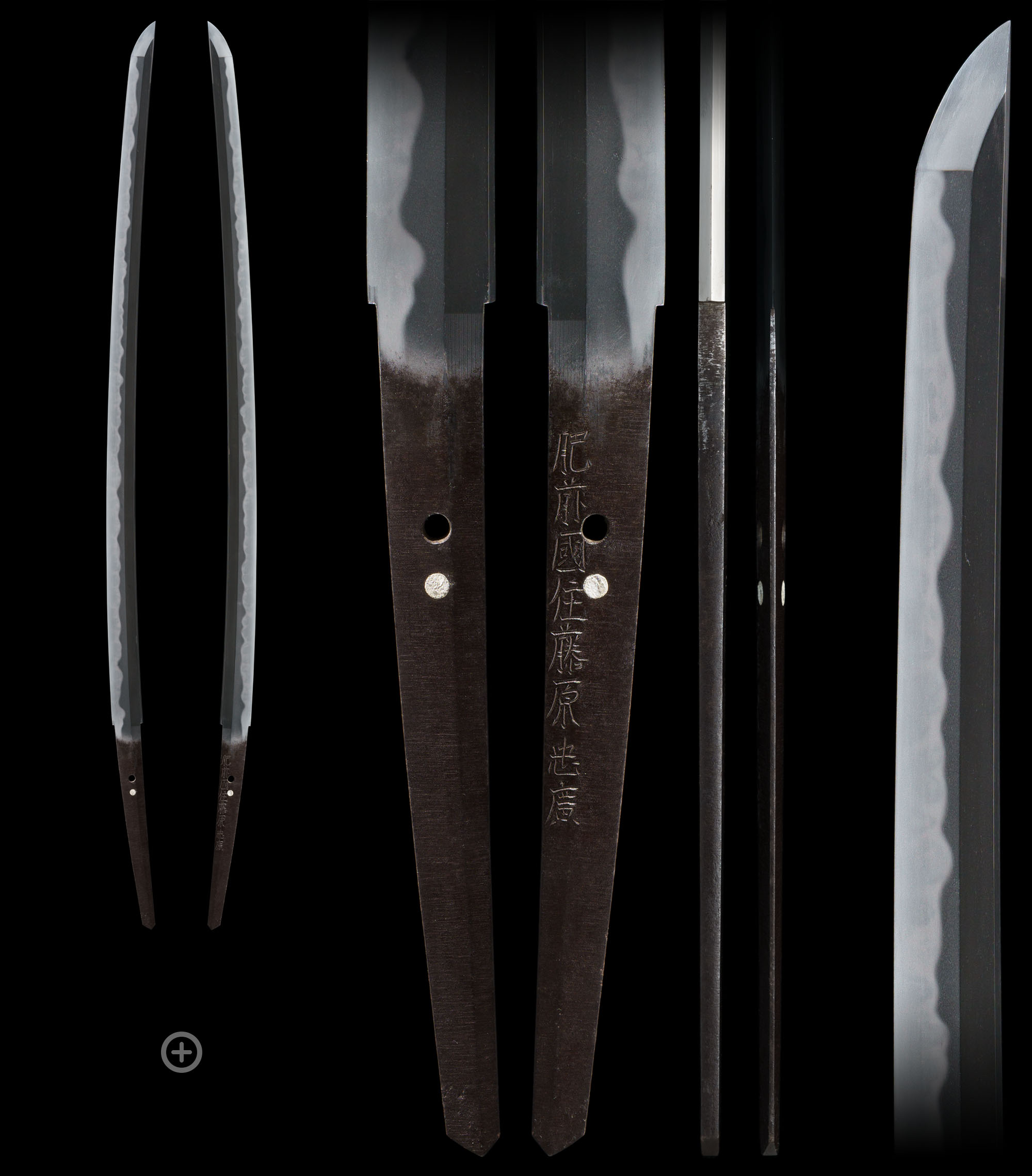
The first-generation of , the published sources record, styled himself Hashimoto Shinzaemon and served as a retained smith of the Nabeshima of . By domain order in Keicho 1 (1596) he went up to Kyoto together with the carver Munenaga and entered the school of Myoju, where he studied sword forging while Munenaga learned carving; they returned to their province in Keicho 3 (1598), and settled in the castle town below Saga, where under the domain's patronage the line flourished greatly. His dated work begins from the eighth month of Keicho 5 (1600) and runs to the eighth month of 'ei 9 (1632), the year he died, a working career the published sources reckon at thirty-two years. In Genna 10 (1624) he went up to Kyoto a second time, received the court title Daijo, and changed his name from to Tadahiro, altering his clan name from Minamoto to Fujiwara. He is the founder of -to, and the school he raised under Nabeshima patronage came to dominate the sword-making of Kyushu.
His mainstay is a bright, tight tempered upon the fine that is the signature of work. The published sources describe it plainly: "his favored is tempered upon a well-knit , the distinctive commonly called , and in it he aimed at the manner of the school". The temper is a or carrying only a shallow , at times mixed with , into which and enter; the is deep with finely clustered , and it tightens to a bright clarity. Yet, the sources note, the work departs from the originals it looks to: the is tighter and brighter, fine enter the abundantly, and the forging "has rather more vigor than the pieces". The temper and the steel together carry the recognition.
That steel is the heart of the matter. The forging is a dense, well-knit , at times with mixed in, over which gathers as the finest particles and lies thickly; fine enter intricately and the steel is notably clear. The published sources give it its name as a feature peculiar to his hand, the surface taking on the "distinctive ", the fine, bright, rice-bran texture that no other school produces. Upon it the runs straight and turns back in a quiet , the regular finish of a point. This combination, the clear konuka- beneath a tight bright , is what the published record returns to again and again as the founder's proper manner, the work that places his at the head of the tradition.
His early years are another matter, and the published sources read them as a period of copies. The constant formula is repeated almost verbatim from blade to blade: "his early manner comprises a wide range, full of -mono", naming Naoe-, old Yamato work, and the and masters. In the Naoe- vein he forges a mixed with , entering and running, the slightly tightened, a manner the sources say inherits the that was Myoju's particular forte and is "commonly called Naoe- ". In the old-Yamato vein the grows larger and flows toward the edge, and mix in with and frequent , and even the finishes with a touch of ; of one such piece the sources say it shows "the most archaic manner among 's works, with deep, lingering appeal", the standing as the exception to the rule that the point turns back in a quiet . He admired the masters as well, above all Kunimitsu, and copied the Kagemitsu on occasion, one being an of a Kagemitsu transmitted in the Nabeshima house.
The through-line of his career is the signature itself, which the published sources divide into three forms by period. He cut " no " in five characters, the so-called five-character ; he signed in eight characters as " no junin ," the junin ; and after the Daijo title of Genna 10 (1624) he used the " Daijo Tadahiro" signature, the rename being a single hand's chronology and not a change of person. The presentation pieces signed " no ju Fujiwara Tadahiro" without the title are the kenjo-, ordered by the Nabeshima, who held the title-signature unnecessary on a blade made for the house. The pieces common in his years, the sources note, become rare under the Tadahiro name. The is cut on the , the practice of and his line; almost all of his recorded work is signed, 125 of 129 records carrying his hand, so the signature is itself part of the appraisal, though the five-character form, imitated by the later Tosa-no-kami and the third-generation Mutsu-no-kami, dates a piece only together with the rest of the workmanship.
From him descends the whole school. His son the second-generation Omi Daijo Tadahiro carried on the konuka- and the to become the most prolific of the smiths, and the line continued through the third-generation Mutsu-no-kami and the Tosa-no-kami branch, the published sources noting that the third generation in particular returned in style toward his grandfather the founder, especially accomplished in and skilled also at . is Sai-jo in Fujishiro's grading. The weight of designation behind his name runs to one Important Cultural Property, ten and a large body of , one hundred and eighteen blades in the and tiers, with a single prewar Bijutsuhin piece and no National Treasures; one hundred and twenty-seven of his works survive with an official record. His blades carry a Nabeshima provenance and pass through notable hands, the recorded transmissions naming the Owari Tokugawa Family, the Satake Family and the Imperial Family among others, with a cutting-test inscription on one and a Myoju on another that documents his discipleship. The bulk of what survives is held in long-standing collections and institutions such as the Takamatsu Historical Museum, and most are kept rather than traded; one comes to open hands only from time to time, and as the founder's own work it is a landmark of the tradition when it does.