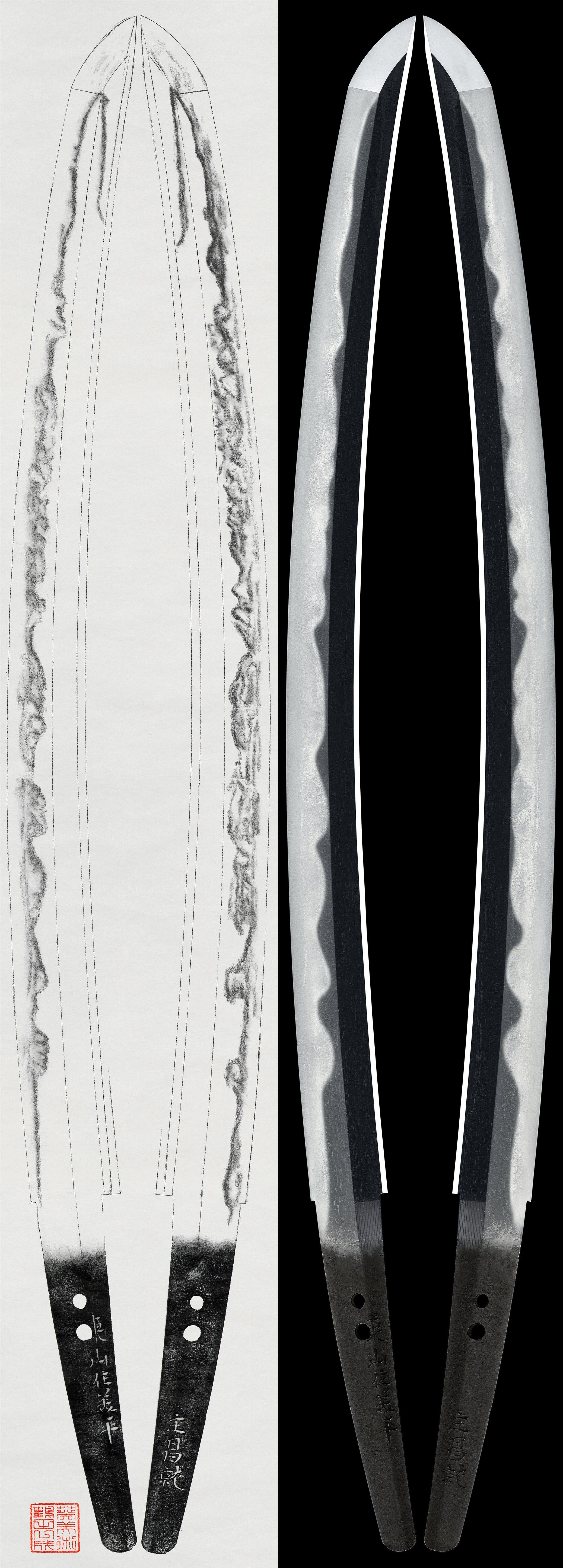
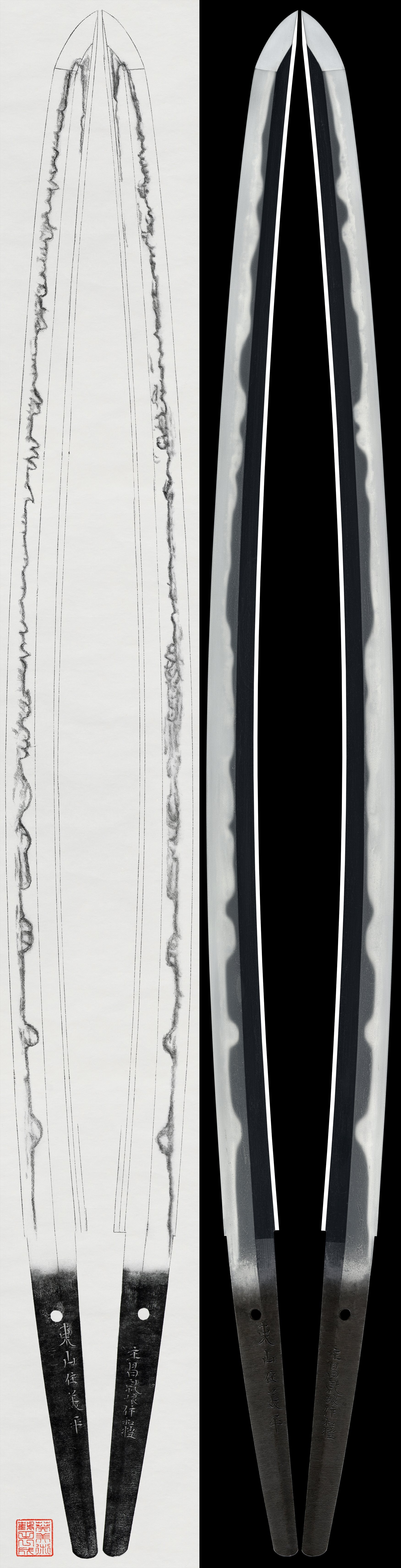
Myoju (埋忠明寿) resided in Nishijin, Kyoto, and was active from the Bunroku era through the 'ei era, with a career spanning the late into early periods. He is said to have been born in Eiroku 1 (1558) under the earlier name Sokichi, with the common name Hikojiro; he later took the tonsure and adopted the name Myoju, and is transmitted as having died in 'ei 8 (1631) at the age of seventy-four. The house claimed descent from Munechika and was a distinguished lineage of metalworkers who, over successive generations, served the Ashikaga shogunal family. Revered as the "founder of smithing," Myoju was also highly accomplished in toshin-bori (carving on sword blades) and is known as the teacher of and no Kami Teruhiro. Together with Kaneie and Nobuie, he is celebrated as one of the "three great masters of the period." His activities extended across many fields — swordmaking, the production of steel and sword fittings, the shortening () of blades, the insertion of inlaid signature attributions (-), and the production of sword mountings — and he accepted commissions for the Toyotomi and Tokugawa houses as well as many families.
Myoju's may be broadly divided into two categories: iron works and soft-metal () works. When the ground is iron, he expresses geometric patterns — , (thunder pattern), -kaminari- (mist-and-thunder designs), and rinzu- — by means of gold , a technique originally a forte of the Shoami lineage that Myoju may initially have adopted. His iron openwork includes celebrated masterpieces such as wheel (kuruma) and double-tomoe . When brass (shinchu), , or (refined copper) serves as the ground, he develops compositions through a distinctive form of - that retains only a slight relief (), deploying colored metals — gold, silver, , , and other — in novel combinations. His chosen subjects are auspicious trees and plants — grapes, kunenbo (a citrus resembling yuzu), oak, pine and bamboo — "boldly stylized into patterns, producing an exceptionally fresh and courtly (miyabi) taste." In his iron works, the nejikaeshi-mimi (twisted turned-back rim) and gold rim inlay are techniques "at which he particularly excelled," while the iron itself is invariably "carefully selected" and displays excellent quality. In soft-metal works, ground textures including hammered (), polished (), and file-finished surfaces are deployed with meticulous care to heighten the pictorial effect.
Across the , Myoju's work is consistently described as possessing "the vitality that preserves the very momentum of brushwork," with refined linework that vividly recalls the paintings of the Rinpa tradition; a "strong connection with Koetsu and Tawaraya Sotatsu" is repeatedly affirmed, and his ability is said to rival that of these contemporaries. The pictorial manner of design, the - technique, and the use of non-iron metals as the ground material "all find their earliest beginning with Myoju" — he stands as the originator of an entire aesthetic vocabulary in kinkō (metalwork). His compositions are praised for giving "priority to open space" while expanding motifs into large-scale patterns, and the coloration of his inlay is executed "with truly meticulous care." He is consistently identified as "a representative figure in the world of -period art and craft," whose works manifest "the spirited character of culture" and convey "a deep, resonant charm" that makes fully visible the essence of a master craftsman.