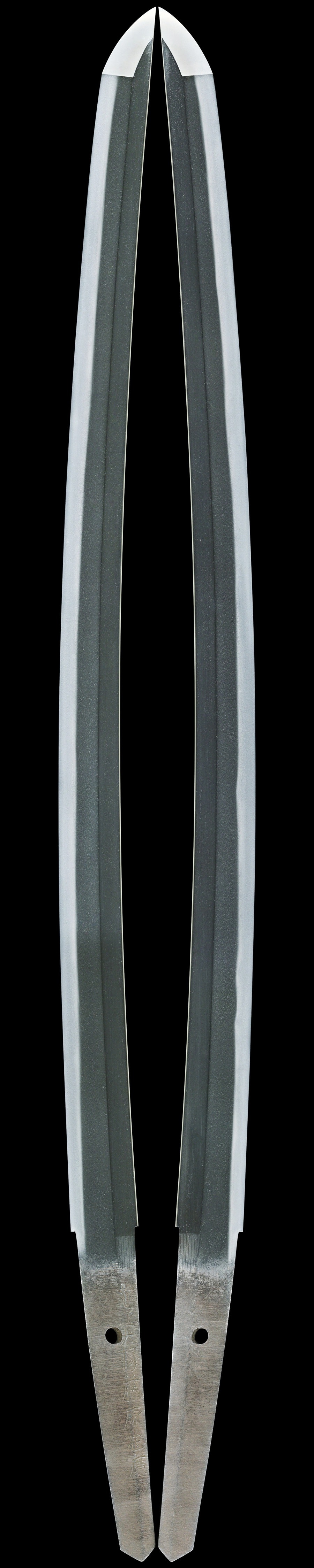
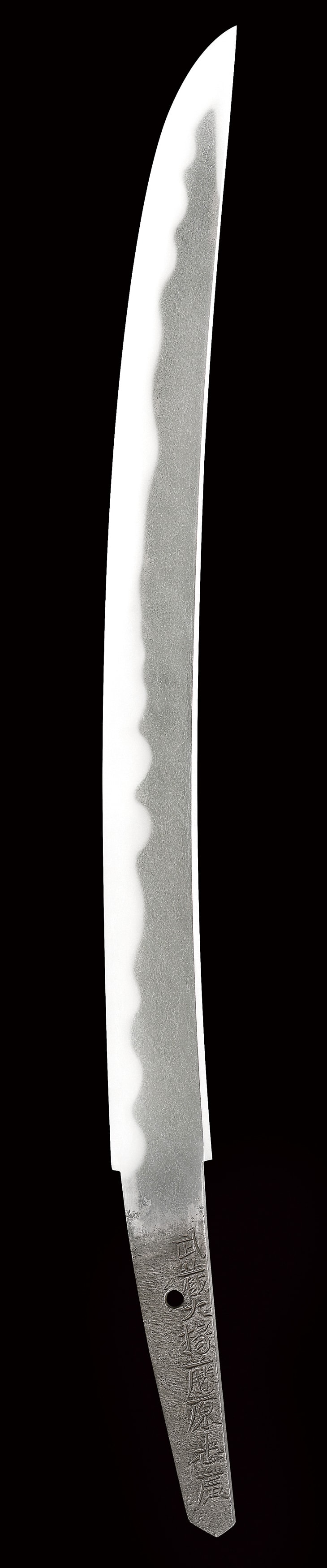
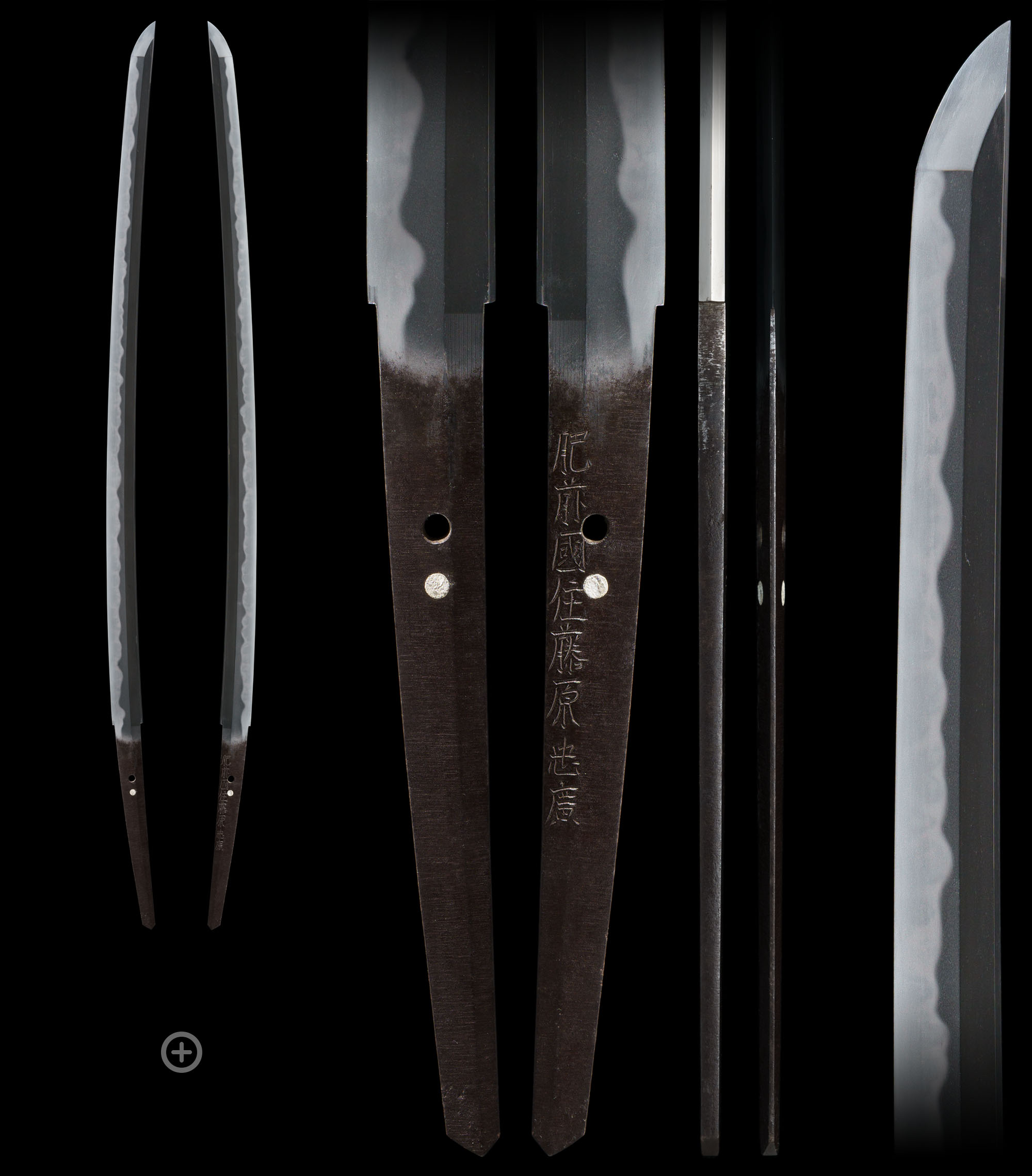
The first-generation Iyo no Jo Munetsugu is said to have borne the name Sakai San'emon, and tradition holds that his family served for generations as priests at the Tenmangu shrine in Nagase Village, the birthplace of . He later moved to Nagase- in the castle town of Saga, where he forged swords, and is further said to have relocated to Isahaya in . According to the "Iyo no Jo Munetsugu Genealogy" preserved among old documents transmitted in the Sakai family, he received the court title of Iyo no Jo in Keicho 11 (1606), a dating supported by extant works of Keicho 12 that already bear the title. Active in the through early period, Munetsugu occupies a distinctive position among the group of smiths, standing apart from the mainstream lineage descended from .
His workmanship reveals an approach in the manner of the tradition, particularly a -like sphere of work. Both and are richly covered in ; he tempers vigorous incorporating , with and appearing conspicuously and in abundance. His characteristically displays tending toward standing grain, mixed with , with fine thickly applied and well formed, while the steel takes on a slightly blackish tone. Whereas swords in general temper the straight into , in Munetsugu's work the great majority show , often with vigorous becoming flame-like at the tip. His construction likewise reflects a conscious attention to - practice, taking on a -like form with the edge-side flesh reduced, and he customarily cuts a distinctive long signature on the in large, bold strokes.
Across the body of his designated work, the consistently recognizes Munetsugu as "a distinctive presence among the group of smiths" who "devoted himself with particular passion to recreating -." His blades are praised for their abundant activities in and , for a brilliant and showy tempered edge "brimming with force," and for the robust, powerfully built that is "bold and magnificent." In works of calmer patterning, the appearance of and -like effects above the temper line is noted as conveying an "antique flavor." Munetsugu's range extended beyond the habitual -like domain to encompass broader influences, as evidenced by ambitious pieces of "great documentary value for understanding the range of his work." His finest examples are characterized as works that "fully display the true strengths of the first-generation Iyo no Jo Munetsugu."