 NihontoWatchNihontoWatch
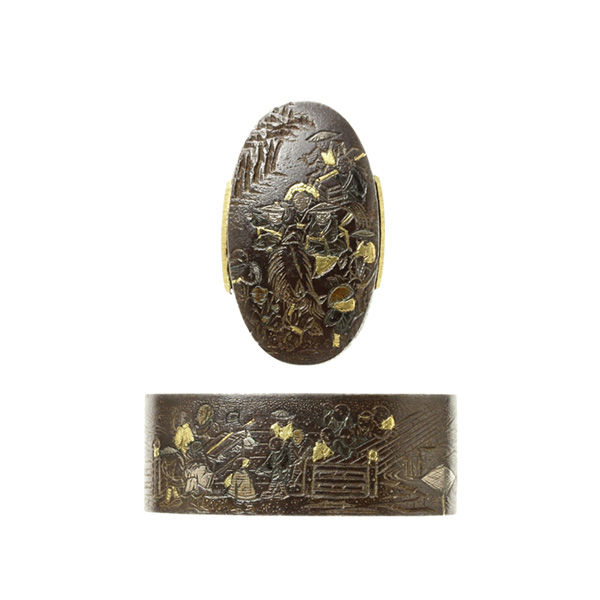
江戸日本橋を出発点とした東海道も大津から山科を経て東山の山襞を縫うように越えると終点の三条大橋は目前。五十三次の長い旅路も終わりである。この大津から京までの短い間には、歌枕に挙げられている逢坂山、謡曲関寺小町の関寺や蝉丸神社、涸れることのない清らかな水が迸ることで有名な湧水の走井などの名所があり、旅人の心を和ませていた。 表題の縁頭はこのような街道の風景、行き交う人々の様子とその表情をスナップ写真のように切り取った作。縁には大きく三条大橋が図取りされ、肩が触れ合うように行き過ぎる町人の様子が濃密に描き表されている。縁の裏側には洛中洛外図屏風などにも散見される網を用いての鮎漁。橋上の町衆は川風を楽しんでいるのであろう。欄干に肘をかけてのんびりと川を眺めている。頭には馬上の旅人。東山を越えて林の木々の間に町並みがうかがえる辺りが背景であろう。 この街道、殊に東山を越える辺りは古くから往来が激しく雨が降れば轍に水が溜まり通行不能となることも多かった。江戸時代中期に車石と呼ばれる石畳で舗装され、荷車の通行を容易にした。長義の没年は未詳だが、師である長常の活躍期から考察し、その生年中に舗装工事が行われたと推定され、あるいはこの出来事を作品に反映させたのかもしれない。
NihontoWatchOffered by Choshuya
This piece has sold
Get an email when a new Ichinomiya Nagayoshi piece hits the market.
Edo
Yamashiro
Signed
Tokuho (NBTHK)
As written by the shop
Machibori · Yamashiro
1 piece on the market now
Machibori · Yamashiro
8 pieces on the market now
The Ichinomiya school is a Kyoto kinko (金工) lineage founded by Ichinomiya Nagatsune (一宮長常), who was born in Kyoho 6 (1721) at Tsuruga in Echizen Province. Known as Kashiwaya Chuhachi, Nagatsune began as a gilder (mekkinshi) before travelling to Kyoto, where he studied under Yasui Takanaga, a craftsman of Goto lineage. In his early period he signed "Setsuzan"[[c:1]], later adopting the name Nagatsune and the art name Ganshoshi (含章子). He also studied painting under Ishida Yutei, teacher of Maruyama Okyo; this grounding in shasei (sketching from life) became the distinguishing intellectual foundation of the Ichinomiya manner. At the age of fifty he received the court title Echizen Daijo, and he died at sixty-six in Tenmei 6 (1786). Members of the school characteristically bear the characters 長 (Naga-) or 常 (-tsune) in their names. The Ichinomiya style synthesizes Goto-lineage metalworking discipline with the observational acuity of Kyoto academic painting. While Nagatsune was highly proficient in Goto-style takabori (高彫, high-relief carving), the school achieved its renown through hira-zogan (平象嵌, flat inlay) combined with katakiribori (片切彫, single-cut engraving) — a technique pairing that became its signature. The preferred ground is polished shibuichi (migaki-ji), upon which modulated chisel-work of varied intensity and rhythm produces supple, painterly line. Colour is introduced with restraint through flat inlay in gold, silver, shakudo, suaka (素銅, plain copper), and shibuichi, the limited application heightening the beauty of the ground metal.
For sculptural subjects the school employs yobori (容彫, modeled relief) on suaka ground, sometimes varying the metal between obverse and reverse in the chuya-ji (昼夜地, "day-and-night ground") construction. Tsuba from the early Setsuzan period favour brass prepared in the yaki-te kusarashi-ji (焼き手腐らかし地) manner, carved in sukidashi takabori with polychrome iroe. Throughout the oeuvre, compositions unfold across front and back surfaces — continuing from the face of a kozuka onto its spine and reverse — prompting the viewer to discover the design in the round. Figural subjects draw on Chinese literary and martial themes — Guan Yu, the Three Laughers of Tiger Ravine, Huang Shigong and Zhang Liang, Ma Shi-huang, the archer Yoyuki — alongside naturalistic studies of turtles, snails, toads, and shishi, and genre scenes such as cormorant fishermen and Genroku-period Bon-odori dancers. The school's pictorial power derives from the accuracy of the underdrawing stage, where powers of observation cultivated through Maruyama-school training are evident before any chisel is taken up. Nagatsune's eminence in the tosogu canon is encapsulated in the phrase repeatedly cited in NBTHK records: "Somin of the East, Nagatsune of the West" (Higashi no Somin, Nishi no Nagatsune). Together with Tetsugendo Shoraku and Otsuki Mitsuoki, he was further lauded as one of the "Three Great Masters of Kyoto metalwork" (Kyoto kinko no sanketsu). " The Four Divine Symbols tsuba, inscribed "Carved in leisure" (kandori kore o horu), is a painstaking work made to the artist's own taste in intervals between commissions. From the robust sukidashi takabori of his early Setsuzan-period tsuba through to the refined katakiribori and flat inlay of his mature years, the Ichinomiya corpus attests to an artistic range and technical command that secured for its founder a permanent place among the foremost machibori metalworkers of the Edo period. Learn more →
| Smith | Era | Designated |
|---|---|---|
| Nagatsune長常 | — | 37 |
| Nagatoshi長年 | — | 0 |
| Tsunenao常直 | — | 0 |
| Sadanaka貞中 | — | 0 |
| Nagayoshi長義 | — | 0 |
A Hozon-certified fitting of notably superior craftsmanship and condition, often with signature or workmanship of high reference value.
The NBTHK (Nihon Bijutsu Tōken Hozon Kyōkai, the Society for the Preservation of Japanese Art Swords) is a public-interest incorporated foundation founded in 1948 and supervised by Japan’s Agency for Cultural Affairs (Bunkachō); it is based at the Japanese Sword Museum in Tokyo. Its expert panels physically examine each submitted work (shinsa) and issue a certificate (kanteishō) ranking it by artistic and historical merit. NBTHK papers are the most widely recognized standard of authentication for Japanese swords and fittings.
NBTHK official siteIf, due to our fault, the item differs significantly from its proper condition, the item may be returned. Cooling-off is within one week of the item's arrival.