Sixty years of war between two courts drove blades long and broad, and Osafune met the demand: Kanemitsu and Chōgi led forges serving the provincial warriors who did the fighting, while Sōshū influence arrived with the armies to create Sōden-Bizen.
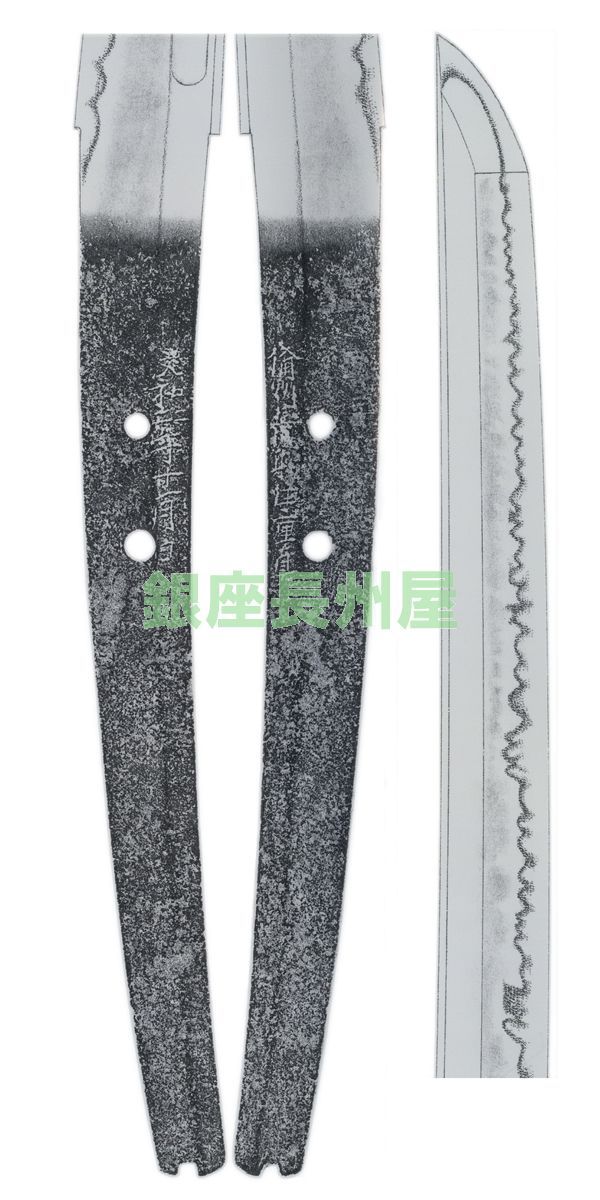
南北朝中期文和四年紀の、備前長舩重真の生ぶ茎完存の太刀。重真は兼光と鎬を削った元重の弟で、活躍期は鎌倉末期嘉暦から南北朝中期延文の三十余年。初期には景光を見るような片落互の目の嘉暦二年五月日紀の短刀(第三十四回重要刀剣)や、角張る小互の目を配した直刃出来の建武元年十一月日紀の太刀(『銀座情報』百七十九号)があり、共に銘字は大振り。これに対し、後期には乱映りの立つ地鉄に丁子乱刃を焼いた延文三年十二月日紀の太刀(第十五回重要刀剣)や、片落互の目出来の延文四年二月日紀の短刀(『鑑刀随録』)があり、銘字は小振りとなることから、建武を境に初代と二代に別ける見解もある。いずれにせよ、元重と重真の兄弟が、大太刀を手に人馬一体の激戦を展開した武士の意気に応え、文字通り命懸けで鎚を振るったことは確実である。 この太刀は、腰反り高く鋒から茎尻まで美しい構成線をなし、腰元の樋と梵字が古風で格調高い造り込み。小杢目鍛えの地鉄は地景が蠢き、地沸が微塵に付き、刃文の影のような黒映りが鮮明に立ち、平地の沸が光を柔らかく反射して霞立つ絶妙の景観。刃文は丁子に互の目、片落ち風の刃を交え、淡雪のような沸で刃縁が明るく、刃中には匂が立ち込め、焼刃が蒼く冴える。帽子は表が浅く弛み、裏は乱れ込み、突き上げて小丸に返る。茎に刻された銘字は鑚の線が清く澄んで古雅。弘化三年に金七十枚と格付けされた本阿弥忠敬の添状(注1)が付された、伝家の宝刀(注2)である。 注1...本阿弥光竜家の九代目。添状は本阿弥分家で出す折紙(福永酔剣先生『日本刀大百科事典』)。 注2...「公爵島津家傳来御刀」と鞘書された備州長舩行元の太刀(本誌四百十三号掲載)と同年同日の連番登録であり、本作も島津家伝来と考えられる。
Offered by Choshuya
This piece has sold
Get an email when a new Osafune Shigezane piece hits the market.


Osafune (Bizen), Motoshige line · Bizen · around 1327-1358
Fujishiro Jo saku · Tōken Taikan top 10%
2 pieces on the market now
Shigezane is an Osafune swordsmith of the Motoshige line, working from the close of the Kamakura period into the Nanbokucho, whose earliest dated work is a slightly elongated tanto of Karyaku 2 (1327) and whose latest reaches Enbun 4 of the Nanbokucho, a documented span of thirty-three years. The published sources record him by old tradition as the younger brother, or in another account a pupil, of the first-generation Motoshige, and they place his hand squarely within the Soden-Bizen of the late Osafune workshop. His is not the brilliant clove-flower of the older Bizen; it is the quieter, more angular manner of the Motoshige group, read by the published commentary as close to Motoshige with the character of Aoe mixed in. Authenticated signed examples are exceedingly few, so much of what survives under his name is judged from the bearing of the blade and the structure of its temper rather than from a signature.
The feature that most distinguishes his work is the temper. Over a suguha-toned base he sets angular gunome, the squared shoulder that reads as Motoshige-line rather than the rounded clove of Fukuoka, joined by the kataochi-gunome that is the structural tell of the group, the asymmetric saw-tooth slanting toward the base. The line frequently leans saka-gakari, the elements inclining in reverse, and into it run ashi and yo with ko-nie gathering and fine sunagashi and kinsuji passing through. The nioiguchi tends to sink to a subdued shizumi, the calm, slightly dimmed temper that the published sources name again and again as the mark of the Motoshige hand. The boshi enters in midare-komi and turns back pointed, at times a ko-maru or a yakizume sweep.
The jigane keeps the attribution in Bizen even where the temper alone might read as Soden. He forges a standing itame, often run through with nagare-hada and mixed with mokume and patches of jifu, the ji-nie thick and chikei entering, the grain a little raised. Across it rises a clear midare-utsuri, the bright reflection of old Bizen steel, sometimes a fainter bo-utsuri along the edge. The steel on his finest pieces takes a bluish-black tonality with a cold clarity, the nioiguchi bright and the activity within the ha abundant, with places where coarse nie glitters strongly.
His record divides into three registers. The mainstream is the suguha-toned, angular-gunome work that the published sources read as close to Motoshige, the manner that anchors his many o-suriage mumei attributions. Against it stands a rare exception, the ubu signed tachi dated Enbun 3, of which the commentary remarks that the workmanship 'is not in a Motoshige-like manner'[[c:1]], opening instead into a frank choji-midare with pointed gunome at the monouchi. The third register is the body of his surviving work, the greatly shortened mumei katana, several originally large tachi exceeding three shaku, wide in body and shallow in sori in the Nanbokucho mode. As with Motoshige, the published sources propose a first and a second generation across his dated span, the bold two-character signature taken for the first and the smaller signature cut 'Saemon-no-jo Shigezane'[[c:2]] for the second, a question still left for further study.
What sets him apart within the late Osafune is exactly what the judges name. His angular gunome and kataochi-gunome, his saka-gakari temper and subdued nioiguchi, and the bright midare-utsuri over his standing itame place him with Motoshige and apart from the rounder, showier Bizen of Fukuoka and Yoshioka, while the published sources read into his forging a manner that incorporates the character of Aoe, the workmanship they call 'a hand with Aoe character mixed in'[[c:3]]. On a mumei katana judged to him the commentary allows that views of 'Unrui or Chikakage'[[c:4]] are possible, the panel narrowing it to Shigezane only on close reading of the whole taihai together with the detail of ji and ha, the clear midare-utsuri leaving no doubt of Bizen.
For the collector Shigezane is a scarce signed name. Fujishiro grades him Jo-jo saku, and his record runs not through National Treasures or Important Cultural Properties, of which he has none, but through a single Tokubetsu Juyo and many Juyo, forty-five blades across the two tiers. The value of his best pieces lies in their documentary weight: the Tokubetsu Juyo katana with its folded-back long signature, called 'a representative work of this smith'[[c:5]]; the Karyaku 2 tanto, the earliest of his dated works and a foothold for his study; and a naginata preserved in its original form, 'a precious example that survives as a naginata without having been reshaped into a sword'[[c:6]]. Of recorded whereabouts a few are held in public collections, among them the Hayashibara Museum of Art and the Bizen Osafune Sword Museum, and the denrai of his blades passes through daimyo and old houses, the Matsudaira family with Matsudaira Ukon-no-suke Terusada and the Takasaki domain, and the Niwa family on to Tokugawa Yoshinobu. A signed Shigezane comes to light only seldom, and a privately held example, especially an ubu or dated one, is a notable thing for a collector to encounter, a document of how the Motoshige hand carried Bizen into the Nanbokucho.

Where Shigezane stands among comparable artisans: across all of nihontō, and within tradition, era, and period. The tiers (Foremost · Leading · Major · Notable) weigh official designations from the NBTHK and Japan's Agency for Cultural Affairs, together with historical honors of lasting repute such as the Sansaku and Meibutsu-chō.
Select a lens to see how it's measured.
Years he was demonstrably active, proven by signed-and-dated blades
Bizen-den · Bizen
186 pieces on the market now
No single workshop in the history of Japanese swordmaking grew larger or lasted longer than Osafune, the riverside village in Bizen Province whose name became, across three centuries, a byword for the province's mainline. Its de facto founder was Mitsutada (光忠), working at Osafune in the middle Kamakura period; tradition makes him the son of Chikatada, and the genealogies derive his line from the Ko-Bizen Masatsune group already settled in the village. His blades, bold and imposing with a jigane so refined the sources say it can at a glance suggest Kyoto work, were treasured from old as the swords of commanders, and from his hand the school spread immediately: his sons Nagamitsu (長光) and Sanenaga (眞長), his grandson Kagemitsu (景光), and outward through pupils and collaterals until, by the late Kamakura years, Osafune was less a family than an industry. The line is conventionally read as a three-generation spine, Mitsutada founding it, Nagamitsu setting its classical standard, Kagemitsu bringing both temper and forging to their finished form before handing the manner to his pupil Chikakage (近景), whose echo of the master is so close that signed Kagemitsu blades are sometimes read as Chikakage daimei. What binds the membership is a shared steel before any shared temper. The forging is itame mixed with mokume, tightening on the finest blades into a dense ko-itame; fine ji-nie adheres, chikei enter, and over all of it stands the midare-utsuri that anchors even the most Kyoto-like jigane back to Bizen. On that floor the founding generation tempers a flamboyant choji-midare mixed with gunome: Mitsutada's tadpole-headed kawazuko-choji, Nagamitsu's round-topped plump choji, the deep nioi with ko-nie, the bright nioiguchi. From here the school divides by hand and by era. Sanenaga draws the calm pole, a gentle chu-suguha of tightened nioiguchi; Kagemitsu completes the slanting, square-shouldered kataochi-gunome over a suguha base, the family's last great Kamakura invention, carried on by his close kinsman Kagemasa (景政). The Nanbokucho generation then turns toward Soshu-den: Kanemitsu (兼光), fourth master of the mainline, pioneers a broad notare and is read, with Chogi (長義), as the head of Soden-Bizen, the Bizen wing that worked Soshu nie into a jigane that still throws a Bizen utsuri.
Chogi is called the most un-Bizen of Bizen smiths, his ear-shaped mimigata his tell; around him Nagashige (長重), Yoshikage (義景), Tomomitsu (倫光) and Kanenaga (兼長) press the Soshu side by degrees, while Motoshige (元重), of a separate Hatakeda descent, carries an Aoe-tinged squared, slanting ha. Two generations later the Oei revival returns to Kamakura: Yasumitsu (康光) and Morimitsu (盛光), the twin pillars of Oei-Bizen, revive the tachi shape and the choji temper over a wide-waisted koshibiraki-gunome, both finishing in the pointed rosoku-no-shin (candle-wick) boshi that gives the late date away. For the collector the school is a school of discriminations, and to kantei it is to read those fine partitions. The constant midare-utsuri over a bright ko-itame fixes the province; the boshi then sorts the maker, Mitsutada's pointed midare-komi against Nagamitsu's composed ko-maru Sansaku turn, Kagemitsu's contained return, the candle-wick tongue of Oei. Within a single phase the calls turn on a half-step: Nagamitsu's plump crests against Sanenaga's cooler nioiguchi, Kagemasa's freer play against Kagemitsu's tighter order, Nagashige read out of Chogi by a nie that surpasses his brother's. The standing of the best is matched by their patrimony. Mitsutada, Nagamitsu and Kagemitsu each hold National Treasures and stand at the head of Fujishiro's Sai-jo saku; their named blades, the Daihannya Nagamitsu, the Kogaryu Kagemitsu, the O-Kanemitsu, passed through Nobunaga, Ieyasu, Uesugi Kenshin and the great daimyo houses. Because Nagamitsu and the Nanbokucho masters signed and survived in number, Osafune offers what most peerage names cannot, a deep field of Tokubetsu Juyo and Juyo work that a patient collector may still realistically hold. Through every register the same hand declares itself: the bright steel, the vivid reflection, and a temper that runs, across three centuries, as the spine of Bizen. Learn more →
| Smith | Era | Designated |
|---|---|---|
| Mitsutada光忠 | 1238-1239 | 60 |
| Nagamitsu長光 | 1274-1304 | 254 |
| Kagemitsu景光 | 1303-1336 | 142 |
| Sanenaga眞長 | 1299-1309 | 68 |
| Kanemitsu兼光 | 1323-1370 | 235 |
Bizen in the Nanbokuchō period
Sixty years of war between two courts drove blades long and broad, and Osafune met the demand: Kanemitsu and Chōgi led forges serving the provincial warriors who did the fighting, while Sōshū influence arrived with the armies to create Sōden-Bizen.
A Hozon-certified blade judged to show notably superior workmanship and a better state of preservation. The bar is higher: re-tempered blades and most unsigned Muromachi/Edo works are excluded.
The NBTHK (Nihon Bijutsu Tōken Hozon Kyōkai, the Society for the Preservation of Japanese Art Swords) is a public-interest incorporated foundation founded in 1948 and supervised by Japan’s Agency for Cultural Affairs (Bunkachō); it is based at the Japanese Sword Museum in Tokyo. Its expert panels physically examine each submitted work (shinsa) and issue a certificate (kanteishō) ranking it by artistic and historical merit. NBTHK papers are the most widely recognized standard of authentication for Japanese swords and fittings.
NBTHK official siteIf, due to our fault, the item differs significantly from its proper condition, the item may be returned. Cooling-off is within one week of the item's arrival.