 NihontoWatchNihontoWatch
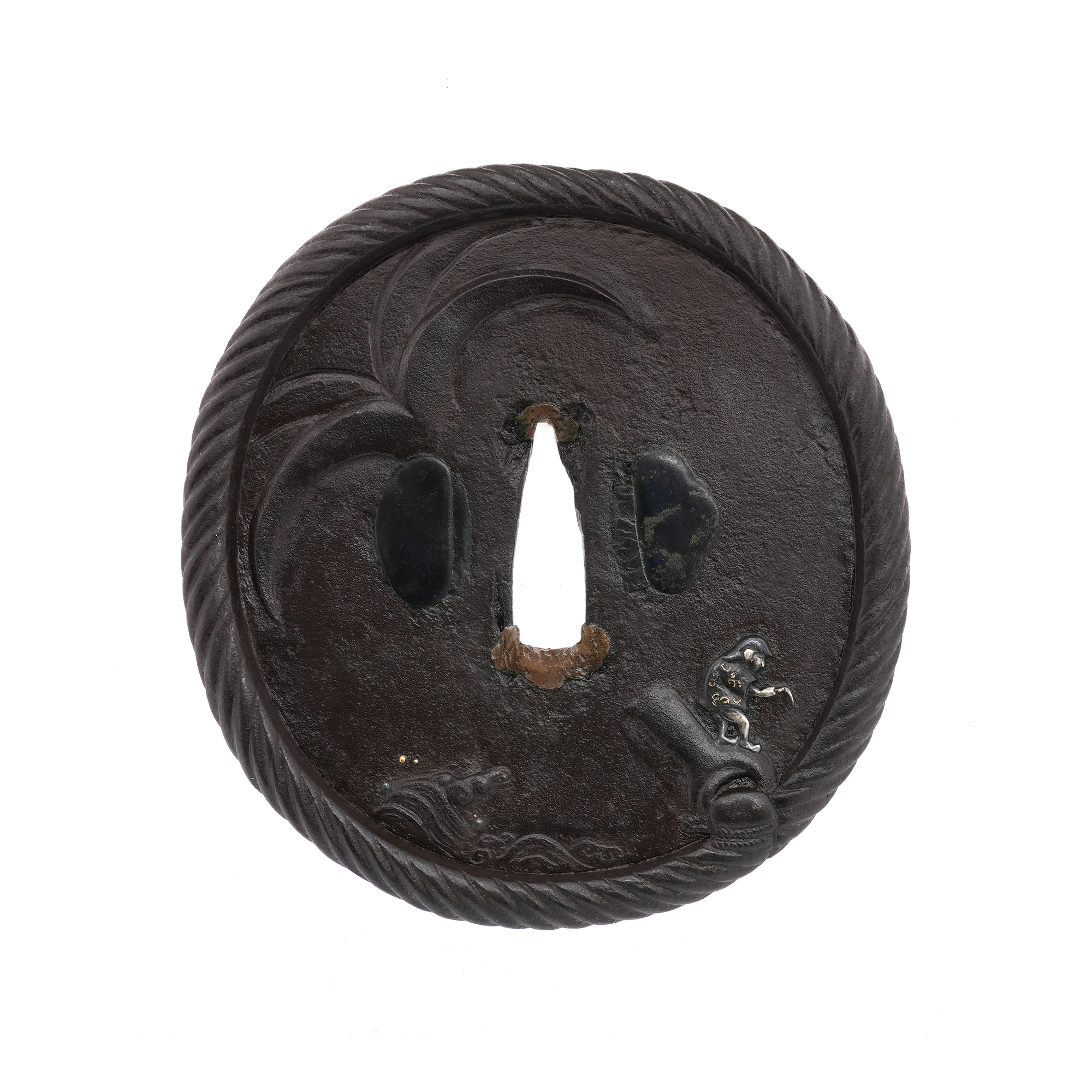
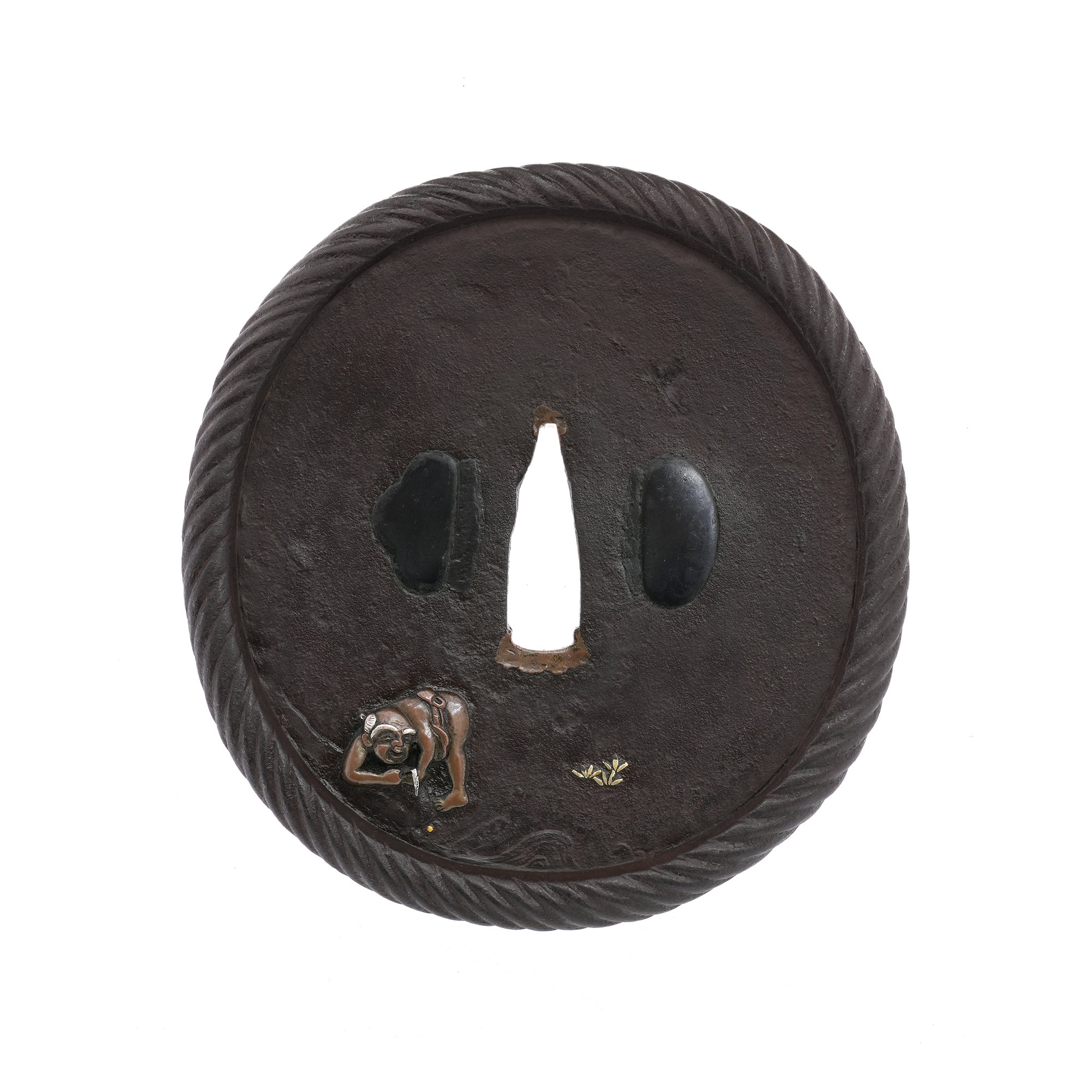
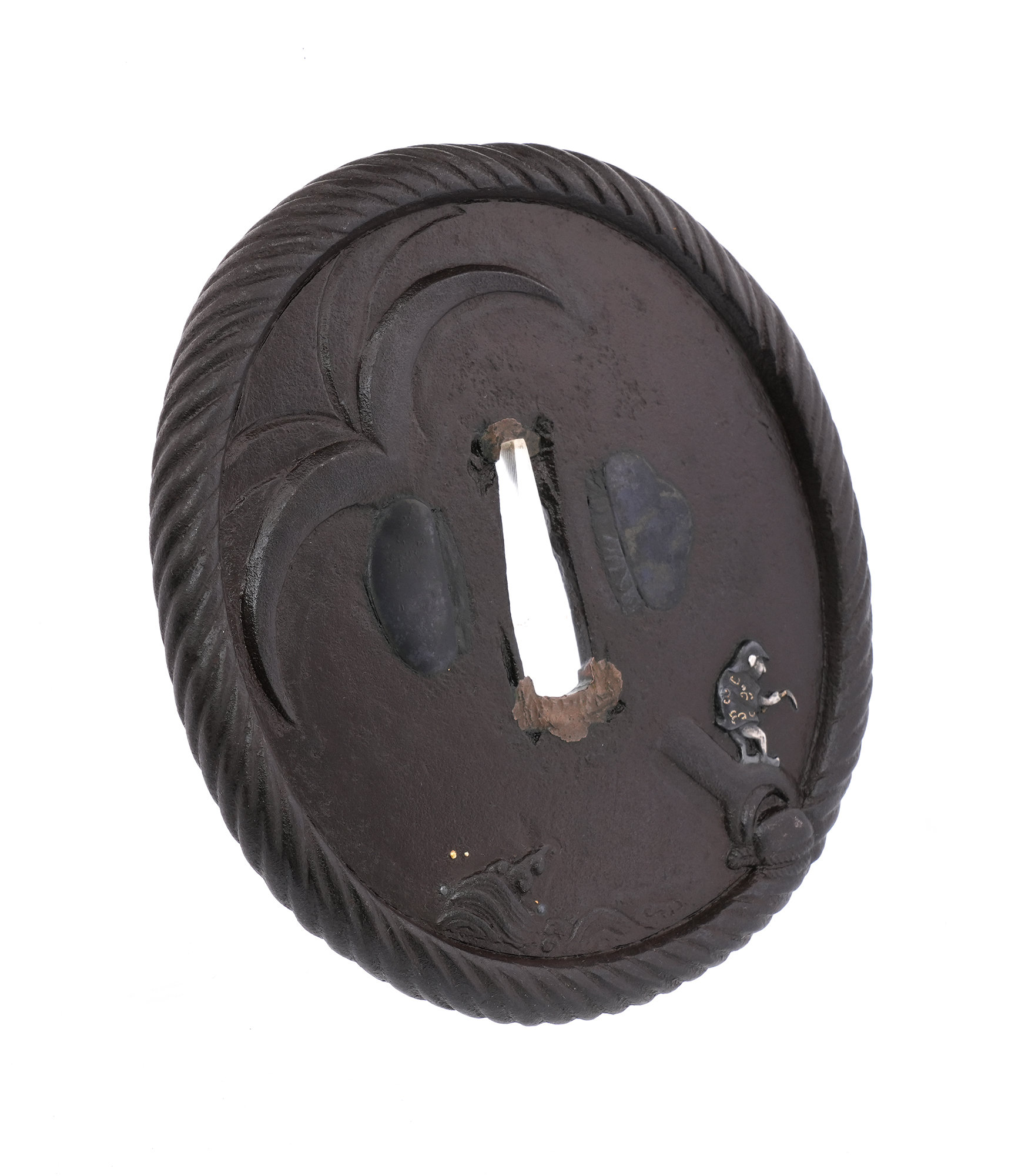
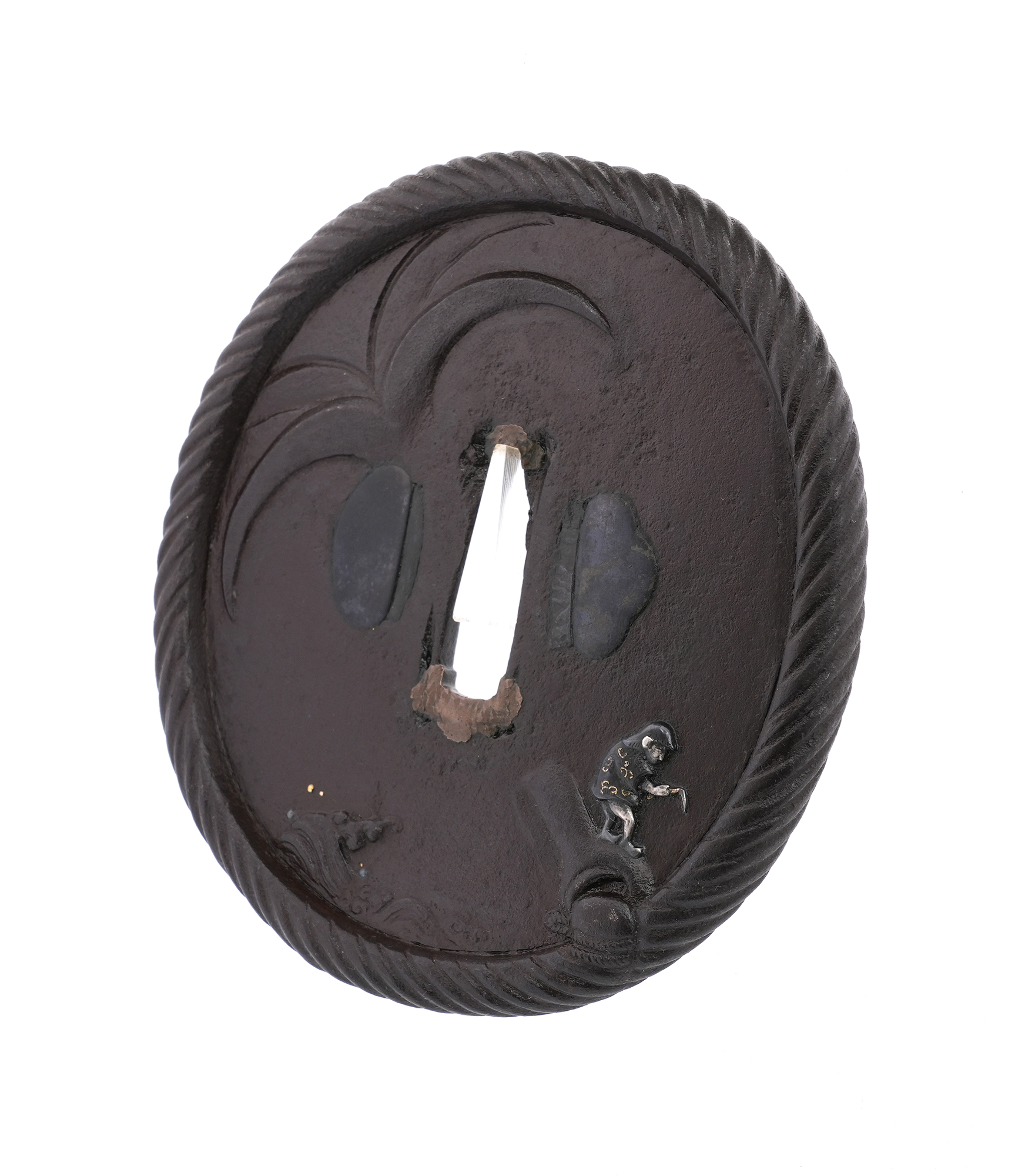
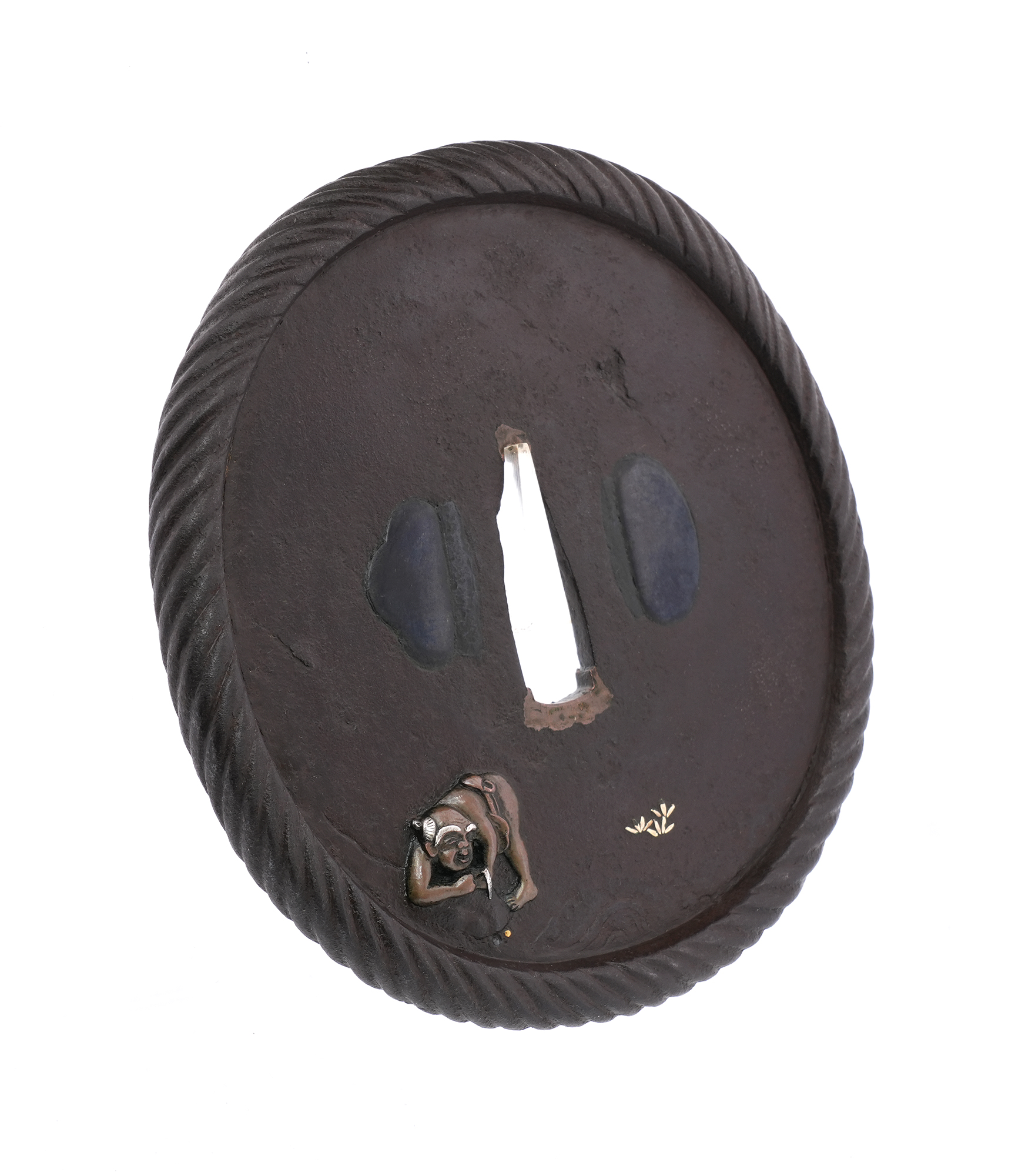
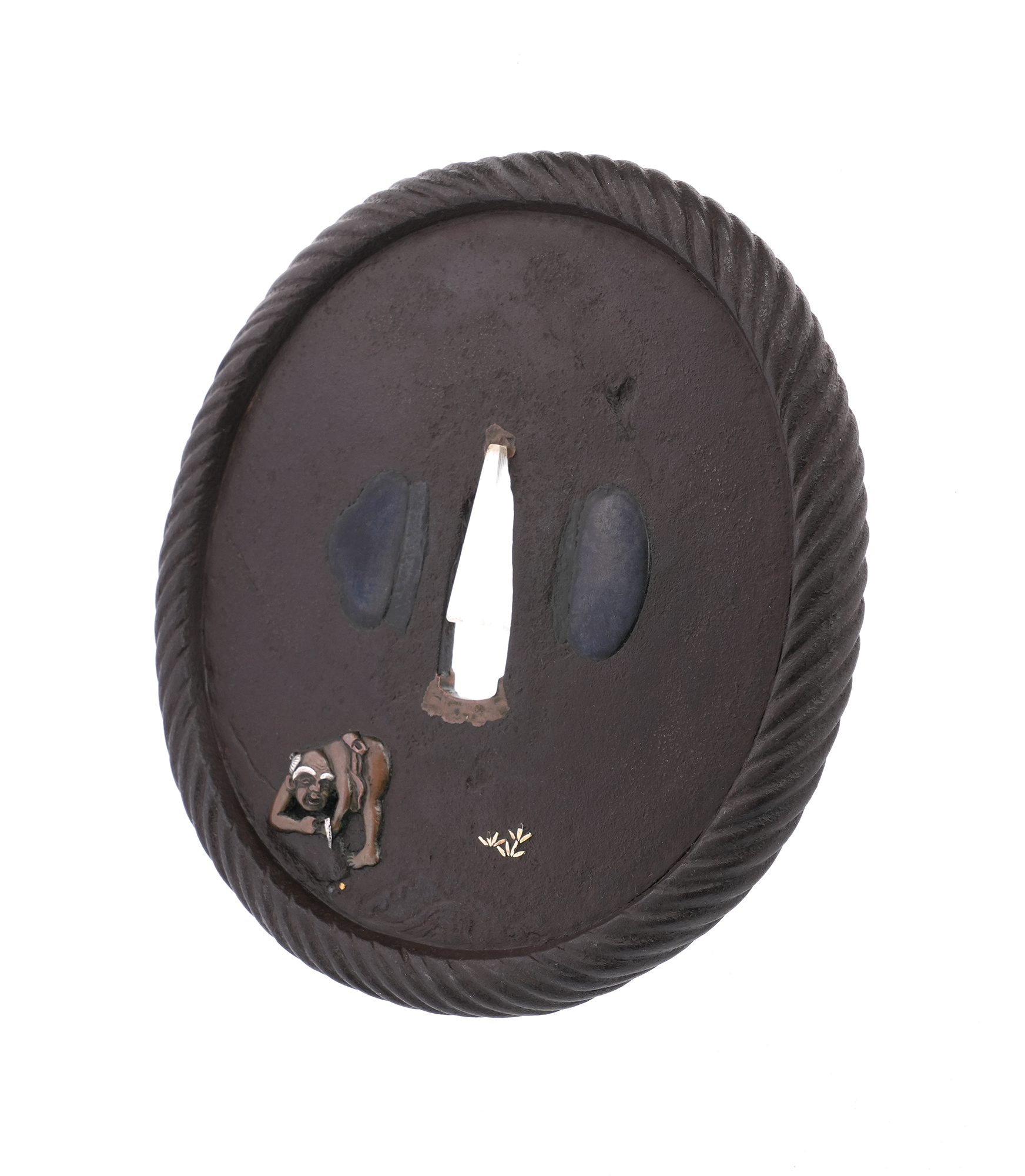
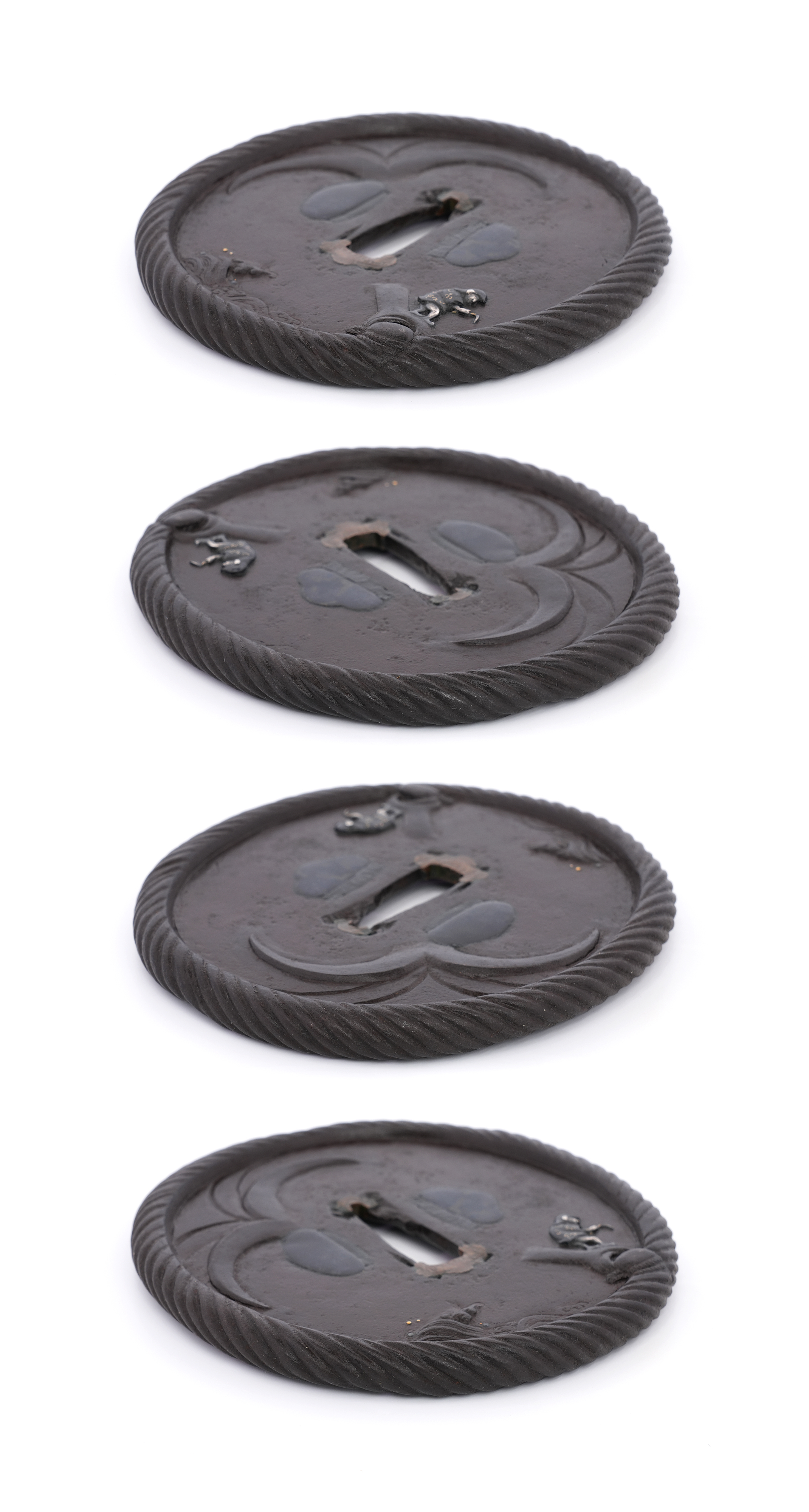
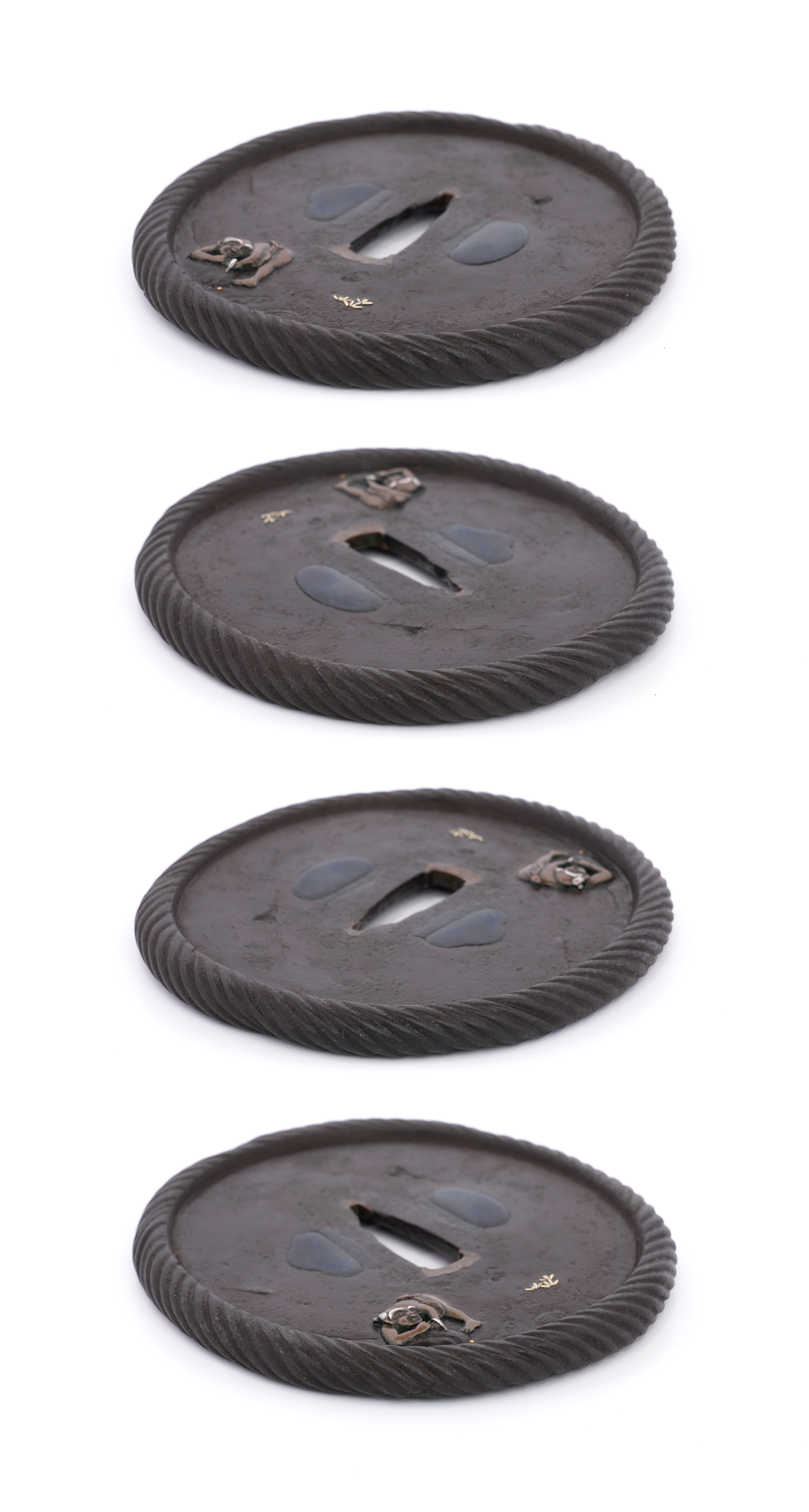
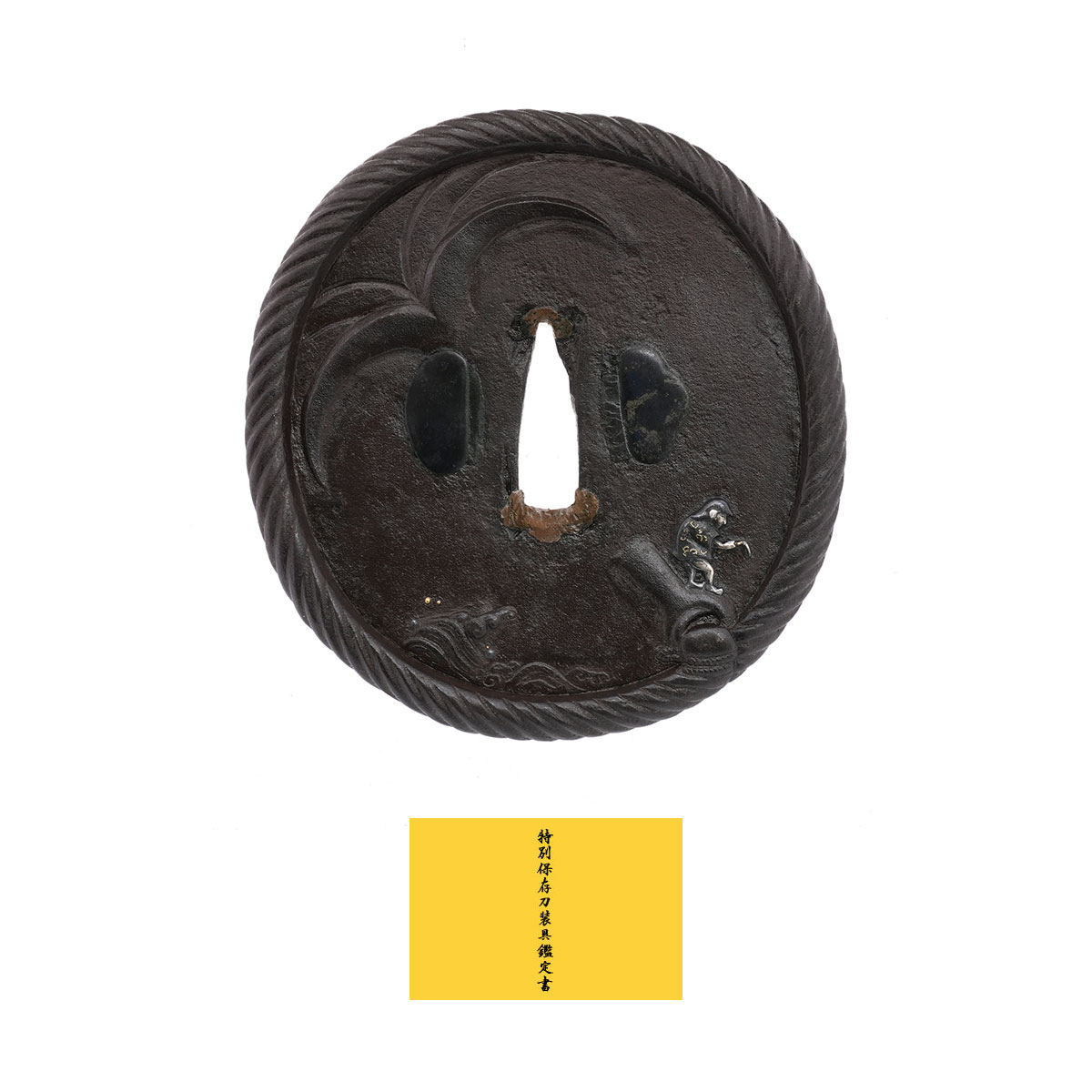
Akita Shoami was a school of tosogu kinkou that developed in Dewa Akita, and its first generation, Shoami Denbei (Suzuki Shigeyoshi), is said to have been born in Shonai and studied in Edo before being employed by the Akita Domain; he is known as a figure who exerted a great influence on later Akita kinkou and is introduced as the "First Generation Akita Shoami" at the Akita Prefectural Museum, and through extant works such as a tsuba with the mei "Dewa Akita ju Shoami Denbei" and another confirmed with the mei "Dewa Akita ju Shoami Nidai saku Kyoho 18 nen 3 gatsu hi", the lineage and development of the Shoami who took root in the land of Akita can be traced through actual works to this day. This work is an imposing o-tsuba measuring 97.4 mm in height and 82.4 mm in width, with a sense of volume weighing 227.7 grams, featuring a thick and powerful nawame-style mimi encircling the tetsu-ji, inside of which a person and a large anchor are depicted on the front and back while boldly leaving a vast expanse of tetsu-ji; on the front, a person crouching by the water to work is rendered in takabori with the clothing, head, and limbs finely expressed using shakudo, suaka, gin, kin-iroe, etc., accompanied by flowers and grasses in kin-iroe, and on the back, a large anchor and waves are the main theme with a person arranged alongside, composing the scene of retrieving a large anchor as a single story across both sides, making it a piece of extremely high conceptual design. What makes this work particularly impressive is the nawame-mimi that makes the large tsuba exceeding 97 mm look even more powerful, and the composition that utilizes the wide tetsu-ji surrounded by it as yohaku without daring to fill it completely; by placing the person relatively small against the entire tsuba while naturally guiding the gaze with the colors of different metals, and boldly representing a giant anchor on the reverse to reveal the full scope of the theme, the omote-ura integrated design conveys a sense of narrative and depth that goes beyond mere decorativeness, and the weight of 227.7 grams in the hand, the koshoku-imbued tetsu-aji, and the thickly carved nawame-mimi combine to allow one to fully appreciate the rustic charm and power unique to Akita Shoami, as well as the relaxed sense of modeling characteristic of local kinkou. Furthermore, both hitsu-ana were originally fitted with shakudo plates to protect the kozuka and kogai, and later, both hitsu-ana themselves were carefully plugged with shakudo, conveying to the present day the process by which a single tsuba was actually mounted on a sword and modified according to the owner's needs over time while being cherished and passed down. Considering the archaic nakago-ana, the calm tetsu-aji, the bold nawame-mimi, and the tsukurikomi where the seppa-dai thickness is kept to 3.3 mm despite the large dimensions exceeding 97 mm, it is thought to be a work from a relatively early period within Akita Shoami, and for this item, it is estimated to be around the early Edo period. This work has recently been issued a Tokubetsu Hozon Tosogu Kanteisho with a kiwame to "Akita Shoami" despite being mumei, and from its overwhelming presence as an o-tsuba reaching 97.4 mm in height, its volume of 227.7 grams, the thick and powerful nawame-mimi, the archaic nakago-ana, the both hitsu-ana plugged after being fitted with shakudo plates, the rare motif of retrieving a large anchor unfolding across the front and back, the carving and iroe using different metals applied to the person, to the deep tetsu-aji nurtured by long years, elements to be appreciated are condensed everywhere in this tsuba. The fact that it received the high evaluation of Tokubetsu Hozon Tosogu despite being a mumei school kiwame also speaks to the quality of this work; not only can one fully enjoy the boldness and skillful kinkou expression of Akita Shoami in a single piece, but works that combine such size and weight, unique nawame-mimi, and a narrative-rich omote-ura composition are not easily encountered, and as a piece representing Akita Shoami and as a masterpiece to adorn the collection of an enthusiast seeking unique ko-tsuba, it is a superior item that I would like you to appreciate closely at hand.
Akita-Shoami School秋田正阿弥派
Offered by Toushin
11 on the market

As written by the shop
Machine translation from the shop's Japanese · may contain errors ·
Iron-tsuba · Dewa
11 pieces on the market now
| Smith | Era | Designated |
|---|---|---|
| Denshichi伝七 | 1670 | 1 |
| Shoami Rokuya正阿弥六弥 | — | 1 |
A Hozon-certified fitting of notably superior craftsmanship and condition, often with signature or workmanship of high reference value.
The NBTHK (Nihon Bijutsu Tōken Hozon Kyōkai, the Society for the Preservation of Japanese Art Swords) is a public-interest incorporated foundation founded in 1948 and supervised by Japan’s Agency for Cultural Affairs (Bunkachō); it is based at the Japanese Sword Museum in Tokyo. Its expert panels physically examine each submitted work (shinsa) and issue a certificate (kanteishō) ranking it by artistic and historical merit. NBTHK papers are the most widely recognized standard of authentication for Japanese swords and fittings.
NBTHK official siteAs a rule we do not accept returns, except when we have sent a different item from the one ordered or when there is a significant discrepancy between the description and the item. If you wish to return an item, please contact us within 3 days of its arrival and then send it back.
¥715,000