Mino was founded, tradition holds, by immigrants: Kaneuji of the Yamato Tegai line settled at Shizu to work in the new Sōshū manner, so persuasively that later appraisers judged his best blades the closest of any to Masamune.
 NihontoWatchNihontoWatch
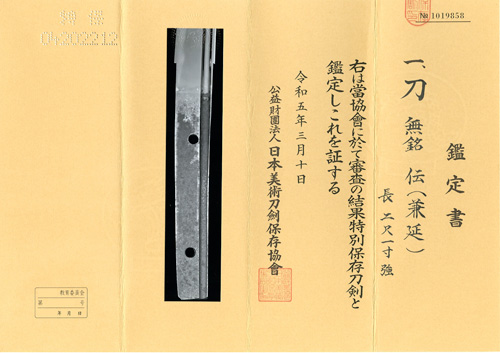
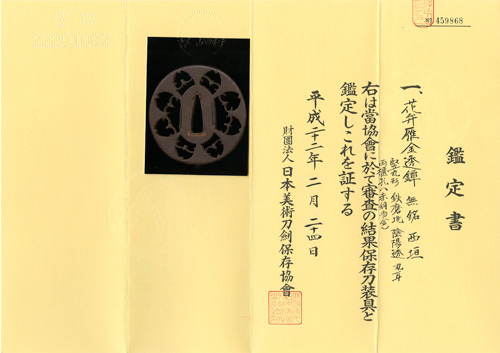
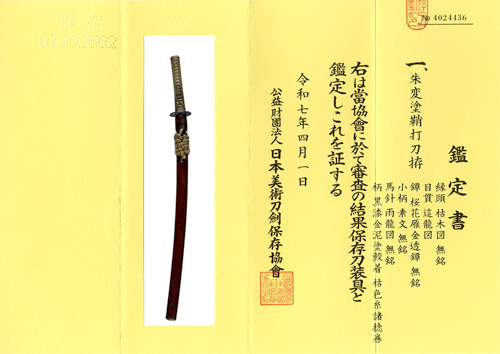
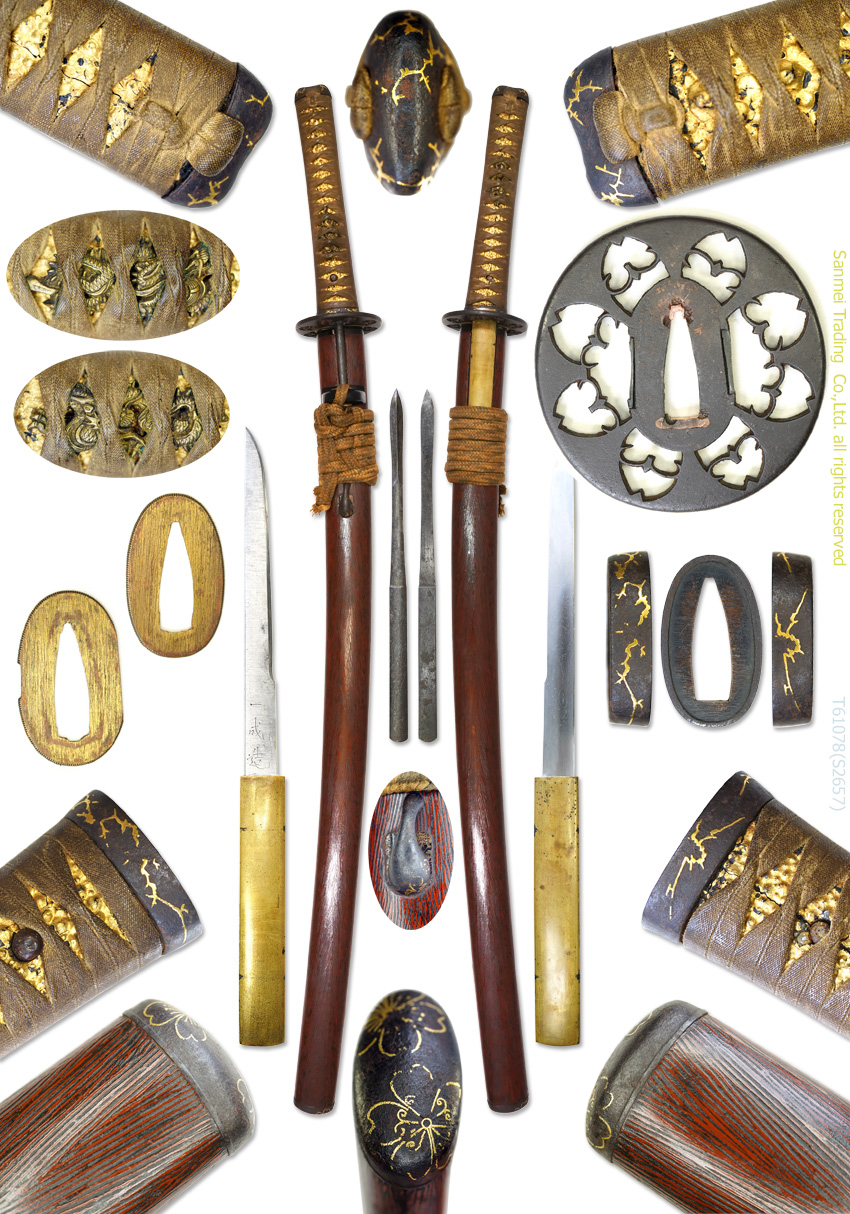
Blade construction: Shinogi-zukuri, Iori-mune, substantially shortened "O-suriage" to be unsigned. Wide ratio of Hira-ji to Shinogi-ji, thick in Kasane and less volume of Hira-niku. There is less degree of tapering from base to an elongated O-kissaki, which is the major trends in the prime of Nanbokucho period.. Carving (Horimono):There is Bo-hi groove on both sides which is chiselled away to Nakago. Forging(Hada): Forging is conspicuous Itame-hada with streaming ware of Masame hada. Crystallized granule of Ji-nie generates on surface sparkling reflection. Darkish thick lines of Nie so called "CHIKEI" activity appears from fine steel. Temper(Hamon): Hamon is based on "Nie" hard steel crystallized, Wide Notare undulating wave mixed with Gunome boundary and Togari outline. The quenching activities such as "Sunagashi" long lines of Nie "Kinsuji" or "Inazuma" thick curved lines run along hardening boundary area. Temper of tip(Boshi): Temper of boshi forms undulating irregular lines and medium circle turns back indication. Tang(Nakago): Nakago is substantially shortened "O-suriage" to be unsigned and slightly curved. Yasurime is KIRI horizontal and it's heel is Horizontal KIRI cut off. Two mekugi-ana holes. Here is a heroic katana of KANENOBU 兼延 (or pronounced KANENOBE) in Naoe-shizu school from Nanbokucho period in 14th C. KANEUJI 兼氏 in Yamato domain, who was one of the leading 10 genius disciples of the famed smith MASAMUNE 正宗,. He moved to Shizu town in Mino domain from Yamato end Kamakura period. His sons and disciples such as Kanetomo 兼友、Kanetoshi 兼俊、Kanenobe 兼延 established a foothold Naoe-shizu school in Naoe town (now Naoe, Youro-cho, Yoro-gun, Gifu) and flourished to meet with sharp rise in demand for the Nanbokucho period while the two courts fought for fifty years. According to Nihontomeikan, the first gen. KANENOBU 兼延 who was a second son of KANEUJI 兼氏 or younger brother of legitimate KANETOSHI 兼俊, was active in Ouan era (1368-) and 2nd gen. was in Meitoku era (1390-). In the prime of Nanbokucho period, Naoe-shizu makers accomplished their own workmanship in the style which Soushu and Yamato both techniques were integrated into Mino technique. This majestic katana is judged Tokubetsu Hozon class especially nominated as a work of KANENOBU 兼延 that belongs to Naoe-shizu school from Nanbokucho period. Although it has been substantially shortened, it reminds us of the ancient magnificent shape. The Katana is solidly heavy on both hands holding massive volume in Hiraniku. The boundary line from hardening crystallized Nie granule sparkles impressively vividly bright under regular light. This Katana clearly indicates an authentic Soshu tradition from Nanbokucho period with 650 years history and comes with an authentic Higo-style traditional mount of Koshirae. with) Brushing traces-surface burgundylacquered scabbard Higo Uchikatana Koshirae Fuchi/Kashira: Withered branch design,Iron ground, polish surface, Gold inlay, unsigned Menuki : Dragon design, Yamagane copper ground, Katabori carving, Gold plated Tsuba: Karigane goose/Sakura flower petal openwork unsigned attributed to a work of NISHIGAKI 西垣 in Higo domain (NBTHK Hozon) Bashin : Iron ground Ama-ryu Dragon design, silver inlay unsigned Kozuka : Brass-work, polish surface unsgined Kogatana signed Kazunari-zou 一成造 (note below) Tsuka : Gold lacquered layskin, Brown silk cord Morohineri-style lozenge warp Double layer Habaki collar (lower layer SEIKAIHA "shallow wave" is copper ground gold plated and the upper layer HATO "billow" is solid silver. preserved in a Shira-saya plain wood mounting Recent good polish/Condition scale: excellent (using a scale of mint-excellent-very good-good-fair-poor) reference data : Honma Kunzan/Ishii Masakuni, Nihontomeikan, Yuzanaku, 1975 (note) : Mr. Naruki Kazunari 成木一成(rean name Kazuhiko 一彦) was born on September 10, 1931, in Nakatsugawa City, Gifu Prefecture. Around 1960, he began his research and experimentation with sword guards (tsuba) and studied under Mr. Takahashi Kaisu. Mr.Naruki Kazunari had been devoted to the restoration of iron tsuba from antient Owari, Akasaka, and Kanayama, collecting sand iron materials from various parts of the country and working on reproducing the refined local iron through his own charcoal-based iron smelting process. He also attempted to revive the traditional technique of "yakite-fusarakashi" for surface treatment of iron, and developed his own unique world of iron steel. Residing near the Hōzan Prefectural Nature Park, he uses the artistic name "Hōzan." On July 16, 1981, he was designated as an intangible cultural heritage holder of Nakatsugawa City. In 1986, he was awarded the Medal of Honor with Yellow Ribbon. In 2009, he was recognized as a certified master craftsman MUKANSA by the Japanese Sword Preservation Society (NBTHK)
Offered by Sanmei
13 on the market


Mino-den · Mino
13 pieces on the market now
Within the province of Mino, in the decades of the Nanbokucho period, a body of smiths gathered at Naoe carrying forward the manner of Shizu Saburo Kaneuji, and from that locality they took the name Naoe Shizu. Kaneuji, originally a member of the Yamato Tegai group who studied under Masamune of Sagami and is counted among the Ten Disciples of Masamune (Masamune jittetsu), settled first at Shizu in Mino and established a flourishing school. His pupils and successors, among them Kanetomo, Kanetsugu, Kaneshige, and Kanenobu, relocated within the province to Naoe and forged there, and the smiths of that group are collectively termed Naoe Shizu to distinguish them from Shizu proper, which signifies Kaneuji himself. The lineage is in essence the second generation of the Shizu line, the Soshu-den of Masamune received through Kaneuji and translated into the steel and temper of Mino; the name ran on across several generations into the Muromachi, so that the reference works list more than one Kanetomo, around the Oan era and again around Oei, while the core Nanbokucho production falls in the Kanno, Enbun, Joji, and Oan years of the middle fourteenth century, anchored by the few signed and dated pieces such as a Kanno-dated wakizashi by Kanetsugu. The shared vocabulary of the school is the Shizu manner rendered in Mino. The forging is itame mixed with mokume and nagare-hada, frequently flowing toward masame and standing at times into hada-dachi, over which thick ji-nie settles and chikei enter well, the dark grain-lines threading a steel that is clear and legible; the midare-utsuri a Bizen smith would carry is absent, the ji speaking instead through the depth of its nie. The hamon is a Soshu-den notare crossed with the pointed togariba of Mino-den, gunome and ko-notare tempered in nie or ko-nie, often showing a saka-tendency, with ashi and yo entering and uchi-noke, yubashiri, and tobiyaki along the habuchi; through the temper run sunagashi and kinsuji in profusion, the streaming nie-lines and bright lightning-lines that are the school's surest sign, the nioiguchi deep and brightening at the best examples into something clear and lucid. The boshi answers the ha in midare-komi or notare-komi, turning in a ko-maru or sweeping into yakizume, the point frequently brushed with hakikake.
Within this common ground the hands separate. Kanetomo is read by the linking of round-headed gunome in sequence, calm and elegant in the ko-nie-deki the sources hold him most proficient in; Kanetsugu inclines toward the saka-slanted gunome and togariba with a more powerful, compelling dekiguchi; Tametsugu, a Norishige hand resettled inland rather than a direct Naoe smith, carries a larger, more billowing notare-midare over a steel that darkens, a manner the commentary holds to differ from Shizu and Kaneshige. Set against Kaneuji himself, the Naoe Shizu smiths work in a milder, more workmanlike register, the hada standing less strongly and the chikei fewer than in the master whose manner most closely approaches Masamune. To kantei a Naoe Shizu blade is to read the Soshu activity through a Mino frame, distinguishing it above from Shizu proper, whose forging stands and brightens more vigorously and whose ji and ha carry the higher Sagami character, and below from the later Sue-Seki, whose togariba harden into a drier, more regular tooth without the deep ji-nie and the run of kinsuji and sunagashi; a suguha blade with a whitish shirake tone, by contrast, reads away from the line entirely, toward the Zenjo hands who also bore these names. The strongest members, Kanetomo and Kanetsugu above all, hold their place in the Juyo register, their signed tanto and wakizashi designated Important Art Objects serving as the documentary spine against which the unsigned majority is measured. For the body of the school survives o-suriage and mumei, broad Nanbokucho katana and tanto attributed by resemblance to those scarce signatures, so that signed examples are held exceptionally valuable and reach private hands only with patience. Provenance is thin but real, blades descending through the Naruse and Akaboshi collections, a pair preserved at Atsuta Jingu, and others held by the NBTHK; the typical encounter remains a mumei attribution carrying the open Naoe jigane and the streaming nie of a tradition the smiths of Mino took from Masamune and made their own. Learn more →
| Smith | Era | Designated |
|---|---|---|
| Kanetomo兼友 | 1336-1340 | 11 |
| Kaneuji兼氏 | 1342-1345 | 3 |
| Kanenobu兼延 | 1368-1375 | 0 |
| Kaneuji兼氏 | 1394-1428 | 0 |
| Kanenobu兼延 | 1390-1394 | 0 |
Mino in the Nanbokuchō period
Mino was founded, tradition holds, by immigrants: Kaneuji of the Yamato Tegai line settled at Shizu to work in the new Sōshū manner, so persuasively that later appraisers judged his best blades the closest of any to Masamune.
A Hozon-certified blade judged to show notably superior workmanship and a better state of preservation. The bar is higher: re-tempered blades and most unsigned Muromachi/Edo works are excluded.
The NBTHK (Nihon Bijutsu Tōken Hozon Kyōkai, the Society for the Preservation of Japanese Art Swords) is a public-interest incorporated foundation founded in 1948 and supervised by Japan’s Agency for Cultural Affairs (Bunkachō); it is based at the Japanese Sword Museum in Tokyo. Its expert panels physically examine each submitted work (shinsa) and issue a certificate (kanteishō) ranking it by artistic and historical merit. NBTHK papers are the most widely recognized standard of authentication for Japanese swords and fittings.
NBTHK official siteFor a return, please contact us within 7 days of the item's arrival. If specification changes such as dimensions were made at the customer's request, a return cannot be accepted. Shipping and transfer fees are the customer's responsibility.
Price on request
Certificate reading — 無銘(兼延)