
NihontoWatch MonNihontoWatch
Market
Encyclopedia
Kantei
NihontoWatch MonNihontoWatch
Market
Encyclopedia
Kantei

Description

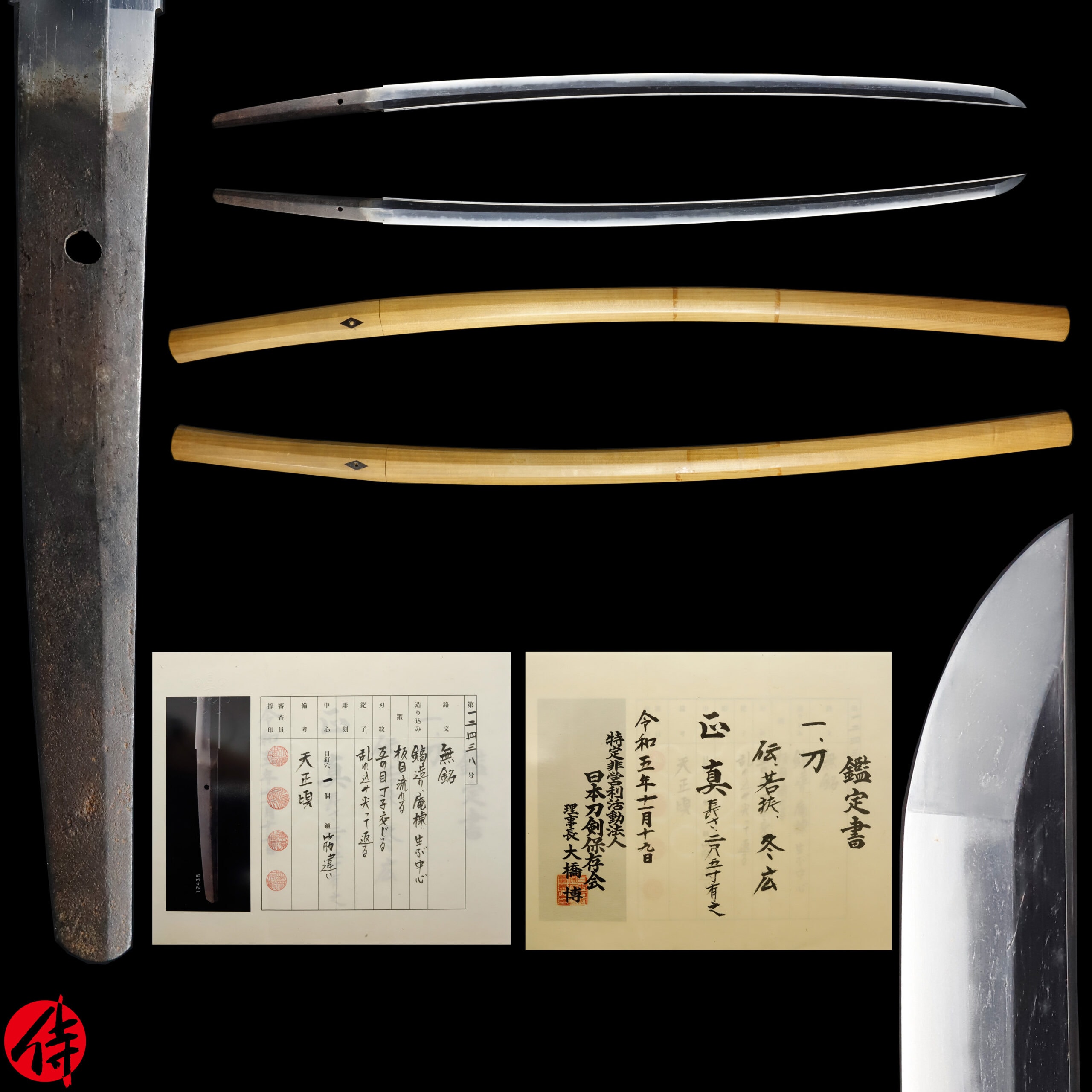
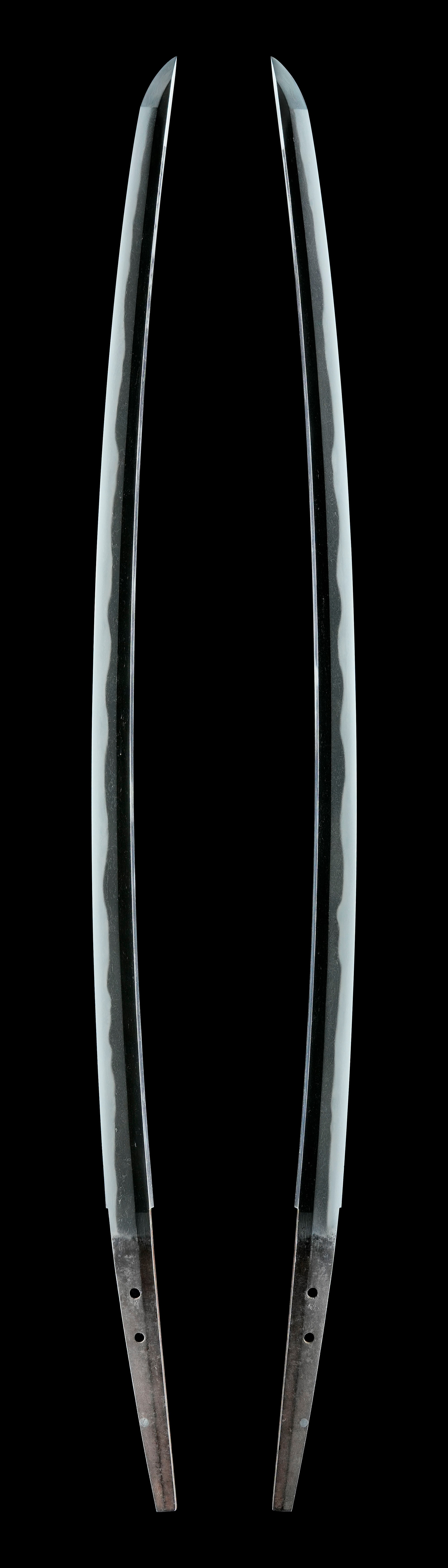
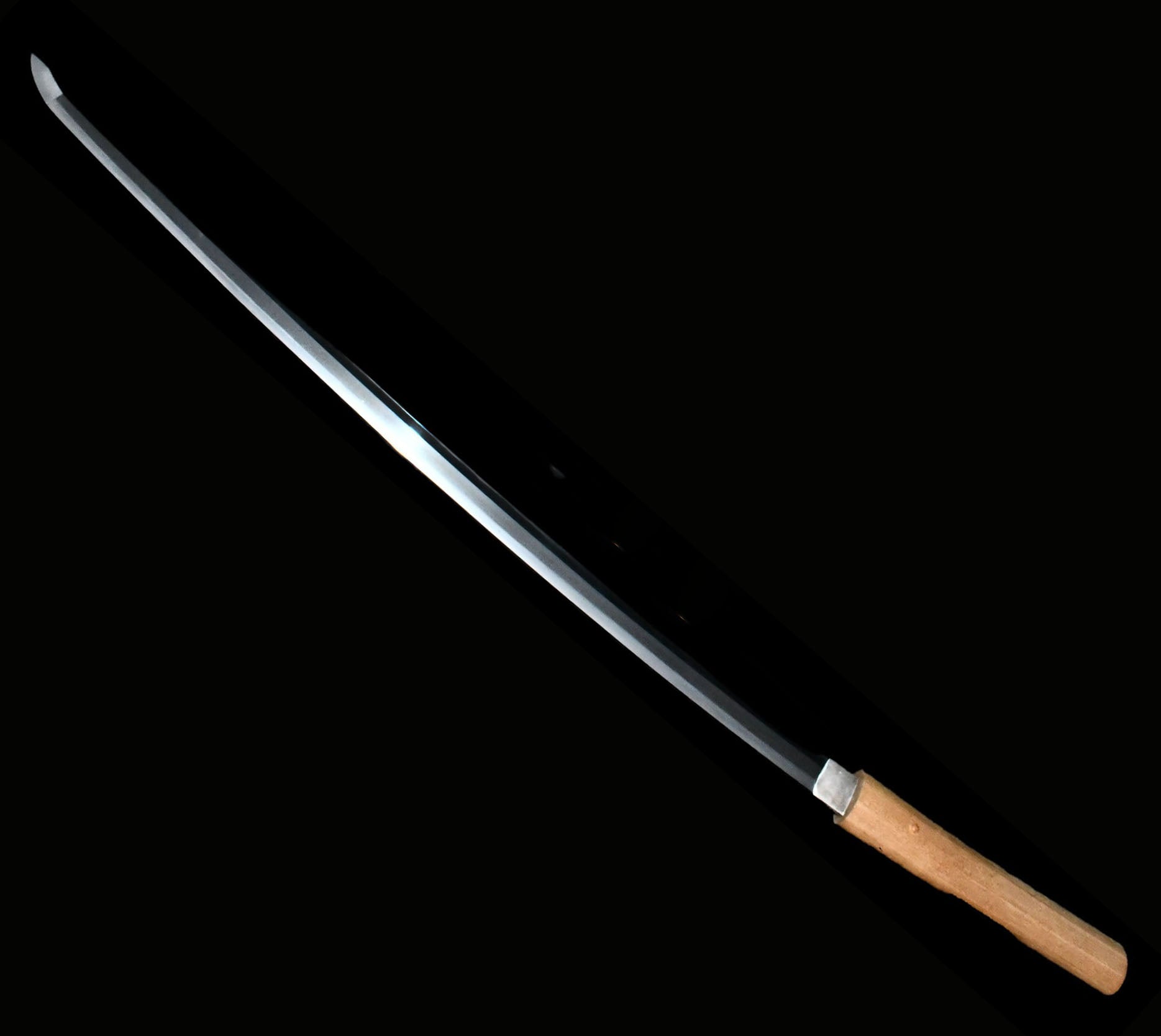
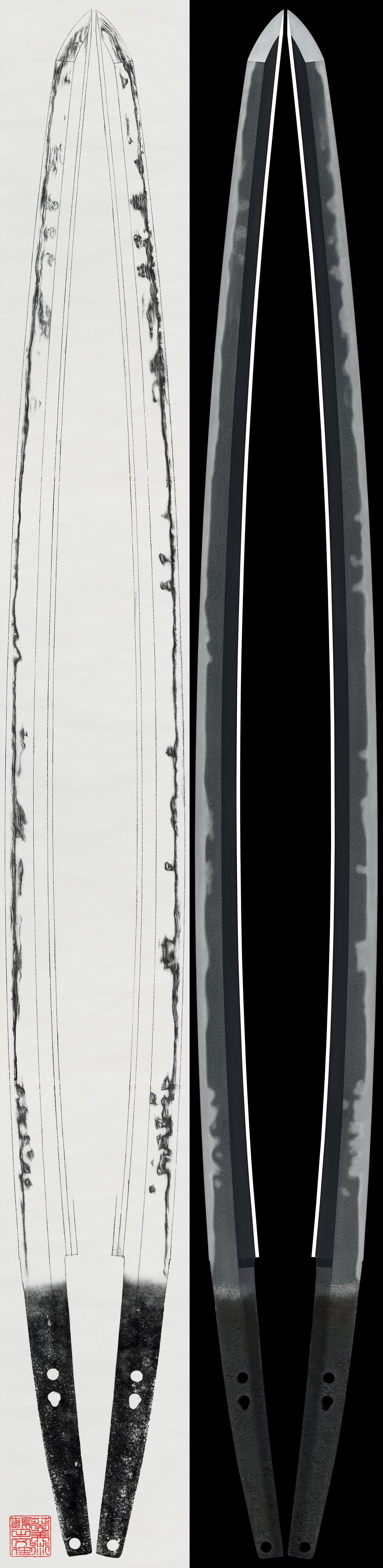
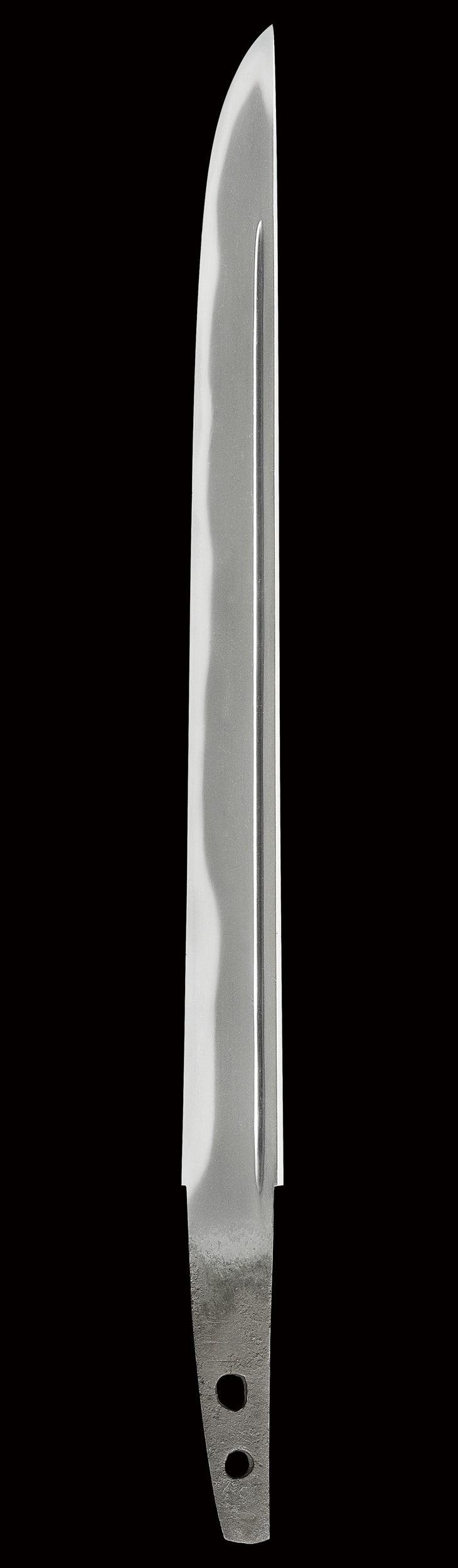
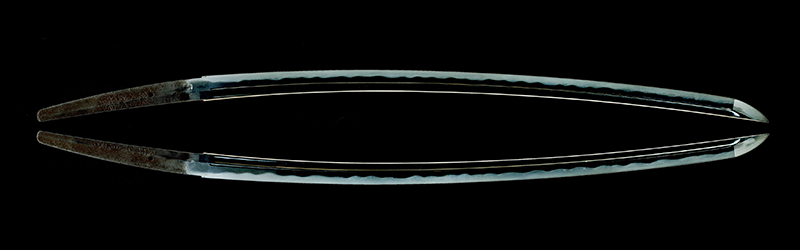
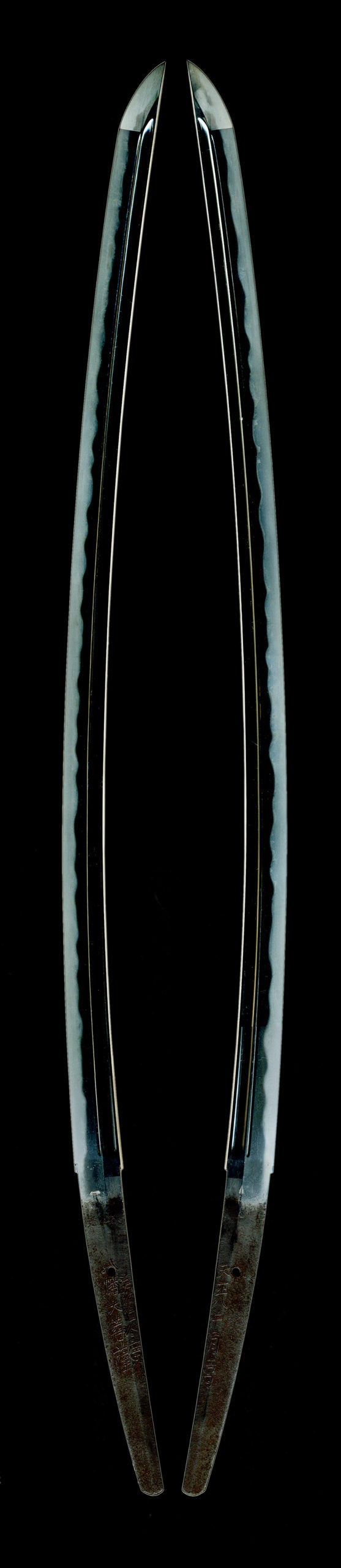
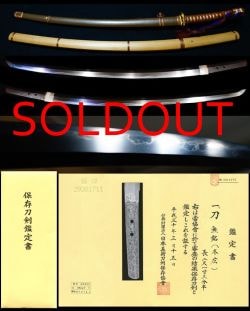
This is a Juyo Token designated katana by Fuyuhiro, an active swordsmith in Wakasa Province (present-day Fukui Prefecture) during the Muromachi period. Fuyuhiro is a renowned lineage, said to be the son of the 3rd generation Soshu Hirotsugu, who moved to Obama in Wakasa around the Kosei era (1455-). This particular blade is a magnificent, long and wide piece, showcasing the typical style of the smith with a robust jigane, mixed itame and mokume hada, thick nie, and a wide notare hamon mixed with gunome and choji midare, adorned with kinsuji and sunagashi. It is an excellent example of his work, in remarkably healthy condition with minimal signs of polishing wear.

NBTHK Setsumei

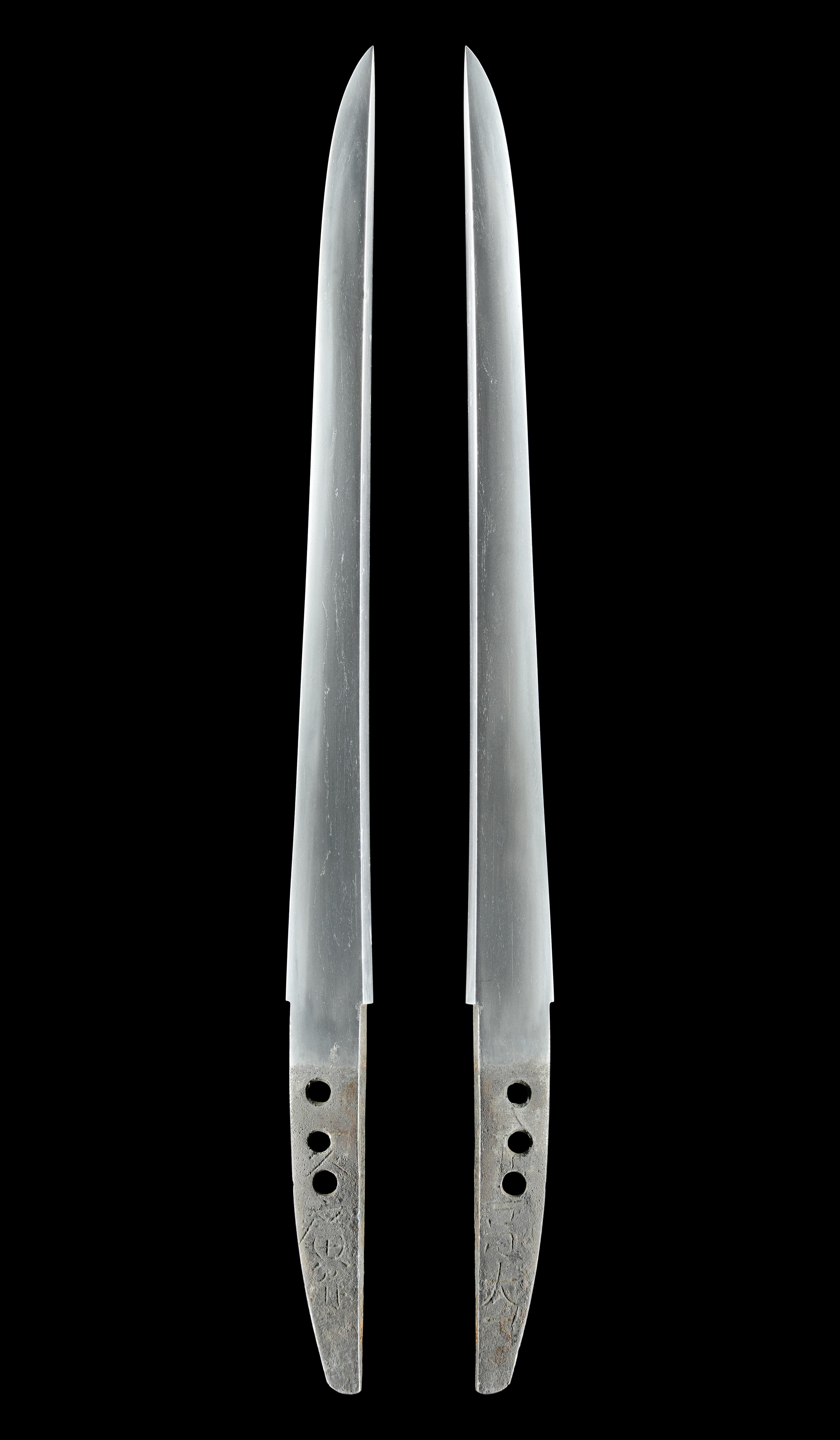
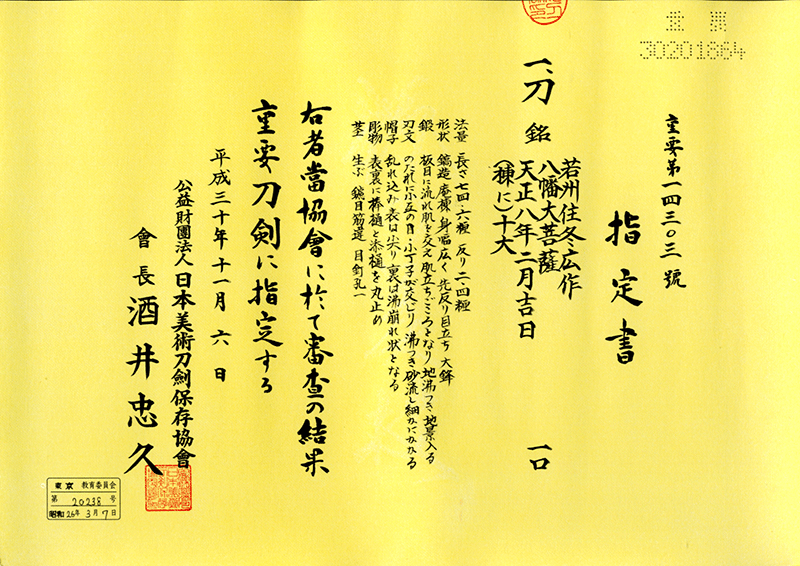
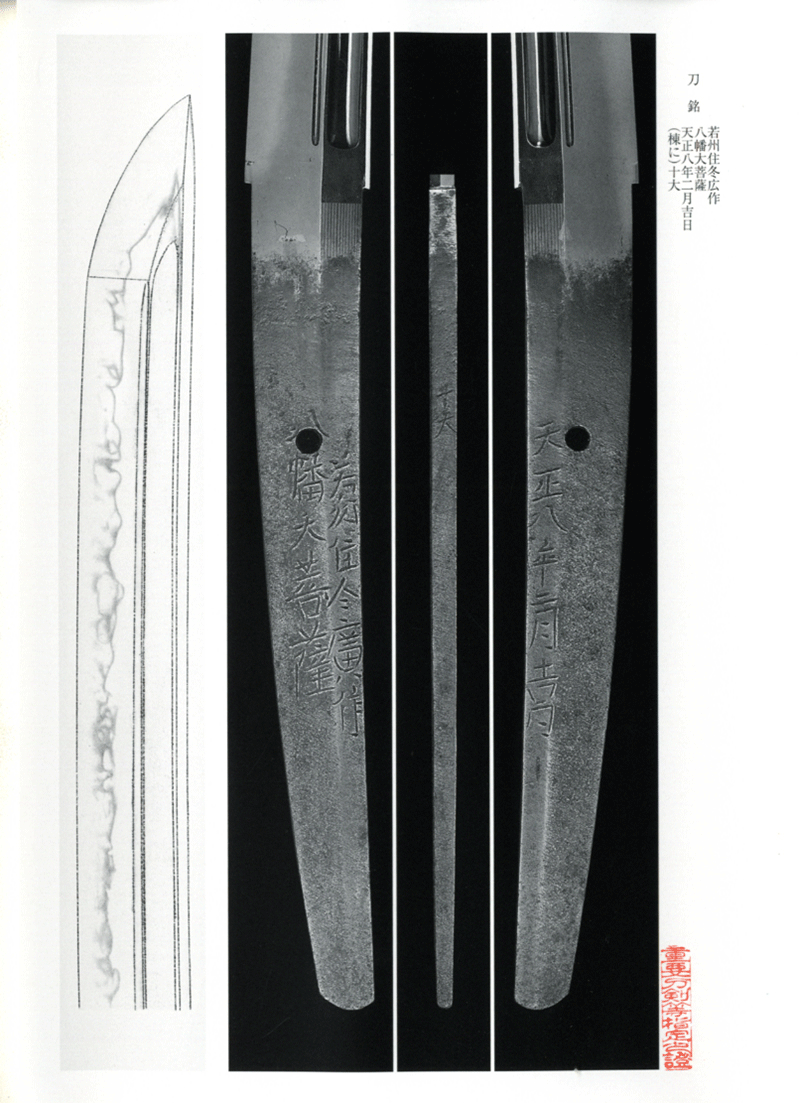
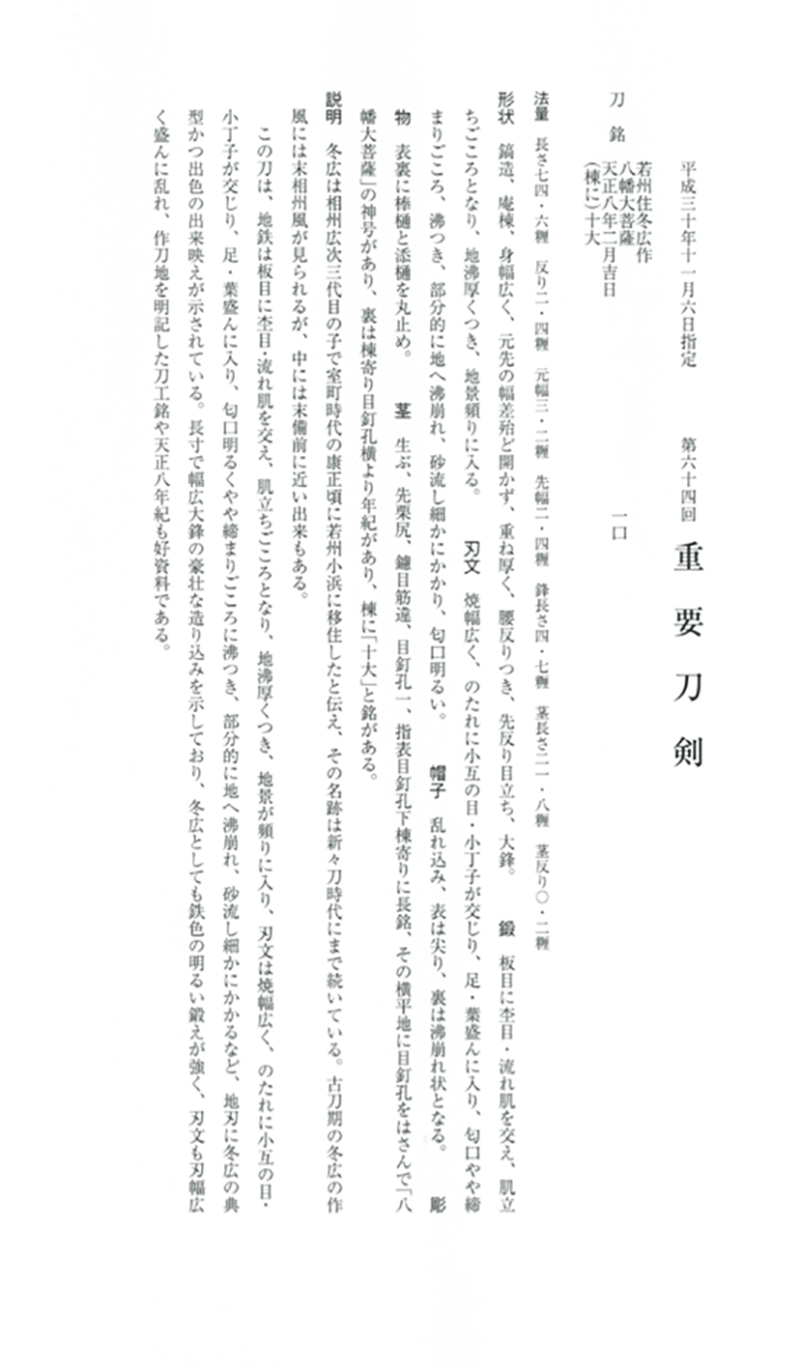
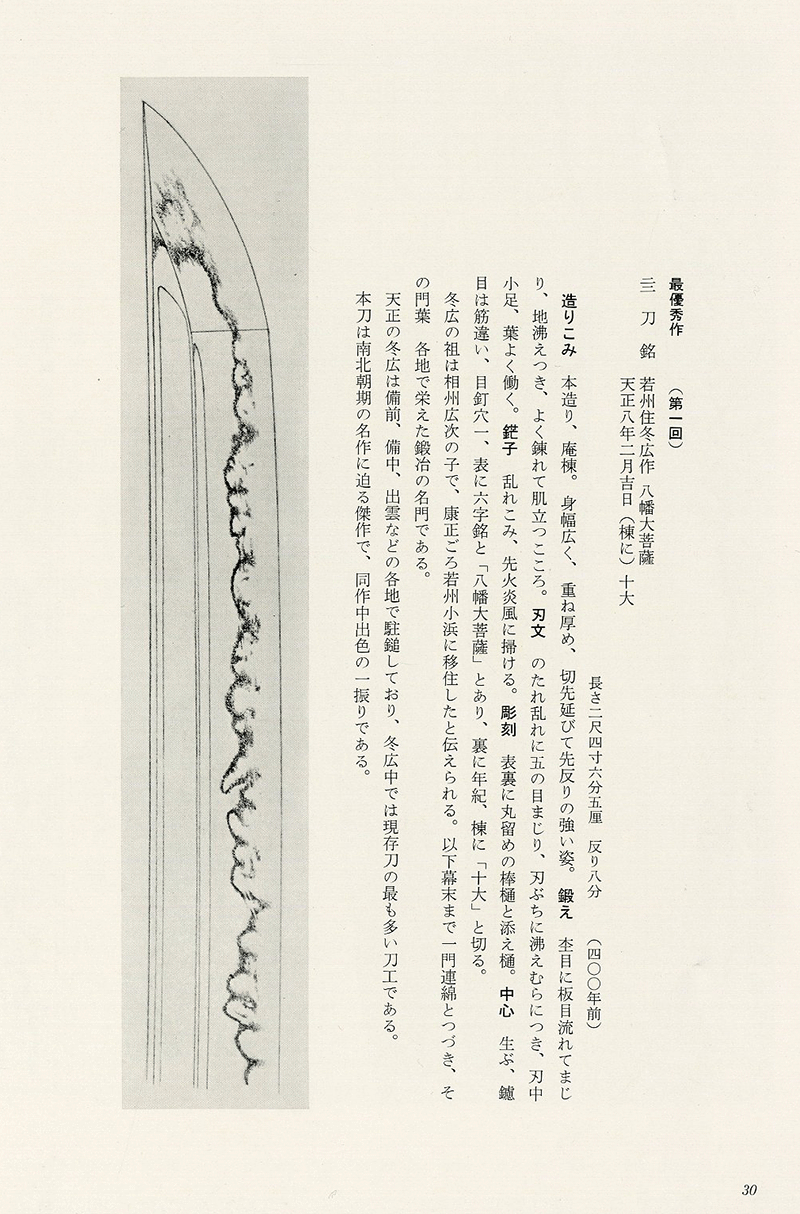
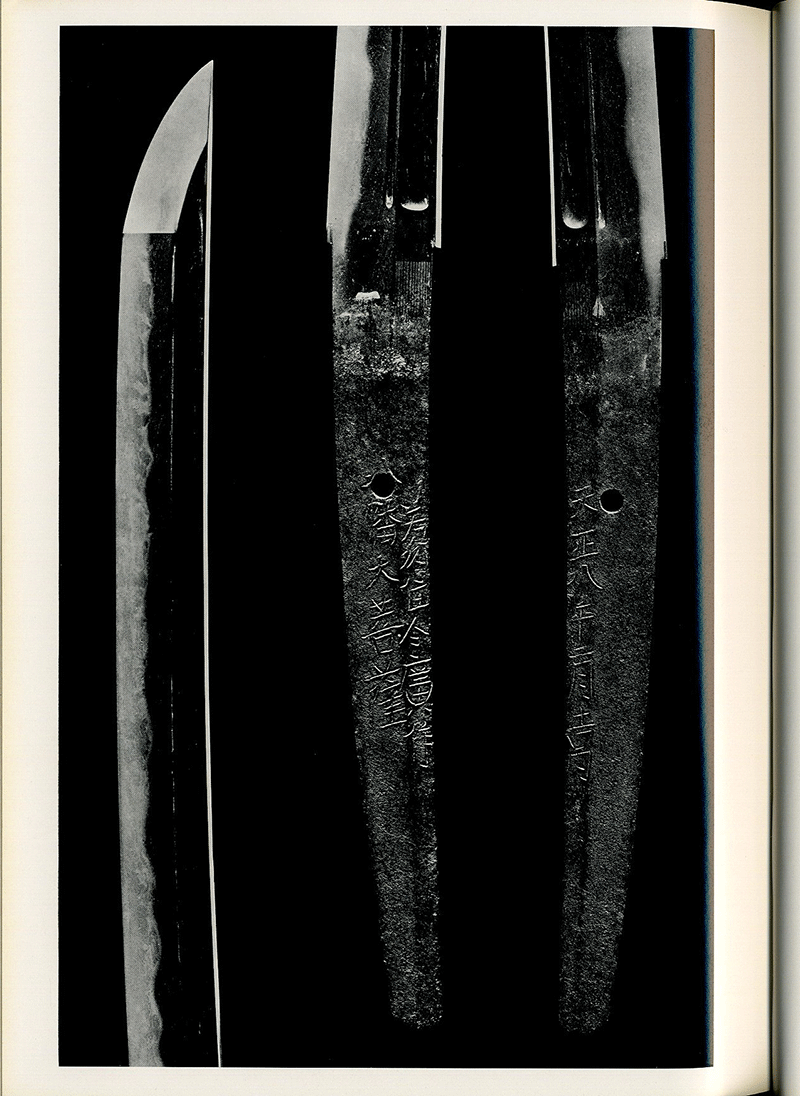
Jūyō-Tōken, 64th Session — Designated November 6, 2018 Katana, mei: Wakashū resident Fuyuhiro saku (若州住冬広作) Measurements Nagasa 74.6 cm, sori 2.4 cm, motohaba 3.2 cm, sakihaba 2.4 cm, kissaki-nagasa 4.7 cm, nakago-nagasa 22.0 cm, nakago-sori 0.2 cm Description Keijō: shinogi-zukuri, iori-mune; wide mihaba with almost no taper between base and tip; thick kasane; koshizori with conspicuous sakizori; ō-kissaki. Kitae: itame-hada mixed with mokume and nagare-hada; tending toward standing grain; thickly formed ji-nie with frequent chikei. Hamon: wide yakihaba; notare mixed with ko-gunome and ko-chōji; abundant ashi and yō; nioiguchi somewhat shimari-gokoro (tending to tighten) and bright; nie adheres, with localized nie-kuzure extending into the ji; fine sunagashi applied throughout. Bōshi: midare-komi; on the omote it becomes pointed (togari), and on the ura it takes on a nie-kuzure aspect. Horimono: on both omote and ura, bō-hi with accompanying soe-hi, maru-dome. Nakago: ubu; kurijiri; sujikai yasurime; one mekugi-ana; on the omote, a long signature is cut toward the mune below the peg-hole, and alongside it on the hiraji, straddling the mekugi-ana, appears the divine appellation “Hachiman Daibosatsu”; on the ura, beginning near the mune beside the peg-hole is the date inscription; on the mune is inscribed “Jūdai” (十大). Artisan Fuyuhiro (冬広), Wakasa Province. Era Tenshō 8 (1580), Muromachi period. Explanation Fuyuhiro is said to have been the son of the third-generation Hirotsugu of Sagami Province, and it is transmitted that around the Kōshō era (1455–1457) in the Muromachi period he relocated to Obama in Wakasa Province. His name line continued on even into the shinshintō period. Within the kotō period, Fuyuhiro’s style shows features of late Sōshū work, though among his swords there are also examples whose workmanship approaches that of late Bizen. This katana shows jihada of itame mixed with mokume and nagare, inclining toward standing grain, with thick ji-nie and frequent chikei. The hamon is of wide yakihaba, a notare mixed with ko-gunome and ko-chōji, in which ashi and yō are vigorous. The nioiguchi is bright and tends slightly toward shimari-gokoro; nie adheres, and in places nie-kuzure falls into the ji, while fine sunagashi runs through the temper. In both ji and ha, this presents a typical yet particularly distinguished workmanship of Fuyuhiro. Moreover, the blade is built on a grand scale—long in length, broad in width, and with a large kissaki—creating a bold and imposing construction. For Fuyuhiro, the forging is especially strong with a bright tone to the steel, and the hamon is also broad and actively irregular. The smith’s signature explicitly stating the place of manufacture, together with the date inscription of Tenshō 8, constitute valuable reference material.
NihontoWatch MonNihontoWatch
MarketEncyclopediaKantei
Swords›Sōshū-den›Wakasa Fuyuhiro›Fuyuhiro›Katana: Jyakushu Ju Fuyuhiro Saku, Dated 1580 - NBTHK Juyo Token No. 64
katanaJūyō
Wakasa Fuyuhiro

Katana: Jyakushu Ju Fuyuhiro Saku, Dated 1580 - NBTHK Juyo Token No. 64

mei · Muromachi · nagasa 74.6cm · sori 2.4cm

SOLD
Wakasa Fuyuhiro (冬廣) · Muromachi2 works for sale →
KatanaJūyō
Could you name the smith from the blade alone? Today’s kantei →
Wakasa Fuyuhiro — 1 of 9
Wakasa Fuyuhiro — 2 of 9
Wakasa Fuyuhiro — 3 of 9
Wakasa Fuyuhiro — 4 of 9
Wakasa Fuyuhiro — 5 of 9
Wakasa Fuyuhiro — 6 of 9
Wakasa Fuyuhiro — 7 of 9
Wakasa Fuyuhiro — 8 of 9
Wakasa Fuyuhiro — 9 of 9
1 / 9
1 / 9
Wakasa Fuyuhiro — 1 of 9Wakasa Fuyuhiro — 2 of 9Wakasa Fuyuhiro — 3 of 9Wakasa Fuyuhiro — 4 of 9Wakasa Fuyuhiro — 5 of 9Wakasa Fuyuhiro — 6 of 9Wakasa Fuyuhiro — 7 of 9Wakasa Fuyuhiro — 8 of 9Wakasa Fuyuhiro — 9 of 9
Wakasa Fuyuhiro (冬廣) · Muromachi2 works for sale →
KatanaJūyō
Could you name the smith from the blade alone? Today’s kantei →
Measurements & details
Smith
Wakasa Fuyuhiro
Type
Katana
School
Wakasa Fuyuhiro
Period
Around 1444–1449(Bunan)
Province
Wakasa
Signature
Signed(0% of this smith's designated works are signed)
Measurements
Nagasa 74.6cmSori 2.4cmMotohaba 3.2cmSakihaba 2.4cmKasane 0.7cm
Description

This is a Juyo Token designated katana by Fuyuhiro, an active swordsmith in Wakasa Province (present-day Fukui Prefecture) during the Muromachi period. Fuyuhiro is a renowned lineage, said to be the son of the 3rd generation Soshu Hirotsugu, who moved to Obama in Wakasa around the Kosei era (1455-). This particular blade is a magnificent, long and wide piece, showcasing the typical style of the smith with a robust jigane, mixed itame and mokume hada, thick nie, and a wide notare hamon mixed with gunome and choji midare, adorned with kinsuji and sunagashi. It is an excellent example of his work, in remarkably healthy condition with minimal signs of polishing wear.

NBTHK Zufu Commentary

Juyo #64

AI translation — may contain errors

-, 64th Session — Designated November 6, 2018

, : Wakashū resident Fuyuhiro (若州住冬広作)

Measurements 74.6 cm, 2.4 cm, 3.2 cm, 2.4 cm, 4.7 cm, 22.0 cm, 0.2 cm

Description Keijō: , ; wide with almost no taper between base and tip; thick ; with conspicuous ; . : mixed with and ; tending toward standing grain; thickly formed with frequent . : wide ; mixed with and ; abundant and ; somewhat (tending to tighten) and bright; adheres, with localized extending into the ; fine applied throughout. : ; on the it becomes pointed (), and on the it takes on a aspect. : on both and , with accompanying , . : ; ; ; one ; on the , a long signature is cut toward the below the peg-hole, and alongside it on the , straddling the , appears the divine appellation “”; on the , beginning near the beside the peg-hole is the date inscription; on the is inscribed “Jūdai” (十大).

Artisan Fuyuhiro (冬広), Wakasa Province.

Era Tenshō 8 (1580), period.

Explanation Fuyuhiro is said to have been the son of the third-generation Hirotsugu of Province, and it is transmitted that around the Kōshō era (1455–1457) in the period he relocated to Obama in Wakasa Province. His name line continued on even into the period. Within the period, Fuyuhiro’s style shows features of late work, though among his swords there are also examples whose workmanship approaches that of late .

This shows of mixed with and , inclining toward standing grain, with thick and frequent . The is of wide , a mixed with and , in which and are vigorous. The is bright and tends slightly toward ; adheres, and in places falls into the , while fine runs through the temper. In both and , this presents a typical yet particularly distinguished workmanship of Fuyuhiro.

Moreover, the blade is built on a grand scale—long in length, broad in width, and with a large —creating a bold and imposing construction. For Fuyuhiro, the forging is especially strong with a bright tone to the steel, and the is also broad and actively irregular. The smith’s signature explicitly stating the place of manufacture, together with the date inscription of Tenshō 8, constitute valuable reference material.

About the maker

Fuyuhiro

冬廣

Soshu-den · Wakasa · around 1444-1449

Fujishiro Chu-jo saku · Tōken Taikan top 49%

2 pieces on the market now

›

Historical importance

Where Fuyuhiro stands among comparable artisans: across all of nihontō, and within tradition, era, and period. The tiers (Foremost · Leading · Major · Notable) weigh official designations from the NBTHK and Japan's Agency for Cultural Affairs, together with historical honors of lasting repute such as the Sansaku and Meibutsu-chō.

随一
Foremost
屈指
Leading
有数
Major
著名
Notable

Select a lens to see how it's measured.

Designation record
1 designated works
Jūyō
1
2 works by Fuyuhiro on the market→
Fuyuhiro — full profileSoshu-den school

Study this maker →

About the school

Wakasa Fuyuhiro

若狭冬広

Soshu-den · Wakasa

8 pieces on the market now

›

The Fuyuhiro line worked at Obama in Wakasa Province, and the setsumei consistently trace its founder to Sagami. He is recorded as the son of the third-generation Hirotsugu of Sagami, said to have relocated to Obama around the Kōshō era (1455 to 1457), with one blade instead reporting that he studied under Tsunahiro of Sagami. The earliest hand is identified on a two-character mei attributed to the first-generation Wakasa Fuyuhiro, and the name continued thereafter, the lineage held to have run for some five generations and the signature extending into the shinshintō period and the closing years of the Edo period. " Several blades carry residence inscriptions for places far from Wakasa, among them Hōki, Unshū, Izumo, Bizen, and Bitchū, including a katana made at Matsuyama in Bitchū; whether these issued from one man or several is left by the setsumei as a matter for further study. The descent from Sagami places the line within the Soshu-den, working its late, provincial idiom. Across these blades the forging is itame mixed with mokume and nagare, repeatedly described as inclining toward hada-dachi, or standing grain, with ji-nie and frequent chikei. Two tempering modes recur. One follows late Sōshū and Sue-Sōshū taste, a wide notare or ō-notare mixed with ko-gunome, ko-chōji, and togariba, carrying ashi and yō, nie that adheres thickly and at times coarsely, with sunagashi and kinsuji, and in the most active examples tobiyaki and muneyaki that build into hitatsura. The other approaches Sue-Bizen, seen in a gunome-midare with koshi-biraki tendency or a tighter nioiguchi over ko-nie.

A third register appears as a broad suguha-chō set with ko-gunome and ko-notare. The bōshi is typically midare-komi, turning ko-maru or pointed with hakikake. To read the hand, the setsumei point to the standing grain and bright nioiguchi, the often grand sakizori construction with extended or ō-kissaki, and the carving: bō-hi with soe-hi, and on one blade a kurikara with bonji and goma-bashi whose manner is likened to Heianjō Nagayoshi rather than to Sōshū. Generations and modes separate by whether the workmanship leans Sue-Sōshū or Sue-Bizen. For kantei, the setsumei treat the place-stating signatures and dated tangs as the principal documentary value, several blades singled out for the clarity their inscriptions bring to the line's chronology and geographic reach; one Tenshō 8 katana adds the invocation "Hachiman Daibosatsu" beside the mekugi-ana and "Jūdai" cut on the mune. The recurring open question of the far-flung residence signatures, Hōki through Bitchū, frames the standing of the name as one whose precise membership the register still weighs. Among individual works, the writers name a suriage katana as a kessaku, a wholly hardened blade close to late Bizen, and a two-character first-generation piece judged the finest in jigane and hamon. Accompanying uchigatana koshirae survive on two katana, one with shakudō nanako fittings bearing the "Misu aoi" crest, the other a black-lacquered leather katate-maki mounting whose saya is held close in date to the blade. The setsumei present Fuyuhiro as a capable smith adept in both suguha and midare and in horimono, his Wakasa workshop carrying the Soshu-den into the late Muromachi and beyond. Learn more →

5 recorded smiths10 designated works
Leading smiths
SmithEraDesignated
Fuyuhiro冬廣1521-15685
Fuyuhiro冬廣1444-14491
Fuyuhiro冬廣1558-15922
Fuyuhiro冬廣1532-15551
Fuyuhiro冬廣1573-15921
Explore the Wakasa Fuyuhiro school →

Historical context

Sōshū in the Muromachi period

›

In the Sengoku era the school served a second warrior court: the Later Hōjō at Odawara, whose patronage kept the Tsunahiro line forging hitatsura for the uchigatana age until the castle fell to Hideyoshi in 1590.

Sōshū in the Muromachi period →

NBTHK Certificate
Jūyō Tōken重要刀剣
Important Sword
›

A blade of top-grade workmanship and condition, formally judged to rank with a nationally recognized Important Art Object (Jūyō Bijutsuhin). Awarded only at the NBTHK’s competitive annual examination.

About the NBTHK›

The NBTHK (Nihon Bijutsu Tōken Hozon Kyōkai, the Society for the Preservation of Japanese Art Swords) is a public-interest incorporated foundation founded in 1948 and supervised by Japan’s Agency for Cultural Affairs (Bunkachō); it is based at the Japanese Sword Museum in Tokyo. Its expert panels physically examine each submitted work (shinsa) and issue a certificate (kanteishō) ranking it by artistic and historical merit. NBTHK papers are the most widely recognized standard of authentication for Japanese swords and fittings.

NBTHK official site→
Seller
I
Iida Koendo
Established 1880 · 146 yrs on the market
🇯🇵Ships from Japan
›
✓Verified dealeriidakoendo.com
✓Ships worldwide✓English supportWire transfer
Return policy

Customer-initiated returns accepted within two days of arrival; return shipping paid by customer and fees non-refundable. Returns/refunds unavailable for overseas deliveries.

View all of Iida Koendo’s listings→View this item on the dealer’s site→

More works by Wakasa Fuyuhiro

View all →
Token Hasegawa
Hozon
Tanto - Hozon - by Wakasa Fuyuhiro - Koto Tanto: Mumei Fuyuhiro - NBTHK Hozon Token, with Koshirae (20.2cm)Tanto - Hozon - by Wakasa Fuyuhiro - Koto Tanto: Mumei Fuyuhiro - NBTHK Hozon Token, with Koshirae (20.2cm)

Tantō

ByWakasa Fuyuhiro
¥253,000
Hyozaemon
Hozon
Katana - Hozon - by Wakasa Fuyuhiro - Fuyuhiro KatanaKatana - Hozon - by Wakasa Fuyuhiro - Fuyuhiro Katana

Katana

ByWakasa Fuyuhiro
¥680,000

Previously sold by Wakasa Fuyuhiro

View all →
Yazawa Shokai
Hozon
Katana - Hozon - by Wakasa Fuyuhiro - Hozon Katana: Fuyuhiro (Muromachi Period) - Nagasa 68cm, Sori 1.1cmKatana - Hozon - by Wakasa Fuyuhiro - Hozon Katana: Fuyuhiro (Muromachi Period) - Nagasa 68cm, Sori 1.1cm
Sold

Katana

ByWakasa Fuyuhiro
SOLD
Yazawa Shokai
Hozon
Katana - Hozon - by Wakasa Fuyuhiro - Daimyo Registration Fuyuhiro - Hozon, Nagasa 61.2cm, Sori 1.6cm, in ShirasayaKatana - Hozon - by Wakasa Fuyuhiro - Daimyo Registration Fuyuhiro - Hozon, Nagasa 61.2cm, Sori 1.6cm, in Shirasaya
Sold

Katana

ByWakasa Fuyuhiro
SOLD
Kusanagi
Hozon
Katana - Hozon - by Wakasa Fuyuhiro - Work identical to Muramasa, masterpiece by first generation Wakasa Fuyuhiro, with mon-inlaid gunto koshirae, Hozon Token.Katana - Hozon - by Wakasa Fuyuhiro - Work identical to Muramasa, masterpiece by first generation Wakasa Fuyuhiro, with mon-inlaid gunto koshirae, Hozon Token.
Sold

Katana

ByWakasa Fuyuhiro
SOLD
Samurai Museum
Katana - by Wakasa Fuyuhiro - Attributed to Fuyuhiro - NTHK KanteishoKatana - by Wakasa Fuyuhiro - Attributed to Fuyuhiro - NTHK Kanteisho
Sold

Katana

ByWakasa Fuyuhiro
SOLD
Ikeda Art
Ken - by Wakasa Fuyuhiro - Ken: Fuyuhhiro, 23.7cm - For Appreciation, Iaido, and Tameshigiri!!!Ken - by Wakasa Fuyuhiro - Ken: Fuyuhhiro, 23.7cm - For Appreciation, Iaido, and Tameshigiri!!!
Sold

Ken

ByWakasa Fuyuhiro
SOLD
Tokyo Sword
Katana - by Wakasa Fuyuhiro - Katana by Fuyuhiro in Shirasaya, Koto Muromachi period, NBTHK CertificateKatana - by Wakasa Fuyuhiro - Katana by Fuyuhiro in Shirasaya, Koto Muromachi period, NBTHK Certificate
Sold

Katana

ByWakasa Fuyuhiro
SOLD

More from the Wakasa Fuyuhiro school

View all →
Toushin
Hozon
Katana - Hozon - by Wakasa Fuyuhiro School - Mumei (Fuyuhiro)Katana - Hozon - by Wakasa Fuyuhiro School - Mumei (Fuyuhiro)

Katana

ByWakasa Fuyuhiro School
¥550,000
Token-Net
Tokuho
Katana - Tokuho - by Wakasa Fuyuhiro - Fuyuhiro (Wakasa)Katana - Tokuho - by Wakasa Fuyuhiro - Fuyuhiro (Wakasa)

Katana

ByWakasa Fuyuhiro
¥1,350,000
Nihonto Australia
Hozon
Wakizashi - Hozon - by Wakasa Fuyuhiro School - FuyuhiroWakizashi - Hozon - by Wakasa Fuyuhiro School - Fuyuhiro

Wakizashi

ByWakasa Fuyuhiro School
¥3,650
Aoi Art
Tokuho
Tanto - Tokuho - by Wakasa Fuyuhiro School - FuyuhiroTanto - Tokuho - by Wakasa Fuyuhiro School - Fuyuhiro

Tantō

ByWakasa Fuyuhiro School
¥1,000,000
Toyuukai
Hozon
Katana - Hozon - by Wakasa Fuyuhiro School - Mumei (Fuyuhiro) with NBTHK Hozon CertificateKatana - Hozon - by Wakasa Fuyuhiro School - Mumei (Fuyuhiro) with NBTHK Hozon Certificate

Katana

ByWakasa Fuyuhiro School
¥500,000
Toushin
Tanto - by Wakasa Fuyuhiro School - Fuyuhiro - Yoshida TakeichiTanto - by Wakasa Fuyuhiro School - Fuyuhiro - Yoshida Takeichi

Tantō

ByWakasa Fuyuhiro School
¥132,000

More from the Sōshū tradition

View all →
Kusanagi
Tokuho
Katana - Tokuho - by Soshu School - Soshu Masamune and Yukimitsu's master "Shintogo Kunimitsu," founder of Soshu-den who brought Awataguchi traditions to their peak; peerless health, masterpiece quality, Tokubetsu Hozon.Katana - Tokuho - by Soshu School - Soshu Masamune and Yukimitsu's master "Shintogo Kunimitsu," founder of Soshu-den who brought Awataguchi traditions to their peak; peerless health, masterpiece quality, Tokubetsu Hozon.

Katana

BySoshu School
¥6,800,000
Aoi Art
Tokuho
Katana - Tokuho - by Gō Yoshihiro - Mumei (Unsigned) Den Go YoshihiroKatana - Tokuho - by Gō Yoshihiro - Mumei (Unsigned) Den Go Yoshihiro

Katana

ByGō Yoshihiro
¥35,000,000
Choshuya
Jūyō
Tanto - Jūyō - by Soshu Norishige - Unsigned (Ubu-nakago) NorishigeTanto - Jūyō - by Soshu Norishige - Unsigned (Ubu-nakago) Norishige

Tantō

BySoshu Norishige
¥6,500,000
Samurai Nippon
Jūyō
Tanto - Jūyō - by Soshu Yukimitsu - Soshu Yukimitsu (Ubu Mumei)Tanto - Jūyō - by Soshu Yukimitsu - Soshu Yukimitsu (Ubu Mumei)

Tantō

BySoshu Yukimitsu
¥6,700,000
Tsuruginoya
Tokujū
Katana - Tokuju - by Soshu Yukimitsu - Soshu YukimitsuKatana - Tokuju - by Soshu Yukimitsu - Soshu Yukimitsu

Katana

BySoshu Yukimitsu
Ask
Eirakudo
Tokuho
Katana - Tokuho - by Soshu Norishige - Norishige - Tokubetsu Hozon TokenKatana - Tokuho - by Soshu Norishige - Norishige - Tokubetsu Hozon Token

Katana

BySoshu Norishige
¥6,500,000
Eirakudo
Tokuho
Katana - Tokuho - by Shintogo Kunimitsu - Shintogo Kunimitsu - Tokubetsu Hozon TokenKatana - Tokuho - by Shintogo Kunimitsu - Shintogo Kunimitsu - Tokubetsu Hozon Token

Katana

ByShintogo Kunimitsu
¥7,500,000
Eirakudo
Jūyō
Tanto - Jūyō - by Soshu Yukimitsu - Sosyu Yukimitsu Tanto Juyo TokenTanto - Jūyō - by Soshu Yukimitsu - Sosyu Yukimitsu Tanto Juyo Token

Tantō

BySoshu Yukimitsu
Ask

Swords

  • Katana
  • Wakizashi
  • Tantō
  • Tachi
  • Naginata
  • Yari
  • Japanese Swords
  • Samurai Swords

Fittings

  • Tsuba
  • Fuchi-Kashira
  • Kozuka
  • Menuki
  • Sword Guards (Tsuba)

Armor

  • Kabuto
  • Samurai Armor
  • All Samurai Armor

By Certification

  • Tokujū
  • Jūyō
  • Tokuho
  • Hozon

Resources

  • Dealer Directory
  • Artist Directory
  • The Daily Kantei
  • Glossary
  • Browse All
Nihontowatch© 2026
TermsPrivacyCookiesAbout
Sold

Description

This is a Juyo Token designated katana by Fuyuhiro, an active swordsmith in Wakasa Province (present-day Fukui Prefecture) during the Muromachi period. Fuyuhiro is a renowned lineage, said to be the son of the 3rd generation Soshu Hirotsugu, who moved to Obama in Wakasa around the Kosei era (1455-). This particular blade is a magnificent, long and wide piece, showcasing the typical style of the smith with a robust jigane, mixed itame and mokume hada, thick nie, and a wide notare hamon mixed with gunome and choji midare, adorned with kinsuji and sunagashi. It is an excellent example of his work, in remarkably healthy condition with minimal signs of polishing wear.

NBTHK Setsumei

Jūyō-Tōken, 64th Session — Designated November 6, 2018 Katana, mei: Wakashū resident Fuyuhiro saku (若州住冬広作) Measurements Nagasa 74.6 cm, sori 2.4 cm, motohaba 3.2 cm, sakihaba 2.4 cm, kissaki-nagasa 4.7 cm, nakago-nagasa 22.0 cm, nakago-sori 0.2 cm Description Keijō: shinogi-zukuri, iori-mune; wide mihaba with almost no taper between base and tip; thick kasane; koshizori with conspicuous sakizori; ō-kissaki. Kitae: itame-hada mixed with mokume and nagare-hada; tending toward standing grain; thickly formed ji-nie with frequent chikei. Hamon: wide yakihaba; notare mixed with ko-gunome and ko-chōji; abundant ashi and yō; nioiguchi somewhat shimari-gokoro (tending to tighten) and bright; nie adheres, with localized nie-kuzure extending into the ji; fine sunagashi applied throughout. Bōshi: midare-komi; on the omote it becomes pointed (togari), and on the ura it takes on a nie-kuzure aspect. Horimono: on both omote and ura, bō-hi with accompanying soe-hi, maru-dome. Nakago: ubu; kurijiri; sujikai yasurime; one mekugi-ana; on the omote, a long signature is cut toward the mune below the peg-hole, and alongside it on the hiraji, straddling the mekugi-ana, appears the divine appellation “Hachiman Daibosatsu”; on the ura, beginning near the mune beside the peg-hole is the date inscription; on the mune is inscribed “Jūdai” (十大). Artisan Fuyuhiro (冬広), Wakasa Province. Era Tenshō 8 (1580), Muromachi period. Explanation Fuyuhiro is said to have been the son of the third-generation Hirotsugu of Sagami Province, and it is transmitted that around the Kōshō era (1455–1457) in the Muromachi period he relocated to Obama in Wakasa Province. His name line continued on even into the shinshintō period. Within the kotō period, Fuyuhiro’s style shows features of late Sōshū work, though among his swords there are also examples whose workmanship approaches that of late Bizen. This katana shows jihada of itame mixed with mokume and nagare, inclining toward standing grain, with thick ji-nie and frequent chikei. The hamon is of wide yakihaba, a notare mixed with ko-gunome and ko-chōji, in which ashi and yō are vigorous. The nioiguchi is bright and tends slightly toward shimari-gokoro; nie adheres, and in places nie-kuzure falls into the ji, while fine sunagashi runs through the temper. In both ji and ha, this presents a typical yet particularly distinguished workmanship of Fuyuhiro. Moreover, the blade is built on a grand scale—long in length, broad in width, and with a large kissaki—creating a bold and imposing construction. For Fuyuhiro, the forging is especially strong with a bright tone to the steel, and the hamon is also broad and actively irregular. The smith’s signature explicitly stating the place of manufacture, together with the date inscription of Tenshō 8, constitute valuable reference material.

NihontoWatch MonNihontoWatch
MarketEncyclopediaKantei
Swords›Sōshū-den›Wakasa Fuyuhiro›Fuyuhiro›Katana: Jyakushu Ju Fuyuhiro Saku, Dated 1580 - NBTHK Juyo Token No. 64
katanaJūyō
Wakasa Fuyuhiro

Katana: Jyakushu Ju Fuyuhiro Saku, Dated 1580 - NBTHK Juyo Token No. 64

mei · Muromachi · nagasa 74.6cm · sori 2.4cm

SOLD
Wakasa Fuyuhiro (冬廣) · Muromachi2 works for sale →
KatanaJūyō
Could you name the smith from the blade alone? Today’s kantei →
Wakasa Fuyuhiro — 1 of 9
Wakasa Fuyuhiro — 2 of 9
Wakasa Fuyuhiro — 3 of 9
Wakasa Fuyuhiro — 4 of 9
Wakasa Fuyuhiro — 5 of 9
Wakasa Fuyuhiro — 6 of 9
Wakasa Fuyuhiro — 7 of 9
Wakasa Fuyuhiro — 8 of 9
Wakasa Fuyuhiro — 9 of 9
1 / 9
1 / 9
Wakasa Fuyuhiro — 1 of 9Wakasa Fuyuhiro — 2 of 9Wakasa Fuyuhiro — 3 of 9Wakasa Fuyuhiro — 4 of 9Wakasa Fuyuhiro — 5 of 9Wakasa Fuyuhiro — 6 of 9Wakasa Fuyuhiro — 7 of 9Wakasa Fuyuhiro — 8 of 9Wakasa Fuyuhiro — 9 of 9
Wakasa Fuyuhiro (冬廣) · Muromachi2 works for sale →
KatanaJūyō
Could you name the smith from the blade alone? Today’s kantei →
Measurements & details
Smith
Wakasa Fuyuhiro
Type
Katana
School
Wakasa Fuyuhiro
Period
Around 1444–1449(Bunan)
Province
Wakasa
Signature
Signed(0% of this smith's designated works are signed)
Measurements
Nagasa 74.6cmSori 2.4cmMotohaba 3.2cmSakihaba 2.4cmKasane 0.7cm
Description

This is a Juyo Token designated katana by Fuyuhiro, an active swordsmith in Wakasa Province (present-day Fukui Prefecture) during the Muromachi period. Fuyuhiro is a renowned lineage, said to be the son of the 3rd generation Soshu Hirotsugu, who moved to Obama in Wakasa around the Kosei era (1455-). This particular blade is a magnificent, long and wide piece, showcasing the typical style of the smith with a robust jigane, mixed itame and mokume hada, thick nie, and a wide notare hamon mixed with gunome and choji midare, adorned with kinsuji and sunagashi. It is an excellent example of his work, in remarkably healthy condition with minimal signs of polishing wear.

NBTHK Zufu Commentary

Juyo #64

AI translation — may contain errors

-, 64th Session — Designated November 6, 2018

, : Wakashū resident Fuyuhiro (若州住冬広作)

Measurements 74.6 cm, 2.4 cm, 3.2 cm, 2.4 cm, 4.7 cm, 22.0 cm, 0.2 cm

Description Keijō: , ; wide with almost no taper between base and tip; thick ; with conspicuous ; . : mixed with and ; tending toward standing grain; thickly formed with frequent . : wide ; mixed with and ; abundant and ; somewhat (tending to tighten) and bright; adheres, with localized extending into the ; fine applied throughout. : ; on the it becomes pointed (), and on the it takes on a aspect. : on both and , with accompanying , . : ; ; ; one ; on the , a long signature is cut toward the below the peg-hole, and alongside it on the , straddling the , appears the divine appellation “”; on the , beginning near the beside the peg-hole is the date inscription; on the is inscribed “Jūdai” (十大).

Artisan Fuyuhiro (冬広), Wakasa Province.

Era Tenshō 8 (1580), period.

Explanation Fuyuhiro is said to have been the son of the third-generation Hirotsugu of Province, and it is transmitted that around the Kōshō era (1455–1457) in the period he relocated to Obama in Wakasa Province. His name line continued on even into the period. Within the period, Fuyuhiro’s style shows features of late work, though among his swords there are also examples whose workmanship approaches that of late .

This shows of mixed with and , inclining toward standing grain, with thick and frequent . The is of wide , a mixed with and , in which and are vigorous. The is bright and tends slightly toward ; adheres, and in places falls into the , while fine runs through the temper. In both and , this presents a typical yet particularly distinguished workmanship of Fuyuhiro.

Moreover, the blade is built on a grand scale—long in length, broad in width, and with a large —creating a bold and imposing construction. For Fuyuhiro, the forging is especially strong with a bright tone to the steel, and the is also broad and actively irregular. The smith’s signature explicitly stating the place of manufacture, together with the date inscription of Tenshō 8, constitute valuable reference material.
About the maker

Fuyuhiro

冬廣

Soshu-den · Wakasa · around 1444-1449

Fujishiro Chu-jo saku · Tōken Taikan top 49%

2 pieces on the market now

›

Historical importance

Where Fuyuhiro stands among comparable artisans: across all of nihontō, and within tradition, era, and period. The tiers (Foremost · Leading · Major · Notable) weigh official designations from the NBTHK and Japan's Agency for Cultural Affairs, together with historical honors of lasting repute such as the Sansaku and Meibutsu-chō.

随一
Foremost
屈指
Leading
有数
Major
著名
Notable

Select a lens to see how it's measured.

Designation record
1 designated works
Jūyō
1
2 works by Fuyuhiro on the market→
Fuyuhiro — full profileSoshu-den school

Study this maker →

About the school

Wakasa Fuyuhiro

若狭冬広

Soshu-den · Wakasa

8 pieces on the market now

›

The Fuyuhiro line worked at Obama in Wakasa Province, and the setsumei consistently trace its founder to Sagami. He is recorded as the son of the third-generation Hirotsugu of Sagami, said to have relocated to Obama around the Kōshō era (1455 to 1457), with one blade instead reporting that he studied under Tsunahiro of Sagami. The earliest hand is identified on a two-character mei attributed to the first-generation Wakasa Fuyuhiro, and the name continued thereafter, the lineage held to have run for some five generations and the signature extending into the shinshintō period and the closing years of the Edo period. " Several blades carry residence inscriptions for places far from Wakasa, among them Hōki, Unshū, Izumo, Bizen, and Bitchū, including a katana made at Matsuyama in Bitchū; whether these issued from one man or several is left by the setsumei as a matter for further study. The descent from Sagami places the line within the Soshu-den, working its late, provincial idiom. Across these blades the forging is itame mixed with mokume and nagare, repeatedly described as inclining toward hada-dachi, or standing grain, with ji-nie and frequent chikei. Two tempering modes recur. One follows late Sōshū and Sue-Sōshū taste, a wide notare or ō-notare mixed with ko-gunome, ko-chōji, and togariba, carrying ashi and yō, nie that adheres thickly and at times coarsely, with sunagashi and kinsuji, and in the most active examples tobiyaki and muneyaki that build into hitatsura. The other approaches Sue-Bizen, seen in a gunome-midare with koshi-biraki tendency or a tighter nioiguchi over ko-nie.

A third register appears as a broad suguha-chō set with ko-gunome and ko-notare. The bōshi is typically midare-komi, turning ko-maru or pointed with hakikake. To read the hand, the setsumei point to the standing grain and bright nioiguchi, the often grand sakizori construction with extended or ō-kissaki, and the carving: bō-hi with soe-hi, and on one blade a kurikara with bonji and goma-bashi whose manner is likened to Heianjō Nagayoshi rather than to Sōshū. Generations and modes separate by whether the workmanship leans Sue-Sōshū or Sue-Bizen. For kantei, the setsumei treat the place-stating signatures and dated tangs as the principal documentary value, several blades singled out for the clarity their inscriptions bring to the line's chronology and geographic reach; one Tenshō 8 katana adds the invocation "Hachiman Daibosatsu" beside the mekugi-ana and "Jūdai" cut on the mune. The recurring open question of the far-flung residence signatures, Hōki through Bitchū, frames the standing of the name as one whose precise membership the register still weighs. Among individual works, the writers name a suriage katana as a kessaku, a wholly hardened blade close to late Bizen, and a two-character first-generation piece judged the finest in jigane and hamon. Accompanying uchigatana koshirae survive on two katana, one with shakudō nanako fittings bearing the "Misu aoi" crest, the other a black-lacquered leather katate-maki mounting whose saya is held close in date to the blade. The setsumei present Fuyuhiro as a capable smith adept in both suguha and midare and in horimono, his Wakasa workshop carrying the Soshu-den into the late Muromachi and beyond. Learn more →

5 recorded smiths10 designated works
Leading smiths
SmithEraDesignated
Fuyuhiro冬廣1521-15685
Fuyuhiro冬廣1444-14491
Fuyuhiro冬廣1558-15922
Fuyuhiro冬廣1532-15551
Fuyuhiro冬廣1573-15921
Explore the Wakasa Fuyuhiro school →

Historical context

Sōshū in the Muromachi period

›

In the Sengoku era the school served a second warrior court: the Later Hōjō at Odawara, whose patronage kept the Tsunahiro line forging hitatsura for the uchigatana age until the castle fell to Hideyoshi in 1590.

Sōshū in the Muromachi period →

NBTHK Certificate
Jūyō Tōken重要刀剣
Important Sword
›

A blade of top-grade workmanship and condition, formally judged to rank with a nationally recognized Important Art Object (Jūyō Bijutsuhin). Awarded only at the NBTHK’s competitive annual examination.

About the NBTHK›

The NBTHK (Nihon Bijutsu Tōken Hozon Kyōkai, the Society for the Preservation of Japanese Art Swords) is a public-interest incorporated foundation founded in 1948 and supervised by Japan’s Agency for Cultural Affairs (Bunkachō); it is based at the Japanese Sword Museum in Tokyo. Its expert panels physically examine each submitted work (shinsa) and issue a certificate (kanteishō) ranking it by artistic and historical merit. NBTHK papers are the most widely recognized standard of authentication for Japanese swords and fittings.

NBTHK official site→
Seller
I
Iida Koendo
Established 1880 · 146 yrs on the market
🇯🇵Ships from Japan
›
✓Verified dealeriidakoendo.com
✓Ships worldwide✓English supportWire transfer
Return policy

Customer-initiated returns accepted within two days of arrival; return shipping paid by customer and fees non-refundable. Returns/refunds unavailable for overseas deliveries.

View all of Iida Koendo’s listings→View this item on the dealer’s site→

More works by Wakasa Fuyuhiro

View all →
Token Hasegawa
Hozon
Tanto - Hozon - by Wakasa Fuyuhiro - Koto Tanto: Mumei Fuyuhiro - NBTHK Hozon Token, with Koshirae (20.2cm)Tanto - Hozon - by Wakasa Fuyuhiro - Koto Tanto: Mumei Fuyuhiro - NBTHK Hozon Token, with Koshirae (20.2cm)

Tantō

ByWakasa Fuyuhiro
¥253,000
Hyozaemon
Hozon
Katana - Hozon - by Wakasa Fuyuhiro - Fuyuhiro KatanaKatana - Hozon - by Wakasa Fuyuhiro - Fuyuhiro Katana

Katana

ByWakasa Fuyuhiro
¥680,000

Previously sold by Wakasa Fuyuhiro

View all →
Yazawa Shokai
Hozon
Katana - Hozon - by Wakasa Fuyuhiro - Hozon Katana: Fuyuhiro (Muromachi Period) - Nagasa 68cm, Sori 1.1cmKatana - Hozon - by Wakasa Fuyuhiro - Hozon Katana: Fuyuhiro (Muromachi Period) - Nagasa 68cm, Sori 1.1cm
Sold

Katana

ByWakasa Fuyuhiro
SOLD
Yazawa Shokai
Hozon
Katana - Hozon - by Wakasa Fuyuhiro - Daimyo Registration Fuyuhiro - Hozon, Nagasa 61.2cm, Sori 1.6cm, in ShirasayaKatana - Hozon - by Wakasa Fuyuhiro - Daimyo Registration Fuyuhiro - Hozon, Nagasa 61.2cm, Sori 1.6cm, in Shirasaya
Sold

Katana

ByWakasa Fuyuhiro
SOLD
Kusanagi
Hozon
Katana - Hozon - by Wakasa Fuyuhiro - Work identical to Muramasa, masterpiece by first generation Wakasa Fuyuhiro, with mon-inlaid gunto koshirae, Hozon Token.Katana - Hozon - by Wakasa Fuyuhiro - Work identical to Muramasa, masterpiece by first generation Wakasa Fuyuhiro, with mon-inlaid gunto koshirae, Hozon Token.
Sold

Katana

ByWakasa Fuyuhiro
SOLD
Samurai Museum
Katana - by Wakasa Fuyuhiro - Attributed to Fuyuhiro - NTHK KanteishoKatana - by Wakasa Fuyuhiro - Attributed to Fuyuhiro - NTHK Kanteisho
Sold

Katana

ByWakasa Fuyuhiro
SOLD
Ikeda Art
Ken - by Wakasa Fuyuhiro - Ken: Fuyuhhiro, 23.7cm - For Appreciation, Iaido, and Tameshigiri!!!Ken - by Wakasa Fuyuhiro - Ken: Fuyuhhiro, 23.7cm - For Appreciation, Iaido, and Tameshigiri!!!
Sold

Ken

ByWakasa Fuyuhiro
SOLD
Tokyo Sword
Katana - by Wakasa Fuyuhiro - Katana by Fuyuhiro in Shirasaya, Koto Muromachi period, NBTHK CertificateKatana - by Wakasa Fuyuhiro - Katana by Fuyuhiro in Shirasaya, Koto Muromachi period, NBTHK Certificate
Sold

Katana

ByWakasa Fuyuhiro
SOLD

More from the Wakasa Fuyuhiro school

View all →
Toushin
Hozon
Katana - Hozon - by Wakasa Fuyuhiro School - Mumei (Fuyuhiro)Katana - Hozon - by Wakasa Fuyuhiro School - Mumei (Fuyuhiro)

Katana

ByWakasa Fuyuhiro School
¥550,000
Token-Net
Tokuho
Katana - Tokuho - by Wakasa Fuyuhiro - Fuyuhiro (Wakasa)Katana - Tokuho - by Wakasa Fuyuhiro - Fuyuhiro (Wakasa)

Katana

ByWakasa Fuyuhiro
¥1,350,000
Nihonto Australia
Hozon
Wakizashi - Hozon - by Wakasa Fuyuhiro School - FuyuhiroWakizashi - Hozon - by Wakasa Fuyuhiro School - Fuyuhiro

Wakizashi

ByWakasa Fuyuhiro School
¥3,650
Aoi Art
Tokuho
Tanto - Tokuho - by Wakasa Fuyuhiro School - FuyuhiroTanto - Tokuho - by Wakasa Fuyuhiro School - Fuyuhiro

Tantō

ByWakasa Fuyuhiro School
¥1,000,000
Toyuukai
Hozon
Katana - Hozon - by Wakasa Fuyuhiro School - Mumei (Fuyuhiro) with NBTHK Hozon CertificateKatana - Hozon - by Wakasa Fuyuhiro School - Mumei (Fuyuhiro) with NBTHK Hozon Certificate

Katana

ByWakasa Fuyuhiro School
¥500,000
Toushin
Tanto - by Wakasa Fuyuhiro School - Fuyuhiro - Yoshida TakeichiTanto - by Wakasa Fuyuhiro School - Fuyuhiro - Yoshida Takeichi

Tantō

ByWakasa Fuyuhiro School
¥132,000

More from the Sōshū tradition

View all →
Kusanagi
Tokuho
Katana - Tokuho - by Soshu School - Soshu Masamune and Yukimitsu's master "Shintogo Kunimitsu," founder of Soshu-den who brought Awataguchi traditions to their peak; peerless health, masterpiece quality, Tokubetsu Hozon.Katana - Tokuho - by Soshu School - Soshu Masamune and Yukimitsu's master "Shintogo Kunimitsu," founder of Soshu-den who brought Awataguchi traditions to their peak; peerless health, masterpiece quality, Tokubetsu Hozon.

Katana

BySoshu School
¥6,800,000
Aoi Art
Tokuho
Katana - Tokuho - by Gō Yoshihiro - Mumei (Unsigned) Den Go YoshihiroKatana - Tokuho - by Gō Yoshihiro - Mumei (Unsigned) Den Go Yoshihiro

Katana

ByGō Yoshihiro
¥35,000,000
Choshuya
Jūyō
Tanto - Jūyō - by Soshu Norishige - Unsigned (Ubu-nakago) NorishigeTanto - Jūyō - by Soshu Norishige - Unsigned (Ubu-nakago) Norishige

Tantō

BySoshu Norishige
¥6,500,000
Samurai Nippon
Jūyō
Tanto - Jūyō - by Soshu Yukimitsu - Soshu Yukimitsu (Ubu Mumei)Tanto - Jūyō - by Soshu Yukimitsu - Soshu Yukimitsu (Ubu Mumei)

Tantō

BySoshu Yukimitsu
¥6,700,000
Tsuruginoya
Tokujū
Katana - Tokuju - by Soshu Yukimitsu - Soshu YukimitsuKatana - Tokuju - by Soshu Yukimitsu - Soshu Yukimitsu

Katana

BySoshu Yukimitsu
Ask
Eirakudo
Tokuho
Katana - Tokuho - by Soshu Norishige - Norishige - Tokubetsu Hozon TokenKatana - Tokuho - by Soshu Norishige - Norishige - Tokubetsu Hozon Token

Katana

BySoshu Norishige
¥6,500,000
Eirakudo
Tokuho
Katana - Tokuho - by Shintogo Kunimitsu - Shintogo Kunimitsu - Tokubetsu Hozon TokenKatana - Tokuho - by Shintogo Kunimitsu - Shintogo Kunimitsu - Tokubetsu Hozon Token

Katana

ByShintogo Kunimitsu
¥7,500,000
Eirakudo
Jūyō
Tanto - Jūyō - by Soshu Yukimitsu - Sosyu Yukimitsu Tanto Juyo TokenTanto - Jūyō - by Soshu Yukimitsu - Sosyu Yukimitsu Tanto Juyo Token

Tantō

BySoshu Yukimitsu
Ask

Swords

  • Katana
  • Wakizashi
  • Tantō
  • Tachi
  • Naginata
  • Yari
  • Japanese Swords
  • Samurai Swords

Fittings

  • Tsuba
  • Fuchi-Kashira
  • Kozuka
  • Menuki
  • Sword Guards (Tsuba)

Armor

  • Kabuto
  • Samurai Armor
  • All Samurai Armor

By Certification

  • Tokujū
  • Jūyō
  • Tokuho
  • Hozon

Resources

  • Dealer Directory
  • Artist Directory
  • The Daily Kantei
  • Glossary
  • Browse All
Nihontowatch© 2026
TermsPrivacyCookiesAbout
Sold
NihontoWatch MonNihontoWatch
Market
Encyclopedia
Kantei
NihontoWatch MonNihontoWatch
Market
Encyclopedia
Kantei