Hizen swords were a domain enterprise: the Nabeshima sent Tadayoshi to study under Umetada Myōju around 1596, then built a licensed school around him. Nine generations carried its famously consistent konuka-hada work into the Meiji era.
 NihontoWatchNihontoWatch
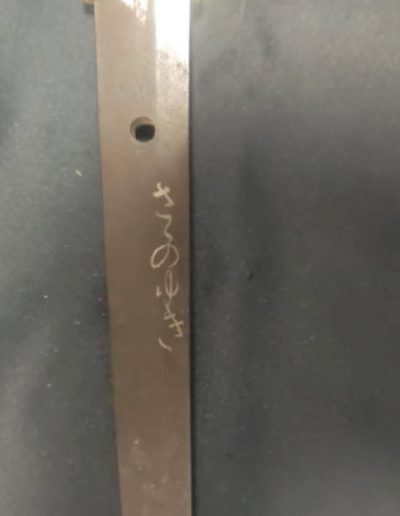
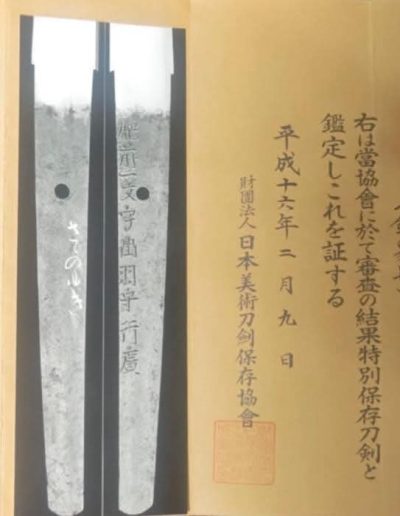
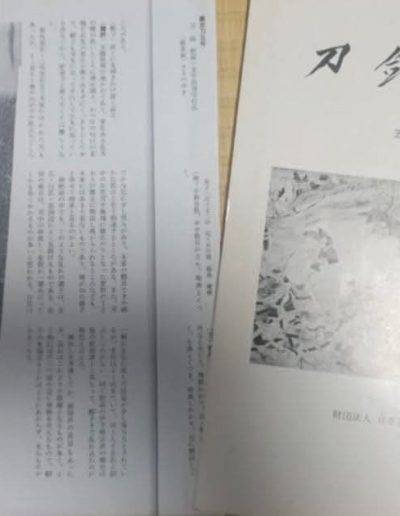
Hizen Ichimonji Dewa-no-kami Yukihiro katana. An Excellent sword with stunning hamon packed with Hataraki. Shirasaya has Sayagaki by Tanobe Sensei Nagasa 70.3cm Nbthk Tokubetsu Hozon certificate Published in the token bijitsu magazine Mounted in Shirasaya Token Bijitsu translation Kantei Sword No. 5 Katana, mei: Ginzōgan-mei: Hizen Ichimonji Dewa no Kami Yukihiro (肥前一文字出羽守行広) Sasanoyuki (ささのゆき) [lit. “snow on bamboo grass;” a reference to the cutting ability of the blade] Nagasa 70.3 cm, sori 1.5 cm, shinogi-zukuri, iori-mune Ji: Ha: Bōshi: rather standing-out ko-itame that features plenty of ji-nie widely hardened and ko-nie-laden gunome-midare with a wide nioiguchi that starts with some yakidashi at the base and that is mixed with chōji, ko-notare, yahazu elements, tobiyaki, ashi, yō, and sunagashi sugu with hakikake at the tip and with a kaeri that runs back in a long fashion Explanation: As the blade displays a konuka-hada, a midareba that is rich in variety, nie accumulations in the valleys between the midare elements, where also the bottom edge of the nioiguchi and the tips of the ashi “fume” out, and a bōshi that runs parallel to the fukura and turns back with a ko-maru-kaeri, it should not be too difficult to recognize that this is a Hizen-tō. Some participants also went for the first and second generation Tadahiro (忠広) and other smiths from the Hizen main line, but a closer examination of the jigane reveals that the hada tends to stand out and that the steel is somewhat blackish, which means, the forging differs slightly from more refined approach seen with the Hizen main line smiths. Also, yahazu elements in the ha, chōji of uncommon shape that are prominently horizontally elongatd, and the presence of a yakidashi are also features that are relatively uncommon for the Hizen main line. This combined with the jigane, it is more appropriate to regard the blade as a collateral Waki-Hizen branch work. Among Waki-Hizen works, a midare as seen here is most typical for Masahiro (正広), Yukihiro (行広), and Tadakuni (忠国). In case of Tadakuni, however, there would be more sunagashi and kinsuji in the ha, which usually also appear in a noticeably longer manner. Yukihiro is sometimes regarded as being slightly inferior in terms of skill than Masahiro, but the Kantei blade is of excellent make and has virtually no elements that would distinguish it from a work of Masahiro. In case of Iyo no Jō Munetsugu (伊予掾宗次), who was a Hizen smith as well, not only the ha, but also the bōshi would display midare, that is, be a midare-komi bōshi, a characteristic, which distinguishes him from all other Hizen smiths. Because of the yakidashi, some went for Oya-Kunisada (親国貞). However, his midare elements would be smaller dimensioned and often there would be tobiyaki in the monouchi and/or around the mitsugashira. Apart from that, his kaeri would not start as late as seen here and would turn back in a more pronouncedly roundish manner Sayagaki By Tanobe Sensei 肥前一文字出羽守行廣 初代行廣ノ十字銘及サヽノユキト利刃ヲ称ス銀象嵌有之細緻ナ米糠肌ニ鍛ヘ焼高ク互乃目ニ丁子・小湾・矢筈刃ヲ交ヘル乱ヲ見セ動勢アリテ匂深デ乱ノ谷ニ沸ガ溜リ砂流・金筋・湯走ガ絡 ミ匂口明ルクヘ小丸帽子ニ結ブナド同工ノ典型且屈指ノ優品也刃⻑弐尺三寸壱分半惟時乙⺒暦卯月穀旦探山観而誌之「花押」 Hizen Ichimonji Dewa no Kami Yukihiro Shodai Yukihiro no jūji-mei oyobi Sasanoyuki to riba o shō-su ginzōgan kore ari. Saichi na konuka-hada ni kitae yaki takaku gunome ni chōji, ko-notare, yahazuba o majieru midare o mise dōsei arite nioi fukashi de midare no tani ni nie ga tamari sunagashi, kinsuji, yubashiri ga karami nioiguchi akaruku sae ko-maru bōshi ni musubu nado dōkō no tenkei katsu kusshi no yūhin nari. Hachō ni-shaku san-sun ichi-bu han Koretoki kinoto-hebidoshi uzuki kokutan Tanzan kore o mite narabi ni shirushite + kaō. Ichimonji Dewa no Kami Yukihiro from Hizen This is a work of the first generation Yukihiro that is signed in ten characters and that bears the silver-inlaid inscription “Sasanoyuki,” which alludes to the cutting ability of the blade. The kitae is a finely forged konuka-hada, the hardening is a wide and vivid gunome-based midare with a wide, bright, and clear nioiguchi that is mixed with chōji, ko-notare, yahazuba, sunagashi, kinsuji, and yubashiri, there are accumulations of nie along the valleys between the midare elements, and the bōshi features a ko-maru-kaeri. With all this, the blade is not only in the textbook style of this smith, but is also an outstanding masterwork of his. Blade length ~ 70.1 cm Examined and written by Tanzan [Tanobe Michihiro] on a lucky day in April in the year of the snake of this era (2025) + monogram
NihontoWatchOffered by Nihonto Australia
9 on the market

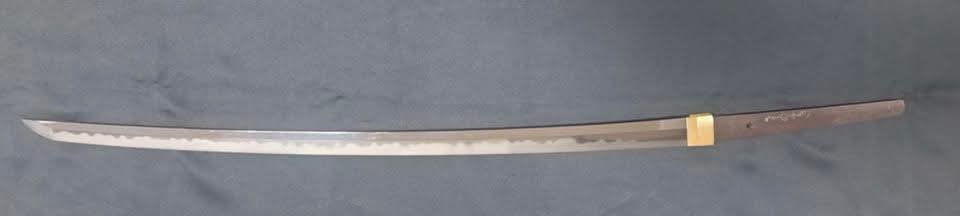
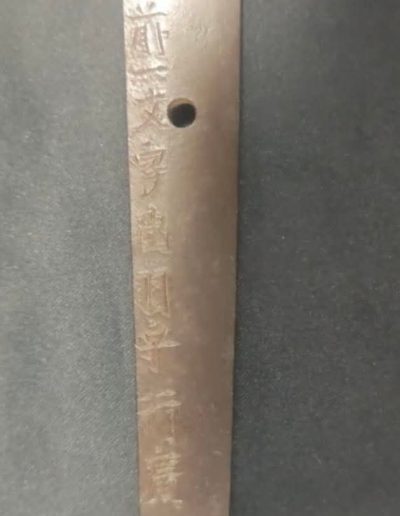
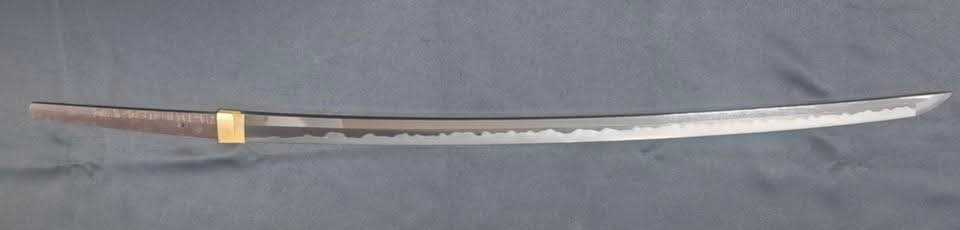
Hizen (waki-Hizen / Soba-Hizen, Saga) · Hizen · around 1639-1683
Fujishiro Jo saku · Tōken Taikan top 23%
9 pieces on the market now
Dewanokami Yukihiro, the first generation of the name, was born in Genna 3 (1617) as the second son of Hashimoto Yoshinobu, with the common name Kurobei. His elder brother was Kawachi no Daijo Masahiro, which made him a grandson of the first-generation Tadayoshi, and he worked at Saga on the collateral line of the Hizen school that the published sources call Soba-Hizen, beside the main house rather than within it. He received the title Dewa Daijo in Shoho 5 (1648), was promoted to Dewanokami in Kanbun 3 (1663), and died in Tenna 2 (1682) at the age of sixty-six. The name passed through several generations, and the published sources are careful on the point: of one katana they write that "there were several generations of the same name; this is the work of the first"[[c:1]].
Within the Hizen group his manner is known above all for a showy choji, and an early paper says simply that he tempers "particularly flamboyant choji within the school"[[c:2]]. On his finest katana a broad yakihaba carries a choji-midare mixed with gunome, angular and round-headed elements and yahazu-like forms, here and there boxy, the pattern large and florid. Long ashi enter vigorously and the nioi runs deep, with nie adhering thickly. Long sunagashi and kinsuji run through the edge, and the nioiguchi is bright. The published sources single out the vertically elongated choji-midare with long ashi as "something often seen in the first-generation Yukihiro" that "clearly manifests this smith's distinctive traits"[[c:3]]. On two outstanding katana they note that the kinsuji and sunagashi stand out beyond his usual work, and on one of them yubashiri-like tobiyaki lends a further charm.
The jigane is that of Hizen: a tightly forged ko-itame with dust-fine ji-nie laid thickly and fine chikei entering, which on several blades the sources call a refined komenuka-hada. On one katana they note a jigane of slightly blackish tone together with a straight yakidashi at the base below the midare, and they treat both as "one of the points of interest of Soba-Hizen"[[c:4]], rather than as faults. A second katana opens with the same straight yakidashi. The boshi runs straight to a ko-maru, on some blades an o-maru, often with hakikake and at times a deep turnback.
Beside the choji he commanded the school's traditional straight temper. A naginata carries a clean suguha over tightly packed ko-itame, its nioiguchi bright and clear. A katana shows a suguha-based temper over komenuka-hada, with an angular notare near the base suggestive of a koshiba. A katana in hiro-suguha, deep in nioi with thick ko-nie, is called a comparatively uncommon example for him, yet "work that could be mistaken for the suguha of the main line"[[c:5]]. One wakizashi reverses the usual Hizen arrangement, with choji and gunome above and a suguha-like shallow notare below; the sources call this unusual within the tradition, though the upper half is still the midare at which he excelled.
Separate from the hamon is the Aranda-kitae. He is said to have gone to Nagasaki in Keian 3 (1650) to learn Dutch forging under the Dutch smith Hisatsugu and Yakushiji Tanenaga, in essence a method of processing imported nanban-tetsu, and many of his blades carry the supplementary inscription "made with Dutch forging." He customarily cut the character ichi on the tang, and in rare cases the full form Hizen Ichimonji. One such katana lacks the Aranda inscription, which the sources take to mean that it was not made by that method. His nearest comparison in the record is his own brother: one large, florid gunome-midare katana is said "at first sight to call to mind rather the work of his elder brother Masahiro"[[c:6]], and another almost to recall a masterwork by Masahiro. His son, the second-generation Dewanokami Yukihiro, first signed Yukinaga, styled himself Tobanojo, and took the Dewanokami title in Jokyo 1 (1684), two years after his father's death.
Fifteen of his works are designated Juyo, and none stands in a higher tier; Fujishiro ranks him Jo saku. Dated pieces are few. A Kanbun 8 (1668) katana, made at fifty-one and bearing the Aranda inscription, is called "valuable source material"[[c:7]], and a long katana dated Enpo 6 (1678) was made as an offering to the Daijingu, a large work without any breakdown in ji or ha. Current owners are not recorded for these blades. Signed Juyo works by him do reach the market from time to time, though, as with most designated swords, they are far more often held than traded.
Where Yukihiro stands among comparable artisans: across all of nihontō, and within tradition, era, and period. The tiers (Foremost · Leading · Major · Notable) weigh official designations from the NBTHK and Japan's Agency for Cultural Affairs, together with historical honors of lasting repute such as the Sansaku and Meibutsu-chō.
Select a lens to see how it's measured.
Years he was demonstrably active, proven by signed-and-dated blades
Shinto · Hizen
105 pieces on the market now
The Hizen school began with a single domain commission. In Keicho 1 (1596) the Nabeshima of Hizen ordered Hashimoto Shinzaemon, the smith who would sign Tadayoshi, up to Kyoto with the carver Munenaga; there he entered the gate of Umetada Myoju and studied forging while Munenaga learned the chisel. The two returned to the province in Keicho 3 (1598), and Tadayoshi settled in the castle town below Saga, where under the domain's patronage the line grew into the dominant sword-making house of Kyushu. His own work runs from Keicho 5 (1600) to his death in Kan'ei 9 (1632); in Genna 10 (1624) he received the court title Musashi Daijo, changed his name to Tadahiro, and shifted his clan name from Minamoto to Fujiwara, so that the late Musashi Daijo blades are the founder under a second name. From him the house became a true generational institution: his son the second-generation Omi Daijo Tadahiro carried it forward as its most prolific hand, the third-generation Mutsu no Kami Tadayoshi returned its highest finish, and a Tosa no Kami branch took the founder's signature when he set it aside. Around this main line grew a circle of disciples and collateral hands, the waki-Hizen or Soba-Hizen smiths, several of them, like Yoshiie and Hironori, working as daisaku substitute makers whose own signed pieces are therefore scarce. The school's signature is its steel. Over a ko-itame forged so tightly it shows no slackness, fine ji-nie gathers in minute particles until the surface takes on the rice-bran konuka-hada (also written komenuka-hada) that no other school produces, fine chikei entering throughout and the ji notably clear and bright.
The orthodox temper laid upon it is a chu-suguha or hiro-suguha, sometimes tinged with a shallow notare and ko-gunome, the nioiguchi deep with finely clustered ko-nie and tightened to a bright clarity, the boshi running straight to a quiet ko-maru. The founder aimed this suguha toward the Rai school yet departed from it, his nioiguchi tighter and his forging carrying more vigor; the third generation refined it to what the published sources call the strongest and most precise hand of the first three generations. Against that calm register the house also worked a showier one, the Hizen choji-midare mixing gunome, long ashi, kinsuji and sunagashi, a manner the published sources already find more often in the founder's late Musashi Daijo work than in his Tadayoshi years, and one the second generation made his own. The branches pushed further from the suguha standard: Tadakuni of the Ogi domain ran sunagashi more conspicuously than any other Hizen hand and reached toward old Ichimonji in his o-choji; Masahiro and Yukihiro favored a flamboyant long-ashi choji over the calm main line; and the Iyo no Jo Munetsugu line worked apart in the Soshu-den, building a midareba on notare with a pointed togariba and a jihada that tends to stand and tone slightly blackish. A collector seeks Hizen-to first for that steel, and reads it the same way the appraiser does: a bright suguha lying over a clear, tight konuka-hada identifies the school before the signature is consulted, and the quiet ko-maru boshi on the ura-signed tang confirms the main-line practice. Generation and branch are then told within that frame, the third generation's powerful sugata recalling not his father but his grandfather, the waki-Hizen hands set apart by their irregular temper, their sujikai file marks and a sashi-ura signature, the Munetsugu line by its Soshu togari. The main line, made in real numbers across so long a span, reaches the market more readily than any Kamakura master, so a papered example is within reach of a patient collector, while the founder's own work and the finest konuka-suguha of the third generation come to open hands only from time to time. Provenance runs back through the house the school served, blades recorded to Nabeshima Katsushige and Nabeshima Naomoto and passing onward to the Owari Tokugawa, the Satake and the Imperial families; documentary inscriptions sharpen the picture further, a Myoju soemei attesting the founder's discipleship, Umetada carving adding flowers to brocade on his late blades, and the gold-inlaid cutting tests of Yamano Kanjuro and Yamano Ka'emon, rare on Hizen work, naming the edge as well as the hand. Learn more →
| Smith | Era | Designated |
|---|---|---|
| Tadayoshi忠吉 | 1596-1632 | 155 |
| Tadayoshi忠吉 | 1660-1686 | 61 |
| Tadahiro忠廣 | 1633-1693 | 133 |
| Masahiro正廣 | 1624-1655 | 30 |
| Tadakuni忠國 | 1648-1652 | 32 |
Hizen: a domain enterprise
Hizen swords were a domain enterprise: the Nabeshima sent Tadayoshi to study under Umetada Myōju around 1596, then built a licensed school around him. Nine generations carried its famously consistent konuka-hada work into the Meiji era.
A Hozon-certified blade judged to show notably superior workmanship and a better state of preservation. The bar is higher: re-tempered blades and most unsigned Muromachi/Edo works are excluded.
The NBTHK (Nihon Bijutsu Tōken Hozon Kyōkai, the Society for the Preservation of Japanese Art Swords) is a public-interest incorporated foundation founded in 1948 and supervised by Japan’s Agency for Cultural Affairs (Bunkachō); it is based at the Japanese Sword Museum in Tokyo. Its expert panels physically examine each submitted work (shinsa) and issue a certificate (kanteishō) ranking it by artistic and historical merit. NBTHK papers are the most widely recognized standard of authentication for Japanese swords and fittings.
NBTHK official sitePrice on request