Edo was the sword’s age of connoisseurship: the Hon’ami appraisers, the shogunal register of famous blades of 1719, and a thriving literature turned the sword into an object of study even as it ceased to be drawn in war.
 NihontoWatchNihontoWatch
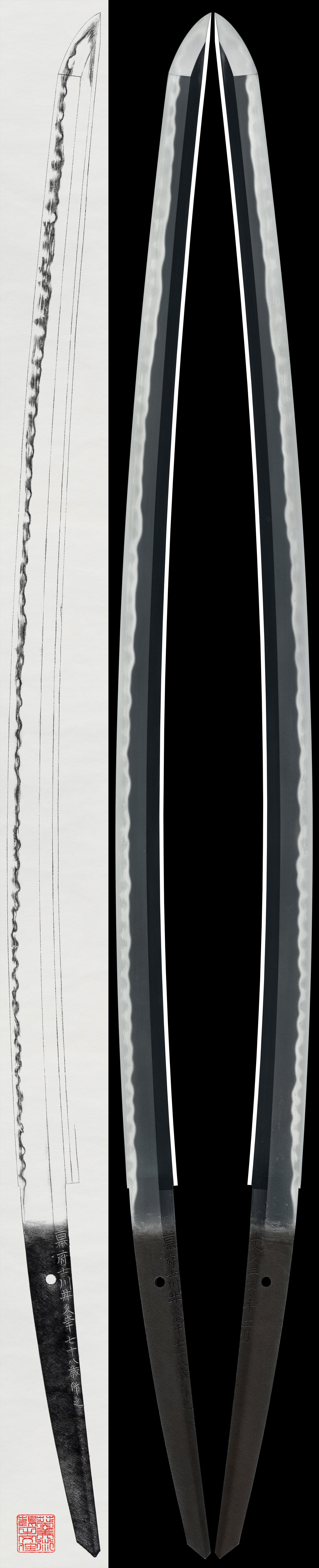
Katana in Shirasaya (NBTHK Tokubetsu Hozon Token) (We divide 4 sections for each sword as Saijyo Saku, Jyojyo Saku, Jyo Saku and Regular Saku). This work ranks as Jyojyo Saku among the works of Kawai Hisayuki. Shape: A fine-looking sword with a length of 74.4 cm (29.29 in), deep curvature, and a long kissaki. Jigane: Well-forged masame-hada with some ubu-ba remaining. Hamon: Nie-deki, gunome-midare. Kinsuji actively appears within the temper line. Features: Shinshinto: Jyo Saku: Musashi. Kawai Hisayuki was a swordsmith active in the late Edo period, born in 1786 into the Hatamoto Kawai family. He studied under Shimizu Hisayoshi, a disciple of Nakayama Ikkansai Yoshihiro and Hosokawa Masayoshi, and worked as a swordsmith in Koishikawa, Edo. This work features a well-forged, tightly packed masame-hada grain pattern, with active sunagashi flowing through the gunome hamon, creating a unified appearance between the Jigane and Hamon. It is a healthy blade with an outstanding workmanship. NBTHK Tokubetsu Hozon Certificate
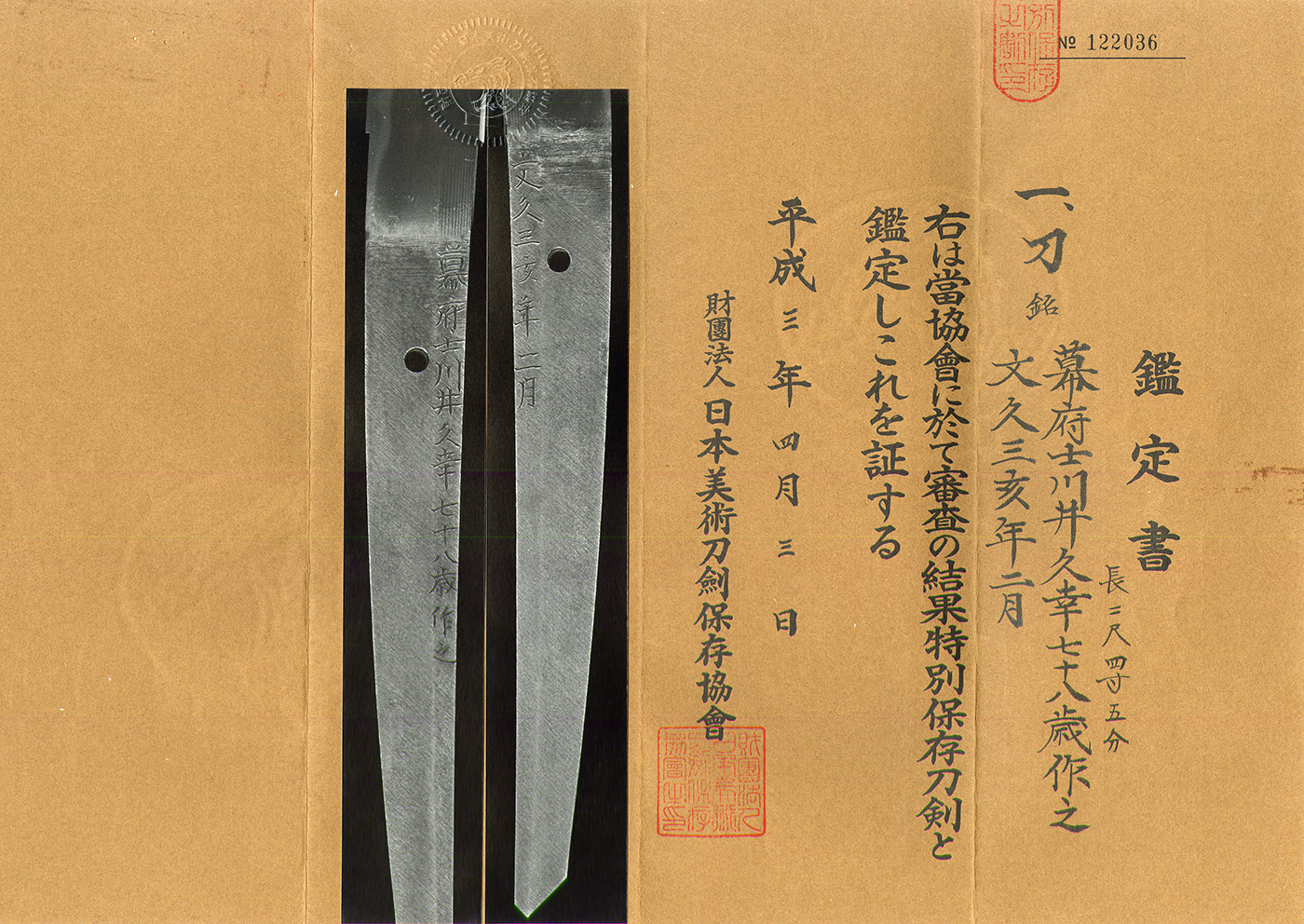
Certificate reading — 銘 幕府士川井久幸七十八歳作之 文久三亥年二月
NihontoWatchHisayuki久幸
Offered by Aoi Art
2 on the market



As written by the shop
Musashi · around 1854-1860
2 pieces on the market now
The Edo period (1615 to 1868)
Edo was the sword’s age of connoisseurship: the Hon’ami appraisers, the shogunal register of famous blades of 1719, and a thriving literature turned the sword into an object of study even as it ceased to be drawn in war.
A Hozon-certified blade judged to show notably superior workmanship and a better state of preservation. The bar is higher: re-tempered blades and most unsigned Muromachi/Edo works are excluded.
The NBTHK (Nihon Bijutsu Tōken Hozon Kyōkai, the Society for the Preservation of Japanese Art Swords) is a public-interest incorporated foundation founded in 1948 and supervised by Japan’s Agency for Cultural Affairs (Bunkachō); it is based at the Japanese Sword Museum in Tokyo. Its expert panels physically examine each submitted work (shinsa) and issue a certificate (kanteishō) ranking it by artistic and historical merit. NBTHK papers are the most widely recognized standard of authentication for Japanese swords and fittings.
NBTHK official siteIf you wish to return an item, please notify us within 3 days of receipt. After this period we cannot accept cancellations. Please ship the return to us within 5 business days. Cancellation is conditional on the item being kept in the same condition as at the time of sale, so please handle it with care.
¥1,450,000