Modern Tokyo, in kenukigata tachi koshirae
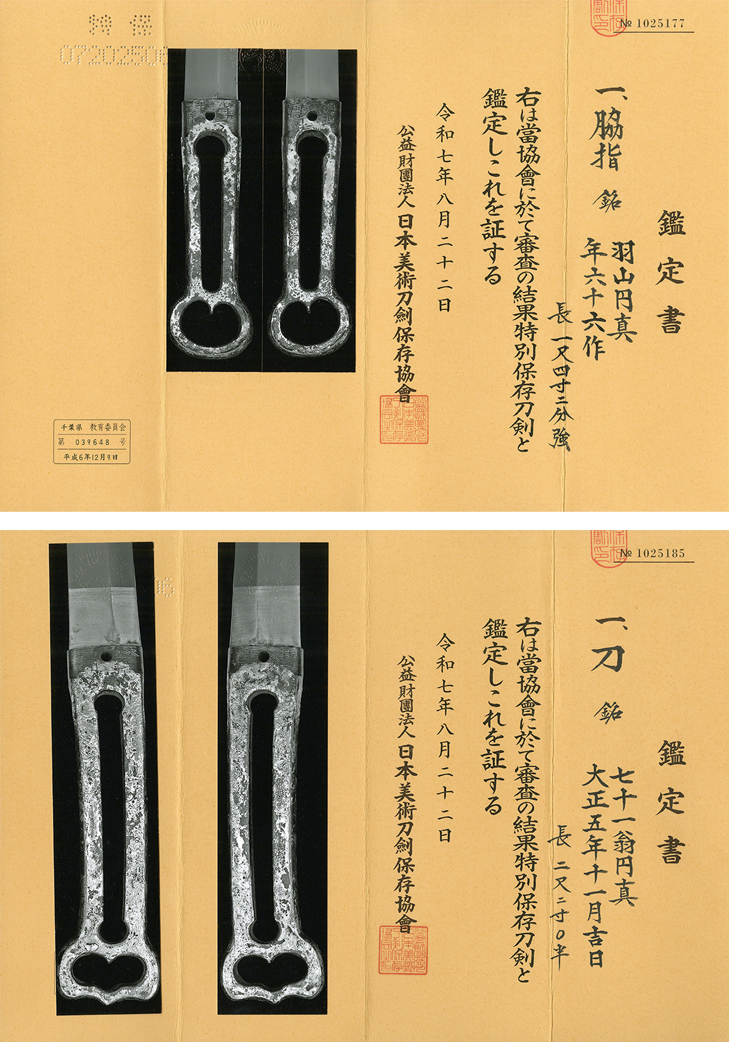
Katana: With Tokubetsu Hozon Token Kanteisho and Tokubetsu Kicho Token Nintisho
Wakizashi: With Tokubetsu Hozon Token Kanteisho
Katana nagasa: 67.0 (2 shaku 2 sun 1 bu plus) sori: 0.2 moto-haba: 3.22 moto-kasane: 0.59 ana: 1
Wakizashi nagasa: 43.2 (1 shaku 4 sun 2 bu) sori: 0.9 moto-haba: 2.51 moto-kasane: 0.65 ana: 1
[Katana]
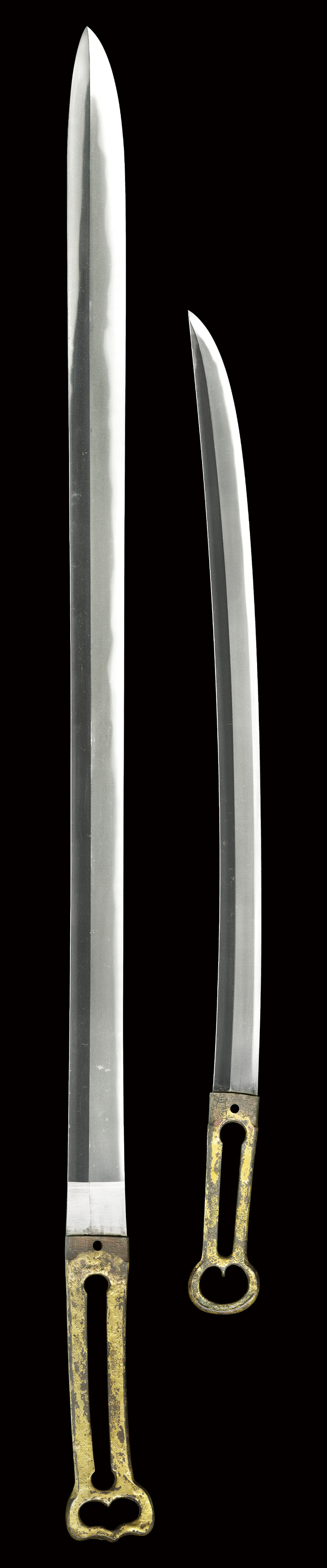
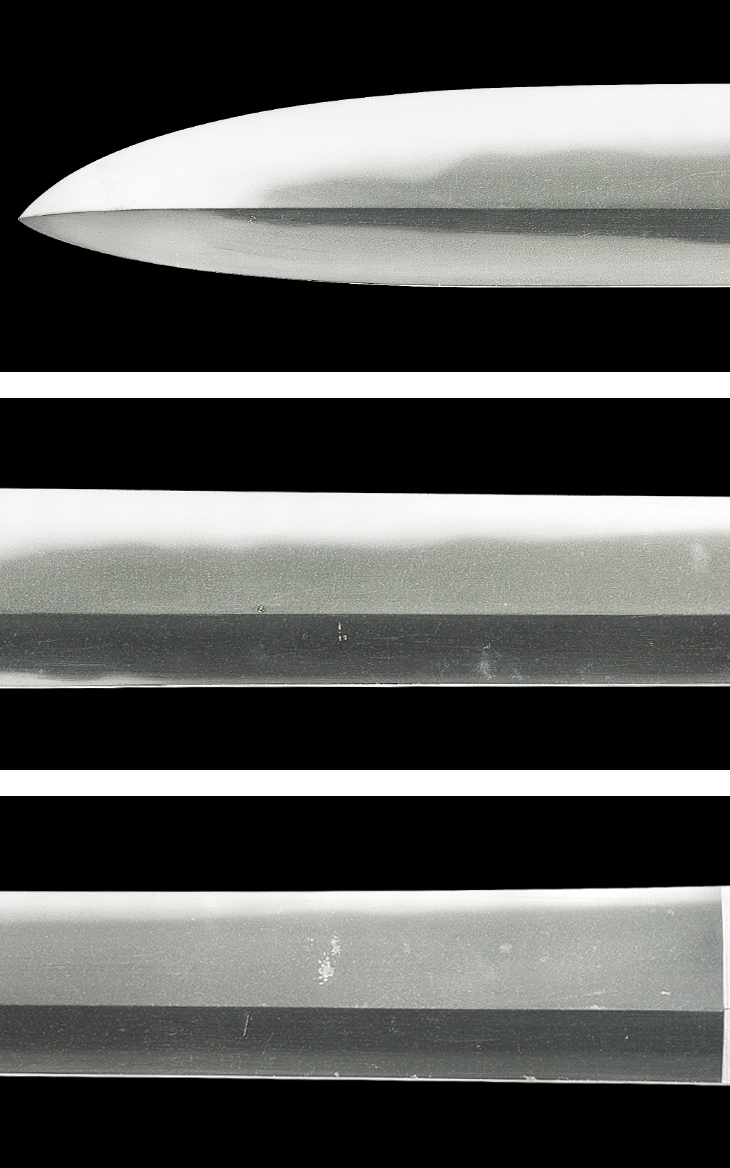
Shinogi (kissaki moroha) zukuri, high shinogi. Kitae, ko-itame hada well-tightened with a tendency to be submerged, ji-nie attached, jitetsu is refined. Hamon, in a notare midare style with the upper half becoming wide, the habuchi is well-covered in nie with deep nioiguchi, bright and clear. Boshi, notare style with the tip returning slightly. Nakago ubu. Habaki is one with the toshin. Period polishes.
[Wakizashi]
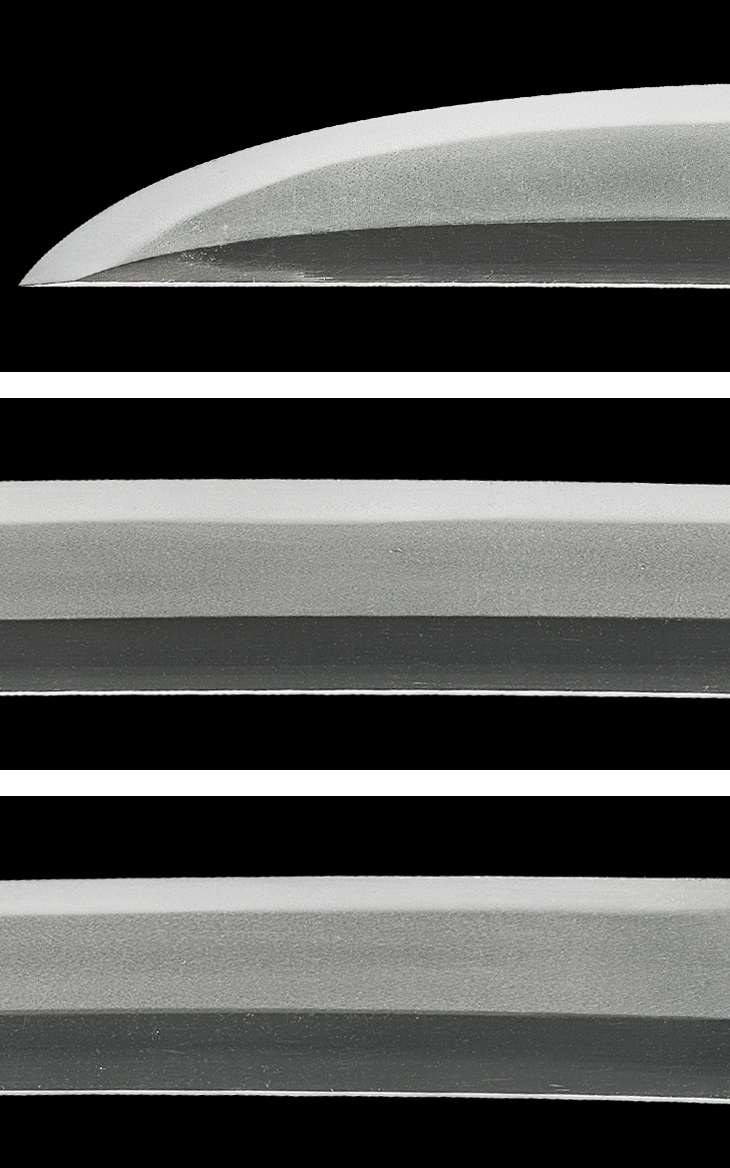
Shobu-fu zukuri, high shinogi. Kitae, ko-itame hada well-tightened with a slight tendency to be submerged, ji-nie attached, chikei enters, jitetsu is refined. Hamon, in a sugu-notare style, the habuchi is well-covered in nie with deep nioiguchi, bright and clear. Boshi, sugu style with the tip returning with slight hakikake. Nakago ubu. Habaki is one with the toshin. Period polishes. Shirasaya included.
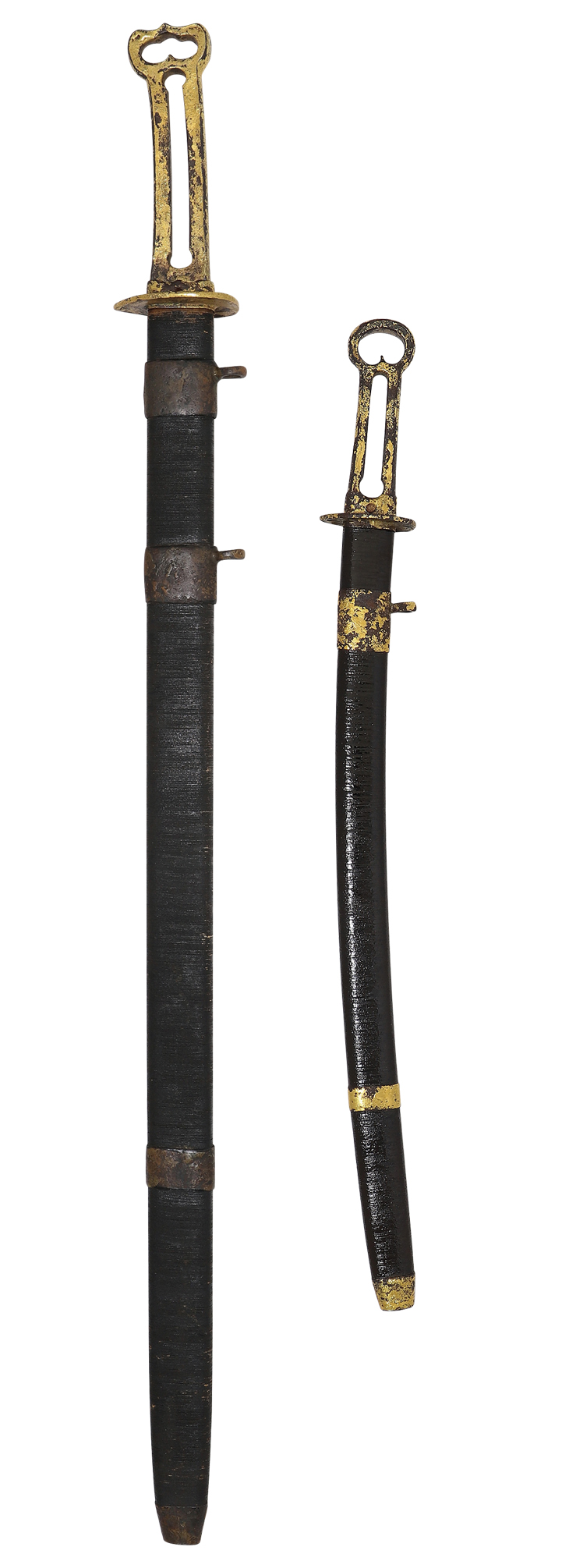
[Kenukigata tachi style daisho koshirae]
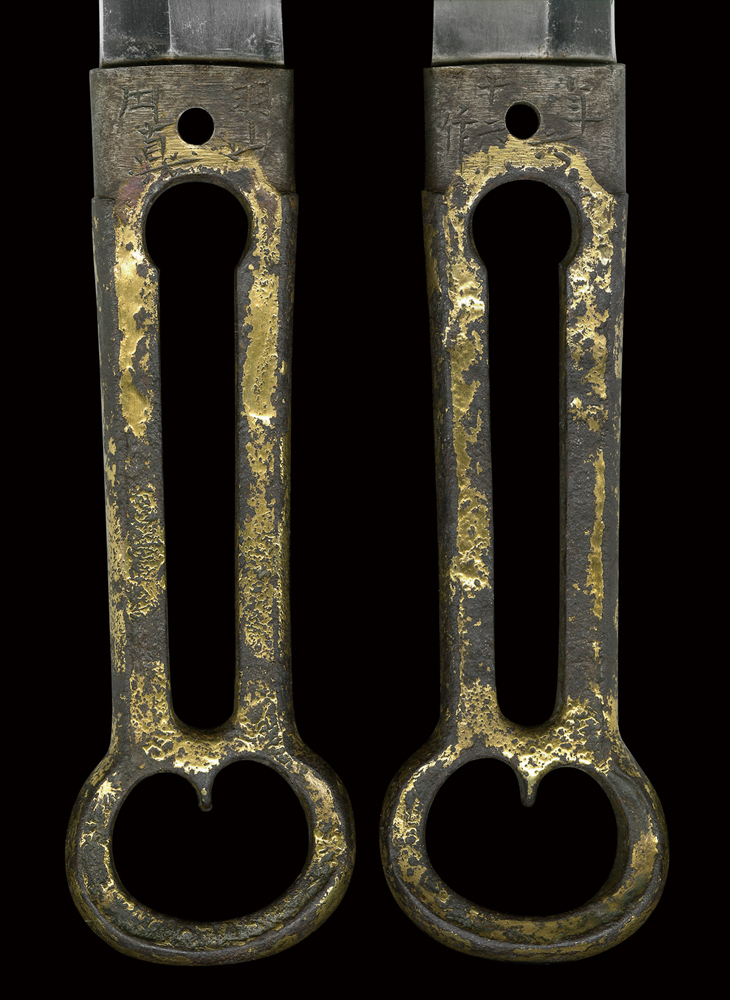
Dai (Edo period, total length dai 89, saya is hardwood with ito-maki urushi-nuri, semegane, koiguchi, ishizuki, ashi-kanamono etc. are tetsu-ji, tsuka is kenukigata tachi style continuing from the toshin, kin-zogan, tsuba is integrated with the toshin, toran kin-zogan) included.
Sho (Edo period, sho 58.5, saya is same style as the daito, iron fittings parts are kin-zogan, tsuka is same style as the daito, tsuba is integrated with the toshin, toran-gata kanto-sukashi kin-zogan) included.
Kenukigata tachi are said to have developed from the warabite-to of the Ezo in the Heian period, and this style was established from the mid to late Heian period. It is considered one of the oldest types of sword exterior, and was used not only for ceremonial purposes but also as a practical combat sword at the time, though from the Kamakura period onwards, it came to be used mainly for ceremonies.
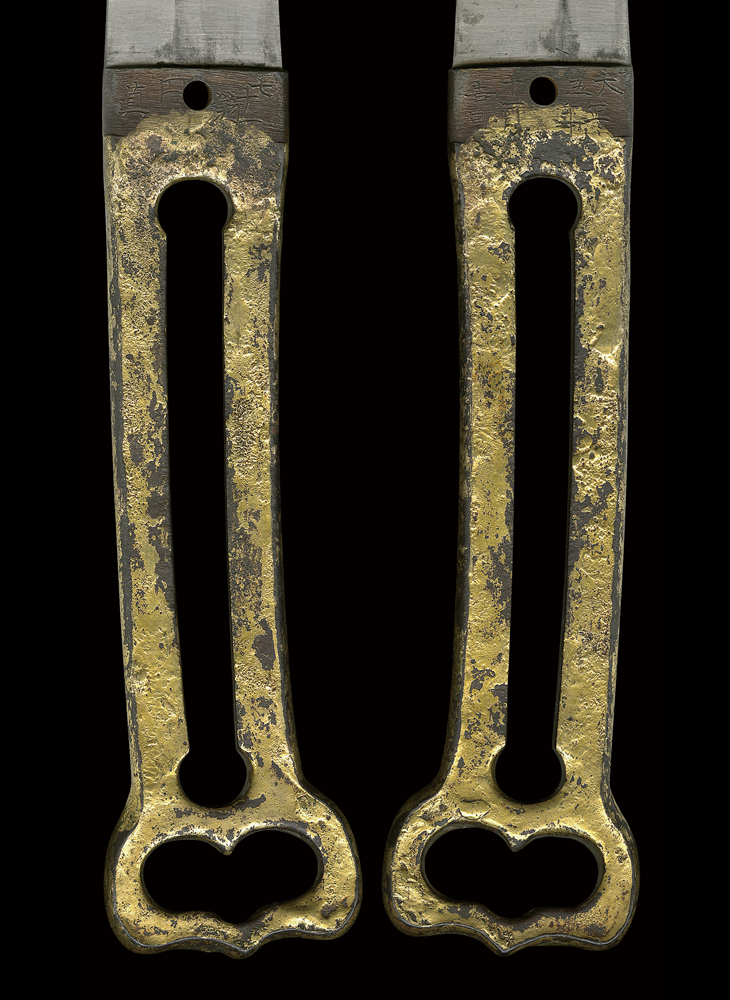
The greatest characteristic is that the tsuka is made of the same iron as the toshin, and a kenukigata sukashi-bori is applied to its center. The majority of extant pieces are works of the Edo period; works older than that are hardly seen.
This work is a kenukigata tachi by Hayama Enshin, and although the production periods differ, it is a precious masterpiece as a matched daisho set.
Since the tsukagashira part is ring-shaped, it is also called a kenukigata kanto tachi.
Enshin was born in Koka 2, named Suzuki Shogaku, and was a retainer of the Yoshida Domain in Owari Mikawa (present-day Toyohashi City, Aichi Prefecture); he later turned to being a swordsmith, studied under Minamoto Kiyomaro's student Suzuki Masao, and took the name Jounsai. Living in Yanaka, Taito-ku, Tokyo, he was active through the Meiji and Taisho eras, and is also appraised as a master of using yotetsu. Died in Taisho 9 at age 75.
The dai was made in Taisho 5, as also carved on the nakago, when the smith was 71 years old, a work from his mature later years, dimensions 2 shaku 2 sun 1 bu plus, in a kissaki moroha-fu style; the sho has no date, but as it says "made at age 66", it is appraised as a work of Meiji 44 (1911). Dimensions slightly under 1 shaku 4 sun 2 bu, in a shobu-fu style.
The jitetsu of both are well-tightened, and as for the blades, the dai has deeper yaki. The atmosphere differs between the large and small; the blade of the dai and the jitetsu of the sho are clearer.
The fittings where the tsuba and fuchi are integrated have gold applied to the tsuka part. The tsuba is, of course, the work of Enshin.
Since the toshin and tsuka are integrated, when removing the tsuba, if the mekugi is pulled out, it becomes possible to attach or detach it, and it can be removed upwards. A kenukigata kanto tachi by Hayama Enshin, and moreover a matched daisho set; at any rate, a greatly rare kenukigata tachi, please be sure to secure it.
Machine translation from the shop's Japanese · may contain errors ·
Modern Tokyo, in kenukigata tachi koshirae
Katana: With Tokubetsu Hozon Token Kanteisho and Tokubetsu Kicho Token Nintisho
Wakizashi: With Tokubetsu Hozon Token Kanteisho
Katana nagasa: 67.0 (2 shaku 2 sun 1 bu plus) sori: 0.2 moto-haba: 3.22 moto-kasane: 0.59 ana: 1
Wakizashi nagasa: 43.2 (1 shaku 4 sun 2 bu) sori: 0.9 moto-haba: 2.51 moto-kasane: 0.65 ana: 1
[Katana]
Shinogi (kissaki moroha) zukuri, high shinogi. Kitae, ko-itame hada well-tightened with a tendency to be submerged, ji-nie attached, jitetsu is refined. Hamon, in a notare midare style with the upper half becoming wide, the habuchi is well-covered in nie with deep nioiguchi, bright and clear. Boshi, notare style with the tip returning slightly. Nakago ubu. Habaki is one with the toshin. Period polishes.
[Wakizashi]
Shobu-fu zukuri, high shinogi. Kitae, ko-itame hada well-tightened with a slight tendency to be submerged, ji-nie attached, chikei enters, jitetsu is refined. Hamon, in a sugu-notare style, the habuchi is well-covered in nie with deep nioiguchi, bright and clear. Boshi, sugu style with the tip returning with slight hakikake. Nakago ubu. Habaki is one with the toshin. Period polishes. Shirasaya included.
[Kenukigata tachi style daisho koshirae]
Dai (Edo period, total length dai 89, saya is hardwood with ito-maki urushi-nuri, semegane, koiguchi, ishizuki, ashi-kanamono etc. are tetsu-ji, tsuka is kenukigata tachi style continuing from the toshin, kin-zogan, tsuba is integrated with the toshin, toran kin-zogan) included.
Sho (Edo period, sho 58.5, saya is same style as the daito, iron fittings parts are kin-zogan, tsuka is same style as the daito, tsuba is integrated with the toshin, toran-gata kanto-sukashi kin-zogan) included.
Kenukigata tachi are said to have developed from the warabite-to of the Ezo in the Heian period, and this style was established from the mid to late Heian period. It is considered one of the oldest types of sword exterior, and was used not only for ceremonial purposes but also as a practical combat sword at the time, though from the Kamakura period onwards, it came to be used mainly for ceremonies.
The greatest characteristic is that the tsuka is made of the same iron as the toshin, and a kenukigata sukashi-bori is applied to its center. The majority of extant pieces are works of the Edo period; works older than that are hardly seen.
This work is a kenukigata tachi by Hayama Enshin, and although the production periods differ, it is a precious masterpiece as a matched daisho set.
Since the tsukagashira part is ring-shaped, it is also called a kenukigata kanto tachi.
Enshin was born in Koka 2, named Suzuki Shogaku, and was a retainer of the Yoshida Domain in Owari Mikawa (present-day Toyohashi City, Aichi Prefecture); he later turned to being a swordsmith, studied under Minamoto Kiyomaro's student Suzuki Masao, and took the name Jounsai. Living in Yanaka, Taito-ku, Tokyo, he was active through the Meiji and Taisho eras, and is also appraised as a master of using yotetsu. Died in Taisho 9 at age 75.
The dai was made in Taisho 5, as also carved on the nakago, when the smith was 71 years old, a work from his mature later years, dimensions 2 shaku 2 sun 1 bu plus, in a kissaki moroha-fu style; the sho has no date, but as it says "made at age 66", it is appraised as a work of Meiji 44 (1911). Dimensions slightly under 1 shaku 4 sun 2 bu, in a shobu-fu style.
The jitetsu of both are well-tightened, and as for the blades, the dai has deeper yaki. The atmosphere differs between the large and small; the blade of the dai and the jitetsu of the sho are clearer.
The fittings where the tsuba and fuchi are integrated have gold applied to the tsuka part. The tsuba is, of course, the work of Enshin.
Since the toshin and tsuka are integrated, when removing the tsuba, if the mekugi is pulled out, it becomes possible to attach or detach it, and it can be removed upwards. A kenukigata kanto tachi by Hayama Enshin, and moreover a matched daisho set; at any rate, a greatly rare kenukigata tachi, please be sure to secure it.
The Haitōrei edict of 1876 ended sword wearing and nearly ended the craft itself. Military demand and imperial patronage kept a remnant alive, and in 1906 Gassan Sadakazu and Miyamoto Kanenori were named Artists to the Imperial Household.
A Hozon-certified blade judged to show notably superior workmanship and a better state of preservation. The bar is higher: re-tempered blades and most unsigned Muromachi/Edo works are excluded.
Signed: 羽山円真 年六十六作 (Enshin)
As written on the certificate
About the NBTHK›
The NBTHK (Nihon Bijutsu Tōken Hozon Kyōkai, the Society for the Preservation of Japanese Art Swords) is a public-interest incorporated foundation founded in 1948 and supervised by Japan’s Agency for Cultural Affairs (Bunkachō); it is based at the Japanese Sword Museum in Tokyo. Its expert panels physically examine each submitted work (shinsa) and issue a certificate (kanteishō) ranking it by artistic and historical merit. NBTHK papers are the most widely recognized standard of authentication for Japanese swords and fittings.
For one-of-a-kind items such as swords, sword fittings and antiques, other customers may be waiting for the item, so please contact us about a return within 3 days of its arrival and ship it back within 8 days. Refunds are made on the day the returned item arrives.
 NihontoWatch