The swordsmith Ishido Teruhide, whose real name was Kikuchi Seiichi, was born in Meiji 33 (1900). He is a descendant of Ishido Unju Korekazu and Musashi Daijo Korekazu, and corresponds to the 10th generation of the Ishido family. The family turned to tool smithing after the Meiji edict banning swords. In Meiji 42 (1909), he became a disciple of the 9th generation Ishido Hidekazu and learned forging methods. During the war, he was engaged in the production of gunto, demonstrating skill worthy of the prestigious Ishido family name and producing many swords with excellent cutting ability. After the war, he devoted himself to the production of planes (kanna), and is widely known among carpenters as a master of plane making. Furthermore, the planes made by this smith possessed great sharpness similar to his swords, and received high praise as legendary masterpieces among master carpenters.
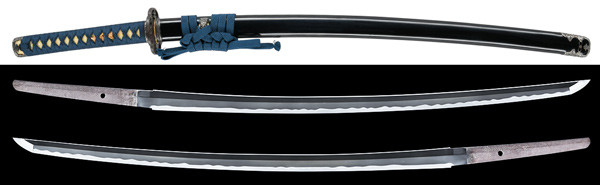
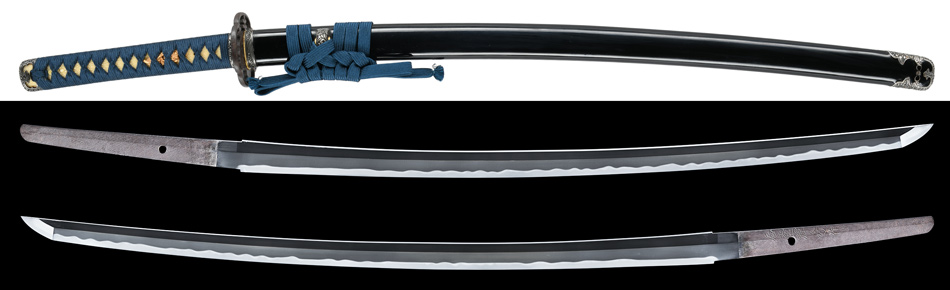
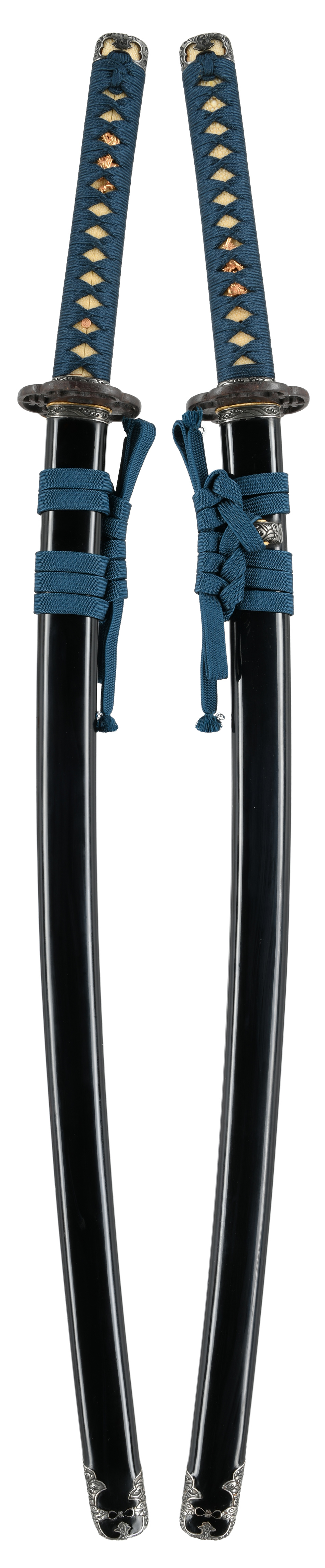
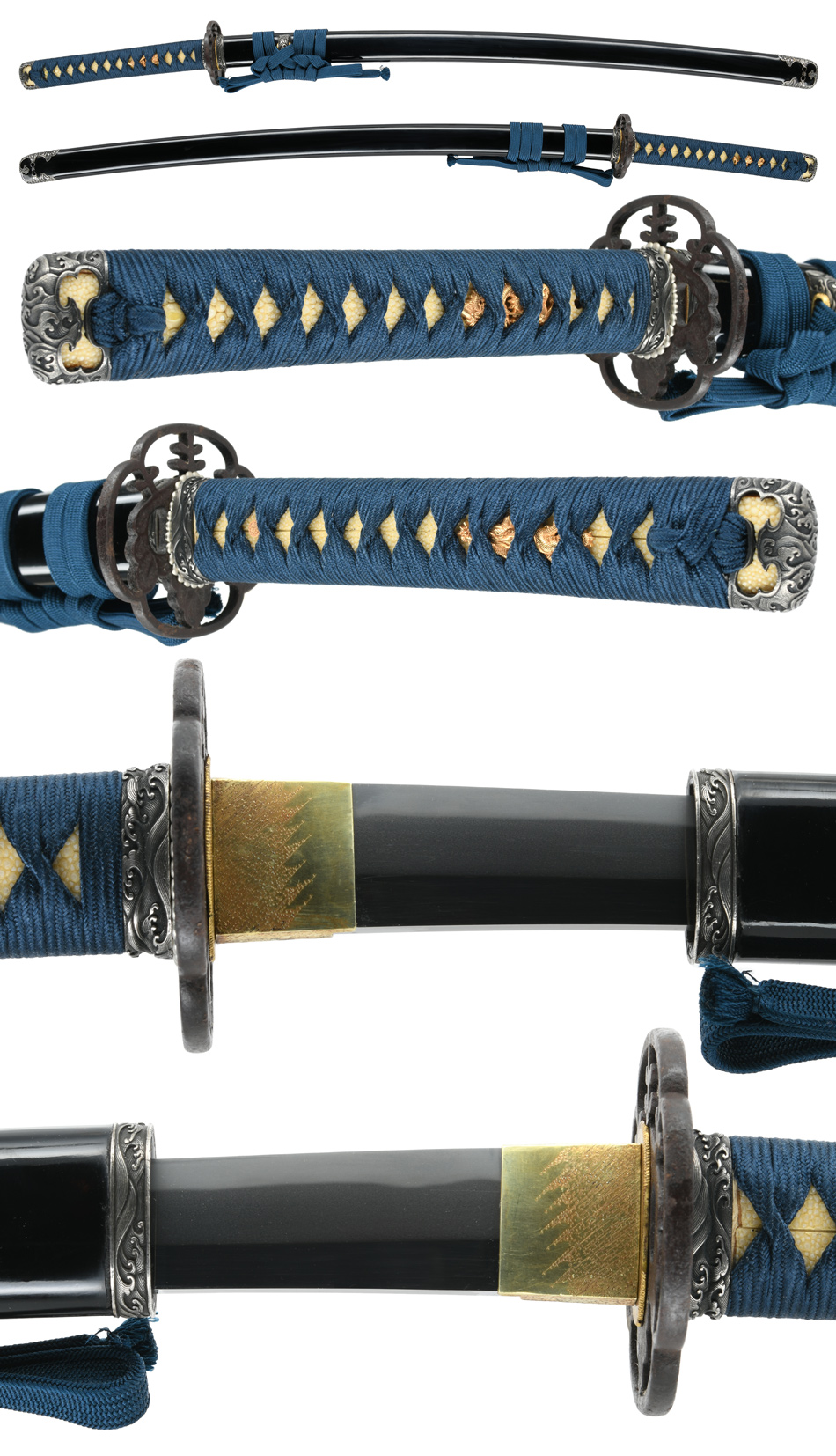
As for the taihai of this work, the nagasa is 2 shaku 1 sun 8 bu. The mihaba and kasane are both ordinary, the sori is moderate, and the kissaki is a sharp sword shape that is slightly elongated in a kare-kokoro style. The jigane is ko-itame hada with ji-nie, showing no cloudiness and presenting a superior forge rich in moisture. The hamon is a yakiba based on notare in ko-nie deki mixed with gunome, fired with a gentle and dignified hamon. The boshi is sugu and returns to a ko-maru tip. The nakago has kesho-sujikai yasurime and is carved with a calligraphic toko-mei. This sword is a superior work by Ishido Teruhide, the 10th generation head of the prestigious Ishido family that has continued since the Muromachi period; the beautiful jigane, forged without any particular flaws, strongly expresses the smith's careful skill and is a highlight.
Details from the shop
Stock No
SKA-040223
Paper(Certificate)
None
Country(Kuni)/Period(Jidai)
Saitama/Showa era about 1940~
Blade length(Cutting edge)
66.0cm
Curve(SORI)
1.6cm
Width at the hamachi(Moto-Haba)
3.07cm
Thickness at the Moto-Kasane
0.68cm
Wide at the Kissaki(Saki-Haba)
2.40cm
Thickness at the Saki-Kasane
0.55cm
Sword tang(Nakago)
Unaltered,Sujikaiyasuri with Keshoyasuri file pattern
Unaltered,Sujikaiyasuri with Keshoyasuri file pattern
Mekugi-ana
1
Registration
Aomori
Description from World Seiyudo
Machine translation from the shop's Japanese · may contain errors ·
The swordsmith Ishido Teruhide, whose real name was Kikuchi Seiichi, was born in Meiji 33 (1900). He is a descendant of Ishido Unju Korekazu and Musashi Daijo Korekazu, and corresponds to the 10th generation of the Ishido family. The family turned to tool smithing after the Meiji edict banning swords. In Meiji 42 (1909), he became a disciple of the 9th generation Ishido Hidekazu and learned forging methods. During the war, he was engaged in the production of gunto, demonstrating skill worthy of the prestigious Ishido family name and producing many swords with excellent cutting ability. After the war, he devoted himself to the production of planes (kanna), and is widely known among carpenters as a master of plane making. Furthermore, the planes made by this smith possessed great sharpness similar to his swords, and received high praise as legendary masterpieces among master carpenters.
As for the taihai of this work, the nagasa is 2 shaku 1 sun 8 bu. The mihaba and kasane are both ordinary, the sori is moderate, and the kissaki is a sharp sword shape that is slightly elongated in a kare-kokoro style. The jigane is ko-itame hada with ji-nie, showing no cloudiness and presenting a superior forge rich in moisture. The hamon is a yakiba based on notare in ko-nie deki mixed with gunome, fired with a gentle and dignified hamon. The boshi is sugu and returns to a ko-maru tip. The nakago has kesho-sujikai yasurime and is carved with a calligraphic toko-mei. This sword is a superior work by Ishido Teruhide, the 10th generation head of the prestigious Ishido family that has continued since the Muromachi period; the beautiful jigane, forged without any particular flaws, strongly expresses the smith's careful skill and is a highlight.
The twentieth century nearly killed the craft twice: wartime distortion, then the occupation ban. The NBTHK’s founding in 1948 and licensed forging from 1953 rebuilt the sword as an art, crowned by Living National Treasures and the mukansa rank.
No cooling-off period or returns; refund only if the purchased sword is proven fake, capped at purchase price (excludes commission sales, accessories, auction items).


 NihontoWatch