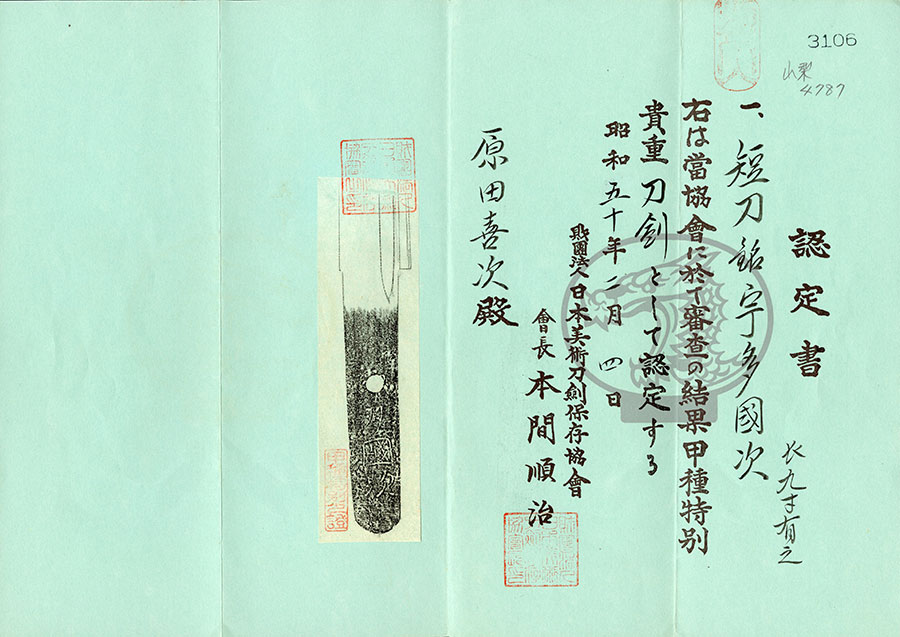
The Iruka group took its name from the locality of Iruka in Kii province, where, according to the Meikan references cited in its setsumei, a lineage of more than ten smiths worked from the Nanbokuchō period into the Muromachi. The setsumei place the line's beginning with Sanetsuna around the Jōwa to Bunna years, and record that many members shared the character Sane in their names, among them Sanetsuna, Sanetsugu, Sanehiro, and Saneyoshi. A signed tantō by Iruka Sanetsugu, dated to the early Muromachi, anchors this older branch. A second, later strand carries the name Kunitsugu: a smith of Kokawa in Kii active around Eishō who drew upon the Iruka line, distinguished by a kuni character whose enclosure interior is written as a cross-form, from which the appellations Sudō and Sasado arose. One setsumei records that the first Sasado generation studied under Norimitsu of the Iruka group around Ōei, with the name passing through successive holders. Across these blades the hand is quiet and disciplined. The setsumei tie the group's forging to the Yamato tradition, naming the Tegai and Hōshō lines, and the kitae bears this out: itame that flows and runs toward masame, with ji-nie, chikei, and on several blades a whitish utsuri or shirake-gokoro over the ji. The temper is consistently a low, narrow suguha, its nioiguchi tight and carried in ko-nie, admitting only slight ko-notare, ko-gunome, ko-ashi, or yō.
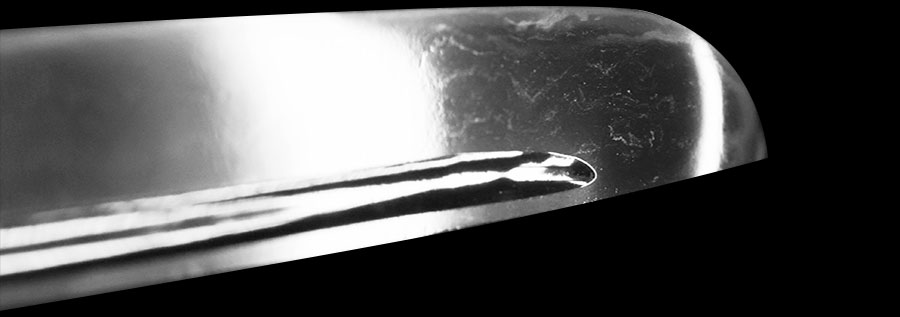
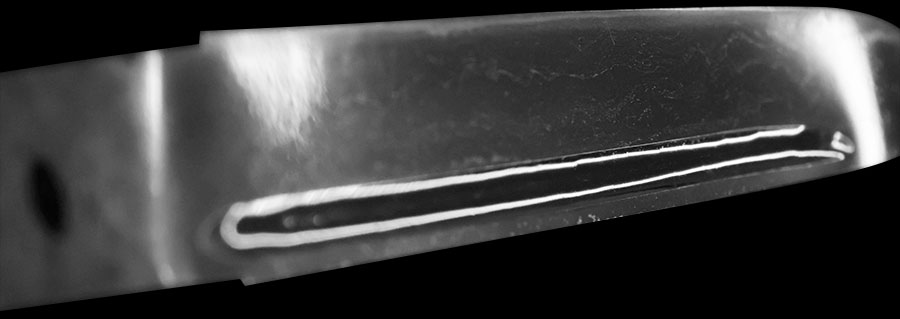
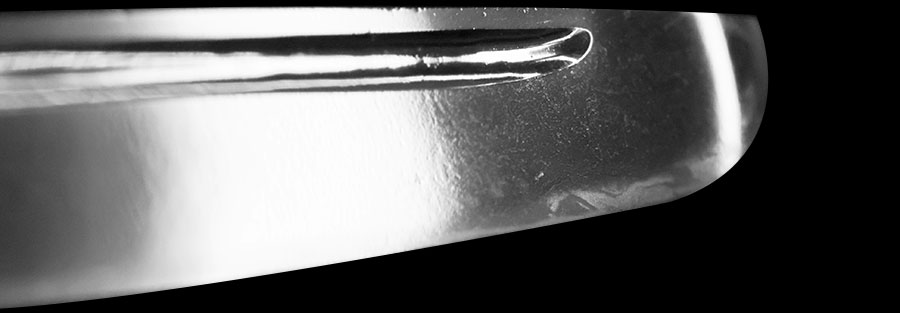
A recurring marker is the doubling of the hamon: yubashiri and hotsure gathering toward nijūba, and on the Sanetsugu tantō a layering suggestive of sanjūba, with muneyaki and a subdued, shizumi nioiguchi. The bōshi runs straight and turns in ko-maru. The Kunitsugu katana add sakizori and slender builds with funbari, while the tantō shows uchizori and thick kasane in the early Muromachi manner. For kantei, the running masame read against a low suguha in ko-nie points to the Iruka hand, the doubled temper toward nijūba and sanjūba sharpening the case, and the archaic, kokō cast of the Sanetsugu tantō marking the older branch. The cross-form kuni signature isolates the Sudō and Sasado Kunitsugu workmanship, where a densely knit ko-itame and tight narrow suguha are the rule, with only occasional gunome midareba or hitatsura. Signed pieces are uncommon, so each carries weight as source material for the group; the Sanetsugu tantō is named a representative Iruka work and is transmitted from the Kaga Ō-Maeda family. The setsumei present the Iruka smiths as a Yamato-rooted provincial line of Kii, recognizable less by display than by the consistency of their narrow temper. Learn more →












 NihontoWatch