 NihontoWatchNihontoWatch
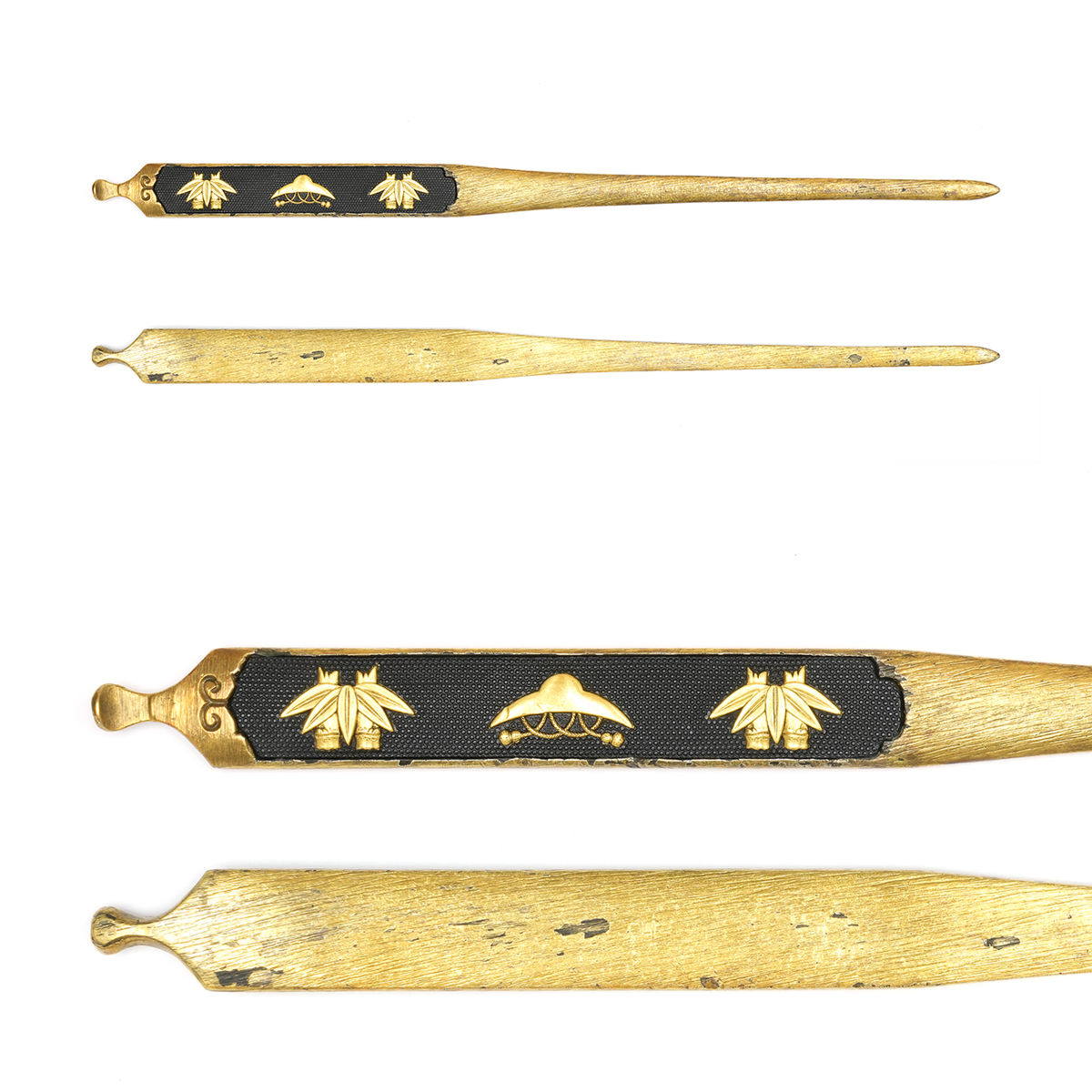
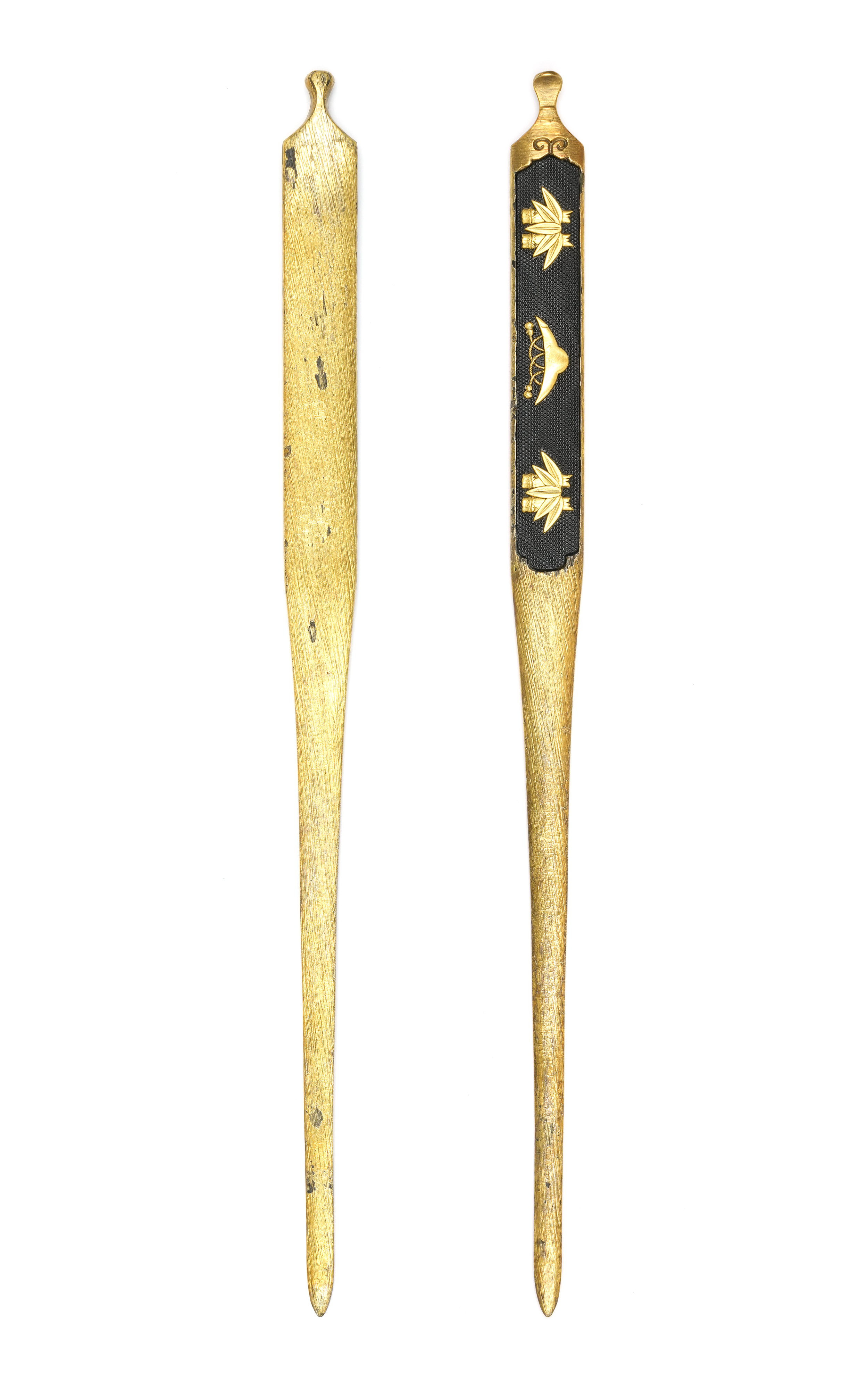
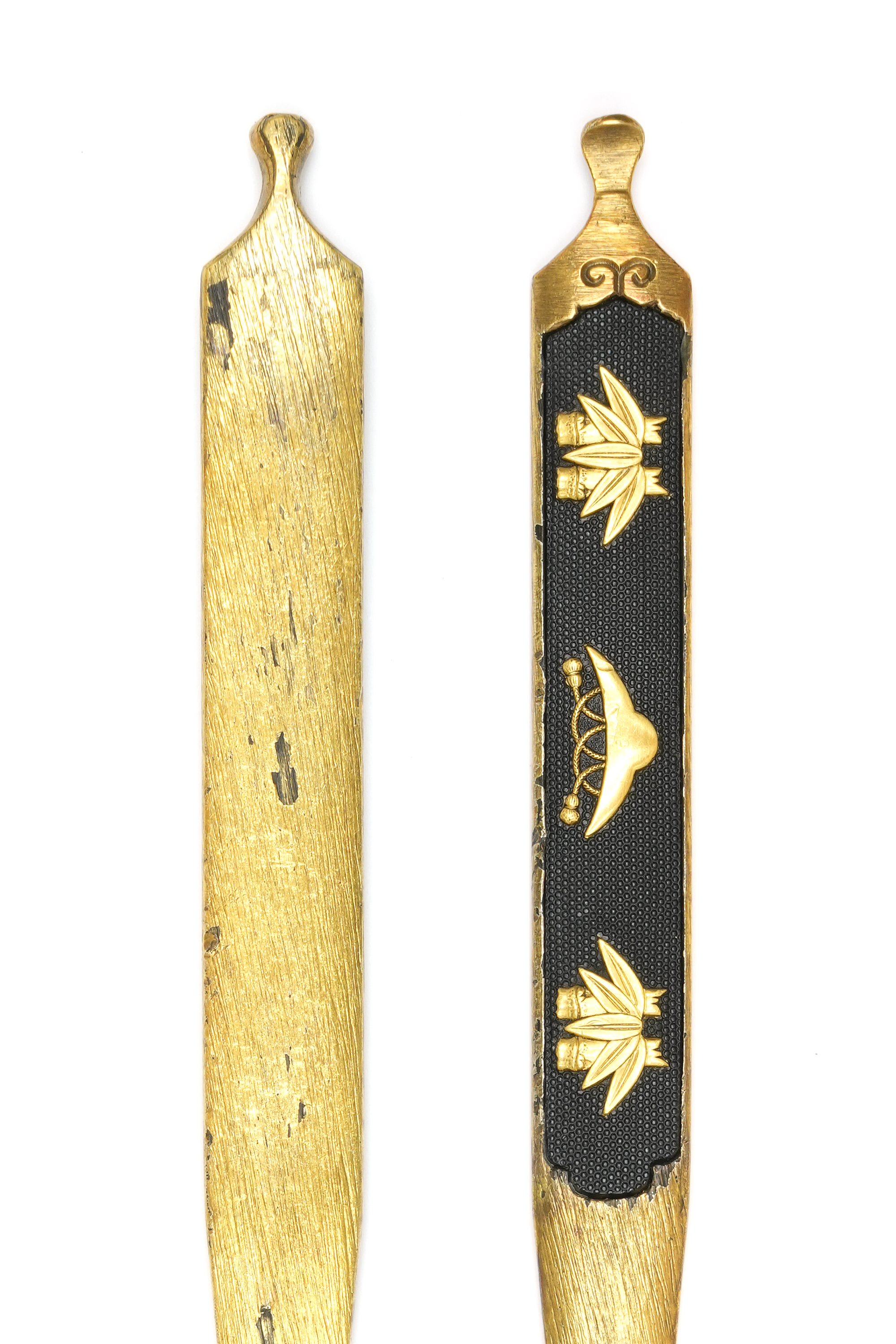
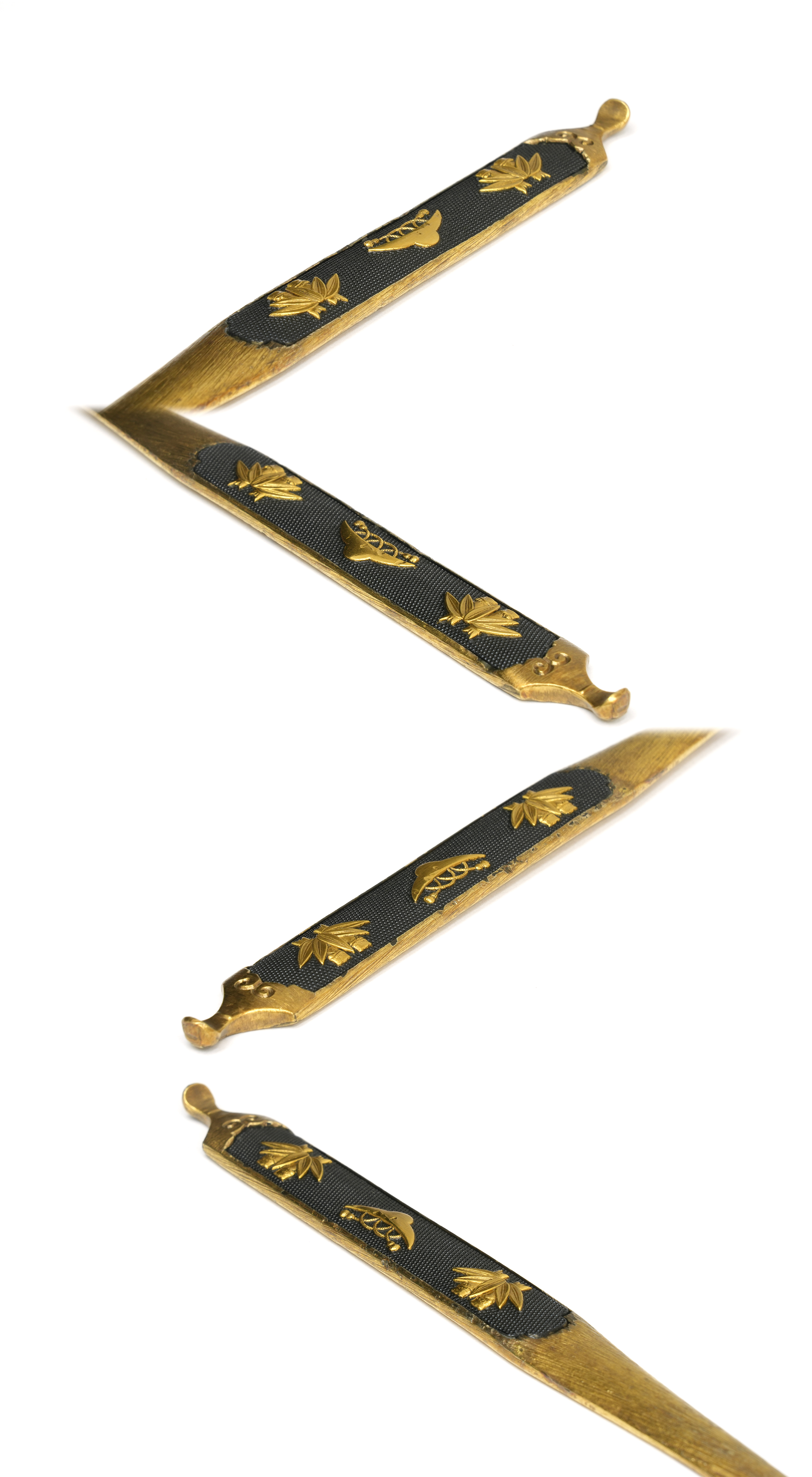
Kamon were used as markers to indicate the lineage, family status, and blood ties of samurai families, while their concisely refined forms themselves became excellent decorative designs and were frequently adopted for tosogu. The Nihontake-sasa-mon depicted on this piece is a design combining straight-growing bamboo with lush bamboo grass leaves, symbolizing vitality that does not lose its color even in winter, prosperity associated with growing through successive nodes, and integrity likened to its flexible, hard-to-break nature; the central Kasa-mon, as a protective hat sublimated into a neat crest, possesses a strength derived from practical tools and a modest dignity. This work is of kin-kise construction, with thin gold plates covering the kogai body from front and back to the tip, and the do is fitted with a deep black shakudo nanako-ji plate, upon which golden crests are arranged in the order of Nihontake-sasa-mon, Kasa-mon, and Nihontake-sasa-mon, creating a vivid contrast between black and gold. The nanako consists of fine grains struck uniformly without gaps, finished as a quiet ground that softly catches the light, and the crests placed upon it are given volume through plump takabori, so that the prestigious golden brilliance stands out from the front, while the thickness of the crests and the standing grains of the nanako are emphasized from an angle, changing expression depending on the viewing perspective. The Nihontake-sasa-mon on the left and right display the nodes of the standing bamboo and the bamboo leaves opening from them in an orderly fashion to the left and right, with ridges running through the center of the leaves to clearly express the overlapping of each one, while the central Kasa-mon finely carves the rounded surface of the hat, the loops of the cords hanging below, and the knots at both ends, skillfully condensing the structure of the actual object within the small crest. The composition of three crests arranged at equal intervals, with the Kasa-mon sandwiched between identical Nihontake-sasa-mon, has good bilateral balance, creating a stable rhythm on the slender surface of the kogai, and the point of imagining the lineage that combined different crests into one set also adds interest for collecting. The periphery of the ji-ita is neatly arranged along the ko-beri, and facing warabite are depicted below the mimi to tighten the start of the composition, from which the bright kin-kise ground continues to the do, sao, and hosaki, making the black shakudo nanako-ji stand out clearly as if it were a single framed picture. No patterns are placed on the ura, and by showing a wide kin-kise surface that retains fine finishing lines, a contrast is created with the dense heraldic expression on the omote, and the shading of the gold color born over many years also adds a calmness and depth unique to old tosogu. With a supple form of 21.4 cm, the deep black of the shakudo nanako-ji, a clear color scheme centered on gold, and the contrast between the precise nanako and the thick crests, the great appeal of this piece lies in how one can appreciate the prestige of the kamon design from a distance and the detailed work down to the bamboo leaves, hat cords, and warabite at hand. When fitted to a koshirae, it will show well against a wide range of saya-nuri such as kuro-urushi-nuri or kin-nashiji, and even when displayed alone, the heraldic beauty condensed into the slender surface shows a certain presence; this is a kogai that combines brilliance and dignity, recommended for those who favor tosogu themed on kamon, the combination of shakudo nanako-ji and kin-iroe, and metalwork pieces that evoke the formality of samurai families.
Offered by Toushin

We couldn’t find current papers for this piece. Ask the dealer whether it has been, or can be, submitted to shinsa. — Hoshi

Edo
Unsigned
As written by the shop
Machine translation from the shop's Japanese · may contain errors ·
We could not find an authenticity certificate on the seller’s listing. Japanese swords and fittings are normally papered by the NBTHK (or the NTHK). Without one, the attribution is the seller’s own assessment and has not been independently verified — treat it with caution and ask the dealer about certification before buying.
As a rule we do not accept returns, except when we have sent a different item from the one ordered or when there is a significant discrepancy between the description and the item. If you wish to return an item, please contact us within 3 days of its arrival and then send it back.
¥165,000