War at home and trade abroad made Muromachi Bizen the busiest forge region in Japan: a century of Sengoku demand after the Ōnin War, and export missions to Ming China carrying blades by the tens of thousands.
 NihontoWatchNihontoWatch
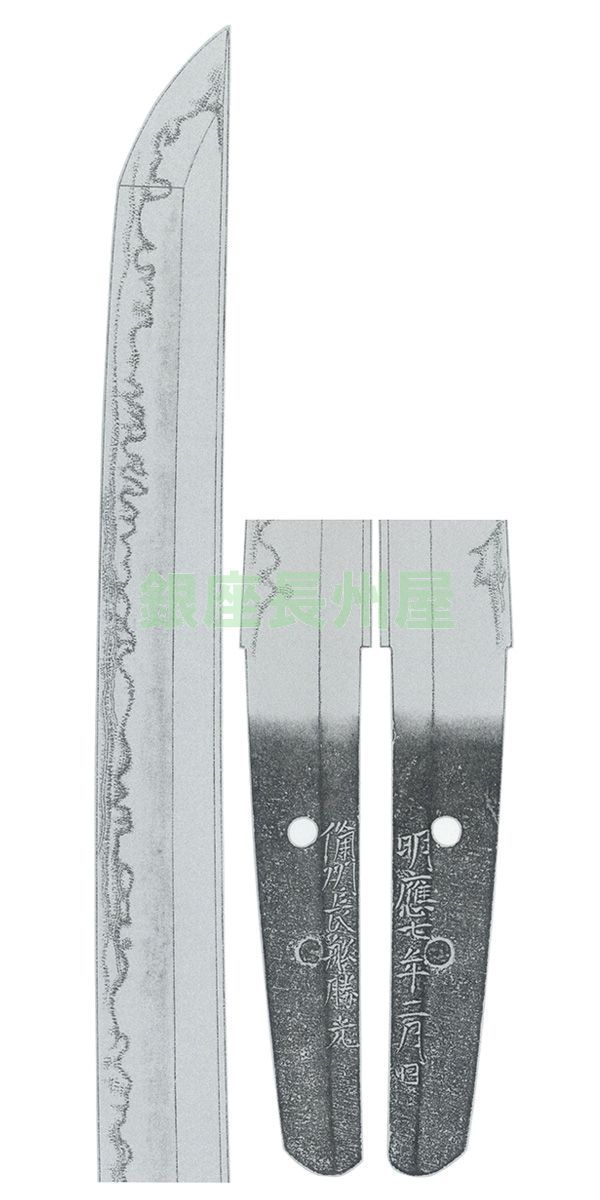
Moto-haba (width at Ha-machi) approx. 3cm Saki-haba (width at Kissaki) approx. 2.09cm 右京亮勝光は六郎左衛門尉祐光の長男。弟左京進宗光と共に備前、播磨、美作の守護大名赤松政則に仕え、文明十五年の備前福岡城(注1)の攻防(注2)では吉井川上流に布陣して松田元隆軍と対峙し(注3)、将軍足利義尚の近江六角討ちでは一族を率いて近江に赴き、将軍御前で鍛刀している。最前線の武将と生死を共にしながら名品を手掛けた、戦国時代屈指の名工である。 この脇差は、身幅広く鎬地の肉が削ぎ落され、鎬筋強く張って中鋒の精悍な姿で、武将が太刀に差し添え、素早く抜き放って用いた打刀(注4)。地鉄は板目に杢、流れごころの肌を交え、太い地景が入って肌模様が明瞭に起ち現れ、小粒の地沸が厚く付いて焼刃の影のような乱映りが立ち冴える。刃文は腰開きごころの互の目に小互の目、小丁子、房状の刃、尖りごころの刃、蛙子形に丸みのある刃、二つ連れた互の目を交えて多彩に変化する。粒子の細かな沸が柔らかく降り積もった焼刃は刃縁が明るく、刃境から刃中に金線、砂流しが幾重にも掛かり、匂で冷たく澄んだ刃中に匂足や葉が盛んに射して焼刃の硬度が絶妙に調整され、刃味と靭性を兼ね備えた、まさに戦国期らしい出来。帽子は焼深く沸付き、華麗に乱れ込んで浅く返る。茎の保存状態は良好で、掌に収まって片手打に適し、「長」の第六画が釣針状に強く跳ね上がった備州銘が丹念に刻されており、入念作なるは明白。備前刀工の最高峰の一人右京亮勝光の実力が遺憾なく示された、出来優れた脇差である。 注2... 西備前の松田元隆が赤松氏より自立を図って挙兵。後に自立した浦上氏は東備前の有力武将。
NihontoWatchKatsumitsu (Meiō — generation undetermined)勝光
Offered by Choshuya
This piece has sold
Get an email when a new Katsumitsu (Meiō — generation undetermined) piece hits the market.








Bizen-den · Bizen · around 1492-1501
Tōken Taikan top 26%
Where Katsumitsu stands among comparable artisans: across all of nihontō, and within tradition, era, and period. The tiers (Foremost · Leading · Major · Notable) weigh official designations from the NBTHK and Japan's Agency for Cultural Affairs, together with historical honors of lasting repute such as the Sansaku and Meibutsu-chō.
Select a lens to see how it's measured.
Bizen-den · Bizen
Phase: Sue-Bizen末備前· 1441–1596
10 pieces on the market now
The last great chapter of Osafune unfolds in the Eisho and Tenbun years of the late Muromachi, when the riverside workshop turned its accumulated craft toward an age of constant war. Where Oei-Bizen had looked backward, reviving the tachi shape and the choji temper of the Kamakura masters under Yasumitsu and Morimitsu, Sue-Bizen faces forward into Sengoku demand. The leading hands carry the same family characters one generation further: the Sukesada group, headed by Yosazaemon-no-jo Sukesada and the Hikobee-jo Sukesada said to be his father, alongside Katsumitsu (often Jirozaemon-no-jo), Munemitsu, Tadamitsu of the Heiroemon-jo line, and the Kiyomitsu smiths Magoemon-no-jo and Gorozaemon-no-jo. The setsumei draw a sharp line through their output. Commissioned blades, chumon-uchi, were signed with full zokumyo, dated, and frequently inscribed with the name of the ordering party, as on the Katsumitsu and Sadamitsu naginata of Meio 8 made for the Miyake of Kojima, a house that fed into the Ukita. Below them ran the bulk trade of kazu-uchimono, the arms that supplied the warring provinces, and it is the chumon-uchi masters that the designations preserve. What the steel does in this window is distinct from every earlier Osafune register. The shape is the uchigatana: wide mihaba with thick kasane, pronounced sakizori, an extended chu-kissaki or o-kissaki, and a short nakago suited to the katate-uchi one-handed draw, a body unlike the koshizori tachi of Ko-Osafune or the broad Nanbokucho profile of Soden-Bizen. The forging tightens into ko-itame over which a midare-utsuri stands faintly rather than vividly, weaker than the bright reflection of the founding generation.
The signature temper is the open-waisted koshi-no-hiraita gunome, splitting at the heads into fukushiki compound midare and mixed with togariba and choji; it is nioi-based with ko-nie and a bright nioiguchi, with ashi, yo, kinsuji and small tobiyaki worked through. Against this, Soden-Bizen had pushed Soshu nie and notare, while the founders had tempered flamboyant choji over a vivid utsuri. Two specialties branch off the gunome base: the Kiyomitsu and Tadamitsu suguha, calm and tightly forged, and the hitatsura of high-tempered pieces with long muneyaki and yubashiri, seen in the warlord-smiths Akamatsu Masanori and Ishikawa Yukihisa. To kantei a Sue-Bizen blade is to read the body first and the temper second. The compact uchigatana sugata with thick kasane and a short tang fixes the late-Muromachi date; the faint utsuri over dense ko-itame keeps it in Bizen; the open-waisted compound gunome names the group. The masters then separate by hand: Katsumitsu is set apart by the abundant choji he folds into the gunome, yielding a more florid, brilliant dekiguchi than his peers; Tadamitsu and the Kiyomitsu smiths are read out by their suguha, with Magoemon-no-jo's itame standing in mokume to distinguish his ground. The cutting reputation is documented directly, as on the Hikobee-jo Sukesada katana of Keicho 5 carrying a tameshi inscription naming the tester Ichihara Hachibee. Provenance threads through the supplementary signatures: Masanori's reward blades cut for his retainers, the Miyake names tying the workshop to the Ukita, and the Shinjuro Sukesada whose few large works may have ended in the Tensho flood. The horimono carried from the mainline, bonji with rendai, Fudo Myoo, and shrine dedications, persist on these blades as a final mark of the line. Learn more →
| Smith | Era | Designated |
|---|---|---|
| Katsumitsu勝光 | 1490-1529 | 29 |
| Katsumitsu勝光 | 1469-1487 | 12 |
| Katsumitsu勝光 | 1528-1532 | 0 |
| Katsumitsu勝光 | 1492-1501 | 2 |
Bizen in the Muromachi period
War at home and trade abroad made Muromachi Bizen the busiest forge region in Japan: a century of Sengoku demand after the Ōnin War, and export missions to Ming China carrying blades by the tens of thousands.
A Hozon-certified blade judged to show notably superior workmanship and a better state of preservation. The bar is higher: re-tempered blades and most unsigned Muromachi/Edo works are excluded.
The NBTHK (Nihon Bijutsu Tōken Hozon Kyōkai, the Society for the Preservation of Japanese Art Swords) is a public-interest incorporated foundation founded in 1948 and supervised by Japan’s Agency for Cultural Affairs (Bunkachō); it is based at the Japanese Sword Museum in Tokyo. Its expert panels physically examine each submitted work (shinsa) and issue a certificate (kanteishō) ranking it by artistic and historical merit. NBTHK papers are the most widely recognized standard of authentication for Japanese swords and fittings.
NBTHK official siteIf, due to our fault, the item differs significantly from its proper condition, the item may be returned. Cooling-off is within one week of the item's arrival.