The monasteries that had sustained Yamato lost ground through the Muromachi period, and the schools thinned with them; Sue-Tegai kept the old masame manner alive in quantity. The burning of Tōdaiji’s Great Buddha hall in 1567 closed the temple age.
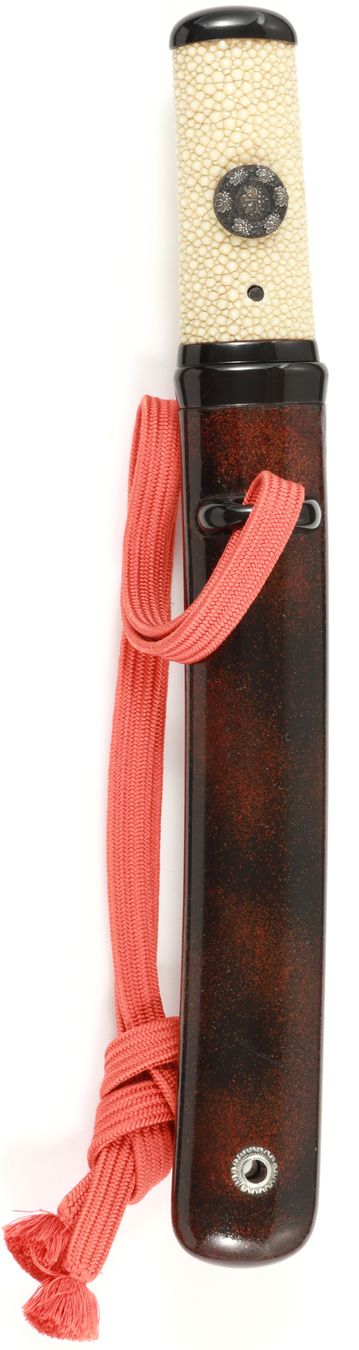
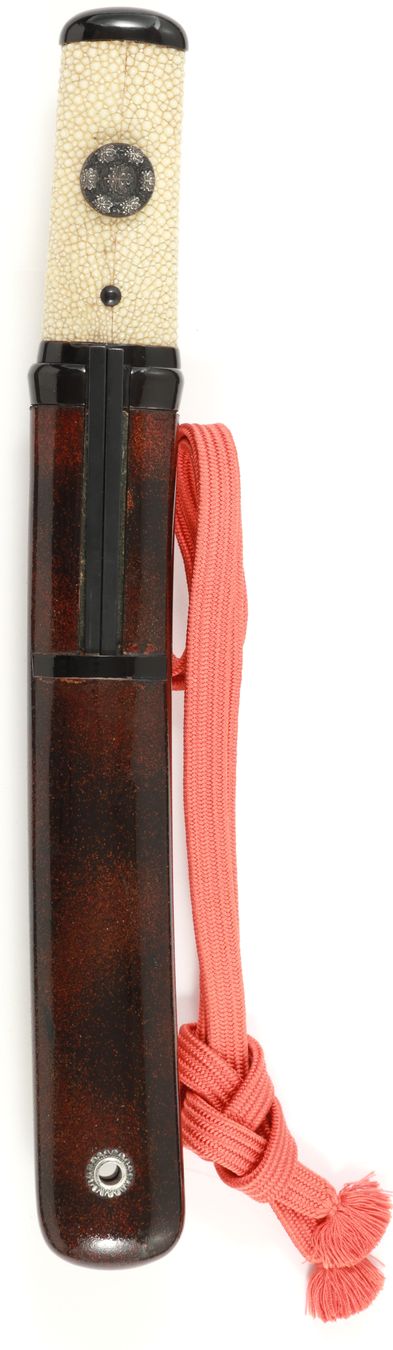
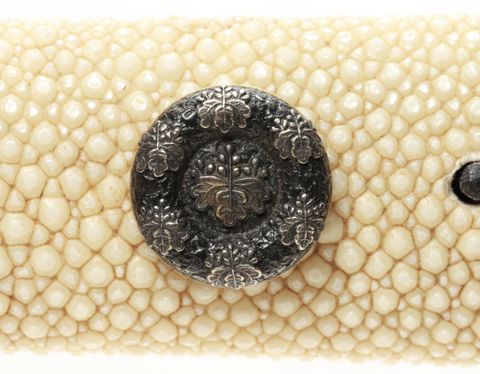
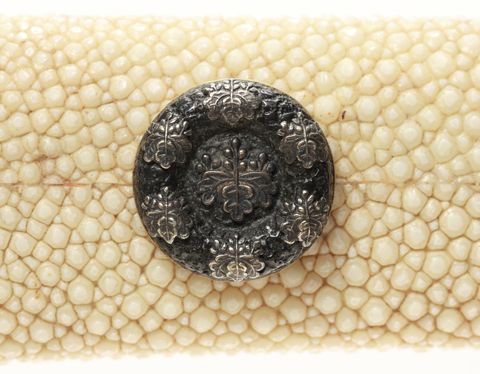
In front of the Tengaimon gate of Todaiji, there was the workshop of the Tegai school led by Kanenaga, which flourished and produced many skilled smiths who used the character "Kane" in their names. Among them, according to the "Nihonto Meikan," Kanekiyo began with a smith active around the Karyaku era of the late Kamakura period who is said to be the son of the first generation Kanenaga, and continued through the Oan era of the Nanbokucho period, and the Oei, Eikyo, Meio, Daiei, and Tenbun eras of the Muromachi period. However, most of the works by Kanekiyo from the late Kamakura to Nanbokucho periods seen today are o-suriage mumei, and signed works by Kanekiyo from the Muromachi period are also extremely rare (Note 1). This tanto is a rare signed example by Kanekiyo engraved with a Tenbun era date. Likely a work kept in the bosom as a mamori-katana, it has a small and tightened sugata. The jigane shows masame-hada standing out in the typical Yamato style, with thick ji-nie, and the area near the ha is clear and dark with nie-utsuri appearing, while the hiraji is covered in faint yubashiri, creating a jihada overflowing with an antique feel. The hamon of hoso-suguha is strongly nie-deki above the machi and near the fukura on the sashi-omote, forming nijuba, with thin kinsuji showing movement, and the clear hachu is bright with nioi. The boshi on both sides retains ample yaki and returns in komaru. The nakago has fine higaki-yasuri applied in the Yamato style, the mekugi-ana is also old-fashioned, and a small niji-mei is engraved with a fine chisel, with the Tenbun 11 Nen 3 Gatsu 25 Nichi date on the sashi-ura also being precious. The "To □ □" characters in the mei are also interesting (Note 2). Despite a body of only about 5 sun 5 bun, it is a superior work in which the charms of Yamato-mono are condensed through exquisite forging and hardening. It is accompanied by a koshirae with a muranashiji-nuri saya. Note 1... In addition to a tanto dated Karyaku 4, a tanto by Washu Saemon-no-jo Kanekiyo dated Oan 3, and a katana by Yamato Tegai-ju Kanekiyo dated Kyoroku 2, there are Juyo Token consisting of a niji-mei tachi and four tanto. Note 2... It can also be read as "Totohon." Considering the ken dated Enkyo 4 signed "Yamato no Kuni Ju Tohon Hoju" ("Gyobutsu Tohaku Meito Oshigata"), it may be a phrase related to Todaiji and its temple buildings.
Offered by Choshuya


Machine translation from the shop's Japanese · may contain errors ·
Yamato-den · Yamato · around 1528-1532
1 piece on the market now
Where Kanekiyo stands among comparable artisans: across all of nihontō, and within tradition, era, and period. The tiers (Foremost · Leading · Major · Notable) weigh official designations from the NBTHK and Japan's Agency for Cultural Affairs, together with historical honors of lasting repute such as the Sansaku and Meibutsu-chō.
Select a lens to see how it's measured.
Years he was demonstrably active, proven by signed-and-dated blades
Yamato-den · Yamato
Phase: Sue-Tegai末手掻· 1390–1700
23 pieces on the market now
Sue-Tegai (末手掻) is the late phase of the Tegai school, from the Ōei era through the Muromachi period (with a thin tail of name-bearers into the early Edo period). The term 末手掻 is used directly in NBTHK setsumei to set this generation apart from the classical Ko-Tegai of the founder Kanenaga. Its representative smiths are Kanezane (包眞), Kanetoshi (包俊 / 包利), Kaneyoshi (包吉), and Kaneyuki (包行), names that recur across several generations as the workshop continued to supply blades through the fifteenth and sixteenth centuries. The Sue-Tegai idiom is a tightening and quieting of the classical Yamato manner.
The jigane becomes a closely-forged ko-itame mixed with prominent masame that frequently takes on a whitish (shirake) cast — a hallmark of the late phase — while the hamon narrows to a nioi-based suguha that frays into hotsure and ko-midare, with a komaru bōshi. The hiogi (檜垣) file-mark on the nakago is a recurring diagnostic. Production shifts toward tantō and wakizashi in standard Muromachi forms alongside some katana, and the NBTHK observes that the work shows comparatively little individual character, faithfully preserving the traditional house style rather than the bold personal expression of the Kamakura founders. The phase represents the orthodox Yamato tradition carried, with conservative consistency, to the close of the Muromachi age. Learn more →
| Smith | Era | Designated |
|---|---|---|
| Kanenaga包永 | 1288-1312 | 66 |
| Kanekiyo包清 | 1362-1370 | 8 |
| Kanetsugu包次 | 1317-1333 | 4 |
| Kanetoshi包俊 | 1381-1384 | 4 |
| Kanekiyo包清 | 1429-1441 | 3 |
Yamato in the Muromachi period
The monasteries that had sustained Yamato lost ground through the Muromachi period, and the schools thinned with them; Sue-Tegai kept the old masame manner alive in quantity. The burning of Tōdaiji’s Great Buddha hall in 1567 closed the temple age.
A Hozon-certified blade judged to show notably superior workmanship and a better state of preservation. The bar is higher: re-tempered blades and most unsigned Muromachi/Edo works are excluded.
The NBTHK (Nihon Bijutsu Tōken Hozon Kyōkai, the Society for the Preservation of Japanese Art Swords) is a public-interest incorporated foundation founded in 1948 and supervised by Japan’s Agency for Cultural Affairs (Bunkachō); it is based at the Japanese Sword Museum in Tokyo. Its expert panels physically examine each submitted work (shinsa) and issue a certificate (kanteishō) ranking it by artistic and historical merit. NBTHK papers are the most widely recognized standard of authentication for Japanese swords and fittings.
NBTHK official siteIf, due to our fault, the item differs significantly from its proper condition, the item may be returned. Cooling-off is within one week of the item's arrival.
¥500,000