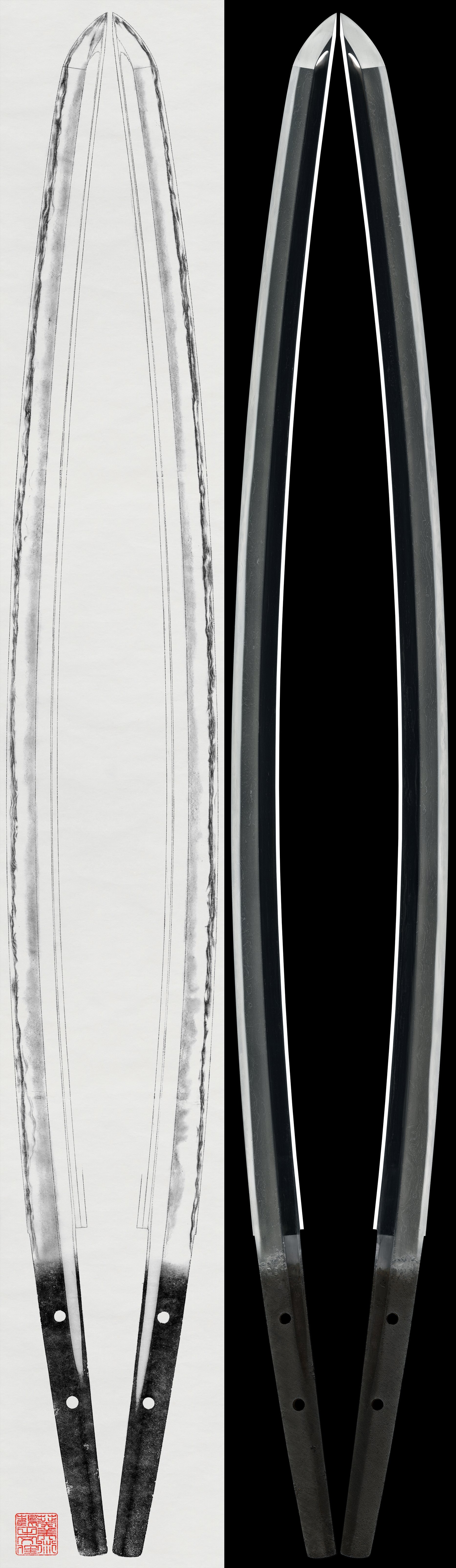
For Kanenaga (包永) of Yamato the published commentary of the returns, blade after blade, to one standing judgment: his manner "is the strongest in among Yamato works, the bright, and the notably clear", and beside the , the figure: "many of his blades present a dignified figure of high bearing". He is the founder of the school, one of the five lineages of Yamato, which resided and forged outside the (転害門), the west main gate of Todai-, thought to have served the temple. The reference works place him around the Shoo era (1288 to 1293), but the published sources repeatedly argue he goes back further: a dated Karyaku 4 (1329) survives by Kanekiyo of the second generation's circle, and his own workmanship points earlier, so his activity is read from the middle into the late period. The name was then carried by successive generations into the period.
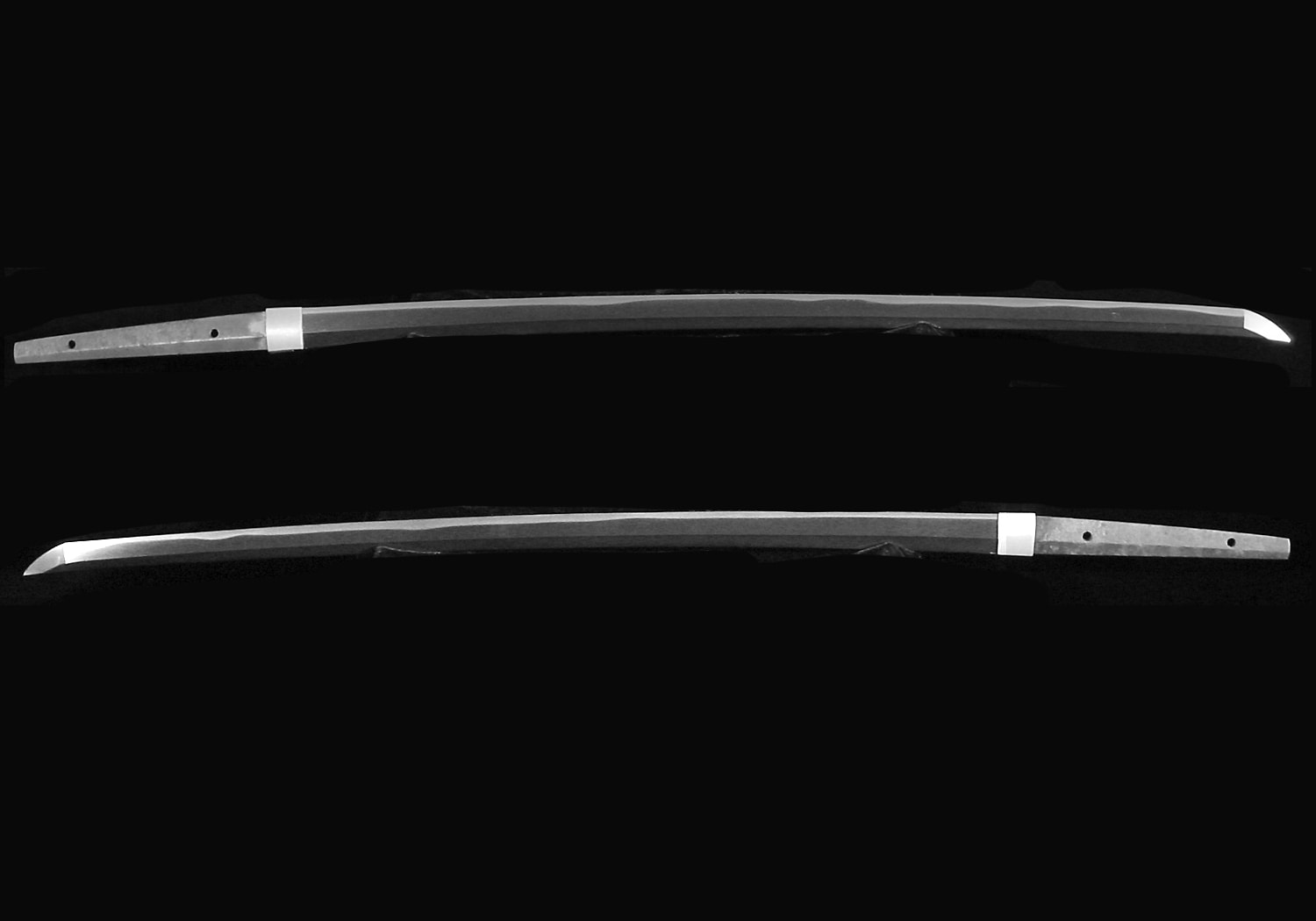
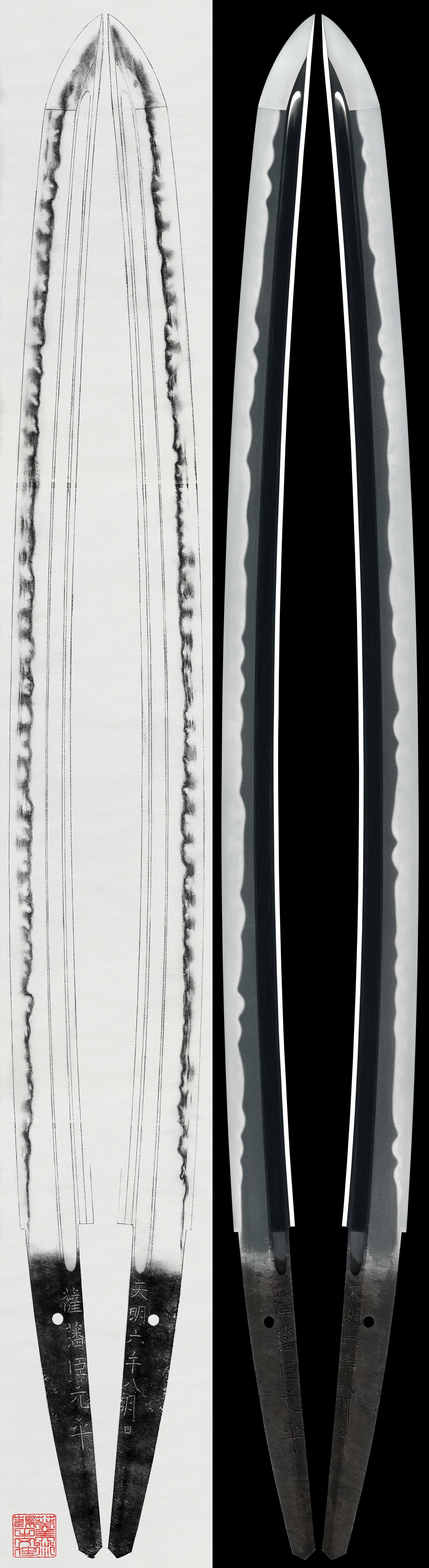
The construction leads in his work. The stands high and the is cut wide, and nearly everything surviving is a of standard width, keeping its and closing in a . The is a bent in shallow , mixing in, the deep; along the the edge frays into , with , and , drifting into the , and running through the . What the sources single out within this activity is the itself, especially strong compared with the other schools: "beautiful that is rounded and lustrous". The continues , strongly swept with , ending or turning back small in .
The is , mixed with in places, flowing along the and tending toward , with thick , entering frequently, and the steel bright and clear. Around the the often widens and the abruptly strengthens. Some blades temper the and differently, the trait typified by the Konotegashiwa Kanenaga. The record also documents a quieter class, blades in a quiet, low-tempered styling, at times narrowing to . One such , bearing the red-lacquer attribution of Honami Koson and transmitted at Nagono Shrine, is read as "a comparatively calm type among Kanenaga's works"; even there the thick , the and the round, shining carry the attribution.
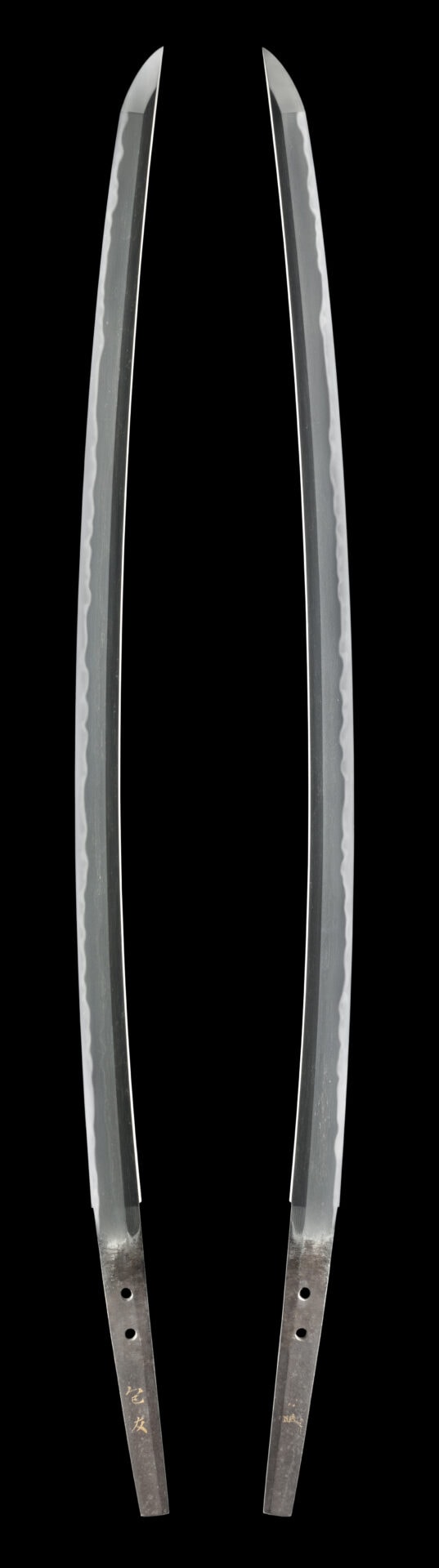
His work survives in two registers. Comparatively many signed remain, the sources note, nearly all with the two-character left at the tip of the ; the pieces are counted at a mere two. The signature itself is a documented tell: the character compressed vertically, the second vertical stroke of Naga drawn out extremely long. To the doubt sometimes raised over their near-uniform state the answers that shortening like yields like : it "does not warrant suspicion". The other register is the attributed to him, where appears far more often than on the signed blades and the judgment rides on the quality of the : of one such blade the published record writes that on close inspection it surpasses typical work, the conspicuously deeper and the gleaming thick; of another, that its workmanship connects directly to his signed works. The blades gathered here are the founder's: the second generation, of the period, is catalogued separately, and the later generations part company readily, their steel turning generally whitish and the tightening toward , against the founder's bright, heavy .
Within Yamato the name set beside his is Shikkake Norinaga, and the separation runs along Kanenaga's own line: he holds the through its shallow , his never stringing into connected rows, and he lets , and play above the with unusual freedom. The judgments reach beyond the province. Honma observed of the first generation's that "at times one sees brilliant, sparkling of the kind observed in Hisakuni", and the eighth session writes of one signed that its beautifully shining rivals the upper masters (相州上工). Of a shogunal-gift the record concludes simply that it is "outstanding among his works".
Kanenaga is rated Jo-jo by Fujishiro, and sixty-seven designated works stand on record, among them one National Treasure, five Important Cultural Properties, nine Bijutsuhin, eight and forty-one . These upper tiers are patrimony, held in shrines, museums and long-private collections, never to trade; recorded holders include the Tokyo National Museum, Himeji Jinja, Shijonawate Jinja, the Sano Art Museum and the Tokugawa Art Museum. The provenance is deep, twenty-five blades carrying a recorded history. One went from the shogun Tokugawa Ieshige to Mizuno Izumi-no-kami Tadayuki and later to Inukai Bokudo; another from Tokugawa Ienari to Sakai Tadanori of Himeji. A signed bears the gold-inlaid possessor mark of Honda Heihachiro Tadatame, that is Tadatoki, husband of Senhime; the folded-back- of the Ishikawa family is transmitted as Horio Mosuke's; a carries a gold-inlaid cutting test of Tenna 2 (1682), four bodies severed. The rolls extend to the Date and Hachisuka families and the Imperial Family. For a collector the realistic field is the and tiers, forty-nine blades in all. Signed pieces are unusually numerous for so early a smith, eighteen against ten attributions here, yet a with the two-character changes hands rarely; what the market more often shows is the attribution, judged, as the published sources always judge it, on the round and lustrous .