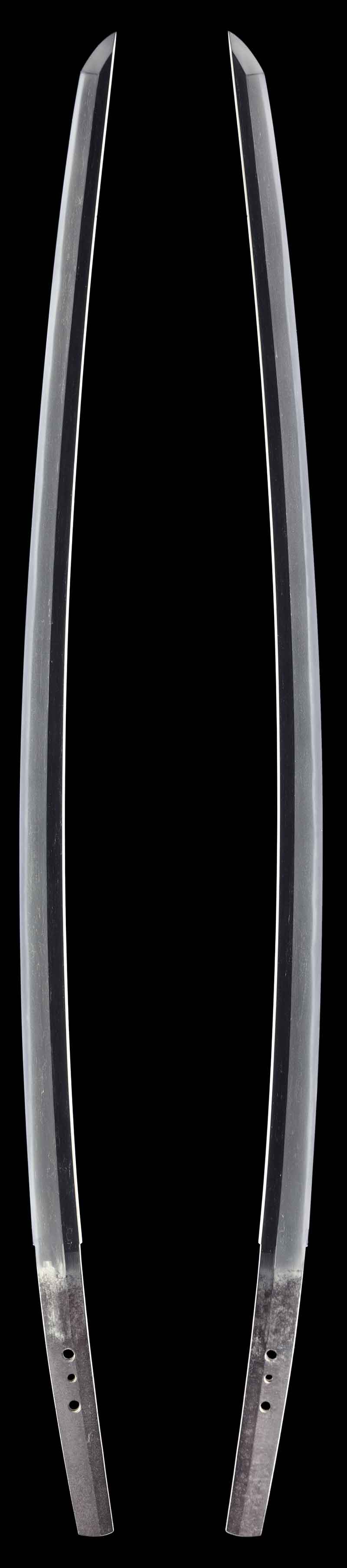
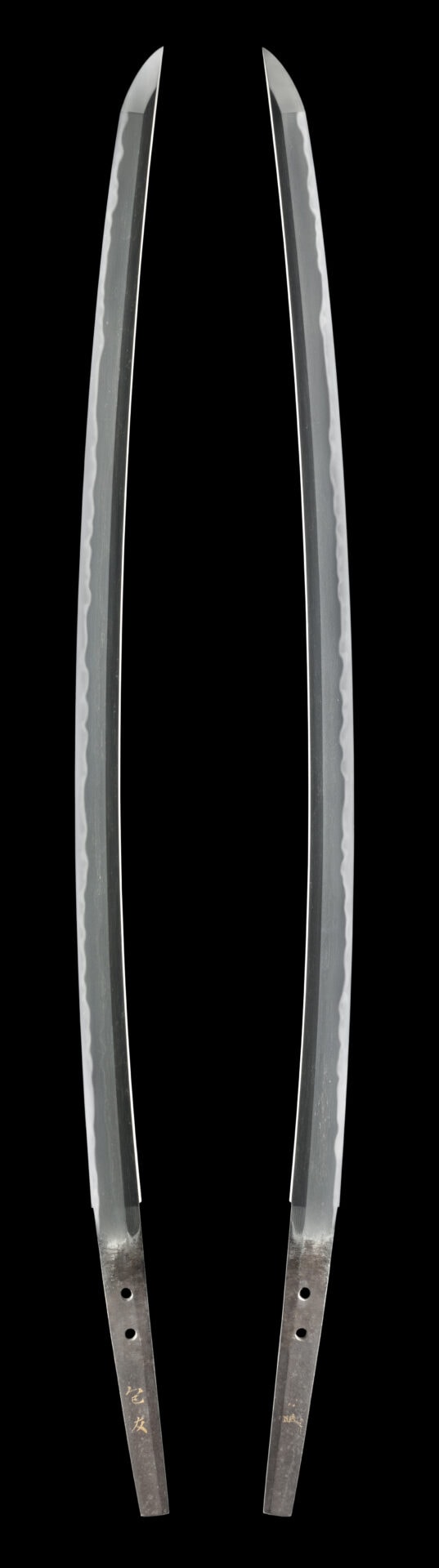
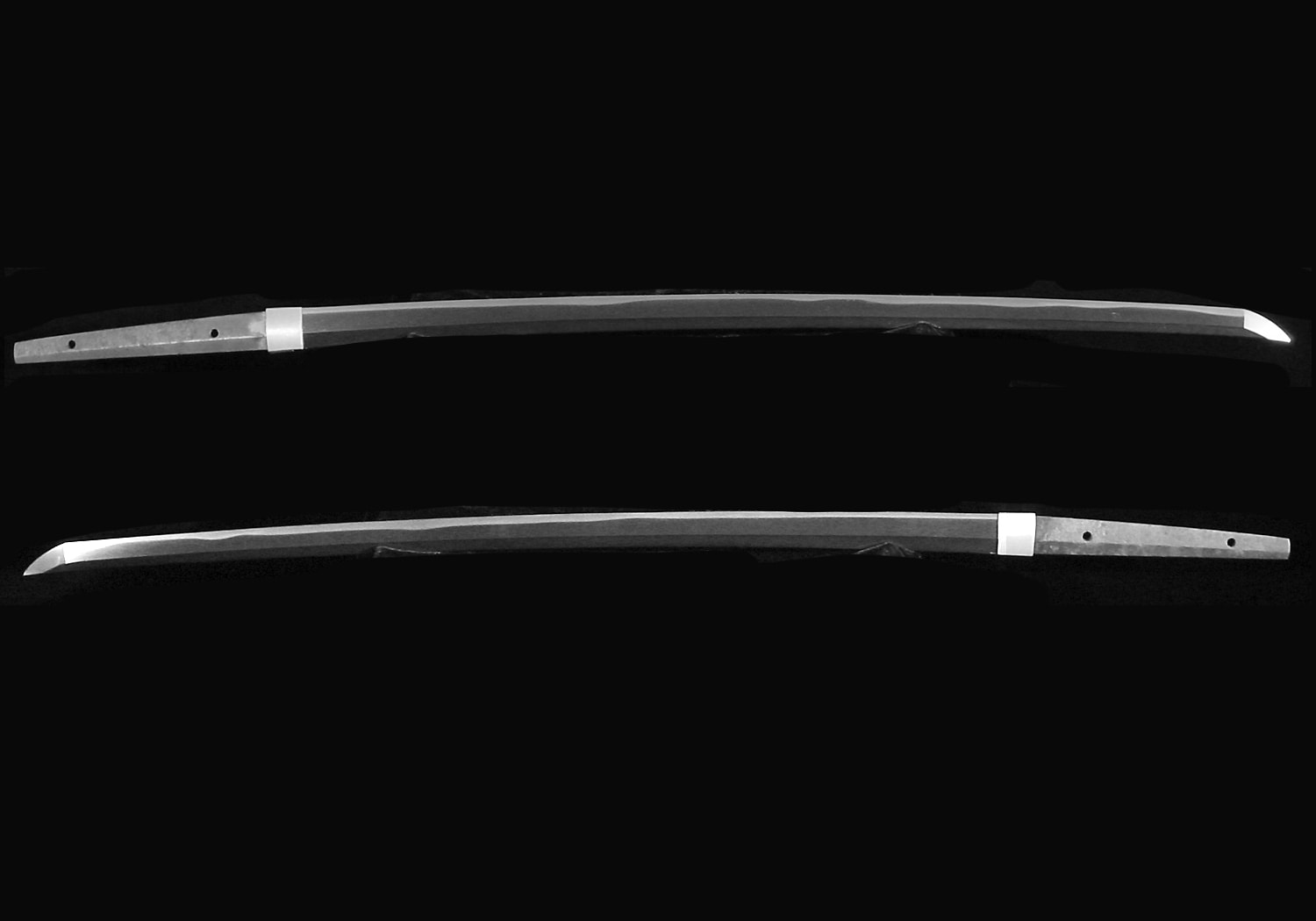
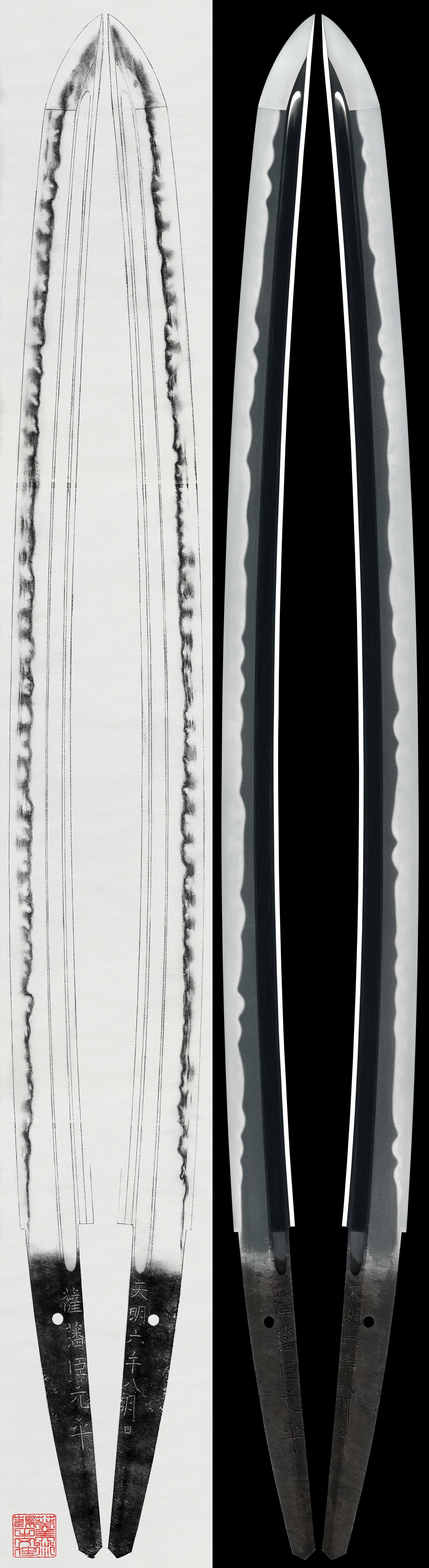
A now in Hyogo, slender and thin in the , carries two cut-in appraisals at the tang, one reading Kanenaga and one the name of the house judge Chikatoshi, and below them the ownership inscription of Ogi Iori, the author of the reference work ' Meizukushi Taizen'. The blade is a -period Kanenaga of the school, one of the five Yamato branches whose founding name was Kanenaga. The published sources name him 'the founder of the school', a smith of the late period whose successors, working outside the Tengaimon gate by the western front of Todai-, carried his manner on into the years. This Kanenaga is one of those successors, the second generation and after, whose blades leave no doubt of their Yamato origin yet whose extended , near-absent taper and strongly standing grain place them after the founder's prime, in the period.
His hand is read first in the temper, a -base that frays at the edge in the Yamato manner. Over the whole of his work the breaks into , and , the crossing and doubling strokes that mark Yamato steel and the school in particular, with and entering, crescents along the line, running and entering finely. The straight base carries a shallow with and mixed in, never far from . The is its companion tell, the point brushed in and finished toward a effect with little or no turnback, on one running into a that breaks down in . The published sources read these features of and as a paradigmatic Yamato work that shows 'the style most frequently and conspicuously encountered among the school'.
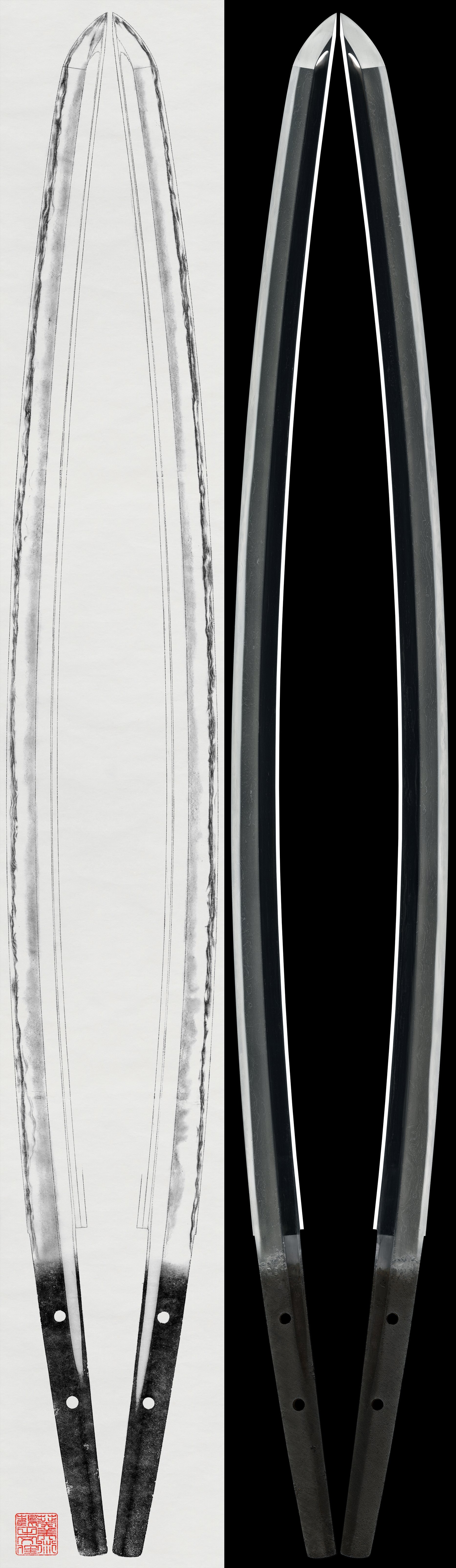
The is the constant beneath the temper. Every blade stands open in an mixed with and flowing grain, the surface tending and the grain running toward near the , with adhering thickly and entering. On his best pieces the steel takes very fine throughout and the run frequently, a strong, standing Yamato rather than the close of the Yamashiro smiths. Against that the are the smith's signature quality, and the published sources hold that within Yamato work Kanenaga's manner is 'the strongest in ', the bright and the notably clear. On a designated in 2018, conspicuously bright, somewhat coarse sparkles along the edge in places, a brilliance the sources read directly as 'the lustrous inherited from the first-generation Kanenaga', even as the standing grain and the broad, little-tapering shape fix the blade in the period.
Because the name was inherited and the manner held close across the generations, the published commentary turns the placing of each blade into the itself. The signature alone does not settle the generation; the construction and the standing forging do, and where a date is wanting the appraisers reach for resemblance, judging one a work because it answers to an example bearing a Joji-era date. The corpus runs through the vocabulary as the generation requires it: ko-suriage and attributed in gold inlay, a whose gold inscription pairs Kanenaga with the name Seio and a , and a single signed two-character . The pieces divide between a prime register, the -base standing- manner the sources call the Yamato type, and a founder-recalling register where the coarse bright carries the memory of the late- first generation; both are the Tegai hand, the one quieter and the other at full strength.
What sets his work apart within Yamato is told in the smith's own grounded traits rather than by contrast with his neighbours. His is the standing that takes strong, bright and the that frays into and under a , where the Yamashiro runs clean over a fine close and the old edge carries and . The published sources add a point of bearing to the steel, noting that many of the Kanenaga hold a dignified, high-toned presence, 'a upright and of high tone'. It is a manner that fully displays, in the words of the commentary, 'the characteristic traits of the school', and on the finest blades the brightness and power of the raise that display to its height.
Kanenaga is rated jo-jo by Fujishiro, and although this generation stands below the celebrated founder, its record is small and uniformly high: five blades, the earliest designated in 1962 and the most recent in 2018, with none yet raised above the level. The connoisseurship around them runs to the inscriptions and the provenance as much as to the steel, and on that count the line is unusually rich, its provenance among the better-documented of any swordsmith. The bearing the Chikatoshi appraisal descends with the cut-in ownership of Ogi Iori, the scholar of swords, and others among these blades pass through the Tokugawa family, held now in the Tokugawa Art Museum, the Tokyo National Museum and the Kurokawa Institute, their whereabouts those of patrimony long kept rather than goods in motion. His designations stop at the level and rise no higher, so the blades are not held out of reach by a higher cultural-property listing, but a Kanenaga of recorded whereabouts is an occasional encounter rather than a regular one, met most readily in his named manner, the bright, strong over the standing Yamato that the published sources trace back to the founder himself.